REVIEW 4 major objections 5 minor 12 references
An Efficient Skyline Computation Framework
T0 review · 4 major / 5 minor · reviewed 2026-08-14 · deepseek-v4-flash
Pith's one-line read One sorted dimension can decide skyline membership.
desk verdict Plausible incremental skyline algorithm with patchable proof gaps and unverifiable experiments; worth a serious referee but needs revision and code/data. read the letter →
The pith
A machine-rendered reading of the paper's core claim, the machinery that carries it, and where it could break.
The reading
What carries the argument
The machinery is the dimensional index: for each dimension i, an ordered list of all tuples sorted by their value in that dimension, with ties broken by tuple ID. Duplicate values are grouped into index blocks, and each block's local skyline is computed by a BNL pass so that Theorem 1 can be applied block-wise. On top of this, the stop line of a skyline tuple p is the set of blocks holding p's value in every dimension; it acts as a frontier such that, once every dimension scan has passed it, all skyline tuples are guaranteed to have been seen. BFS or DFS dimension switching decides which index is scanned next, and the algorithm maintains the current best stop line from the skyline tuple minimizing maximum and mean offsets.
What would settle it
On every small database over a tiny value domain (for example four dimensions with values in {0,1,2}, including duplicates), compare the SDI-RS output with an exhaustive skyline computed by checking all pairs; any tuple that SDI-RS classifies as skyline but that is dominated by another tuple, or any skyline tuple the stop-line rule would skip, refutes the central claim.
Extended reading notes
Core claim
The core discovery is the pairing of two theorems. Theorem 1 states that, given a dimensional index I_i (a list of tuples sorted by their values in dimension i, ties broken by ID), a block-skyline tuple t belongs to the skyline if and only if no skyline tuple s with offset o_i(s) < o_i(t) dominates t; in fact a single dominance test s ⊁ t suffices, in contrast to BNL-style two-way comparisons. Theorem 2 states that for any skyline tuple p, the stop line S_p—the set of index blocks containing p in every dimension—has the property that once all stop-line blocks have been traversed in a top-down scan of all dimensional indexes, every skyline tuple has been found, so computation can terminate. Together they justify the SDI-RS algorithm: scan per-dimension sorted indexes block by block, compare each candidate only with earlier skyline tuples in that dimension, update the best stop line whenever a new skyline tuple appears, and stop when every dimension has reached the stop line.
Load-bearing premise
The pruning rule assumes that any tuple dominated by any other tuple is also dominated by at least one skyline tuple; the paper uses this to conclude that a tuple incomparable with every skyline tuple must be skyline, but it never states or proves that property.
Editorial extensions
If this is right
- Each new candidate is compared only with earlier skyline tuples in the current dimension, so the number of dominance comparisons is bounded by the size of the skyline rather than the whole database in the no-duplicate case.
- The best stop line chosen from any skyline tuple can end the scan early, which is especially effective on correlated data where skyline tuples cluster near the top of the indexes.
- Because each dimension is sorted under its own total order, the method handles mixed criteria (less-than on one attribute, greater-than on another) and ordered categorical data without normalization.
- The space cost is two sorted values per tuple per dimension, and preprocessing is O(dn log n); the worst-case comparison count is O(k^2 + (n-k)(n-k-1)/2), where k duplicate values sit in one block of the best dimension.
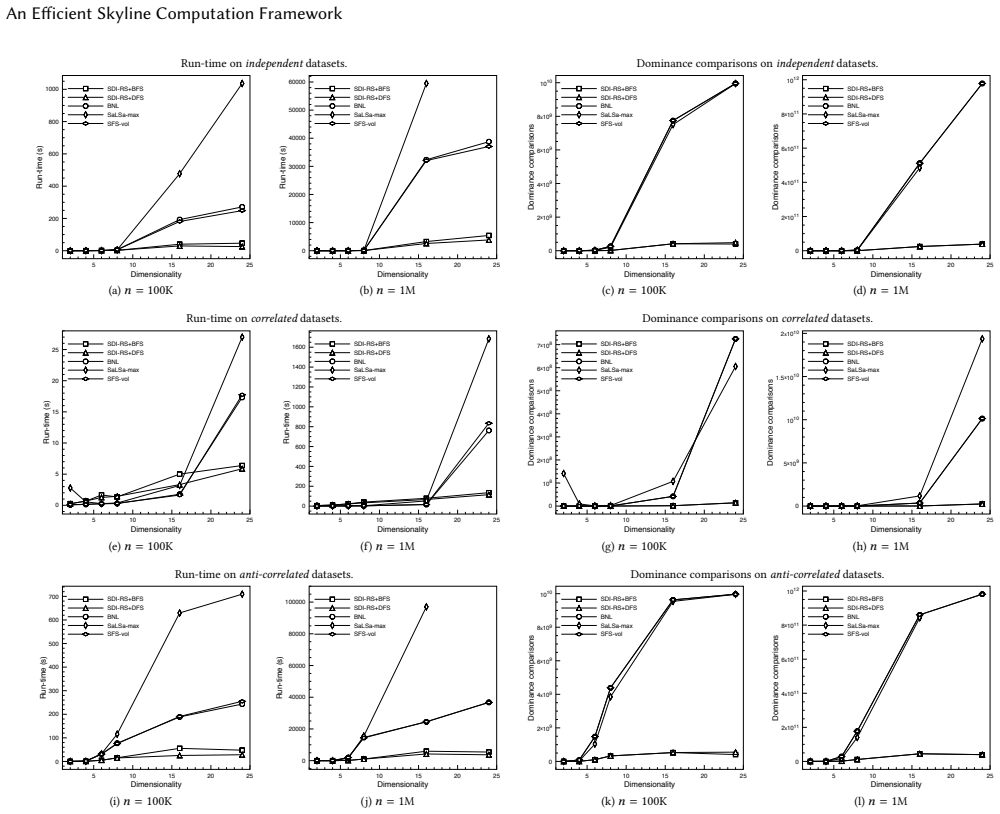
- On the tested real and synthetic data, SDI-RS reduces both run-time and dominance comparisons compared with BNL, SFS, and SaLSa, with the largest gains at 16 to 24 dimensions.
Reading between the lines
- The stop-line theorem suggests an incremental or streaming variant: since any skyline tuple can halt the scan, a system could maintain a running best stop line and bound the work needed to incorporate newly arriving tuples, though the paper does not develop this.
- Because the reduction isolates one dimension at a time, the framework could combine naturally with subspace skyline queries: reusing per-dimension indexes for multiple user-defined subspaces would avoid re-sorting, an extension beyond the paper's own tests.
- The experiments stop at 24 dimensions; a natural stress test is to push SDI-RS to much higher dimensionality (for example 50 to 100) where classic algorithms degrade, to see whether the near-linear scaling observed here persists.
Signed reviews
Editorial analysis
A structured set of objections, weighed in public.
Referee Report
Summary. The paper proposes SDI (Skyline on Dimension Index), a framework for skyline computation that builds a sorted index per dimension. It claims (i) that membership of a tuple in the skyline can be decided by comparing it only with skyline tuples that precede it in a single dimensional index, rather than with all skyline tuples, and (ii) that any skyline tuple defines a 'stop line' such that once all stop-line blocks have been traversed, the complete skyline has been found. Based on these properties, the paper presents Algorithm SDI-RS and evaluates it against BNL, SFS, and SaLSa on synthetic and real datasets.
Significance. If the two claimed properties are correct, the framework is genuinely attractive: it replaces the usual quadratic dominance-comparison pattern by per-dimension bounded comparisons and offers a principled early-termination condition. The paper also identifies a practical point that is often under-emphasized, namely that skyline computation can be performed on arbitrary dimension indexes and can handle non-numeric total orders. The reported experiments show consistent gains on high-dimensional data. However, the significance is conditional: the key lemmas and the algorithm specification contain gaps that must be repaired before the claims can be accepted.
major comments (4)
- [Section 3, Lemma 1] The proof of the 'if' direction jumps from 't is incomparable with every skyline tuple' to 't is a skyline tuple'. This inference is not automatic; it requires the finite-dominance-order property that every non-skyline tuple is dominated by some skyline tuple. That property is true for finite databases (dominance is a strict partial order, so every element is below a maximal element above it), but it is never stated or proved in the manuscript. Since this step is exactly what justifies accepting t on the basis of 'Si ⊀ t' in Algorithm 1, the soundness of the pruning rule depends on filling this gap.
- [Section 4.1, Theorem 2] The proof of Theorem 2 uses the wrong direction of incomparability. For t ≺≻ p it states '∃k, p[k]≻t[k] ⇒ bk(p) < bk(t)' and concludes that passing the stop line in dimension k identifies t. But in that dimension k, t appears after p, so reaching p's block does not imply that t's block has been processed. The argument must instead use a dimension l where t[l]≻p[l], so that bl(t) < bl(p), meaning t appears before p and would already have been examined when the stop-line block is reached. Please rewrite the proof with the correct dimension.
- [Section 4.2, Algorithm 1] The algorithm leaves two crucial objects undefined: the local skyline set Si used in the test 'Si ⊀ t' at line 12, and the current scan position od used in the stop-line test 'od ≥ L[d]' at line 18. Without definitions of Si and of how od is maintained across dimension switches in BFS/DFS, the pseudo-code is not a complete specification and one cannot verify the claimed correctness or complexity. Please supply precise definitions and state invariants.
- [Section 4.2, complexity paragraph] The claimed best-case time complexity O(1) for m = 1 is not justified. Even if the skyline has a single tuple, the algorithm must scan the sorted indexes until that tuple is located and a stop line is built; only after the stop line exists can it stop. The statement 'the only skyline tuple is the stop line and the computation stops immediately' confuses the role of the stop line with the process of finding it. Please restate the best-case complexity in terms of the scanning cost, or specify a stronger condition under which O(1) applies.
minor comments (5)
- [Abstract and Introduction] There are several typographical errors: 'Base on' should be 'Based on', 'Different form' should be 'Different from', 'of wihch' should be 'of which', and 'the the' appears in the related work on Bitmap/Index.
- [Example 3] In the last sentence of Example 3, 'the block 8.3' should read 'the block 8.4'.
- [Definition 5] The notation 'e§p' is unexplained and appears to be a typo; it should read 'e ∈ Sp' or similar.
- [Section 4.1, stop line optimality] The definition of the optimal stop-line function mixes a set-valued 'arg min' with two objectives; please clarify whether it is a lexicographic minimization and state the order in which the two criteria are applied.
- [Algorithm 1] The line 'if B = null then return S' is stated as if B were a pointer; since B is a block of entries, the condition should be phrased as 'if no more block can be obtained from Ii then return S'.
Circularity Check
No circularity: SDI's theorems are derived from standard dominance-order definitions; proof gaps are rigor issues, not self-referential reductions.
full rationale
The paper's derivation chain is self-contained in the sense that no central claim reduces by construction to its own inputs. Lemma 1 and Theorem 1 are mathematical statements about dominance in a finite partially ordered set, proved directly from the standard definitions of dominance and skyline; the algorithm then uses those theorems for pruning. There is no fitted parameter later renamed as a prediction, no calibration on a subset of data that is then 'predicted', and no load-bearing self-citation: the reference list contains standard external skyline literature, and the authors do not invoke any prior work of their own to justify the framework. The stop-line argument (Theorem 2) is likewise an attempted proof about traversal order, not a circular assumption of the output. Two evident rigor gaps exist but are not circularity: Lemma 1's 'if' direction silently relies on the finite-poset property that any dominated tuple is dominated by some skyline tuple (block-skyline handling makes the property true), and Theorem 2's proof appears to select the dimension where the stop-line tuple is better than the target tuple rather than the dimension where the target tuple is better, which would be the direction that guarantees the target was already seen. These are correctness/proof-completeness concerns, not constructional reductions of the claimed results to their premises. The experimental evaluation compares SDI-RS against BNL, SFS, and SaLSa on benchmark generators and real datasets; nothing in the experiments is derived from the theoretical claims in a way that would make the comparison circular. Score 0.
Assumptions & free parameters
assumptions (4)
- domain assumption The database is finite and each dimension is equipped with a total order; this is the setting in which skyline is defined (Definitions 1 and 2).
- domain assumption Every tuple dominated by some tuple in D is also dominated by at least one skyline tuple; this is used implicitly to justify comparing only with skyline tuples.
- standard math The standard definition of dominance is transitive and strict, so a maximal element (skyline tuple) exists among the set of dominators of any tuple.
- domain assumption Block skyline tuples computed by BNL within a block are exactly those not dominated by other tuples in the same block; this handles duplicate dimensional values.
Cite this review
Pith. "Pith review of An Efficient Skyline Computation Framework." pith.science (2026). https://pith.science/paper/EUX2FWCF
@misc{pith2026190804083,
  author       = {Pith},
  title        = {Pith review of: An Efficient Skyline Computation Framework},
  year         = {2026},
  howpublished = {\url{https://pith.science/paper/EUX2FWCF}},
  note         = {Machine review of arXiv:1908.04083}
}
read the original abstract
Skyline computation aims at looking for the set of tuples that are not worse than any other tuples in all dimensions from a multidimensional database. In this paper, we present SDI (Skyline on Dimension Index), a dimension indexing conducted general framework to skyline computation. We prove that to determine whether a tuple belongs to the skyline, it is enough to compare this tuple with a bounded subset of skyline tuples in an arbitrary dimensional index, but not with all existing skyline tuples. Base on SDI, we also show that any skyline tuple can be used to stop the whole skyline computation process with outputting the complete set of all skyline tuples. We develop an efficient algorithm SDI-RS that significantly reduces the skyline computation time, of which the space and time complexity can be guaranteed. Our experimental evaluation shows that SDI-RS outperforms the baseline algorithms in general and is especially very efficient on high-dimensional data.
Figures

Reference graph
Works this paper leans on
-
[1]
I. Bartolini, P. Ciaccia, and M. Patella. Salsa: Computing the skyline without scanning the whole sky. In Proceedings of the 15th ACM International Conference on Information and Knowledge Management , CIKM’06, pages 405–414, 2006
work page 2006
-
[2]
S. Borzsony, D. Kossmann, and K. Stocker. The Skyline operator. In Proceedings of the 17th International Conference on Data Engineering , ICDE’01, pages 421–430, 2001
work page 2001
-
[3]
S. Chester, D. Šidlauskas, I. Assent, and K. S. Bøgh. Scalable parallelization of skyline computation for multi-core processors. In Proceedings of the 31st International Conference on Data Engineering , ICDE’15, pages 1083–1094, 2015
work page 2015
-
[4]
J. Chomicki, P. Godfrey, J. Gryz, and D. Liang. Skyline with presorting: Theory and optimizations. In Intelligent Information Processing and Web Mining , pages 595–604, 2005
work page 2005
-
[5]
P. Godfrey, R. Shipley, and J. Gryz. Maximal vector computation in large data sets. In Proceedings of the 31st International Conference on Very Large Data Bases , VLDB’05, pages 229–240, 2005
work page 2005
-
[6]
D. Kossmann, F. Ramsak, and S. Rost. Shooting stars in the sky: An online algorithm for skyline queries. In Proceedings of the 28th International Conference on Very Large Data Bases , VLDB’02, pages 275–286, 2002
work page 2002
-
[7]
K. C. K. Lee, B. Zheng, H. Li, and W.-C. Lee. Approaching the skyline in z order. In Proceedings of the 33rd International Conference on Very Large Data Bases , VLDB’07, pages 279–290, 2007
work page 2007
-
[8]
X. Lin, Y. Yuan, W. Wang, and H. Lu. Stabbing the sky: Efficient skyline compu- tation over sliding windows. In Proceedings of the 21st International Conference on Data Engineering, ICDE’05, pages 502–513, 2005
work page 2005
Show all 12 references
-
[9]
Liu and C.-Y
B. Liu and C.-Y. Chan. Zinc: Efficient indexing for skyline computation. PVLDB, 4:197–207, 12 2010
2010
-
[10]
Papadias, Y
D. Papadias, Y. Tao, G. Fu, and B. Seeger. Progressive skyline computation in database systems. ACM Transactions on Database Systems , 30(1):41–82, 2005
2005
-
[11]
Tan, P.-K
K.-L. Tan, P.-K. Eng, and B. C. Ooi. Efficient progressive skyline computation. In Proceedings of the 27th International Conference on Very Large Data Bases , VLDB’01, pages 301–310, 2001
2001
-
[12]
Y. Tao, X. Xiao, and J. Pei. Efficient skyline and top-k retrieval in subspaces. IEEE Transactions on Knowledge and Data Engineering , 19(8):1072–1088, 2007
2007
Reviewed August 14, 2026 · model on record in the stance chip above.
Discussion (0). Continue with ORCID to comment.