REVIEW 4 major objections 5 minor 41 references
WiSer: A Highly Available HTAP DBMS for IoT Applications
T0 review · 4 major / 5 minor · reviewed 2026-08-14 · deepseek-v4-flash
Pith's one-line read WiSer claims that splitting commit into a coordinator-free PROMISE and a consensus-based SERIALIZE delivers consistency with availability in an unsharded HTAP system.
desk verdict A clever PROMISE/SERIALIZE split for HTAP without sharding, but the 'highly available' claim is not backed by failure or partition experiments and sits awkwardly with Section 2.3's admission that node departures are not directly supported. read the letter →
The pith
A machine-rendered reading of the paper's core claim, the machinery that carries it, and where it could break.
The reading
What carries the argument
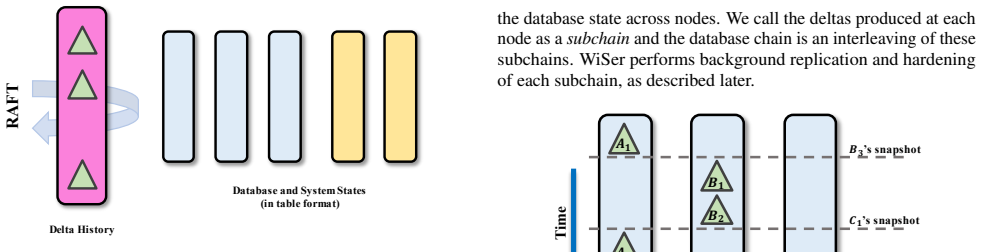
The load-bearing mechanism is the symbolic commit: a delta that carries three unresolved placeholders—its position in the serial order, its read-write conflict status, and its aggregation-constraint status—all of which are settled after SERIALIZE. Supporting that mechanism is a data representation in which transaction deltas, including read-sets, are appended to node-local logs, rows are stamped with their serialization sequence number at publish time, and the only consensus log in the system tracks serializer elections rather than data changes. That separation is what turns ordering into a consensus problem while keeping data movement out of the consensus path, and it is what makes lazy, parallel conflict and constraint resolution possible.
What would settle it
Run WiSer under a network partition that separates a transaction node from the current SERIALIZER but not from its own replicas: if no transaction on the partitioned side can ever complete SERIALIZE while the partition persists, then the PROMISE step alone does not deliver availability under the partition, and the availability claim is refuted.
Extended reading notes
Core claim
In WiSer's own terms, a transaction is durably recorded at PROMISE without any global coordination, and its delta is later assigned a serialization sequence number by a lightweight Raft log that records only serializer elections, not user data. Because each delta embeds the transaction's read-set and each published row carries its serialization sequence number, the state at the serialization frontier is deterministic; read-write conflicts and aggregation constraint violations can therefore be checked in background, on a non-changing state, and the system need not lock or escrow anything at transaction time. The result is meant to be consistency with availability: strict serializability is available to applications that wait for SERIALIZE, while the PROMISE step provides the fast acknowledgment that interactive and IoT-facing applications expect.
Load-bearing premise
The load-bearing premise is that a PROMISE acknowledgment from a quorum of replicas, made without contacting the coordinator, provides meaningful availability even though the transaction's true outcome remains undecided until the later SERIALIZE step.
Editorial extensions
If this is right
- Applications can acknowledge a transaction's durability locally at PROMISE and still receive full serializability if they wait for SERIALIZE.
- Aggregation constraints like non-negative inventory can be enforced by the DBMS in the background, removing the need for escrow mechanisms and compensating application code.
- Because conflict resolution runs on a deterministic, non-changing state after SERIALIZE, it can be parallelized across nodes and can keep up with transaction rates using streaming queries.
- Read-write conflicts, including phantoms from range predicates, are handled by comparing embedded read-sets against writes after ordering, avoiding lock-table scans of the database.
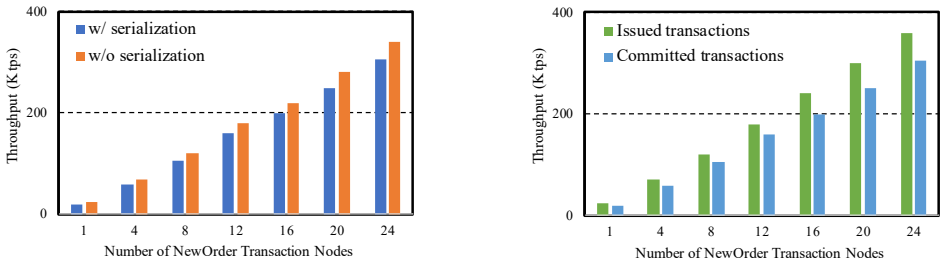
- Serialization cost is independent of transaction load, so throughput scales by adding transaction nodes, subject to the publish bottleneck the paper reports.
Reading between the lines
- The availability delivered by PROMISE is narrower than a classic commit: the client knows the delta is durably stored but cannot act on the outcome until SERIALIZE, so the practical gain is reduced blocking rather than early knowledge of commit.
- The same split could be adapted to geo-replicated settings by letting multiple serializers order batches by timestamps, but the paper only sketches a single elected serializer and does not analyze such configurations.
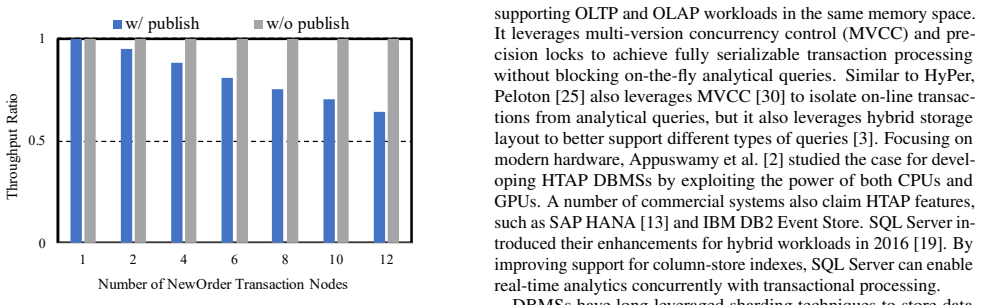
- The paper's own experiments show publish is the throughput bottleneck; a natural test is whether batching or columnar reorganization at publish, rather than consensus, dominates end-to-end latency as nodes scale.
- Read-sets stored as 64-bit hashes will cause some false-positive rollbacks, so measuring that rate against exact key sets would quantify the cost of the approximate representation the paper acknowledges.
Signed reviews
Editorial analysis
A structured set of objections, weighed in public.
Referee Report
Summary. The paper presents WiSer, a distributed HTAP DBMS that splits transaction commit into a PROMISE stage, during which a transaction's delta is durably replicated to a quorum of nodes without contacting a global coordinator, and a SERIALIZE stage, during which a small Raft-log-based consensus procedure fixes the transaction's position in the serial order. The system embeds read-sets and snapshots into transaction deltas, stores all system and database state in tables, and resolves read-write conflicts and aggregation constraints lazily after serialization. The paper claims that this design provides consistency with high availability, avoids sharding, and enforces aggregation constraints efficiently, and it reports throughput and latency experiments on a healthy 28-node cluster.
Significance. The PROMISE/SERIALIZE decomposition is a genuinely interesting architectural idea that separates client-visible acknowledgment from final serializable commitment, and the 'all state in tables' principle is a clean way to reason about metadata and failure. The work targets a real and current problem—HTAP with aggregation constraints in distributed settings—and the healthy-cluster experiments show good scaling. However, the central availability claim is not demonstrated: node departures are explicitly unsupported, no failure or partition experiments are reported, and the lazy constraint-resolution protocol has a potential correctness gap involving transactions that read data later removed by constraint rollbacks. If these issues are resolved, the work would be a solid contribution to HTAP and transaction-processing design.
major comments (4)
- [Section 2.3 and Abstract] The abstract states that WiSer 'covers node joins and departures as database tables,' but Section 2.3 says 'Node departures from the network are not supported directly' and describes no mechanism for replicas to advance the subchain of an unresponsive node or to deliver a final status to clients. Because PROMISE can return to a client before SERIALIZE, a transaction acknowledged at PROMISE on a node that subsequently fails may never be serialized or rolled back. The paper therefore does not establish the liveness of PROMISE-completed transactions under node failure, which directly undermines the central 'high availability' claim. This must be addressed either by adding a concrete recovery protocol or by substantially softening the availability claim.
- [Section 5] None of the experiments in Section 5 exercise node failure, network partition, or node departure; all measurements in Figures 4–8 are taken on healthy clusters. The abstract and introduction promise availability benefits from PROMISE, but the paper provides no experimental evidence that PROMISE completes in scenarios where a coordinator-based system would block, nor does it analyze the quorum requirement: PROMISE still needs a quorum of replicas, so under a majority partition it cannot complete for at least some nodes. A microbenchmark with injected partitions, and an explicit statement of the partition behavior, are needed to make the HA claim credible.
- [Section 4.1 and Section 2.1 Stage 5] Constraint resolution can roll back transactions after SERIALIZE, but the paper does not describe how this interacts with already-resolved read-write conflicts. A transaction T2 that is serialized after a constraint-violating transaction T1 may have read T1's writes and have been marked conflict-free at CONFLICT RESOLVE time. If T1 is later removed via the ConstraintFailures table, T2's read result changes, yet T2 is not re-examined. The statement in Section 4.1 that removing violating transactions 'only moves the running aggregate in a beneficial direction, so it is safe for other nodes to ignore this effect' addresses only the aggregate value, not the correctness of previously published transactions that depend on the removed writes. This is a load-bearing correctness gap: the paper needs either a cascading rollback protocol, a re-evaluation of conflict status after constraint resolution, or a proof that such dependencies cannot occur in the proposed execution model.
- [Section 2.1 Stage 1 and Section 1.2.1] The paper's terminology conflates 'commit' with 'PROMISE.' A transaction that completes PROMISE is acknowledged durably, but its final outcome is not known until SERIALIZE, and it may later roll back due to conflicts or constraint violations. The claim that 'the semantics upon such a time-out is identical to that of time-out at commit in a classical DBMS' is not argued: in a classical DBMS, an acknowledged commit implies that the transaction is committed and durable, whereas here a PROMISE-acknowledged transaction can later be aborted. The paper should either introduce a clearer term for this intermediate state or provide a precise statement of what the client is guaranteed at each stage, including under a subsequent node failure.
minor comments (5)
- [Section 5.2] The text says 'Figure 5 and Figure 5 show...'; the second reference should likely be to Figure 6, which is the plot for the UpdatePrice transaction size of 20.
- [Section 1.2.1] The sentence 'Applications requiring strict serializability can stop at SERIALIZE stage' is confusing because the next paragraphs state that the system waits for publish and constraint resolution before returning a status to the client; clarify what 'stop' means for such applications.
- [Section 2.1] The sentence 'PROMISE needs no global cluster communication; AP applications stop at this stage' is ambiguous and potentially misleading, because PROMISE still requires a quorum of replicas and the transaction may later roll back. Please rephrase to state exactly what an AP application that 'stops' at PROMISE can rely on.
- [Figures 4–8] The figures do not include error bars or any measure of variance. For reproducibility, at least a brief statement of run-to-run variability would be helpful, even if error bars are omitted for readability.
- [References] Reference [14] is a vendor white paper; consider citing a peer-reviewed description of FaunaDB if one exists, and ensure all references are complete (for example, [32] and [33] are both listed as SIGMOD 2019 entries but with different formatting).
Circularity Check
No circular derivation; the availability claim is under-supported but not definitionally forced.
full rationale
The paper contains no fitted-parameter-as-prediction, no load-bearing self-citation chain, and no equation-level reduction of a result to its own inputs. The rollback-rate calculation in Section 5.2 is a transparent probabilistic prediction from stated workload parameters (10/10,000 per-product update probability and 10 reads per NewOrder), matching observed rates without fitting. The design's core mechanisms—embedded read-sets, SSN-stamped rows, lazy conflict and constraint resolvers, and reliance on Raft for serialization—are independent content; Raft is an external consensus protocol with its own liveness properties. The closest concern is that the headline 'consistency with availability' depends on treating PROMISE as the commit step: PROMISE is defined as needing no coordinator, so the availability benefit is a property of the protocol's definition rather than a measured end-to-end guarantee. But the paper is explicit that PROMISE is only a symbolic commit, that final status is fixed only at SERIALIZE, and that transactions may subsequently roll back; Section 2.3 further admits 'Node departures from the network are not supported directly.' These are real gaps in the support for the HA claim and are correctness/scope concerns, not circular derivations. No step reduces by construction to its own input, so no circularity is established.
Assumptions & free parameters
assumptions (5)
- domain assumption Raft consensus produces a correct total order of SERIALIZE events.
- domain assumption Aggregation constraints are algebraic and incrementally maintainable.
- domain assumption Read-sets can be represented as equality/range predicates over key columns or escalated to full table.
- domain assumption PROMISE can always reach a quorum of replicas to harden the delta.
- domain assumption Applications accept 'symbolic' commit with possible later rollback and compensation.
invented entities (5)
-
SerializeFrontiers table
-
ReadWriteSet table
-
PROMISE/SERIALIZE stages
-
SSN (serialization sequence number)
-
Constraint resolver
Cite this review
Pith. "Pith review of WiSer: A Highly Available HTAP DBMS for IoT Applications." pith.science (2026). https://pith.science/paper/EV55WXWF
@misc{pith2026190801908,
  author       = {Pith},
  title        = {Pith review of: WiSer: A Highly Available HTAP DBMS for IoT Applications},
  year         = {2026},
  howpublished = {\url{https://pith.science/paper/EV55WXWF}},
  note         = {Machine review of arXiv:1908.01908}
}
read the original abstract
In a classic transactional distributed database management system (DBMS), write transactions invariably synchronize with a coordinator before final commitment. While enforcing serializability, this model has long been criticized for not satisfying the applications' availability requirements. When entering the era of Internet of Things (IoT), this problem has become more severe, as an increasing number of applications call for the capability of hybrid transactional and analytical processing (HTAP), where aggregation constraints need to be enforced as part of transactions. Current systems work around this by creating escrows, allowing occasional overshoots of constraints, which are handled via compensating application logic. The WiSer DBMS targets consistency with availability, by splitting the database commit into two steps. First, a PROMISE step that corresponds to what humans are used to as commitment, and runs without talking to a coordinator. Second, a SERIALIZE step, that fixes transactions' positions in the serializable order, via a consensus procedure. We achieve this split via a novel data representation that embeds read-sets into transaction deltas, and serialization sequence numbers into table rows. WiSer does no sharding (all nodes can run transactions that modify the entire database), and yet enforces aggregation constraints. Both readwrite conflicts and aggregation constraint violations are resolved lazily in the serialized data. WiSer also covers node joins and departures as database tables, thus simplifying correctness and failure handling. We present the design of WiSer as well as experiments suggesting this approach has promise.
Figures

Figures from the paper (3 more)


Reference graph
Works this paper leans on
-
[1]
WiSer: A Highly Available HTAP DBMS for IoT Applications
INTRODUCTION For decades, database management systems (DBMSs) have sepa- rated on-line transaction processing (OLTP) from on-line analytics processing (OLAP) in distinct systems. This has been more an engineering compromise than a desirable feature: OLTP systems typically modified small portions of the database and demanded low latency, whereas OLAP system...
work page Pith review arXiv 1908
-
[2]
DESIGN We model a database as a logical chain of state modifications, called deltas. The chain is in time order, that is, smaller prefixes of the chain correspond to earlier states of the database. These state modifications are made by programs called transactions that logically read the current database state (the chain prefix up to that modification), and ac...
-
[3]
CONFLICT RESOLUTION Conflicts in WiSer are resolved after we have determined a serial order. Thus the resolution problem is simple: the reads in a transac- tion X saw a snapshot that is earlier than where its delta fits in the serial order. X’s delta includesX’s read-set andX’s snapshot (seen SSN). So the CONFLICT RESOLVER needs to traverse the database cha...
-
[4]
CONSTRAINT RESOLUTION We have now built up enough machinery to discuss how aggre- gation constraints are checked. These constraints are checked after conflict resolution and after publish, who has stamped each row with the SSN (its position in the serial order). Logically, constraint resolution is a walk through the published data in SSN order, from the pr...
-
[5]
PERFORMANCE EV ALUATION WiSer is the next version of the Wildfire research prototype [5]. It is a HTAP DBMS that currently supports ingest, via Apache Spark and via a custom API; queries, directly via a SQL dialect, as well as ones pushed-down from Spark, and now multi-statement trans- actions. The last feature is the focus of this section. Transactional c...
-
[6]
RELATED WORK WiSer builds on and borrows hugely from the large volume of literature on transaction processing, where both shared-nothing and shared-storage models have been heavily studied [9, 11]. After many efforts on NoSQL databases that downplayed the importance of consistency, the last decade has seen a renewed in- terest in systems that provide stro...
work page 2016
-
[7]
CONCLUSIONS AND FUTURE WORK The distributed systems community has developed consensus protocols mostly independently from the database community’s struggles with distributed transactions. We have described one ap- proach to exploiting consensus as the underlying mechanism for transaction serialization, and shown it provides two key benefits: higher availab...
- [8]
Show all 41 references
-
[9]
Appuswamy, M
R. Appuswamy, M. Karpathiotakis, D. Porobic, and A. Ailamaki. The Case For Heterogeneous HTAP. In CIDR, 2017
2017
-
[10]
Arulraj, A
J. Arulraj, A. Pavlo, and P. Menon. Bridging the Archipelago between Row-Stores and Column-Stores for Hybrid Workloads. In SIGMOD, 2016
2016
-
[11]
Barber, C
R. Barber, C. Garcia-Arellano, R. Grosman, R. Mueller, V . Raman, R. Sidle, M. Spilchen, A. Storm, Y . Tian, P. Tozun, et al. Wildfire: Fast HTAP on a Loosely-Coupled System. In HTPS, 2017
2017
-
[12]
Barber, M
R. Barber, M. Huras, G. Lohman, C. Mohan, R. Mueller, F. Özcan, H. Pirahesh, V . Raman, R. Sidle, O. Sidorkin, et al. Wildfire: Concurrent Blazing Data Ingest and Analytics. In CIDR, 2016
2016
-
[13]
P. A. Bernstein, C. W. Reid, and S. Das. Hyder-A Transactional Record Manager for Shared Flash. In CIDR, 2011
2011
-
[14]
E. Brewer. CAP 12 years Later: How the rules have changed. IEEE Computer, 45, 2012
2012
-
[15]
E. Brewer. NoSQL: Past, Present, and Future. In QCon SF, 2012
2012
-
[16]
Mohan and B
C. Mohan and B. Lindsay and R. Obermarck. Transaction management in the R* distributed database management system. In TODS, volume 11
-
[17]
J. C. Corbett, J. Dean, M. Epstein, A. Fikes, C. Frost, J. J. Furman, S. Ghemawat, A. Gubarev, C. Heiser, P. Hochschild, et al. Spanner: Google’s globally distributed database.TOCS, 31(3), 2013
2013
-
[18]
Parallel Database Systems: The Future of High Performance Database Systems
David DeWitt and Jim Gray. Parallel Database Systems: The Future of High Performance Database Systems. In CACM, volume 35
-
[19]
Dragojevi ´c, D
A. Dragojevi ´c, D. Narayanan, E. B. Nightingale, M. Renzelmann, A. Shamis, A. Badam, and M. Castro. No Compromises: Distributed Transactions with Consistency, Availability, and Performance. In SOSP, 2015
2015
-
[20]
Farber, N
F. Farber, N. May, W. Lehner, P. Grobe, I. Muller, H. Rauhe, and J. Dees. The SAP HANA Database â ˘A¸ S An Architecture Overview
-
[21]
M. Freels. FaunaDB: An Architectural Overview. 2018
2018
-
[22]
Harding, D
R. Harding, D. Van Aken, A. Pavlo, and M. Stonebraker. An Evaluation of Distributed Concurrency Control. PVLDB, 10(5), 2017
2017
-
[23]
Kallman, H
R. Kallman, H. Kimura, J. Natkins, A. Pavlo, A. Rasin, S. Zdonik, E. P. Jones, S. Madden, M. Stonebraker, Y . Zhang, et al. H-Store: A High-Performance, Distributed Main Memory Transaction Processing System. PVLDB, 1(2), 2008
2008
-
[24]
Kemper and T
A. Kemper and T. Neumann. Hyper: A hybrid oltp&olap main memory database system based on virtual memory snapshots. In ICDE, 2011
2011
-
[25]
L. Lamport. The Part-Time Parliament. TOCS, 16(2), 1998
1998
-
[26]
Larson, A
P.-Å. Larson, A. Birka, E. N. Hanson, W. Huang, M. Nowakiewicz, and V . Papadimos. Real-Time Analytical Processing with SQL Server. PVLDB, 8(12), 2015
2015
-
[27]
C. Mohan. ARIES/KVL: A Key-Value Locking Method for Concurrency Control of Multiaction Transactions Operating on B-Tree Indexes. In VLDB, 1990
1990
-
[28]
S. Mu, Y . Cui, Y . Zhang, W. Lloyd, and J. Li. Extracting More Concurrency from Distributed Transactions. In OSDI, 2014
2014
-
[29]
O’Neil, E
P. O’Neil, E. Cheng, D. Gawlick, and E. O’Neil. The Log-Structured Merge-Tree (LSM-Tree). Acta Informatica, 33(4), 1996
1996
-
[30]
Ongaro and J
D. Ongaro and J. K. Ousterhout. In Search of an Understandable Consensus Algorithm. In USENIX ATC, 2014
2014
-
[31]
Özcan, Y
F. Özcan, Y . Tian, and P. Tözün. Hybrid Transactional/Analytical Processing: A Survey. In SIGMOD, 2017
2017
-
[32]
Pavlo, G
A. Pavlo, G. Angulo, J. Arulraj, H. Lin, J. Lin, L. Ma, P. Menon, T. C. Mowry, M. Perron, I. Quah, et al. Self-Driving Database Management Systems. In CIDR, 2017
2017
-
[33]
Pezzini, D
M. Pezzini, D. Feinberg, N. Rayner, and R. Edjlali. Hybrid Transaction/Analytical Processing Will Foster Opportunities for Dramatic Business Innovation. https://www.gartner.com/doc/2657815/hybrid-transactionanalytical- processing-foster-opportunities, 2014
2014
-
[34]
J. Rao, E. J. Shekita, and S. Tata. Using Paxos to Build a Scalable, Consistent, and Highly Available Datastore. PVLDB, 4(4), 2011
2011
-
[35]
Stonebraker and A
M. Stonebraker and A. Weisberg. The V oltDB Main Memory DBMS. IEEE Data Eng. Bull., 36(2), 2013
2013
-
[36]
Thomson, T
A. Thomson, T. Diamond, S.-C. Weng, K. Ren, P. Shao, and D. J. Abadi. Calvin: Fast Distributed Transactions for Partitioned Database Systems. In SIGMOD, 2012
2012
-
[37]
Y . Wu, J. Arulraj, J. Lin, R. Xian, and A. Pavlo. An Empirical Evaluation of In-Memory Multi-Version Concurrency Control. PVLDB, 10(7), 2017
2017
-
[38]
Y . Wu, W. Guo, C.-Y . Chan, and K.-L. Tan. Fast failure recovery for main-memory dbmss on multicores. In SIGMOD. ACM, 2017
2017
-
[39]
Y . Wu, J. Yu, Y . Tian, R. Sidle, and R. Barber. Designing Succinct Secondary Indexing Mechanism by Exploiting Column Correlations. In SIGMOD, 2019
2019
-
[40]
Y . Wu, J. Yu, Y . Tian, R. Sidle, and R. Barber. HERMIT in Action: Succinct Secondary Indexing Mechanism via Correlation Exploration. volume 12, 2019
2019
-
[41]
Zhang, R
Y . Zhang, R. Power, S. Zhou, Y . Sovran, M. K. Aguilera, and J. Li. Transaction Chains: Achieving Serializability with Low Latency in Geo-Distributed Storage Systems. In SOSP, 2013
2013
Reviewed August 14, 2026 · model on record in the stance chip above.
Discussion (0). Continue with ORCID to comment.