REVIEW 4 major objections 5 minor 14 references
Numerical Analysis of Lensless Imaging with Active Metasurfaces and Single-Pixel Detectors
T0 review · 4 major / 5 minor · reviewed 2026-08-12 · deepseek-v4-flash
Pith's one-line read The paper establishes that an active metasurface can serve as the programmable aperture of a lensless single-pixel imager, resolving about 73,000 points from a 0.2 mm aperture at 1510 nm.
desk verdict A clean conceptual framework for active-metasurface single-pixel imaging, with honest assumptions; the simulated ~60k-point capability is plausible but rests on angle-flat scatterer response and negligible coupling that the paper's own FDTD only partially supports. read the letter →
The pith
A machine-rendered reading of the paper's core claim, the machinery that carries it, and where it could break.
The reading
What carries the argument
The carrying object is the array factor $A(k_{in}-k_{out}) = \sum_n a_n e^{i\psi_n} e^{i(k_{in}-k_{out})\cdot r_n}$, the Fourier transform of the metasurface's per-scatterer amplitude $a_n(v_n)$ and phase $\psi_n(v_n)$, multiplied by a scalar antenna factor $g(k)$ that describes how a single scatterer couples to plane waves. The detected intensity is the integral over incident wavevectors of the scene, the antenna factor, and the squared array factor, which makes the metasurface a programmable filter in k-space. For point-by-point imaging the phase is set to a blazed gradient so the coupling peaks at one target angle; the Gerchberg-Saxton algorithm then projects the ideal coupling onto the physically achievable amplitude-phase curve of the real metasurface. This machinery converts the imaging problem into one of whether the achievable array factors can approximate enough measurement bases.
What would settle it
Measure the angle-resolved reflection or transmission amplitude and phase of a single metasurface unit cell from normal incidence out to ±90° at 1510 nm, and compare the result with the normal-incidence response the model assumes; if the response varies substantially across the intended field of view, or if a fabricated array shows unmodeled PSF broadening rather than the predicted conjugate ghost peaks, the simulated image recovery and the $N_p$ bound no longer describe a real device.
Extended reading notes
Core claim
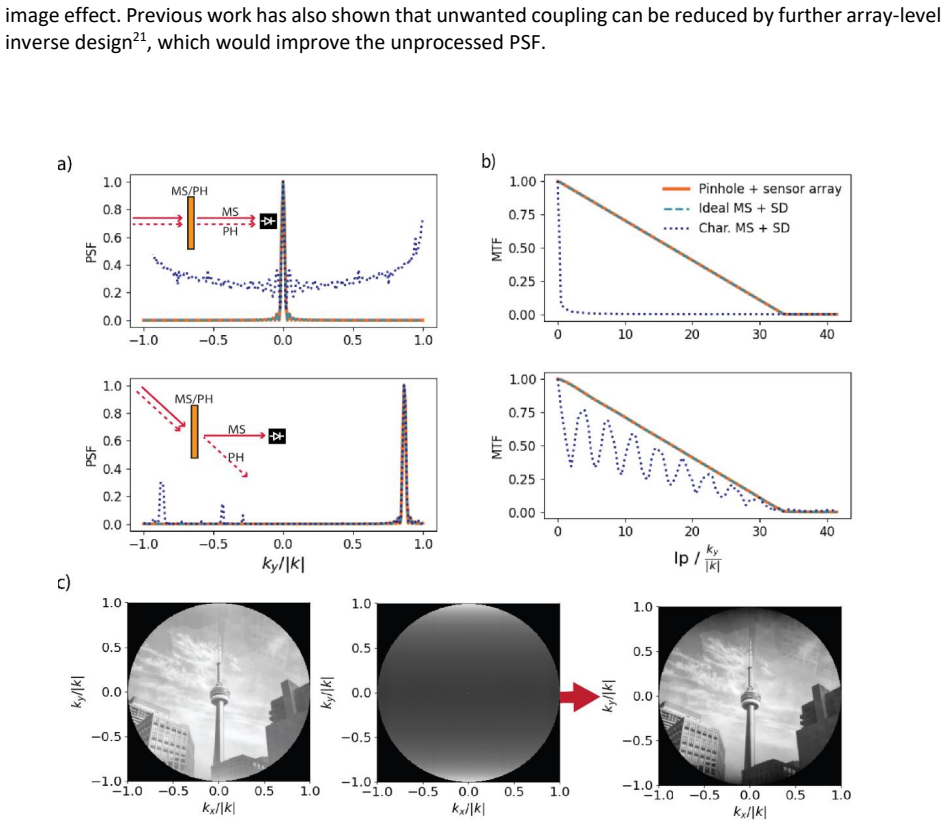
The central claim is that a subwavelength-pitch active metasurface coupled to a single detector collects enough angular information to reconstruct a scene without any lens, with the number of independently resolvable points $N_p = \pi NA^2/(4H^2) (N_x \Delta x/\lambda)(N_y \Delta y/\lambda)$, where $H \approx 0.443$ comes from the sinc half-maximum of the array factor. For the worked example, a 0.2 mm by 0.2 mm aperture with 400 nm pitch at 1510 nm, this gives about 73,400 points, exceeding what a same-size DMD or infrared sensor array would provide. Using the amplitude and phase response of an experimentally realized indium tin oxide metasurface, the simulations recover about 57,609 image points; non-idealities such as reduced contrast and conjugate ghost peaks appear because the antenna factor is not isotropic, but the point-spread function is predictable, so a simple subtraction step improves the recovered image. The same array-factor coupling can be programmed in Hadamard bases to trade acquisition time for image quality, and widening the detector's k-space acceptance improves SNR at the cost of resolution.
Load-bearing premise
The load-bearing premise is that each scatterer's amplitude and phase response, measured at normal incidence, stays the same for light arriving at any angle across the full field of view, and that neighboring scatterers do not couple to each other; if either fails, the array factor no longer describes the physical device.
Editorial extensions
If this is right
- For a fixed aperture diameter, a subwavelength-pitch active metasurface can resolve more points than a DMD or detector array occupying the same footprint, because the number of points scales with $L/\lambda$ per side rather than with pixel count.
- At one-sun illumination and 1510 nm, a lossy but fast transparent-conducting-oxide metasurface can collect a 57,609-point image at video rate with SNR around 21 dB, while liquid-crystal and DMD platforms are too slow for that frame rate.
- Non-ideal angle-dependent point-spread functions can be characterized once per scene and corrected by post-processing, so the realistic device's aberrations do not require new optics.
- Detector acceptance wider than the diffraction limit sacrifices resolution as $1/(\Delta k_D)^2$ but improves SNR as $(\Delta k_D)^4$, giving an explicit design tradeoff between image quality and acquisition time.
- Hadamard basis measurements produce a useful low-resolution preview with almost an order of magnitude fewer acquisitions, supporting hierarchical or compressed-sensing imaging.
Reading between the lines
- Beyond the paper, if the angle-independent scatterer response survives experimental test, the same array-factor formalism suggests the device could also support phase imaging, since the metasurface conserves phase relationships across the scene; the authors themselves leave phase retrieval as an open question.
- The paper's normalization-error result implies that an angularly flat antenna factor would improve both SNR and calibration robustness, so engineering scatterers for isotropic coupling might be a more decisive design goal than maximizing peak efficiency.
- A detector-integrated transmissive version, which the paper identifies as the route to zero added thickness, would make the system competitive for low-size, weight, and power platforms; whether that works hinges on transmissive active metasurface technology that is less mature than reflective devices.
- A benchtop comparison of the predicted conjugate ghost peaks with a real single-pixel setup would separate array-factor artifacts from inter-element coupling effects, since coupling would appear as unmodeled PSF broadening rather than the predicted reflected peaks.
Signed reviews
Editorial analysis
A structured set of objections, weighed in public.
Referee Report
Summary. The paper proposes a lensless single-pixel imaging architecture in which an actively tunable metasurface acts as a programmable aperture that couples selected far-field directions into a single-pixel detector. Using an array-factor formalism (Eqs. 1–3), the authors derive an analytic bound on the number of resolvable points, N_p = π·NA^2/(4H^2)·(N_xΔ_x/λ)(N_yΔ_y/λ) (Eq. 7), giving about 73,400 resolvable points for a 0.2 mm × 0.2 mm aperture at 1510 nm with 400 nm pitch. They then simulate point-by-point image recovery for both an ideal metasurface and a model based on an experimentally demonstrated TCO-based plasmonic metasurface, reporting about 57,609 recovered image points with correctable aberrations (Figs. 3c, 4c), and they analyze acquisition time, SNR, Hadamard-basis imaging, edge detection, and the effect of detector k-space width. The work is explicitly numerical and conditional on stated assumptions: angle-independent scatterer response, negligible inter-element coupling, and exact knowledge of per-measurement efficiency for normalization.
Significance. If the assumptions hold, the paper gives a clean analytical framework for a new class of compact, wide-FOV single-pixel imagers, and the analytic bounds (Eqs. 6 and 7) are a useful design tool. The ideal-metasurface simulations correctly reproduce pinhole PSFs, and the paper is unusually explicit about its assumptions and limitations, including the angle-independence assumption in the Formalism section, the coupling-neglect assumption in the Discussion, and the normalization-error analysis in SI.11. The SNR and acquisition-time analysis is a thoughtful comparison of metasurface platforms. The main numerical demonstrations, however, are not validations of a physical device; they illustrate a forward model under idealizing assumptions. The central claim that an experimentally realized TCO metasurface can recover ~57,609 image points with correctable aberrations is therefore plausible but not yet established for the full 180° FOV.
major comments (4)
- [Formalism, Eqs. (1)–(3), and SI.7] The factorization of the metasurface response into a scalar antenna factor g and an array factor A assumes that each scatterer's complex amplitude and phase response is independent of incidence angle over the full FOV and that inter-element coupling is negligible. The paper states these assumptions, but the full-wave support in SI.7 only demonstrates beam-steering (and by reciprocity collection) at 33° and 71° for a periodic 1D array. It does not show that the normal-incidence complex response used in the imaging simulations remains valid at all oblique angles up to 90°, nor that a 2D array of independent scatterers reproduces the FDTD steering efficiency. This is load-bearing because the normalization in Eq. (5) and the ghost-image subtraction in Fig. 4c assume the factorization with a single g(k_in)g(k_out). I recommend adding a direct numerical test: simulate the same TCO unit cell and a small 2D array at multiple incidence angles and compare the resulting PSFs (or coupling maps) with the array-factor prediction for those angles.
- [Materials and Methods, Eq. (8), and SI.11] The point-by-point recovery simulations enforce normalization by setting ∫|G|^2|A|^2 dk = 1 (Eq. 8), i.e., the simulator uses the exact per-measurement efficiency η. In a physical system the efficiency must be calibrated from measurements, as stated after Eq. (5). The paper's own SI.11 shows that with a non-isotropic antenna factor the normalization error is unavoidable, scene-dependent, and can limit SNR to ~40 dB. The Fig. 3c and Fig. 4c results therefore use an ideal normalization that would not be available experimentally, which overstates the fidelity of the recovered images. Please re-run the point-by-point recovery using the average-efficiency normalization described in SI.11 (applied to the full FOV, not just the wide-bin case) and report the resulting SNR and image quality, or state clearly that the figures assume perfect knowledge of η.
- [Fig. 2a and the 'Acquisition times and SNR' section] The dipole antenna factor g(k) ∝ √(1 − (k_y/|k|)^2) is an ad hoc choice, not derived from the experimentally realized TCO metasurface. The stated mean efficiency μη = 4.2% and the ~16 dB SNR reduction are therefore not quantitative predictions for the TCO device but for a hypothetical dipole-like scatterer. The paper does disclose this where the factor is introduced, but the Abstract's wording that image recovery is simulated 'considering the phase and amplitude modulation characteristics of an experimentally realized indium tin oxide-based metasurface' omits the dipole assumption and makes the claim appear more device-specific than the model supports. Please qualify the Abstract and the Fig. 2 caption to state that the realizable-metasurface simulations combine the TCO voltage response with a dipole-like angular coupling model.
- [Fig. 4c and the Discussion] The Abstract's claim that aberrations 'can be corrected through post-processing' is supported only by subtracting the (0,0) PSF, which the text itself says improves contrast but does not eliminate the 'ghost images' at reflected locations; the text states that 'more sophisticated post-processing could also be used' to remove them, without demonstration. The demonstrated correction is thus partial. Either add a post-processing example that removes the ghost peaks (e.g., by deconvolution using the full angle-dependent PSF set) or weaken the abstract and the Discussion claim to 'partially correctable through post-processing'.
minor comments (5)
- [Abstract] The phrase 'simulate image recovery with ~60,000 image points for a 0.2 mm x 0.2 mm active metasurface aperture' is used in the Abstract, but the actual point-by-point simulation in Fig. 3 uses 57,609 points; the approximate wording is acceptable but the later discussion uses the exact number inconsistently.
- [Acquisition times and SNR section] The sentence 'the realizable TCO metasurface can collect an image with an SNR of less than 35 dB faster than a liquid crystal metasurface' lacks a comma after 'dB' and is initially ambiguous; it should read 'an SNR of less than 35 dB, faster than a liquid crystal metasurface.'
- [Fig. 2a caption] The caption states 'SNR (dB) as a function of the logarithm of time t' but the figure also includes modulation-rate-limited times as vertical lines and an SNR-vs-time region; the caption should make clear that the black vertical lines are separate markers, not part of the SNR curves.
- [References] Reference 35, 'A water-soluble label for food products prevents packaging waste and counterfeiting,' appears unrelated to the claim about nanoimprint lithography in the Discussion; this is likely a citation error and should be corrected or replaced with the intended nanoimprint reference.
- [SI.2, Eq. (S14)] In the derivation of the FWHM, the text states sinc(H) = 1/√2 with H ≈ 0.443; this is correct, but the defining equation for sinc is given only in the text, not in a numbered equation, which makes the derivation slightly harder to follow.
Circularity Check
No significant circularity: the imaging simulations are forward-model computations whose inputs (TCO response, antenna factor) are not outputs of the reconstruction.
full rationale
The paper's derivation chain is a forward model rather than a fit masquerading as a prediction. The detected photon count in Eq. (3) is computed from a chosen scene, a chosen antenna factor, and voltage-dependent scatterer responses; the normalization in the Methods section (Eq. 8) is a calibration of the coupling kernel, not a fit to the ground-truth image. The recovered point-by-point, Hadamard, and edge-detection images are inner products of the scene with the simulated coupling patterns, so the agreement of the ideal-metasurface image with the scene is by construction a sanity check, not an independent prediction. The TCO amplitude/phase response is taken from prior experimental/full-wave work (Ref. 16) and used as an input dataset, not claimed as a predicted output; the dipole antenna factor is explicitly stated to be selected rather than fitted. The FDTD support in SI.7 is a new full-wave simulation performed for this paper, and the paper openly flags the angle-independence and negligible-coupling assumptions as limitations rather than concealing them. One caveat is that the post-processing illustration in Fig. 4c weights the 0-degree PSF by the known 0-degree scene intensity, so that specific correction demonstration is a proof-of-principle using ground-truth information rather than a blind algorithm; this weakens the practical claim but does not make the central numerical derivation circular.
Assumptions & free parameters
free parameters (6)
- Example aperture and pitch parameters =
λ=1510 nm, Δx=Δy=400 nm, L=0.2 mm
- Gaussian RBF fit amplitudes for TCO voltage response =
BFGS-fitted amplitudes, fixed standard deviation 1.5 V
- Dipole antenna factor g(k) =
g ∝ sqrt(1 − (ky/|k|)^2)
- Gerchberg-Saxton amplitude normalization =
Maximum scatterer amplitude set to 0.37
- Voltage perturbation for Hadamard basis =
Uniform in [−0.9, 0.9] V
- Loss variance model in Fig. 2a =
Mean efficiency 0.5, standard deviation 0.18
assumptions (7)
- domain assumption Far-field scene points are mutually incoherent over the detector integration time, so field cross-terms vanish (Eq. S9).
- domain assumption Near-monochromatic, single-polarization illumination and a rectangular subwavelength scatterer grid.
- domain assumption Scatterer phase and amplitude responses are angle-independent over the FOV, and inter-element coupling is negligible.
- domain assumption The Gerchberg-Saxton algorithm converges to a good approximation of the desired far-field coupling for the bases used.
- domain assumption Shot noise is the dominant noise source and follows Poisson statistics.
- standard math Reciprocity of the antenna factor and the normalization integral Eq. S39 represent the lossless full-coupling ideal.
- standard math The array factor is the Fourier transform of the scatterer configuration with negligible mutual coupling (Eq. 2).
Cite this review
Pith. "Pith review of Numerical Analysis of Lensless Imaging with Active Metasurfaces and Single-Pixel Detectors." pith.science (2026). https://pith.science/paper/EVXKR2N2
@misc{pith2026241108282,
  author       = {Pith},
  title        = {Pith review of: Numerical Analysis of Lensless Imaging with Active Metasurfaces and Single-Pixel Detectors},
  year         = {2026},
  howpublished = {\url{https://pith.science/paper/EVXKR2N2}},
  note         = {Machine review of arXiv:2411.08282}
}
read the original abstract
We introduce a conceptual framework for a lensless imaging system which employs an active metasurface as a high-frequency, continuously tunable amplitude and phase modulation aperture, coupled to a discrete single-pixel detector. Using an array factor formalism, we first study fundamental limits in information collection, offering a comparison to existing technologies. We also study the effects of modulation rate and losses on the system acquisition time and signal-to-noise ratio, which place bounds on system performance for set illumination conditions. Considering both an ideal metasurface and the phase and amplitude modulation characteristics of an experimentally realized indium tin oxide-based metasurface operating at 1510 nm, we then simulate image recovery with ~60,000 image points for a 0.2 mm x 0.2 mm active metasurface aperture. We show that aberrations appearing in the simulated images produced by the metasurface can be corrected through post-processing. We further investigate trade-offs between image acquisition time and image quality both through the realization of Hadamard coupling bases and by modifying the k-space width coupling to the detector. Finally, we discuss the technical challenges which remain to be overcome for experimental realization of a lensless single-pixel imaging technology.
Figures


Reference graph
Works this paper leans on
-
[1]
Anti-aliased metasurfaces beyond the Nyquist limit
Kim, S., Kim, J., Kim, K., Jeong, M. & Rho, J. Anti-aliased metasurfaces beyond the Nyquist limit. Preprint at https://doi.org/10.48550/arXiv.2406.11261 (2024)
work page Pith review arXiv doi:10.48550/arxiv.2406.11261 2024
-
[2]
Gonzalez, R. C. & Woods, R. E. Digital Image Processing. (Pearson, New York, NY, 2018)
work page 2018
-
[3]
K., Sokhoyan, R., Wu, P
Shirmanesh, G. K., Sokhoyan, R., Wu, P. C. & Atwater, H. A. Electro-optically Tunable Multifunctional Metasurfaces. ACS Nano 14, 6912–6920 (2020)
2020
-
[4]
Davoyan, A. & Atwater, H. Perimeter-Control Architecture for Optical Phased Arrays and Metasurfaces. Phys. Rev. Applied 14, 024038 (2020)
work page 2020
-
[5]
Thureja, P. et al. Toward a universal metasurface for optical imaging, communication, and computation. Nanophotonics 11, 3745–3768 (2022)
work page 2022
-
[6]
Kuznetsov, A. I. Passive and active flat optics based on dielectric nanoantennas. in Metamaterials XIV vol. PC12990 PC1299019 (SPIE, 2024)
work page 2024
-
[7]
Kim, S. I. et al. Two-dimensional beam steering with tunable metasurface in infrared regime. Nanophotonics 11, 2719–2726 (2022)
work page 2022
-
[8]
Sokhoyan, R. et al. Electrically tunable conducting oxide metasurfaces for high power applications. Nanophotonics 12, 239–253 (2023)
work page 2023
Show all 14 references
-
[9]
M., Johnson, S
Gibson, G. M., Johnson, S. D. & Padgett, M. J. Single-pixel imaging 12 years on: a review. Opt. Express 28, 28190 (2020)
2020
-
[10]
Rani, M., Dhok, S. B. & Deshmukh, R. B. A Systematic Review of Compressive Sensing: Concepts, Implementations and Applications. IEEE Access 6, 4875–4894 (2018)
2018
-
[11]
Sun, R. et al. Survey of Image Edge Detection. Front. Signal Process. 2, (2022)
2022
-
[12]
& Ding, G
Ding, X., Zhang, X., Han, J. & Ding, G. Scaling Up Your Kernels to 31×31: Revisiting Large Kernel Design in CNNs. in 2022 IEEE/CVF Conference on Computer Vision and Pattern Recognition (CVPR) 11953–11965 (2022)
2022
-
[13]
Davenport, M. et al. The smashed filter for compressive classification and target recognition - art. no. 64980H. Proceedings of SPIE 6498, (2007)
2007
-
[14]
López-García, L. et al. Efficient ordering of the Hadamard basis for single pixel imaging. Opt. Express, OE 30, 13714–13732 (2022)
2022
Reviewed August 12, 2026 · model on record in the stance chip above.
Discussion (0). Continue with ORCID to comment.