REVIEW 3 major objections 3 minor 38 references
Note on wavefront dislocation in surface water waves
T0 review · 3 major / 3 minor · reviewed 2026-08-14 · deepseek-v4-flash
Pith's one-line read This paper establishes that an unbounded Chu–Mei quotient is necessary for wavefront dislocation at a vanishing-amplitude point, and that this unboundedness is generic.
desk verdict Plausible and useful necessary-condition claim about wavefront dislocation, but the proof of Proposition 1 has a genuine gap around the contour integral and the abstract overstates the case for phase singularity. read the letter →
The pith
A machine-rendered reading of the paper's core claim, the machinery that carries it, and where it could break.
The reading
What carries the argument
The Chu–Mei quotient $\mathrm{CMq}=\partial_t^2 a/a$ (with $x$-derivatives for initial-value problems) is the central object; it enters through the nonlinear dispersion relation $K(\omega)-k=\beta\,\partial_t^2 a/a+\gamma a^2$, which results from writing the complex amplitude in polar form. Because $\gamma a^2$ vanishes at a zero of amplitude, the quotient is the only term that can make local wavenumber and frequency blow up there. Wavefront dislocation is detected by the contour integral $\oint d\Phi=\oint(k\,dx-\omega\,dt)=2\pi n$, and the paper uses the quotient's boundedness to force this integral to vanish on shrinking contours. The generic-perturbation argument uses the identity $\partial_t^2 a/a = \mathrm{Re}(F''F^*)/|F|^2 + [\mathrm{Im}(F'F^*)]^2/|F|^4$ for a complex field $F$.
What would settle it
Search the family of complex wave fields $F(x,t)$ with a zero at the origin and finite $\partial_t^2 a/a$, computing the strength integral $I=\lim_{\epsilon\to0}\oint_{C(\epsilon)}(k\,dx-\omega\,dt)$ around a shrinking circle; the claim predicts the integral is always zero, so a single example with $I=\pm2\pi$ would refute it.
Extended reading notes
Core claim
The central claim is Proposition 1: for a wave group in one spatial dimension modelled by a linear or nonlinear dispersive equation, a necessary condition for wavefront dislocation at a singular point is that the Chu–Mei quotient $\partial_t^2 a/a$ is unbounded there. The proof runs through the nonlinear dispersion relation $K(\omega)-k=\beta\,\partial_t^2 a/a+\gamma a^2$: at vanishing amplitude the nonlinear term vanishes, so an unbounded quotient forces the local wavenumber and frequency to be unbounded, and a bounded quotient is argued to make the contour integral $\oint(k\,dx-\omega\,dt)$ vanish. The paper also proves that boundedness of the quotient is exceptional: any generic perturbation of a wave field whose amplitude vanishes with vanishing "acceleration" makes the quotient unbounded.
Load-bearing premise
The proof's load-bearing step is the unproved assertion that when the local frequency and wavenumber both blow up but the Chu–Mei quotient stays bounded, one can choose a shrinking contour (for instance a rectangle with $dx=O(\omega/K(\omega))\,dt$) on which $\oint(K(\omega)\,dx-\omega\,dt)$ vanishes; if that integral does not vanish, the necessity claim no longer follows.
Editorial extensions
If this is right
- At any singular point where the Chu–Mei quotient is bounded, the contour integral $\oint(k\,dx-\omega\,dt)$ vanishes, so no crests merge or split there.
- For a generic wave field, a vanishing-amplitude point has phase singularity, wavefront dislocation, and unbounded Chu–Mei quotient together; the phenomena are typical, not exceptional.
- Because the nonlinear term $\gamma a^2$ vanishes at a zero of the amplitude, the mechanism is essentially linear and already present in linear dispersive models such as the linear Schrödinger equation.
- The soliton on finite background of the NLS equation has exactly this structure: the quotient is unbounded at its singular points, and one crest is lost and then regained over each modulation period.
Reading between the lines
- If this necessity result survives contact with data, a practical detection rule follows: in a measured time series, a zero of the envelope whose second-derivative-to-amplitude ratio grows without bound is a reliable indicator of crest splitting or merging nearby.
- Since the argument uses only the polar decomposition of a complex amplitude and the vanishing of the nonlinear term at the zero, the same condition should control phase singularities in other NLS-type systems (optical pulses, plasmas, and other nonlinear dispersive media), not just water waves.
- A testable extension: add weak dissipation or a small higher-order dispersion term to the NLS model; the genericity argument suggests the unbounded quotient and the integer-valued contour integral persist until the singular point itself is destroyed.
Signed reviews
Editorial analysis
A structured set of objections, weighed in public.
Referee Report
Summary. The paper studies phase singularities and wavefront dislocations in one-dimensional surface water wave fields at points where the amplitude vanishes. It introduces the Chu–Mei quotient ∂²_t a / a, which appears in the nonlinear dispersion relation for wave groups, and claims that unboundedness of this quotient at a singular point is necessary for wavefront dislocation (Proposition 1) and is generic under perturbation. The paper illustrates the phenomena with bichromatic and trichromatic wave superpositions and with the soliton-on-finite-background solution of the NLS equation, for which it reports wavefront dislocations and unbounded Chu–Mei quotients.
Significance. If the central necessary condition is valid, it provides a physically useful criterion: wavefront dislocation in a wave group can occur only where the Chu–Mei quotient is unbounded, connecting a quantity familiar from modulation theory to the topology of the wave field. The explicit treatment of the NLS soliton-on-finite-background solution is a strength, as are the simple bichromatic and trichromatic examples that separate phase singularity from wavefront dislocation. However, the proof of Proposition 1 as written has a load-bearing gap, and the abstract's claim about phase singularity is contradicted by the paper's own example, so the manuscript needs substantive revision before the claims can be accepted.
major comments (3)
- [Sec. 3.1, proof of Prop. 1] The proof does not establish the vanishing of ∮(K(ω) dx − ω dt). The sentence about selecting a limiting rectangle with dx = O(ω/K(ω)) dt is an assertion, not a derivation, and the dislocation integral ∮ dΦ is a homotopy invariant on loops around an isolated singular point: if the limiting value were ±2π, every sufficiently small admissible loop would have the same value, so no choice of shrinking contour can force the limit to zero. The displayed chain of inequalities is also incorrect as written: since ∮ M dx = 0 for a closed contour, the inequalities reduce to equality between the two integrals, and even with the intended M ∮ |dx| they only bound the difference between ∮(k dx − ω dt) and ∮(K(ω) dx − ω dt), not the value of either integral. This is the load-bearing step connecting boundedness of the quotient to absence of dislocation; it needs a genuine estimate, for instance a parameterization of the shrinking contour that uses the boundedness of K(ω) − k together with a growth condition on ω and K(ω), or an additional hypothesis that makes the conclusion true.
- [Abstract; Sec. 2.2] The abstract states that unboundedness of the Chu–Mei quotient is necessary for 'phase singularity and wavefront dislocation', but the bichromatic example in Sec. 2.2 explicitly has phase singularity at singular points while the Chu–Mei quotient is finite (CMq = −ν²) and there is no wavefront dislocation. The correct statement, as in Sec. 3.1, is that unboundedness is claimed to be necessary for wavefront dislocation, not for phase singularity. The abstract and any summary sentences making the stronger claim should be corrected.
- [Sec. 3.2] The genericity argument is not a proof. The displayed formula for ∂²_t a / a in terms of F is an identity for a ≠ 0, but at the singular point both numerator and denominator vanish and the limit of the expression is direction-dependent. The statement that boundedness is 'highly exceptional' is an assertion rather than a demonstration. To support the genericity claim, one would need to show that for a residual set of perturbations of a function whose quotient is bounded, the quotient becomes unbounded along the zero set of the amplitude. As it stands, Section 3.2 does not establish the claimed genericity.
minor comments (3)
- [Sec. 2.1, Eq. (1)] The use of Stokes' theorem in Eq. (1) assumes smoothness of k and ω in the region enclosed by the contour, but these quantities are singular at the singular point; the limiting definition in Eq. (2) should be stated as the primary definition, with the area integral understood over a region excluding the singularity.
- [Sec. 3.1, Eq. (6)] The sentence 'Unboundedness of the Chu–Mei quotient implies that K(ω)−k becomes unbounded, and hence that the local wavenumber and the local frequency become unbounded' needs a short justification that K(ω) is monotone and that γa² vanishes at the singular point, so that unboundedness of the difference forces both terms to be unbounded; without this, the 'hence' is not immediate.
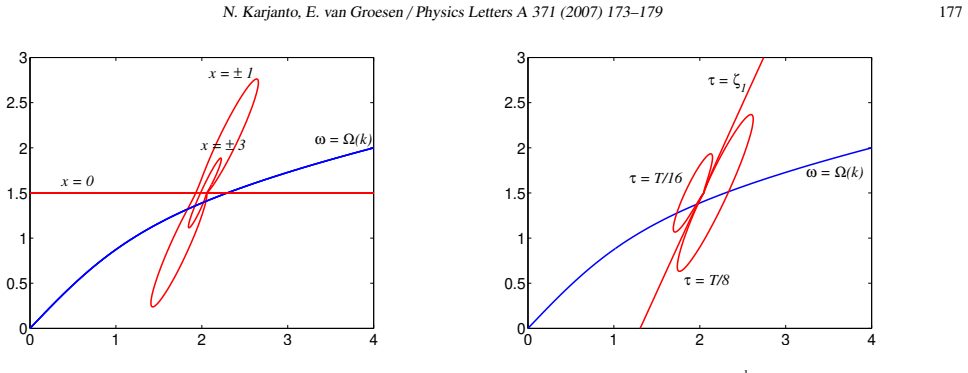
- [Figures 2 and 3] The plots are informative, but the caption should clarify that the curves are trajectories parameterized by time or position and that the axis 'ω = Ω(k)' is the dispersion curve, since the text refers to unbounded local wavenumber and frequency that lie off the dispersion curve.
Circularity Check
No significant circularity: Proposition 1 is derived from independent phase-amplitude equations; the disputed contour-integral step is a proof gap, not a circular reduction, and the self-cited SFB solution is used only as an example.
full rationale
The paper's central claim (Proposition 1, Section 3.1) is that wavefront dislocation, defined via the contour integral ∮(k dx − ω dt) = 2nπ (Eq. (1)), requires unboundedness of the Chu-Mei quotient (Eq. (3)). These are distinct definitions, and the proof derives the connecting relation K(ω) − k = β(a_tt/a) + γa^2 (Eq. (6)) from the NLS phase-amplitude equations rather than assuming the target statement. The proof of the contrapositive is not circular: for a bounded quotient it attempts to show the integral vanishes, with the load-bearing step being the assertion that ∮(K(ω) dx − ω dt) → 0 on a carefully chosen shrinking rectangle. That assertion is not rigorously justified and is a legitimate correctness concern (the integral is not made zero by contour choice unless the winding is already zero), but it is not an identity between premise and conclusion, and no parameter is fitted and renamed as a prediction. The SFB solution is imported from the authors' prior work [36–38], yet the wavefront-dislocation and unbounded-CMq properties are then computed from the explicit solution; the citation is not needed for Proposition 1 and does not smuggle in the target result. The abstract's wording about phase singularity could be read as inconsistent with the bounded-CMq bichromatic example in Section 2.2, but that is an internal-consistency issue, not a circular derivation. Therefore, no circular step meeting the required evidence standard was found.
Assumptions & free parameters
assumptions (4)
- domain assumption The real wave field is represented by its complexification via the Hilbert transform, and the phase is continuous outside singular points.
- standard math The contour integral ∮ dΦ equals the winding number and can be computed by shrinking a circle around an isolated singular point.
- ad hoc to paper In Proposition 1, the contour integral ∮(K(ω) dx - ω dt) vanishes for a suitably chosen shrinking contour when K(ω)-k is bounded.
- domain assumption Boundedness of the Chu-Mei quotient at a singular point is exceptional in the space of perturbations; the qualitative behavior of the Argand trajectory determines genericity.
Cite this review
Pith. "Pith review of Note on wavefront dislocation in surface water waves." pith.science (2026). https://pith.science/paper/EVXPABNV
@misc{pith2026190806260,
  author       = {Pith},
  title        = {Pith review of: Note on wavefront dislocation in surface water waves},
  year         = {2026},
  howpublished = {\url{https://pith.science/paper/EVXPABNV}},
  note         = {Machine review of arXiv:1908.06260}
}
read the original abstract
At singular points of a wave field, where the amplitude vanishes, the phase may become singular and wavefront dislocation may occur. In this Letter, we investigate for wave fields in one spatial dimension the appearance of these essentially linear phenomena. We introduce the Chu-Mei quotient as it is known to appear in the 'nonlinear dispersion relation' for wave groups as a consequence of the nonlinear transformation of the complex amplitude to real phase-amplitude variables. We show that unboundedness of this quotient at a singular point, related to unboundedness of the local wavenumber and frequency, is a generic property and that it is necessary for the occurrence of phase singularity and wavefront dislocation, while these phenomena are generic too. We also show that the 'soliton on finite background', an explicit solution of the NLS equation and a model for modulational instability leading to extreme waves, possesses wavefront dislocations and unboundedness of the Chu-Mei quotient.
Figures


Figures from the paper (1 more)

Reference graph
Works this paper leans on
-
[1]
M.L.M. Balistreri, J.P. Korterik, L. Kuipers, N.F. van Hulst, Phys. Rev. Lett. 85 (2000) 294
work page 2000
-
[2]
J.F. Nye, Natural Focussing and Fine Structure of Light: Caustics and Wave Dislocations, IOP, Bristol, 1999
work page 1999
- [3]
- [4]
- [5]
- [6]
-
[7]
Tanaka, in: Proceedings IUTAM /ISIMM Symp
M. Tanaka, in: Proceedings IUTAM /ISIMM Symp. Struct. Dynamics Nonli. Waves Fluids, 1995, p. 392–398. N. Karjanto, E. van Groesen / Physics Letters A 371 (2007) 173–179 179
work page 2007
- [8]
Show all 38 references
-
[9]
Polanyi, Z
M. Polanyi, Z. Phys. 89 (1934) 660
1934
-
[10]
Taylor, Proc
G.I. Taylor, Proc. R. Soc. London 145A (1934) 362
1934
-
[11]
Hull, D.J
D. Hull, D.J. Bacon, Introduction to Dislocations, fourth ed., Butterworth Heinemann, Oxford, 2001
2001
-
[12]
Dieter, Mechanical Metallurgy, SI Metric ed., McGraw–Hill, London, 1988
G.E. Dieter, Mechanical Metallurgy, SI Metric ed., McGraw–Hill, London, 1988
1988
-
[13]
Honeycombe, The Plastic Deformation of Metals, second ed., Edward Arnold, London, 1984
R.W.K. Honeycombe, The Plastic Deformation of Metals, second ed., Edward Arnold, London, 1984
1984
-
[14]
Read Jr., Dislocations in Crystals, McGraw–Hill, New York, 1953
W.T. Read Jr., Dislocations in Crystals, McGraw–Hill, New York, 1953
1953
-
[15]
Dennis, Ph.D
M.R. Dennis, Ph.D. Thesis, University of Bristol, 2001
2001
-
[16]
Kr ´asa, J
J. Kr ´asa, J. Phys. D: Appl. Phys. 14 (1981) 1241
1981
-
[17]
Berry, et al., Eur
M.V . Berry, et al., Eur. J. Phys. 1 (1980) 154
1980
-
[18]
Wright, in: W
F.J. Wright, in: W. G¨uttinger, H. Eikemeier (Eds.), Structural Stability in Physics, Springer, Berlin, 1979, pp. 141–156
1979
-
[19]
Basistiy, M.S
I.V . Basistiy, M.S. Soskin, M.V . Vasnetsov, Opt. Commun. 119 (1995) 604
1995
-
[20]
Nabarro (Ed.), Dislocations in Solids 1–12 (1979-2004)
F.R.N. Nabarro (Ed.), Dislocations in Solids 1–12 (1979-2004)
1979
-
[21]
Nye, Proc
J.F. Nye, Proc. R. Soc. London A 355 (1997) 2065
1997
-
[22]
Nye, Proc
J.F. Nye, Proc. R. Soc. London A 378 (1981) 219
1981
-
[23]
Nye, M.V
J.F. Nye, M.V . Berry, Proc. R. Soc. London A 336 (1974) 165
1974
-
[24]
Trulsen, J
K. Trulsen, J. Geophys. Res. 103 (1998) C2:3143
1998
-
[25]
Berry, Les Houches 1980, Session XXXV , Physics of Defects, North- Holland, Amsterdam, 1981, pp
M.V . Berry, Les Houches 1980, Session XXXV , Physics of Defects, North- Holland, Amsterdam, 1981, pp. 453–459
1980
-
[26]
Berry, in: Proceedings of International Conference on Singular Optics, SPIE, 1998, pp
M.V . Berry, in: Proceedings of International Conference on Singular Optics, SPIE, 1998, pp. 1–10
1998
-
[27]
Infeld, G
E. Infeld, G. Rowlands, Nonlinear Waves, Solitons and Chaos, Cambridge Univ. Press, Cambridge, 1990, pp. 117–119
1990
-
[28]
Fornberg, G.B
V . Fornberg, G.B. Whitham, Phil. Trans. R. Soc. London A 289 (1978) 373
1978
-
[29]
Chu, C.C
V .H. Chu, C.C. Mei, J. Fluid Mech. 41 (1970) 873
1970
-
[30]
Chu, C.C
V .H. Chu, C.C. Mei, J. Fluid Mech. 47 (1971) 337
1971
-
[31]
Whitham, J
G.B. Whitham, J. Fluid Mech. 27 (1967) 399
1967
-
[32]
Karpman, JETP Lett
V .I. Karpman, JETP Lett. 6 (1967) 277
1967
-
[33]
Karpman, E.M
V .I. Karpman, E.M. Krushkal’, Sov. Phys. JETP 28 (1969) 277
1969
-
[34]
Akhmediev, A
N.N. Akhmediev, A. Ankiewicz, Solitons–Nonlinear Pulses and Beams, Chapman and Hall, London, 1997 pp. 50–57
1997
-
[35]
Benjamin, J.E
T.B. Benjamin, J.E. Feir, J. Fluid Mech. 27 (1967) 417
1967
-
[36]
Karjanto, E
Andonowati, N. Karjanto, E. van Groesen, Appl. Math. Mod. 31 (2007) 1425
2007
-
[37]
Karjanto, Ph.D
N. Karjanto, Ph.D. Thesis, University of Twente, 2006
2006
-
[38]
van Groesen, Andonowati, N
E. van Groesen, Andonowati, N. Karjanto, Phys. Lett. A 354 (2006) 312
2006
Reviewed August 14, 2026 · model on record in the stance chip above.
Discussion (0). Continue with ORCID to comment.