Two Equivalence Results between Unemployment Insurance and Wage Insurance
Pith reviewed 2026-06-29 09:12 UTC · model grok-4.3
The pith
In the McCall model, wage insurance plus lump-sum unemployment insurance can be replicated exactly by unemployment insurance and taxes that both depend on wages.
A machine-rendered reading of the paper's core claim, the machinery that carries it, and where it could break.
Core claim
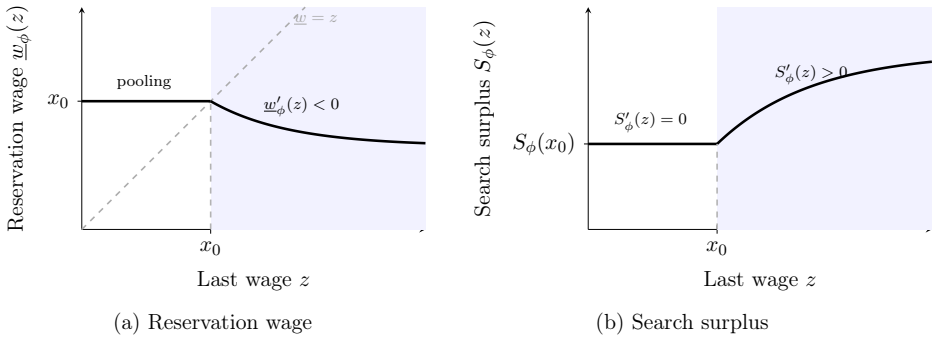
The author shows that a system of wage insurance combined with unemployment insurance financed by a lump-sum tax on the employed can be replicated in the ex ante sense by a system of unemployment insurance that depends on the agent's wage when last employed and a tax that depends on the agent's wage when employed. This holds with or without endogenous search when unemployed. Wage insurance is not binding until the last earned wage exceeds a threshold.
What carries the argument
Ex ante replication of value functions in the McCall job search model, matching expected utilities across the two policy regimes.
If this is right
- The two policy systems produce identical labor market participation and search decisions ex ante.
- The equivalence persists whether or not search effort is endogenous.
- Wage insurance only activates above a wage threshold, allowing targeted implementation.
- Policy design can focus on wage-dependent benefits and taxes to achieve multiple insurance goals.
Where Pith is reading between the lines
- If workers are risk averse rather than risk neutral, the exact replication may require different tax and benefit formulas.
- The result suggests that existing unemployment insurance programs could be adjusted to incorporate wage insurance features without new administrative structures.
- Extensions to models with multiple job types or human capital accumulation could test if the equivalence generalizes.
Load-bearing premise
Workers are assumed to be risk-neutral in their preferences over consumption and leisure.
What would settle it
A direct comparison of the two insurance systems in a version of the McCall model where agents have concave utility functions would show whether the ex ante equivalence continues to hold.
Figures
read the original abstract
In this short note, I show that in a McCall (1970) model with risk-neutral agents, a system of wage insurance combined with unemployment insurance financed by a lump-sum tax on the employed can be replicated -- in the ex ante sense -- by a system of unemployment insurance that depends on the agent's wage when last employed and a tax that depends on the agent's wage when employed. This holds with or without endogenous search when unemployed. I also show that wage insurance is not binding until the last earned wage exceeds a threshold, which may be of independent interest.
Editorial analysis
A structured set of objections, weighed in public.
Referee Report
Summary. The paper establishes two equivalence results in the McCall (1970) search model under risk-neutral agents. It shows that a wage-insurance system combined with lump-sum-tax-financed unemployment insurance can be replicated ex ante by a wage-dependent unemployment insurance benefit (conditional on the wage when last employed) and a wage-dependent tax (when employed). This equivalence holds both with and without endogenous search effort. A second result states that wage insurance is non-binding until the last earned wage exceeds a threshold value.
Significance. If the derivations hold, the results offer a clean mapping between policy instruments that can simplify analysis of insurance design in canonical search models. The invariance to endogenous search strengthens the claim, and the threshold result on wage insurance may have standalone value for understanding when such policies bind.
minor comments (1)
- The manuscript is a short note; adding a brief concluding paragraph that discusses the economic interpretation of the threshold and any limitations of the risk-neutrality assumption would improve readability without altering the technical contribution.
Simulated Author's Rebuttal
We thank the referee for their positive assessment of the manuscript and their recommendation to accept. The report correctly summarizes the two equivalence results (with and without endogenous search) and the threshold property of wage insurance in the McCall model.
Circularity Check
No significant circularity identified
full rationale
The paper derives two explicit equivalence results inside the standard McCall (1970) framework with risk-neutral agents. The central claim is a mathematical replication (ex ante) between a wage-insurance-plus-lump-sum-tax system and a wage-dependent UI-plus-wage-dependent-tax system; this is shown to hold whether or not search is endogenous. No parameters are fitted to data, no self-citations are load-bearing, no uniqueness theorems are imported from the author's prior work, and no ansatz is smuggled via citation. The derivation is therefore self-contained against the model's own equations and does not reduce to its inputs by construction.
Axiom & Free-Parameter Ledger
axioms (2)
- domain assumption Agents in the model are risk-neutral
- domain assumption The economic environment follows the McCall (1970) job search model
Reference graph
Works this paper leans on
-
[1]
Wage insurance for displaced workers
Benjamin G Hyman, Brian K Kovak, and Adam Leive. Wage insurance for displaced workers. Technical report, National Bureau of Economic Research, 2024. John Joseph McCall. Economics of information and job search.The Quarterly Journal of Economics, 84(1):113–126, 1970. 9
2024
discussion (0)
Sign in with ORCID, Apple, or X to comment. Anyone can read and Pith papers without signing in.