REVIEW 3 major objections 5 minor 102 references
SDSS-V LVM: Collisionless Shocks in the Supernova Remnant RCW86
T0 review · 3 major / 5 minor · reviewed 2026-08-06 · deepseek-v4-flash
Pith's one-line read A single supernova remnant maps how collisionless shocks divide heat between electrons and protons.
desk verdict The IFU dataset is a solid new resource, but the slow-shock end of the Te/Tp trend is on shakier ground than the abstract suggests, because the anchoring regions show the very neutral precursor that the comparison models omit. read the letter →
The pith
A machine-rendered reading of the paper's core claim, the machinery that carries it, and where it could break.
The reading
What carries the argument
The central object is the Balmer-dominated shock, a fast non-radiative collisionless shock in partially ionized gas whose H-alpha line splits into a narrow component from cold pre-shock neutrals and a broad component from fast neutrals produced by charge exchange with hot post-shock protons. The argument is carried by the relation between the broad-to-narrow intensity ratio, the broad-line FWHM, and a model grid that converts these observables into a shock velocity and an electron-to-proton temperature ratio. The integral-field unit provides the new capability: 148 fibers across one shock front now fill the broad-to-narrow versus FWHM plane that earlier single-slit studies had sampled with only a few points from different remnants.
What would settle it
Recompute the same broad-to-narrow versus FWHM comparison using a model grid that includes neutral-precursor heating and full Lyman-line radiative transfer; if the fast shocks above 800 km/s become consistent with full equilibration once precursors are included, the claimed velocity-dependent equilibration would be an artifact of the simplified models.
Extended reading notes
Core claim
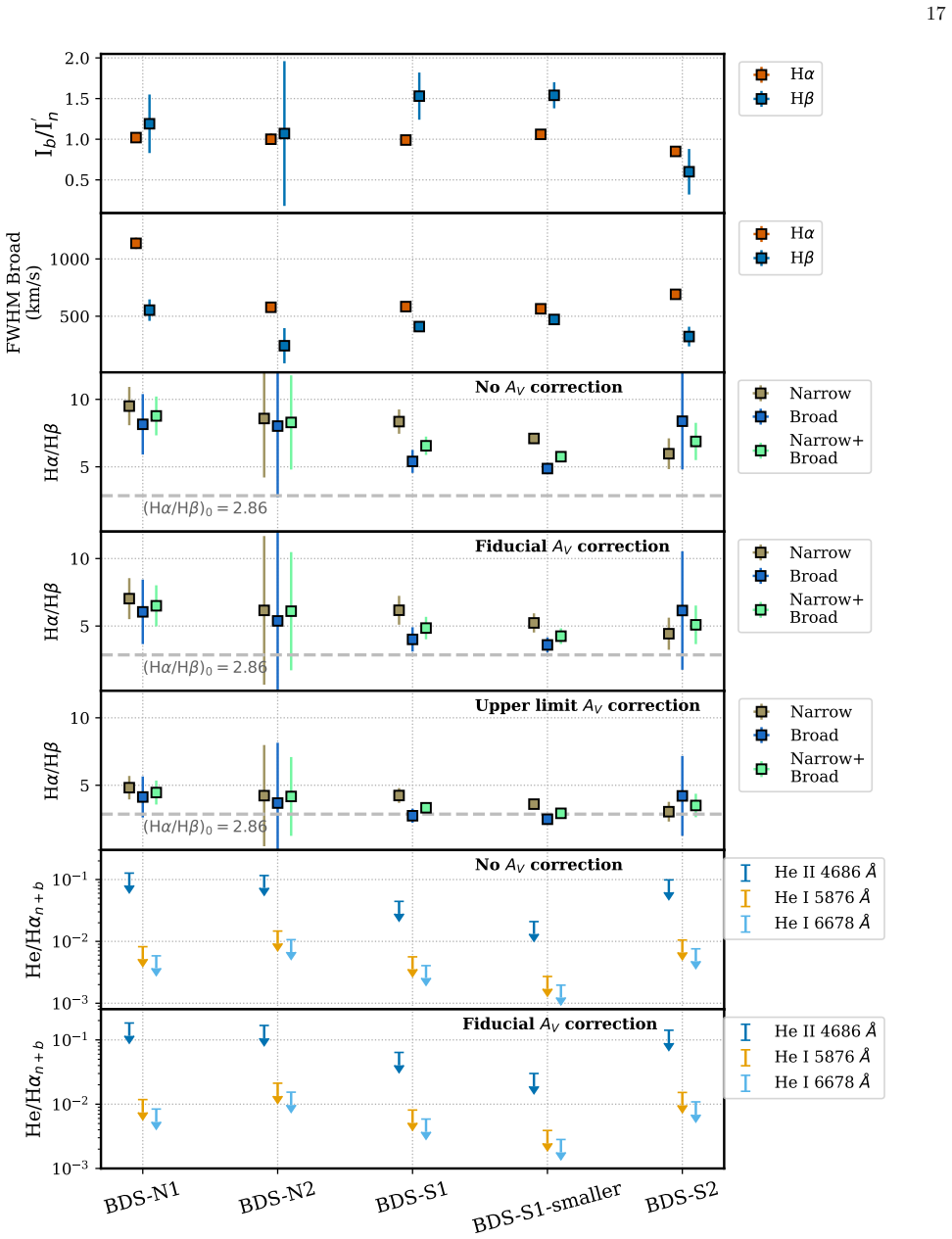
On the paper's own terms, the discovery is that electron-ion temperature equilibration in collisionless shocks varies systematically with shock speed within one supernova remnant. Comparing the broad-to-narrow H-alpha intensity ratio and the broad-line FWHM against the adopted model grid that maps these observables to shock velocity and electron-to-proton temperature ratio, the authors find that the faster parts of the RCW86 shock, above about 800 km/s, favor a temperature ratio close to 0.1, while the slower parts, below about 500 km/s, favor a ratio close to 0.5 to 1. The broad-component FWHM spans roughly 400 to 800 km/s in the south and 1000 to 1500 km/s in the north, revealing a large velocity gradient along the same shock front. The paper also reports the first intermediate-velocity H-alpha component in RCW86, with FWHM of 192 to 207 km/s, attributed to a neutral-precursor-heated region, and narrow-component Balmer decrements of 3 to 5 that support Lyman-beta trapping in the cold neutrals.
Load-bearing premise
The load-bearing premise is that the adopted model grid accurately predicts the broad-to-narrow ratio and line width for the plasma conditions in RCW86; if its assumptions about Lyman-photon transport, precursor heating, and pre-shock ionization are biased, the inferred electron-to-proton temperature ratios would shift.
Editorial extensions
If this is right
- If correct, electron-ion equilibration is not a constant but a function of shock velocity, with faster shocks leaving electrons far cooler than protons in a way that supports the idea that electron heating is nearly independent of velocity above roughly 400 km/s.
- The single-remnant mapping means Balmer-dominated supernova remnants can calibrate collisionless shock physics over a wide velocity range without the systematic differences that plague cross-remnant comparisons.
- The first detection of an intermediate H-alpha component in RCW86 strengthens neutral-precursor models and gives observers a new line-width diagnostic for precursor heating and cosmic-ray effects.
- The narrow-component Balmer decrements of 3 to 5 imply that Lyman-line trapping must be included when interpreting Balmer-dominated shock spectra, and that the cold neutral population is the main site of that trapping.
- The broad-to-narrow centroid offsets of up to about 100 km/s indicate bulk post-shock motion or non-Maxwellian ion distributions, which complicates but also enriches simple velocity diagnostics.
Reading between the lines
- The same integral-field method could be applied to other Balmer-dominated remnants, such as Tycho, SN1006, and Kepler, to test whether the velocity-dependent equilibration trend seen in RCW86 is universal or depends on local conditions.
- The inferred high neutral fraction in the southern shock, combined with the neutral-precursor evidence, suggests RCW86's forward shock is advancing into partly neutral material, which may sharpen limits on the ionizing flux of its Type Ia progenitor.
- If neutral-precursor heating is modeled more completely, part of the scatter in the broad-to-narrow ratio may be absorbed by the precursor, possibly tightening the inferred temperature-ratio relation and exposing residual variations due to magnetic field or density structure.
- The ongoing full-remnant survey that this observation previews could map the entire 360-degree shock front of RCW86 and test whether the velocity-equilibration relation is azimuthally uniform or correlated with the surrounding density distribution.
Editorial analysis
A structured set of objections, weighed in public.
Referee Report
Summary. This paper presents SDSS-V LVM integral-field spectroscopy of the southwestern part of the supernova remnant RCW86, covering the Balmer-dominated non-radiative shock and adjacent radiative clouds at ~0.3 pc scales. After median stacking and local background subtraction, the authors fit Hα+[NII] with one- and two-component Gaussian models and select 148 spaxels with a statistically significant broad Hα component, using AIC-based criteria validated in Appendix A. From the broad-to-narrow intensity ratio and broad FWHM, they derive shock velocities of ~500–1500 km/s and, by comparison with the van Adelsberg et al. (2008) model grids for Te/Tp = 0.1, 0.5, and 1.0, conclude that faster shocks have lower electron-ion temperature equilibration while slower shocks tend toward full equilibration. Additional results include broad-narrow centroid offsets, enhanced narrow Hα/Hβ ratios attributed to Lyβ trapping, a marginal HeII 4686 detection implying a high preshock neutral fraction, and the first intermediate Hα component in RCW86, interpreted as a neutral precursor. A brief comparison of radiative-cloud line ratios with MAPPINGS-III grids is also presented.
Significance. If the equilibration trend survives the model-dependence tests requested below, the paper delivers a significant observational step: a single SNR covering a wide velocity range, filling the Ib/In–FWHM plane previously populated by a handful of slit observations, and providing the first evidence for a neutral precursor in RCW86. The analysis is careful in several respects: the broad-component selection uses explicit AIC and FWHM-ratio criteria with rejected examples shown in Appendix A, the background-subtraction robustness is tested with three independent fiber sets in Appendix B, and the measurements are consistent with previous slit spectroscopy of the same region (Section 5.3). The main caveat is that the central Te/Tp inference relies on precursor-free models even though the data indicate a neutral precursor in the slow-shock region; this is acknowledged in Section 5.1.3 but not in the abstract or the conclusions.
major comments (3)
- [§5.1.3, Figure 7; §5.5] The central inference that Te/Tp rises toward unity at low shock velocity is made by comparing measured Ib/In and FWHM with the van Adelsberg et al. (2008) model grid, which the authors explicitly state excludes cosmic-ray and neutral precursors. The same dataset, however, shows an intermediate Hα component with FWHM 192–207 km/s in BDS-S1 and BDS-S1-smaller (Section 5.5, Figure 12), attributed to a neutral return-flux precursor, and those southern stacks are precisely the slow-shock regions that anchor the near-full-equilibration endpoint. Because Morlino et al. (2012), cited in Section 5.1.3, show that precursor heating can lower Ib/In relative to precursor-free predictions, the apparent trend toward Te/Tp ~ 0.5–1 at low vs could be a precursor effect rather than genuine electron-ion equilibration. I ask the authors to compare the slow-shock stacks with precursor-inclusive models, at least in the 685–941 km/s range and extending Morlino et al.'s 10^3 km/s grid downward, or to restate the abstract and Section 7 conclusions as an upper limit with this caveat made explicit.
- [§5.1.3, Eq. (10)] The radiative-shock contamination correction subtracts a fixed (NII/Hα)_rad = 2/3 of the [NII]6584 intensity from the narrow Hα flux in every fiber. The correction is therefore largest in the southern fibers, which have the highest [NII]/Hα ratios (Figure 5, top panel) because they lie nearest the bright radiative cloud; this differentially increases Ib/In' at low shock velocities and can mimic the rise of Te/Tp toward the slow-shock end. Please report the sensitivity of Figure 7 to (NII/Hα)_rad over a plausible range (e.g., 0.4–1.0) and to the by-eye membership of the BDS-S1 and BDS-S1-smaller stacks, and state explicitly whether the trend persists.
- [§5.1.3, Figure 7 and footnote 23] The paper itself notes in footnote 23 that it cannot verify the Te/Tp-vs relation because it lacks the full model grid, and the comparison in Figure 7 is presented by eye, with the data split into panels according to the Te/Tp value used to convert FWHM to shock velocity. As a result, the statement that electrons and ions are not fully equilibrated in faster shocks but tend toward full equilibration in slower shocks is a qualitative consistency statement rather than a statistical inference. Please add a quantitative agreement measure (e.g., a chi-squared or bootstrap test over the three panels, including the covariance of FWHM and Ib/In and the uncertainties in the model grid) or clearly label the claim as illustrative.
minor comments (5)
- [Abstract and §4.2] The abstract states shock velocities of 500–900 km/s in the south and 1000–1500 km/s in the north, while Section 4.2 reports broad-component FWHM values of 400–800 km/s and 1000–1500 km/s for the same regions; please clarify whether the quoted numbers are shock velocities or FWHM and make the wording consistent.
- [§5.3, paragraph defining BDS groups] The BDS-S1-smaller group is defined as four fibers with the most prominent broad Hα components selected visually; please give the fiber count and selection criterion for every BDS group, since the stacked spectra in Figure 11 are the basis for the He and Balmer-decrement results.
- [§5.5, penultimate paragraph] The phrase 'the broad component amplitude is forced to be negative' should read 'the fitted broad-component amplitude goes to zero or negative' to avoid implying a physical constraint rather than a fitting behavior.
- [References] The reference entry for van Adelsberg et al. (2008) is missing the journal name and article identifier; as printed it appears as a title and DOI only.
- [Figure 7] Figure 7 would benefit from a legend identifying the three Te/Tp panels and from error bars on a few representative data points; the grayscale overplot makes the comparison hard to evaluate by eye.
Circularity Check
No significant circularity: the Te/Tp inference is a comparison with the independent published van Adelsberg et al. (2008) model grid; the acknowledged precursor, extinction, and stacking caveats are model-dependence, not circularity.
full rationale
The paper's central claim is not derived from a parameter fitted to the same data or from a same-author uniqueness theorem. Section 5.1.3 compares observed Ib/In and broad Halpha FWHM with the published van Adelsberg et al. (2008) models. The FWHM-to-shock-velocity mapping (Figure 6) and the predicted Ib/In-versus-velocity curves (Figure 7) are different outputs of the same external model, which is parameter-free in the relevant sense: its stated assumptions (Case-B Ly-beta recombination, 50% preshock ionization, 10% He) are not tuned to reproduce the RCW86 trend. Although one current author is also a vA08 author, the model is independent support and does not reduce to a self-citation. The radiative-contamination corrections (Eqs. 10 and 12) use a fixed assumed (NII/Halpha)_rad = 2/3 and could shift points, but the conclusion that Te/Tp rises toward low vs is not built into those corrections by construction. The slow-shock endpoint is caveated by the paper's own admission that vA08 omits neutral and cosmic-ray precursors (Section 5.1.3) and by the independent detection of an intermediate Halpha component in the southern slow-shock regions (Section 5.5); likewise the by-eye stacking groups and measured extinction are assumptions. These are external-validity and model-dependence concerns, not cases where a prediction equals its input by definition. I find no circular step that can be exhibited as Eq. X = Eq. Y by construction or as a fitted parameter renamed as a prediction.
Assumptions & free parameters
free parameters (5)
- Radiative-shock contamination ratio (NII/Halpha)_rad =
2/3
- Extinction AV (north and south) =
AV = 1.21 +/- 0.41 mag (north), 0.90 +/- 0.34 mag (south)
- AIC threshold for broad-component selection =
80
- FWHM ratio thresholds for broad component =
3 < FWHM_b/FWHM_n < 20
- Preshock He abundance and ionization fraction in modeling comparison =
He/H = 0.1, ionization fraction = 50%
assumptions (5)
- domain assumption The van Adelsberg et al. (2008) models provide an accurate mapping between Ib/In, FWHM and (vs, Te/Tp) for the relevant RCW86 conditions.
- domain assumption The broad H-alpha component traces the forward shock velocity with a well-defined relation (FWHM proportional to vs for fixed Te/Tp).
- domain assumption The narrow H-alpha component is dominated by cold neutral atoms in the preshock gas, with any radiative-shock contamination removable via a fixed (NII/Halpha) ratio.
- domain assumption The extinction toward the Balmer-dominated shocks is the same as toward the nearby 'Av-north' and 'Av-south' fibers.
- standard math The distance to RCW86 is 2.5 kpc, giving the physical scale of 0.3 pc per fiber.
Cite this review
Pith. "Pith review of SDSS-V LVM: Collisionless Shocks in the Supernova Remnant RCW86." pith.science (2026). https://pith.science/paper/EXBKVUBU
@misc{pith2026250708257,
  author       = {Pith},
  title        = {Pith review of: SDSS-V LVM: Collisionless Shocks in the Supernova Remnant RCW86},
  year         = {2026},
  howpublished = {\url{https://pith.science/paper/EXBKVUBU}},
  note         = {Machine review of arXiv:2507.08257}
}
abstract
The supernova remnant (SNR) RCW86 is among the few SNRs with Balmer-emission lines containing broad and narrow spectral components that trace fast, non-radiative shocks in partially-ionized gas.\ These are invaluable laboratories for collisionless shock physics, especially for poorly-understood phenomena like electron-ion equilibration, and shock precursors. Here we present the first $\sim$0.3 pc spatial scale integral field unit (IFU) observations of the southwestern RCW86 shock, obtained as part of the Sloan Digital Sky Survey-V Local Volume Mapper (SDSS-V LVM). The forward shock, clearly visible as thin filaments in narrowband images, have broad H$\alpha$ components, indicating shock velocities varying from 500--900 km/s in the south to 1000--1500 km/s in the north. The varying velocity widths and broad-to-narrow intensity ratios show that electrons and ions have lower equilibration ($T_e/T_p \rightarrow 0.1$) in faster ($>$800 km/s) shocks, in line with previous studies. The broad components are generally redshifted from the narrow components by $\lesssim$100 km/s, likely due to shock-obliquity or non-Maxwellian post-shock distributions. We observe high extinction-corrected Balmer-decrements of 3--5 in the narrow components, indicating that conversion of Ly$\beta$ photons to H$\alpha$ is more efficient than Ly$\gamma$ to H$\beta$. Broad HeII$\lambda$4686 was marginally ($\gtrsim$2$\sigma$) detected in the southern shock, meaning the shock is impacting gas with high ($>$30--100\%) neutral fraction. We also find the first evidence of an intermediate H$\alpha$ component in RCW86, with $\Delta$V(FWHM) = 193--207 km/s, likely due to a neutral precursor. We also briefly discuss the southwestern radiative shock, and lay out the exciting future of studying astrophysical shocks with LVM.
Figures


Figures from the paper (13 more)




Reference graph
Works this paper leans on
-
[1]
2016, ApJ, 819, 98, doi: 10.3847/0004-637X/819/2/98
Ajello, M., Baldini, L., Barbiellini, G., et al. 2016, ApJ, 819, 98, doi: 10.3847/0004-637X/819/2/98
-
[2]
Allen, M. G., Groves, B. A., Dopita, M. A., Sutherland, R. S., & Kewley, L. J. 2008, ApJS, 178, 20, doi: 10.1086/589652 Astropy Collaboration, Price-Whelan, A. M., Lim, P. L., et al. 2022, ApJ, 935, 167, doi: 10.3847/1538-4357/ac7c74 Astropy-Specutils Development Team. 2019, Specutils: Spectroscopic analysis and reduction,, Astrophysics Source Code Librar...
doi:10.1086/589652 2008
-
[3]
Badenes, C., Hughes, J. P., Bravo, E., & Langer, N. 2007, ApJ, 662, 472, doi: 10.1086/518022
doi:10.1086/518022 2007
-
[4]
2025, A&A, 694, A212, doi: 10.1051/0004-6361/202451934
Belfiore, F., Ginolfi, M., Blanc, G., et al. 2025, A&A, 694, A212, doi: 10.1051/0004-6361/202451934
-
[5]
Blair, W. P., & Long, K. S. 1997, ApJS, 108, 261, doi: 10.1086/312958
-
[6]
Blair, W. P., Long, K. S., & Vancura, O. 1991, ApJ, 366, 484, doi: 10.1086/169583
doi:10.1086/169583 1991
-
[7]
A., Morales, F., Besser, F., et al
Blanc, G. A., Morales, F., Besser, F., et al. 2024, in Society of Photo-Optical Instrumentation Engineers (SPIE) Conference Series, Vol. 13094, Ground-based and Airborne Telescopes X, ed. H. K. Marshall, J. Spyromilio, & T. Usuda, 1309403, doi: 10.1117/12.3018767 27 Figure 16.Effect of choice of background fiber locations on selection and science of broad...
-
[8]
2012, ApJ, 755, 121, doi: 10.1088/0004-637X/755/2/121
Blasi, P., Morlino, G., Bandiera, R., Amato, E., & Caprioli, D. 2012, ApJ, 755, 121, doi: 10.1088/0004-637X/755/2/121
Show all 102 references
- [9]
-
[10]
2022, astropy/regions: v0.7, v0.7 Zenodo, doi: 10.5281/zenodo.7259631
Bradley, L., Deil, C., Ginsburg, A., et al. 2022, astropy/regions: v0.7, v0.7 Zenodo, doi: 10.5281/zenodo.7259631
2022 doi
-
[11]
2014, MNRAS, 441, 3040, doi: 10.1093/mnras/stu667
Broersen, S., Chiotellis, A., Vink, J., & Bamba, A. 2014, MNRAS, 441, 3040, doi: 10.1093/mnras/stu667
2014 doi
- [12]
-
[13]
A., Kirshner, R
Chevalier, R. A., Kirshner, R. P., & Raymond, J. C. 1980, ApJ, 235, 186, doi: 10.1086/157623
1980 doi
-
[14]
A., & Raymond, J
Chevalier, R. A., & Raymond, J. C. 1978, ApJL, 225, L27, doi: 10.1086/182785 Cid Fernandes, R., Carvalho, M. S., S´ anchez, S. F., de
1978 doi
-
[15]
2021, MNRAS, 502, 1386, doi: 10.1093/mnras/stab059
Amorim, A., & Ruschel-Dutra, D. 2021, MNRAS, 502, 1386, doi: 10.1093/mnras/stab059
2021 doi
-
[16]
A., Belfiore, F., et al
Congiu, E., Blanc, G. A., Belfiore, F., et al. 2023, A&A, 672, A148, doi: 10.1051/0004-6361/202245153 C´ uneo, V. A., Mu˜ noz-Darias, T., Jim´ enez-Ibarra, F., et al. 2023, A&A, 679, A85, doi: 10.1051/0004-6361/202347265 Del Zanna, G., Dere, K. P., Young, P. R., & Landi, E. 20...
2023 doi
-
[17]
A., Seitenzahl, I
Dopita, M. A., Seitenzahl, I. R., Sutherland, R. S., et al. 2019, AJ, 157, 50, doi: 10.3847/1538-3881/aaf235
2019 doi
-
[18]
A., Groves, B
Dopita, M. A., Groves, B. A., Fischera, J., et al. 2005, ApJ, 619, 755, doi: 10.1086/423948
2005 doi
-
[19]
A., Kreckel, K., et al
Drory, N., Blanc, G. A., Kreckel, K., et al. 2024, AJ, 168, 198, doi: 10.3847/1538-3881/ad6de9 Duarte Puertas, S., Drissen, L., Robert, C., et al. 2024, MNRAS, 533, 2677, doi: 10.1093/mnras/stae1641
2024 doi
-
[20]
A., Becker, R
Fesen, R. A., Becker, R. H., Blair, W. P., & Long, K. S. 1989, ApJL, 338, L13, doi: 10.1086/185389
1989 doi
-
[21]
M., & Rakowski, C
Ghavamian, P., Laming, J. M., & Rakowski, C. E. 2007, ApJL, 654, L69, doi: 10.1086/510740
2007 doi
-
[22]
Williams, T. B. 2003, ApJ, 590, 833, doi: 10.1086/375161
2003 doi
-
[23]
Ghavamian, P., Raymond, J., Hartigan, P., & Blair, W. P. 2000, ApJ, 535, 266, doi: 10.1086/308811
2000 doi
-
[24]
C., & Hartigan, P
Ghavamian, P., Raymond, J., Smith, R. C., & Hartigan, P. 2001, ApJ, 547, 995, doi: 10.1086/318408
2001 doi
-
[25]
Laming, J. M. 2013, SSRv, 178, 633, doi: 10.1007/s11214-013-9999-0
2013 doi
-
[26]
R., Vogt, F
Ghavamian, P., Seitenzahl, I. R., Vogt, F. P. A., et al. 2017, ApJ, 847, 122, doi: 10.3847/1538-4357/aa83b8
2017 doi
-
[27]
F., Raymond, J
Ghavamian, P., Winkler, P. F., Raymond, J. C., & Long, K. S. 2002, ApJ, 572, 888, doi: 10.1086/340437
2002 doi
- [28]
-
[29]
1996, ApJL, 470, L97, doi: 10.1086/310303
Hachisu, I., Kato, M., & Nomoto, K. 1996, ApJL, 470, L97, doi: 10.1086/310303
1996 doi
-
[30]
2004, MNRAS, 350, 1301, doi: 10.1111/j.1365-2966.2004.07713.x
Han, Z., & Podsiadlowski, P. 2004, MNRAS, 350, 1301, doi: 10.1111/j.1365-2966.2004.07713.x
2004
-
[31]
R., Millman, K
Harris, C. R., Millman, K. J., van der Walt, S. J., et al. 2020, Nature, 585, 357, doi: 10.1038/s41586-020-2649-2
2020 doi
-
[32]
1999, ApJ, 526, 274, doi: 10.1086/307998
Hartigan, P. 1999, ApJ, 526, 274, doi: 10.1086/307998
1999 doi
-
[33]
A., Vink, J., Bamba, A., et al
Helder, E. A., Vink, J., Bamba, A., et al. 2013, MNRAS, 435, 910, doi: 10.1093/mnras/stt993
2013 doi
-
[34]
A., Vink, J., Bassa, C
Helder, E. A., Vink, J., Bassa, C. G., et al. 2009, Science, 325, 719, doi: 10.1126/science.1173383
2009 doi
- [35]
-
[36]
2007, ApJ, 654, 923, doi: 10.1086/509601
Heng, K., & McCray, R. 2007, ApJ, 654, 923, doi: 10.1086/509601
2007 doi
-
[37]
Heng, K., van Adelsberg, M., McCray, R., & Raymond, J. C. 2007, ApJ, 668, 275, doi: 10.1086/521298
2007 doi
-
[38]
M., Bizenberger, P., Blanc, G
Herbst, T. M., Bizenberger, P., Blanc, G. A., et al. 2024, AJ, 168, 267, doi: 10.3847/1538- 3881/ad794810.1134/S1063772908070044
2024
-
[39]
J., Raymond, J
Hester, J. J., Raymond, J. C., & Blair, W. P. 1994, ApJ, 420, 721, doi: 10.1086/173598
1994 doi
-
[40]
Hunter, J. D. 2007, Computing in Science & Engineering, 9, 90, doi: 10.1109/MCSE.2007.55
2007 doi
-
[41]
2008, ApJ, 689, 225, doi: 10.1086/592376
Katsuda, S., Tsunemi, H., Uchida, H., & Kimura, M. 2008, ApJ, 689, 225, doi: 10.1086/592376
2008 doi
-
[42]
F., & Chevalier, R
Kirshner, R., Winkler, P. F., & Chevalier, R. A. 1987, ApJL, 315, L135, doi: 10.1086/184875
1987 doi
-
[43]
P., & Chevalier, R
Kirshner, R. P., & Chevalier, R. A. 1978, A&A, 67, 267 Kneˇ zevi´ c, S., L¨ asker, R., van de Ven, G., et al. 2017, ApJ, 846, 167, doi: 10.3847/1538-4357/aa8323
1978 doi
-
[44]
P., Herbst, T., Froning, C., et al
Konidaris, N. P., Herbst, T., Froning, C., et al. 2024, in Society of Photo-Optical Instrumentation Engineers (SPIE) Conference Series, Vol. 13096, Ground-based and Airborne Instrumentation for Astronomy X, ed. J. J
2024
- [45]
-
[46]
2024, MNRAS, 530, 1078, doi: 10.1093/mnras/stae874
Kopsacheili, M., Jim´ enez-Palau, C., Galbany, L., Boumis, P., & Gonz´ alez-D ´ ıaz, R. 2024, MNRAS, 530, 1078, doi: 10.1093/mnras/stae874
2024 doi
- [47]
-
[48]
Blair, W. P. 1996, ApJ, 472, 267, doi: 10.1086/178061
1996 doi
-
[49]
H., & Lee, M
Lee, J. H., & Lee, M. G. 2014, ApJ, 786, 130, doi: 10.1088/0004-637X/786/2/130
2014 doi
-
[50]
C., et al
Li, C.-J., Chu, Y.-H., Raymond, J. C., et al. 2021, ApJ, 923, 141, doi: 10.3847/1538-4357/ac2c04
2021 doi
-
[51]
A., et al
Li, C.-J., Chu, Y.-H., Gruendl, R. A., et al. 2017, ApJ, 836, 85, doi: 10.3847/1538-4357/836/1/85
2017 doi
-
[52]
2024, A&A, 690, A161, doi: 10.1051/0004-6361/202450730
Li, J., Kreckel, K., Sarbadhicary, S., et al. 2024, A&A, 690, A161, doi: 10.1051/0004-6361/202450730
2024 doi
-
[53]
Liddle, A. R. 2007, MNRAS, 377, L74, doi: 10.1111/j.1745-3933.2007.00306.x
2007
- [54]
-
[55]
S., Blair, W
Long, K. S., Blair, W. P., Kirshner, R. P., & Winkler, P. F. 1990, ApJS, 72, 61, doi: 10.1086/191409 29
1990 doi
-
[56]
S., Blair, W
Long, K. S., Blair, W. P., Winkler, P. F., et al. 2022, ApJ, 929, 144, doi: 10.3847/1538-4357/ac5aa3
2022 doi
-
[57]
S., Winkler, P
Long, K. S., Winkler, P. F., & Blair, W. P. 2019, ApJ, 875, 85, doi: 10.3847/1538-4357/ab0d94
2019 doi
-
[58]
Luridiana, V., Morisset, C., & Shaw, R. A. 2015, A&A, 573, A42, doi: 10.1051/0004-6361/201323152
2015 doi
-
[59]
I., Walch, S., Clarke, S
Makarenko, E. I., Walch, S., Clarke, S. D., et al. 2023, MNRAS, 523, 1421, doi: 10.1093/mnras/stad1472 Mart ´ ınez-Rodr ´ ıguez, H., Badenes, C., Lee, S.-H., et al. 2018, ApJ, 865, 151, doi: 10.3847/1538-4357/aadaec
2023 doi
-
[60]
A., Raymond, J
Medina, A. A., Raymond, J. C., Edgar, R. J., et al. 2014, ApJ, 791, 30, doi: 10.1088/0004-637X/791/1/30
2014 doi
-
[61]
2012, ApJ, 760, 137, doi: 10.1088/0004-637X/760/2/137
Morlino, G., Bandiera, R., Blasi, P., & Amato, E. 2012, ApJ, 760, 137, doi: 10.1088/0004-637X/760/2/137
2012 doi
-
[62]
2013a, A&A, 557, A142, doi: 10.1051/0004-6361/201322161
Morlino, G., Blasi, P., Bandiera, R., & Amato, E. 2013a, A&A, 557, A142, doi: 10.1051/0004-6361/201322161
-
[63]
2013b, A&A, 558, A25, doi: 10.1051/0004-6361/201322006
Morlino, G., Blasi, P., Bandiera, R., & Amato, E. 2013b, A&A, 558, A25, doi: 10.1051/0004-6361/201322006
-
[64]
2014, A&A, 562, A141, doi: 10.1051/0004-6361/201322986
Morlino, G., Blasi, P., Bandiera, R., & Amato, E. 2014, A&A, 562, A141, doi: 10.1051/0004-6361/201322986
2014 doi
-
[65]
2013c, ApJ, 768, 148, doi: 10.1088/0004-637X/768/2/148
Morlino, G., Blasi, P., Bandiera, R., Amato, E., & Caprioli, D. 2013c, ApJ, 768, 148, doi: 10.1088/0004-637X/768/2/148
-
[66]
2019, MNRAS, 488, 803, doi: 10.1093/mnras/stz1734
Moumen, I., Robert, C., Devost, D., et al. 2019, MNRAS, 488, 803, doi: 10.1093/mnras/stz1734
2019 doi
-
[67]
2017, PASP, 129, 062001, doi: 10.1088/1538-3873/aa6736 O’Donnell, J
Mukai, K. 2017, PASP, 129, 062001, doi: 10.1088/1538-3873/aa6736 O’Donnell, J. E. 1994, ApJ, 422, 158, doi: 10.1086/173713
2017 doi
-
[68]
E., Ghavamian, P., & Hughes, J
Rakowski, C. E., Ghavamian, P., & Hughes, J. P. 2003, ApJ, 590, 846, doi: 10.1086/375162
2003 doi
-
[69]
Raymond, J. C. 1991, PASP, 103, 781, doi: 10.1086/132881
1991 doi
-
[70]
Raymond, J. C. 2001, SSRv, 99, 209, doi: 10.1023/A:1013849116273
2001 doi
-
[71]
C., Blair, W
Raymond, J. C., Blair, W. P., Fesen, R. A., & Gull, T. R. 1983, ApJ, 275, 636, doi: 10.1086/161561
1983 doi
-
[72]
C., Chilingarian, I
Raymond, J. C., Chilingarian, I. V., Blair, W. P., et al. 2020, ApJ, 894, 108, doi: 10.3847/1538-4357/ab886d
2020 doi
-
[73]
C., Isenberg, P
Raymond, J. C., Isenberg, P. A., & Laming, J. M. 2008, ApJ, 682, 408, doi: 10.1086/589645
2008 doi
-
[74]
C., Seok, J
Raymond, J. C., Seok, J. Y., Koo, B.-C., et al. 2023a, ApJ, 954, 34, doi: 10.3847/1538-4357/ace692
-
[75]
C., Vink, J., Helder, E
Raymond, J. C., Vink, J., Helder, E. A., & de Laat, A. 2011, ApJL, 731, L14, doi: 10.1088/2041-8205/731/1/L14
2011 doi
-
[76]
2010, ApJ, 712, 901, doi: 10.1088/0004-637X/712/2/901
Park, S. 2010, ApJ, 712, 901, doi: 10.1088/0004-637X/712/2/901
2010 doi
-
[77]
C., Ghavamian, P., Bohdan, A., et al
Raymond, J. C., Ghavamian, P., Bohdan, A., et al. 2023b, ApJ, 949, 50, doi: 10.3847/1538-4357/acc528
-
[78]
Romano, L. E. C., Behrendt, M., & Burkert, A. 2025, arXiv e-prints, arXiv:2503.12977, doi: 10.48550/arXiv.2503.12977 S´ anchez, S. F., Mej ´ ıa-Narv´ aez, A., Egorov, O. V., et al. 2025, AJ, 169, 52, doi: 10.3847/1538-3881/ad93bb
2025 doi
-
[79]
P., Delaney, T., et al
Sankrit, R., Blair, W. P., Delaney, T., et al. 2005, Advances in Space Research, 35, 1027, doi: 10.1016/j.asr.2004.11.018
2005 doi
-
[80]
P., & Raymond, J
Sankrit, R., Blair, W. P., & Raymond, J. C. 2023, ApJ, 948, 97, doi: 10.3847/1538-4357/acc860
2023 doi
-
[81]
C., Blair, W
Sankrit, R., Raymond, J. C., Blair, W. P., et al. 2016, ApJ, 817, 36, doi: 10.3847/0004-637X/817/1/36
2016 doi
-
[82]
M., Mitsuishi, I., et al
Sano, H., Reynoso, E. M., Mitsuishi, I., et al. 2017, Journal of High Energy Astrophysics, 15, 1, doi: 10.1016/j.jheap.2017.04.002
2017 doi
-
[83]
I., Clarke, S
Smirnova, P., Makarenko, E. I., Clarke, S. D., et al. 2025, A&A, 693, A38, doi: 10.1051/0004-6361/202451108
2025 doi
-
[84]
Smith, R. C. 1997, AJ, 114, 2664, doi: 10.1086/118676
1997 doi
-
[85]
C., Kirshner, R
Smith, R. C., Kirshner, R. P., Blair, W. P., & Winkler, P. F. 1991, ApJ, 375, 652, doi: 10.1086/170228
1991 doi
-
[86]
C., Raymond, J
Smith, R. C., Raymond, J. C., & Laming, J. M. 1994, ApJ, 420, 286, doi: 10.1086/173558 Smithsonian Astrophysical Observatory. 2000, SAOImage DS9: A utility for displaying astronomical images in the X11 window environment,, Astrophysics Source Code Library, record ascl:0003.002
1994 doi
-
[87]
Sollerman, J., Ghavamian, P., Lundqvist, P., & Smith, R. C. 2003, A&A, 407, 249, doi: 10.1051/0004-6361:20030839
2003 doi
-
[88]
2018, MAPPINGS V: Astrophysical plasma modeling code,, Astrophysics Source Code Library, record ascl:1807.005
Sutherland, R., Dopita, M., Binette, L., & Groves, B. 2018, MAPPINGS V: Astrophysical plasma modeling code,, Astrophysics Source Code Library, record ascl:1807.005
2018
-
[89]
S., & Dopita, M
Sutherland, R. S., & Dopita, M. A. 2017, ApJS, 229, 34, doi: 10.3847/1538-4365/aa6541
2017 doi
-
[90]
M., & Heng, K
Tseliakhovich, D., Hirata, C. M., & Heng, K. 2012, MNRAS, 422, 2357, doi: 10.1111/j.1365-2966.2012.20787.x
2012
-
[91]
R., Dopita, M
Tuohy, I. R., Dopita, M. A., Mathewson, D. S., Long, K. S., & Helfand, D. J. 1982, ApJ, 261, 473, doi: 10.1086/160358 van Adelsberg, M., Heng, K., McCray, R., & Raymond, J. C. 2008, Spatial Structure and Collisionless Electron Heating in Balmer-dominated Shocks, doi: 10.1086/592680
1982 doi
-
[92]
2024, PhRvL, 132, 265201, doi: 10.1103/PhysRevLett.132.265201
Vanthieghem, A., Tsiolis, V., Spitkovsky, A., et al. 2024, PhRvL, 132, 265201, doi: 10.1103/PhysRevLett.132.265201
2024 doi
-
[93]
E., et al
Virtanen, P., Gommers, R., Oliphant, T. E., et al. 2020, Nature Methods, 17, 261, doi: 10.1038/s41592-019-0686-2 30
2020 doi
-
[94]
Y., Lee, J
Wagner, A. Y., Lee, J. J., Raymond, J. C., Hartquist, T. W., & Falle, S. A. E. G. 2009, ApJ, 690, 1412, doi: 10.1088/0004-637X/690/2/1412
2009 doi
-
[95]
J., Blair, W
Williams, B. J., Blair, W. P., Blondin, J. M., et al. 2011, ApJ, 741, 96, doi: 10.1088/0004-637X/741/2/96
2011 doi
-
[96]
J., Borkowski, K
Williams, B. J., Borkowski, K. J., Reynolds, S. P., et al. 2014, ApJ, 790, 139, doi: 10.1088/0004-637X/790/2/139
2014 doi
-
[97]
F., Gupta, G., & Long, K
Winkler, P. F., Gupta, G., & Long, K. S. 2003, ApJ, 585, 324, doi: 10.1086/345985
2003 doi
- [98]
-
[99]
F., Long, K
Winkler, P. F., Long, K. S., & Blair, W. P. 2023, ApJ, 959, 62, doi: 10.3847/1538-4357/ad0237
2023 doi
-
[100]
M., Bildsten, L., Brooks, J., & Paxton, B
Wolf, W. M., Bildsten, L., Brooks, J., & Paxton, B. 2013, ApJ, 777, 136, doi: 10.1088/0004-637X/777/2/136
2013 doi
-
[101]
E., Ghavamian, P., Badenes, C., & Gilfanov, M
Woods, T. E., Ghavamian, P., Badenes, C., & Gilfanov, M. 2017, Nature Astronomy, 1, 800, doi: 10.1038/s41550-017-0263-5
2017 doi
-
[102]
E., Ghavamian, P., Badenes, C., & Gilfanov, M
Woods, T. E., Ghavamian, P., Badenes, C., & Gilfanov, M. 2018, ApJ, 863, 120, doi: 10.3847/1538-4357/aad1ee
2018 doi
Reviewed August 6, 2026 · model on record in the stance chip above.
Discussion (0). Continue with ORCID to comment.