REVIEW 4 major objections 4 minor 12 references
Item-centric Exploration for Cold Start Problem
T0 review · 4 major / 4 minor · reviewed 2026-08-06 · deepseek-v4-flash
Pith's one-line read A single post-ranking filter that skips mismatched audiences lifted cold-start satisfaction by 40-50% and grew the recommendable corpus by 10% in live traffic.
desk verdict Plausible item-centric cold-start filter, but the live-experiment evidence is too thin to back the headline claims — referee it with a demand for the corpus metric. read the letter →
The pith
A machine-rendered reading of the paper's core claim, the machinery that carries it, and where it could break.
The reading
What carries the argument
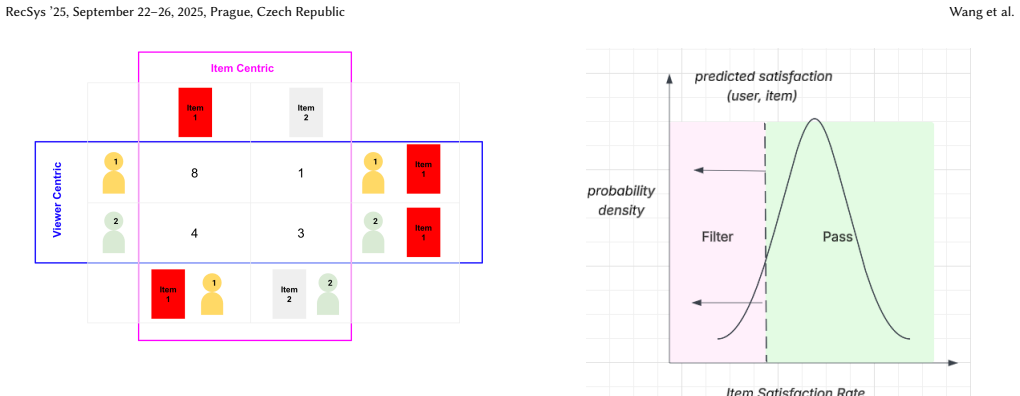
The load-bearing object is the item-centric control, an inequality filter (Eq. 1) applied after ranking. It compares the ranking model's satisfaction-head prediction $p(S^+|u,i)$ against the item-level posterior $B(\alpha_0 + N^+, \beta_0 + N - N^+)$, whose conjugate Beta posterior mean $\mu_i$ and standard deviation $\sigma_i$ come from Eqs. 2 and 3. The filter's work is to block exposure when the predicted user satisfaction falls below $\mu_i - 2\sigma_i$, flagging an audience mismatch before the item is shown.
What would settle it
On logged exploration data, apply Eq. 1 retroactively and count how many blocked pairs actually ended in a satisfied interaction; if that rate is close to or above the item's mean satisfaction, the filter is discarding good audiences. A second check is varying the 2-sigma threshold per item category and testing whether any single threshold reproduces the 40-50% satisfaction gains.
Extended reading notes
Core claim
The paper's central discovery is that the item cold-start problem has an item-centric remedy: after ranking, suppress any user-item pair whose predicted satisfaction $p(S^+|u,i)$ is more than two standard deviations below the item's posterior satisfaction mean $\mu_i$. Because the item's satisfaction rate is modeled as a Beta distribution, $\mu_i$ and $\sigma_i$ update cheaply from satisfaction counts and impressions. In live short-video exploration experiments, this filter increased two user-satisfaction metrics by 50% and 40%, reduced exploration impressions by 20%, and enlarged the recommendable corpus by 10%, all without auxiliary data or a new ranking model.
Load-bearing premise
The filter assumes the model's predicted satisfaction for a user-item pair is comparable in scale to the item's own Beta posterior satisfaction rate, so a fixed two-standard-deviation gap means 'wrong audience'; the calibration plot shows the low-satisfaction region is miscalibrated, yet the paper treats that deviation as harmless.
Editorial extensions
If this is right
- Cold-start targeting improves without auxiliary data: a purely item-side filter, not new features or models, drives the reported gains.
- Exploration becomes more selective, lowering exploration impression load by 20% while improving satisfaction with the explored content.
- The recommendable corpus can grow independently of exploration traffic volume, because better initial audiences let more new items survive to the main system.
- The control can be layered onto existing ranking and exploration stacks as a post-ranking stage, avoiding a risky full-system transition.
- The approach directly attacks popularity bias by stopping long-tail items from being burned on mismatched mass audiences.
Reading between the lines
- One testable extension is tuning the 2-sigma threshold per item category or traffic regime; the paper's calibration caveat at very low satisfaction rates suggests a single threshold may not be optimal everywhere.
- Because the filter depends on comparing probability outputs, its benefits likely hinge on ranking-model calibration; a re-calibrated satisfaction head may require a different threshold to reproduce the reported gains.
- The same item-centric logic could be applied beyond cold-start exploration, for instance to diversify recommendations or to give creators more control over who first sees their content; these applications are not in the paper.
- The user-corpus co-diverted experiment design, used to measure the recommendable-corpus gain, is a reusable tool for evaluating any item-side intervention.
Signed reviews
Editorial analysis
A structured set of objections, weighed in public.
Referee Report
Summary. The paper proposes an item-centric control for the item cold-start problem: after ranking, each candidate item i for user u is filtered out if the model's predicted satisfaction probability p(S+|u,i) falls below the item's posterior mean mu_i minus two posterior standard deviations sigma_i, where mu_i and sigma_i come from a Beta-Bernoulli model of the item's satisfaction rate (Eqs. 1-3). The control is evaluated in a live short-video recommendation system, and Table 1 reports a 50% and 40% increase in two satisfaction metrics, a 20% reduction in exploration impressions, and a 10% increase in the recommendable corpus. The paper argues that this demonstrates improved cold-start targeting and more efficient exploration.
Significance. If the reported effects are real, the contribution is practically significant: a lightweight post-ranking filter that requires only per-item Beta statistics and the ranking model's score could plausibly improve both short-term satisfaction on exploration traffic and the long-term size of the recommendable item set. The Beta-Bernoulli formulation is clean, and the memory-efficient conjugate update is a genuine engineering advantage. However, the empirical evidence as presented is not sufficient to establish the central claims: the satisfaction gains can be explained by selection bias, the corpus metric is undefined, and no statistical details are given. The idea is worth publishing if the evaluation is substantially strengthened.
major comments (4)
- [3.1 (Table 1)] The headline satisfaction gains are plausibly mechanical. Because Eq. (1) withholds impressions for which the model predicts low satisfaction, the observed satisfaction rate among the remaining impressions would rise even if the filter did not improve audience targeting at all. The paper therefore needs to report satisfaction under a fixed evaluation policy, for example by re-scoring held-out or counterfactual impressions, and to provide absolute rates and confidence intervals rather than only percentage changes. Without this, the central claim that the control improves cold-start targeting is not supported.
- [3.1] The recommendable-corpus result is unverifiable as stated. The paper mentions a 'user-corpus co-diverted exploration experiment framework' but never defines what counts as a recommendable item, how the corpus size is measured, or how treatment and control are compared. If an item is counted as recommendable when its observed satisfaction rate exceeds a threshold, then removing low-p(S+|u,i) users via Eq. (1) will mechanically raise each item's observed satisfaction rate even if its intrinsic quality is unchanged. The +10% corpus gain can therefore be a selection artifact; a precise metric definition and a validation against a fixed evaluation policy are required.
- [2.3 (Eq. 1)] The method cannot be reproduced or stress-tested without disclosing the values of alpha_0 and beta_0 in Eq. (2) and the reasoning behind the 2-sigma threshold in Eq. (1). Furthermore, Eq. (1) assumes that the ranking model's predicted p(S+|u,i) is numerically comparable to the item-level posterior mean; the calibration plot in Figure 4 reports miscalibration in the low-satisfaction region, which is exactly the region where the filter operates, yet no sensitivity analysis or category-level analysis is provided. Please disclose these parameters and report robustness across item categories and traffic regimes.
- [Table 1] Table 1 gives only relative percentage changes with no sample size, no confidence intervals, no significance tests, no experiment duration, and no pre-registered metric definitions. Given the small set of numbers, the statements 'significant positive gains' and 'remarkable' are not supported by the evidence presented.
minor comments (4)
- [Abstract / Introduction] The sentence 'While existing solutions often rely on auxiliary data, but this paper illuminates...' contains a double conjunction; please revise to use either 'while' or 'but'.
- [Figure 1] The caption reads 'Illustration the asymmetry'; it should read 'Illustrating the asymmetry' or 'Illustration of the asymmetry'.
- [Figure 4] The calibration plot has no axis labels or bin description; please add both so the reader can interpret the plot.
- [2.3] The notation is inconsistent: the text and Figure 2 use mu_item and sigma_item, while Eqs. (1)-(3) use mu_i and sigma_i; please unify the notation.
Circularity Check
No significant circularity; the item-centric filter is a decision rule evaluated by live traffic, not a prediction derived from its own inputs.
full rationale
The paper's derivation chain is the definition of an item-centric filter (Eq. 1) followed by a live-traffic measurement (Table 1). The filter compares a ranking model's predicted satisfaction p(S+|u,i) with an item-level Beta posterior mean and standard deviation (Eqs. 2-3); it is not fitted to the reported outcome metrics, and no equation in the paper maps the filter to the observed +50%/+40% satisfaction or +10% corpus changes. The satisfaction and corpus numbers are empirical measurements under a changed exploration policy, not predictions derived from the model, so there is no self-definitional or fitted-input-as-prediction reduction. The citations to the multi-task ranking model and to exploration references are background; none serves as an unverified load-bearing premise, and the paper does not invoke a uniqueness theorem or adopt an ansatz via self-citation. The admitted miscalibration at very low satisfaction rates is a limitation for calibration quality, but the paper does not use that region as evidence for its headline claims. The 'recommendable corpus' metric is not formally defined, which weakens the causal interpretation of the +10% result, but this is an evaluation-design gap rather than a circular argument. Accordingly, no step satisfies the quoted-reduction requirement, and the circularity score is 0.
Assumptions & free parameters
free parameters (2)
- Beta prior parameters alpha_0 and beta_0 =
not reported
- Threshold coefficient in Eq.1 =
2
assumptions (4)
- standard math The Beta distribution is conjugate to the Bernoulli likelihood for satisfied/not-satisfied impressions.
- domain assumption The ranking model's satisfaction prediction p(S+|u,i) is well-calibrated and comparable to the item-level satisfaction rate.
- domain assumption The item's posterior satisfaction rate represents its intrinsic quality independently of the audience.
- domain assumption The user-corpus co-diverted experiment framework validly measures the recommendable corpus.
Cite this review
Pith. "Pith review of Item-centric Exploration for Cold Start Problem." pith.science (2026). https://pith.science/paper/EXYUSSJG
@misc{pith2026250709423,
  author       = {Pith},
  title        = {Pith review of: Item-centric Exploration for Cold Start Problem},
  year         = {2026},
  howpublished = {\url{https://pith.science/paper/EXYUSSJG}},
  note         = {Machine review of arXiv:2507.09423}
}
read the original abstract
Recommender systems face a critical challenge in the item cold-start problem, which limits content diversity and exacerbates popularity bias by struggling to recommend new items. While existing solutions often rely on auxiliary data, but this paper illuminates a distinct, yet equally pressing, issue stemming from the inherent user-centricity of many recommender systems. We argue that in environments with large and rapidly expanding item inventories, the traditional focus on finding the "best item for a user" can inadvertently obscure the ideal audience for nascent content. To counter this, we introduce the concept of item-centric recommendations, shifting the paradigm to identify the optimal users for new items. Our initial realization of this vision involves an item-centric control integrated into an exploration system. This control employs a Bayesian model with Beta distributions to assess candidate items based on a predicted balance between user satisfaction and the item's inherent quality. Empirical online evaluations reveal that this straightforward control markedly improves cold-start targeting efficacy, enhances user satisfaction with newly explored content, and significantly increases overall exploration efficiency.
Figures


Reference graph
Works this paper leans on
-
[1]
Gaode Chen, Ruina Sun, Yuezihan Jiang, Jiangxia Cao, Qi Zhang, Jingjian Lin, Han Li, Kun Gai, and Xinghua Zhang. 2024. A Multi-modal Modeling Framework for Cold-start Short-video Recommendation. In Proceedings of the 18th ACM Confer- ence on Recommender Systems (Bari, Italy) (RecSys ’24). Association for Computing Machinery, New York, NY, USA, 391–400. do...
arXiv 2024
-
[2]
Minmin Chen. 2021. Exploration in Recommender Systems. In Proceedings of the 15th ACM Conference on Recommender Systems (Amsterdam, Netherlands) (RecSys ’21). Association for Computing Machinery, New York, NY, USA, 551–553. doi:10.1145/3460231.3474601
arXiv 2021
-
[3]
Xiaoshuang Chen, Yibo Wang, Yao Wang, Husheng Liu, Kaiqiao Zhan, Ben Wang, and Kun Gai. 2025. Creator-Side Recommender System: Challenges, Designs, and Applications. arXiv preprint arXiv:2502.20497 (2025)
work page Pith review arXiv 2025
-
[4]
Chao Huang, Lianghao Xia, Xiang Wang, Xiangnan He, and Dawei Yin. 2022. Self-Supervised Learning for Recommendation. In Proceedings of the 31st ACM International Conference on Information & Knowledge Management (Atlanta, GA, USA) (CIKM ’22). Association for Computing Machinery, New York, NY, USA, 5136–5139. doi:10.1145/3511808.3557506
arXiv 2022
-
[5]
Chi, Cristos Goodrow, Su-Lin Wu, Lexi Baugher, and Minmin Chen
Yi Su, Xiangyu Wang, Elaine Ya Le, Liang Liu, Yuening Li, Haokai Lu, Benjamin Lipshitz, Sriraj Badam, Lukasz Heldt, Shuchao Bi, Ed H. Chi, Cristos Goodrow, Su-Lin Wu, Lexi Baugher, and Minmin Chen. 2024. Long-Term Value of Ex- ploration: Measurements, Findings and Algorithms. In Proceedings of the 17th ACM International Conference on Web Search and Data M...
arXiv 2024
-
[6]
Manasi Vartak, Arvind Thiagarajan, Conrado Miranda, Jeshua Bratman, and Hugo Larochelle. 2017. A meta-learning perspective on cold-start recommendations for items. In Proceedings of the 31st International Conference on Neural Information Processing Systems (Long Beach, California, USA) (NIPS’17). Curran Associates Inc., Red Hook, NY, USA, 6907–6917
work page 2017
-
[7]
Maksims Volkovs, Guangwei Yu, and Tomi Poutanen. 2017. DropoutNet: address- ing cold start in recommender systems. In Proceedings of the 31st International Conference on Neural Information Processing Systems (Long Beach, California, USA) (NIPS’17). Curran Associates Inc., Red Hook, NY, USA, 4964–4973
work page 2017
-
[8]
Hongwei Wang, Fuzheng Zhang, Mengdi Zhang, Jure Leskovec, Miao Zhao, Wen- jie Li, and Zhongyuan Wang. 2019. Knowledge-aware Graph Neural Networks with Label Smoothness Regularization for Recommender Systems. In Proceedings of the 25th ACM SIGKDD International Conference on Knowledge Discovery & Data Mining (Anchorage, AK, USA) (KDD ’19). Association for C...
arXiv 2019
Show all 12 references
-
[9]
Chunyu Wei, Jian Liang, Di Liu, Zehui Dai, Mang Li, and Fei Wang. 2023. Meta Graph Learning for Long-tail Recommendation. In Proceedings of the 29th ACM SIGKDD Conference on Knowledge Discovery and Data Mining (Long Beach, CA, USA) (KDD ’23). Association for Computing Machiner...
2023
-
[10]
Yueqi Xie, Peilin Zhou, and Sunghun Kim. 2022. Decoupled Side Information Fusion for Sequential Recommendation. In Proceedings of the 45th International ACM SIGIR Conference on Research and Development in Information Retrieval (Madrid, Spain) (SIGIR ’22). Association for Compu...
2022
-
[11]
Xiaoxiao Xu, Chen Yang, Qian Yu, Zhiwei Fang, Jiaxing Wang, Chaosheng Fan, Yang He, Changping Peng, Zhangang Lin, and Jingping Shao. 2022. Alleviating Cold-start Problem in CTR Prediction with A Variational Embedding Learning Framework. In Proceedings of the ACM Web Conference...
2022
-
[12]
Zhe Zhao, Lichan Hong, Li Wei, Jilin Chen, Aniruddh Nath, Shawn Andrews, Aditee Kumthekar, Maheswaran Sathiamoorthy, Xinyang Yi, and Ed Chi. 2019. Recommending what video to watch next: a multitask ranking system. In Pro- ceedings of the 13th ACM Conference on Recommender Syst...
2019
Reviewed August 6, 2026 · model on record in the stance chip above.
Discussion (0). Continue with ORCID to comment.