REVIEW 2 major objections 4 minor 26 references
Graphon-valued stochastic processes from population genetics
T0 review · 2 major / 4 minor · reviewed 2026-08-14 · deepseek-v4-flash
Pith's one-line read Multi-type Moran random graphs converge weakly to graphon-valued diffusion processes driven by Wright-Fisher and Fleming-Viot dynamics.
desk verdict A solid construction of graphon-valued diffusions from population genetics, with a flawed flagship example and an unproven Markov claim; the core theorems are sound. read the letter →
The pith
A machine-rendered reading of the paper's core claim, the machinery that carries it, and where it could break.
The reading
What carries the argument
The central object is the graphon-valued process defined by composing a type-connection kernel with a fitness landscape and the quantile function of the type distribution: $h(s;x,y)=r(H(s; \bar F(s;x)), H(s; \bar F(s;y)))$. Here $r:[0,1]^2 \to [0,1]$ is continuous, $H(s;\cdot)$ is a continuous fitness landscape on the type space, and $\bar F(s;\cdot)$ is the right-continuous generalised inverse of the cumulative type-distribution function; this last map reparameterises the vertex space by the evolving type measure. The proof machinery is Theorem 3.1, which identifies weak convergence in the Skorohod space of graphons with convergence of subgraph-density processes $t_F$, together with McDiarmid's concentration inequality to control the random edges around their conditional mean and Ethier-Kurtz tightness criteria to upgrade finite-dimensional convergence to process convergence.
What would settle it
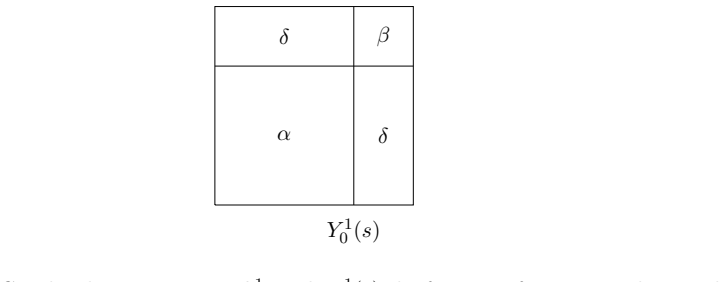
Simulate the $m=1$ two-type model of Example 4.1 with connection matrix $[[\alpha,\delta],[\delta,\beta]]$ and compare the empirical subgraph densities of the evolving graph at large $n$ to those of the two-block graphon whose boundary is the Wright-Fisher diffusion $Y(s)$ and whose block heights are $\alpha$, $\beta$, and $\delta$; a systematic mismatch at the $n\to\infty$ scaling would falsify Theorem 3.3.
Extended reading notes
Core claim
The paper's discovery is the explicit scaling limit of a time-evolving dense random graph built from a multi-type Moran model. Fix $m+1$ types and $n$ individuals; at rescaled time $s$, vertices $i$ and $j$ are connected with probability $r(H^{m,n}(s; \tau_i^{m,n}(s)), H^{m,n}(s; \tau_j^{m,n}(s)))$, where $\tau_i^{m,n}(s)$ is the type of individual $i$ normalised to $[0,1]$, $H^{m,n}$ is a fitness landscape process, and $r$ is a continuous type-connection kernel. Theorem 3.3 states that, under the joint convergence $(Y^{m,n},H^{m,n}) \Rightarrow (Y^m,H^m)$, the graph process converges to the graphon process with representative $h^m(s;x,y) = r(H^m(s; \bar F^m(s;x)), H^m(s; \bar F^m(s;y)))$, where $\bar F^m$ is the quantile transform of the Wright-Fisher type measure. Theorem 3.4 lets the number of types tend to infinity and obtains $h(s;x,y) = r(H(s; \bar F(s;x)), H(s; \bar F(s;y)))$ with the Fleming-Viot limit $Z$ in place of $Z^m$. The paper also proves a general criterion (Theorem 3.1) saying that weak convergence of graphon processes is equivalent to convergence of all finite-dimensional subgraph-density processes, and uses that criterion as the route to the scaling limits.
Load-bearing premise
The load-bearing premise is the joint convergence of the fitness landscape and type-count processes to their Wright-Fisher or Fleming-Viot limits, together with continuity of the connection kernel and fitness landscape; if these fail, the limiting graphon formula is not justified.
Editorial extensions
If this is right
- For each fixed $m$, the limiting graphon process is a moving $(m+1)\times(m+1)$ block graphon: the boundaries of the blocks evolve by the Wright-Fisher diffusion, and the height of each block is the connection probability evaluated on the fitness landscape.
- As the number of types goes to infinity, the block structure is lost in general; the Fleming-Viot limit can produce graphon diffusions not confined to the stochastic block model class.
- Every finite-dimensional subgraph density of the finite graph process converges to a functional of the type-diffusion, so standard network statistics such as edge densities, triangle counts, and motif frequencies follow diffusive dynamics in the limit.
- Markovianity on the graphon level does not require a Markov lift to infinitely exchangeable arrays; a non-Markov array process can project to a Markov graphon process, so graphon dynamics are more flexible than the exchangeable-array framework alone would suggest.
Reading between the lines
- The same quantile-composition formula suggests a general recipe for turning any Fleming-Viot martingale problem into a graphon diffusion: choose a continuous connection kernel $r$ and a fitness landscape $H$, and define $h$ by this composition; the paper's examples show this yields non-block limits, but the full class of graphons reachable this way is not characterized.
- If the Markov generator computation in Section 4.2 is made rigorous, the state-to-graphon map $G$ would give an explicit generator on graphon space for any type-diffusion whose state-to-graphon map is invertible; proving that invertibility is the natural next step.
- The construction should extend to state-dependent resampling rates and to other measure-valued diffusions beyond Wright-Fisher and Fleming-Viot, provided the joint convergence assumption $(H1)$ holds; this would yield graphon dynamics whose speed is modulated by population diversity.
- The formula can be tested computationally: simulate the finite Moran graph, compute its subgraph densities, and compare them to the integrals over $Z^m$ of $r(H^m(\bar F^m(\cdot)), H^m(\bar F^m(\cdot)))$; a systematic mismatch as $n$ grows would indicate a breakdown of the joint convergence assumption.
Signed reviews
Editorial analysis
A structured set of objections, weighed in public.
Referee Report
Summary. The paper develops a framework for graphon-valued stochastic processes and constructs a natural class of such processes from population genetics. After establishing a metric characterization of weak convergence in the space of graphon-valued cadlag paths in terms of subgraph densities (Theorem 3.1 and Corollary 3.2), the authors consider a Moran model with n individuals and m+1 types, forming a random graph at each time by connecting two individuals i and j with probability r(H^{m,n}(s; type_i), H^{m,n}(s; type_j)), where H^{m,n} is a dynamically evolving fitness landscape. Theorem 3.3 states that, under joint convergence of the type-frequency process and the fitness landscape process, the graph processes converge to a block graphon whose boundaries move according to the Wright-Fisher diffusion. Theorem 3.4 passes to the Fleming-Viot limit by letting the number of types tend to infinity, yielding a limiting graphon driven by the Fleming-Viot diffusion. The paper gives three examples, including a claimed non-block example based on an indicator-threshold fitness landscape, and discusses possible generalizations. The proofs use McDiarmid's concentration inequality, Skorokhod embedding, and standard tightness criteria.
Significance. If the results are correct, the paper provides a useful and explicit route from finite population-genetic graph dynamics to diffusive graphon limits, and its subgraph-density characterization of weak convergence for graphon-valued processes is a valuable technical tool. The main convergence theorems are proved in a self-contained way with standard concentration and tightness arguments, and no free parameters are fitted. The principal weaknesses are that the advertised non-block Fleming-Viot example does not satisfy the continuity hypothesis of Theorem 3.4 as stated, and the Markov property asserted in Section 4.2 is not established; both concern load-bearing parts of the paper's narrative.
major comments (2)
- [Section 4.1, Example 4.3] Example 4.3 claims that the fitness landscapes H^m defined by H^m(s;u) = integral of I[f(barF^m(s;u), barF^m(s;v)) >= c] Z^m(dv) satisfy hypothesis (H1). This is false for finite m: because Z^m is atomic and barF^m is a step function, H^m is a step function in u and is not an element of L = C([0,1],[0,1]). For a concrete instance, take m=1, Y_0=Y_1=1/2, f(x,y)=xy, and c=1/4; then H^1(s;u)=0 for u<1/2 and H^1(s;u)=1/2 for u>=1/2, a jump at u=1/2. The claimed limit H(s;u) has the same discontinuity whenever the Fleming-Viot measure Z(s) has atoms, which is typical. Consequently Theorem 3.4 does not apply to Example 4.3 as written, and the statement in the example that the H^m satisfy (H1) is incorrect. This does not invalidate Theorem 3.4, but it removes the paper's advertised demonstration of graphon dynamics beyond block models and indicates that the continuity requirement in (H1) is too restrictive for the natural Z-dependent fitness landscapes considered here.
- [Section 4.2] The assertion that the limiting graphon dynamics in Theorems 3.3 and 3.4 are Markov processes, based on the formula tilde h(s) = G(Y(s)) for 'some invertible map G', is not supported and is false as stated. If r is identically 1, then G sends every state Y(s) to the same complete graphon, so no invertible map exists. Even when G is not constant, the generator computation tilde L phi = L(phi o G) o G^{-1} presupposes that the graphon state determines the underlying diffusion state Y(s), and this invertibility is exactly what is not established. The paper's own Example 1.2 shows that a function of a Markov process need not be Markov under its own filtration. The Markov property should either be proved directly from the dynamics or stated under explicit additional conditions on r and H; as written, the claim overreaches.
minor comments (4)
- [Theorem 3.1(iii)] The statement of Theorem 3.1(iii) quantifies over 'all k >= 1' but then uses d in the display; the intended condition is for all d >= 1.
- [Proof of Theorem 3.1] In the proof near the strong separation argument, 'f_{F_i}(h')' should be 't_{F_i}(h')' in the displayed inequalities; the same typo appears once more in the following sentence.
- [Example 4.1] The displayed formula for h^m(s;x,y) has awkward parentheses: 'r(m+1) barF^m(s;x), (m+1) barF^m(s;y)' should be 'r((m+1)barF^m(s;x), (m+1)barF^m(s;y))'.
- [Section 5.2] The event notation An,m is introduced as 'An,m' but later rendered as 'A_{m,n}'; the notation should be unified.
Circularity Check
No significant circularity: the graphon limits are derived from external diffusion limits and stated convergence assumptions, with only a non-load-bearing self-citation.
full rationale
The paper's central results, Theorems 3.3 and 3.4, derive graphon-valued limits from the Moran model and then from the Fleming-Viot diffusion. The limiting graphons are explicit continuous functions of the assumed limiting type distributions and fitness landscapes: h^m(s;x,y) = r(H^m(s; bar F^m(s;x)), H^m(s; bar F^m(s;y))) and h(s;x,y) = r(H(s; bar F(s;x)), H(s; bar F(s;y))). These formulas are not fitted to the target graphon processes; they are obtained by taking limits of finite-urn connection probabilities, with the convergence of (Y^{m,n},H^{m,n}) to (Y^m,H^m) and (Z^m,H^m) to (Z,H) assumed as hypotheses. The convergence of finite-dimensional subgraph densities and tightness are established using standard concentration inequalities and the continuity of r and of the map lambda. The Moran-to-Wright-Fisher and empirical-measure-to-Fleming-Viot limits are external benchmark results, not imported from this paper. The only self-citation, to Athreya and Röllin (2016), concerns the interpretation of the inverse distribution function as a change of reference measure and is not used to justify any theorem or to exclude alternatives; it is therefore not load-bearing. The paper does not fit parameters, rename a known empirical pattern, or invoke a uniqueness theorem from the authors' prior work. The serious concerns raised by the example and remarks are correctness or hypothesis-violation issues rather than circularity: Example 4.3 defines H^m via an indicator integral against an atomic measure, so H^m need not lie in C([0,1],[0,1]) as required by (H1), and the Markov-generator argument in Section 4.2 assumes an invertible map G that is not established and can fail, for example when r is identically 1. These do not make the derivation circular. Overall, the derivation chain is self-contained relative to its explicitly stated convergence assumptions, so the circularity score is minimal.
Assumptions & free parameters
assumptions (6)
- standard math Multi-type Moran model converges weakly, after time scaling, to the multi-type Wright-Fisher diffusion.
- standard math Empirical type distributions of the rescaled Moran model converge to the Fleming-Viot diffusion as the number of types tends to infinity.
- domain assumption The type-connection function r is continuous on [0,1]^2 (assumption R1).
- domain assumption The fitness landscape processes H^{m,n}, H^m, H are cadlag with values in C([0,1],[0,1]) and converge jointly with the type processes (assumption H1).
- domain assumption For each n, the edge variables U_ij are independent uniform and independent of the type dynamics.
- standard math The space of graphons with the subgraph distance is compact and homomorphism densities form a separating algebra.
Cite this review
Pith. "Pith review of Graphon-valued stochastic processes from population genetics." pith.science (2026). https://pith.science/paper/EY3KXHN7
@misc{pith2026190806241,
  author       = {Pith},
  title        = {Pith review of: Graphon-valued stochastic processes from population genetics},
  year         = {2026},
  howpublished = {\url{https://pith.science/paper/EY3KXHN7}},
  note         = {Machine review of arXiv:1908.06241}
}
read the original abstract
The goal of this paper is to develop a theory of graphon-valued stochastic processes, and to construct and analyse a natural class of such processes arising from population genetics. We consider finite populations where individuals change type according to Wright-Fisher resampling. At any time, each pair of individuals is linked by an edge with a probability that is given by a type-connection matrix, whose entries depend on the current empirical type distribution of the entire population via a fitness function. We show that, in the large-population-size limit and with an appropriate scaling of time, the evolution of the associated adjacency matrix converges to a random process in the space of graphons, driven by the type-connection matrix and the underlying Wright-Fisher diffusion on the multi-type simplex. In the limit as the number of types tends to infinity, the limiting process is driven by the type-connection kernel and the underlying Fleming-Viot diffusion.
Figures

Reference graph
Works this paper leans on
-
[1]
D.J. Aldous (1981). Representations for partially exchangeable arrays of random variables. J. Multivariate Anal. 11, 0 581--598
work page 1981
-
[2]
S. Athreya and A. R\"ollin (2016). Dense graph limits under respondent-driven sampling. Ann. Appl. Probab. 44, 0 2193--2210
work page 2016
-
[3]
R.F. Bass and E.A. Perkins (2008). Degenerate stochastic differential equations arising from catalytic branching networks. Electron. J. Probab. 13, 0 1808--1885
work page 2008
-
[4]
P. Billingsley (1999). Convergence of Probability Measures (second edition). John Wiley & Sons, Inc., New York
work page 1999
-
[5]
B. Bollob \'a s and O. Riordan (2009). Metrics for sparse graphs. In Surveys in combinatorics 2009, volume 365 of London Math. Soc. Lecture Note Ser., pages 211--287. Cambridge University Press, Cambridge
work page 2009
- [6]
-
[7]
J. C ern\'y and A. Klimovsky (2018). Markovian dynamics of exchangeable arrays. arXiv preprint arXiv:1810.1316a5
-
[8]
H. Crane (2016). Dynamic random networks and their graph limits. Ann. Appl. Probab. 26, 0 691--721
work page 2016
Show all 26 references
-
[9]
Dawson (1993)
D.A. Dawson (1993). Measure-valued M arkov processes. In \'E cole d' \'e t \'e de Probabilit \'e s de Saint-Flour XXI-1991 . pages 7--249. Springer
1993
-
[10]
Dawson and P
D.A. Dawson and P. March (1995). Resolvent estimates for F leming- V iot operators and uniqueness of solutions to related martingale problems. J. Funct. Anal. 132, 0 417--472
1995
-
[11]
Diaconis and S
P. Diaconis and S. Janson (2008). Graph limits and exchangeable random graphs. Rend. Mat. Appl. (7) 28, 0 33--61
2008
-
[12]
P. Diao, D. Guillot, A. Khare and B. Rajaratnam (2015). Differential calculus on graphon space. J. Combin. Theory Ser. A 133, 0 183--227
2015
-
[13]
Ethier and T.G
S.N. Ethier and T.G. Kurtz (1986). Markov processes. Wiley Series in Probability and Mathematical Statistics: Probability and Mathematical Statistics. John Wiley & Sons Inc., New York. Characterization and convergence
1986
-
[14]
Holland and S
P.W. Holland and S. Leinhardt (1977). A dynamic model for social networks. Journal of Mathematical Sociology 5, 5--20
1977
-
[15]
Holme and J
P. Holme and J. Saram \"a ki (2012). Temporal networks. Physics Reports 519, 97--125
2012
-
[16]
Hoover (1979)
D.N. Hoover (1979). Relations on probability spaces and arrays of random variables. Preprint, Institute for Advanced Study, Princeton, NJ 2
1979
-
[17]
Karlin and H.E
S. Karlin and H.E. Taylor (1981). A Second Course in Stochastic Processes Elsevier
1981
-
[18]
Kermack and A.G
W.O. Kermack and A.G. McKendrick (1927). Contributions to the mathematical theory of epidemics. In Proc. R. Soc. Lond. A , volume 115, pages 700--721
1927
-
[19]
Leskovec (2008)
J. Leskovec (2008). Dynamics of large networks Doctoral dissertation , Carnegie Mellon University, School of Computer Science, Machine Learning Department
2008
-
[20]
Levin and Y
D. Levin and Y. Peres (2017). Markov Chains and Mixing Times (second edition). American Mathematical Society
2017
-
[21]
Lov \'a sz (2012)
L. Lov \'a sz (2012). Large Networks and Graph Limits. American Mathematical Society
2012
-
[22]
Lov \'a sz and B
L. Lov \'a sz and B. Szegedy (2006). Limits of dense graph sequences. J. Combin. Theory Ser. B 96, 0 933--957
2006
-
[23]
McDiarmid (1989)
C. McDiarmid (1989). On the method of bounded differences. In Surveys in Combinatorics, London Mathematical Society Lecture Note Series, pages 148--188. Cambridge University Press
1989
-
[24]
Morris and M
M. Morris and M. Kretzschmar (1997). Concurrent partnerships and the spread of HIV . Aids 11, 641--648
1997
-
[25]
Snijders (2001)
T.A.B. Snijders (2001). The statistical evaluation of social network dynamics. Sociological Methodology 31, 361--395
2001
-
[26]
Snijders, J
T.A.B. Snijders, J. Koskinen, and M. Schweinberger (2010). Maximum likelihood estimation for social network dynamics. Ann. Appl. Statist. 4, 567--588
2010
Reviewed August 14, 2026 · model on record in the stance chip above.
Discussion (0). Continue with ORCID to comment.