REVIEW 4 major objections 6 minor 33 references
Rotational equilibrium of C$_2$ in diffuse interstellar clouds
T0 review · 4 major / 6 minor · reviewed 2026-08-07 · deepseek-v4-flash
Pith's one-line read New high-J C$_2$ spectra cannot be explained by standard cloud physics: the paper argues that freshly formed C$_2$ molecules are born rotationally hot, populating levels in proportion to statistical weights, and that this…
desk verdict A careful, useful paper with new HPF data, but the formation-excitation conclusion is baked into the assumed source shape rather than independently measured. read the letter →
The pith
A machine-rendered reading of the paper's core claim, the machinery that carries it, and where it could break.
The reading
What carries the argument
The central object is a 120-level excitation model in statistical equilibrium, solving detailed balance for all levels up to $X, v=0, J=34$, including triplet-state levels interleaved with the singlet ladder. It combines updated collisional rates with H$_2$ and He (extrapolated to high $J$), electric quadrupole radiative transitions, and electronic pumping followed by radiative cascades through eight electronic states. The decisive ingredient is the chemical-formation law $F_i = k_f \, g_i / \sum_j g_j$ with destruction $D_i = k_f$, which assumes nascent C$_2$ is born with populations proportional to statistical weights. Because high-lying levels have similar destruction and radiative loss, this prescription produces the observed plateau in $N_J/g_J$, and the single parameter $k_f$ carries all chemical-formation excitation.
What would settle it
A state-resolved calculation or laboratory measurement of the rotational distribution of C$_2$ produced by the main formation reactions, especially $C_2H^+ + e^-$ and $C^+ + CH$, would settle the claim: if the nascent distribution peaks at low or moderate $J$ instead of following statistical weights, the flat high-$J$ plateau disappears and chemical formation excitation cannot rescue the standard balance. Alternatively, observing the high-$J$ C$_2$ ladder toward a cloud where independent chemistry predicts a much lower formation rate would test whether $k_f$ actually tracks chemical conditions.
Extended reading notes
Core claim
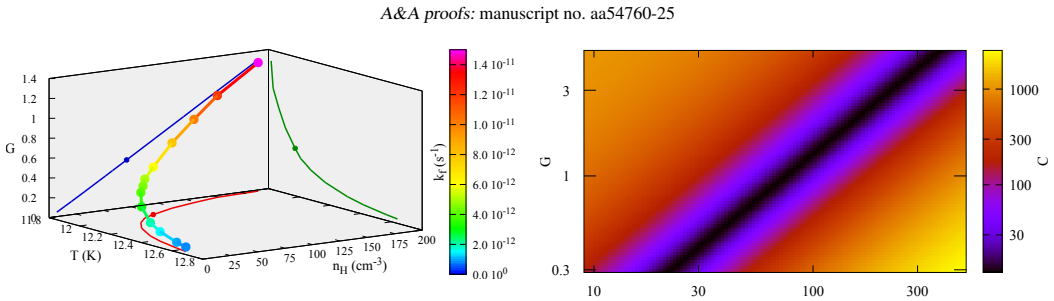
The central claim is that chemical excitation at formation is the only mechanism among those tested that maintains a nearly constant $N_J/g_J$ at high $J$, as newly observed toward Cyg OB2-12. Varying temperature, density, or radiation field strength in the model never produces the observed population of levels above about $J=18$ once only collisions and radiative processes are included. Adding one effective formation rate $k_f$, which feeds all 120 computed levels in proportion to their statistical weights, flattens the high-$J$ ladder and fits the data; the paper reports $k_f \simeq 5.6 \times 10^{-12}\,\mathrm{s^{-1}}$ for Cyg OB2-12 and a similar value for HD 29647. Because $k_f$ does not scale with $n_H$, the high-$J$ observations also break the $n_H/G$ degeneracy that otherwise leaves density and radiation field interchangeable. The authors also re-confirm that the recent H$_2$ collisional rates lower the inferred densities relative to older analyses.
Load-bearing premise
The argument assumes that newly formed C$_2$ molecules are born with populations spread over all rotational levels in proportion to the number of quantum states in each level, and that destruction removes them equally from every level.
Editorial extensions
If this is right
- High-J C$_2$ absorption becomes a practical probe of the chemical formation rate in diffuse clouds, not just an upper-limit nuisance.
- When levels above about $J=16$ are observed, the density-radiation degeneracy is lifted, giving a unique, within the 0D model, set of $T$, $n_H$, $G$, and $k_f$.
- For Cyg OB2-12 the fit favors a low density, $n_H \simeq 24$ cm$^{-3}$ at $G \simeq 0.27$, roughly one-third of the density derived before the updated H$_2$ collision rates.
- Sight lines with only low-$J$ data (up to $J=16$) cannot break the $n_H/G$ degeneracy, so comparisons with older studies that lack high-$J$ levels are inherently ambiguous.
Reading between the lines
- A natural next step is to compute the nascent rotational distribution of C$_2$ from state-resolved dissociative recombination of C$_2$H$^+$; if that distribution differs from statistical weights, the fitted $k_f$ values would need reinterpretation.
- The same formation-excitation logic may apply to other small molecules whose high-$J$ lines are observed in diffuse clouds, such as CN and CH, so a plateau in their weighted populations could be a general signature of chemical pumping rather than a C$_2$ peculiarity.
- Because the 0D model averages over the whole line of sight, a decisive test is to map inferred $k_f$ across sightlines with different chemical ages and radiation fields: if $k_f$ tracks chemical conditions rather than radiative pumping, chemical formation excitation is the right explanation.
Editorial analysis
A structured set of objections, weighed in public.
Referee Report
Summary. The paper constructs a 0D detailed-balance model of interstellar C2 rotational excitation including levels up to J = 34, with updated quadrupole radiative rates, radiative pumping and cascades through the first eight electronic states, collisional rates with para-H2, ortho-H2, and He, and a newly introduced chemical-formation excitation term. It applies the model to new HET/HPF observations of Cyg OB2-12 and HD 29647 and to literature data for HD 24534. The central claim is that the standard balance of collisions, radiative decay, and radiative pumping cannot reproduce the observed near-constant NJ/gJ at high J, and that chemical excitation at formation is the only mechanism that can, with a fitted formation rate kf that also lifts the nH/G degeneracy. The paper closes by cautioning that a 0D model is limited and that a full PDR model is needed.
Significance. If the central claim were established, high-J C2 absorption would become a genuinely new probe of C2 formation chemistry and would break the nH/G degeneracy that hampers standard excitation analyses. The paper contains real strengths: new high-J observations up to J = 32 toward Cyg OB2-12, a 120-level model with modern ExoMol radiative data, explicit treatment of intercombination and cascade processes, and a clearly presented negative result that varying T, nH, and G at kf = 0 cannot flatten the high-J excitation diagram. The fitted kf values being of the same order as rates from the Meudon PDR chemistry is useful consistency evidence. The main weakness is that the flat high-J plateau is not an emergent prediction of the model but is largely imposed by the statistical-weight formation ansatz of Eqs. (5) and (7), so the evidence that C2 is 'born rotationally hot' is weaker than the text suggests. The significance is therefore conditional on reframing the claim and adding sensitivity tests.
major comments (4)
- [Sect. 2.6, Eqs. (5)-(7)] The high-J plateau is imposed by the formation ansatz rather than independently predicted. For high-J levels where collisional and radiative terms in Eq. (1) are negligible compared with Di, the steady-state solution becomes xi ≈ Fi/Di = gi/Σj gj, so xi/gi is constant by construction. Thus the near-constant NJ/gJ at high J seen in Figs. 6, 8, and 11 is a direct restatement of Eq. (5), not an emergent result. The paper calls this a 'zeroth order approximation' but still concludes in Sect. 3.2 that chemical excitation is 'the only mechanism' and in Sect. 6 that C2 is formed rotationally hot. Because kf is fitted to the same high-J data, this is partly a fit. I request an explicit sensitivity test with a family of nascent distributions, e.g., Fi ∝ gi exp(−Ei/T_form), with T_form from 100 K to 3000 K, reporting how the fitted kf and the inferred T, nH, G change and whether the J = 32 point is still matched. Without such a test, the conclusion should be limited to 'some non-collisional, non-radiative source is needed', not 'chemical excitation with a statistical-weight distribution is at work'.
- [Sect. 5.2, Table 1, Fig. 8] The consistency check with the Meudon PDR code validates only the total formation rate kf, not the level-to-level distribution Fi, so it does not test the statistical-weight assumption. The text in Sect. 5.2 states that T and kf are 'well defined' with uncertainties of ±2 K and ±2×10⁻¹² s−1, but these uncertainties are conditional on the assumed source shape. If the true nascent distribution were colder, e.g., peaked near J = 4–8 as in many exothermic reactions, the required kf would change substantially and the derived density and radiation field could shift. I recommend that the paper either provide independent state-resolved formation data or explicitly state in the abstract and conclusions that the inferred kf and physical parameters are model-dependent and specifically tied to the statistical-weight assumption.
- [Sect. 2.2, Fig. 2, Tables A.4-A.5] The collisional de-excitation rates for J > 20 are extrapolations using a simple exponential fit, with no uncertainty estimate. These rates enter the balance between formation and destruction for the high-J levels that define the plateau, so an order-of-magnitude error in them could change the inferred kf and partly mimic or mask a non-statistical formation distribution. I ask for a sensitivity test that multiplies the extrapolated rates by factors of, say, 3 and 1/3 (or 10 and 1/10) for J > 20 and reports the resulting changes in the fitted parameters and in the high-J excitation diagram. If the plateau is robust to such variations, state that explicitly; if not, the uncertainty should be carried into the conclusions.
- [Sect. 3.2 and Appendix C] The claim that no variation of T, nH, or G can reproduce the flat high-J plateau is based on Appendix C, which varies each parameter by only ±20% around a single reference (T = 40 K, nH = 100 cm−3, G = 1). Because the degeneracy nH/G already collapses many low-J solutions, a wider and combined parameter exploration at kf = 0 would strengthen the negative result. As written, the phrase 'the only mechanism' is stronger than what this localized exploration demonstrates. I suggest expanding Appendix C to cover the full plausible parameter range, e.g., T = 10–100 K, nH = 10–1000 cm−3, G = 0.1–10, or explicitly qualifying the conclusion as valid within the tested ranges.
minor comments (6)
- [References] The reference list contains two identical entries for van Dishoeck & Black (1982); one should be removed.
- [Table A.4] The entries '7.8872e−19', '3.7062e−19', and '1.8210e−19' use a different notation from the rest of the table, which writes powers of ten as (−18); the formatting should be made uniform.
- [Fig. 11] The caption 'kf = 0.8-15 10−12 s−1' is ambiguous; it should read 'kf from 0.8 to 15 × 10−12 s−1' (or the equivalent).
- [Sect. 2.5] The pumping rates '4.3 10−9 s−1' and '6.7 10−9 s−1' lack the multiplication symbol and are initially confusing; writing '4.3 × 10⁻⁹ s−1' would improve clarity.
- [Sect. 5.1, Eq. (9)] The text defines τi = σi/xobs_i and then says τi = giσi/xobs_i 'in difficult cases'; the paper should state clearly which definition was used for the fits reported in Table 1 and Figs. 8–13.
- [Footnote 1] The footnote '38 years have passed since the first paper of this series... Never give up hope...' is out of place in a formal A&A manuscript and should be removed or moved to an acknowledgments footnote if the authors wish to keep it.
Circularity Check
The high-J plateau is built into the formation ansatz (Eqs. 5 and 7), and the fitted k_f is then used to 'confirm' chemical excitation; only the k_f=0 failure is independent.
-
self definitional
[Sect. 2.6, Eqs. (5) and (7); Sect. 3.2; Appendix C]
"Fi = k_f g_i / Σ g_j (5) ... So we take simply Di = k_f (in s−1), which ensures that Σ_i x_i D_i = Σ_i F_i (7) ... Then, chemical excitation appears as the only mechanism that allows such a nearly constant ratio NJ/gJ, as observed for high Js. ... Chemical excitation succeeds because the state specific formation rate is assumed to be proportional to the statistical weight gJ = 2J + 1. As deexcitation is roughly the same for all high lying levels, this results in a similar value for NJ/gJ."
For high-J levels where collisional and radiative terms in Eq. (1) are weak, the steady-state solution with Di = k_f and Fi = k_f g_i / Σ g_j reduces to xi ≈ Fi/Di = g_i / Σ g_j, hence xi/gi is constant. The observed near-constant NJ/gJ at high J is therefore not an independent prediction; it is the formation ansatz itself. Appendix C states this reduction explicitly, and Sect. 3.2 then presents the constant ratio as evidence that chemical excitation is 'the only mechanism'. The conclusion is thus supported by a source function defined to produce it, with no independent state-resolved formation data presented.
-
fitted input called prediction
[Sect. 5.1, cost function Eq. (9); Table 1; Sect. 2.6]
"The free parameters are the temperature, T, of the gas, its number density, nH, and a scaling factor, G, for the radiation field intensity. If chemical formation excitation is included, then we must also specify the relevant formation rate, k_f. ... Optimal values for k_f derived below have been checked for consistency with the results from the Meudon PDR code, where the full chemistry is solved, including over 8000 reactions between over 230 species."
The k_f values reported in Table 1 are obtained by minimizing the cost function (Eq. 9) against the same observed high-J column densities (e.g., J up to 32 toward Cyg OB2-12) that define the flat plateau. The subsequent claim that chemical excitation is 'the only mechanism' and that it lifts the nH/G degeneracy presents a fitted input as the explanation of the very data used to fit it. The shape of the plateau is fixed by the assumed gi weighting, while k_f only sets its normalization. The non-circular negative result is that k_f = 0 models fail for high J, showing the standard balance is insufficient, but this does not independently validate the statistical-weight formation law.
full rationale
The molecular-data side of the paper is self-contained and externally sourced: radiative rates come from ExoMol/McKemmish et al. and van Dishoeck & Black, collision rates from Najar & Kalugina and others, all with stated extrapolations. The self-citations (Le Bourlot et al. 1987, 2024) are contextual and not load-bearing. However, the central interpretive claim—that chemical formation-excitation is 'the only mechanism' producing the flat high-J NJ/gJ ratio—is circular in a specific, equation-level sense. Equation (5) sets Fi ∝ gi and Eq. (7) sets Di = k_f, which forces the steady-state high-J solution to have xi/gi ≈ constant, exactly the pattern later cited as confirmation. Appendix C admits the mechanism 'succeeds because the state specific formation rate is assumed to be proportional to the statistical weight'. Moreover, k_f is a free parameter optimized against the same high-J data that exhibit the plateau, so the positive evidence reduces to the ansatz plus a fitted normalization. The independent content is the negative result that k_f = 0 models cannot reproduce the high-J observations; this establishes that the standard collisional/radiative balance is incomplete, but does not establish the proposed formation law. A score of 6 reflects this partial circularity of the central positive claim.
Assumptions & free parameters
free parameters (4)
- k_f (chemical formation excitation rate) =
5.6e-12 s^-1 (Cyg OB2-12); 6e-12 s^-1 (HD 29647, chosen arbitrarily among degenerate fits); 0 (HD 24534)
- T (gas kinetic temperature) =
34.7 K (Cyg OB2-12); 12.0 K (HD 29647); 38.0 K (HD 24534)
- nH (gas density) =
24.1 cm^-3 (Cyg OB2-12); 70.7 cm^-3 (HD 29647); 42.0 cm^-3 (HD 24534)
- G (radiation field scaling) =
0.27 (Cyg OB2-12); 0.48 (HD 29647); 0.7 (HD 24534)
assumptions (7)
- domain assumption Gas is fully molecular: n(H2)=nH/2, He=0.2 n(H2), no H-atom collisions.
- domain assumption Ortho-to-para ratio of H2 is in thermal equilibrium at the gas temperature.
- ad hoc to paper Nascent C2 formed by chemistry is distributed over all 120 modeled levels as Fi = k_f g_i / sum(g_j), and destruction Di = k_f is level independent.
- ad hoc to paper Collisional de-excitation rates of C2 with H2 and He beyond J=20 are extrapolated using a simple exponential fit for Delta J=2, 4, 6, 8.
- domain assumption Electric quadrupole radiative A coefficients above J=20 follow the J^5 scaling of the high-J limit.
- domain assumption The ambient interstellar radiation field is the Mathis et al. (1983) field scaled by G, with CMB added at millimeter wavelengths.
- domain assumption ExoMol radiative data (McKemmish et al. 2020) and the added Mulliken system data are accurate enough for cascade coefficients.
Cite this review
Pith. "Pith review of Rotational equilibrium of C$_2$ in diffuse interstellar clouds." pith.science (2026). https://pith.science/paper/EZ5LH66J
@misc{pith2026250521273,
  author       = {Pith},
  title        = {Pith review of: Rotational equilibrium of C$_2$ in diffuse interstellar clouds},
  year         = {2026},
  howpublished = {\url{https://pith.science/paper/EZ5LH66J}},
  note         = {Machine review of arXiv:2505.21273}
}
abstract
Context. Recent spectroscopic measurements have revealed absorption from higher rotational levels in C$_2$ than previous observations. These improvements are accompanied by the availability of updated radiative and collisional data. Aims. We revisit the density and radiation field intensity diagnostics provided by the observations of many rotational levels of inter- stellar C$_2$ and extensive molecular information. Methods. We built an excitation model of C2 without spatial structure, including levels up to J= 34 where updated radiative and collisional excitation data are introduced as well as excitation by chemical formation. Results. We confirm the importance of the recent collisional excitation rate coefficients of C$_2$ by molecular H$_2$. We show that the new higher level observations cannot be explained by the standard balance between collisional excitation and radiative transitions. We propose that chemical excitation at formation provides a plausible mechanism to explain the observed high excitation of C$_2$. In addition, it allows us to lift the degeneracy of the density over radiation field strength parameter in the excitation model. Conclusions. A 0D model remains limited and it is highly desirable to use a full Photon Dominated Region (PDR) model, which includes all excitation processes introduced here and full chemical and thermal balance.
Figures


Figures from the paper (8 more)



Reference graph
Works this paper leans on
- [1]
-
[2]
Chabot , M., B \'e roff , K., Gratier , P., Jallat , A., & Wakelam , V. 2013, , 771, 90
work page 2013
-
[3]
Chauville , J., Maillard , J. P., & Mantz , A. W. 1977, Journal of Molecular Spectroscopy, 68, 399
work page 1977
-
[4]
Fan , H., Rocha , C. M. R., Cordiner , M., et al. 2024, , 681, A6
work page 2024
-
[5]
Federman , S. R., Rice , J. S., Ritchey , A. M., et al. 2021, ApJ, 914, 59
work page 2021
-
[6]
Florescu-Mitchell , A. I. & Mitchell , J. B. A. 2006, , 430, 277
work page 2006
- [7]
-
[8]
C., Sheffer , Y., & Federman , S
Hupe , R. C., Sheffer , Y., & Federman , S. R. 2012, , 761, 38
work page 2012
Show all 33 references
-
[9]
A., Fr \'e reux , J
Krechkivska , O., Welsh , B. A., Fr \'e reux , J. N., et al. 2018, Journal of Molecular Spectroscopy, 344, 1
2018
-
[10]
L., Sheffer , Y., & Federman , S
Lambert , D. L., Sheffer , Y., & Federman , S. R. 1995, , 438, 740
1995
-
[11]
& Roueff , E
Le Bourlot , J. & Roueff , E. 1986, Journal of Molecular Spectroscopy, 120, 157
1986
-
[12]
2024, Molecular Physics, 122, e2182612
Le Bourlot , J., Roueff , E., Le Petit , F., et al. 2024, Molecular Physics, 122, e2182612
2024
-
[13]
1987, , 188, 137
Le Bourlot , J., Roueff , E., & Viala , Y. 1987, , 188, 137
1987
-
[14]
2018, in Ground-based and Airborne Instrumentation for Astronomy VII, ed
Mahadevan, S., Anderson, T., Balderrama, E., et al. 2018, in Ground-based and Airborne Instrumentation for Astronomy VII, ed. C. J. Evans, L. Simard, & H. Takami, Vol. 10702, International Society for Optics and Photonics (SPIE), 1070214
2018
-
[15]
W., Terrien , R., et al
Mahadevan , S., Ramsey , L. W., Terrien , R., et al. 2014, in Society of Photo-Optical Instrumentation Engineers (SPIE) Conference Series, Vol. 9147, Ground-based and Airborne Instrumentation for Astronomy V, ed. S. K. Ramsay , I. S. McLean , & H. Takami , 91471G
2014
-
[16]
S., Mezger , P
Mathis , J. S., Mezger , P. G., & Panagia , N. 1983, , 128, 212
1983
-
[17]
K., Syme , A.-M., Borsovszky , J., et al
McKemmish , L. K., Syme , A.-M., Borsovszky , J., et al. 2020, MNRAS, 497, 1081
2020
-
[18]
Morton , D. C. 2003, , 149, 205
2003
-
[19]
2008, Chemical Physics Letters, 460, 31
Najar , F., Ben Abdallah , D., Jaidane , N., & Ben Lakhdar , Z. 2008, Chemical Physics Letters, 460, 31
2008
-
[20]
& Kalugina, Y
Najar, F. & Kalugina, Y. 2020, RSC Adv., 10, 8580
2020
-
[21]
A., Welty , D
Neufeld , D. A., Welty , D. E., Ivlev , A. V., et al. 2024, , 973, 143
2024
-
[22]
2022, Chemical Physics Letters, 798, 139623
Ritika & Dhilip Kumar , T. 2022, Chemical Physics Letters, 798, 139623
2022
-
[23]
Schmidt , T. W. & Bacskay , G. B. 2007, , 127, 234310
2007
-
[24]
R., et al
Sheffer , Y., Rogers , M., Federman , S. R., et al. 2008, ApJ, 687, 1075
2008
-
[25]
M., Danforth , C
Shull , J. M., Danforth , C. W., & Anderson , K. L. 2021, , 911, 55
2021
-
[26]
P., Hanson , M
Snow , T. P., Hanson , M. M., Black , J. H., et al. 1998, , 496, L113
1998
-
[27]
E., Thorburn , J
Sonnentrucker , P., Welty , D. E., Thorburn , J. A., & York , D. G. 2007, , 168, 58
2007
-
[28]
Souza , S. P. & Lutz , B. L. 1977, , 216, L49
1977
-
[29]
Van Dishoeck , E. F. & Black , J. H. 1982, ApJ, 258, 533
1982
-
[30]
van Dishoeck , E. F. & Black , J. H. 1982, ApJ, 258, 533
1982
-
[31]
N., Szab \'o , I., Pyatenko , E., & Tennyson , J
Yurchenko , S. N., Szab \'o , I., Pyatenko , E., & Tennyson , J. 2018, , 480, 3397
2018
-
[32]
, " * write output.state after.block = add.period write newline
ENTRY address archiveprefix author booktitle chapter edition editor howpublished institution eprint journal key month note number organization pages publisher school series title type volume year label extra.label sort.label short.list INTEGERS output.state before.all mid.sent...
-
[33]
write newline
" write newline "" before.all 'output.state := FUNCTION n.dashify 't := "" t empty not t #1 #1 substring "-" = t #1 #2 substring "--" = not "--" * t #2 global.max substring 't := t #1 #1 substring "-" = "-" * t #2 global.max substring 't := while if t #1 #1 substring * t #2 gl...
Reviewed August 7, 2026 · model on record in the stance chip above.
Discussion (0). Sign in to comment.