REVIEW 1 major objections 4 minor 22 references
A numerical toolkit for multiprojective varieties
T0 review · 1 major / 4 minor · reviewed 2026-08-14 · deepseek-v4-flash
Pith's one-line read The paper develops a numerical toolkit that reduces irreducible decomposition of multiprojective varieties to monodromy and a trace test on an affine curve.
desk verdict Solid multiprojective numerical-algebraic toolkit with a real application win, but the central decomposition algorithm has a dimensional bug in Step (7) and relies on acknowledged heuristics. read the letter →
The pith
A machine-rendered reading of the paper's core claim, the machinery that carries it, and where it could break.
The reading
What carries the argument
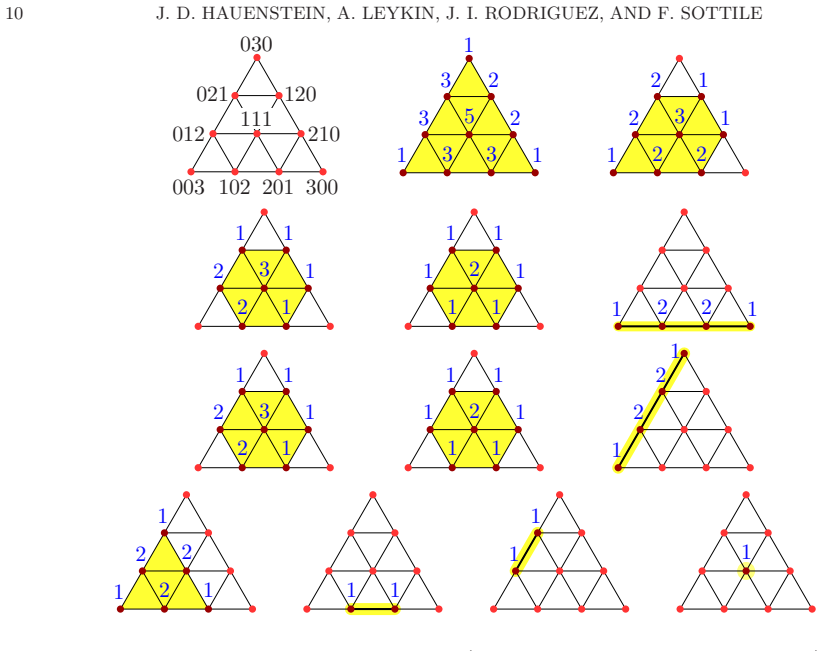
The load-bearing object is the witness collection, the map $e \mapsto (F, L_e, X \cap V(L_e))$ over the support $\operatorname{Dim}(X) \subseteq \prod_i \{0,\dots,n_i\}$, where the support plays the role of dimension and the entries of the multidegree play the role of degree. The support is a polymatroid polytope, and Proposition 2.1 describes it by the inequalities $e_{i_1}+\cdots+e_{i_s} \le \dim_I(X)$ for all subsets $I$ of factors, which Algorithm 2.3 computes from the rank of Jacobian submatrices. The action is carried by three mechanisms: monodromy, which completes a partial witness set by tracking points as the linear section moves in loops; the refining and coarsening homotopies of Section 4, which move between multilinear and bilinear sections and thereby change the multiprojective structure; and slicing, which replaces $\operatorname{Dim}(X)$ by $\{e-\epsilon_i : e \in \operatorname{Dim}(X), e_i>0\}$ and preserves (ir)reducibility when the $i$-th projection has dimension at least two. Algorithm 6.2 uses these mechanisms to pass from an arbitrary point to an affine curve whose witness set is complete, then applies the trace test.
What would settle it
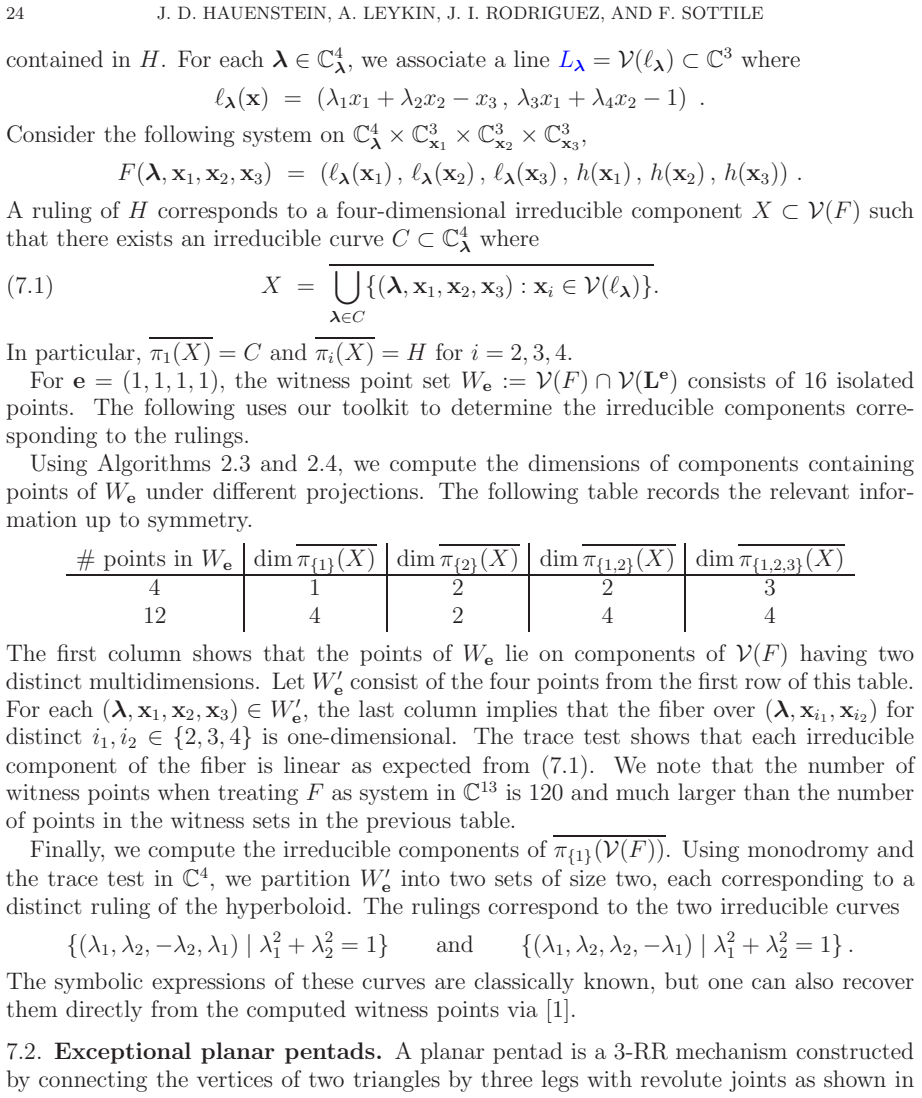
Run Algorithm 6.2 on the hyperboloid fiber-product system of Section 7.1 starting from the 16-point witness set, and compare the two recovered ruling curves with the symbolic equations $\{(\lambda_1,\lambda_2,-\lambda_2,\lambda_1): \lambda_1^2+\lambda_2^2=1\}$ and $\{(\lambda_1,\lambda_2,\lambda_2,-\lambda_1): \lambda_1^2+\lambda_2^2=1\}$; any mismatch in the partition or in the recovered curve equations would show the reduction to curve trace test fails in a concrete instance.
Extended reading notes
Core claim
The central claim is that the extra structure of a multiprojective variety can be made algorithmic. A variety $X \subset \mathbb{P}^{n_1} \times \cdots \times \mathbb{P}^{n_k}$ is represented by a witness collection, which assigns to each $e \in \operatorname{Dim}(X)$ the isolated points of $X \cap V(L_e)$, with $L_e$ a general linear section of multidegree $e$. The support $\operatorname{Dim}(X)$ is characterized by projection inequalities (Proposition 2.1) and is computed locally from Jacobian ranks. From one general smooth point, monodromy completes a partial witness collection; the toolkit then recognizes when $\operatorname{Dim}(X)$ factors as a product of polymatroid polytopes, which is exactly when $X$ is a Cartesian product, and it transforms witness collections under reparameterizations that refine or coarsen the product structure and under slicing by a linear form. Slicing preserves irreducibility whenever the projection to that factor has dimension at least two, so repeated slicing and coarsening reduce an irreducible component to an affine curve $\mathcal{C}_L$; a complete witness set for that curve is obtained by monodromy with the trace test as stopping criterion, and that witness set yields a membership test that sorts all input points into components. This is the content of Algorithm 6.2.
Load-bearing premise
The whole decomposition rests on the assumption that monodromy, run with the trace test as a stopping rule, actually finds every point of the curve witness set and recognizes when a subset is a complete witness set; the paper itself notes that the completion step has no guaranteed stopping criterion and the trace test is a heuristic.
Editorial extensions
If this is right
- For any multiprojective variety, numerical irreducible decomposition can be performed without computing the Segre embedding, avoiding the drastic growth in ambient dimension and degree that the embedding causes.
- The trace test, previously limited to curves in products of two projective spaces, now serves as a stopping criterion for decomposing varieties with any number of projective factors.
- A witness collection for a slice $X \cap V(\ell)$ is obtained from a witness collection for $X$ by shifting the support: $\operatorname{Dim}$ loses the vectors with $e_i = 0$, and the multidegree is read off from the original collection.
- When $\operatorname{Dim}(X)$ factors as a product of polymatroid polytopes, $X$ itself is a Cartesian product and its witness collections factor, so membership can be tested in each factor separately.
- The same machinery partitions arbitrary finite sets of general smooth points on $V(F)$, not just points that already lie in a witness collection.
Reading between the lines
- Inference: the cost of the curve reduction depends on the order and type of slices and coarsenings chosen; the paper leaves the search for the minimal-degree reduction open, so an automatic strategy that minimizes the final curve degree would make the toolkit independently useful.
- Inference: the local computation of $\operatorname{Dim}(X)$ via projections is a numerical computation of the algebraic matroid of the variety, so the toolkit gives a practical way to extract matroid bases from a witness collection.
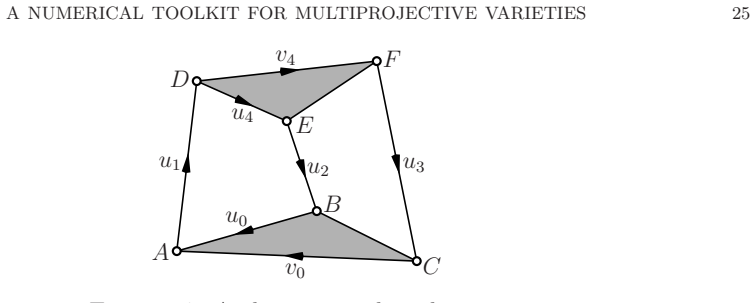
- Inference: for fiber-product systems like the exceptional pentad, the same reduction could be used to certify exceptional components directly from one witness point, without ever forming the full witness collection in the high-dimensional ambient space.
- Inference: a testable extension is to feed points from a long homotopy run into the membership test of Algorithm 6.2 incrementally, classifying them online instead of first collecting a full witness set.
Signed reviews
Editorial analysis
A structured set of objections, weighed in public.
Referee Report
Summary. The paper develops a numerical toolkit for manipulating multiprojective (and multiaffine) varieties, extending prior work by the same authors. The main ingredients are: computing the (multi)dimension of an irreducible component from a smooth point via Jacobian ranks (Algorithm 2.3); completing a partial witness collection by monodromy (Algorithm 2.5); detecting Cartesian product structure from the polymatroid polytope of the multidimension (Theorem 3.1); transforming witness collections under refinement and coarsening of the multiprojective structure (Algorithms 4.3 and 4.5); and slicing with linear forms while controlling dimension, degree, and irreducibility (Lemma 5.1, Algorithm 5.3). These tools are assembled into Algorithm 6.2, which aims to partition an arbitrary finite set of general smooth points on a multiprojective variety according to the irreducible components, by reducing each component to an affine curve and using monodromy plus a trace test. The paper includes worked examples, including a Richardson variety, fiber-product systems for hyperboloid rulings, and exceptional planar pentads.
Significance. If correct, the paper would provide a practical and conceptually clean way to perform numerical irreducible decomposition for multiprojective varieties without passing to a large Segre embedding, extending the curve-based trace test of [10] to arbitrarily many projective factors. The geometric statements (Theorem 3.1, Lemma 5.1, Propositions 4.2) are proved against standard algebraic geometry, and the examples show genuine computational savings (e.g., 16 witness points versus 120 in the hyperboloid example, and 14,828 versus roughly 10^8 in the pentad example). The paper is transparent about the heuristic nature of the trace test and about the lack of a stopping criterion in Algorithm 2.5. However, the central decomposition algorithm contains a concrete dimensional inconsistency in its Step (7), and its completeness relies on unproven heuristics; these issues must be addressed before the algorithmic claims can be accepted.
major comments (1)
- [Section 2.2 and Section 6.2] Algorithm 6.2 invokes Algorithm 2.5 in Step (7) to compute a witness set for CL, but the proof of correctness of Algorithm 2.5 explicitly states that it "does not have a stopping criterion, and is therefore technically not an algorithm." Moreover, the trace test is described in Section 1.2 as a "heuristic stopping criterion for monodromy break up." Consequently, the partition output by Algorithm 6.2 is not certified: if monodromy fails to discover all points of CL, or if the trace test accepts an incomplete partition, the membership test in Step (8) may misclassify points, and the output N may merge or miss irreducible components. The paper should either supply a termination and completeness argument under explicit genericity assumptions or clearly label Algorithm 6.2 as a heuristic procedure, separate from the proven geometric statements in Sections 3–5.
minor comments (4)
- [Sections 4.1 and 4.2] The notation "Y /integerdivideV(Λ)" appears several times and should be the set difference "Y \ V(Λ)" or "Y ∖ V(Λ)"; the current rendering obscures the intended meaning.
- [Section 6.2, Step (3)] There is a typo: "irredicubility" should be "irreducibility." Also, "coordinatewise maximal integer vector" should be defined explicitly (e.g., maximal with respect to the product order on [n•]).
- [Section 2.1, Equation (2.1)] The symbol e is used both for the intrinsic dimension of X and for an element of [n•], leading to the confusing expression {e ∈ [n•] | |e| = e}. Please rename one of them (e.g., use d for the intrinsic dimension).
- [Section 7.2] The line "u0 + u1 + u2 + u4 = u0 + u1 + u2 + u4 = v0 + u1 + u3 + v4 = v0 + u1 + u3 + v4 = 0" is ambiguous; it should be written as four separate equations so that the distinct variables u and u, and v0 and v0, are clearly handled.
Circularity Check
No significant circularity: the toolkit's constructions are proved from independent geometric facts (Bertini, Segre degree formula, monodromy), and self-citations [6,10] supply definitions and a trace-test criterion rather than the target decomposition.
full rationale
The paper's derivation chain runs from witness collections (Section 1.3) through dimension computation (Section 2.1), monodromy completion (Section 2.2), product detection (Section 3), refining/coarsening (Section 4), slicing (Section 5), and finally the decomposition algorithm (Section 6). Each constructive step is justified by independent mathematics: Proposition 2.1 is cited to Castillo, Li, and Zhang [2]; Lemma 5.1 uses Bertini's theorem [9]; Algorithm 4.5's correctness uses the Segre-degree formula (1.2) from Harris [5]; and monodromy completion is cited to Duff et al. [3]. The trace test is cited both to the authors' [10] and to Sommese, Verschelde, and Wampler [19], and the paper itself calls it 'a heuristic stopping criterion for monodromy break up' (Section 1.2), meaning a numerical termination test whose mathematical criterion is a theorem about collinearity of averages, not an assumed decomposition. The paper's explicit caveats -- Algorithm 2.5 'does not have a stopping criterion, and is therefore technically not an algorithm' (Section 2.2) and 'a witness set produced by Algorithm 4.5 is incomplete' (Remark 6.3) -- are honest limitations, not inputs disguised as outputs. The numerical examples recover known classifications (hyperboloid rulings, exceptional planar pentads) rather than fitting parameters. The Step (7) cardinality issue noted by a reviewer is an internal inconsistency in the printed algorithm, not a circular reduction: it concerns whether CL as written is a curve, not whether the claim is assumed as an input. No step in the derivation is equivalent by construction to its own input; self-citations transfer definitions and prior theorems, but the present results are proven from them, not identified with them.
Assumptions & free parameters
assumptions (6)
- standard math Bertini's theorem: general linear sections preserve irreducibility in dimension at least 2 and are transverse when the section dimension matches the variety dimension.
- standard math The support characterization Dim(Y) = {e : |e| = dim(Y) and inequality (2.2) holds for all proper subsets I} of Castillo-Li-Zhang [2, Thm 1.1].
- standard math Standard theory of numerical homotopy continuation: tracked arcs end at the intended solutions and diverging paths can be detected.
- standard math The trace test correctly certifies that a subset of a witness point set is a witness point set of an irreducible component.
- domain assumption Input points are general smooth points: they lie on a unique irreducible component and are regular for the projections pi_I, so the Jacobian ranks computed in Algorithm 2.3 equal the local dimensions.
- domain assumption In Algorithm 6.2 Step (5), the support positions can be ordered so that dim pi_{i1,...,ij}(Xp) = j for each prefix.
Cite this review
Pith. "Pith review of A numerical toolkit for multiprojective varieties." pith.science (2026). https://pith.science/paper/EZUSEIJT
@misc{pith2026190800899,
  author       = {Pith},
  title        = {Pith review of: A numerical toolkit for multiprojective varieties},
  year         = {2026},
  howpublished = {\url{https://pith.science/paper/EZUSEIJT}},
  note         = {Machine review of arXiv:1908.00899}
}
read the original abstract
A numerical description of an algebraic subvariety of projective space is given by a general linear section, called a witness set. For a subvariety of a product of projective spaces (a multiprojective variety), the corresponding numerical description is given by a witness collection, whose structure is more involved. We build on recent work to develop a toolkit for the numerical manipulation of multiprojective varieties that operates on witness collections, and use this toolkit in an algorithm for numerical irreducible decomposition of multiprojective varieties. The toolkit and decomposition algorithm are illustrated throughout in a series of examples.
Figures


Figures from the paper (2 more)
Reference graph
Works this paper leans on
-
[10]
A. Leykin, J.I. Rodriguez, and F. Sottile, Trace test, Arnold Mathematical Journal 4 (2018), no. 1, 113–125
work page 2018
-
[1]
D.J. Bates, J.D. Hauenstein, T.M. McCoy, C. Peterson, and A.J. S ommese, Recovering exact results from inexact numerical data in algebraic geometry , Experimental Mathematics, 22 (2013), 38–50
work page 2013
-
[2]
Representable Chow classes of a product of projective spaces
F. Castillo, B. Li, and N. Zhang, Representable Chow classes of a product of projective space s, arXiv:1612.00154, 2016. A NUMERICAL TOOLKIT FOR MULTIPROJECTIVE V ARIETIES 27
work page Pith review arXiv 2016
-
[3]
T. Duff, C. Hill, A. Jensen, K. Lee, A. Leykin, and J. Sommars, Solving polynomial systems via homotopy continuation and monodromy , IMA Journal of Numerical Analysis 39 (2018), no. 3, 1421– 1446
work page 2018
-
[4]
Fulton, Intersection theory, Ergebnisse der Math., no
W. Fulton, Intersection theory, Ergebnisse der Math., no. 2, Springer-Verlag, 1984
work page 1984
-
[5]
Harris, Algebraic geometry, Graduate Texts in Mathematics, vol
J. Harris, Algebraic geometry, Graduate Texts in Mathematics, vol. 133, Springer-Verlag, New Y ork, 1992
work page 1992
-
[6]
J.D. Hauenstein and J.I. Rodriguez, Multiprojective witness sets and a trace test , Advances in Ge- ometry, to appear
-
[7]
J.D. Hauenstein, S.N. Sherman, and C.W. Wampler, Exceptional Stewart-Gough platforms, Segre embeddings, and the special Euclidean group , SIAM J. Appl. Algebra Geom. 2 (2018), no. 1, 179– 205
work page 2018
Show all 22 references
-
[8]
Hauenstein, A.J
J.D. Hauenstein, A.J. Sommese, and C.W. Wampler, Regeneration homotopies for solving systems of polynomials, Math. Comp. 80 (2011), no. 273, 345–377
2011
-
[9]
Jouanolou, Th´ eor` emes de Bertini et applications, Progress in Mathematics, vol
J.-P. Jouanolou, Th´ eor` emes de Bertini et applications, Progress in Mathematics, vol. 42, Birkh¨ auser Boston, Inc., Boston, MA, 1983
1983
-
[11]
Miller and B
E. Miller and B. Sturmfels, Combinatorial commutative algebra , Graduate Texts in Mathematics, vol. 227, Springer-Verlag, New York, 2005
2005
-
[12]
Morgan, Solving polynomial systems using continuation for enginee ring and scientific problems , Classics in Applied Mathematics, vol
A. Morgan, Solving polynomial systems using continuation for enginee ring and scientific problems , Classics in Applied Mathematics, vol. 57, SIAM, Philadelphia, PA, 2009
2009
-
[13]
Morgan and A
A. Morgan and A. Sommese, A homotopy for solving general polynomial systems that resp ects m- homogeneous structures, Appl. Math. Comput. 24 (1987), no. 2, 101–113
1987
-
[14]
Oxley, Matroid theory, second ed., Oxford Graduate Texts in Mathematics, vol
J. Oxley, Matroid theory, second ed., Oxford Graduate Texts in Mathematics, vol. 21, Oxfo rd Uni- versity Press, Oxford, 2011
2011
-
[15]
Postnikov, Permutohedra, associahedra, and beyond , Int
A. Postnikov, Permutohedra, associahedra, and beyond , Int. Math. Res. Not. IMRN (2009), no. 6, 1026–1106
2009
-
[16]
Sommese and J
A.J. Sommese and J. Verschelde, Numerical homotopies to compute generic points on positive di- mensional algebraic sets , J. Complexity 16 (2000), no. 3, 572–602
2000
-
[17]
Sommese, J
A.J. Sommese, J. Verschelde, and C.W. Wampler, Numerical decomposition of the solution sets of polynomial systems into irreducible components , SIAM J. Numer. Anal. 38 (2001), no. 6, 2022–2046
2001
-
[18]
, Using monodromy to decompose solution sets of polynomial sy stems into irreducible compo- nents, Applications of algebraic geometry to coding theory, physics and c omputation (Eilat, 2001), NATO Sci. Ser. II Math. Phys. Chem., vol. 36, Kluwer Acad. Publ., Dor drecht, 2001, p...
2001
-
[19]
, Symmetric functions applied to decomposing solution sets o f polynomial systems , SIAM J. Numer. Anal. 40 (2002), no. 6, 2026–2046
2002
-
[20]
Sommese and C.W
A.J. Sommese and C.W. Wampler, The numerical solution of systems of polynomials , World Scientific Publishing Co. Pte. Ltd., Hackensack, NJ, 2005
2005
-
[21]
, Exceptional sets and fiber products , Found. Comput. Math. 8 (2008), no. 2, 171–196
2008
-
[22]
Wampler and A.J
C.W. Wampler and A.J. Sommese, Numerical algebraic geometry and algebraic kinematics , Acta Numer. 20 (2011), 469–567. 28 J. D. HAUENSTEIN, A. LEYKIN, J. I. RODRIGUEZ, AND F. SOTTIL E Department of Applied & Computational Mathematics & Statis tics, University of Notre Dame, No...
2011
Reviewed August 14, 2026 · model on record in the stance chip above.
Discussion (0). Continue with ORCID to comment.