REVIEW 4 major objections 5 minor 56 references
A Time-Series Model for Areal Data Using Spatially Correlated Gaussian Processes
T0 review · 4 major / 5 minor · reviewed 2026-08-05 · deepseek-v4-flash
Pith's one-line read A region-by-region Gaussian-process model with spatially correlated variances claims better forecasts and tighter uncertainty for areal time series than standard spatio-temporal models.
desk verdict A novel GP-time-series model for areal data, but the empirical case for spatial correlation is undermined by an unmatched MLE vs Bayesian comparison. read the letter →
The pith
A machine-rendered reading of the paper's core claim, the machinery that carries it, and where it could break.
The reading
What carries the argument
The key object is the region-specific Gaussian process Z_it with Matérn covariance γ_i(h) = σ_i² ρ_i(h; φ_i). Spatial dependence is induced by a CAR prior on log(σ_i²) and by the conditional prior log(φ_i) | log(σ_i²) ~ N(µ(log σ_i²), χ²), where µ is estimated from separate maximum-likelihood GP fits per region. This variance–range link is what turns spatially similar variability into spatially similar temporal correlation. Posterior inference is carried out with a hybrid MCMC sampler that updates the variance and range parameters with MALA, the signal-to-noise ratio with Metropolis–Hastings, and regression coefficients and GP effects with Gibbs steps.
What would settle it
Simulate areal data under the null hypothesis that the regions' Gaussian processes are independent, with no spatial correlation in the true generating process, then fit the proposed model and the independent-GP benchmark on identical training/test splits; if the proposed model still reports lower CRPS or narrower credible intervals in most regions, the claimed benefit is an artifact of the empirical variance–range prior rather than genuine spatial borrowing.
Extended reading notes
Core claim
The central claim is that spatial structure can enter a spatio-temporal model through the parameters of region-specific Gaussian processes rather than through random effects added to a shared linear predictor. The authors specify each region's temporal process with a Matérn covariance and put a CAR prior on the log variances; the log temporal range is then modeled conditionally on the log variance, with the prior mean fixed from the empirical variance–range relationship estimated from independent single-region fits. This construction is intended to let nearby regions share information about variability and temporal correlation while preserving each region's own trend. The paper reports that
Load-bearing premise
The load-bearing premise is that the empirical relationship between temporal variance and temporal range, estimated from the same data by fitting each region separately, is a reliable guide for the joint model; if that relationship is noise or does not transfer, the spatial component is mis-specified and the forecast gains could be an artifact of using the data twice.
Editorial extensions
If this is right
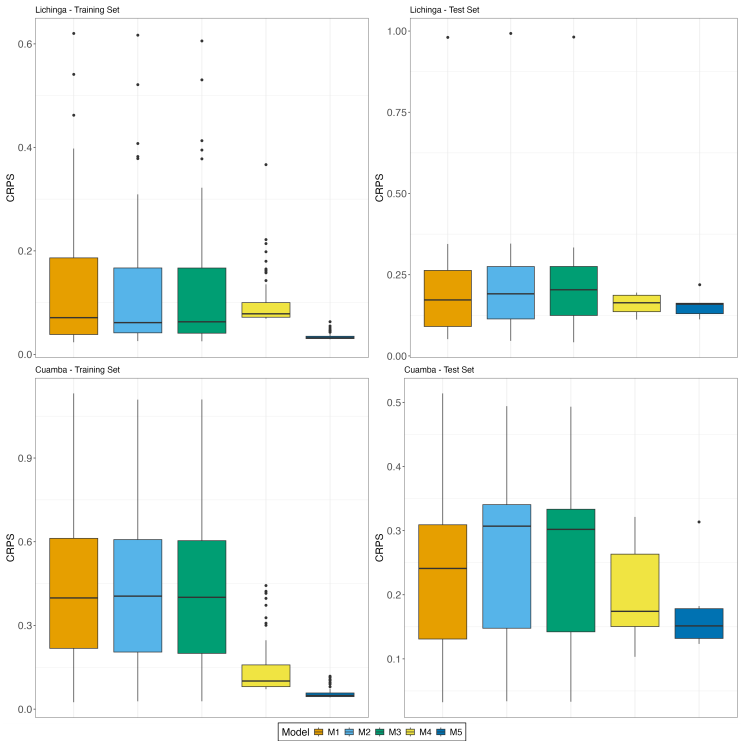
- In both applications, the proposed model achieves the lowest median CRPS across most districts or regions in training and remains among the best-performing models in out-of-sample forecasting.
- The model produces narrow in-sample credible intervals and generally high empirical coverage out-of-sample, which supports reliable uncertainty quantification in sparse-data settings.
- Because it preserves region-specific temporal dynamics while borrowing strength from neighboring areas, it addresses a known limitation of spatio-temporal models that impose common temporal trends.
- The framework is built on Gaussian processes with a flexible mean specification, so it can be adapted to other areal time-series settings with seasonal patterns, covariates, or non-Gaussian responses.
- The authors identify computational cost as the main current bottleneck and point to extensions for larger spatial domains and more scalable implementations.
Reading between the lines
- The empirical variance–range prior acts as a built-in shrinkage device: when the true relationship between σ² and φ is weak or noisy, the model should behave much like independent GPs, so the reported gains may be concentrated where this relationship is strong—an easily testable stratification of the results.
- The same construction could be applied to other GP hyperparameters, such as smoothness or covariate coefficients, to induce spatial structure through different aspects of the temporal process rather than only variance and range.
- Because training-set empirical coverage is often near 1.00, the model's credible intervals may be conservative; applications that need sharp early-warning signals may require post-hoc calibration despite good CRPS.
- A natural extension would be to replace the fixed empirical prior mean with a prior that fully accounts for uncertainty in the estimated σ²–φ relationship, which would reveal whether the forecast gains survive without double-use of the data.
Editorial analysis
A structured set of objections, weighed in public.
Referee Report
Summary. The paper proposes a hierarchical spatio-temporal model for areal data in which each region has its own Gaussian-process time-series component, and spatial dependence is induced by a CAR prior on the log temporal variances together with a conditional prior for the log temporal range given the log variance. The mean and variance of that conditional prior, as well as the prior mean for the log signal-to-noise ratio, are calibrated from independent region-specific GP fits on the same data. The model is applied to monthly malaria incidence in Niassa, Mozambique, and weekly food insecurity prevalence in Cameroon, and compared with four benchmarks: Knorr-Held (2000), two Rushworth et al. (2014) variants, and an independent GP model. The central claim is that the proposed model has strong in-sample performance with narrow credible intervals and outperforms established spatio-temporal approaches in many regions when forecasting.
Significance. If the modeling claims are established, the paper offers a useful alternative to standard ST models: it allows region-specific temporal dynamics while borrowing strength across neighbouring areas through the variance/range structure, and it is interpretable for applied users. The authors provide a substantial empirical evaluation, make results available through an interactive Shiny tool, and document computation and convergence diagnostics. However, the strength of the evidence depends on whether the spatial-correlation component is isolated from other modeling choices and whether the data-calibrated priors are handled transparently. These issues are load-bearing because the abstract and Section 5.1 attribute forecasting gains specifically to the spatially correlated Gaussian-process mechanism.
major comments (4)
- [Section 4.3.1 and Section 5.1] The key comparison for the central claim is between M4 (independent GP) and M5 (spatially correlated GP), but M4 is estimated by maximum likelihood using PrevMap, while M5 is estimated by full Bayesian MCMC with informative priors. This conflates model structure with inference paradigm: MLE plug-in predictive distributions ignore parameter uncertainty, which can inflate CRPS and deflate ECP relative to a Bayesian M4. Since Figures 4 and 7 show M4 and M5 CRPS are very close in many districts/regions, the reported advantage of M5 cannot be attributed to the spatial correlation without a matched Bayesian independent GP baseline or a no-spatial version of M5 using the same sampler and priors. This control is necessary to support the abstract's claim of outperforming established spatio-temporal approaches.
- [Section 4, after Eq. (4), and final paragraph of Section 4] The prior for log(phi_i) is specified as N(mu(log(sigma^2_i)), chi^2), where mu is derived from the empirical relationship between log(phi_i) and log(sigma^2_i) estimated from district-specific MLE fits on the same training data; the prior mean for log(nu^2_i) is also calibrated from those fits. This is a double use of data: the spatial structure of the range is partly determined by the same observations used for fitting. Because the hyperparameters are fixed rather than given a full hierarchical prior or a sensitivity analysis, the credible intervals reported for M5 are conditional on data-dependent priors. The authors should provide either a proper hierarchical treatment of these hyperparameters or a sensitivity analysis under alternative prior means/variances, otherwise the spatial-borrowing contribution may be an artifact of empirical-Bayes calibration.
- [Tables 1 and 2] The ECP results are not evidence of good uncertainty calibration in the claimed sense. In the training set, M5 has ECP equal to 1.00 in nearly every district/region, and in the test set many entries are also 1.00. With only 7 (malaria) or 9 (Cameroon) test time points, ECP has very low resolution, but training ECP = 1.00 indicates intervals that are systematically too wide. The abstract's phrase 'narrow credible intervals' is therefore not supported by the reported ECP alone. The authors should report interval widths or use a strictly proper scoring rule that directly penalizes width; the Discussion's acknowledgment that ECP = 1 'may indicate overly wide credible intervals' is not sufficient to dismiss this concern.
- [Section 6, Limitations] The paper states that 'we observed occasional weak convergence for parameters such as the temporal ranges and variances of the GPs' and that these parameters 'may not be fully identifiable.' These are precisely the parameters that carry the spatial mechanism (CAR on log sigma^2 and the conditional prior on log phi). If the temporal range and variance are not identifiable or converge poorly, the claim that spatial correlation in these parameters improves prediction is weakened. The authors should report convergence and mixing diagnostics for all regions/districts, not only four units in the Supplementary Material, and discuss the practical consequences of partial identifiability for the spatial-borrowing interpretation.
minor comments (5)
- [Equation (4)] The correlation function is written as rho(h) without the region index, although Eq. (3) uses rho_i(h). Add the subscript for consistency.
- [Section 4, priors paragraph] The prior is stated as log(beta_i) ~ N_{p+1}(0, 10^5 I_{p+1}). Since the model in Eqs. (5) and (6) includes Fourier coefficients that can plausibly be negative, a prior on the log of beta_i is either a typo or a substantive restriction. If it is a typo, correct it; if intended, explain why coefficients are constrained to be positive.
- [Abstract and Section 5.1] The phrase 'narrow credible intervals' is used repeatedly, but no numerical interval widths are reported. Given the near-universal ECP of 1.00 for M5, the authors should quantify actual interval widths or temper the wording.
- [Section 5.1 and 5.2] The test-set ECP values are based on only 7 or 9 time points. This should be stated prominently when interpreting Table 1 and Table 2, because values such as 0.00 or 1.00 are coarse and should not be over-read.
- [Figure captions] Minor typos: 'T op panel' in the captions of Figures 1 and 2; also 'the the' appears in the Discussion sentence about the model's ability to smooth over time.
Circularity Check
No significant circularity: the empirical prior uses training data, but out-of-sample forecasting is genuinely held out and benchmarked externally.
full rationale
The paper's central derivation is a hierarchical GP model with a CAR prior on log-variance and a conditional prior on log-range. The mean of the conditional prior is calibrated from independent district-specific MLEs on the same training data (Section 4: 'we use the region-specific estimates of log(σ2_i), log(ϕ_i) and log(ν2_i) from these models to calibrate the mean components of the prior distributions'). This is a form of empirical Bayes double-use of training data, but it does not make the out-of-sample forecasting claim circular: the test set is held out, and the posterior for log(ϕ_i) is not set equal to the fitted regression but is shrunk toward it with an estimated variance. The performance comparison is against external benchmarks implemented in CARBayesST and PrevMap, and the paper openly reports that M4 and M5 median CRPS are similar in many districts. The M4-vs-M5 comparison is arguably unfair because M4 is fit by MLE and M5 by full Bayes, but that is a fairness/correctness concern, not a reduction of a prediction to its inputs. No self-citation is load-bearing: PrevMap is cited only as the software used to fit a benchmark model. There is no uniqueness theorem imported from the authors, no ansatz smuggled in via self-citation, and no renaming of a known result. The paper's own admission that range and variance parameters may be weakly identifiable is a modeling limitation, not evidence of circularity.
Assumptions & free parameters
free parameters (4)
- Mean function parameters μ(log σ^2_i) (intercept and slope) =
not reported
- Variance χ^2 of conditional prior for log(ϕ_i) =
not reported
- Prior mean μν for log(ν^2_i) =
not reported
- Prior variance σ^2_ν for log(ν^2_i) =
not reported
assumptions (5)
- domain assumption Queen contiguity adjacency correctly captures spatial dependence among regions
- domain assumption Matérn correlation with fixed smoothness κ is appropriate for the temporal processes
- domain assumption Observed responses are conditionally independent given the Gaussian process and parameters
- ad hoc to paper The empirical relationship between log(ϕ_i) and log(σ^2_i) estimated from independent fits holds under the spatially correlated model
- domain assumption Gaussianity of responses after log or logit transformation
invented entities (1)
-
Conditional prior linking temporal range to temporal variance (log(ϕ_i) | log(σ^2_i))
Cite this review
Pith. "Pith review of A Time-Series Model for Areal Data Using Spatially Correlated Gaussian Processes." pith.science (2026). https://pith.science/paper/F2I3HVDG
@misc{pith2026250901604,
  author       = {Pith},
  title        = {Pith review of: A Time-Series Model for Areal Data Using Spatially Correlated Gaussian Processes},
  year         = {2026},
  howpublished = {\url{https://pith.science/paper/F2I3HVDG}},
  note         = {Machine review of arXiv:2509.01604}
}
read the original abstract
Traditional spatio-temporal models for areal data typically begin with spatial structure imposed at the level of random effects and later extend to include temporal dynamics. We propose an alternative hierarchical modeling framework that captures temporal trends in areal data through Gaussian processes that share spatial information via correlated variance components. This allows the model to better capture shared patterns of variability across regions while preserving local temporal dynamics, offering a more flexible representation of spatio-temporal processes. Specifically, we extend independent Gaussian-process models for time-series data to a spatially correlated framework by placing a conditional autoregressive (CAR) prior on the parameters governing the temporal variability and imposing a conditional dependence of the temporal range on the temporal variance. We apply this model to two case studies: monthly malaria incidence in Niassa, Mozambique, and weekly food insecurity prevalence in Cameroon. Inference is conducted within a Bayesian framework using approximate posterior sampling. Given the hierarchical structure of the model, we employ a combination of Markov chain Monte Carlo (MCMC) techniques, including the Metropolis-adjusted Langevin algorithm (MALA), Metropolis-Hastings, and Gibbs sampling. In both applications, the model demonstrates strong in-sample performance with narrow credible intervals and outperforms established spatio-temporal approaches in many regions when forecasting. These results underscore the model's ability to capture complex spatio-temporal dependencies while maintaining interpretability, key in settings with sparse data and policy relevance. By accounting for spatio-temporal variation through the evolution of temporal dynamics themselves, our approach offers a flexible and principled tool for many applied contexts.
Figures


Figures from the paper (5 more)



Reference graph
Works this paper leans on
-
[1]
write newline
" write newline "" before.all 'output.state := FUNCTION n.dashify 't := "" t empty not t #1 #1 substring "-" = t #1 #2 substring "--" = not "--" * t #2 global.max substring 't := t #1 #1 substring "-" = "-" * t #2 global.max substring 't := while if t #1 #1 substring * t #2 global.max substring 't := if while FUNCTION word.in bbl.in ":" * " " * FUNCTION f...
-
[2]
author Acosta, K. , year 2025 . title Mapping multidimensional poverty: The case of cambodia . journal Applied Spatial Analysis and Policy volume 18 , pages 42
work page 2025
-
[3]
author Amoatey, P. , author Osborne, N.J. , author Xu, Z. , author Trancoso, R. , author Phung, D. , year 2025 . title A longitudinal study of heatwave-health vulnerability in australia . journal Urban Climate volume 60 , pages 102346
work page 2025
-
[4]
author Anselin, L. , year 1992 . title Spatial data analysis with gis: an introduction to application in the social sciences
work page 1992
-
[5]
author Armando, C.J. , author Rockl \"o v, J. , author Sidat, M. , author Tozan, Y. , author Mavume, A.F. , author Sewe, M.O. , year 2025 . title Spatio-temporal modelling and prediction of malaria incidence in mozambique using climatic indicators from 2001 to 2018 . journal Scientific reports volume 15 , pages 11971
work page 2025
-
[6]
author Ayalew, M.M. , author Dessie, Z.G. , author Mitiku, A.A. , author Zewotir, T. , year 2024 . title Exploring the spatial and spatiotemporal patterns of severe food insecurity across africa (2015--2021) . journal Scientific Reports volume 14 , pages 29846
work page 2024
-
[7]
author Bernardinelli, L. , author Clayton, D. , author Pascutto, C. , author Montomoli, C. , author Ghislandi, M. , author Songini, M. , year 1995 . title Bayesian analysis of space—time variation in disease risk . journal Statistics in medicine volume 14 , pages 2433--2443
work page 1995
-
[8]
author Besag, J. , author York, J. , author Molli \'e , A. , year 1991 . title Bayesian image restoration, with two applications in spatial statistics . journal Annals of the institute of statistical mathematics volume 43 , pages 1--20
work page 1991
Show all 56 references
-
[9]
, author Zewotir, T
author Bofa, A. , author Zewotir, T. , year 2024 . title Key predictors of food security and nutrition in africa: a spatio-temporal model-based study . journal BMC Public Health volume 24 , pages 885
2024
-
[10]
, author Jenkins, G.M
author Box, G.E. , author Jenkins, G.M. , author Reinsel, G.C. , author Ljung, G.M. , year 2015 . title Time series analysis: forecasting and control . publisher John Wiley & Sons
2015
-
[11]
, author Ragonnet, R
author Bui, L.V. , author Ragonnet, R. , author Hughes, A.E. , author Nguyen, H.B. , author Do, N.H. , author McBryde, E.S. , author Sexton, J. , author Nguyen, T.P. , author Shipman, D.S. , author Fox, G.J. , et al., year 2025 . title Bayesian spatio-temporal modelling of tub...
2025
-
[12]
, author Giorgi, E
author Colborn, K.L. , author Giorgi, E. , author Monaghan, A.J. , author Gudo, E. , author Candrinho, B. , author Marrufo, T.J. , author Colborn, J.M. , year 2018 . title Spatio-temporal modelling of weekly malaria incidence in children under 5 for early epidemic detection in...
2018
-
[13]
, author Martinez-Beneito, M.A
author Corpas-Burgos, F. , author Martinez-Beneito, M.A. , year 2020 . title On the use of adaptive spatial weight matrices from disease mapping multivariate analyses . journal Stochastic Environmental Research and Risk Assessment volume 34 , pages 531--544
2020
-
[14]
, author Giorgi, E
author Diggle, P. , author Giorgi, E. , year 2025 . title Time series: a biostatistical introduction . publisher Oxford University Press
2025
-
[15]
, author Pinay, J
author d’Errico, M. , author Pinay, J. , author Jumbe, E. , author Luu, A.H. , year 2023 . title Drivers and stressors of resilience to food insecurity: evidence from 35 countries . journal Food Security volume 15 , pages 1161--1183
2023
-
[16]
, author Fran c ois, R
author Eddelbuettel, D. , author Fran c ois, R. , year 2011 . title Rcpp: Seamless r and c++ integration . journal Journal of statistical software volume 40 , pages 1--18
2011
-
[17]
, year 2022
author Feng, C. , year 2022 . title Spatial-temporal generalized additive model for modeling covid-19 mortality risk in toronto, canada . journal Spatial statistics volume 49 , pages 100526
2022
-
[18]
, author Bradley, J.R
author Gao, H. , author Bradley, J.R. , year 2019 . title Bayesian analysis of areal data with unknown adjacencies using the stochastic edge mixed effects model . journal Spatial Statistics volume 31 , pages 100357
2019
-
[19]
, author Carpenter, B
author Gelman, A. , author Carpenter, B. , author Cripps, J. , author Deemer, D. , author Bürkner, P. , author Kerman, J. , author Lee, D. , author Natarajan, R. , author Riddell, A. , author Stanford, J. , et al., year 2017 . title Stan: A probabilistic programming language ....
2017 doi
-
[20]
, author Diggle, P.J
author Giorgi, E. , author Diggle, P.J. , year 2017 . title Prevmap: an r package for prevalence mapping . journal Journal of Statistical Software volume 78 , pages 1--29
2017
-
[21]
, author Ranjan, R
author Gneiting, T. , author Ranjan, R. , year 2011 . title Comparing density forecasts using threshold- and quantile-weighted scoring rules . journal Journal of Business & Economic Statistics volume 29 , pages 411--422 . :10.1198/jbes.2010.08110
2011 arXiv
-
[22]
, author Best, N
author G \'o mez-Rubio, V. , author Best, N. , author Richardson, S. , year 2006 . title Bayesian methods for small area estimation using spatio-temporal models
2006
-
[23]
, year 2000
author Knorr-Held, L. , year 2000 . title Bayesian modelling of inseparable space-time variation in disease risk . journal Statistics in medicine volume 19 , pages 2555--2567
2000
-
[24]
, author Lawson, A
author Lee, D. , author Lawson, A. , year 2016 . title Quantifying the spatial inequality and temporal trends in maternal smoking rates in glasgow . journal The Annals of Applied Statistics volume 10 , pages 1427--1446 . :10.1214/16-AOAS941
2016 doi
-
[25]
, author Rushworth, A
author Lee, D. , author Rushworth, A. , author Napier, G. , year 2018 . title Spatio-temporal areal unit modeling in r with conditional autoregressive priors using the carbayesst package . journal Journal of Statistical Software volume 84 , pages 1--39
2018
-
[26]
, author Lei, X
author Leroux, B.G. , author Lei, X. , author Breslow, N. , year 2000 . title Estimation of disease rates in small areas: a new mixed model for spatial dependence , in: booktitle Statistical models in epidemiology, the environment, and clinical trials . publisher Springer , pp...
2000
-
[27]
, author Zhang, C
author Li, X. , author Zhang, C. , year 2025 . title Spatiotemporal trends of poverty in the united states, 2006--2021 . journal Applied Spatial Analysis and Policy volume 18 , pages 3
2025
-
[28]
, author Munoz, F
author L \'o pez-Qu lez, A. , author Munoz, F. , year 2009 . title Review of spatio-temporal models for disease mapping . journal Final Report for the EUROHEIS volume 2
2009
-
[29]
, year 2007
author MacNab, Y.C. , year 2007 . title Spline smoothing in bayesian disease mapping . journal Environmetrics: The official journal of the International Environmetrics Society volume 18 , pages 727--744
2007
-
[30]
, year 2011
author MacNab, Y.C. , year 2011 . title On gaussian markov random fields and bayesian disease mapping . journal Statistical methods in medical research volume 20 , pages 49--68
2011
-
[31]
, year 2018
author MacNab, Y.C. , year 2018 . title Some recent work on multivariate gaussian markov random fields . journal Test volume 27 , pages 497--541
2018
-
[32]
, year 2022
author MacNab, Y.C. , year 2022 . title Bayesian disease mapping: Past, present, and future . journal Spatial Statistics volume 50 , pages 100593
2022
-
[33]
, year 2023
author MacNab, Y.C. , year 2023 . title Adaptive gaussian markov random field spatiotemporal models for infectious disease mapping and forecasting . journal Spatial Statistics volume 53 , pages 100726
2023
-
[34]
, year 2013
author Mat \'e rn, B. , year 2013 . title Spatial variation . volume volume 36 . publisher Springer Science & Business Media
2013
-
[35]
, author Winkler, R.L
author Matheson, J.E. , author Winkler, R.L. , year 1976 . title Scoring rules for continuous probability distributions . journal Management Science volume 22 , pages 1087--1095 . :10.1287/mnsc.22.10.1087
1976 doi
-
[36]
, author Lee, D
author Napier, G. , author Lee, D. , author Robertson, C. , author Lawson, A. , author Pollock, K.G. , year 2016 . title A model to estimate the impact of changes in mmr vaccine uptake on inequalities in measles susceptibility in scotland . journal Statistical Methods in Medic...
2016
-
[37]
, author Butt, Z.A
author Nazia, N. , author Butt, Z.A. , author Bedard, M.L. , author Tang, W.C. , author Sehar, H. , author Law, J. , year 2022 . title Methods used in the spatial and spatiotemporal analysis of covid-19 epidemiology: a systematic review . journal International journal of envir...
2022
-
[38]
, year 2024
author Odumuyiwa-Bake, D. , year 2024 . title Digital health for malaria elimination . howpublished https://dp.malariaconsortium.org . note Accessed: [February 19, 2025]
2024
-
[39]
, author Thinkhamrop, K
author Pratumchart, K. , author Thinkhamrop, K. , author Suwannatrai, K. , author Sudathip, P. , author Kitchakarn, S. , author Tam, L.T. , author Soukavong, M. , author Varnakovida, P. , author Boonmars, T. , author Wisetmora, A. , et al., year 2025 . title Mapping malaria in...
2025
-
[40]
title R: A Language and Environment for Statistical Computing
author R Core Team , year 2021 . title R: A Language and Environment for Statistical Computing . organization R Foundation for Statistical Computing . address Vienna, Austria . https://www.R-project.org/
2021
-
[41]
, author Hodges, J.S
author Reich, B.J. , author Hodges, J.S. , year 2008 . title Modeling longitudinal spatial periodontal data: A spatially adaptive model with tools for specifying priors and checking fit . journal Biometrics volume 64 , pages 790--799
2008
-
[42]
, author Sørbye, S.H
author Riebler, A. , author Sørbye, S.H. , author Simpson, D. , author Lindgren, F. , author Rue, H. , year 2015 . title R-inla: A program for statistical analysis of spatio-temporal and other latent variable models . journal Journal of Statistical Software volume 63 , pages 1...
2015 doi
-
[43]
, author Tweedie, R.L
author Roberts, G.O. , author Tweedie, R.L. , year 1996 . title Exponential convergence of langevin distributions and their discrete approximations
1996
-
[44]
, author Doll, J.D
author Rossky, P.J. , author Doll, J.D. , author Friedman, H.L. , year 1978 . title Brownian dynamics as smart monte carlo simulation . journal The Journal of Chemical Physics volume 69 , pages 4628--4633
1978
-
[45]
, author Lee, D
author Rushworth, A. , author Lee, D. , author Mitchell, R. , year 2014 . title A spatio-temporal model for estimating the long-term effects of air pollution on respiratory hospital admissions in greater london . journal Spatial and spatio-temporal epidemiology volume 10 , pag...
2014
-
[46]
, author Lee, D
author Rushworth, A. , author Lee, D. , author Sarran, C. , year 2017 . title An adaptive spatiotemporal smoothing model for estimating trends and step changes in disease risk . journal Journal of the Royal Statistical Society Series C: Applied Statistics volume 66 , pages 141--157
2017
-
[47]
, author B \"o hning, D
author Sahu, S.K. , author B \"o hning, D. , year 2022 . title Bayesian spatio-temporal joint disease mapping of covid-19 cases and deaths in local authorities of england . journal Spatial Statistics volume 49 , pages 100519
2022
-
[48]
, author Jiao, J
author Seong, K. , author Jiao, J. , author Mandalapu, A. , author Niyogi, D. , year 2024 . title Spatio-temporal patterns of heat index and heat-related emergency medical services (ems) . journal Sustainable Cities and Society volume 111 , pages 105562
2024
-
[49]
, author Tessema, Z.T
author Tesema, G.A. , author Tessema, Z.T. , author Heritier, S. , author Stirling, R.G. , author Earnest, A. , year 2025 . title Timeliness of lung cancer care and area-level determinants in victoria: A bayesian spatiotemporal analysis . journal Cancer Epidemiology, Biomarker...
2025
-
[50]
, author Adin, A
author Ugarte, M. , author Adin, A. , author Goicoa, T. , year 2017 . title One-dimensional, two-dimensional, and three dimensional b-splines to specify space--time interactions in bayesian disease mapping: model fitting and model identifiability . journal Spatial Statistics v...
2017
-
[51]
, author Etxeberria, J
author Ugarte, M. , author Etxeberria, J. , author Goicoa, T. , author Ardanaz, E. , year 2012 . title Gender-specific spatio-temporal patterns of colorectal cancer incidence in navarre, spain (1990--2005) . journal Cancer Epidemiology volume 36 , pages 254--262
2012
-
[52]
, author Paciorek, C
author de Valpine, P. , author Paciorek, C. , author Turek, D. , author Michaud, N. , author Anderson-Bergman, C. , author Obermeyer, F. , author Wehrhahn Cortes, C. , author Rodr \' guez, A. , author Temple Lang, D. , author Paganin, S. , year 2024 . title NIMBLE User Manual ...
2024 doi
-
[53]
, author Chen, X
author Wang, Y. , author Chen, X. , author Xue, F. , year 2024 . title A review of bayesian spatiotemporal models in spatial epidemiology . journal ISPRS International Journal of Geo-Information volume 13 , pages 97
2024
-
[54]
title Hungermaplive
author World Food Programme , year 2024 a. title Hungermaplive . https://hungermap.wfp.org. note accessed: June 01, 2024
2024
-
[55]
title What the world food programme is doing in cameroon
author World Food Programme , year 2024 b. title What the world food programme is doing in cameroon . https://www.wfp.org/countries/cameroon. note accessed: February 23, 2025
2024
-
[56]
, author Zewotir, T
author Wubetie, H.T. , author Zewotir, T. , author Mitku, A.A. , author Dessie, Z.G. , year 2024 . title Spatiotemporal modeling of household's food insecurity levels in ethiopia . journal Heliyon volume 10
2024
Reviewed August 5, 2026 · model on record in the stance chip above.
Discussion (0). Continue with ORCID to comment.