REVIEW 3 major objections 6 minor 29 references
On Energy Harvesting of Hybrid TDMA-NOMA Systems
T0 review · 3 major / 6 minor · reviewed 2026-08-14 · deepseek-v4-flash
Pith's one-line read By having users split each received signal into information and energy branches and serving grouped users with NOMA inside TDMA slots, the paper claims minimum transmit power falls below TDMA's while meeting the same rate and…
desk verdict A reasonable problem and a standard SCA template, but the printed rate constraints do not enforce the minimum rate, so the headline power savings over TDMA are not established. read the letter →
The pith
A machine-rendered reading of the paper's core claim, the machinery that carries it, and where it could break.
The reading
What carries the argument
The central object is the power-splitting SIC SINR model combined with a successive convex approximation reformulation. Each nonconvex rate constraint $t_i\log_2(1+\mathrm{SINR}_{j,i})\ge R_{\min}$ is replaced in OP1 by slack variables $\vartheta_{j,i}$, $\theta_{j,i}$, $\alpha^d_{j,i}$, and $\chi_{j,i}$ linked by constraints (14a)--(14c) and (19)--(21), with bilinear products linearized by first-order Taylor expansions around the previous iterate. This machinery turns the joint power-allocation and power-splitting design into a sequence of convex subproblems; the paper treats the converged point of that sequence as the solution of the original minimization.
What would settle it
Run OP1 for a single two-user group with $C=1$ and fixed channel gains, then evaluate the returned allocation against the original formulas: $R_{j,1}=t_1\log_2(1+\mathrm{SINR}_{j,1})$ using (6) and $P_{j,1}=\eta(1-\beta_{j,1})|h_{j,1}|^2(p_{1,1}^2+p_{2,1}^2)$. If the slack variables satisfy the printed constraints while the true rate or harvested power drops below $R_{\min}$ or $P_{\min}$, the power-saving comparison is settled by the surrogate rather than by the original problem.
Extended reading notes
Core claim
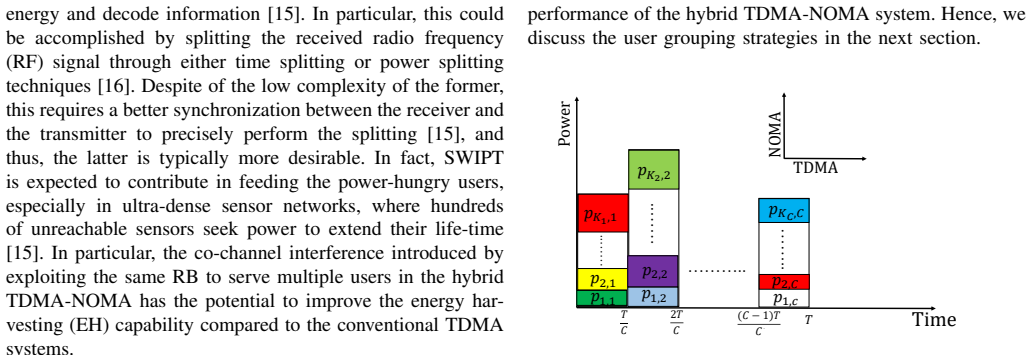
The paper's central claim is that in a single-antenna downlink, dividing users into groups, serving each group in its own time slot with power-domain NOMA, and letting every receiver split the received signal between information decoding and energy harvesting yields a lower minimum transmit power than the TDMA-only schedule under the same constraints. The decisive mechanism is that the NOMA superposition signal contributes to the harvested power at each user, $P_{j,i}=\eta(1-\beta_{j,i})|h_{j,i}|^2\sum_s p_{s,i}^2$, while SIC keeps the information branch decodable. The paper reports simulations in which the hybrid scheme's required transmit power stays below TDMA's over the tested range of minimum harvested-power requirements.
Load-bearing premise
The load-bearing premise is that the convex chain that replaces the rate constraint actually enforces the promised minimum rate rather than just a slack bound; in the printed version the step $\theta \ge 2^{\vartheta}$ omits the time-slot duration $t_i$, and if that omission is not harmless the reported transmit powers are below what the original problem truly requires.
Editorial extensions
If this is right
- For the simulated system, the hybrid TDMA-NOMA design satisfies the same minimum rate per user and minimum harvested power with lower base-station transmit power than TDMA.
- As the minimum harvested-power requirement grows, both schemes need more transmit power, but the hybrid scheme's interference-assisted harvesting keeps its power lower.
- The SCA algorithm converges in a small number of iterations for the tested parameters, so the design is computationally practical for the ten-user, five-group setup.
- The grouping strategy pairs the strongest user with the weakest so that SIC differences are large, which the paper argues is needed for practical NOMA.
Reading between the lines
- The paper fixes two users per group; because harvested power scales with total received power, larger groups would likely make the energy constraint easier to satisfy, though at additional SIC decoding burden, and testing $K_i>2$ would show whether the power advantage grows.
- The time slots are fixed at $T/C$; allowing unequal slot lengths would add a degree of freedom that could trade per-user rate against harvesting time, a direct extension of the same problem.
- The rate surrogate in (14c) would need to be scaled by the slot duration to strictly enforce $R_{\min}$; rerunning the reported simulations with $\theta \ge 2^{R_{\min}/t_i}$ would test how much of the power saving is robust to the surrogate gap.
- Before the algorithm can be reimplemented, a value or rule for the multiplier $\gamma$ in (21a) must be supplied, since the printed linearized bound leaves it unspecified.
Signed reviews
Editorial analysis
A structured set of objections, weighed in public.
Referee Report
Summary. The paper proposes a hybrid TDMA-NOMA downlink system with simultaneous wireless power and information transfer (SWIPT). Users are divided into groups, each served in a dedicated time slot using power-domain NOMA, and each user splits its received signal between information decoding and energy harvesting. The authors formulate a non-convex power minimization problem with minimum rate and minimum harvested-power constraints per user, and propose an iterative successive convex approximation (SCA) algorithm to jointly optimize the power allocations and power-splitting ratios. Simulation results compare the required transmit power of the proposed hybrid scheme with that of a conventional TDMA system and report a transmit-power advantage for the hybrid scheme.
Significance. If the proposed algorithm were correct, the paper would provide a useful design framework for energy-harvesting NOMA systems and a quantitative comparison against a TDMA baseline. The system model is clearly presented, the SWIPT formulation is standard, and the comparison with TDMA is a natural evaluation. However, the central claim in the conclusion rests entirely on the correctness of the SCA reformulation, and that reformulation contains several load-bearing errors, detailed below, which mean the numerical results in Section IV do not currently establish the claimed transmit-power advantage.
major comments (3)
- [Section III.B, Eqs. (14a)-(14c) and OP1 (25)] The rate constraint is not enforced with the time-sharing factor t_i. The chain in (14a)-(14c) together with r_{j,i} >= Rmin in (25b) imposes log2(1+SINR_{j,i}) >= Rmin, but the actual rate is R_{j,i} = t_i log2(1+SINR_{j,i}) with t_i = T/C < 1. Consequently, a point feasible for the surrogate can have R_{j,i} as low as t_i Rmin, which is below the required minimum rate. The correct surrogate requires theta_{j,i} >= 2^{Rmin/t_i} (or equivalently vartheta_{j,i} >= Rmin/t_i). In addition, OP1 omits (14a) and does not link r_{j,i} to theta_{j,i} or vartheta_{j,i}; the variable set Gamma in (25) does not contain theta or vartheta, so the chain is incomplete as printed.
- [Section III.B, Eq. (21a)] The multiplier gamma in (21a) is undefined. It is not introduced in the text, is not included in the optimization variable set Gamma, and is not listed as a simulation parameter. Since (21) is used in OP1, the feasible set actually implemented in simulations is unspecified; if gamma is not equal to 1, the constraint is not equivalent to (17). The authors must either remove gamma or define it explicitly and justify its value.
- [Section III.B, Eqs. (19) and (23)] The first-order Taylor linearization of beta p^2 (and similarly of (1-beta)p^2) is not a valid SCA lower bound. The function f(beta,p) = beta p^2 has an indefinite Hessian, so its linearization is not a global underestimator; for example, at (beta0,p0)=(1,1), the linearization at (beta,p)=(4,0.5) equals 3 while f equals 1. Therefore the constraint (19) >= alpha can be satisfied while the original constraint (18) is violated. This means the SCA may return points that are infeasible for OPP, and the claimed equivalence of OP1 and OPP is not established. A different convex underestimator or a proof of conservativeness over the domain is needed.
minor comments (6)
- [Abstract] The abstract says 'we employ successive interference cancellation to overcome these non-convexity issues'; this should be 'successive convex approximation' (SCA), not SIC.
- [Section III.B, Eq. (25)] The variable set Gamma lists r_{j,i}, while the derivation uses vartheta_{j,i} as the rate slack variable; the relationship between r_{j,i} and vartheta_{j,i} is never defined, which makes OP1 difficult to interpret.
- [Section II.A, Eq. (13a)] The grouping notation in (13a) mixes two indexing conventions and is difficult to follow; an explicit example for the simulated case K=10, C=5 would clarify the proposed grouping strategy.
- [Section IV, Fig. 3] Figure 3 contains an inset whose axes and meaning are not described in the caption; please add an explanation.
- [Section III, Algorithm 1] The stopping threshold mu in Algorithm 1 is not given a value in Section IV, so the convergence results in Fig. 4 are not fully reproducible.
- [References] Reference [28] is cited as 'Accepted IEEE Trans. Commun. 2019' without volume, pages, or DOI; please complete the reference.
Circularity Check
No circularity: the TDMA-NOMA vs TDMA comparison is generated from two independent optimization formulations, not from fitted inputs or self-citation.
full rationale
The paper's central claim—that the hybrid TDMA-NOMA design requires less transmit power than conventional TDMA under identical rate and harvested-power constraints—is obtained by solving the P-Min problem OPP (12) through the SCA surrogate OP1 (25) and comparing it with the TDMA problem OP2 (28). The design variables (power allocations and splitting ratios) are optimization outputs, not calibrated constants; no parameter is fitted to the simulated curves and then re-labeled as a prediction. The citations to the authors' prior work [14,19,20] are used only to justify the SCA technique ('Note that SCA has been utilized to solve different non-convex optimization problem in the literature [19], [20], [14]'), not as a premise that forces the claimed advantage; no uniqueness theorem from the authors' prior work is invoked. There is a real correctness concern, but it is not circularity: the link between the slack variable r_{j,i} in OP1 (25b) and the actual rate R_{j,i}=t_i log2(1+SINR_{j,i}) is incomplete, because Eq. (14a) (R_{j,i}≥ϑ_{j,i}) is not carried into the constraint list of OP1 and the t_i factor is absent from the θ_{j,i}≥2^{ϑ_{j,i}} surrogate; Eq. (21a) also contains an undefined multiplier γ. If these surrogates are inexact, the reported transmit-power values may solve a relaxed or infeasible problem, but that is an equivalence/feasibility defect, not a derivation that reduces to its own inputs. The comparison itself is therefore not circular, and the circularity score is 0.
Assumptions & free parameters
assumptions (4)
- domain assumption SIC is implemented with no errors at every user.
- domain assumption Perfect channel state information is available at the base station and users.
- domain assumption The energy harvester has a linear RF-to-DC conversion model.
- ad hoc to paper The convex approximations in (19), (20), (21), (23) are faithful surrogates of the original non-convex constraints.
Cite this review
Pith. "Pith review of On Energy Harvesting of Hybrid TDMA-NOMA Systems." pith.science (2026). https://pith.science/paper/F3MWZHDP
@misc{pith2026190808719,
  author       = {Pith},
  title        = {Pith review of: On Energy Harvesting of Hybrid TDMA-NOMA Systems},
  year         = {2026},
  howpublished = {\url{https://pith.science/paper/F3MWZHDP}},
  note         = {Machine review of arXiv:1908.08719}
}
read the original abstract
In this paper, we investigate energy harvesting capabilities of non-orthogonal multiple access (NOMA) scheme integrated with the conventional time division multiple access (TDMA) scheme, which is referred to as hybrid TDMA-NOMA system. In a such hybrid scheme, users are divided into a number of groups, with the total time allocated for transmission is shared between these groups through multiple time slots. In particular, a time slot is assigned to serve each group, whereas the users in the corresponding group are served based on power-domain NOMA technique. Furthermore, simultaneous wireless power and information transfer technique is utilized to simultaneously harvest energy and decode information at each user. Therefore, each user splits the received signal into two parts, namely, energy harvesting part and information decoding part. In particular, we jointly determine the power allocation and power splitting ratios for all users to minimize the transmit power under minimum rate and minimum energy harvesting requirements at each user. Furthermore, this joint design is a non-convex problem in nature. Hence, we employ successive interference cancellation to overcome these non-convexity issues and determine the design parameters (i.e., the power allocations and the power splitting ratios). In simulation results, we demonstrate the performance of the proposed hybrid TDMA-NOMA design and show that it outperforms the conventional TDMA scheme in terms of transmit power consumption.
Figures


Figures from the paper (2 more)


Reference graph
Works this paper leans on
-
[1]
Non-orthogonal multiple access (NOMA) for cellular future radio access,
Y . Saito, Y . Kishiyama, A. Benjebbour, T. Nakamura, A. Li, and K. Higuchi, “Non-orthogonal multiple access (NOMA) for cellular future radio access,” in Proc. IEEE VTC Spring 2013 , pp. 1–5
work page 2013
-
[2]
Beamforming techniques for non-orthogonal multiple access in 5G cellular networks,
F. Alavi, K. Cumanan, Z. Ding, and A. G. Burr, “Beamforming techniques for non-orthogonal multiple access in 5G cellular networks,” IEEE Trans. V eh. Technol., vol. 67, no. 10, pp. 9474–9487, Oct. 2018
work page 2018
-
[3]
——, “Robust beamforming techniques for non-orthogonal multiple access systems with bounded channel uncertainties,” IEEE Commun. Lett., vol. 21, no. 9, pp. 2033–2036, Sept. 2017
work page 2017
-
[4]
A. Benjebbour, Y . Saito, Y . Kishiyama, A. Li, A. Harada, and T. Naka- mura, “Concept and practical considerations of non-orthogonal multiple access (NOMA) for future radio access,” in Proc. IEEE Intell. Signal Process. and Commun. Syst. (ISPACS), 2013 , pp. 770–774
work page 2013
-
[5]
Sinr balancing technique for downlink beamforming in cognitive radio networks,
K. Cumanan, L. Musavian, S. Lambotharan, and A. B. Gershman, “Sinr balancing technique for downlink beamforming in cognitive radio networks,” IEEE Signal Processing Letters , vol. 17, no. 2, pp. 133–136, 2010
work page 2010
-
[6]
Optimal power allocation scheme for non- orthogonal multiple access with α-fairness,
P. Xu and K. Cumanan, “Optimal power allocation scheme for non- orthogonal multiple access with α-fairness,” IEEE J. Sel. Areas in Commun., vol. 35, no. 10, pp. 2357–2369, Oct. 2017
work page 2017
-
[7]
Superposition coding strategies: Design and experimental evaluation,
S. Vanka, S. Srinivasa, Z. Gong, P. Vizi, K. Stamatiou, and M. Haenggi, “Superposition coding strategies: Design and experimental evaluation,” IEEE Trans. Wireless Commun. , vol. 11, no. 7, pp. 2628–2639, Jul. 2012
work page 2012
-
[8]
Non-orthogonal multiple access for 5G and beyond,
Y . Liu, Z. Qin, M. Elkashlan, Z. Ding, A. Nallanathan, and L. Hanzo, “Non-orthogonal multiple access for 5G and beyond,” Proceedings of the IEEE , vol. 105, no. 12, pp. 2347–2381, Dec. 2017
work page 2017
Show all 29 references
-
[9]
Power-domain non-orthogonal multiple access (NOMA) in 5G systems: Potentials and challenges,
S. R. Islam, N. Avazov, O. A. Dobre, and K.-S. Kwak, “Power-domain non-orthogonal multiple access (NOMA) in 5G systems: Potentials and challenges,” IEEE Commun. Surveys Tuts. , vol. 19, no. 2, pp. 721–742, 2017
2017
-
[10]
NOMA in downlink SDMA with limited feedback: Performance analysis and optimization,
Q. Yang, H.-M. Wang, D. W. K. Ng, and M. H. Lee, “NOMA in downlink SDMA with limited feedback: Performance analysis and optimization,” IEEE J. Sel. Areas Commun. , vol. 35, no. 10, pp. 2281– 2294, Oct. 2017
2017
-
[11]
Energy-efficient power allocation for mimo-noma with multiple users in a cluster,
M. Zeng, A. Yadav, O. A. Dobre, and H. V . Poor, “Energy-efficient power allocation for mimo-noma with multiple users in a cluster,” IEEE Access, vol. 6, pp. 5170–5181, Feb. 2018
2018
-
[12]
Green communication in next generation cellular networks: a survey,
P. Gandotra, R. K. Jha, and S. Jain, “Green communication in next generation cellular networks: a survey,”IEEE Access, vol. 5, pp. 11 727– 11 758, Jun. 2017
2017
-
[13]
Energy efficiency in wireless networks via fractional programming theory,
A. Zappone and E. Jorswieck, “Energy efficiency in wireless networks via fractional programming theory,” F ound. Trends Commun. Inf. The- ory, vol. 11, no. 3-4, pp. 185–396, Jan. 2015
2015
-
[14]
Energy efficient beamforming design for MISO non-orthogonal multiple access systems,
H. M. Al-Obiedollah, K. Cumanan, J. Thiyagalingam, A. G. Burr, Z. Ding, and O. A. Dobre, “Energy efficient beamforming design for MISO non-orthogonal multiple access systems,” IEEE Trans. Commun., vol. 67, no. 6, pp. 4117–4131, Jun. 2019
2019
-
[15]
Transporting information and energy simultaneously,
L. R. Varshney, “Transporting information and energy simultaneously,” in Proc. IEEE ISIT 2008 , pp. 1612–1616
2008
-
[16]
Simultaneous wireless information and power transfer in modern communication systems,
I. Krikidis, S. Timotheou, S. Nikolaou, G. Zheng, D. W. K. Ng, and R. Schober, “Simultaneous wireless information and power transfer in modern communication systems,” IEEE Commun. Mag., vol. 52, no. 11, pp. 104–110, Nov. 2014
2014
-
[17]
Optimal sum-throughput analysis for downlink cooperative SWIPT NOMA systems,
T. N. Do and B. An, “Optimal sum-throughput analysis for downlink cooperative SWIPT NOMA systems,” in Proc. IEEE 2nd SigTelCom
-
[18]
Resource allocation for downlink NOMA systems: Key techniques and open issues,
S. Islam, M. Zeng, O. A. Dobre, and K.-S. Kwak, “Resource allocation for downlink NOMA systems: Key techniques and open issues,” IEEE Wireless Commun., vol. 25, no. 2, pp. 40–47, Apr. 2018
2018
-
[19]
Energy efficiency fairness beamforming design for MISO NOMA systems,
H. Al-Obiedollah, K. Cumanan, J. Thiyagalingam, A. G. Burr, Z. Ding, and O. A. Dobre, “Energy efficiency fairness beamforming design for MISO NOMA systems,” in Proc. IEEE WCNC 2019
2019
-
[20]
Sum rate fairness trade-off-based resource allocation technique for MISO NOMA systems,
——, “Sum rate fairness trade-off-based resource allocation technique for MISO NOMA systems,” in Proc. IEEE WCNC 2019
2019
-
[21]
The application of MIMO to non- orthogonal multiple access,
Z. Ding, F. Adachi, and H. V . Poor, “The application of MIMO to non- orthogonal multiple access,” IEEE Trans. Wireless Commun. , vol. 15, no. 1, pp. 537–552, Jan. 2016
2016
-
[22]
Exploiting interference for energy harvesting: A survey, re- search issues, and challenges,
N. Zhao, S. Zhang, F. R. Yu, Y . Chen, A. Nallanathan, and V . C. Leung, “Exploiting interference for energy harvesting: A survey, re- search issues, and challenges,” IEEE Access, vol. 5, pp. 10 403–10 421, May 2017
2017
-
[23]
A generic receiver architecture for mimo wireless power transfer with nonlinear energy harvesting,
G. Ma, J. Xu, Y . Zeng, and M. R. V . Moghadam, “A generic receiver architecture for mimo wireless power transfer with nonlinear energy harvesting,” IEEE Signal Process. Lett. , vol. 26, no. 2, pp. 312–316, Feb. 2019
2019
-
[24]
A minorization-maximization method for optimizing sum rate in the downlink of non-orthogonal multiple access systems,
M. F. Hanif, Z. Ding, T. Ratnarajah, and G. K. Karagiannidis, “A minorization-maximization method for optimizing sum rate in the downlink of non-orthogonal multiple access systems,” IEEE Trans. Signal Process., vol. 64, no. 1, pp. 76–88, Jan. 2016
2016
-
[25]
Wireless energy and information transfer tradeoff for limited-feedback multiantenna systems with energy beamforming,
X. Chen, C. Yuen, and Z. Zhang, “Wireless energy and information transfer tradeoff for limited-feedback multiantenna systems with energy beamforming,” IEEE Trans. V eh. Techn., vol. 63, no. 1, pp. 407–412, Jan. 2013
2013
-
[26]
Wireless networks with RF energy harvesting: A contemporary survey,
X. Lu, P. Wang, D. Niyato, D. I. Kim, and Z. Han, “Wireless networks with RF energy harvesting: A contemporary survey,” IEEE Commun. Surv. Tutor ., vol. 17, no. 2, pp. 757–789, Sec. Quarter 2015
2015
-
[27]
Joint beamforming and user maximization techniques for cognitive radio networks based on branch and bound method,
K. Cumanan, R. Krishna, L. Musavian, and S. Lambotharan, “Joint beamforming and user maximization techniques for cognitive radio networks based on branch and bound method,” IEEE Trans. Wireless Commun., vol. 9, no. 10, pp. 3082–3092, Oct. 2010
2010
-
[28]
Robust energy-efficient design for miso non-orthogonal multiple access systems,
F. Alavi, K. Cumanan, F. Milad, Z. Ding, S. Lambotharan, and O. A. Dobre, “Robust energy-efficient design for miso non-orthogonal multiple access systems,” Accepted IEEE Trans. Commun. , 2019
2019
-
[29]
Design of user clustering and precoding for downlink non-orthogonal multiple access (NOMA),
J. Kim, J. Koh, J. Kang, K. Lee, and J. Kang, “Design of user clustering and precoding for downlink non-orthogonal multiple access (NOMA),” in Proc. IEEE Military Communications Conference, MILCOM 2015 , pp. 1170–1175
2015
Reviewed August 14, 2026 · model on record in the stance chip above.
Discussion (0). Continue with ORCID to comment.