REVIEW 2 major objections 5 minor 18 references
Linear response theory for Google matrix
T0 review · 2 major / 5 minor · reviewed 2026-08-14 · deepseek-v4-flash
Pith's one-line read A new algorithm computes the exact linear response of PageRank, locating the pathway between any two nodes.
desk verdict Sound linear-response math and a scalable algorithm, but the 'effective pathway' claim rests on an unvalidated interpretive step the authors themselves flag. read the letter →
The pith
A machine-rendered reading of the paper's core claim, the machinery that carries it, and where it could break.
The reading
What carries the argument
The load-bearing object is the inhomogeneous PageRank equation $P_1 = G_0 P_1 + V_0$ together with the iterative solver and the projection $Q(X)=X-(E^TX)P_0$. The equation converts the linear-response problem into a source-driven version of the PageRank fixed-point problem, so it can be solved by the same convergent iteration as PageRank itself. The projection removes the numerical component along $P_0$ that would otherwise accumulate and slow convergence, and it enforces the normalization condition $E^TP_1=0$. For the injection/absorption model, the special choice of the perturbation matrix makes $V_0$ a difference of two columns of $G_0$, which is what ties the response vector to a directed pathway between two nodes.
What would settle it
Compute $P_1$ with LIRGOMAX on a small directed network where the true pathway is known from an independent flow-based metric, for example maximum flow or random-walk hitting probabilities, and check whether the top-$|P_1|$ subset contains both endpoints and coincides with that pathway. A pair with a low-PageRank absorption node having few incoming links, where the paper itself expects the endpoints to fall outside the top subset, would already falsify the automatic pathway-selection claim.
Extended reading notes
Core claim
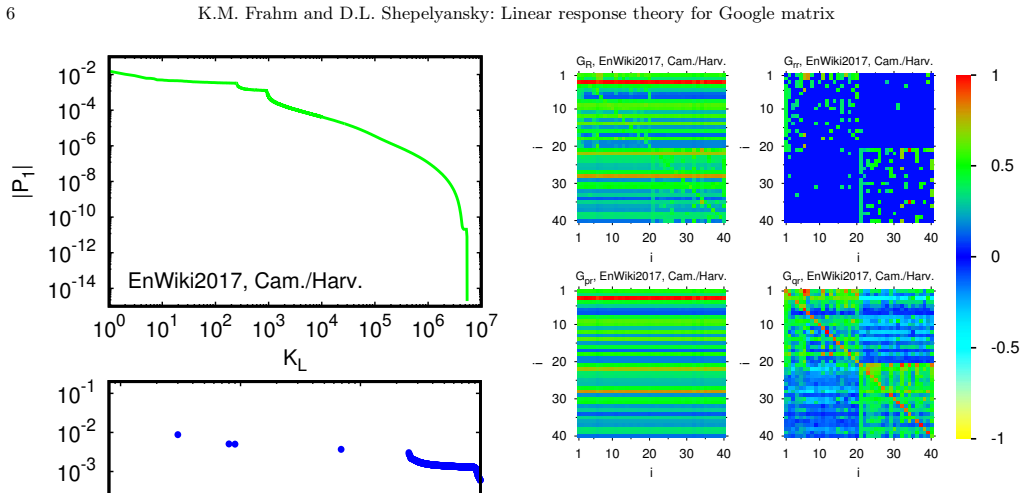
The central discovery is that the linear response of PageRank is governed by a single inhomogeneous fixed-point equation. Expanding $G(\varepsilon)=G_0+\varepsilon G_1$ and $F(\varepsilon,P)=P+\varepsilon F_1(P)$ around $\varepsilon=0$, the $O(\varepsilon)$ correction $P_1$ satisfies $P_1 = G_0 P_1 + V_0$ with $V_0 = G_1P_0 + G_0F_1(P_0)$. Because $E^T V_0 = 0$, the apparent singularity of $(1-G_0)^{-1}$ is harmless: $V_0$ has no component along the PageRank eigenvector, and iteration $P^{(n+1)}_1=G_0P^{(n)}_1+V_0$ converges with the same speed as the PageRank power method. For injection at $i$ and absorption at $j$, the special scaling $D_i=1/P_0(i)$, $D_j=-1/P_0(j)$ makes the source term exactly the difference between the $i$-th and $j$-th columns of $G_0$, so the response is driven by the difference of two columns of the Google matrix. Ordering all nodes by $|P_1|$ and keeping the extremes yields the most sensitive nodes, and applying REGOMAX to that subset gives the reduced Google matrix with its direct and indirect interaction components.
Load-bearing premise
The ranking of nodes by the magnitude of the first-order response $|P_1|$ is taken to identify the 'effective pathway' between the injection and absorption nodes; the paper states in Section 2.5 that there is no mathematical argument placing the two endpoints in that top subset, especially for low-PageRank nodes.
Editorial extensions
If this is right
- The PageRank sensitivity $D^{(j\to i)}(k)=P_1(k)/P_0(k)$ to a matrix-element perturbation can be computed in the exact $\varepsilon\to 0$ limit, avoiding the numerical loss of precision of finite-difference formulas.
- The method provides an automatic, non-heuristic way to select a small subset of nodes relevant to a perturbation, which can then be studied with REGOMAX; this replaces arbitrary choices of subset.
- The same linear-response framework applies to any perturbation of the Google matrix or of the Markov process, not only injection/absorption, so it can quantify how small structural changes propagate through a directed network.
- On the tested five-million-node network, the top positive and negative entries of $P_1$ form two coherent blocks around the injection and absorption nodes, showing that the response captures meaningful global structure.
- Because the iteration has the same cost as the power method, the computation is feasible for any network where the unperturbed PageRank can be computed.
Reading between the lines
- I read the paper's 'pathway' as a claim about linear sensitivity, not about graph-theoretic paths; a natural test is whether top-$|P_1|$ nodes coincide with high-flow or high-commute-time routes on small networks where those quantities can be computed exactly.
- The difference-of-columns form $V_0=(G_0)_{:i}-(G_0)_{:j}$ suggests a Green's-function interpretation: $P_1$ is the response of the Markov chain to a unit source-sink pair, so the same machinery could be applied to node influence, betweenness, or random-walk hitting times.
- The paper's own caveat that injection nodes with low PageRank and few incoming links may not appear in the top-response subset implies that the automatic selection is endpoint-blind in those cases; a low-PageRank pair would require a separate criterion for including the endpoints themselves.
Signed reviews
Editorial analysis
A structured set of objections, weighed in public.
Referee Report
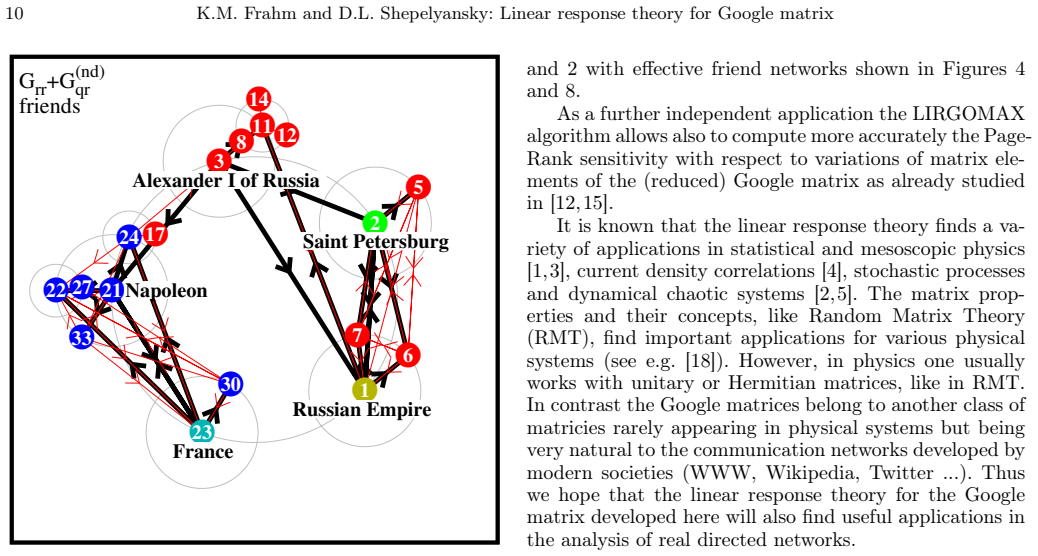
Summary. The paper develops a linear response formalism for the Google matrix/PageRank problem, deriving the first-order correction P1 to the PageRank vector under a weak perturbation of either the Google matrix or the stochastic process. The central algorithmic contribution is LIRGOMAX, which solves the inhomogeneous PageRank equation P1 = G0 P1 + V0 by iteration with a projection step, avoiding the numerical loss of precision of finite-difference estimates. Two perturbation models are treated: a pump model with probability injection at one node and absorption at another, and a PageRank-sensitivity model for individual matrix-element changes. The method is applied to the 2017 English Wikipedia network (N ≈ 5.4 million) for two injection/absorption pairs (University of Cambridge / Harvard University, and Napoleon / Alexander I of Russia). In each case the authors select 40 nodes from the extremes of P1, apply the REGOMAX reduction to that subset, and present reduced Google matrices and 'friend' networks, which they interpret as revealing the effective pathway between the initial pair of nodes.
Significance. If assessed as a computational method for the exact ε→0 limit of PageRank linear response, the contribution is solid and potentially useful. The derivation in Section 2.4 is internally consistent; the iteration (12) with projection (13) is a standard and efficient way to solve the singular inhomogeneous equation, and the reported scalability to a 5-million-node network is a genuine practical advantage. The paper honestly acknowledges some limitations, notably in Section 2.5 where it concedes that there is no mathematical argument guaranteeing the initial nodes belong to the top-response set. However, the paper's central application claim—that the selected nodes constitute the 'effective pathway' between the injection and absorption nodes—is an interpretive step that is not validated by any independent ground truth, flow-based metric, or comparison with alternative pathway-finding methods. As written, the paper demonstrates a sensitivity-analysis algorithm; the pathway-discovery language overstates what is established.
major comments (2)
- [Section 2.5 and Section 3] The identification of the nodes with the largest linear-response values as an 'effective pathway' between injection and absorption nodes is unsupported. Section 2.5 explicitly states that there is 'no simple mathematical argument' that the two initial nodes even belong to the top-response set, and Sections 3.1–3.2 provide no external validation: no comparison with explicit hyperlink paths, random-walk hitting or commute probabilities, betweenness/flow centrality, or any other pathway benchmark. Because the abstract and Discussion present pathway identification as the main application, this is a load-bearing issue. The authors should either provide such validation or explicitly reframe the contribution as a sensitivity-analysis tool rather than a pathway-discovery method.
- [Section 2.5, Tables 1 and 2] The implemented node-selection rule is not the top-40 subset by |P1| implied by the surrounding narrative; it is the union of the 20 most negative and 20 most positive entries of P1. Table 1 omits negative entries with KL ranks between 24 and 68 while including positive entries with KL ranks as low as 278, and Table 2 shows the same pattern (e.g., positive entries down to KL=209 while intervening negative entries are skipped). This sign-balanced selection changes the REGOMAX subset and therefore changes all subsequent reduced-matrix results in Figures 2–4 and 6–8. The authors should justify this unstated modeling choice or report results for the literal top-40 magnitude criterion, since the current rule is an additional arbitrary element in the pipeline.
minor comments (5)
- [Section 4 and Section 3.2] There are small language errors: 'matricies' in Section 4 should be 'matrices', and Section 3.2 contains the duplicated article in 'In contrast to the the previous example'.
- [Section 2.1] The statement that results are insensitive to α in the range 0.5 ≤ α ≤ 0.95 is cited to previous work; since P1 is a new derived quantity, a one-line check that the reported top-response tables are stable under this α variation would make the algorithmic claim more self-contained.
- [Figures 4 and 8] The caption explains that friends are chosen by the largest matrix elements in the same column of Grr+Gqr^(nd), but the direction convention of the drawn arrows should be stated explicitly in the captions, because the column-stochastic convention may make the link direction non-obvious to readers.
- [References] Reference [10] is cited as an arXiv preprint; if a peer-reviewed version exists, it should be cited instead, and reference [16] is a project URL without a persistent identifier, so the exact data and code snapshot used for the figures should be archived with a DOI.
- [Section 2.5] The term 'pathway' is used before it is operationally defined; the manuscript would be clearer if it stated in Section 2.5 that 'pathway' is a heuristic label for the set of nodes with large |P1|, rather than a mathematically defined object.
Circularity Check
No significant circularity: LIRGOMAX solves the exact first-order PageRank response equation with no fitted inputs; the 'effective pathway' label is an acknowledged interpretation, not a by-construction prediction.
full rationale
The LIRGOMAX derivation is self-contained. Equations (6)-(10) expand the perturbed stationary condition P = G(ε)F(ε,P) to first order and obtain the inhomogeneous equation P1 = G0 P1 + V0, with V0 = G1P0 + G0F1(P0). For the pump model, Section 2.4.2 reduces V0 to Q(G0DP0), and the choice Di = 1/P0(i), Dj = -1/P0(j) is a normalization that makes e(P0) = 0 and gives W0 entries +1 and -1; no parameter is fitted to the final subset. The iteration (12) is a standard convergent linear solve of that fixed equation, and the projection (13) only removes numerical contamination along the PageRank direction. REGOMAX is invoked from prior work as a downstream analysis tool, but the central LIRGOMAX claim does not depend on an unverified self-citation or an imported uniqueness theorem. The only soft point is Section 2.5, which explicitly concedes 'there is no simple mathematical argument' that the injection and absorption nodes belong to the largest-|P1| subset; this is a caveat about whether the top-response set deserves the label 'effective pathway', not a circular reduction, because P1 is not defined in terms of the selected subset. The sign-balanced 20+20 subset selection and the absence of external pathway ground truth affect external validity and interpretation, not the logical independence of the computation.
Assumptions & free parameters
free parameters (2)
- Subset size: number of top |P1| nodes per sign =
20 negative and 20 positive entries (Nr = 40)
- Injection/absorption weights D_i and D_j =
D_i = 1/P0(i), D_j = -1/P0(j)
assumptions (4)
- standard math G0 is a primitive stochastic matrix with a unique PageRank eigenvector P0.
- standard math The left leading eigenvector of G0 is the uniform vector ET.
- domain assumption Terms of order ε² and higher are negligible in the expansion.
- ad hoc to paper Ranking by |P1| identifies the 'effective pathway' between injection and absorption nodes.
Cite this review
Pith. "Pith review of Linear response theory for Google matrix." pith.science (2026). https://pith.science/paper/F53EBMGD
@misc{pith2026190808924,
  author       = {Pith},
  title        = {Pith review of: Linear response theory for Google matrix},
  year         = {2026},
  howpublished = {\url{https://pith.science/paper/F53EBMGD}},
  note         = {Machine review of arXiv:1908.08924}
}
read the original abstract
We develop the linear response theory for the Google matrix PageRank algorithm with respect to a general weak perturbation and a numerical efficient and accurate algorithm, called LIRGOMAX algorithm, to compute the linear response of the PageRank with respect to this perturbation. We illustrate its efficiency on the example of the English Wikipedia network with more than 5 millions of articles (nodes). For a group of initial nodes (or simply a pair of nodes) this algorithm allows to identify the effective pathway between initial nodes thus selecting a particular subset of nodes which are most sensitive to the weak perturbation applied to them (injection or pumping at one node and absorption of probability at another node). The further application of the reduced Google matrix algorithm (REGOMAX) allows to determine the effective interactions between the nodes of this subset. General linear response theory already found numerous applications in various areas of science including statistical and mesoscopic physics. Based on these grounds we argue that the developed LIRGOMAX algorithm will find broad applications in the analysis of complex directed networks.
Figures


Figures from the paper (4 more)


Reference graph
Works this paper leans on
-
[1]
Kubo, Statistical-mechanical theory of irreversible pro- cesses
R. Kubo, Statistical-mechanical theory of irreversible pro- cesses. I. General theory and simple applications to mag- netic and conduction problems, J. Phys. Soc. Japan12(6), 570 (1957)
work page 1957
-
[2]
P. Hanggi and H. Thomas,Stochastic processes: time evo- lution, symmetries and linear response, Phys. Rep.88, 207 (1982)
work page 1982
-
[3]
H.U. Baranger and A.D. Stone,Electrical linear-response theory in an arbitrary magnetic field: a new Fermi-surface formation, Phys. Rev. B40, 8159 (1989)
work page 1989
-
[4]
G. Vignale and W. Kohn, Current-dependent exchange- correlation potential for dynamical linear response theory, Phys. Rev. Lett.77, 2037 (1996)
work page 1996
-
[5]
D. Ruelle, A review of linear response theory for gen- eral differentiable dynamical systems, Nonlinearity22, 855 (2009)
work page 2009
-
[6]
S.Brin and L.Page, The anatomy of a large-scale hyper- textual Web search engine, Computer Networks and ISDN Systems 30, 107 (1998)
work page 1998
-
[7]
A.M. Langville and C.D. Meyer,Google’s PageRank and beyond: the science of search engine rankings, Princeton University Press, Princeton (2006)
work page 2006
-
[8]
L.Ermann, K.M. Frahm and D.L. Shepelyansky Google matrix analysis of directed networks, Rev. Mod. Phys.87, 1261 (2015) K.M. Frahm and D.L. Shepelyansky: Linear response theory for Google matrix 11
work page 2015
Show all 18 references
-
[9]
Frahm and D.L
K.M. Frahm and D.L. Shepelyansky, Wikipedia net- works of 24 editions of 2017 , Available: http: //www.quantware.ups-tlse.fr/QWLIB/24wiki2017/. Accessed August (2019)
2019
-
[10]
Frahm and D.L
K.M. Frahm and D.L. Shepelyansky,Reduced Google ma- trix, arXiv:1602.02394[physics.soc] (2016)
2016 arXiv
-
[11]
Frahm, K
K.M. Frahm, K. Jaffres-Runser and D.L. Shepelyansky, Wikipedia mining of hidden links between political leaders, Eur. Phys. J. B89, 269 (2016)
2016
-
[12]
Coquide, J
C. Coquide, J. Lages and D.L. Shepelyansky,World influ- ence and interactions of universities from Wikipedia net- works, Eur. Phys. J. B92, 3 (2019)
2019
-
[13]
Lages, D.L
J. Lages, D.L. Shepelyansky and A. Zinovyev,Inferring hidden causal relations between pathway members using re- duced Google matrix of directed biological networks, PLoS ONE 13(1), e0190812 (2018)
2018
-
[14]
Cao, Lasing in random media, Waves Random Media 13, R1 (2003)
H. Cao, Lasing in random media, Waves Random Media 13, R1 (2003)
2003
-
[15]
Coquide, L
C. Coquide, L. Ermann, J. Lages and D.L. Shepelyansky, Influence of petroleum and gas trade on EU economies from the reduced Google matrix analysis of UN COM- TRADE data, Eur. Phys. J. B92, 171 (2019)
2019
-
[16]
Frahm and D.L
K.M. Frahm and D.L. Shepelyansky, LIRGOMAX al- gorithm, Available:http://www.quantware.ups-tlse.fr/ QWLIB/lirgomax. Accessed August (2019)
2019
-
[17]
Chepelianskii A.D.,Towards physical laws for software ar- chitecture, arXiv:1003.5455 [cs.SE] (2010)
2010 arXiv
-
[18]
T. Guhr, A. Müller-Groeling, H.A. Weidenmüller, Random-matrix theories in quantum physics: common con- cepts, Phys. Rep.299, 189 (1998)
1998
Reviewed August 14, 2026 · model on record in the stance chip above.
Discussion (0). Continue with ORCID to comment.