Small Torsion Topological Generators for Big Mapping Class Groups
Pith reviewed 2026-05-21 15:48 UTC · model grok-4.3
The pith
Mapping class groups of infinite-type surfaces with n ends are topologically generated by three or four torsion elements.
A machine-rendered reading of the paper's core claim, the machinery that carries it, and where it could break.
Core claim
Map(S(n)) is topologically generated by four involutions for every n greater than or equal to 16, by three involutions when n equals 1 or 2, by four elements of order n when n is even and at least 8, and by three elements of order n together with one element of order n minus 1 when n is odd and at least 8.
What carries the argument
Finite topological generating sets consisting entirely of torsion elements inside the Polish group Map(S(n)) equipped with the compact-open topology.
If this is right
- For all sufficiently large n the group admits a topological generating set of size four consisting of involutions.
- The Loch Ness Monster surface and the Jacob's Ladder surface have mapping class groups topologically generated by three involutions.
- When n is at least 8, torsion elements whose orders are n or n-1 can replace involutions in the topological generating sets.
- The minimal number of topological generators needed can be strictly smaller than the algebraic generation number.
Where Pith is reading between the lines
- Similar small torsion generating sets may exist for other families of infinite-type surfaces whose ends are accumulated differently.
- The existence of these sets could be used to construct explicit dense subgroups inside representations of Map(S(n)) into larger Polish groups.
- One could ask whether the same surfaces admit topological generating sets consisting of elements of bounded order independent of n.
Load-bearing premise
The surfaces S(n) admit a Polish topology on their mapping class groups under which finite sets of torsion elements can be dense.
What would settle it
An explicit continuous homomorphism from Map(S(n)) onto a Hausdorff topological group in which the images of any three or four candidate torsion elements fail to generate a dense subgroup.
Figures


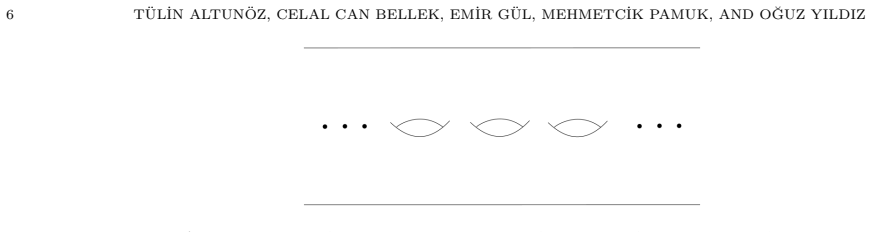


read the original abstract
Let $S(n)$, for $n \in \mathbb{N}$, be the infinite-type surface of infinite genus with $n$ ends, each accumulated by genus. Although the mapping class groups of these surfaces are not countably generated,they are Polish groups and hence admit a countable topological generating set. We study minimal topological generating sets for $\mathrm{Map}(S(n))$ consisting entirely of torsion elements, with special attention to involutions. In particular, we prove that $\mathrm{Map}(S(n))$ is topologically generated by four involutions for all $n \geq 16$, and by three involutions for the Loch Ness Monster surface ($n = 1$) and the Jacob's Ladder surface ($n = 2$). We also establish that for even $n \geq 8$, $\mathrm{Map}(S(n))$ is topologically generated by four torsion elements of order $n$. For odd $n \geq 8$, it is topologically generated by three torsion elements of order $n$ and one torsion element of order $n - 1$.
Editorial analysis
A structured set of objections, weighed in public.
Referee Report
Summary. The paper defines surfaces S(n) as infinite-genus surfaces with n ends each accumulated by genus and studies their mapping class groups Map(S(n)) under the compact-open topology. It proves that these Polish groups are topologically generated by four involutions when n ≥ 16, by three involutions for the Loch Ness Monster (n=1) and Jacob's Ladder (n=2) surfaces, and by four (resp. three plus one) torsion elements of specified orders for even (resp. odd) n ≥ 8.
Significance. If the density arguments hold, the results supply explicit small torsion topological generating sets for these big mapping class groups, which are known to be uncountably generated as abstract groups. This contributes concrete examples to the study of topological generation in Polish groups arising from infinite-type surfaces and complements existing work on countable dense subgroups.
major comments (2)
- [§4] §4 (density argument for four involutions when n=16): the construction places the involutions on disjoint subsurfaces covering the ends, but the proof that finite products and conjugates can approximate arbitrary compactly supported homeomorphisms (including those sliding handles arbitrarily close to an end) is not fully detailed; it is unclear whether the fixed supports leave gaps in the genus-accumulation regions that cannot be filled by the generated subgroup.
- [Theorem 1.1] Theorem 1.1 and the statement for odd n ≥ 8: the reduction from four involutions to three order-n torsion elements plus one order-(n-1) element relies on an auxiliary construction whose support-overlap properties are invoked without an explicit verification that the resulting subgroup remains dense in the compact-open topology near all n ends.
minor comments (2)
- [§2] The definition of the surfaces S(n) and the precise statement of the compact-open topology should be recalled in §2 with a reference to the standard Polish-group structure on Map(S).
- Notation for the specific involutions (e.g., their supports relative to the ends) is introduced without a diagram; a figure illustrating the placement for n=16 would improve readability.
Simulated Author's Rebuttal
We thank the referee for their thorough review of our manuscript on small torsion topological generators for big mapping class groups. We have carefully considered the major comments and have revised the manuscript to address the concerns about the density arguments by providing more detailed explanations and verifications. We believe these changes clarify the proofs while preserving the validity of our results.
read point-by-point responses
-
Referee: [§4] §4 (density argument for four involutions when n=16): the construction places the involutions on disjoint subsurfaces covering the ends, but the proof that finite products and conjugates can approximate arbitrary compactly supported homeomorphisms (including those sliding handles arbitrarily close to an end) is not fully detailed; it is unclear whether the fixed supports leave gaps in the genus-accumulation regions that cannot be filled by the generated subgroup.
Authors: We appreciate the referee's observation regarding the density argument in §4. Upon review, we agree that the original proof sketch could be more explicit in detailing how the generated subgroup approximates homeomorphisms that slide handles near the ends. In the revised manuscript, we have added a detailed explanation showing that by taking suitable conjugates of the involutions, we can move their supports arbitrarily close to any end while preserving the torsion property. Furthermore, we demonstrate that the union of the supports and their images under the group action covers the entire genus-accumulation regions without leaving gaps, ensuring that any compactly supported mapping class can be approximated in the compact-open topology. This clarification strengthens the argument without altering the main result. revision: yes
-
Referee: [Theorem 1.1] Theorem 1.1 and the statement for odd n ≥ 8: the reduction from four involutions to three order-n torsion elements plus one order-(n-1) element relies on an auxiliary construction whose support-overlap properties are invoked without an explicit verification that the resulting subgroup remains dense in the compact-open topology near all n ends.
Authors: We thank the referee for highlighting this aspect of the proof for odd n ≥ 8 in Theorem 1.1. We acknowledge that the support-overlap properties of the auxiliary construction were not verified in sufficient detail. In the revision, we have included an additional lemma that explicitly verifies the density: by analyzing the overlaps between the supports of the three order-n elements and the order-(n-1) element, we show that their generated subgroup can approximate arbitrary local homeomorphisms near each of the n ends. This is achieved by combining rotations of handles with the torsion actions to fill any potential gaps, confirming that the subgroup is dense in the compact-open topology. revision: yes
Circularity Check
No circularity; explicit constructions from standard Polish group facts
full rationale
The paper proves topological generation of Map(S(n)) by four (or three) involutions or torsion elements via explicit geometric constructions placing these elements on disjoint subsurfaces that accumulate genus at the n ends. It invokes the standard fact that Polish groups admit countable topological generating sets, then builds the specific generators directly from surface homeomorphisms without any fitted parameters, self-definitional loops, or load-bearing self-citations that reduce the central claim to prior unverified inputs. The derivation chain remains self-contained against external benchmarks in infinite-type mapping class group theory.
Axiom & Free-Parameter Ledger
axioms (2)
- standard math Mapping class groups of infinite-type surfaces are Polish groups under the compact-open topology.
- domain assumption S(n) is the infinite-type surface of infinite genus with n ends each accumulated by genus.
Lean theorems connected to this paper
-
IndisputableMonolith/Foundation/AlexanderDuality.leanalexander_duality_circle_linking unclear?
unclearRelation between the paper passage and the cited Recognition theorem.
We prove that Map(S(n)) is topologically generated by four involutions for all n ≥ 16 … by three involutions for the Loch Ness Monster surface (n = 1) and the Jacob’s Ladder surface (n = 2).
-
IndisputableMonolith/Foundation/ArithmeticFromLogic.leanembed_injective unclear?
unclearRelation between the paper passage and the cited Recognition theorem.
PMap(S(n)) = PMapc(S(n)) ⋊ Z^{n-1} … handle shifts … Dehn twists
What do these tags mean?
- matches
- The paper's claim is directly supported by a theorem in the formal canon.
- supports
- The theorem supports part of the paper's argument, but the paper may add assumptions or extra steps.
- extends
- The paper goes beyond the formal theorem; the theorem is a base layer rather than the whole result.
- uses
- The paper appears to rely on the theorem as machinery.
- contradicts
- The paper's claim conflicts with a theorem or certificate in the canon.
- unclear
- Pith found a possible connection, but the passage is too broad, indirect, or ambiguous to say the theorem truly supports the claim.
Reference graph
Works this paper leans on
-
[1]
T¨ ulin Altun¨ oz, Celal Can Bellek, Emir G¨ ul, Mehmetcik Pamuk, and O˘ guz Yıldız,Minimal sets of generators for big mapping class groups, 2025, arXiv:2512.17465
work page internal anchor Pith review arXiv 2025
-
[2]
T¨ ulin Altun¨ oz, Mehmetcik Pamuk, and O˘ guz Yıldız,Involution generators of the big mapping class group, Journal of Topology and Analysis0(0), no. 0, 1–18
-
[3]
,Involution generators of the mapping class group of a punctured surface, Mediterr. J. Math.20(2023), no. 233, 1–16
work page 2023
-
[4]
Javier Aramayona, Priyam Patel, and Nicholas G Vlamis,The first integral cohomology of pure mapping class groups, International Mathematics Research Notices2020(2020), no. 22, 8973–8996
work page 2020
-
[5]
Vlamis,Big mapping class groups: An overview, p
Javier Aramayona and Nicholas G. Vlamis,Big mapping class groups: An overview, p. 459–496, Springer International Publishing, 2020
work page 2020
- [6]
-
[7]
Tara E. Brendle and Benson Farb,Every mapping class group is generated by 6 involutions, Journal of Algebra 278(2004), no. 1, 187–198
work page 2004
-
[8]
256–362, Springer New York, New York, NY, 1987
Max Dehn,The group of mapping classes, pp. 256–362, Springer New York, New York, NY, 1987
work page 1987
-
[9]
Stephen P. Humphries,Generators for the mapping class group, Topology of Low-Dimensional Manifolds (Berlin, Heidelberg) (Roger Fenn, ed.), Springer Berlin Heidelberg, 1979, pp. 44–47
work page 1979
-
[10]
thesis, Rutgers, The State University of New Jersey, 2022
Andy Huynh,Torsion in big mapping class groups, Ph.D. thesis, Rutgers, The State University of New Jersey, 2022
work page 2022
-
[11]
Martin Kassabov,Generating mapping class groups by involutions, 2003, arXiv:math/0311455
work page internal anchor Pith review Pith/arXiv arXiv 2003
-
[12]
Mustafa Korkmaz,Generating the surface mapping class group by two elements, Transactions of the American Mathematical Society357(2004), no. 8, 3299–3310
work page 2004
-
[13]
Mustafa Korkmaz,Mapping class group is generated by three involutions, Mathematical Research Letters27 (2020), no. 4, 1095–1108
work page 2020
-
[14]
W. B. R. Lickorish,A finite set of generators for the homeotopy group of a 2-manifold, Mathematical Proceed- ings of the Cambridge Philosophical Society60(1964), no. 4, 769–778
work page 1964
-
[15]
Feng Luo,Torsion elements in the mapping class group of a surface, 2000, arXiv:math/0004048
work page internal anchor Pith review Pith/arXiv arXiv 2000
-
[16]
McCarthy and Athanase Papadopoulos,Involutions in surface mapping class groups, Enseign
John D. McCarthy and Athanase Papadopoulos,Involutions in surface mapping class groups, Enseign. Math. 33(1987), no. 2, 275–290
work page 1987
-
[17]
Priyam Patel and Nicholas Vlamis,Algebraic and topological properties of big mapping class groups, Algebraic & Geometric Topology18(2018), no. 7, 4109–4142
work page 2018
-
[18]
Bronislaw Wajnryb,Mapping class group of a surface is generated by two elements, Topology35(1996), no. 2, 377–383
work page 1996
-
[19]
O˘ guz Yıldız,Generating mapping class group by two torsion elements, Mediterranean Journal of Mathematics 19(2022), no. 59. Faculty of Engineering, Bas ¸kent University, Ankara, Turkey Email address:tulinaltunoz@baskent.edu.tr Department of Mathematics, Middle East Technical University, Ankara, Turkey Email address:celal.bellek@metu.edu.tr MINIMAL SETS O...
work page 2022
discussion (0)
Sign in with ORCID, Apple, or X to comment. Anyone can read and Pith papers without signing in.