REVIEW 3 major objections 6 minor 91 references
An Optically Motivated Gamma-ray Study of Fermi-LAT Novae
T0 review · 3 major / 6 minor · reviewed 2026-08-12 · deepseek-v4-flash
Pith's one-line read A nova's optical t3 decay time is the integration window that maximizes its Fermi-LAT gamma-ray significance, and V679 Car is a >5 sigma gamma-ray nova.
desk verdict A useful systematic re-analysis whose headline t3 claim needs a null test and trials correction before it is established. read the letter →
The pith
A machine-rendered reading of the paper's core claim, the machinery that carries it, and where it could break.
The reading
What carries the argument
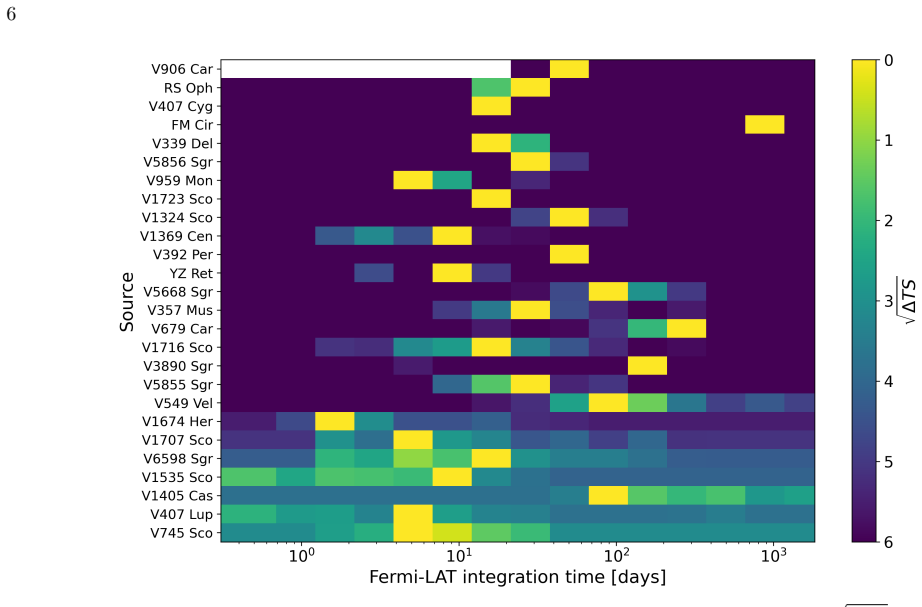
The central object is t*_gamma, the gamma-ray integration window that maximizes the likelihood Test Statistic TS = 2 ln(L/L0) in a logarithmic scan of bin sizes from 0.5 to 1500 days. It is paired with t_N, the optical decay time measured by the paper's machine-learning tool (nova-times) — a gradient-boosted fit to irregular V-band lightcurves that returns the time for the brightness to fall N magnitudes from maximum. The argument is carried by comparing t*_gamma with the optical magnitude drop measured over that same window (peaking near N ≈ 3) and by plotting t_gamma against t3 across the population, with the 1:1 line as the reference for agreement.
What would settle it
Repeat the bin scan on null data — for example, on off-peak time intervals or scrambled photon arrival times for each source — and record the distribution of the maximum Test Statistic over the many bins tested. If this null distribution yields 'optimal' bins as significant as those seen for the real eruptions, or if applying that trials factor drops V679 Car below 5 sigma, the central claim fails.
Extended reading notes
Core claim
The paper's central claim is that a nova's optical t3 — the time to decay three magnitudes in the V band — is the favored analysis bin for Fermi-LAT gamma-ray detection. For each of 26 novae, the authors run a binned maximum-likelihood analysis in logarithmically spaced time windows from 0.5 to 1500 days and define t*_gamma as the window with the largest Test Statistic (TS = 2 ln(L/L0)). They then measure optical decay times t_N with a gradient-boosted machine-learning tool applied to V-band lightcurves, and compare t*_gamma with the optical magnitude drop over the same window. The resulting distribution peaks at roughly three magnitudes of decay, with first and third quartiles near two and four, and a plot of t_gamma against t3 shows many sources near the 1:1 line. Interpreting sqrt(ΔTS) between windows as sigma, the paper reports V679 Car as a >5 sigma gamma-ray nova, and cross-correlation of optical and gamma-ray lightcurves for 18 sources finds zero-lag alignment for most, with ~1-day lags for RS Oph, V1723 Sco, V357 Mus, and V5856 Sgr.
Load-bearing premise
The analysis treats the time bin that maximizes the test statistic in a wide scan of bin sizes as a robust measurement, without correcting for the number of bins tested, so the claimed >5 sigma significance of V679 Car and the t3 correspondence could be inflated by a selection effect.
Editorial extensions
If this is right
- Future Fermi-LAT analyses of newly discovered novae can set their gamma-ray integration window from optical monitoring alone, choosing the optical t3 decay time and skipping blind bin scans.
- The three 4FGL sources coincident with V1324 Sco, V5855 Sgr, and V549 Vel should be removed from the ROI background model during eruption windows, improving the measured flux of these novae.
- V679 Car joins the confirmed gamma-ray nova population as a >5 sigma source, strengthening the case that ordinary classical novae are regularly GeV emitters.
- The near-zero optical/gamma-ray lags measured for most sources, with ~1-day lags for RS Oph, V1723 Sco, V357 Mus, and V5856 Sgr, support the shock-reprocessing scenario in which optical emission is absorbed and re-radiated shock power.
Reading between the lines
- If the t3 correspondence survives a trials correction for the number of scanned bins, it gives observers a cheap optical prior for gamma-ray timing that could be applied to archival Fermi-LAT data to search for fainter or previously missed novae.
- The large spread around t3 (quartiles from ~2 to ~4 magnitudes) suggests that a single universal gamma-ray window is not physical; population studies should weight each system's window by its own optical decay rather than adopt a common bin.
- The nova-times tool's gradient-boosted decay-time measurement from sparse lightcurves could be carried over to other transient classes, where decay timescales similarly select observing strategies.
- A direct test: for a nova discovered purely optically with no gamma-ray trigger, predict the optimal gamma-ray window from its t3 and check that this bin alone yields a significant detection in archival LAT data.
Editorial analysis
A structured set of objections, weighed in public.
Referee Report
Summary. The paper analyzes all 26 Fermi-LAT-detected novae on Koji Mukai's list for the period August 2008 through June 2024. For each nova, the authors perform a binned likelihood analysis over a logarithmically spaced grid of integration times t_gamma and define t*_gamma as the bin that maximizes the Test Statistic. They compare t*_gamma with optical decay times t_N measured from AAVSO V-band light curves using a new open-source machine-learning tool (nova-times), and interpret the resulting distribution as showing that t_3 is the favored gamma-ray integration window. They also report V679 Car as a >5 sigma gamma-ray nova, propose associations for three coincident 4FGL sources, and perform cross-correlation analyses of optical and gamma-ray light curves for sources with TS>30.
Significance. If the claimed t_3 correspondence is real, the paper would provide a physically motivated optical prior for choosing gamma-ray integration windows in future Fermi-LAT nova analyses, directly tying gamma-ray detectability to the shock-reprocessing scenario. The confirmation of V679 Car as a >5 sigma source would add a new gamma-ray nova to the sample. The paper also ships the open-source nova-times tool and a full table of t_N measurements, which are useful community resources. The main caveat is that the central statistical claims are currently supported mainly by visual trends and unquantified comparisons; the significance of the result depends on whether the t_3 preference survives a proper null-hypothesis treatment and trials correction.
major comments (3)
- [§2.4, §3] The quantity t*_gamma is defined as the bin that maximizes TS over a logarithmically sampled grid from 0.5 to 1500 days, yet the quoted significances, including the V679 Car claim of >5 sigma (Table 1, TS=61.97), are derived from sqrt(TS) or sqrt(Delta TS) with no correction for this maximization. Because Section 3 itself notes that weakly detected novae have broad TS distributions, the single maximizing bin is not a robust measurement; please provide either a trials-corrected significance, a null-hypothesis simulation of the scan, or an explicit argument that the number of effectively independent bins is small enough that the multiplicity penalty is negligible.
- [§4.2, Fig. 2] The central claim that t_3 is the favored gamma-ray integration window rests on a histogram that peaks near N approximately 3, but no null model, p-value, or uncertainty on the bin counts is given, and t_3 was selected only after comparing t_2, t_3, and t_4. The RMS comparisons in §4.2 are quoted without errors or a statistical test. Please provide a quantitative test, such as a permutation of the t*_gamma values against the optical t_N values or a bootstrap distribution of the histogram peak, and report correlation coefficients with uncertainties for Figs. 3 and 4.
- [Table 2, §4.1] The t_N measurements are reported without uncertainties even though the text states that variance increases for sparse AAVSO light curves and the GBM fit has a tunable depth. Since t*_gamma is discretized on a logarithmic grid, the Fig. 3 comparison of t*_gamma with t_3 needs error bars on both axes before claims such as 'many sources lie on the 1:1 line' and the t_2/t_3/t_4 RMS ranking can be evaluated.
minor comments (6)
- [Table 1] The column header 'Positional Optimal t*_gamma Offset (deg) ROI TS a (days)' is ambiguous; the units for t*_gamma should be labeled clearly in the header or caption.
- [Fig. 1 caption] The color-bar label 'sqrt(Delta TS) ~ sigma' is informal; since Delta TS is not guaranteed to follow the Wilks distribution for an on-peak scan, please either define the mapping precisely or relabel the color scale.
- [§2.4, Fig. 2] V906 Car and V959 Mon are excluded from Fig. 2 and the §4.3 analysis, but this exclusion is only explained in §2.4; please state these exclusions explicitly in the relevant figure captions and main text.
- [§4.1] The nova-times tool assumes that the observations sample the peak brightness, while the text also notes that the peak may be missed; please state how this assumption affects the measured t_N values and whether any sources are particularly affected.
- [§4.2] The sentence referring to 'the undetected sources' in the context of Fig. 3 should be reworded, since the sources under discussion are weakly detected rather than undetected.
- [References] The Li et al. (2017) reference appears twice in the reference list and should be deduplicated.
Circularity Check
No circularity found: t*_gamma and t_N are independent measurements, and the paper's central correlation is a post-hoc comparison, not a construction.
full rationale
The derivation chain is self-contained. In Section 2.4, t*_gamma is defined purely from Fermi-LAT binned likelihood fits: 'We define t*_gamma as the time bin that maximizes the TS.' The optical decay times t_N are measured independently in Section 4.1 from AAVSO V-band lightcurves using the nova-times tool, which is a machine-learning imputation and decay-time estimator, not a function of the gamma-ray analysis. The central comparison in Figure 2 and Section 4.2 overlays these two independently measured quantities: the gamma-ray optimal bin is compared with the optical magnitude drop over that same window. No parameter is fitted to the optical data and then relabeled as a gamma-ray prediction, and no equation defines t*_gamma in terms of t_3 or vice versa. The paper contains no load-bearing self-citations: the cited prior work for the PLEC spectral model and the shock scenario is external, and the authors' own nova-times code is a measurement tool rather than a source of the claimed correlation. The main caveat is statistical rather than circular: t*_gamma is the maximum over a logarithmically sampled grid of bins and is interpreted without an explicit trials correction, so the V679 Car significance and the Figure 2 peak could be affected by selection effects. That is a correctness or statistical-validity concern, not a case where the output reduces to the input by construction. Therefore no circular step can be quoted, and the appropriate circularity score is 0.
Assumptions & free parameters
free parameters (2)
- GBM data richness threshold and tree depth
- Fixed spectral parameters Ec and b =
Ec = 1 GeV, b = 1
assumptions (4)
- domain assumption AAVSO V-band lightcurves sample the nova peak and are adequately calibrated for t_N measurement.
- domain assumption The gamma-ray eruption start time (tmin) can be set from optical and discovery dates and aligns with the optical lightcurve.
- domain assumption GeV gamma-rays and optical light in novae are both powered by the same non-relativistic shocks, with optical as reprocessed shock power.
- standard math sqrt(TS) can be interpreted as a Gaussian significance via Wilks' theorem.
Cite this review
Pith. "Pith review of An Optically Motivated Gamma-ray Study of Fermi-LAT Novae." pith.science (2026). https://pith.science/paper/F5TLS4KF
@misc{pith2026260810388,
  author       = {Pith},
  title        = {Pith review of: An Optically Motivated Gamma-ray Study of Fermi-LAT Novae},
  year         = {2026},
  howpublished = {\url{https://pith.science/paper/F5TLS4KF}},
  note         = {Machine review of arXiv:2608.10388}
}
abstract
High-energy (GeV) gamma-ray emission from nova eruptions was a surprise detection by the Fermi-LAT in 2010. Since then, it has been suggested that the gamma-rays from these systems are generated in collisionless non-relativistic shocks. In this theory, the observed correlation between optical and gamma-ray nova lightcurves naturally arises if a portion of the optical luminosity is reprocessed shock power. In this work, we investigate this scenario by analyzing Fermi-LAT-detected novae in varied time bins and then correlating the bin size that maximizes the nova's significance (tgam) with the nova's optical eruption data. Furthermore, we investigate whether there is a common optical decay across the sources' measured tgam values in the population. We find that across our population, a nova's $t_3$ (the time it takes the nova V band brightness to decay 3 magnitudes) appears to be the favored analysis bin that optimizes the Fermi-LAT detection significance, although there is significant spread. Additionally, we report V679 Car, a source previously noted as a marginally detected gamma-ray nova, as a $>5 \sigma$ detection in this work. We perform cross-correlation analysis of gamma-ray and optical lightcurves.
Figures


Figures from the paper (1 more)

Reference graph
Works this paper leans on
-
[2]
Fermi. Science , author =. 2014 , note =. doi:10.1126/science.1253947 , abstract =
-
[3]
Annual Review of Astronomy and Astrophysics , author =
New. Annual Review of Astronomy and Astrophysics , author =. 2021 , note =. doi:10.1146/annurev-astro-112420-114502 , abstract =
-
[4]
Publications of the Astronomical Society of the Pacific , author =
The. Publications of the Astronomical Society of the Pacific , author =. 2016 , note =. doi:10.1088/1538-3873/128/963/051001 , abstract =
-
[5]
A. Nature Astronomy , author =. 2017 , note =. doi:10.1038/s41550-017-0222-1 , abstract =
-
[6]
Particle acceleration by astrophysical shocks. , keywords =. doi:10.1086/182658 , adsurl =
-
[7]
The acceleration of cosmic rays in shock fronts - I. , keywords =. doi:10.1093/mnras/182.2.147 , adsurl =
-
[8]
Fermi establishes classical novae as a distinct class of gamma-ray sources. Science , keywords =. doi:10.1126/science.1253947 , archivePrefix =. 1408.0735 , primaryClass =
-
[9]
Fermi-LAT Gamma-Ray Detections of Classical Novae V1369 Centauri 2013 and V5668 Sagittarii 2015. , keywords =. doi:10.3847/0004-637X/826/2/142 , archivePrefix =. 1605.04216 , primaryClass =
arXiv 2013
Show all 91 references
-
[10]
, keywords =
Fermi Large Area Telescope Fourth Source Catalog. , keywords =. doi:10.3847/1538-4365/ab6bcb , archivePrefix =. 1902.10045 , primaryClass =
1902 arXiv
-
[11]
The Astrophysical Journal , author =
Fermi. The Astrophysical Journal , author =. 2022 , note =. doi:10.3847/1538-4357/ac7eb7 , abstract =
2022 doi
-
[12]
, keywords =
What determines the -ray luminosities of classical novae?. , keywords =. doi:10.1093/mnras/staf2270 , archivePrefix =. 2508.15900 , primaryClass =
-
[13]
Astronomy and Astrophysics , author =
Search for gamma-ray emission from. Astronomy and Astrophysics , author =. 2018 , note =. doi:10.1051/0004-6361/201731516 , abstract =
2018 doi
-
[14]
, year = 1942, month = feb, volume =
Review of Publications - The Story of Variable Stars, by Leon Campbell and Luigi Jacchia. , year = 1942, month = feb, volume =
1942
-
[15]
Physics Today , year = 2019, month = nov, volume =
The new science of novae. Physics Today , year = 2019, month = nov, volume =. doi:10.1063/PT.3.4341 , adsurl =
2019 doi
- [16]
-
[17]
, keywords =
Gamma-ray novae as probes of relativistic particle acceleration at non-relativistic shocks. , keywords =. doi:10.1093/mnras/stv742 , archivePrefix =. 1501.05308 , primaryClass =
-
[18]
Nature Astronomy , keywords =
A nova outburst powered by shocks. Nature Astronomy , keywords =. doi:10.1038/s41550-017-0222-1 , archivePrefix =. 1709.00763 , primaryClass =
-
[19]
Nature Astronomy , keywords =
Direct evidence for shock-powered optical emission in a nova. Nature Astronomy , keywords =. doi:10.1038/s41550-020-1070-y , archivePrefix =. 2004.05562 , primaryClass =
2004 arXiv
-
[20]
, keywords =
Nova multiwavelength light curves: predicting UV precursor flashes and pre-maximum halts. , keywords =. doi:10.1093/mnras/stt2027 , adsurl =
-
[21]
Thermal emission
Shocks in nova outflows - I. Thermal emission. , keywords =. doi:10.1093/mnras/stu844 , archivePrefix =. 1403.1579 , primaryClass =
-
[22]
, keywords =
Suppression of Shock X-Ray Emission in Novae from Turbulent Mixing with Cool Gas. , keywords =. doi:10.3847/1538-4357/ade711 , archivePrefix =. 2505.08907 , primaryClass =
- [23]
-
[24]
, keywords =
A stacking survey of gamma-ray pulsars. , keywords =. doi:10.1093/mnras/stad2217 , archivePrefix =. 2112.10030 , primaryClass =
-
[25]
, keywords =
Blazars at the Cosmic Dawn. , keywords =. doi:10.3847/1538-4357/ab9c1a , archivePrefix =. 2006.01857 , primaryClass =
2006 arXiv
-
[26]
, keywords =
Fermi LAT Observation of Diffuse Gamma Rays Produced Through Interactions Between Local Interstellar Matter and High-energy Cosmic Rays. , keywords =. doi:10.1088/0004-637X/703/2/1249 , archivePrefix =. 0908.1171 , primaryClass =
-
[27]
, title=
Anaconda, Inc. , title=. Anaconda Documentation , version=
-
[28]
Fermitools: Fermi Science Tools
-
[29]
35th International Cosmic Ray Conference (ICRC2017) , year = 2017, series =
Fermipy: An open-source Python package for analysis of Fermi-LAT Data. 35th International Cosmic Ray Conference (ICRC2017) , year = 2017, series =. doi:10.22323/1.301.0824 , archivePrefix =. 1707.09551 , primaryClass =
2017 arXiv
-
[30]
, year = 1972, month = aug, volume =
CNO Abundances and Hydrodynamic Models of the Nova Outburst. , year = 1972, month = aug, volume =. doi:10.1086/151619 , adsurl =
1972 doi
-
[31]
(4FGL-DR3) (Fermi-LAT col., 2022)
VizieR Online Data Catalog: Incremental Fermi LAT 4th source cat. (4FGL-DR3) (Fermi-LAT col., 2022). VizieR Online Data Catalog , keywords =
2022
-
[32]
Astrophysics , keywords =
Gamma and radio emission of neutrons stars in the state of accretion. Astrophysics , keywords =. doi:10.1007/BF01002575 , adsurl =
-
[33]
Journal of High Energy Astrophysics , keywords =
Pair production due to absorption of 2.2 MeV photons in magnetospheres of X-ray pulsars. Journal of High Energy Astrophysics , keywords =. doi:10.1016/j.jheap.2025.100420 , adsurl =
2025
-
[34]
, keywords =
Helium Destruction and Gamma-Ray Line Emission in Accreting Neutron Stars. , keywords =. doi:10.1086/172621 , adsurl =
- [35]
-
[36]
, keywords =
Particle acceleration and non-thermal emission during the V407 Cygni nova outburst. , keywords =. doi:10.1051/0004-6361/201220289 , archivePrefix =. 1209.0625 , primaryClass =
-
[37]
, keywords =
High-energy Emission from Nonrelativistic Radiative Shocks: Application to Gamma-Ray Novae. , keywords =. doi:10.3847/1538-4357/aa9c4a , archivePrefix =. 1611.04532 , primaryClass =
-
[38]
Cataclysmic variable stars
-
[39]
, keywords =
The orbital period distribution of novae. , keywords =
- [40]
-
[41]
, keywords =
The Calibration of Novae as Distance Indicators. , keywords =. doi:10.1086/176342 , adsurl =
-
[42]
, keywords =
On the Light Curves of Disk and Bulge Novae. , keywords =. doi:10.3847/1538-4357/adb628 , archivePrefix =. 2502.08198 , primaryClass =
-
[43]
, keywords =
A Detailed Observational Analysis of V1324 Sco, the Most Gamma-Ray-luminous Classical Nova to Date. , keywords =. doi:10.3847/1538-4357/aaa12a , archivePrefix =. 1701.03094 , primaryClass =
-
[44]
The Astronomer's Telegram , keywords =
MOA 2012 BLG-320: Discovery and Observations of a Nova Candidate Towards the Galactic Bulge. The Astronomer's Telegram , keywords =
2012
-
[45]
, keywords =
Gamma-ray emission from internal shocks in novae. , keywords =. doi:10.1051/0004-6361/201731692 , archivePrefix =. 1710.05515 , primaryClass =
-
[46]
, keywords =
NuSTAR Detection of X-Rays Concurrent with Gamma-Rays in the Nova V5855 Sgr. , keywords =. doi:10.3847/1538-4357/aafb6d , archivePrefix =. 1901.00030 , primaryClass =
1901 arXiv
-
[47]
, keywords =
An update on Fermi-LAT transients in the Galactic plane, including strong activity of Cygnus X-3 in mid-2020. , keywords =. doi:10.1093/mnras/stac3453 , archivePrefix =. 2209.12461 , primaryClass =
2020 arXiv
-
[48]
, keywords =
Evidence of the -ray counterpart of nova FM Cir from Fermi-LAT. , keywords =. doi:10.1093/mnrasl/slae032 , archivePrefix =. 2404.08409 , primaryClass =
-
[49]
The Astronomer's Telegram , keywords =
Detection of a Wind in the Fast Nova V1674 Her. The Astronomer's Telegram , keywords =
-
[50]
The Astronomer's Telegram , keywords =
V1674 Her is a Neon Nova. The Astronomer's Telegram , keywords =
-
[51]
, keywords =
X-ray spectroscopy of the -ray brightest nova V906 Car (ASASSN-18fv). , keywords =. doi:10.1093/mnras/staa2104 , archivePrefix =. 2007.07885 , primaryClass =
2007 arXiv
- [52]
-
[53]
The Astronomer's Telegram , keywords =
Fermi-LAT Observations of Nova V1369 Centauri 2013 Brightening in Gamma rays. The Astronomer's Telegram , keywords =
2013
-
[54]
, keywords =
Astropy: A community Python package for astronomy. , keywords =. doi:10.1051/0004-6361/201322068 , archivePrefix =. 1307.6212 , primaryClass =
-
[55]
, keywords =
The Astropy Project: Building an Open-science Project and Status of the v2.0 Core Package. , keywords =. doi:10.3847/1538-3881/aabc4f , archivePrefix =. 1801.02634 , primaryClass =
-
[56]
, keywords =
The Astropy Project: Sustaining and Growing a Community-oriented Open-source Project and the Latest Major Release (v5.0) of the Core Package. , keywords =. doi:10.3847/1538-4357/ac7c74 , archivePrefix =. 2206.14220 , primaryClass =
-
[57]
and Varoquaux, G
Pedregosa, F. and Varoquaux, G. and Gramfort, A. and Michel, V. and Thirion, B. and Grisel, O. and Blondel, M. and Prettenhofer, P. and Weiss, R. and Dubourg, V. and Vanderplas, J. and Passos, A. and Cournapeau, D. and Brucher, M. and Perrot, M. and Duchesnay, E. , journal=. S...
-
[58]
, keywords =
GeV-TeV gamma rays and neutrinos from the Nova V407 Cygni. , keywords =. doi:10.1103/PhysRevD.86.063011 , archivePrefix =. 1208.6200 , primaryClass =
-
[59]
, keywords =
Evidence for Multiple Shocks from the -Ray Emission of RS Ophiuchi. , keywords =. doi:10.3847/1538-4357/acc105 , archivePrefix =. 2211.02059 , primaryClass =
-
[60]
Science , keywords =
Gamma-Ray Emission Concurrent with the Nova in the Symbiotic Binary V407 Cygni. Science , keywords =. doi:10.1126/science.1192537 , archivePrefix =. 1008.3912 , primaryClass =
-
[61]
Machine Learning for Physics and Astronomy
-
[62]
arXiv e-prints , keywords =
Multiple outflows and delayed ejections revealed by early imaging of novae. arXiv e-prints , keywords =. doi:10.48550/arXiv.2512.05220 , archivePrefix =. 2512.05220 , primaryClass =
-
[63]
Nova shells. II. Calibration of the distance scale using novae. , keywords =. doi:10.1086/163135 , adsurl =
-
[64]
, keywords =
Spectroscopic and photometric behavior of Nova Cygni 1992 in the first nine months following outburst. , keywords =
1992
-
[65]
, keywords =
Photometric evolution of seven recent novae and the double-component characterizing the light curve of those emitting in gamma rays. , keywords =. doi:10.1093/mnras/stx1116 , archivePrefix =. 1703.09017 , primaryClass =
-
[66]
, keywords =
Spectroscopic study of the quiescent stages in between the 2006 and 2021 outbursts of RS Ophiuchi. , keywords =. doi:10.1093/mnras/staf119 , archivePrefix =. 2402.03234 , primaryClass =
2006 arXiv
-
[67]
, keywords =
Persistent nuclear burning in Nova Sgr 2016 N.4 (=V5856 Sgr = ASASSN-16ma) six years past its outburst. , keywords =. doi:10.1051/0004-6361/202244498 , archivePrefix =. 2208.09630 , primaryClass =
2016 arXiv
-
[68]
, keywords =
The sustained post-outburst brightness of Nova Per 2018, the evolved companion, and the long orbital period. , keywords =. doi:10.1051/0004-6361/202038403 , archivePrefix =. 2007.12196 , primaryClass =
2018 arXiv
-
[69]
Research Notes of the American Astronomical Society , keywords =
Discovery of 12 New Orbital Periods for Classical Novae. Research Notes of the American Astronomical Society , keywords =. doi:10.3847/2515-5172/ade5a5 , adsurl =
-
[70]
, keywords =
Comprehensive catalogue of the overall best distances and properties of 402 galactic novae. , keywords =. doi:10.1093/mnras/stac2900 , archivePrefix =. 2210.03181 , primaryClass =
-
[71]
, title =
Schaefer, Bradley E. , title =. arXiv e-prints , archivePrefix=. 2106.13907 , year =
-
[72]
2025 , eprint=
Fermi-LAT detections of novae V1723 Sco and V6598 Sgr , author=. 2025 , eprint=
2025
-
[73]
arXiv e-prints , keywords =
Formation of an optically thick shocked shell in the very fast nova V1674 Herculis: the origin of superbrightness. arXiv e-prints , keywords =. doi:10.48550/arXiv.2512.20175 , archivePrefix =. 2512.20175 , primaryClass =
- [74]
-
[75]
Ptolemy, Claudius , title =. c. 150 , note =
-
[76]
, keywords =
Unraveling the oldest and faintest recovered nova : CK Vulpeculae (1670). , keywords =. doi:10.1086/163296 , adsurl =
-
[77]
S. S. Wilks , journal =. The Large-Sample Distribution of the Likelihood Ratio for Testing Composite Hypotheses , urldate =
-
[78]
Boletin de la Asociacion Argentina de Astronomia La Plata Argentina , keywords =
The orbital period of the nova V1674 Her as observed with TESS. Boletin de la Asociacion Argentina de Astronomia La Plata Argentina , keywords =. doi:10.48550/arXiv.2310.02220 , archivePrefix =. 2310.02220 , primaryClass =
-
[79]
Harris and K
Charles R. Harris and K. Jarrod Millman and St. Array programming with. 2020 , month = sep, journal =. doi:10.1038/s41586-020-2649-2 , publisher =
2020 doi
-
[80]
doi:10.5281/zenodo.3509134 , url =
The pandas development team , title =. doi:10.5281/zenodo.3509134 , url =
- [81]
-
[82]
arXiv e-prints , keywords =
Probing the potential high-energy messengers of the anticipated T Coronae Borealis outburst. arXiv e-prints , keywords =. doi:10.48550/arXiv.2603.15570 , archivePrefix =. 2603.15570 , primaryClass =
-
[83]
Astronomy Letters , keywords =
Recurrent Symbiotic Nova T Coronae Borealis before Outburst. Astronomy Letters , keywords =. doi:10.1134/S1063773723090037 , archivePrefix =. 2308.10011 , primaryClass =
- [84]
-
[85]
, keywords =
The B & V light curves for recurrent nova T CrB from 1842-2022, the unique pre- and post-eruption high-states, the complex period changes, and the upcoming eruption in 2025.5 1.3. , keywords =. doi:10.1093/mnras/stad735 , archivePrefix =. 2303.04933 , primaryClass =
2022 arXiv
-
[86]
Nature Astronomy , keywords =
Proton acceleration in thermonuclear nova explosions revealed by gamma rays. Nature Astronomy , keywords =. doi:10.1038/s41550-022-01640-z , archivePrefix =. 2202.07681 , primaryClass =
-
[87]
Science , keywords =
Time-resolved hadronic particle acceleration in the recurrent nova RS Ophiuchi. Science , keywords =. doi:10.1126/science.abn0567 , archivePrefix =. 2202.08201 , primaryClass =
-
[88]
, keywords =
Detection of RS Oph with LST-1 and modelling of its HE/VHE gamma-ray emission. , keywords =. doi:10.1051/0004-6361/202452447 , archivePrefix =. 2503.13283 , primaryClass =
-
[89]
, keywords =
A new catalogue of Galactic novae: investigation of the MMRD relation and spatial distribution. , keywords =. doi:10.1093/mnras/sty432 , archivePrefix =. 1802.05725 , primaryClass =
-
[90]
arXiv e-prints , keywords =
Shocks in the Symbiotic Recurrent Nova V3890 Sgr: VLBI Radio Imaging and Fermi GeV Gamma-Rays. arXiv e-prints , keywords =. doi:10.48550/arXiv.2603.15480 , archivePrefix =. 2603.15480 , primaryClass =
-
[91]
, keywords =
A Unified Model for Shock Interaction and -Ray Emission in Classical Novae. , keywords =. doi:10.3847/1538-4357/ae6db1 , archivePrefix =. 2604.06310 , primaryClass =
-
[92]
Journal of Computational and Applied Mathematics , volume =
Paul Dierckx , title =. Journal of Computational and Applied Mathematics , volume =. 1975 , keywords =
1975
Reviewed August 12, 2026 · model on record in the stance chip above.
Discussion (0). Continue with ORCID to comment.