Investigating nonlinear dynamics in a mass-spring oscillator using real-time computer vision
Pith reviewed 2026-07-03 01:09 UTC · model grok-4.3
The pith
A smartphone camera tracks a vertical mass-spring oscillator in real time to capture nonlinear effects such as harmonic generation and frequency mixing.
A machine-rendered reading of the paper's core claim, the machinery that carries it, and where it could break.
Core claim
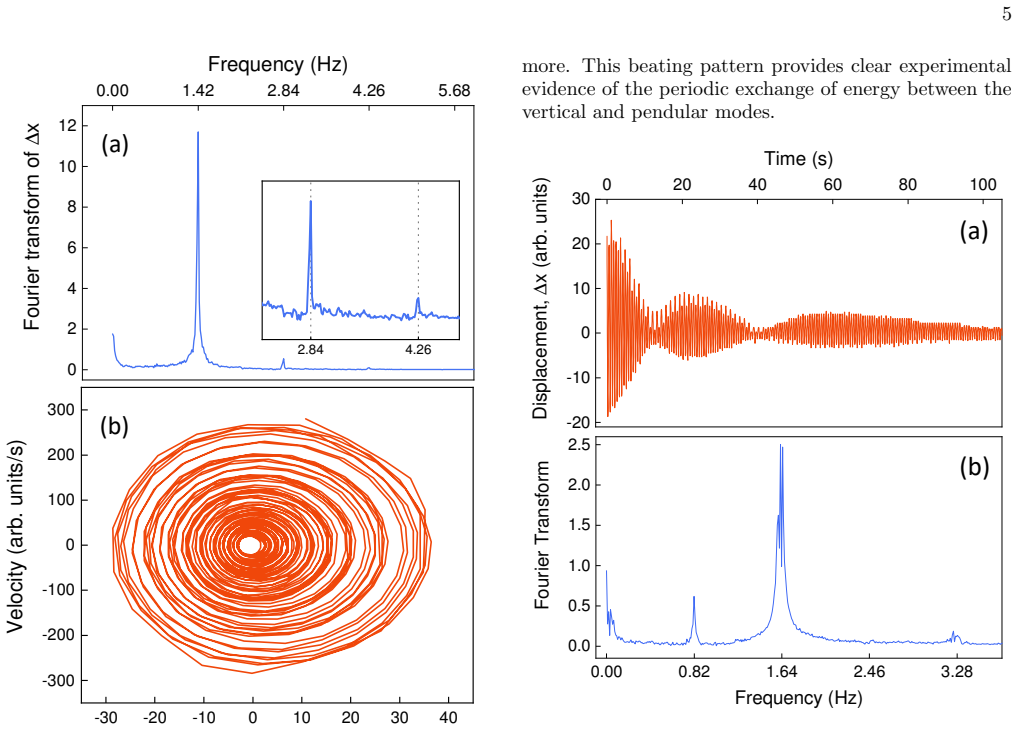
The proposed system automatically tracks the motion of the oscillating mass with a smartphone camera, displays the displacement in real time, and exports the recorded data for further analysis, enabling investigation of nonlinear phenomena including harmonic generation, frequency mixing, and energy exchange between coupled oscillation modes.
What carries the argument
Real-time computer vision tracking that converts smartphone video frames into a live displacement time series without manual measurement.
If this is right
- Damped oscillation decay and period can be measured directly from the exported data.
- Power spectra of the motion reveal harmonic generation when the spring is driven into the nonlinear regime.
- Phase-space portraits can be reconstructed from the position and velocity time series.
- Energy exchange between two coupled oscillation modes becomes visible in the time records.
Where Pith is reading between the lines
- The same camera-tracking approach could be applied to other simple mechanical systems such as pendulums or coupled carts to introduce nonlinear topics without new hardware.
- Because data export is automatic, the method could support remote or at-home labs where students analyze files on their own computers.
- Comparison of the tracked trajectories against numerical solutions of the nonlinear equations would let students test model assumptions directly from the same dataset.
Load-bearing premise
The vision-based position tracking stays accurate enough under ordinary lab lighting and minor camera movement to resolve the small amplitude harmonics and mixing products that signal nonlinearity.
What would settle it
Record the displacement time series from the system during a known nonlinear drive and check whether the Fourier spectrum contains the expected harmonic peaks at the predicted amplitudes; absence of those peaks at the level theory requires would show the tracking cannot support the claimed nonlinear investigations.
Figures


read the original abstract
We present a low-cost laboratory for investigating the dynamics of a vertical mass-spring oscillator using real-time computer vision. The proposed system automatically tracks the motion of the oscillating mass with a smartphone camera, displays the displacement in real time, and exports the recorded data for further analysis. Representative experiments include damped oscillations, oscillation period measurements, spectral analysis, and phase-space reconstruction. The system also enables the investigation of nonlinear phenomena, including harmonic generation, frequency mixing, and energy exchange between coupled oscillation modes. Owing to its low cost, ease of construction, and automated data acquisition, the proposed apparatus extends the traditional mass-spring experiment to include topics in nonlinear dynamics that are rarely explored in undergraduate laboratories.
Editorial analysis
A structured set of objections, weighed in public.
Referee Report
Summary. The manuscript presents a low-cost smartphone-camera computer-vision apparatus for real-time tracking of a vertical mass-spring oscillator. It claims the system automatically tracks the oscillating mass, displays displacement in real time, exports data, and thereby enables undergraduate experiments on damped oscillations, period measurement, spectral analysis, phase-space reconstruction, and nonlinear phenomena including harmonic generation, frequency mixing, and energy exchange between coupled modes.
Significance. If the tracking precision is adequate to resolve small nonlinear signatures, the work would usefully extend the traditional mass-spring experiment into nonlinear dynamics at minimal cost. The real-time display and data-export features are practical strengths for lab instruction. The educational impact, however, remains conditional on unprovided validation that the computer-vision measurements are accurate enough for the claimed nonlinear investigations.
major comments (1)
- [Abstract; representative experiments] Abstract and representative-experiments description: the central claim that the apparatus 'enables investigation of nonlinear phenomena, including harmonic generation, frequency mixing, and energy exchange' is unsupported by any reported tracking-error metrics, error bars on extracted frequencies or amplitudes, or comparison against a calibrated reference sensor. The representative experiments (damped oscillation, spectral analysis) therefore do not demonstrate that nonlinear products exceed the tracking noise floor under typical lab lighting and camera jitter.
Simulated Author's Rebuttal
We thank the referee for highlighting the need for explicit validation of tracking accuracy to support claims about nonlinear investigations. We agree this is a substantive gap in the current manuscript and will address it directly.
read point-by-point responses
-
Referee: [Abstract; representative experiments] Abstract and representative-experiments description: the central claim that the apparatus 'enables investigation of nonlinear phenomena, including harmonic generation, frequency mixing, and energy exchange' is unsupported by any reported tracking-error metrics, error bars on extracted frequencies or amplitudes, or comparison against a calibrated reference sensor. The representative experiments (damped oscillation, spectral analysis) therefore do not demonstrate that nonlinear products exceed the tracking noise floor under typical lab lighting and camera jitter.
Authors: We agree that the manuscript does not report quantitative tracking-error metrics, error bars, or reference-sensor comparisons, leaving the nonlinear-phenomena claim unsupported. In revision we will add a validation section that (i) quantifies RMS position error on a static target under representative lab lighting, (ii) includes error bars on all frequency and amplitude values extracted from the damped-oscillation and spectral-analysis data, and (iii) presents a side-by-side comparison of computer-vision trajectories against simultaneous recordings from a calibrated linear potentiometer. These additions will demonstrate whether the reported nonlinear signatures lie above the measurement noise floor. revision: yes
Circularity Check
No circularity: apparatus description with no derivations, predictions, or self-referential claims
full rationale
The paper presents a hardware/software apparatus for real-time tracking of a mass-spring system and lists representative experiments (damped oscillations, spectral analysis, phase-space plots, nonlinear phenomena). No equations, parameter fits, predictions, or self-citations appear in the provided text. The central claim that the system 'enables investigation' of nonlinear effects rests on the apparatus description itself rather than reducing to any fitted input or prior self-citation by construction. This matches the default expectation of no circularity for an experimental methods paper.
discussion (0)
Sign in with ORCID, Apple, or X to comment. Anyone can read and Pith papers without signing in.