Joint Visibility Analysis of RIS in Non-Terrestrial Networks through Stochastic Geometry
Pith reviewed 2026-06-26 11:50 UTC · model grok-4.3
The pith
RISs modeled as a Poisson point process with exponential heights yield a closed-form expected count of surfaces jointly visible to both user and non-terrestrial base station, maximized at twice the Basel number in 2D.
A machine-rendered reading of the paper's core claim, the machinery that carries it, and where it could break.
Core claim
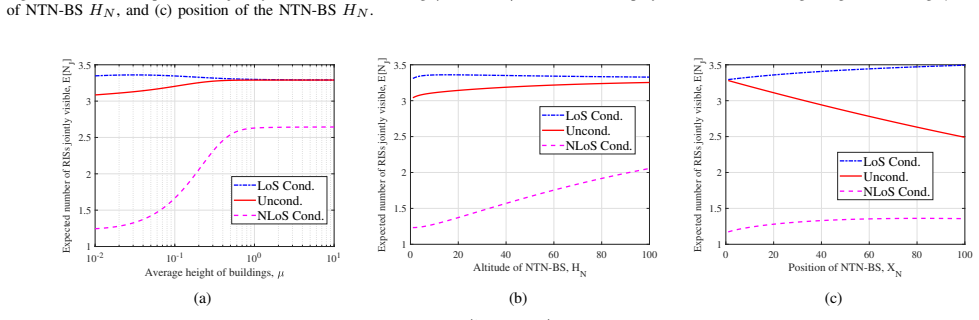
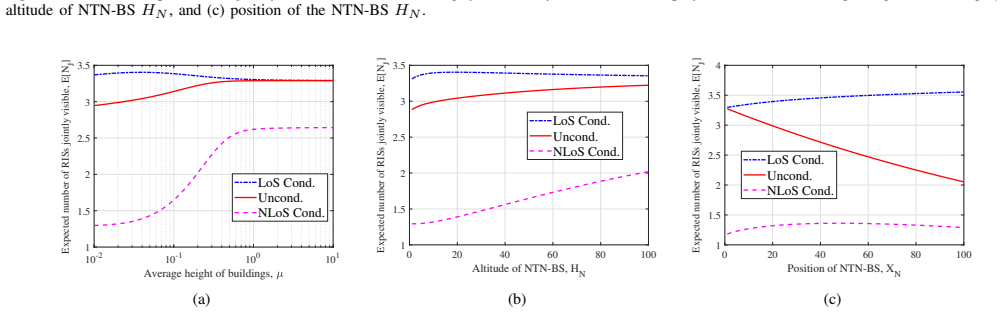
Accounting for the dual stochasticity from RIS locations and heights, the expected number of jointly visible RISs is derived in closed form for a homogeneous Poisson point process with exponentially distributed heights; in the 2D setting this expectation reaches a maximum value of twice the Basel number π²/6.
What carries the argument
The joint visibility probability obtained by integrating the void probability of the Poisson point process of building locations together with the independent exponential height distribution.
If this is right
- The unconditional maximum expected count equals 2*(π²/6).
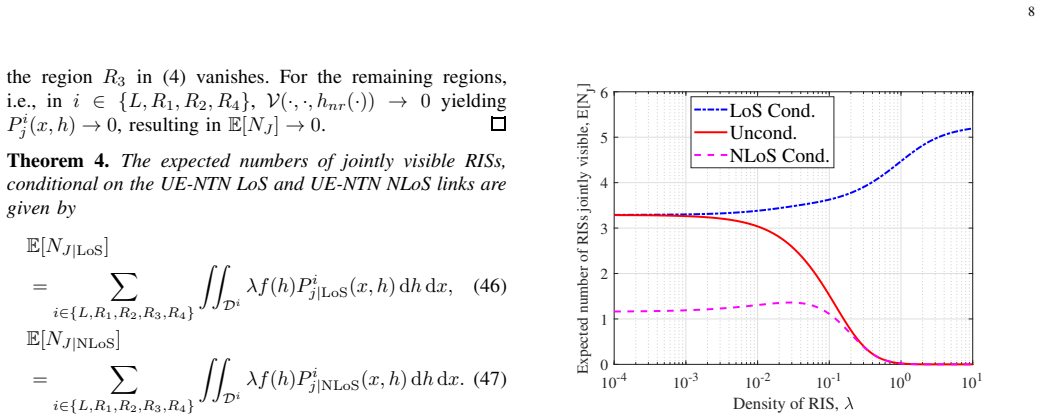
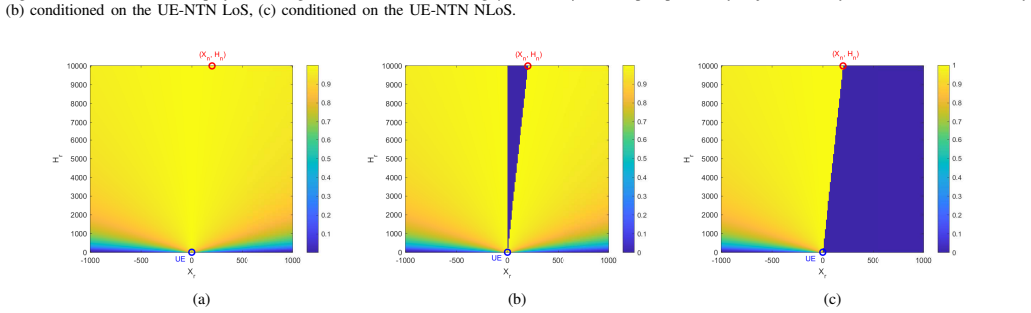
- Separate closed-form expressions exist for the count conditioned on the user-to-base-station link being line-of-sight or non-line-of-sight.
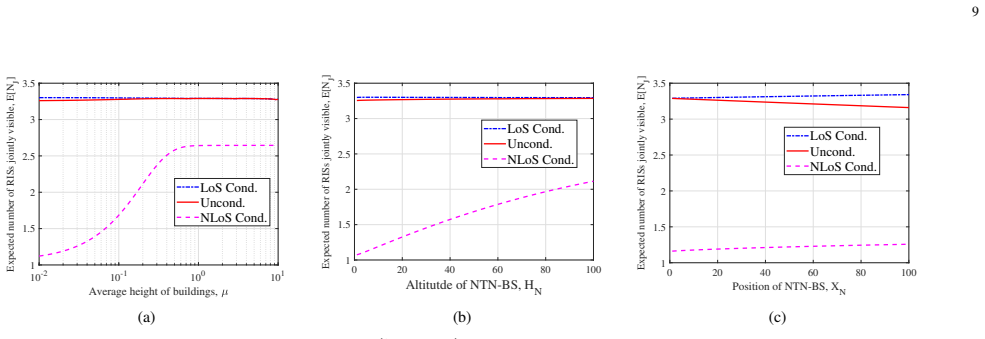
- The expressions depend explicitly on building density, mean height, base-station altitude, and horizontal position.
Where Pith is reading between the lines
- The factor of two that appears in the 2D maximum may be replaced by a different constant when the same model is lifted to three dimensions.
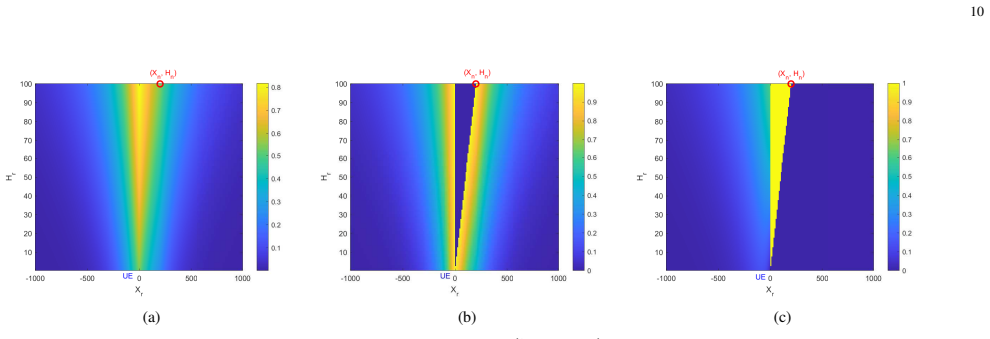
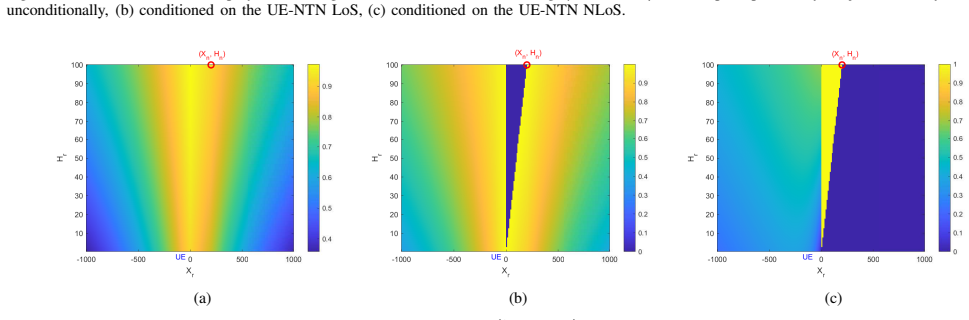
- The probability heatmaps supplied in the paper can be used to derive location-specific placement rules rather than relying solely on the average count.
- Economic cost-benefit calculations for surface density follow immediately from the closed-form expectation once installation and maintenance costs per surface are known.
Load-bearing premise
Building rooftops form a homogeneous Poisson point process with independent exponentially distributed heights and the non-terrestrial base station sits at a fixed deterministic location.
What would settle it
Measure the average number of jointly visible rooftop surfaces in a real urban block with recorded building positions and heights, then compare the empirical average against the closed-form expression evaluated at the measured density and mean height.
Figures
read the original abstract
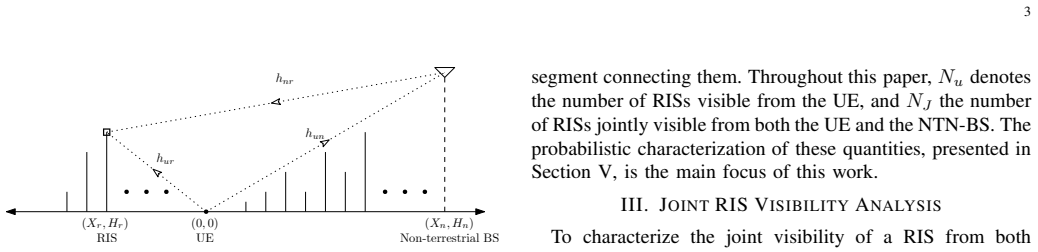
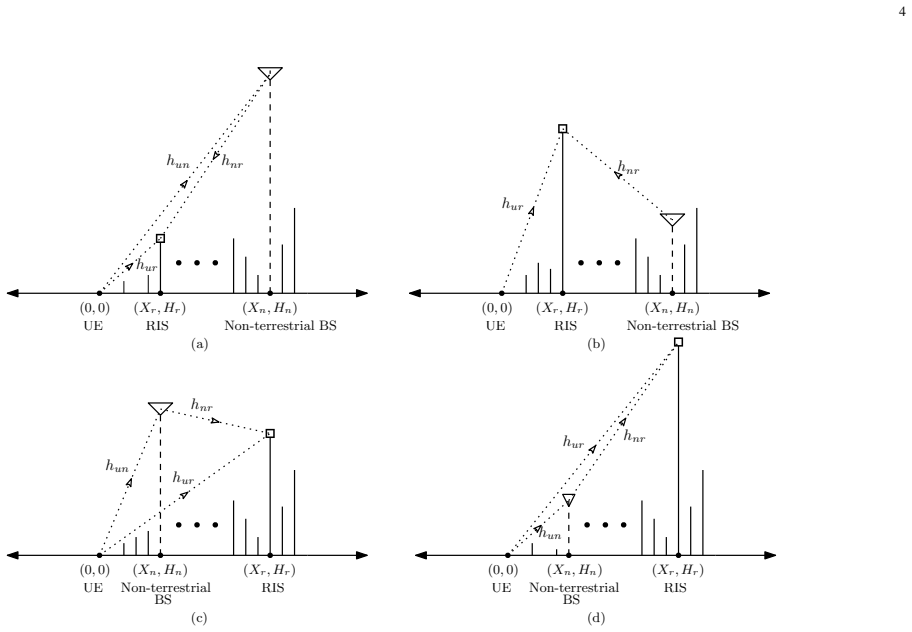
Non-Terrestrial networks (NTNs) are a key theme in upcoming 6G communications, especially for ubiquitous coverage. Urban environments, comprising of high rise buildings often result in blocking the line of sight (LoS) path between the user equipment (UE) and the NTN base station (NTN-BS). In this paper we investigate the situation where reconfigurable intelligent surfaces (RIS) are deployed on the building roof-tops to ensure multi-hop connectivity between the UE and the NTN-BS. In such a scenario, it becomes crucial to statistically study the LoS visibility of the RIS from the UE as well as from the NTN-BS, hence termed as joint visibility. In this work, accounting for the dual stochasticity arising from the locations of the RIS deployed buildings and the respective random building heights, we statistically study the probability of joint RIS visibility in a two-dimensional (2D) scenario considering a deterministic location of the NTN-BS. Further, we study the joint RIS visibility statistics conditional on the UE-NTN link being LoS or non-LoS. For the RISs deployed as a point point process (PPP) having exponentially distributed heights, the expected RISs jointly visible under the unconditional and conditional geometric settings are derived in closed form. Interestingly, in the 2D setting, the maximum expected RISs jointly visible, unconditionally, is twice the Basel number $(\pi^2/ 6)$. The simulated results are analyzed over building density, average building height, the altitude and position of the NTN-BS. We also illustrate probability heatmaps, demonstrating the strongest chance to have a RIS used conditioned on the system geometry. This study is expected to be useful in planning the deployment of RIS in urban areas, improving the signal and for assessing economic aspects.
Editorial analysis
A structured set of objections, weighed in public.
Referee Report
Summary. The paper models RIS locations on building rooftops as a homogeneous Poisson point process (PPP) in 2D with i.i.d. exponential heights and a deterministic NTN-BS location. It derives closed-form expressions for the expected number of jointly visible RISs (visible to both UE and NTN-BS) in the unconditional case and conditional on the UE-NTN link being LoS or NLoS. The unconditional expectation is shown to attain a maximum value of twice the Basel number (π²/6). Simulation results and visibility heatmaps are presented over parameters including building density, average height, NTN-BS altitude, and position.
Significance. If the derivations hold, the work supplies exact analytical expressions for joint visibility statistics under standard stochastic-geometry assumptions, directly linking PPP properties and exponential height distributions to expected counts. The explicit connection to the Basel number is a notable mathematical feature, and the conditional results are relevant for NTN link-budget planning and RIS deployment economics in urban settings.
minor comments (4)
- [Abstract] Abstract: the phrase 'point point process (PPP)' is a typographical error and should read 'Poisson point process'.
- [Derivation sections (e.g., §III or §IV)] The manuscript states that closed forms are obtained from PPP properties and exponential heights, but the main text should explicitly flag any steps that rely on the memoryless property or on independence between horizontal locations and heights.
- [Numerical results] Simulation section: the parameter ranges used for Monte-Carlo validation (density, height mean, altitude) should be listed in a table so readers can directly compare against the closed-form expressions.
- [Figures] Figure captions for the heatmaps should state the exact conditioning (unconditional vs. LoS/NLoS) and the fixed values of all other parameters.
Simulated Author's Rebuttal
We thank the referee for the positive summary, significance assessment, and recommendation of minor revision. No major comments were listed in the report.
Circularity Check
No significant circularity; derivations follow directly from PPP and exponential assumptions
full rationale
The paper's central results are closed-form expectations for the count of jointly visible RISs (unconditional and conditional on UE-NTN LoS/NLoS) obtained by integrating over a homogeneous PPP of building locations with i.i.d. exponential heights under a fixed NTN-BS position in 2D. These follow from standard stochastic-geometry properties (void probabilities, Campbell's theorem) applied to the visibility indicators; the Basel-number maximum is an extremum of one such integral, not a redefinition or fit. No self-citation is invoked as a load-bearing uniqueness theorem, no parameter is fitted then relabeled a prediction, and no ansatz is smuggled via prior work. The derivation chain is therefore self-contained against the modeling premises stated in the abstract.
Axiom & Free-Parameter Ledger
axioms (2)
- domain assumption RIS locations form a homogeneous Poisson point process
- domain assumption Building heights are independent and exponentially distributed
Reference graph
Works this paper leans on
-
[1]
Baccelli and B
F. Baccelli and B. Blaszczyszyn, Stochastic Geometry and Wireless Networks: V olume 1: THEORY . Now Publishers Inc, 2009, vol. 1
2009
-
[2]
An Aloha protocol for multihop mobile wireless networks,
F. Baccelli et al. , “An Aloha protocol for multihop mobile wireless networks,” IEEE Trans. Inf. Theory , vol. 52, no. 2, pp. 421–436, 2006
2006
-
[3]
Stochastic analysis of spatial and opportunistic A loha,
——, “Stochastic analysis of spatial and opportunistic A loha,” IEEE J. Sel. Areas Commun. , vol. 27, no. 7, pp. 1105–1119, 2009
2009
-
[4]
Spectral efficiency scaling laws in dense random wireless networks with multiple receive anten nas,
N. Lee, F. Baccelli, and R. W. Heath, “Spectral efficiency scaling laws in dense random wireless networks with multiple receive anten nas,” IEEE Trans. Inf. Theory , vol. 62, no. 3, pp. 1344–1359, 2016
2016
-
[5]
A tractable approach to coverage and rate in cellular networks,
J. G. Andrews et al. , “A tractable approach to coverage and rate in cellular networks,” IEEE Trans. Commun. , vol. 59, no. 11, pp. 3122– 3134, 2011
2011
-
[6]
Modeling and analysis of K-tier downlink heterogeneous cellular networks,
H. S. Dhillon et al. , “Modeling and analysis of K-tier downlink heterogeneous cellular networks,” IEEE J. Sel. Areas Commun. , vol. 30, no. 3, pp. 550–560, 2012
2012
-
[7]
A stochastic geometry approach to the modeling of DSRC for vehicular safety communication,
Z. Tong et al. , “A stochastic geometry approach to the modeling of DSRC for vehicular safety communication,” IEEE Trans. Intell. Transp. Syst., vol. 17, no. 5, pp. 1448–1458, 2016
2016
-
[8]
Modeling and analysis of mmWave V2X networks with vehicular platoon systems,
W. Yi et al. , “Modeling and analysis of mmWave V2X networks with vehicular platoon systems,” IEEE J. Sel. Areas Commun., vol. 37, no. 12, pp. 2851–2866, 2019
2019
-
[9]
Downlink coverage analy sis for a finite 3-D wireless network of unmanned aerial vehicles,
V . V . Chetlur and H. S. Dhillon, “Downlink coverage analy sis for a finite 3-D wireless network of unmanned aerial vehicles,” IEEE Trans. Commun., vol. 65, no. 10, pp. 4543–4558, 2017
2017
-
[10]
Performance characteriz ation of canon- ical mobility models in drone cellular networks,
M. Banagar and H. S. Dhillon, “Performance characteriz ation of canon- ical mobility models in drone cellular networks,” IEEE Trans. Wireless Commun., vol. 19, no. 7, pp. 4994–5009, 2020
2020
-
[11]
Stochastic coverage analysi s for multi- altitude leo satellite networks,
N. Okati and T. Riihonen, “Stochastic coverage analysi s for multi- altitude leo satellite networks,” IEEE Communications Letters , vol. 27, no. 12, pp. 3305–3309, 2023
2023
-
[12]
Next generation mega satellite networks for access equality: Opportunities, challenges, and performance,
B. Al Homssi et al., “Next generation mega satellite networks for access equality: Opportunities, challenges, and performance,” IEEE Commun. Mag., vol. 60, no. 4, pp. 18–24, 2022
2022
-
[13]
Performance analysis of RIS-assisted communications,
H. Adrat et al., “Performance analysis of RIS-assisted communications,” in EAI International Conference on Performance Evaluation Me thod- ologies and Tools . Springer, 2024, pp. 213–228
2024
-
[14]
A stochastic geometry framework for performance analysis of ris-assisted ofdm cellular networks,
G. Sun et al. , “A stochastic geometry framework for performance analysis of ris-assisted ofdm cellular networks,” IEEE Trans. Wireless Commun., 2025
2025
-
[15]
Propagation data and prediction methods for th e planning of short-range outdoor radiocommunication systems and radio local area networks in the frequency range 300 MHz to 100 GHz,
ITU-R, “Propagation data and prediction methods for th e planning of short-range outdoor radiocommunication systems and radio local area networks in the frequency range 300 MHz to 100 GHz,” Internat ional Telecommunication Union, Recommendation ITU-R P .1411-11 , Oct. 2021
2021
-
[16]
A survey of the statistical theory of sha pe,
D. G. Kendall, “A survey of the statistical theory of sha pe,” Statistical Science, vol. 4, no. 2, pp. 87–99, 1989
1989
-
[17]
Analysis of blockage effects on urban cellular networks,
T. Bai et al. , “Analysis of blockage effects on urban cellular networks, ” IEEE Trans. Wireless Commun. , vol. 13, no. 9, pp. 5070–5083, 2014
2014
-
[18]
Wirele ss networks appear Poissonian due to strong shadowing,
B. Błaszczyszyn, M. K. Karray, and H. P . Keeler, “Wirele ss networks appear Poissonian due to strong shadowing,” IEEE Trans. Wireless Commun., vol. 14, no. 8, pp. 4379–4390, 2015
2015
-
[19]
Analytic alpha-stable nois e modeling in a poisson field of interferers or scatterers,
J. Ilow and D. Hatzinakos, “Analytic alpha-stable nois e modeling in a poisson field of interferers or scatterers,” IEEE Trans. Signal Process. , vol. 46, no. 6, pp. 1601–1611, 1998
1998
-
[20]
A correlated shadowing model for urban wireless networks,
F. Baccelli and X. Zhang, “A correlated shadowing model for urban wireless networks,” in Proc. IEEE INFOCOM , 2015, pp. 801–809
2015
-
[21]
An indoor correl ated shadow- ing model,
X. Zhang, F. Baccelli, and R. W. Heath, “An indoor correl ated shadow- ing model,” in Proc. IEEE GLOBECOM . IEEE, 2015, pp. 1–7
2015
-
[22]
A 3-D spatial model fo r in-building wireless networks with correlated shadowing,
J. Lee, X. Zhang, and F. Baccelli, “A 3-D spatial model fo r in-building wireless networks with correlated shadowing,” IEEE Trans. Wireless Commun., vol. 15, no. 11, pp. 7778–7793, 2016
2016
-
[23]
On the probability of line-of-sight in urban environ- ments,
A. Al-Hourani, “On the probability of line-of-sight in urban environ- ments,” IEEE Wireless Commun. Lett. , vol. 9, no. 8, pp. 1178–1181, 2020
2020
-
[24]
Line-of-Sight Probability and Holding Distance i n Non- Terrestrial Networks,
——, “Line-of-Sight Probability and Holding Distance i n Non- Terrestrial Networks,” IEEE Commun. Lett. , 2024
2024
-
[25]
A user centric blockage model for wireless networks,
F. Baccelli et al., “A user centric blockage model for wireless networks,” IEEE Trans. Wireless Commun. , vol. 21, no. 10, pp. 8431–8440, 2022
2022
-
[26]
Macro-Diversity in Cellular Networks With Correlated Blockage Model,
B. Liu et al. , “Macro-Diversity in Cellular Networks With Correlated Blockage Model,” IEEE Trans. Commun., vol. 72, no. 4, pp. 2399–2411, 2023
2023
-
[27]
A 3D correlated blockage model for satellite netwo rks,
——, “A 3D correlated blockage model for satellite netwo rks,” IEEE Trans. Commun., 2026
2026
-
[28]
How much can reconfigurable inte lligent surfaces augment sky visibility: a stochastic geometry app roach,
J. Lee and F. Baccelli, “How much can reconfigurable inte lligent surfaces augment sky visibility: a stochastic geometry app roach,” IEEE Trans. Wireless Commun. , vol. 24, no. 1, pp. 796–809, 2024
2024
-
[29]
The Skyline Process: Quantifying Sky Visibility i n 3D Urban Environments,
——, “The Skyline Process: Quantifying Sky Visibility i n 3D Urban Environments,” arXiv preprint arXiv:2603.26072 , 2026
arXiv 2026
-
[30]
Technical advancements toward RIS-assisted NTN-based THz communication for 6G and beyond,
O. A. Amodu et al. , “Technical advancements toward RIS-assisted NTN-based THz communication for 6G and beyond,” IEEE Access , vol. 12, pp. 183 153–183 181, 2024
2024
-
[31]
A simple solution to Basel problem,
M. Ivan, “A simple solution to Basel problem,” Gen. Math , vol. 16, no. 4, pp. 111–113, 2008
2008
-
[32]
Study on New Radio (NR) to support non-terrest rial net- works,
W. 3GPP , “Study on New Radio (NR) to support non-terrest rial net- works,” 3rd Generation Partnership Project (3GPP), Technical Repo rt (TR), TR 38.811 , 2020
2020
discussion (0)
Sign in with ORCID, Apple, or X to comment. Anyone can read and Pith papers without signing in.