REVIEW 3 major objections 5 minor 36 references
Post-common Envelope Evolution of Helium-core White Dwarfs
T0 review · 3 major / 5 minor · reviewed 2026-08-07 · deepseek-v4-flash
Pith's one-line read Helium-core white dwarfs born in common-envelope ejection may cool much faster than standard Roche-lobe-overflow models predict: with a thin residual hydrogen skin they reach 12,000–27,000 K in 5–130 Myr, while a thicker skin delays…
desk verdict A solid, honest scenario grid for post-CE He WDs—but the young ages hinge on the unmodeled choice of the CE bifurcation point, so treat the tables as conditional tools. read the letter →
The pith
A machine-rendered reading of the paper's core claim, the machinery that carries it, and where it could break.
The reading
What carries the argument
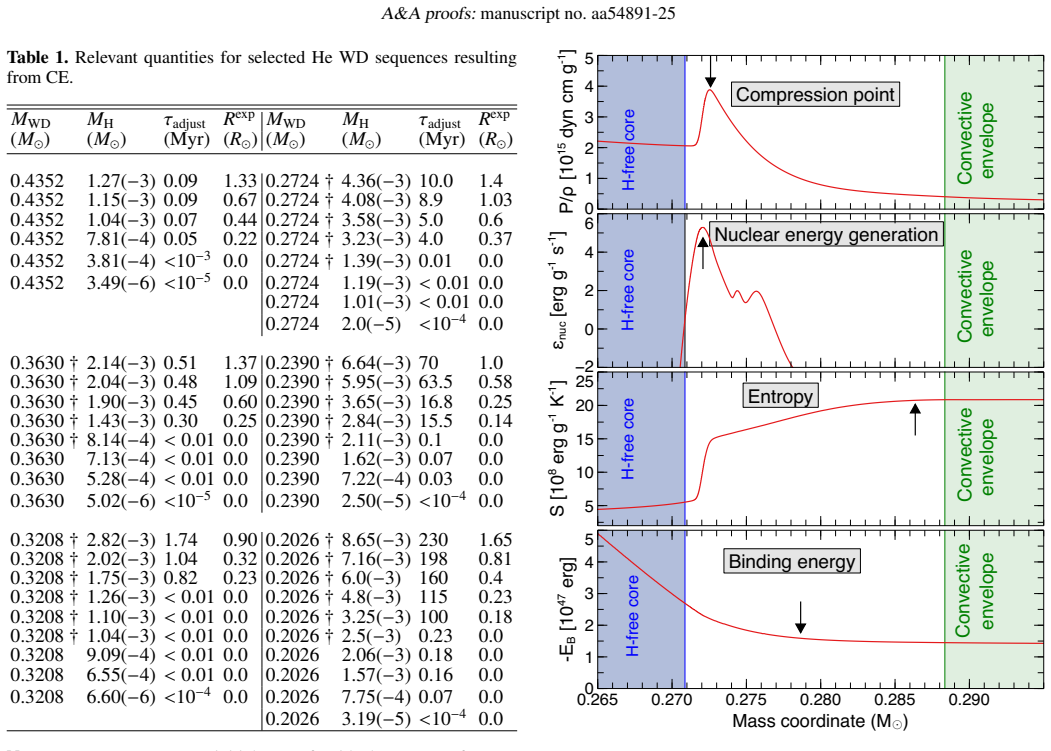
The load-bearing object is the bifurcation point, specifically the maximum-compression point $m_{\rm cp}$, the innermost mass coordinate where $P/\rho$ peaks in the H-burning shell before the CE ejection; it sets $M_H$ and therefore decides whether the remnant cools with or without nuclear support. The paper additionally maps three threshold lines in the $M_H$–$M_{\rm WD}$ plane, the line where H burning dominates the luminosity, the line above which H-shell flashes occur, and the line above which nuclear expansion pushes the radius past roughly 1 $R_\odot$, and uses them to delimit the allowed post-CE envelope masses.
What would settle it
Measure the hydrogen-layer mass of a short-period (P < 0.1 day) He WD with a known dynamical mass, for example through asteroseismic fits to an ELM pulsator or through the combination of cooling rate and gravitational-wave orbital decay for an eclipsing system such as J0651+2844. If $M_H$ is found to exceed a few times $10^{-4}\,M_\odot$ with significant residual burning, the predicted 5–130 Myr ages in the 12,000–27,000 K range would be ruled out, and the predicted low-temperature merges for P $\gtrsim$ 0.07-day systems would not occur.
Extended reading notes
Core claim
The paper claims that post-CE He WDs of a given mass follow two distinct cooling channels fixed by the initial residual hydrogen mass $M_H$. With the bifurcation point placed at the maximum-compression point $m_{\rm cp}$, the local maximum of $P/\rho$ inside the H-burning shell, $M_H$ is so small, a few times $10^{-4}\,M_\odot$, that residual burning supplies less than half the luminosity; these non-flashing sequences cool in 5–130 Myr across the observed $T_{\rm eff}$ range 12,000–27,000 K and reach roughly 300 Myr below 10,000 K, much younger than SRLOF tracks. With larger $M_H$, still below the roughly 1 $R_\odot$ envelope-expansion cap set by the tight orbits, residual H burning powers the envelope and ages grow to several Gyr; beyond a higher threshold, an early H-shell flash reshapes the envelope and extends the pre-WD phase to tens or hundreds of Myr. The same $M_H$ shifts the inferred mass at fixed $\log g$ and $T_{\rm eff}$, since a thinner envelope makes the WD more compact.
Load-bearing premise
The rapid-cooling branch assumes common-envelope ejection strips the red giant down to the maximum-compression point $m_{\rm cp}$, leaving only a very thin hydrogen envelope of order $10^{-4}\,M_\odot$, and treats the ejection as instantaneous structural removal without modeling the energetics required to reach such a bifurcation point; the paper explicitly states that it is a structural analysis that does not account for ejection energetics.
Editorial extensions
If this is right
- For the observed P < 0.1-day extremely low-mass white dwarfs, the minimal-envelope CE sequences put most ages below 200 Myr, many below 5 Myr, a large downward shift from SRLOF-based estimates.
- At fixed $T_{\rm eff}$ and $\log g$, minimal-$M_H$ CE sequences give smaller masses than SRLOF sequences, while maximum-$M_H$ sequences give larger masses, introducing systematic offsets in inferred stellar parameters.
- Systems with orbital periods $P \gtrsim 0.07$ days are expected to merge below 8000 K after up to roughly 2 Gyr when the envelope is thin, whereas hydrogen-richer remnants merge at higher temperatures and younger ages.
- Flashing sequences lengthen the pre-WD phase, up to about 260 Myr for a 0.20 $M_\odot$ remnant, but remain shorter than SRLOF evolution; after a flash, the resulting WD is observationally indistinguishable from one born with a thin envelope.
- The allowed range of $M_H$ is capped at $1.2\times10^{-3}$ to $8\times10^{-3}\,M_\odot$ because a thicker envelope would expand the star past the binary separation of about 1 $R_\odot$ before cooling begins.
Reading between the lines
- If the young-age branch is right, the observable lifetime of short-period He WDs at a given formation rate shrinks to roughly 10–100 Myr, so the systems we detect must be very recently formed, and the implied formation rate of these binaries is higher than SRLOF-based ages suggest.
- A three-dimensional or energy-consistent CE simulation could place the bifurcation point deeper in the envelope than $m_{\rm cp}$; in that case more hydrogen would survive, residual burning would resume, and ages would drift back toward SRLOF values, so the 5–130 Myr numbers are best read as a speed limit set by the most aggressive stripping scenario.
- Asteroseismic or spectral inference of the hydrogen-layer mass of an ELM WD in a short-period binary would discriminate the scenarios directly: a measured $M_H$ above a few times $10^{-4}\,M_\odot$ would rule out the minimal-envelope tracks and their rapid cooling ages.
Editorial analysis
A structured set of objections, weighed in public.
Referee Report
Summary. The paper presents new LPCODE evolutionary sequences for helium-core white dwarfs (He WDs) formed through the common envelope (CE) channel, covering WD masses from 0.20 to 0.4352 Msun. The key variable is the residual hydrogen envelope mass MH, set by the assumed CE bifurcation point. Two branches are identified: non-flashing sequences, where MH is small and the WD cools rapidly, and flashing sequences, where hydrogen shell flashes delay the pre-WD phase. For minimal MH, the models predict cooling ages of 5-130 Myr for Teff between 12,000 and 27,000 K, much younger than standard SRLOF tracks. For larger MH, residual H burning can extend ages to several Gyr. The sequences are applied to a sample of observed He WDs with orbital periods below 0.1 day to infer masses, ages, and merger properties, and the cooling tracks are made publicly available.
Significance. If the young-age branch is correct, the paper has substantial implications for the interpretation of ELM WDs in compact binaries: masses and ages inferred with SRLOF models could be systematically biased, and the merger temperatures of CE-formed systems would be significantly lower than previously assumed. The paper provides a useful grid of post-CE tracks and explicit tables for observers, and it is a strength that the sequences are publicly available and that the dependence on MH is explored systematically. However, the central young-age result is not a direct output of CE physics; it is contingent on the adopted choice of the bifurcation point. The paper itself acknowledges this limitation, but the abstract and conclusions present the young ages as the main finding without quantifying the sensitivity to the unmodeled CE energetics.
major comments (3)
- [4. Conclusions / 3.1] The central claim that CE He WDs cool within 5-130 Myr at Teff = 12,000-27,000 K is a scenario prediction, not a robust result. It follows from adopting the maximum-compression point mcp and the even smaller XH=0.1 coordinate as the post-CE remnant boundary. The paper explicitly states in Sect. 4 that this 'is a structural analysis and does not account for the energetics required to reach such bifurcation points during CE ejection.' The entropy and binding-energy criteria shown in Figs. 1-2 place the bifurcation point at larger MH, in the flashing or H-burning regime. Table 2 quantifies the impact: the same observed objects yield ages differing by factors of 5-15 between the minimum and maximum non-flashing MH (e.g., J0651+2844: 10.5 vs 159 Myr; J0822+3048: 111 vs 430 Myr; J1738+2927: 134 vs 708 Myr). The manuscript does not provide a quantitative estimate of the energetic cost of stripping the envelope down to mcp, nor a defensible argument that the entropy/binding-energy criteria are excluded. Without such a sensitivity analysis, the young-age branch must be presented as conditional on the low-MH end of the bifurcation-point uncertainty, not as a definitive prediction.
- [3.1 / Fig. 3] The upper bound on MH imposed by the condition that nuclear expansion does not exceed 1 Rsun (dashed red line in Fig. 3) is used to exclude models with larger MH. However, this 1 Rsun limit is motivated by orbital separations of P < 0.05 day systems, while Table 2 includes binaries with periods up to 0.0995 days. For a 0.0995-day orbit, the Roche lobe radius is substantially larger than 1 Rsun, so the adopted cutoff may be too restrictive for the long-period end of the sample. The paper should either derive the radius cutoff consistently with each system's orbital period or state explicitly that the 1 Rsun limit is a conservative simplification and discuss how relaxing it would affect the maximum-MH ages in Table 2.
- [3.3 / Table 2] The treatment of the adjustment time in the flashing sequences is unclear. Section 3.3 reports maximum pre-WD times from the end of CE of up to 230 Myr for the 0.2026 Msun flashing sequence, and the footnote to Fig. 4 states that in flashing sequences 'tau_adjust does not include the time spent in the first cooling track prior to the occurrence of the H flash.' The paper then states in Sect. 4 that the tables 'are also appropriate for He WD flashing sequences; in these cases, it is essential to consider pre-WD ages.' It is not clear whether the ages listed in Table 2 for the minimum-MH and maximum-MH columns include the full pre-WD phase for flashing cases. If they do not, then ages inferred for objects that actually followed the flashing branch would be underestimated by up to several hundred Myr. The manuscript should state explicitly which times are included in the tabulated ages and, if the flashing pre-WD phase is excluded, provide corrected ages or a prescription for adding tau_adjust.
minor comments (5)
- [Abstract / Table 1] The abstract and introduction state that the sequences cover 0.20 to 0.42 Msun, but Table 1 includes a sequence at 0.4352 Msun. Please harmonize the stated mass range with the actual grid.
- [2.1, Eq. (1)] The binding energy definition as written yields a negative quantity for a bound envelope; the sign convention is not stated. Please define the sign explicitly or use the absolute value so that the 'steep increase' description is unambiguous.
- [Table 2] Several SRLOF ages have lower uncertainties larger than the central value, e.g., J0935+4411 with 2.13 +/- 48 Myr, implying negative ages. This is presumably a consequence of the multi-solution nature of SRLOF tracks, but the presentation should be clarified, e.g., by quoting asymmetric ranges or stating that the uncertainty covers multiple solutions.
- [Fig. 4] The caption refers to the 'solid black line' as 'predictions from SRLOF mass transfer,' but the line presumably shows SRLOF cooling tracks rather than mass-transfer rates. Please reword to avoid ambiguity.
- [3.1] The sentence 'these objects... reach the cooling track almost instantaneously after CE (within a century; see Table 1)' is contradicted by Table 1 for the 0.2026 and 0.2390 Msun sequences, which have tau_adjust values of 0.16-0.23 Myr and 0.07 Myr. The statement should be qualified to apply only to the lowest-MH sequences or to the specific masses shown.
Circularity Check
No significant circularity: predicted ages are genuine model outputs from MH values set by external bifurcation criteria; self-citations serve as benchmarks, not as the source of the CE claim.
full rationale
The central claim—that CE He WDs with minimal MH cool within 5–130 Myr for Teff between 12,000 and 27,000 K—is a genuine model output, not a restatement of an input. The residual H mass MH is fixed a priori by external bifurcation-point criteria (the maximum compression point mcp of Ivanova 2011, and the XH = 0.1 coordinate from Tauris & Dewi 2001 and Kruckow et al. 2016), and the cooling ages are then computed with the LPCODE stellar evolution code from those MH values. The observed ELM sample is used only to read off masses and ages by matching Teff and log g to the tracks; no parameter is fitted to the sample, so no 'prediction' reduces by construction to an input. The paper's own caveat that 'this is a structural analysis and does not account for the energetics required to reach such bifurcation points during CE ejection' is a stated conditionality of the scenario, not a circular step. Self-citations are present but not load-bearing: the SRLOF tracks of Althaus et al. (2013) serve as external comparison benchmarks; LPCODE is independently established; the low-MH motivation is also supported by external works. No uniqueness theorem is imported from the authors' prior work, and the flashing/non-flashing branches are attributed to be consistent with Scherbak & Fuller (2023). The derivation chain is self-contained; the result is a conditional scenario calculation with honest sensitivity analysis.
Assumptions & free parameters
free parameters (2)
- XH = 0.10 minimum-envelope threshold =
0.10
- Critical expansion radius for MH exclusion =
1.0 solar radius
assumptions (4)
- domain assumption A 1 solar mass, Z=0.01 RGB star represents the CE progenitors for the entire 0.20 to 0.42 solar mass WD range.
- domain assumption The bifurcation point for envelope ejection is the maximum compression point mcp.
- ad hoc to paper Envelope ejection can be approximated by instantaneous mass removal at a specified core mass; CE energetics are not modeled.
- domain assumption LPCODE input physics, including opacities, equation of state, diffusion, and nuclear reactions, is accurate enough for the cooling timescales.
Cite this review
Pith. "Pith review of Post-common Envelope Evolution of Helium-core White Dwarfs." pith.science (2026). https://pith.science/paper/F6BMP2VG
@misc{pith2026250605618,
  author       = {Pith},
  title        = {Pith review of: Post-common Envelope Evolution of Helium-core White Dwarfs},
  year         = {2026},
  howpublished = {\url{https://pith.science/paper/F6BMP2VG}},
  note         = {Machine review of arXiv:2506.05618}
}
read the original abstract
Helium-core white dwarfs (He WDs) formed through common envelope (CE) evolution offer valuable insight into binary interaction channels and compact remnant formation. Their cooling rates critically impact both detectability and age estimates in close binaries. Compared to He WDs formed via stable Roche-lobe overflow (SRLOF), those from the CE channel undergo markedly different mass-loss histories, resulting in distinct post-CE evolutionary behavior. We explore how the mass of the residual hydrogen envelope (Mh) shapes the cooling evolution of CE He WDs, focusing on the role of the bifurcation point in setting Mh and enabling residual hydrogen burning. Using the LPCODE stellar evolution code, we computed models of He WDs with masses from 0.20 to 0.42 solar masses, evolving from post-CE conditions to the white dwarf cooling track. Two evolutionary branches emerge: (i) non-flashing sequences, which cool rapidly with negligible hydrogen burning, and (ii) flashing sequences, where hydrogen shell flashes alter the envelope structure prior to cooling. Minimal-envelope models cool within 5-130 million years for effective temperatures between 12,000 and 27,000 K, and reach in approx. 300 million years at lower temperatures, remaining much younger than SRLOF counterparts. In contrast, models with more hydrogen retain active nuclear burning, delaying cooling and yielding ages of several billion years. Flashing sequences prolong the pre-white dwarf phase, though still shorter than in SRLOF evolution. The value of Mh also affects WD mass and surface gravity estimates, introducing systematic shifts with respect to SRLOF WDs. Our results show that CE He WDs follow distinct evolutionary paths, with important implications for interpreting the nature and fate of compact binaries hosting He WDs.
Figures


Figures from the paper (3 more)


Reference graph
Works this paper leans on
-
[1]
G., Camisassa, M
Althaus, L. G., Camisassa, M. E., Miller Bertolami, M. M., Córsico, A. H., & García-Berro, E. 2015, A&A, 576, A9
2015
-
[2]
Althaus, L. G. & Córsico, A. H. 2022, A&A, 663, A167
2022
-
[3]
G., De Gerónimo, F., Córsico, A., Torres, S., & García-Berro, E
Althaus, L. G., De Gerónimo, F., Córsico, A., Torres, S., & García-Berro, E. 2017, A&A, 597, A67
work page 2017
-
[4]
G., Miller Bertolami, M
Althaus, L. G., Miller Bertolami, M. M., & Córsico, A. H. 2013, A&A, 557, A19
2013
-
[5]
Althaus, L. G., Serenelli, A. M., Panei, J. A., et al. 2005, A&A, 435, 631
work page 2005
-
[6]
Bellini, A., Anderson, J., Salaris, M., et al. 2013, ApJ, 769, L32
work page 2013
-
[7]
R., Kilic, M., Allende Prieto, C., Gianninas, A., & Kenyon, S
Brown, W. R., Kilic, M., Allende Prieto, C., Gianninas, A., & Kenyon, S. J. 2013, ApJ, 769, 66
work page 2013
-
[8]
R., Kilic, M., Allende Prieto, C., & Kenyon, S
Brown, W. R., Kilic, M., Allende Prieto, C., & Kenyon, S. J. 2010, ApJ, 723, 1072 —. 2012, ApJ, 744, 142
work page 2010
Show all 36 references
-
[9]
R., Kilic, M., Kosakowski, A., et al
Brown, W. R., Kilic, M., Kosakowski, A., et al. 2020, ApJ, 889, 49
2020
-
[10]
E., Bono, G., et al
Calamida, A., Corsi, C. E., Bono, G., et al. 2008, ApJ, 673, L29
2008
-
[11]
M., Córsico, A
Calcaferro, L. M., Córsico, A. H., Althaus, L. G., Romero, A. D., & Kepler, S. O. 2018, A&A, 620, A196
2018
-
[12]
& Salaris, M
Cassisi, S. & Salaris, M. 2013, Old Stellar Populations: How to Study the Fossil Record of Galaxy Formation (Wiley-VCH)
2013
-
[13]
2024, Progress in Particle and Nuclear Physics, 134, 104083
Chen, X., Liu, Z., & Han, Z. 2024, Progress in Particle and Nuclear Physics, 134, 104083
2024
-
[14]
Chen, X., Maxted, P. F. L., Li, J., & Han, Z. 2017, MNRAS, 467, 1874 Córsico, A. H., Althaus, L. G., Miller Bertolami, M. M., & Kepler, S. O. 2019, A&A Rev., 27, 7
2017
-
[15]
& Li, X.-D
Gao, S.-J. & Li, X.-D. 2023, MNRAS, 525, 2605
2023
-
[16]
2014, ApJ, 794, 35
Gianninas, A., Dufour, P., Kilic, M., et al. 2014, ApJ, 794, 35
2014
-
[17]
R., Canton, P., & Kenyon, S
Gianninas, A., Kilic, M., Brown, W. R., Canton, P., & Kenyon, S. J. 2015, ApJ, 812, 167
2015
-
[18]
Han, Z., Podsiadlowski, P., & Eggleton, P. P. 1994, MNRAS, 270, 121
1994
-
[19]
2021, A&A, 650, A102
Irrgang, A., Geier, S., Heber, U., et al. 2021, A&A, 650, A102
2021
-
[20]
G., Marchant, P., Tauris, T
Istrate, A. G., Marchant, P., Tauris, T. M., et al. 2016, A&A, 595, A35
2016
-
[21]
2011, ApJ, 730, 76
Ivanova, N. 2011, ApJ, 730, 76
2011
-
[22]
2013, A&A Rev., 21, 59
Ivanova, N., Justham, S., Chen, X., et al. 2013, A&A Rev., 21, 59
2013
-
[23]
& Nandez, J
Ivanova, N. & Nandez, J. L. A. 2016, MNRAS, 462, 362
2016
-
[24]
2009, A&A, 505, 441
Koester, D., V oss, B., Napiwotzki, R., et al. 2009, A&A, 505, 441
2009
-
[25]
U., Tauris, T
Kruckow, M. U., Tauris, T. M., Langer, N., et al. 2016, A&A, 596, A58
2016
-
[26]
2019, ApJ, 871, 148
Li, Z., Chen, X., Chen, H.-L., & Han, Z. 2019, ApJ, 871, 148
2019
-
[27]
C., J., Proulx, Z
Lombardi, J. C., J., Proulx, Z. F., Dooley, K. L., et al. 2006, ApJ, 640, 441
2006
-
[28]
Maxted, P. F. L., Anderson, D. R., Burleigh, M. R., et al. 2011, MNRAS, 418, 1156 Miller Bertolami, M. M. 2016, A&A, 588, A25
2011
-
[29]
Nandez, J. L. A. & Ivanova, N. 2016, MNRAS, 460, 3992
2016
-
[30]
G., & García-Berro, E
Salaris, M., Althaus, L. G., & García-Berro, E. 2013, A&A, 555, A96
2013
-
[31]
T., Schneider, F
Sand, C., Ohlmann, S. T., Schneider, F. R. N., Pakmor, R., & Röpke, F. K. 2020, A&A, 644, A60
2020
-
[32]
& Fuller, J
Scherbak, P. & Fuller, J. 2023, MNRAS, 518, 3966
2023
-
[33]
R., Cool, A
Strickler, R. R., Cool, A. M., Anderson, J., et al. 2009, ApJ, 699, 40
2009
-
[34]
& Arras, P
Sun, M. & Arras, P. 2018, ApJ, 858, 14
2018
-
[35]
Tauris, T. M. & Dewi, J. D. M. 2001, A&A, 369, 170 Vigna-Gómez, A., Wassink, M., Klencki, J., et al. 2022, MNRAS, 511, 2326
2001
-
[36]
2021, MNRAS, 502, 383 Article number, page 9 of 9
Zhang, Y ., Chen, H., Chen, X., & Han, Z. 2021, MNRAS, 502, 383 Article number, page 9 of 9
2021
Reviewed August 7, 2026 · model on record in the stance chip above.
Discussion (0). Sign in to comment.