REVIEW 2 major objections 6 minor 93 references
Prospects for characterizing Population III remnants with next-generation gravitational-wave observatories
T0 review · 2 major / 6 minor · reviewed 2026-08-07 · deepseek-v4-flash
Pith's one-line read A next-generation gravitational-wave network with 5 Hz sensitivity can place the most distant first-star black-hole mergers above redshift 18.5 at 90 percent credibility.
desk verdict Solid Bayesian forecast for ET/CE low-frequency science; the headline redshift-reach numbers are statistical-only and would shift once lensing is included. read the letter →
The pith
A machine-rendered reading of the paper's core claim, the machinery that carries it, and where it could break.
The reading
What carries the argument
The load-bearing object is the detector network's low-frequency sensitivity band, encoded in the lower cutoff frequency $f_{\mathrm{low}}$ (5 Hz versus 10 Hz). It does the work because the Population III binaries studied here have detector-frame total masses of 740–1480 $M_\odot$, pushing their inspiral end $f_{\mathrm{MECO}}$ to 2.9–6.7 Hz and their (2,2) ringdown to 12–27 Hz: whether that low-frequency content enters the detectors determines how much phase information the likelihood can use. The central quantitative devices are the one-sided 90 percent lower redshift bound $z_{90\%}$, the posterior-quantile diagnostic $Q$ that flags systematic over- or under-estimation, and the 90 percent sky-localisation area $\Delta\Omega_{90}$. Together they turn 'detected' into 'characterised'.
What would settle it
Compare the realised strain noise of an Einstein Telescope + Cosmic Explorer network between 5 and 10 Hz with the projected power spectral densities, then rerun the paper's injection-recovery pipeline: if the 5 Hz configuration does not increase the number of detected $z\geq15$ sources by roughly the factor of 2.3 seen for 10 Hz, or if the loudest source's 90 percent lower redshift bound drops below 18.5, the central quantitative claim is falsified.
Extended reading notes
Core claim
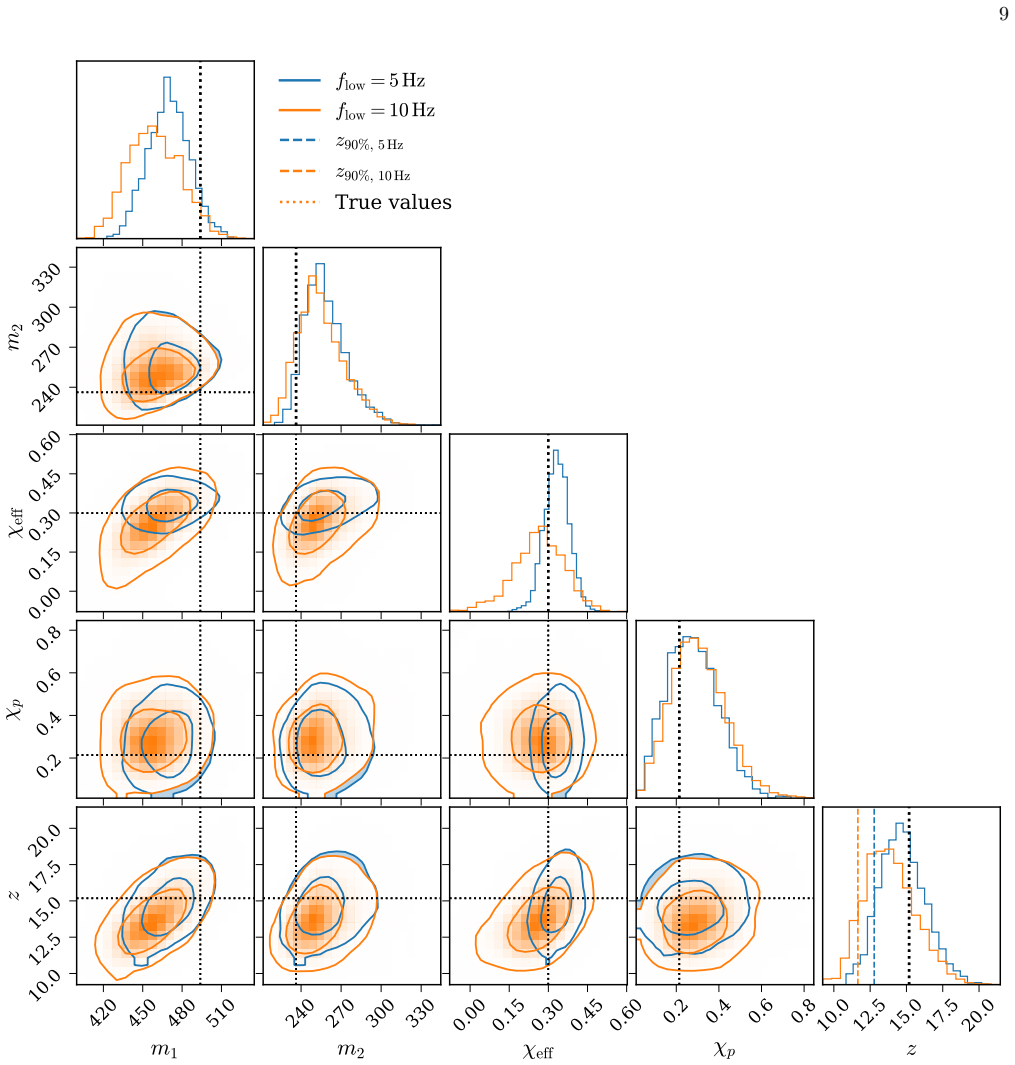
On the paper's own terms, the central discovery is that the bottleneck for studying the earliest black-hole mergers is not detection but low-frequency bandwidth. The target binaries have detector-frame total masses of roughly 740–1480 $M_\odot$, so their inspiral ends at $f_{\mathrm{MECO}} \simeq 2.9$–$6.7$ Hz and their (2,2) ringdown sits at 12–27 Hz; with a 10 Hz cutoff nearly all of what is observed is merger-ringdown, whereas 5 Hz admits substantially more late-inspiral and merger signal. Using the IMRPhenomXPHM waveform model for both injection and recovery, the paper finds that the extra band multiplies the number of high-SNR detections by a factor of $\sim 2.3$ (395 versus 175 sources), raises the maximum 90 percent lower redshift bound from $z=17.5$ to $z=18.5$, and improves average source-frame mass recovery to roughly 11 percent for the primary and 13 percent for the secondary. Every source in the selected sample has a 90 percent lower redshift bound above $z\simeq 12.8$, so the sample is firmly in the cosmic-dawn regime. Spins, in contrast, are poorly constrained: the precession spin $\chi_p$ is biased toward the prior and the bias is not removed by the lower cutoff.
Load-bearing premise
The quantitative forecasts assume that the projected Einstein Telescope and Cosmic Explorer noise power spectral densities, including a 5 Hz low-frequency cutoff, are actually achieved; if low-frequency sensitivity is worse, the quoted event gains, redshift reach, and mass uncertainties will not hold.
Editorial extensions
If this is right
- With $f_{\mathrm{low}}=5$ Hz, the loudest source in the population, injected at $z_{\mathrm{true}}=19.8$, is inferred to lie at $z \geq 18.5$ at 90 percent credibility, and for the loudest events the 90 percent lower bound is within $|z_{\mathrm{true}}-z_{90\%}| \lesssim 0.1$ of the truth.
- Every event in the $z \geq 15$ selected sample has a 90 percent lower redshift bound above $z \simeq 12.8$, so the network can isolate a high-confidence cosmic-dawn catalogue for population studies.
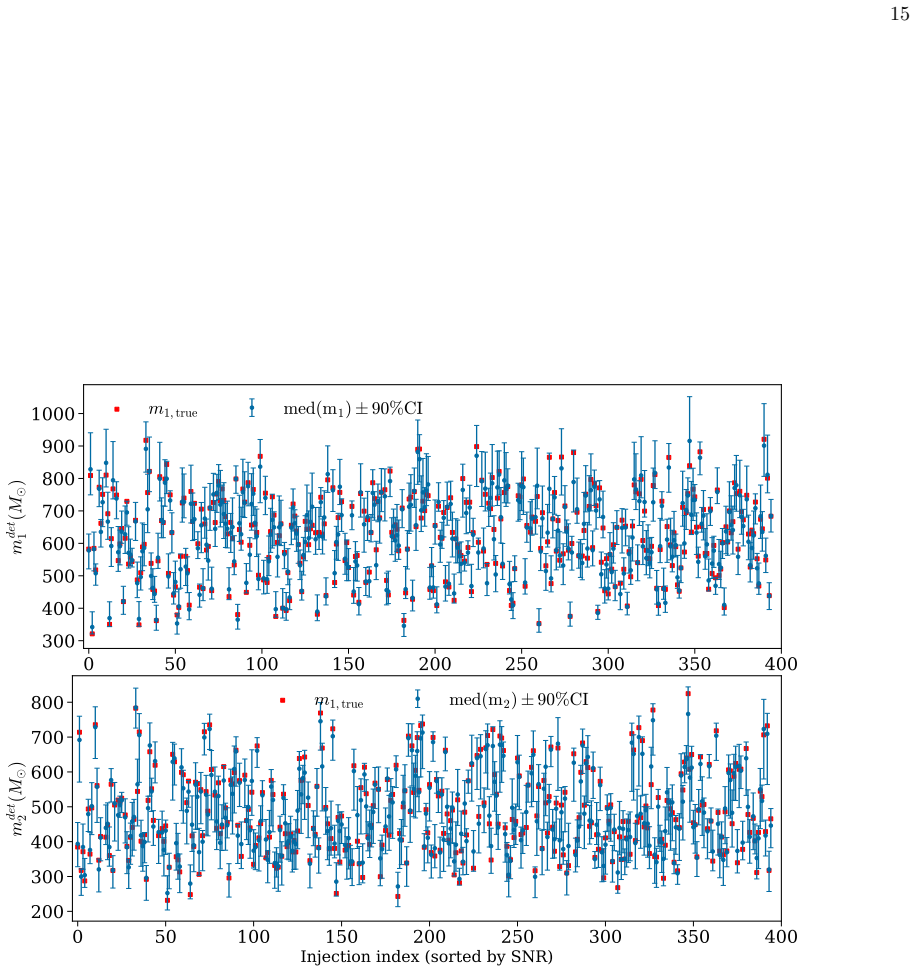
- Source-frame component masses are measured on average to $\sim 11$ percent (primary) and $\sim 13$ percent (secondary) at $f_{\mathrm{low}}=5$ Hz, with slightly larger uncertainties at 10 Hz.
- Lowering the cutoff from 10 to 5 Hz increases the number of detected sources by a factor of $\sim 2.3$ (395 versus 175) and extends the maximum 90 percent lower redshift bound from 17.5 to 18.5.
- The precession spin $\chi_p$ is only weakly constrained and systematically biased toward the prior under both cutoffs, so individual events will not cleanly separate formation channels using spin.
Reading between the lines
- The headline numbers are conditional on the assumed detector performance: if the real 5–10 Hz noise is higher than the projected power spectral densities, the factor-2.3 event increase, the $z_{90\%}=18.5$ reach, and the $\sim 12$ percent mass uncertainties will degrade toward the 10 Hz values.
- Because individual-event spin information is weak, distinguishing Population III remnants from primordial black holes will likely have to be done statistically through merger-rate evolution and joint mass–redshift distributions rather than through any single event's spin.
- The quoted redshift bounds are purely statistical: the paper itself notes that weak lensing adds $\mathcal{O}(10\%)$ distance scatter at $z \gtrsim 15$ and that magnified low-redshift sources can contaminate the apparent high-redshift tail, so a lensing-aware analysis would likely widen the bounds.
- A direct robustness test would be to re-run the same injection set with an independent waveform family; if mass uncertainties or redshift bounds shift by more than the quoted values, part of the claimed characterisation power is a waveform-model artefact.
Editorial analysis
A structured set of objections, weighed in public.
Referee Report
Summary. The paper uses a fully Bayesian pipeline (Bilby/Dynesty with IMRPhenomXPHM) on an astrophysically motivated Population III binary black hole population (Santoliquido et al.) to quantify how well an ET+CE network can characterize mergers at z>=15, comparing low-frequency cutoffs of 5 Hz and 10 Hz. From 10^3 injected binaries, 395 (175) pass the SNR thresholds at 5 Hz (10 Hz); the authors report ~11-13% source-frame mass uncertainties, weak constraints on spins (especially chi_p), 90% sky localization areas below ~140 deg^2, and a 90% lower redshift bound of z>=18.5 for the most distant source (z_true=19.8) at 5 Hz, with every selected event bounded at z>=~12. The analysis is transparent about priors, the cosmological reweighting of distance posteriors, and the idealizations of zero noise and identical injection/recovery waveforms.
Significance. The study is a solid and useful forecast that goes beyond the Fisher-matrix diagnostics of Mancarella et al. (2023) by performing full Bayesian inference on an astrophysically motivated population, and it is commendably transparent about sampling priors, selection criteria, and the distance-prior reweighting (Appendix A). The controlled 5 Hz versus 10 Hz comparison cleanly isolates the role of the low-frequency band, and the main negative result (that spin parameters, particularly chi_p, remain only weakly constrained even at 5 Hz) is an honest and important conclusion for the field. The quantitative results (event counts, mass uncertainties, z90% bounds, sky areas) are falsifiable predictions for the ET+CE network and will be useful for planning next-generation detector sensitivity requirements. However, the headline numbers assume the projected PSDs, neglect lensing, and use identical injection and recovery waveforms; all three are acknowledged, but the lensing omission is comparable in size to the stated statistical errors and needs to be addressed or explicitly conditioned before the central redshift claims can be taken at face value.
major comments (2)
- [Sec. IV (Discussion) and Sec. III.A, Fig. 6, Eq. (8)] The headline redshift bounds quoted in the abstract and in Sec. III.A are computed from a likelihood that assumes unlensed signals, and the Discussion (Sec. IV) states that weak lensing produces O(10%) scatter in the luminosity distance at z>=15, 'comparable to the statistical distance uncertainties of the loudest sources in our sample.' This admission conflicts with the robustness of the central quantitative claims. For the most distant source (z_true=19.8, z90%=18.5), D_L is about 260 Gpc, and a 10% distance scatter at that redshift corresponds to a shift of roughly 1.8 in z; folding lensing into the distance posterior would move the 90% lower bound down by about 1-2 units, so the 'beyond z=18.5' claim is not robust. The 'every event has z90%>12' statement rests on a minimum bound of 12.8, leaving little margin. The '|z_true-z90%| < 0.1 for the loudest sources' claim corresponds to a ~1% distance measurement, an order of magnitude smaller than the quoted lensing scatter, and cannot survive lensing. I recommend that the authors either (i) quantify the effect by convolving the distance posteriors with a weak-lensing magnification kernel or by injecting a lensed subset of signals and reporting the degraded z90% values, or (ii) explicitly label the redshift-reach numbers throughout, including the abstract, as statistical bounds that neglect lensing.
- [Sec. III.A, Fig. 6, and Abstract] The headline comparison of the redshift reach (z90%=18.5 at 5 Hz versus z90%=17.5 at 10 Hz) compares the maximum of the z90% distribution over each detected sample, and these maxima come from different events (z_true=19.8 in the 5 Hz case and z_true=19.1 in the 10 Hz case). The maximum order statistic over 395 versus 175 events is a noisy estimator, and the paper does not report the 10 Hz bound for the z_true=19.8 event itself, so the quoted improvement does not isolate the effect of the low-frequency cutoff. Please report the paired z90% values for the 175 events common to both configurations (e.g., the median and scatter of the 5 Hz minus 10 Hz difference), or the fraction of common events whose bound improves by more than a given amount; the population-level statement in Fig. 9 is more robust and should carry the headline claim.
minor comments (6)
- [Sec. II.B] The sentence 'Lowering the low-frequency cutoff increases the fraction of detectable systems by 47.1%' is not consistent with the stated sample sizes (395 and 175 detected out of the same injected set, a factor of 2.26, i.e., a ~126% relative increase); please specify how the 47.1% figure is computed.
- [Sec. III.B, Fig. 10] The text says the uncertainties are shown 'for flow = 5 Hz (solid) and flow = 10 Hz (solid)'; the second should presumably be 'dashed' as in the caption, and the values '~11% and~13%' should state explicitly which component mass and which cutoff each value refers to.
- [Sec. III.A] The sentence 'for the loudest sources the lower bound lies within 0.1 of the true value' should identify the specific event(s) in Fig. 7; the most distant source quoted immediately above has |z_true - z90%| = 1.3, so the two statements are only consistent if the loudest and most distant events are different, which should be stated explicitly.
- [Sec. II.A] The injected spins (uniform magnitude, isotropic orientation) are an ad hoc addition to the [47] population model, which is described as non-spinning; since the weak spin constraints are a main conclusion, a brief robustness check against a physically motivated spin prior (e.g., high aligned spins from Pop III disk accretion) would strengthen the claim that spin information is generically limited for these sources.
- [References] The choice of Planck15 cosmological parameters is cited via GWTC-4 catalog papers (Refs. [65]-[67]); citing the original Planck 2015 paper directly would be more appropriate.
- [Sec. III.B, Eq. (5)] The '~11-13%' mass uncertainties are defined by Eq. (5) with an unspecified confidence level X; state the confidence level used (presumably 90%) so the quoted numbers are unambiguous.
Circularity Check
No significant circularity: the redshift, mass, and spin claims are obtained by Bayesian likelihood inference from external detector PSDs and an external Pop III population model.
full rationale
The paper's central quantities—the z90% lower bounds (Eq. 8, Fig. 6), the ~11–13% source-frame mass uncertainties, and the spin constraints—are outputs of full Bayesian parameter estimation on simulated signals, not inputs. The detector noise PSDs are taken from Ref. [17], the population model from Santoliquido et al. [47,52], and the waveform model IMRPhenomXPHM is used for both injection and recovery, an explicit idealization that the paper states: 'We assume the IMRPhenomXPHM waveform model for both injection and recovery to avoid any biases due to waveform systematics.' No parameter is fitted to the target claims, and no uniqueness theorem or self-citation is invoked to force the choice of model. The self-citations (e.g., to Pratten et al. for the waveform model and to Pratten, Schmidt et al. for the Q diagnostic) are to publicly available, independently validated codes and definitions; they are not load-bearing in the derivation of the headline numbers. The paper's own caveat that weak lensing can introduce O(10%) distance scatter at z>15 is a limitation on the interpretation of the statistical-only results, not evidence that the results are circular. Correctness and robustness concerns about lensing or waveform systematics are separate from circularity; the derivation chain remains self-contained.
Assumptions & free parameters
free parameters (2)
- Network SNR threshold =
30
- Single-detector SNR threshold =
8
assumptions (7)
- domain assumption ET and CE noise power spectral densities from Ref. [17] represent achievable XG detector sensitivities.
- domain assumption A 5 Hz low-frequency cutoff is physically realizable for the ET+CE network.
- domain assumption The LOG IMF and SW20 SFRD population model from Ref. [47] is representative of Population III remnants.
- ad hoc to paper Spin magnitudes are uniformly drawn from [0,1] and orientations are isotropic, added independently of the [47] population model.
- domain assumption IMRPhenomXPHM is sufficiently accurate for both injection and recovery of these signals.
- domain assumption Gravitational lensing is neglected in the quoted uncertainties.
- domain assumption Planck15 flat LCDM cosmology is used for luminosity distance to redshift conversion.
Cite this review
Pith. "Pith review of Prospects for characterizing Population III remnants with next-generation gravitational-wave observatories." pith.science (2026). https://pith.science/paper/F6H2P7LL
@misc{pith2026260805846,
  author       = {Pith},
  title        = {Pith review of: Prospects for characterizing Population III remnants with next-generation gravitational-wave observatories},
  year         = {2026},
  howpublished = {\url{https://pith.science/paper/F6H2P7LL}},
  note         = {Machine review of arXiv:2608.05846}
}
abstract
The most distant gravitational-wave (GW) detection by LIGO, Virgo and KAGRA so far is a binary black hole (BBH) merger at a redshift of $z\sim 1.1$, corresponding to a luminosity distance of $D_L \sim 8 \, \rm Gpc$. The next-generation GW detectors, the Einstein Telescope (ET) and Cosmic Explorer (CE), will detect mergers beyond the peak of star formation at $z_{\rm peak}\sim 2$, enabling the direct detection of the remnants of the first stars in the early Universe. Realising this science potential requires accurate inference of the redshift, sky localization and intrinsic properties of the most distant mergers. In this work, using a fully Bayesian framework and an astrophysically motivated model, we study Population III remnants with an ET-CE detector network and quantify the measurement uncertainties in redshift, sky localisation, intrinsic masses and spins for BBHs at $z \geq 15$. Considering an optimistic ($5\, \rm Hz$) and pessimistic ($10\,\rm Hz$) lower cutoff frequency for the detectors' sensitivity, we show that the $5\, \rm Hz$ configuration consistently improves the redshift inference for spin-precessing binaries. We also find that the source-frame component masses can be measured to within $\sim 12\%$ on average, and that the highest-redshift sources in the population can be reliably characterised. In contrast, we find only modest constraints on the BH spins. The improved low-frequency sensitivity also extends the redshift reach of the detector network, enabling events injected at $z_{\rm true}\simeq19.8$ to be confidently identified as originating beyond $z\simeq18.5$ at $90\%$ credibility, compared to a maximum lower-bound redshift of $z\simeq17.5$ for the $10\,\rm Hz$ configuration. Improved detector sensitivity below $10\, \rm Hz$ also reduces the sky-localisation uncertainties, which are essential for cosmological cross-correlation.
Figures


Figures from the paper (11 more)




Reference graph
Works this paper leans on
-
[1]
B. P. Abbott et al. (KAGRA, LIGO Scientific, Virgo), Prospects for observing and localizing gravitational-wave transients with Advanced LIGO, Advanced Virgo and KAGRA, Living Rev. Rel. 19, 1 (2016), arXiv:1304.0670 [gr-qc]
arXiv 2016
-
[2]
G. M. Harry and LIGO Scientific Collaboration, Ad- vanced LIGO: the next generation of gravitational wave detectors, Classical and Quantum Gravity 27, 084006 (2010)
2010
-
[3]
J. Aasi et al. (LIGO Scientific), Advanced LIGO, Class. Quant. Grav. 32, 074001 (2015), arXiv:1411.4547 [gr-qc]
arXiv 2015
-
[4]
F. Acernese et al. (VIRGO), Advanced Virgo: a second- generation interferometric gravitational wave detector, Class. Quant. Grav. 32, 024001 (2015), arXiv:1408.3978 [gr-qc]
arXiv 2015
-
[5]
Acernese and P
F. Acernese and P. A. et.al., The virgo status, Classical and Quantum Gravity 23, S635 (2006)
2006
-
[6]
LIGO Scientific Collaboration, https://dcc.ligo.org/ LIGO-P1200087-v42/public (2022)
2022
-
[7]
L.-V.-K. S. Collaboration, Gravitational-wave candidate event database (gracedb) (2026)
2026
-
[9]
A. G. Abac et al. (LIGO Scientific, VIRGO, KAGRA), GWTC-4.0: Methods for Identifying and Characterizing Gravitational-wave Transients, (2025), arXiv:2508.18081 [gr-qc]
arXiv 2025
Show all 93 references
-
[10]
A. G. Abac et al. (LIGO Scientific, KAGRA, VIRGO), GWTC-4.0: An Introduction to Version 4.0 of the Gravitational-Wave Transient Catalog, Astrophys. J. Lett. 995, L18 (2025), arXiv:2508.18080 [gr-qc]
2025 arXiv
-
[12]
Maggiore et al
M. Maggiore et al. (ET), Science Case for the Ein- stein Telescope, JCAP 03, 050, arXiv:1912.02622 [astro- ph.CO]
1912 arXiv
-
[13]
Abac et al
A. Abac et al. (ET), The Science of the Einstein Tele- scope, (2025), arXiv:2503.12263 [gr-qc]
2025 arXiv
-
[14]
Punturo et al
M. Punturo et al. , The Einstein Telescope: A third- generation gravitational wave observatory, Class. Quant. Grav. 27, 194002 (2010)
2010
-
[15]
Evans et al
M. Evans et al. , A Horizon Study for Cosmic Ex- plorer: Science, Observatories, and Community, (2021), arXiv:2109.09882 [astro-ph.IM]
2021 arXiv
-
[16]
Reitze et al
D. Reitze et al. , Cosmic Explorer: The U.S. Contribu- tion to Gravitational-Wave Astronomy beyond LIGO, Bull. Am. Astron. Soc. 51, 035 (2019), arXiv:1907.04833 [astro-ph.IM]
2019 arXiv
-
[17]
Evans et al
M. Evans et al. , Cosmic Explorer: A Submission to the NSF MPSAC ngGW Subcommittee, (2023), arXiv:2306.13745 [astro-ph.IM]
2023 arXiv
-
[18]
K. K. Y. Ng, S. Vitale, W. M. Farr, and C. L. Ro- driguez, Probing multiple populations of compact bina- ries with third-generation gravitational-wave detectors, Astrophys. J. Lett. 913, L5 (2021), arXiv:2012.09876 [astro-ph.CO]
2021 arXiv
-
[19]
Iacovelli, M
F. Iacovelli, M. Mancarella, S. Foffa, and M. Mag- giore, Forecasting the Detection Capabilities of Third- generation Gravitational-wave Detectors Using GW- FAST, Astrophys. J. 941, 208 (2022), arXiv:2207.02771 [gr-qc]
2022 arXiv
-
[20]
Plunkett, M
C. Plunkett, M. Mould, and S. Vitale, Constraining Population III stellar demographics with next-generation gravitational-wave observatories, Phys. Rev. D 112, 023039 (2025), arXiv:2504.18615 [gr-qc]
2025 arXiv
-
[21]
Fishbach, D
M. Fishbach, D. E. Holz, and W. M. Farr, Does the black hole merger rate evolve with redshift?, The Astrophysical Journal Letters 863, L41 (2018)
2018
-
[22]
Fishbach and L
M. Fishbach and L. van Son, LIGO–Virgo–KAGRA’s Oldest Black Holes: Probing Star Formation at Cos- mic Noon With GWTC-3, Astrophys. J. Lett. 957, L31 (2023), arXiv:2307.15824 [astro-ph.GA]
2023 arXiv
-
[23]
A. G. Abac et al. (LIGO Scientific, VIRGO, KAGRA), GWTC-4.0: Population Properties of Merging Compact Binaries, (2025), arXiv:2508.18083 [astro-ph.HE]
2025 arXiv
-
[24]
Natarajan et al
P. Natarajan et al. , First Detection of an Overmassive Black Hole Galaxy UHZ1: Evidence for Heavy Black Hole Seed Formation from Direct Collapse, Astrophys. J. Lett. 960, L1 (2024), arXiv:2308.02654 [astro-ph.HE]
2024
-
[25]
X. Fan, E. Ba˜ nados, and R. A. Simcoe, Quasars and the Intergalactic Medium at Cosmic Dawn, ARA&A 61, 373 (2023), arXiv:2212.06907 [astro-ph.GA]
2023 arXiv
-
[26]
Volonteri, The Formation and Evolution of Massive Black Holes, Science 337, 544 (2012), arXiv:1208.1106 [astro-ph.CO]
M. Volonteri, The Formation and Evolution of Massive Black Holes, Science 337, 544 (2012), arXiv:1208.1106 [astro-ph.CO]
2012 arXiv
-
[27]
Mangiagli et al
A. Mangiagli et al. , Massive black hole binaries in LISA: Constraining cosmological parameters at high redshifts, Phys. Rev. D 111, 083043 (2025), arXiv:2312.04632 [astro-ph.CO]
2025 arXiv
-
[28]
B. D. Smith, J. A. Regan, T. P. Downes, M. L. Nor- man, B. W. O’Shea, and J. H. Wise, The growth of black holes from Population III remnants in the Renaissance simulations, MNRAS 480, 3762 (2018), arXiv:1804.06477 [astro-ph.GA]
2018 arXiv
-
[29]
Madau and M
P. Madau and M. J. Rees, Massive black holes as Popu- lation III remnants, Astrophys. J. Lett. 551, L27 (2001), arXiv:astro-ph/0101223
2001 arXiv
-
[30]
Kroupa, L
P. Kroupa, L. Subr, T. Jerabkova, and L. Wang, Very high redshift quasars and the rapid emergence of su- permassive black holes, MNRAS 498, 5652 (2020), arXiv:2007.14402 [astro-ph.GA]
2020 arXiv
-
[31]
C. L. Fryer, S. E. Woosley, and A. Heger, Pair instabil- ity supernovae, gravity waves, and gamma-ray transients, Astrophys. J. 550, 372 (2001), arXiv:astro-ph/0007176
2001 arXiv
-
[32]
M. C. Begelman and J. Silk, Magnetic fields catalyse mas- sive black hole formation and growth, Mon. Not. Roy. Astron. Soc. 526, L94 (2023), arXiv:2305.19081 [astro- ph.HE]
2023 arXiv
-
[33]
D. J. Eisenstein et al. , Overview of the JWST Advanced Deep Extragalactic Survey (JADES), apjs 283, 6 (2026), arXiv:2306.02465 [astro-ph.GA]
2026 arXiv
-
[34]
K. N. Hainline et al. , JWST Advanced Deep Extra- galactic Survey (JADES) Data Release 5: Photomet- rically Selected Galaxy Candidates at z ¿ 8, arXiv e-prints , arXiv:2601.15959 (2026), arXiv:2601.15959 [astro-ph.GA]
2026 arXiv
-
[35]
Chira et al
M. Chira et al. , Revisiting the X-ray-to-UV relation of quasars in the era of all-sky surveys, Mon. Not. Roy. As- 17 tron. Soc. 545, staf1905 (2025), arXiv:2512.09767 [astro- ph.GA]
2025
-
[36]
Ding et al., Detection of stellar light from quasar host galaxies at redshifts above 6, Nature 621, 51 (2023), arXiv:2211.14329 [astro-ph.GA]
X. Ding et al., Detection of stellar light from quasar host galaxies at redshifts above 6, Nature 621, 51 (2023), arXiv:2211.14329 [astro-ph.GA]
2023 arXiv
-
[37]
C. Wolf, S. Lai, C. A. Onken, N. Amrutha, F. Bian, W. J. Hon, P. Tisserand, and R. L. Webster, The accretion of a solar mass per day by a 17-billion solar mass black hole, Nature Astronomy 8, 520 (2024), arXiv:2402.15101 [astro-ph.CO]
2024 arXiv
-
[38]
Kinugawa, K
T. Kinugawa, K. Inayoshi, K. Hotokezaka, D. Nakauchi, and T. Nakamura, Possible Indirect Confirmation of the Existence of Pop III Massive Stars by Gravitational Wave, Mon. Not. Roy. Astron. Soc. 442, 2963 (2014), arXiv:1402.6672 [astro-ph.HE]
2014 arXiv
-
[39]
Kinugawa, A
T. Kinugawa, A. Miyamoto, N. Kanda, and T. Naka- mura, The detection rate of inspiral and quasi-normal modes of Population III binary black holes which can con- firm or refute the general relativity in the strong gravity region, Mon. Not. Roy. Astron. Soc. 456, 1093 (2016), ar...
2016 arXiv
-
[40]
Hartwig, M
T. Hartwig, M. Volonteri, V. Bromm, R. S. Klessen, E. Barausse, M. Magg, and A. Stacy, Gravitational Waves from the Remnants of the First Stars, Mon. Not. Roy. Astron. Soc. 460, L74 (2016), arXiv:1603.05655 [astro-ph.GA]
2016 arXiv
-
[41]
Belczynski, T
K. Belczynski, T. Ryu, R. Perna, E. Berti, T. L. Tanaka, and T. Bulik, On the likelihood of detecting gravita- tional waves from Population III compact object bina- ries, Mon. Not. Roy. Astron. Soc. 471, 4702 (2017), arXiv:1612.01524 [astro-ph.HE]
2017 arXiv
-
[42]
Tanikawa, T
A. Tanikawa, T. Kinugawa, T. Yoshida, K. Hijikawa, and H. Umeda, Population III binary black holes: effects of convective overshooting on formation of GW190521, Mon. Not. Roy. Astron. Soc. 505, 2170 (2021), arXiv:2010.07616 [astro-ph.HE]
2021 arXiv
-
[43]
Tanikawa, T
A. Tanikawa, T. Yoshida, T. Kinugawa, A. A. Trani, T. Hosokawa, H. Susa, and K. Omukai, Merger Rate Den- sity of Binary Black Holes through Isolated Population I, II, III and Extremely Metal-poor Binary Star Evolution, Astrophys. J. 926, 83 (2022), arXiv:2110.10846 [astro- ph.HE]
2022 arXiv
-
[44]
K. K. Y. Ng, G. Franciolini, E. Berti, P. Pani, A. Riotto, and S. Vitale, Constraining High-redshift Stellar-mass Primordial Black Holes with Next-generation Ground- based Gravitational-wave Detectors, Astrophys. J. Lett. 933, L41 (2022), arXiv:2204.11864 [astro-ph.CO]
2022 arXiv
-
[45]
Liu and V
B. Liu and V. Bromm, Gravitational waves from Popu- lation III binary black holes formed by dynamical cap- ture, Mon. Not. Roy. Astron. Soc. 495, 2475 (2020), arXiv:2003.00065 [astro-ph.CO]
2020 arXiv
-
[46]
Costa, M
G. Costa, M. Mapelli, G. Iorio, F. Santoliquido, G. J. Escobar, R. S. Klessen, and A. Bressan, Massive binary black holes from Population II and III stars, Mon. Not. Roy. Astron. Soc. 525, 2891 (2023), arXiv:2303.15511 [astro-ph.GA]
2023 arXiv
-
[47]
Santoliquido, M
F. Santoliquido, M. Mapelli, G. Iorio, G. Costa, S. C. O. Glover, T. Hartwig, R. S. Klessen, and L. Merli, Bi- nary black hole mergers from population III stars: un- certainties from star formation and binary star proper- ties, Mon. Not. Roy. Astron. Soc. 524, 307 (2023), [Er-...
2023 arXiv
-
[48]
K. K. Y. Ng et al. , On the Single-event-based Identi- fication of Primordial Black Hole Mergers at Cosmo- logical Distances, Astrophys. J. Lett. 931, L12 (2022), arXiv:2108.07276 [astro-ph.CO]
2022 arXiv
-
[49]
K. K. Y. Ng et al. , Measuring properties of primordial black hole mergers at cosmological distances: Effect of higher order modes in gravitational waves, Phys. Rev. D 107, 024041 (2023), arXiv:2210.03132 [astro-ph.CO]
2023 arXiv
-
[50]
Vitale, D
S. Vitale, D. Gerosa, W. M. Farr, and S. R. Taylor, Infer- ring the properties of a population of compact binaries in presence of selection effects, in Handbook of Gravitational Wave Astronomy (Springer Singapore, 2021) p. 1–60
2021
-
[51]
Mancarella, F
M. Mancarella, F. Iacovelli, and D. Gerosa, Inferring, not just detecting: Metrics for high-redshift sources observed with third-generation gravitational-wave detectors, Phys. Rev. D 107, L101302 (2023), arXiv:2303.16323 [gr-qc]
2023
-
[52]
Santoliquido, U
F. Santoliquido, U. Dupletsa, J. Tissino, M. Branch- esi, F. Iacovelli, G. Iorio, M. Mapelli, D. Gerosa, J. Harms, and M. Pasquato, Classifying binary black holes from Population III stars with the Einstein Tele- scope: A machine-learning approach, Astron. Astrophys. 690, A362...
2024 arXiv
-
[53]
Bressan, P
A. Bressan, P. Marigo, L. Girardi, B. Salasnich, C. Dal Cero, S. Rubele, and A. Nanni, PARSEC: stellar tracks and isochrones with the PAdova and TRieste Stellar Evo- lution Code, MNRAS 427, 127 (2012)
2012
-
[54]
Iorio et al., Compact object mergers: exploring uncer- tainties from stellar and binary evolution with sevn, Mon
G. Iorio et al., Compact object mergers: exploring uncer- tainties from stellar and binary evolution with sevn, Mon. Not. Roy. Astron. Soc.524, 426 (2023), arXiv:2211.11774 [astro-ph.HE]
2023 arXiv
-
[55]
Santoliquido, M
F. Santoliquido, M. Mapelli, N. Giacobbo, Y. Bouffanais, and M. C. Artale, The cosmic merger rate density of com- pact objects: impact of star formation, metallicity, ini- tial mass function and binary evolution, Mon. Not. Roy. Astron. Soc. 502, 4877 (2021), arXiv:2009.03911 [...
2021 arXiv
-
[56]
Pratten et al
G. Pratten et al. , Computationally efficient models for the dominant and subdominant harmonic modes of pre- cessing binary black holes, Phys. Rev. D 103, 104056 (2021), arXiv:2004.06503 [gr-qc]
2021 arXiv
-
[57]
Garc´ ıa-Quir´ os, M
C. Garc´ ıa-Quir´ os, M. Colleoni, S. Husa, H. Estell´ es, G. Pratten, A. Ramos-Buades, M. Mateu-Lucena, and R. Jaume, Multimode frequency-domain model for the gravitational wave signal from nonprecessing black-hole binaries, Phys. Rev. D 102, 064002 (2020), arXiv:2001.10914 [gr-qc]
2020 arXiv
-
[58]
Ori and K
A. Ori and K. S. Thorne, The Transition from inspiral to plunge for a compact body in a circular equatorial orbit around a massive, spinning black hole, Phys. Rev. D 62, 124022 (2000), arXiv:gr-qc/0003032
2000 arXiv
-
[59]
Veitch and A
J. Veitch and A. Vecchio, Bayesian coherent analysis of in-spiral gravitational wave signals with a detector net- work, Phys. Rev. D 81, 062003 (2010), arXiv:0911.3820 [astro-ph.CO]
2010 arXiv
-
[60]
Veitch et al
J. Veitch et al. , Parameter estimation for compact bina- ries with ground-based gravitational-wave observations using the LALInference software library, Phys. Rev. D 91, 042003 (2015), arXiv:arXiv:1409.7215 [gr-qc] [gr-qc]
2015 arXiv
-
[61]
Skilling, Nested sampling for general Bayesian compu- tation, Bayesian Analysis 1, 833 (2006)
J. Skilling, Nested sampling for general Bayesian compu- tation, Bayesian Analysis 1, 833 (2006)
2006
-
[62]
Pratten, P
G. Pratten, P. Schmidt, R. Buscicchio, and L. M. Thomas, Measuring precession in asymmetric com- pact binaries, Phys. Rev. Res. 2, 043096 (2020), arXiv:2006.16153 [gr-qc]
2020 arXiv
-
[63]
J. S. Speagle, DYNESTY: a dynamic nested sampling 18 package for estimating Bayesian posteriors and evi- dences, MNRAS 493, 3132 (2020), arXiv:1904.02180 [astro-ph.IM]
2020 arXiv
-
[64]
Ashton et al
G. Ashton et al. , BILBY: A user-friendly Bayesian infer- ence library for gravitational-wave astronomy, Astrophys. J. Suppl. 241, 27 (2019), arXiv:1811.02042 [astro-ph.IM]
2019 arXiv
-
[65]
A. G. Abac et al. (LIGO Scientific, VIRGO, KAGRA), GWTC-4.0: Updating the Gravitational-Wave Transient Catalog with Observations from the First Part of the Fourth LIGO-Virgo-KAGRA Observing Run, (2025), arXiv:2508.18082 [gr-qc]
2025 arXiv
-
[67]
A. G. Abac et al. (LIGO Scientific, VIRGO, KAGRA), GWTC-4.0: Constraints on the Cosmic Expansion Rate and Modified Gravitational-wave Propagation, (2025), arXiv:2509.04348 [astro-ph.CO]
2025 arXiv
-
[68]
Abbott et al
R. Abbott et al. (LIGO Scientific, Virgo), GWTC-2: Compact Binary Coalescences Observed by LIGO and Virgo During the First Half of the Third Observing Run, Phys. Rev. X 11, 021053 (2021), arXiv:2010.14527 [gr- qc]
2021 arXiv
-
[69]
P. A. R. Ade et al. (Planck), Planck 2015 results. XIII. Cosmological parameters, Astron. Astrophys. 594, A13 (2016), arXiv:1502.01589 [astro-ph.CO]
2016 arXiv
-
[70]
M. A. Latif and D. J. Whalen, Euclid and Roman with JWST Could Reveal Supermassive Black Holes at up to z∼ 15, Astrophys. J. Lett. 990, L58 (2025)
2025
-
[71]
Urrutia, J
J. Urrutia, J. Ellis, M. Fairbairn, and V. Vaskonen, The origin of the JWST supermassive black holes, Astron. Astrophys. 703, A138 (2025), arXiv:2410.24224 [astro- ph.CO]
2025
-
[72]
Kamaretsos, M
I. Kamaretsos, M. Hannam, and B. Sathyaprakash, Is black-hole ringdown a memory of its progenitor?, Phys. Rev. Lett. 109, 141102 (2012), arXiv:1207.0399 [gr-qc]
2012 arXiv
-
[73]
London, D
L. London, D. Shoemaker, and J. Healy, Modeling ring- down: Beyond the fundamental quasinormal modes, Phys. Rev. D 90, 124032 (2014), [Erratum: Phys.Rev.D 94, 069902 (2016)], arXiv:1404.3197 [gr-qc]
2014 arXiv
-
[74]
Borhanian, K
S. Borhanian, K. G. Arun, H. P. Pfeiffer, and B. S. Sathyaprakash, Comparison of post-Newtonian mode amplitudes with numerical relativity simulations of bi- nary black holes, Class. Quant. Grav. 37, 065006 (2020), arXiv:1901.08516 [gr-qc]
2020 arXiv
-
[75]
Zhu et al
H. Zhu et al. , Black hole spectroscopy for precessing bi- nary black hole coalescences, Phys. Rev. D 111, 064052 (2025), arXiv:2312.08588 [gr-qc]
2025 arXiv
-
[76]
V. A. C´ aceres-Barbosa, Persistence of post-Newtonian amplitude structure in binary black hole mergers, Phys. Rev. D 113, 084032 (2026), arXiv:2508.21216 [gr-qc]
2026 arXiv
-
[77]
Ajith et al
P. Ajith et al. , Inspiral-merger-ringdown waveforms for black-hole binaries with non-precessing spins, Phys. Rev. Lett. 106, 241101 (2011), arXiv:0909.2867 [gr-qc]
2011 arXiv
-
[78]
Schmidt, F
P. Schmidt, F. Ohme, and M. Hannam, Towards mod- els of gravitational waveforms from generic binaries II: Modelling precession effects with a single effective pre- cession parameter, Phys. Rev. D 91, 024043 (2015), arXiv:1408.1810 [gr-qc]
2015 arXiv
-
[79]
S. R. Cook, A. Gelman, and D. B. Rubin, Validation of software for bayesian models using posterior quantiles, J. Comput. Graph. Stat. 15, 675 (2006)
2006
- [80]
-
[81]
S.-C. Yoon, A. Dierks, and N. Langer, Evolution of mas- sive Population III stars with rotation and magnetic fields, A&A 542, A113 (2012), arXiv:1201.2364 [astro- ph.SR]
2012 arXiv
-
[82]
Stacy, T
A. Stacy, T. H. Greif, R. S. Klessen, V. Bromm, and A. Loeb, Rotation and internal structure of Pop- ulation III protostars, MNRAS 431, 1470 (2013), arXiv:1209.1439 [astro-ph.CO]
2013 arXiv
-
[83]
Stacy and V
A. Stacy and V. Bromm, Constraining the statistics of Population III binaries, MNRAS 433, 1094 (2013), arXiv:1211.1889 [astro-ph.CO]
2013 arXiv
-
[84]
Bonaldi et al
A. Bonaldi et al. , Advancing Astrophysics with the SKA II, arXiv e-prints , arXiv:2606.20366 (2026), arXiv:2606.20366 [astro-ph.IM]
2026 arXiv
-
[85]
Baker et al
T. Baker et al. , Cosmology from Synergies Between SKAO Surveys and Gravitational Wave Observations, (2026), arXiv:2606.26011 [astro-ph.CO]
2026 arXiv
-
[86]
Curtis-Lake et al
E. Curtis-Lake et al. , Spectroscopic confirmation of four metal-poor galaxies at z = 10.3-13.2, Nature Astronomy 7, 622 (2023), arXiv:2212.04568 [astro-ph.GA]
2023 arXiv
-
[87]
R. P. Naidu et al., A Cosmic Miracle: A Remarkably Lu- minous Galaxy at zspec = 14.44 Confirmed with JWST, (2025), arXiv:2505.11263 [astro-ph.GA]
2025
-
[88]
Colpi et al
M. Colpi et al. (LISA), LISA Definition Study Report, (2024), arXiv:2402.07571 [astro-ph.CO]
2024 arXiv
-
[89]
Saini, S
P. Saini, S. A. Bhat, and K. G. Arun, Premerger localization of intermediate mass binary black holes with LISA and prospects of joint observations with Athena and LSST, Phys. Rev. D 106, 104015 (2022), arXiv:2208.03004 [gr-qc]
2022 arXiv
-
[90]
B. Liu, T. Hartwig, N. S. Sartorio, I. Dvorkin, G. Costa, F. Santoliquido, A. Fialkov, R. S. Klessen, and V. Bromm, Gravitational waves from mergers of Popula- tion III binary black holes: roles played by two evolution channels, Mon. Not. Roy. Astron. Soc. 534, 1634 (2024), ar...
2024 arXiv
-
[91]
C. M. Hirata, D. E. Holz, and C. Cutler, Reducing the weak lensing noise for the gravitational wave Hub- ble diagram using the non-Gaussianity of the magni- fication distribution, Phys. Rev. D 81, 124046 (2010), arXiv:1004.3988 [astro-ph.CO]
2010 arXiv
-
[92]
L. Dai, T. Venumadhav, and K. Sigurdson, Effect of lensing magnification on the apparent distribution of black hole mergers, Phys. Rev. D 95, 044011 (2017), arXiv:1605.09398 [astro-ph.CO]
2017 arXiv
-
[93]
Oguri, Effect of gravitational lensing on the distribu- tion of gravitational waves from distant binary black hole mergers, Mon
M. Oguri, Effect of gravitational lensing on the distribu- tion of gravitational waves from distant binary black hole mergers, Mon. Not. Roy. Astron. Soc. 480, 3842 (2018), arXiv:1807.02584 [astro-ph.CO]
2018 arXiv
-
[94]
, Astropy: A community Python package for astronomy, Astronomy & Astro- physics 558, A33 (2013), arXiv:1307.6212 [astro-ph.IM]
Astropy Collaboration et al. , Astropy: A community Python package for astronomy, Astronomy & Astro- physics 558, A33 (2013), arXiv:1307.6212 [astro-ph.IM]
2013 arXiv
-
[95]
K. M. e. a. G´ orski, Healpix: A framework for high- resolution discretization and fast analysis of data dis- tributed on the sphere, Astrophys. J. 622, 759 (2005)
2005
-
[96]
L. P. Singer and L. R. Price, Rapid bayesian position reconstruction for gravitational-wave transients, Phys. Rev. D 93, 024013 (2016)
2016
Reviewed August 7, 2026 · model on record in the stance chip above.
Discussion (0). Continue with ORCID to comment.