NoLimits.jl: Flexible and Composable Nonlinear Mixed-Effects Modeling in Julia
Pith reviewed 2026-06-25 21:52 UTC · model grok-4.3
The pith
NoLimits.jl provides a macro-based interface for building and estimating nonlinear mixed-effects models from ODEs, neural networks, and normalizing flows.
A machine-rendered reading of the paper's core claim, the machinery that carries it, and where it could break.
Core claim
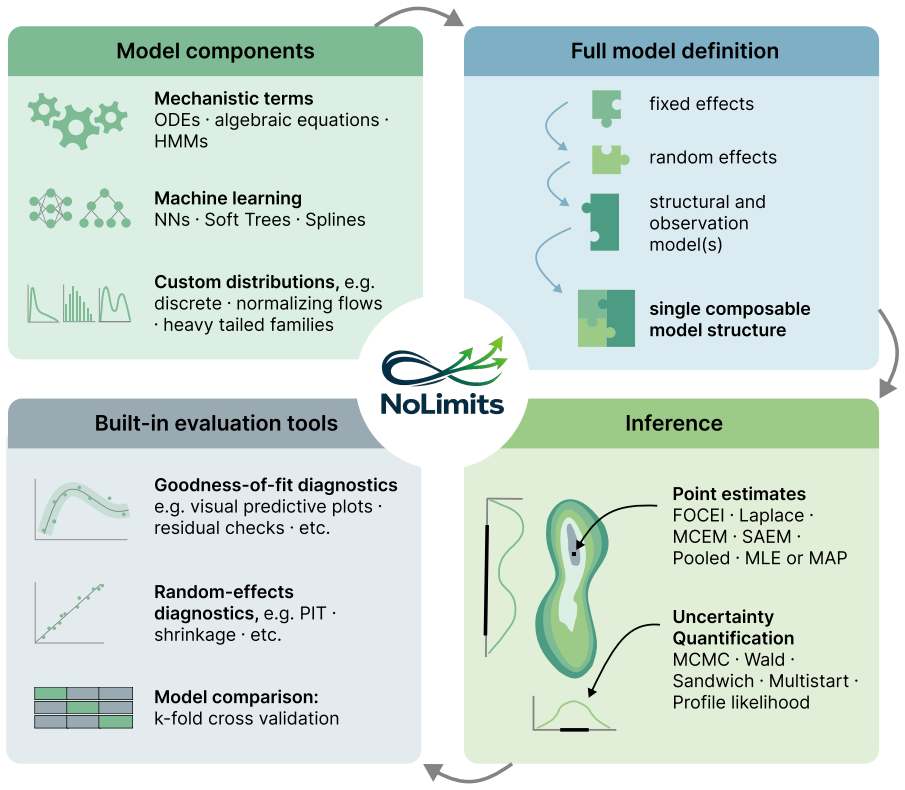
NoLimits.jl is an open-source Julia package whose macro-based modeling language enables construction of observation and latent-state models from diverse building blocks including ordinary differential equations, Markov models, and neural networks. It supports flexible, covariate-dependent observation and random-effects distributions and provides a unified interface to frequentist inference through Laplace approximation, stochastic expectation maximization, and Bayesian Markov chain Monte Carlo methods. The package is shown on three case studies that include workflows with differentiable machine-learning components and estimation of random-effects distributions using normalizing flows.
What carries the argument
The macro-based modeling language that composes observation and latent-state models from ODEs, Markov models, neural networks, and normalizing flows.
If this is right
- The same model specification can be estimated with Laplace approximation, stochastic expectation maximization, or MCMC without rewriting the model.
- Neural networks can be inserted as components for observation or latent states inside a mixed-effects structure.
- Random-effects distributions can be estimated directly from data using normalizing flows instead of fixed parametric forms.
- Covariate dependence can be added to both observation and random-effects distributions within the same modeling syntax.
Where Pith is reading between the lines
- Users may spend less time translating models between separate packages when different inference or component types are needed.
- The composable structure could make it easier to test and compare model variants that mix mechanistic and data-driven elements.
- Further building blocks beyond those shown could be added to the macro language to cover additional longitudinal data settings.
Load-bearing premise
The macro-based modeling language can actually construct and estimate the full range of models including ODEs, neural networks, and normalizing flows without hidden restrictions that block the demonstrated workflows.
What would settle it
An attempt to define a model that combines an ODE latent process with a neural-network observation model and a normalizing-flow random effect, then run estimation under all three inference methods, produces errors or fails to complete.
Figures
read the original abstract
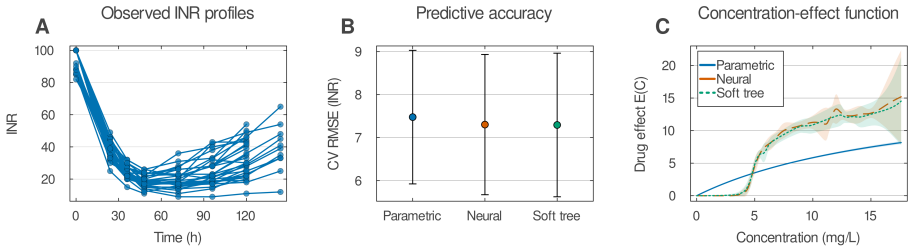
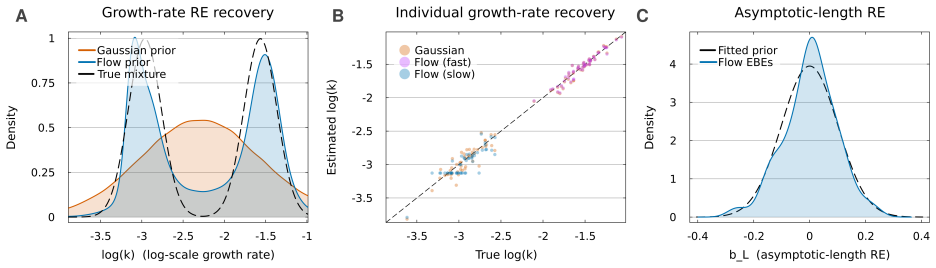
Nonlinear mixed-effects models are widely used to analyze longitudinal data, but existing open-source software often supports only a limited subset of the model structures, inference methods, machine-learning components, automatic differentiation techniques, and random-effects distributions required in modern applications. We introduce NoLimits.jl, an open-source Julia package for flexible and composable nonlinear mixed-effects modeling. Its macro-based modeling language enables observation and latent-state models to be constructed from diverse building blocks, including ordinary differential equations, Markov models, and neural networks. NoLimits.jl supports flexible, covariate-dependent observation and random-effects distributions and provides a unified interface to frequentist inference through Laplace approximation, stochastic expectation maximization, and Bayesian Markov chain Monte Carlo methods. We demonstrate the package on three case studies showcasing its workflows, integration of differentiable machine-learning components, and data-driven estimation of random-effects distributions using normalizing flows. Together, these capabilities substantially expand the range of nonlinear mixed-effects models that can be specified, estimated, and compared within a single open-source framework.
Editorial analysis
A structured set of objections, weighed in public.
Referee Report
Summary. The paper introduces NoLimits.jl, an open-source Julia package for nonlinear mixed-effects modeling. Its macro-based modeling language allows construction of observation and latent-state models from components including ODEs, Markov models, neural networks, and normalizing flows; it supports covariate-dependent distributions for observations and random effects; and it provides a unified interface to Laplace approximation, stochastic expectation maximization, and MCMC inference. Three case studies demonstrate selected workflows, integration of differentiable ML components, and data-driven random-effects estimation.
Significance. If the implementation matches the claims, the package would meaningfully expand the set of NLME models that can be specified and estimated in a single open-source framework, particularly by enabling seamless combination of mechanistic models with neural networks or normalizing flows and by supporting multiple inference paradigms without switching packages. This could reduce fragmentation in pharmacometrics, longitudinal analysis, and related fields.
major comments (2)
- [Abstract] Abstract and case-studies section: the central claim that the macro system 'substantially expand[s] the range' of models rests on the assumption that arbitrary combinations of ODEs/Markov/NNs/flows with covariate-dependent observation and random-effects distributions are supported by all three inference back-ends; the three demonstrations cover only selected subsets and do not enumerate or test the Cartesian product, so latent macro-expansion or type constraints could silently invalidate the generality assertion.
- [Abstract] Abstract: the statement that the package 'provides a unified interface' to Laplace, SEM, and MCMC is load-bearing for the 'single framework' claim, yet the manuscript supplies no description of the common model representation, automatic-differentiation requirements, or error-handling paths that would allow a reader to verify that all three back-ends can be applied to the same macro-constructed model without hidden restrictions.
minor comments (1)
- The manuscript should include a short table or diagram that explicitly lists which combinations of building blocks have been verified to work with each inference method.
Simulated Author's Rebuttal
We thank the referee for their constructive comments, which help clarify the scope of our claims about model generality and the unified inference interface in NoLimits.jl. We address each point below and indicate revisions where the manuscript will be updated.
read point-by-point responses
-
Referee: [Abstract] Abstract and case-studies section: the central claim that the macro system 'substantially expand[s] the range' of models rests on the assumption that arbitrary combinations of ODEs/Markov/NNs/flows with covariate-dependent observation and random-effects distributions are supported by all three inference back-ends; the three demonstrations cover only selected subsets and do not enumerate or test the Cartesian product, so latent macro-expansion or type constraints could silently invalidate the generality assertion.
Authors: The case studies were selected to highlight distinct capabilities (workflows, ML integration, and data-driven random effects) rather than to exhaustively cover every combination. The macro system generates a unified internal representation that is intended to be compatible with all three back-ends, and compatibility has been verified in the package test suite for the combinations used in the demonstrations. We acknowledge that the manuscript does not enumerate the full Cartesian product or discuss potential type constraints in detail. We will revise the abstract to qualify the generality claim and add a supplementary note or table summarizing tested combinations and their supported inference methods. revision: partial
-
Referee: [Abstract] Abstract: the statement that the package 'provides a unified interface' to Laplace, SEM, and MCMC is load-bearing for the 'single framework' claim, yet the manuscript supplies no description of the common model representation, automatic-differentiation requirements, or error-handling paths that would allow a reader to verify that all three back-ends can be applied to the same macro-constructed model without hidden restrictions.
Authors: The manuscript focuses on the user-facing macro language and case studies. The common model representation is an expression graph that supports automatic differentiation through Julia's AD ecosystem and is shared across back-ends, with error handling managed via standard Julia mechanisms; these internals are documented in the package source and README. We agree that a brief description in the paper would strengthen the unified-interface claim. We will add a short paragraph in the methods section outlining the shared representation, AD requirements, and compatibility approach. revision: yes
Circularity Check
No circularity: software package description with no derivations
full rationale
This is a software introduction paper presenting the NoLimits.jl package. Its claims concern the existence and demonstrated functionality of modeling macros, inference back-ends, and case-study workflows. No mathematical derivation chain, predictions, or first-principles results exist that could reduce to inputs by construction. No equations, fitted parameters presented as predictions, uniqueness theorems, or ansatzes are invoked. Self-citations, if any, are not load-bearing for any derivation. The paper is self-contained against external benchmarks (the package itself) and receives the default non-finding.
Axiom & Free-Parameter Ledger
Reference graph
Works this paper leans on
-
[1]
1974 , journal =
A New Look at the Statistical Model Identification , author =. 1974 , journal =
1974
-
[2]
2015 , journal =
A nonlinear mixed effects approach for modeling the cell-to-cell variability of Mig1 dynamics in yeast , author =. 2015 , journal =
2015
-
[3]
2015 , journal =
Using sensitivity equations for computing gradients of the FOCE and FOCEI approximations to the population likelihood , author =. 2015 , journal =
2015
-
[4]
Proceedings of the 41st International Conference on Machine Learning , publisher =
An amortized approach to non-linear mixed-effects modeling based on neural posterior estimation , author =. Proceedings of the 41st International Conference on Machine Learning , publisher =. 2024 , month =
2024
-
[5]
2024 , booktitle =
An amortized approach to non-linear mixed-effects modeling based on neural posterior estimation , author =. 2024 , booktitle =
2024
-
[6]
2018 , journal =
Mechanistic models versus machine learning, a fight worth fighting for the biological community? , author =. 2018 , journal =
2018
-
[7]
Fitting Linear Mixed-Effects Models Using
Bates, Douglas and M. Fitting Linear Mixed-Effects Models Using. 2015 , journal =
2015
-
[8]
2019 , journal =
NONMEM tutorial part I: description of commands and options, with simple examples of population analysis , author =. 2019 , journal =
2019
-
[9]
2011 , journal =
Prediction-Corrected Visual Predictive Checks for Diagnosing Nonlinear Mixed-Effects Models , author =. 2011 , journal =
2011
-
[10]
2021 , journal =
Besan. 2021 , journal =
2021
-
[11]
2017 , journal =
Julia: A fresh approach to numerical computing , author =. 2017 , journal =
2017
-
[12]
2024 , journal =
DataInterpolations.jl: Fast Interpolations of 1D Data , author =. 2024 , journal =
2024
-
[13]
2026 , url =
BlackBoxOptim.jl: Black-Box Optimization in Julia , author =. 2026 , url =
2026
-
[14]
2017 , journal =
Variational inference: A review for statisticians , author =. 2017 , journal =
2017
-
[15]
2023 , journal =
Universal differential equations for glacier ice flow modelling , author =. 2023 , journal =
2023
-
[16]
Journal of Open Source Software , volume =
Borisov, Ivan and Demin, Aleksander and Metelkin, Evgeny , year =. Journal of Open Source Software , volume =
-
[17]
2023 , journal =
A multidimensional ODE-based model of Alzheimer’s disease progression , author =. 2023 , journal =
2023
-
[18]
2023 , journal =
DataFrames.jl: Flexible and Fast Tabular Data in Julia , author =. 2023 , journal =
2023
-
[19]
2022 , journal =
Using scientific machine learning to develop universal differential equation for multicomponent adsorption separation systems , author =. 2022 , journal =
2022
-
[20]
2024 , journal =
Low-dimensional neural ODEs and their application in pharmacokinetics , author =. 2024 , journal =
2024
-
[21]
Low-Dimensional Neural Ordinary Differential Equations Accounting for Inter-Individual Variability Implemented in
Br. Low-Dimensional Neural Ordinary Differential Equations Accounting for Inter-Individual Variability Implemented in. 2025 , journal =
2025
-
[22]
2001 , publisher =
Foundations of mathematical economics , author =. 2001 , publisher =
2001
-
[23]
2025 , journal =
A nonparametric approach to practical identifiability of nonlinear mixed effects models , author =. 2025 , journal =
2025
-
[24]
2018 , journal =
Neural ordinary differential equations , author =. 2018 , journal =
2018
-
[25]
1995 , journal =
Understanding the Metropolis-Hastings Algorithm , author =. 1995 , journal =
1995
-
[26]
2017 , journal =
Parameter estimation in nonlinear mixed effect models using saemix, an R implementation of the SAEM algorithm , author =. 2017 , journal =
2017
-
[27]
Extending the
Comets, Emmanuelle and Delattre, Maud and Karimi, Belhal , year =. Extending the
-
[28]
2024 , note =
Improving Simulations by Learning the True Random Effects' Distribution from a Population Using Generative Machine Learning , author =. 2024 , note =
2024
-
[29]
jl , author =
Interpretable machine learning for science with PySR and SymbolicRegression. jl , author =. 2023 , journal =
2023
-
[30]
2003 , journal =
Nonlinear models for repeated measurement data: an overview and update , author =. 2003 , journal =
2003
-
[31]
1997 , publisher =
Bootstrap methods and their application , author =. 1997 , publisher =
1997
-
[32]
1993 , journal =
Comparison of four basic models of indirect pharmacodynamic responses , author =. 1993 , journal =
1993
-
[33]
2025 , journal =
Conditional universal differential equations capture population dynamics and interindividual variation in c-peptide production , author =. 2025 , journal =
2025
-
[34]
2025 , journal =
Physiology-informed regularisation enables training of universal differential equation systems for biological applications , author =. 2025 , journal =
2025
-
[35]
1999 , journal =
Convergence of a stochastic approximation version of the EM algorithm , author =. 1999 , journal =
1999
-
[36]
1977 , journal =
Maximum likelihood from incomplete data via the EM algorithm , author =. 1977 , journal =
1977
-
[37]
doi:10.5281/zenodo.7738525 , url =
Vaibhav Kumar Dixit and Christopher Rackauckas , year =. doi:10.5281/zenodo.7738525 , url =
-
[38]
2021 , journal =
Practical identifiability in the frame of nonlinear mixed effects models: the example of the in vitro erythropoiesis , author =. 2021 , journal =
2021
-
[39]
2025 , doi =
nlmixr2: Nonlinear Mixed Effects Models in Population PK/PD , author =. 2025 , doi =
2025
-
[40]
1925 , journal =
Theory of Statistical Estimation , author =. 1925 , journal =
1925
-
[41]
Huber sandwich estimator
On the so-called “Huber sandwich estimator” and “robust standard errors” , author =. 2006 , journal =
2006
-
[42]
1990 , journal =
Sampling-based approaches to calculating marginal densities , author =. 1990 , journal =
1990
-
[43]
1995 , publisher =
Bayesian data analysis , author =. 1995 , publisher =
1995
-
[44]
Gelman, Andrew and Carlin, John B and Stern, Hal S and Dunson, David B and Vehtari, Aki and Rubin, Donald B , year =. doi:10.1201/b16018 , url =
-
[45]
2015 , journal =
Partial Migration: Growth Varies between Resident and Migratory Fish , author =. 2015 , journal =
2015
-
[46]
2016 , publisher =
Deep Learning , author =. 2016 , publisher =
2016
-
[47]
1998 , booktitle =
The general approximation theorem , author =. 1998 , booktitle =
1998
-
[48]
2013 , publisher =
Foundations of Applied Mathematics , author =. 2013 , publisher =
2013
-
[49]
2002 , publisher =
Ordinary Differential Equations , author =. 2002 , publisher =
2002
-
[50]
2019 , journal =
A Physiological Perspective on the Ecology and Evolution of Partial Migration , author =. 2019 , journal =
2019
-
[51]
, author =
The No-U-Turn sampler: adaptively setting path lengths in Hamiltonian Monte Carlo. , author =. 2014 , journal =
2014
-
[52]
and Staatz, Christine E
Hooker, Andrew C. and Staatz, Christine E. and Karlsson, Mats O. , year =. Conditional Weighted Residuals (. Pharmaceutical Research , publisher =
-
[53]
1989 , journal =
Multilayer Feedforward Networks Are Universal Approximators , author =. 1989 , journal =
1989
-
[54]
2018 , journal =
Flux: Elegant Machine Learning with Julia , author =. 2018 , journal =
2018
-
[55]
2012 , booktitle =
Soft Decision Trees , author =. 2012 , booktitle =
2012
-
[56]
1985 , journal =
Numerical parameter identifiability and estimability: Integrating identifiability, estimability, and optimal sampling design , author =. 1985 , journal =
1985
-
[57]
2022 , journal =
Deep compartment models: a deep learning approach for the reliable prediction of time-series data in pharmacokinetic modeling , author =. 2022 , journal =
2022
-
[58]
2016 , journal =
Parameter identifiability of fundamental pharmacodynamic models , author =. 2016 , journal =
2016
-
[59]
1995 , journal =
Three new residual error models for population PK/PD analyses , author =. 1995 , journal =
1995
-
[60]
2015 , journal =
Nonlinear mixed-effects modelling for single cell estimation: when, why, and how to use it , author =. 2015 , journal =
2015
-
[61]
2024 , journal =
Longitudinal single-cell data informs deterministic modelling of inflammatory bowel disease , author =. 2024 , journal =
2024
-
[62]
2016 , journal =
Improved variational inference with inverse autoregressive flow , author =. 2016 , journal =
2016
-
[63]
2013 , journal =
Profile Likelihood in Systems Biology , author =. 2013 , journal =
2013
-
[64]
2004 , journal =
Coupling a stochastic approximation version of EMwith an MCMC procedure , author =. 2004 , journal =
2004
-
[65]
2005 , journal =
Maximum Likelihood Estimation in Nonlinear Mixed Effects Models , author =. 2005 , journal =
2005
-
[66]
and Deloukas, Panos and Daly, Ann K
Lane, Steven and Al-Zubiedi, Sameh and Hatch, Ellen and Matthews, Ivan and Jorgensen, Andrea L. and Deloukas, Panos and Daly, Ann K. and Park, B. Kevin and Aarons, Leon and Ogungbenro, Kayode and others , year =. The Population Pharmacokinetics of. British Journal of Clinical Pharmacology , publisher =
-
[67]
2014 , publisher =
Mixed effects models for the population approach: models, tasks, methods and tools , author =. 2014 , publisher =
2014
-
[68]
2016 , journal =
What do we mean by identifiability in mixed effects models? , author =. 2016 , journal =
2016
-
[69]
2023 , journal =
Improved modeling of crystallization processes by universal differential equations , author =. 2023 , journal =
2023
-
[70]
1990 , journal =
Nonlinear mixed effects models for repeated measures data , author =. 1990 , journal =
1990
-
[71]
and Nocedal, Jorge , year =
Liu, Dong C. and Nocedal, Jorge , year =. On the Limited Memory. Mathematical Programming , publisher =
-
[72]
2018 , journal =
A hierarchical, data-driven approach to modeling single-cell populations predicts latent causes of cell-to-cell variability , author =. 2018 , journal =
2018
-
[73]
1982 , journal =
Finding the observed information matrix when using the EM algorithm , author =. 1982 , journal =
1982
-
[74]
2021 , journal =
Neural-ODE for pharmacokinetics modeling and its advantage to alternative machine learning models in predicting new dosing regimens , author =. 2021 , journal =
2021
-
[75]
2002 , journal =
Bayesian analysis of population PK/PD models: general concepts and software , author =. 2002 , journal =
2002
-
[76]
2012 , journal =
A longitudinal model for magnetic resonance imaging lesion count data in multiple sclerosis patients , author =. 2012 , journal =
2012
-
[77]
1993 , journal =
Bootstrap and wild bootstrap for high dimensional linear models , author =. 1993 , journal =
1993
-
[78]
2024 , journal =
Data-Driven Discovery of Feedback Mechanisms in Acute Myeloid Leukaemia: Alternatives to classical models using Deep Nonlinear Mixed Effect modeling and Symbolic Regression , author =. 2024 , journal =
2024
-
[79]
2011 , journal =
Mixed hidden Markov models for longitudinal data: An overview , author =. 2011 , journal =
2011
-
[80]
1979 , journal =
A Comparison of Three Methods for Selecting Values of Input Variables in the Analysis of Output from a Computer Code , author =. 1979 , journal =
1979
discussion (0)
Sign in with ORCID, Apple, or X to comment. Anyone can read and Pith papers without signing in.