REVIEW 3 major objections 4 minor 9 references
A modular mini-pad photon detector prototype for RICH application at the Electron Ion Collider
T0 review · 3 major / 4 minor · reviewed 2026-08-14 · deepseek-v4-flash
Pith's one-line read A modular gas detector with 3.5 mm pad pitch reports first Cherenkov rings and argues that tiled modules can meet the Electron-Ion Collider's need for fine-granularity single-photon imaging.
desk verdict A modest but honest first-prototype status report: the new geometry and modular design are real, but the 'high space resolution' claim is not yet backed by a single-photon position resolution measurement. read the letter →
The pith
A machine-rendered reading of the paper's core claim, the machinery that carries it, and where it could break.
The reading
What carries the argument
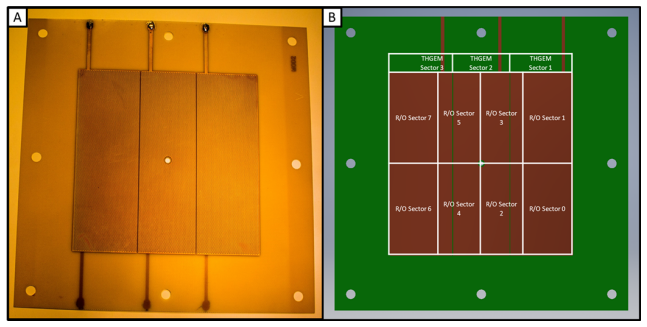
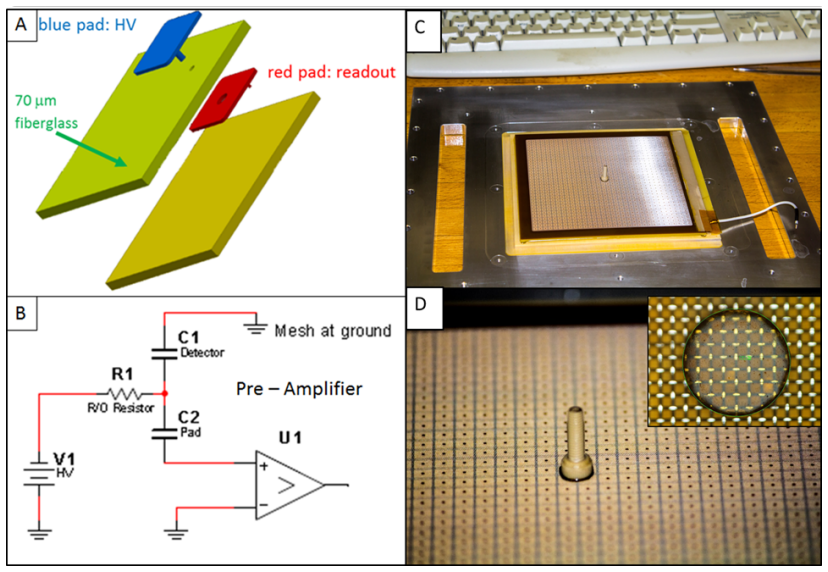
The load-bearing mechanism is the capacitive readout of a finely segmented anode: 3 mm pads at 3.5 mm pitch on the top surface of the PCB couple to identical buried readout pads 70 µm below, with each anode pad individually biased through 470 MΩ resistors. This geometry keeps the front-end electronics and services inside the 10×10 cm module, so the design scales by tiling identical modules. Because the buried-pad signals vary with parasitic capacitance from pad to pad (up to ±20%), the analysis chain corrects amplitudes using measured capacitance differences before reconstructing cluster positions. The second necessary element is the THGEM/Micromegas gain stack, where THGEM is a thick gas electron multiplier (a PCB with drilled holes, each acting as a multiplication site) and a Micromegas is a micromesh gaseous detector stage; together they produce high effective gain above 50k with a CsI reflective photocathode for UV photons.
What would settle it
Illuminate the module with a collimated UV spot stepped in sub-millimetre increments across pad boundaries and reconstruct cluster centroids; if the centroids do not track the true position to within a fraction of the 3.5 mm pitch, or show residual periodic distortion from the uncorrected pad capacitance, the high-spatial-resolution claim fails.
Extended reading notes
Core claim
The paper claims that a modular mini-pad hybrid MPGD detector—two staggered THGEM layers, the first coated with CsI, followed by a Micromegas anode with 1024 pads at 3.5 mm pitch read out capacitively—can serve as the photon detector for an Electron-Ion Collider RICH. The evidence is a full prototype that operated stably at effective gains above 50k in the laboratory, showed uniform response after correcting readout capacitance differences, and produced clear Cherenkov rings in a test beam with a solid radiator. On that evidence the authors conclude that such a modular detector of single photons could provide high spatial resolution for single-photon detection and cover large areas. The claim is an extension of an already-working architecture; the genuinely new elements are the smaller pad pitch, the capacitive pickup, and the modular form factor that can be tiled.
Load-bearing premise
The resolution claim rests on the assumption that the capacitance-based amplitude correction fully restores the signal-to-position mapping, but no single-photon position resolution or residual non-uniformity measurement is reported.
Editorial extensions
If this is right
- A RICH for the Electron-Ion Collider could cover several square metres by tiling 10×10 cm modules, with cost set by PCB-based MPGD production rather than by photomultiplier arrays.
- Shrinking the pad pitch from 8 mm to 3.5 mm directly improves the achievable Cherenkov-angle resolution, which is the limiting factor for hadron identification with a short radiator.
- Stable operation at effective gains above 50k in the laboratory, in a gas mixture already used by an operating RICH photon detector, indicates the finer granularity does not force a riskier gas regime.
- The APV25-based readout chain, together with the new Raven DAQ and Raven Decoder software, already works in beam tests and gives a concrete route to scaling the readout to many modules.
Reading between the lines
- A decisive next measurement the paper leaves implicit is single-photon position resolution: stepping a collimated UV spot across pad boundaries and comparing reconstructed centroids would directly test whether the 3.5 mm pitch delivers the claimed improvement.
- The ±20% pad-to-pad parasitic capacitance spread implies that a full-scale detector needs an automated per-pad gain calibration in the readout chain; otherwise the corrected centroid map will carry a periodic 3.5 mm bias.
- If the modular design and resolution are confirmed, the same tile could serve other imaging gas detectors needing millimetre-scale granularity, such as tracking or thermal-neutron imaging, not only Cherenkov counters.
Signed reviews
Editorial analysis
A structured set of objections, weighed in public.
Referee Report
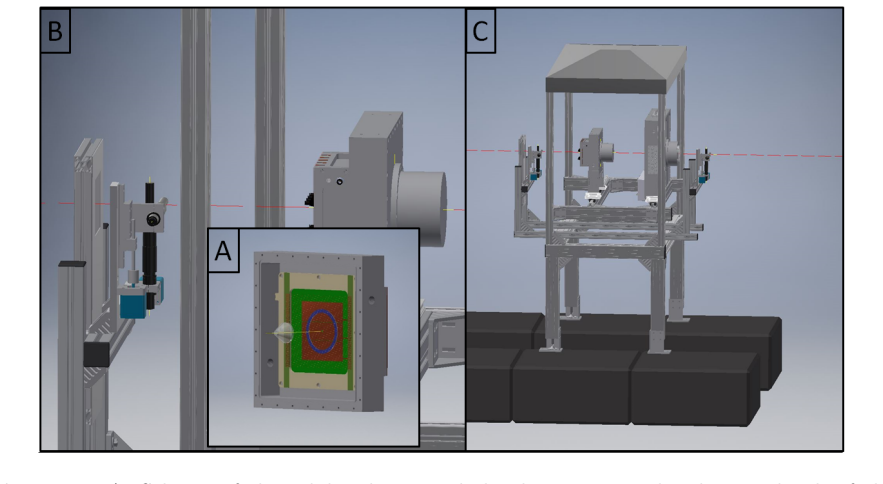
Summary. The paper describes the design, construction, and preliminary characterization of a modular 10x10 cm2 mini-pad photon detector prototype for a future EIC RICH. The detector couples two THGEM stages (the first with a CsI photocathode) to a bulk Micromegas with an anode segmented into 1024 square pads of 3.5 mm pitch, read out via capacitive coupling and APV-25/SRS electronics. Laboratory tests with X-ray and UV sources characterize THGEM gain uniformity, Micromegas stability, and pad-response non-uniformity; a beam test at the CERN SPS H4 line observes clear Cherenkov rings in Ar:CH4 50:50 and in pure CH4. The authors also present the Raven DAQ and Raven Decoder software. The conclusion claims that the modular detector 'could provide high space resolution for single photon detection and can cover large areas.'
Significance. If the spatial-resolution claim were quantitatively established, this work would be a useful step toward an EIC RICH photon detector with better granularity than the COMPASS RICH-1 baseline (8 mm pitch) while preserving a modular MPGD architecture. The paper's strengths are its direct laboratory measurements, the absence of fitted parameters or circular reasoning, the explicit modular design philosophy, and the development of readable DAQ/decoder tools. These are appropriate for an R&D progress report. However, the central advance over COMPASS RICH-1 is supposed to be improved single-photon position resolution, and the paper does not measure it. The observed Cherenkov rings demonstrate sensitivity to Cherenkov photons but not the quantitative spatial resolution required for the EIC physics case. The significance is therefore conditional: the prototype works, but the key performance claim remains unverified as presented.
major comments (3)
- [Section 4 and Section 5] The central conclusion that the detector 'could provide high space resolution for single photon detection' is not supported by any direct position-resolution measurement. The beam test in Section 4 shows Cherenkov rings (Fig. 8), but no single-photon hit-position residual, centroiding accuracy, point-spread function, or comparison with a known track/point pattern is reported. Since the motivation for the 3.5 mm pitch is the EIC RICH requirement of improved resolution over the COMPASS 8 mm pitch, the paper should either report a quantitative position-resolution measurement (e.g., a mask or collimated source with known positions) or explicitly temper the conclusion to claim only successful single-photon detection and ring imaging.
- [Section 2.2, Fig. 5] The correction for pad-to-pad parasitic capacitance differences restores the amplitude peak positions in 55Fe spectra, but amplitude uniformity is not equivalent to position linearity. The paper does not demonstrate that the capacitive readout correctly reconstructs the position of a single photon after the correction, nor does it report residual non-uniformity after correction. A position-scan measurement across the pad plane, or at least a comparison of reconstructed hit positions with a known deposited pattern, is needed to validate the signal-to-position mapping that underpins the resolution claim.
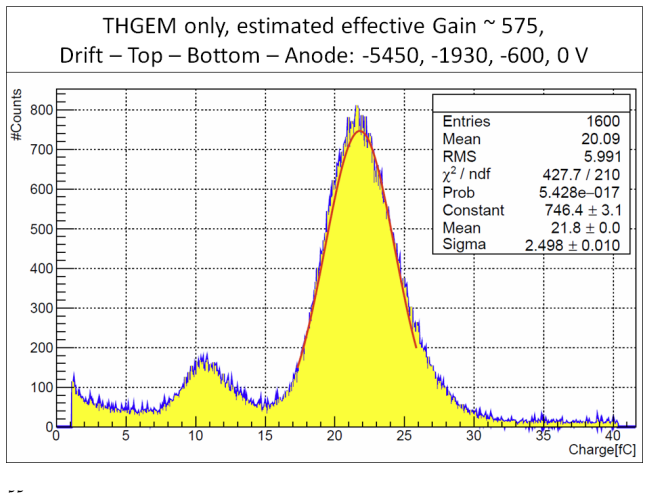
- [Section 2.1 and Section 4] Several quantitative claims lack error bars, statistics, or definitions. For example, 'an effective gain uniformity of ~5%' (Section 2.1) is stated without the number of pads/sectors sampled or the spread definition; 'a discharge rate <10^-3 Hz' has no confidence level; 'stable operation above 50k effective gain' is reported without measurement conditions or uncertainty; and the Cherenkov ring images in Fig. 8 include no ring radius, number of photoelectrons, signal-to-noise ratio, or background estimate. These additions would make the claims reproducible and comparable with existing RICH photon-detector results.
minor comments (4)
- [Author list] The author name 'S. Dalla T orre' contains an extra space; it should read 'S. Dalla Torre'.
- [Section 4, Fig. 8] Figure 8 would benefit from labeled axes, a scale bar in pad units, and a statement of how many events are accumulated; without this, the reader cannot assess the ring quality or background.
- [Section 3] The Raven DAQ rate statement '10 kHz for 1 APV with 7200 RPM SATA disks' should clarify whether this is a sustained throughput and what zero-suppression threshold is used.
- [Introduction] The spelling 'Cerenkov' in the Introduction should be made consistent with 'Cherenkov' used elsewhere in the manuscript.
Circularity Check
No circularity found: the prototype results are direct laboratory and beam measurements, and self-citations appear only as background context.
full rationale
The paper reports a new modular mini-pad photon detector prototype and presents direct laboratory and test-beam measurements. The central conclusion, that such a detector 'could provide high space resolution for single photon detection and can cover large areas,' is an extrapolation from the observed Cherenkov rings in Fig. 8, not a quantity derived from an input that already contains it. No parameter is fitted to a subset of the data and then presented as a prediction of a closely related quantity; the only correction, for measured parasitic capacitance differences among pads, is explicitly described as a measured correction applied to amplitude spectra. The self-citations in the reference list are to background technology and prior work by the same collaboration on COMPASS RICH-1, THGEM R&D, Micromegas bulk technology, APV-25, and SRS readout; these are cited as context and existing hardware, not as the source of the claimed new result. In particular, no uniqueness theorem or prior-work assumption is invoked to force the design choice, and no equation in the paper equates the claimed resolution to an input by construction. The absence of a directly measured single-photon position resolution would be a correctness or support concern, but it is not circularity: the paper does not derive its resolution claim from the pad pitch by construction, it states it as an expectation from 'promising first results.' Therefore, under the strict definition required, no circular step can be exhibited.
Assumptions & free parameters
assumptions (3)
- domain assumption The capacitive-coupled pad readout preserves the spatial information of single photoelectrons after correction for parasitic capacitance.
- domain assumption The ring patterns observed in the test beam originate from Cherenkov light produced in the solid radiator.
- domain assumption Effective gain values quoted for the THGEM and MM stages correspond to stable single-photon detection conditions.
Cite this review
Pith. "Pith review of A modular mini-pad photon detector prototype for RICH application at the Electron Ion Collider." pith.science (2026). https://pith.science/paper/F6NKUSGC
@misc{pith2026190805052,
  author       = {Pith},
  title        = {Pith review of: A modular mini-pad photon detector prototype for RICH application at the Electron Ion Collider},
  year         = {2026},
  howpublished = {\url{https://pith.science/paper/F6NKUSGC}},
  note         = {Machine review of arXiv:1908.05052}
}
read the original abstract
Experiments at the future Electron Ion Collider require excellent hadron identification in a broad momentum range, in harsh conditions. A RICH capable to fulfill the PID requirements of the EIC could use MPGD-based photon detectors with solid photocathodes for covering large surfaces at affordable cost, providing good efficiency, high resolution and compatibility with magnetic field. Photon detectors realized by coupling THGEMs and Micromegas have been successfully operated at the RICH-1 detector of the COMPASS Experiment at CERN since 2016. A similar technology could be envisaged for an EIC RICH, provided a large improvement in the photon position resolution is achieved. An R\&D effort in this direction is ongoing at INFN Trieste. Few prototypes with smaller pixel size (down to 3 mm x 3 mm) have been built and tested in the laboratory with X-Ray and UV LED light sources. A modular mini-pad detector prototype has also been tested at the CERN SPS H4 beamline. New data acquisition and analysis software called Raven DAQ and Raven Decoder have been developed and used with the APV-25 based Scalable Readout System (SRS), for the modular mini-pad prototype tests.
Figures

Figures from the paper (5 more)



Reference graph
Works this paper leans on
-
[1]
Accardi et al ., Electron-Ion Collider: The next QCD frontier, Eur
A. Accardi et al ., Electron-Ion Collider: The next QCD frontier, Eur. Phys. J A52 (2016) 268
work page 2016
-
[2]
Agarwala et al ., The MPGD-based photon detectors for the upgrade of COMPASS RICH-1, Nucl
J. Agarwala et al ., The MPGD-based photon detectors for the upgrade of COMPASS RICH-1, Nucl. Instr. and Meth. A 876, (2017) 96
work page 2017
-
[3]
Agarwala et al ., The MPGD-based photon detectors for the upgrade of COMPASS RICH-1 and beyond, Nucl
J. Agarwala et al ., The MPGD-based photon detectors for the upgrade of COMPASS RICH-1 and beyond, Nucl. Instr. and Meth. A 936 (2019) 416
work page 2019
-
[4]
L. Periale et al ., Detection of the primary scintillation light from dense Ar, Kr and Xe with novel photosensitive gaseous detectors, Nucl. Instr. and Meth. A 478 (2002) 377; P. Jeanneret, PhD thesis, Neuchatel University, 2001; P.S. Barbeau et al ., IEEE NS-50 (2003) 1285; R. Chechik et al ., Thick GEM- like hole multipliers: properties and possible app...
work page 2002
-
[5]
M.Alexeev et al., The quest for a third generation of gaseous photon detectors for Cherenkov imaging counters, Nucl. Instr. and Meth. A 610 (2009) 174; M.Alexeev et al., THGEM based photon detector for Cherenkov Figure 6. Raven DAQ GUI. A. The amplitude spectrum collected using a 55Fe X-Ray source to illuminate the prototype and reading the 128 channels o...
work page 2009
-
[6]
M.Alexeev et al ., Status and progress of the novel photon detectors based on THGEM and hybrid MPGD architectures, Nucl. Instr. and Meth. A 766 (2014) 133
work page 2014
-
[7]
I. Giomataris et al . Micromegas in a bulk, Nucl. Instr. and Meth. A 560 (2006), p. 405
work page 2006
-
[8]
M.J. French et al., Design and results from the APV25, a deep sub-micron CMOS front-end chip for the CMS tracker, Nucl. Instr. and Meth. A 466 (2001) 359
work page 2001
Show all 9 references
-
[9]
S.Martoiu et al ., JINST 8 C03015 (2013) Figure 7. A: Scheme of the solid radiator and the detector; B: The closeup sketch of the chamber with radiator housing in the test beam setup with the trigger system; C: The complete test beam setup. Figure 8. Observed Cherenkov rings i...
2013
Reviewed August 14, 2026 · model on record in the stance chip above.
Discussion (0). Continue with ORCID to comment.