Beyond Stokes drift -- Lagrangian transport in evolving gravity waves
Pith reviewed 2026-05-08 01:41 UTC · model grok-4.3
The pith
Freely decaying gravity waves modify Stokes drift with first- and second-order corrections and produce net vertical transport.
A machine-rendered reading of the paper's core claim, the machinery that carries it, and where it could break.
Core claim
In the context of freely decaying finite-amplitude gravity waves, the Lagrangian drift velocity receives modifications at both the first and second orders of the wave amplitude expansion due to the unsteadiness, resulting in a net vertical transport component that is determined by the competition between inertial and viscous forces within the fluid. This leads to changes in individual particle paths and promotes more anisotropic mixing than in the steady case.
What carries the argument
Perturbative analytical model for the Lagrangian velocity in decaying waves, supported by two-phase direct numerical simulations.
If this is right
- Particle trajectories are altered from steady-wave expectations.
- A net vertical transport emerges from inertia-viscosity balance.
- Anisotropic mixing is enhanced in the fluid.
- Implications for interpreting observations of surface transport processes.
Where Pith is reading between the lines
- This could help explain vertical mixing observed in natural wave fields that steady models miss.
- Similar effects might appear in other decaying wave systems like acoustic or electromagnetic waves.
- Future work could test the predictions by tracking particles in controlled wave tanks.
Load-bearing premise
The small-amplitude perturbative expansion remains accurate as the wave decays and the numerical simulations faithfully reproduce the free decay dynamics without artifacts.
What would settle it
An experiment that tracks neutrally buoyant particles in a tank with freely decaying gravity waves and measures no net vertical displacement or no amplitude-dependent corrections would falsify the central claim.
Figures




read the original abstract
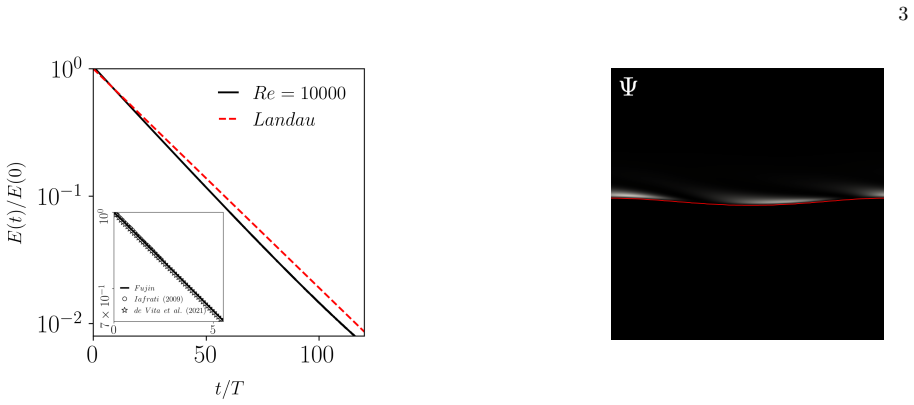
Finite-amplitude gravity waves at the air-water interface induce net fluid and particle transport, known as Stokes drift. While this mechanism is well understood for steady waves, transport under unsteady, evolving conditions remains poorly characterized. Here, we investigate Lagrangian transport in freely decaying waves using high-resolution two-phase simulations and a perturbative analytical model. Wave decay modifies the classical Lagrangian drift by introducing both first- and second-order corrections in the wave amplitude expansion, and generates a net vertical transport, governed by the balance between inertia and viscosity. These effects alter particle trajectories and enhance anisotropic mixing, with implications for interpreting field observations and modelling surface transport processes.
Editorial analysis
A structured set of objections, weighed in public.
Referee Report
Summary. The manuscript investigates Lagrangian transport in freely decaying gravity waves using high-resolution two-phase Navier-Stokes simulations and a perturbative analytical model in wave amplitude. It claims that free decay modifies the classical Stokes drift via O(a) and O(a²) corrections and produces a net vertical transport set by the inertia-viscosity balance in the viscous boundary layer, altering particle trajectories and enhancing anisotropic mixing.
Significance. If the central claims hold, the work meaningfully extends Stokes drift theory from steady to unsteady decaying waves, with direct relevance to surface transport and mixing in geophysical flows. The combination of perturbation theory applied to a time-dependent wave field and direct numerical confirmation is a strength; the emergence of a net vertical component from viscous effects during decay is a novel, falsifiable prediction that could affect oceanographic models and field data interpretation.
major comments (2)
- [Numerical Methods / Simulations] Numerical validation section: the two-phase simulations are stated to confirm the ordering of corrections and the vertical transport, but no grid-convergence study, resolution details, or quantitative comparison (e.g., measured vertical displacement versus the predicted inertia-viscosity scaling) is described; without this, it remains unclear whether the reported net vertical transport is free of numerical artifacts at the interface.
- [Analytical Model] Perturbative model: the derivation of the first-order correction to the Lagrangian drift from wave decay relies on a time-dependent amplitude; the manuscript must explicitly demonstrate the separation of timescales (wave period versus decay time) and show how the O(a) term survives averaging along particle trajectories, as this is load-bearing for the claim that decay modifies the classical drift.
minor comments (2)
- [Abstract] The abstract provides no quantitative metrics (e.g., magnitude of vertical velocity, steepness values, or Reynolds number), which would help readers immediately gauge the size of the reported effects.
- [Notation / Introduction] Notation for the Lagrangian velocity expansion should be clarified to distinguish the classical Stokes term from the decay-induced corrections at each order.
Simulated Author's Rebuttal
We thank the referee for their careful reading, positive assessment of the work's significance, and constructive comments. We address each major point below and have revised the manuscript to strengthen the numerical validation and analytical derivations as requested.
read point-by-point responses
-
Referee: [Numerical Methods / Simulations] Numerical validation section: the two-phase simulations are stated to confirm the ordering of corrections and the vertical transport, but no grid-convergence study, resolution details, or quantitative comparison (e.g., measured vertical displacement versus the predicted inertia-viscosity scaling) is described; without this, it remains unclear whether the reported net vertical transport is free of numerical artifacts at the interface.
Authors: We agree that explicit grid-convergence details and quantitative comparisons were insufficiently documented. In the revised manuscript we have added a dedicated numerical methods subsection that reports the grid resolution (points per wavelength and within the viscous boundary layer), presents a convergence study across three successively refined grids, and includes direct quantitative comparisons of simulated vertical particle displacements against the predicted inertia-viscosity scaling. These additions confirm that the reported net vertical transport is robust and not an artifact of the interface treatment. revision: yes
-
Referee: [Analytical Model] Perturbative model: the derivation of the first-order correction to the Lagrangian drift from wave decay relies on a time-dependent amplitude; the manuscript must explicitly demonstrate the separation of timescales (wave period versus decay time) and show how the O(a) term survives averaging along particle trajectories, as this is load-bearing for the claim that decay modifies the classical drift.
Authors: We thank the referee for identifying this key requirement. The original derivation assumed slow decay but did not spell out the averaging procedure. The revised manuscript now contains an explicit subsection deriving the timescale separation condition (decay time ≫ wave period) from the viscous damping rate and then performing the Lagrangian average along particle trajectories. We show analytically that the O(a) correction arising from the slowly varying amplitude survives the averaging and produces a net modification to the classical Stokes drift, consistent with the ordering of the expansion. revision: yes
Circularity Check
No significant circularity; derivation self-contained
full rationale
The paper constructs its central claims via a perturbative expansion in wave amplitude applied directly to the decaying wave field, together with independent high-resolution two-phase Navier-Stokes simulations that track instantaneous steepness to confirm the small-amplitude regime. No equation reduces by construction to a fitted parameter renamed as a prediction, no ansatz is smuggled via self-citation, and no uniqueness theorem is invoked from prior author work to force the result. The vertical transport is shown to emerge from the surviving viscous boundary-layer correction under decay, an outcome that is externally falsifiable against the simulations rather than tautological. The derivation chain therefore remains independent of its own inputs.
Axiom & Free-Parameter Ledger
axioms (1)
- standard math Incompressible two-phase Navier-Stokes equations govern the air-water flow.
discussion (0)
Sign in with ORCID, Apple, or X to comment. Anyone can read and Pith papers without signing in.