REVIEW 4 major objections 5 minor 117 references
A Comprehensive Study of Czernik 41 and NGC 1342 Using CCD UBV and Gaia DR3 Data
T0 review · 4 major / 5 minor · reviewed 2026-08-06 · deepseek-v4-flash
Pith's one-line read Combining UBV photometry with Gaia astrometry settles the ages, distances, and metallicities of two poorly studied open clusters and traces their birthplaces to opposite sides of the Solar circle.
desk verdict A competent open-cluster study with a real new dataset, but the Czernik 41 age is not as precise as claimed and the cross-method agreement is partly circular. read the letter →
The pith
A machine-rendered reading of the paper's core claim, the machinery that carries it, and where it could break.
The reading
What carries the argument
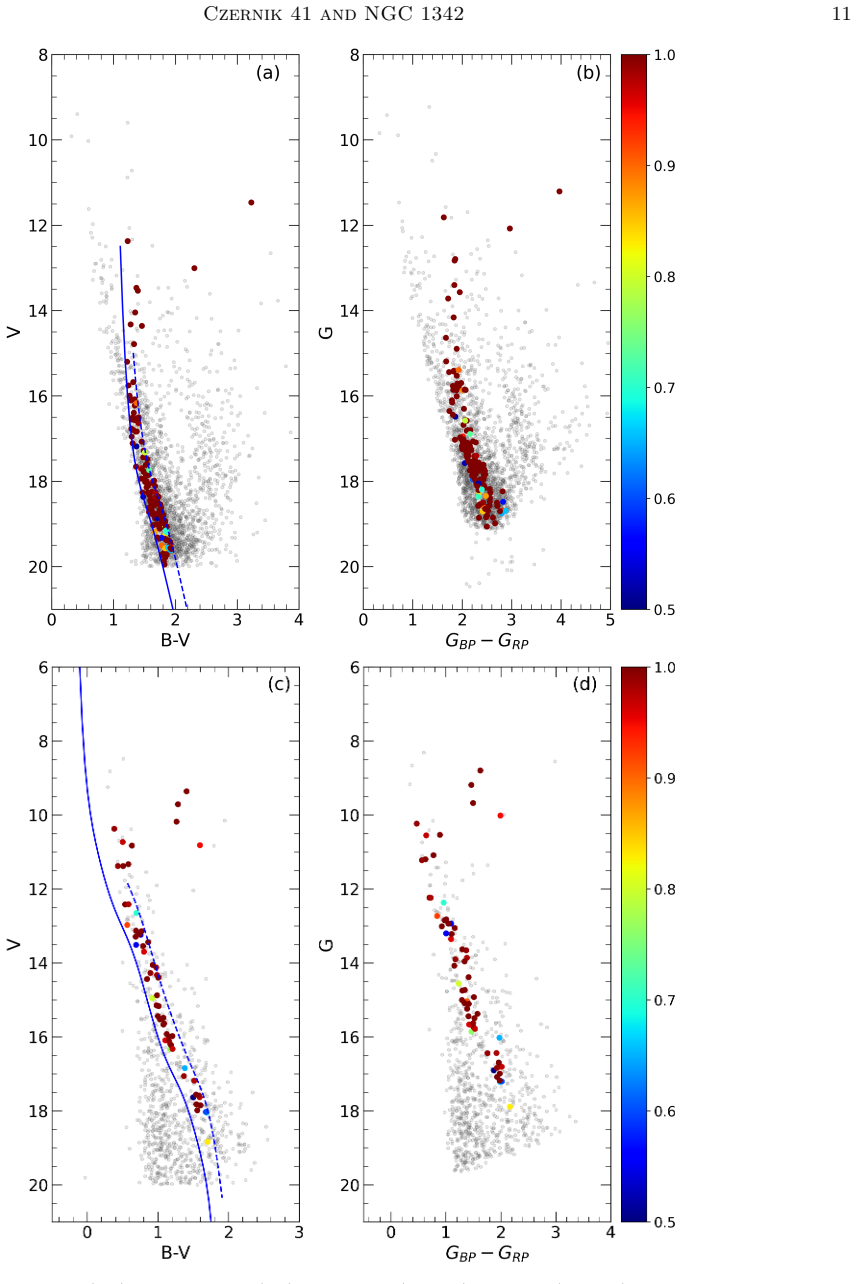
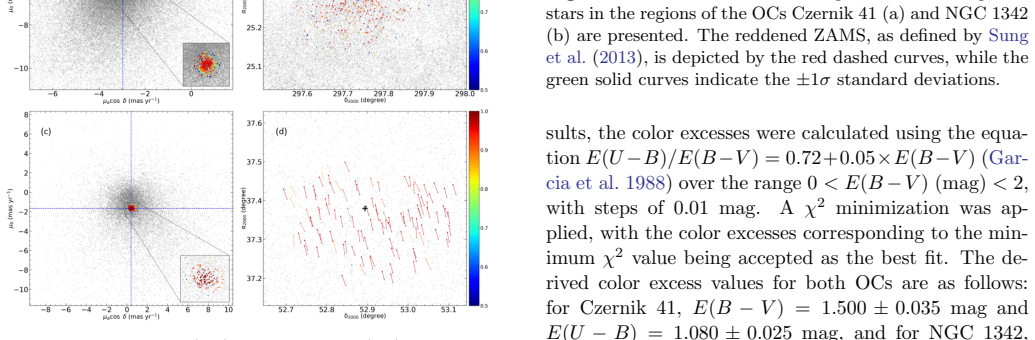
The load-bearing machinery is a two-stage pipeline. Stage one is UPMASK, an unsupervised clustering algorithm that groups stars by their astrometric similarity, applied to Gaia positions, parallaxes, and proper motions; keeping membership probability $P\ge0.5$ within an 11-arcmin limiting radius leaves 382 members for Czernik 41 and 111 for NGC 1342. Stage two is dual parameter estimation: a classical route that fixes reddening from two-color diagrams and metallicity from UV-excess calibrations before fitting PARSEC isochrones, and an MCMC route in which every member star is a walker sampling a Delaunay-interpolated isochrone grid in age, metallicity, distance, and extinction with a Gaussian likelihood across the Gaia $G$, $G_{\mathrm{BP}}$, and $G_{\mathrm{RP}}$ bands. A King-profile radial density fit sets the limiting radius, and backward orbit integration in a static Galactic potential supplies the birth-region claim via the traceback early orbital radius.
What would settle it
Refit Czernik 41 with a stricter membership threshold, $P\ge0.8$, and compare the resulting age and distance: if the age moves by more than roughly 30 Myr or the distance by more than roughly 200 pc, the claimed robustness against membership contamination fails. Alternatively, high-resolution spectra of about two dozen high-probability members would directly show whether their radial velocities are coherent and whether the mean [Fe/H] is truly near +0.07 dex.
Extended reading notes
Core claim
On the paper's own terms, the central discovery is that two independent fitting strategies converge on the same cluster parameters: for Czernik 41, $E(B-V)=1.500\pm0.035$ mag, $[\mathrm{Fe/H}]=0.07\pm0.09$ dex, distance $2485\pm151$ pc, and age $69\pm10$ Myr; for NGC 1342, $E(B-V)=0.270\pm0.043$ mag, $[\mathrm{Fe/H}]=-0.14\pm0.07$ dex, distance $645\pm42$ pc, and age $1000\pm50$ Myr. The classical route fixes reddening and metallicity first and then fits isochrones, while the MCMC route fits all parameters at once; their agreement is presented as evidence that the age-reddening-distance-metallicity degeneracy is not hiding a second solution. The paper then integrates the clusters' orbits backward and, using the traceback early orbital radius, concludes that Czernik 41 formed inside the Solar circle ($R_{\mathrm{teo}}\approx6.65$ kpc) whereas NGC 1342 formed outside it ($R_{\mathrm{teo}}\approx9.32$ kpc).
Load-bearing premise
The member list produced by UPMASK at $P\ge0.5$ inside the 11 arcmin limiting radius is clean enough that the fitted main sequence is not shifted by the few percent of field stars or unresolved binaries in the sample; the paper offers no independent spectroscopic check of that purity.
Editorial extensions
If this is right
- Czernik 41 becomes a young (69 Myr), heavily reddened cluster at 2485 pc, nearly twice as distant and much younger than some pre-Gaia catalog estimates.
- NGC 1342 is pinned as a 1 Gyr old, mildly metal-poor cluster at 645 pc, with its photogeometric distance matching the isochrone distance.
- The agreement between classical and MCMC fits indicates that the age-reddening-distance-metallicity degeneracy is largely broken for these two clusters.
- Orbit integrations imply Czernik 41 was born inside the Solar circle and NGC 1342 outside it, with both on near-circular thin-disc orbits.
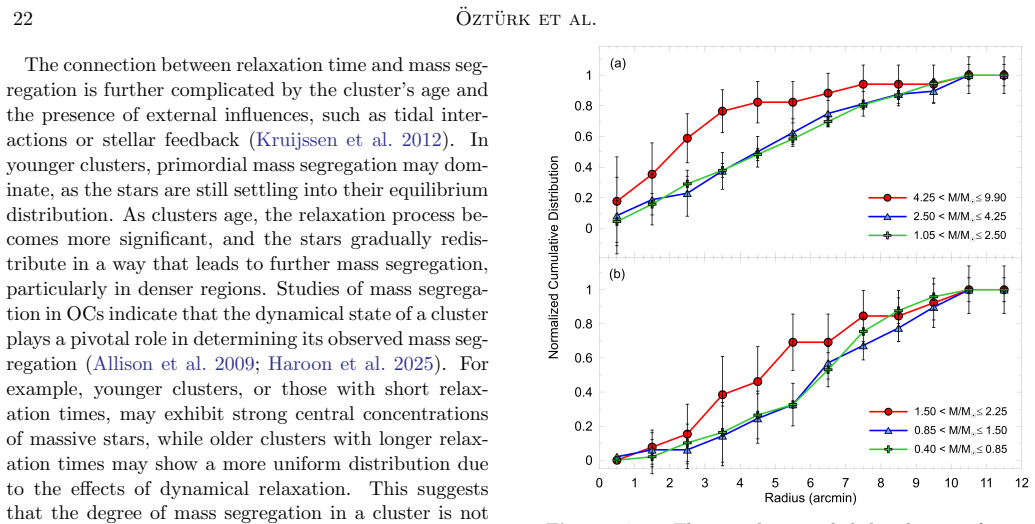
- Mass-function slopes of 1.67 and 1.56 are consistent with a typical initial mass function, and both clusters appear dynamically relaxed.
Reading between the lines
- Not stated in the paper, but if Czernik 41 really is 69 Myr old, its turnoff is sparse enough that a single unresolved binary near the turnoff could bias the fitted age; high-cadence time-series photometry or spectra of the few turnoff stars would settle it.
- The birth-radius inference assumes a static Galactic potential; under strong radial migration or non-axisymmetric perturbations, birth radius and early orbital radius need not coincide, so the inside/outside Solar circle conclusion is most safely read as a statement about orbits, not necessarily formation sites.
- The agreement between the two fitting routes could be exploited further: a joint fit of the UBV and Gaia datasets in one posterior would propagate the shared reddening and membership systematics and sharpen the error bars.
- For NGC 1342, the nine-star photometric metallicity agrees with two LAMOST spectra; adding a few more high-resolution abundance measurements would turn this cluster into a useful calibrator for the UV-excess metallicity scale.
Editorial analysis
A structured set of objections, weighed in public.
Referee Report
Summary. The paper presents a combined CCD UBV and Gaia DR3 analysis of the open clusters Czernik 41 and NGC 1342. Membership probabilities are derived with UPMASK, and cluster parameters are estimated twice: by a classical sequential approach (TCD reddening, photometric or adopted metallicity, then isochrone fitting of distance and age) and by a simultaneous MCMC fit of PARSEC isochrones to the Gaia photometry. The two approaches are claimed to agree, yielding for Czernik 41 E(B-V)=1.500±0.035, [Fe/H]=0.07±0.09, distance 2485±151 pc, and age 69±10 Myr, and for NGC 1342 E(B-V)=0.270±0.043, [Fe/H]=-0.14±0.07, distance 645±42 pc, and age 1000±50 Myr. The paper also derives structural parameters, proper motions, parallax and photogeometric distances, radial velocities, Galactic orbits, mass functions, relaxation times, and mass-segregation indicators. The abstract and conclusions emphasize that consistency between classical and MCMC results demonstrates robustness against parameter degeneracies, and that traceback orbits place Czernik 41's birth inside the Solar circle and NGC 1342's birth outside it.
Significance. If the derived parameters are correct, the paper provides a useful, fairly complete characterization of two under-studied open clusters, including a new MCMC fitting framework and four distance estimators that agree at the 1-2 sigma level. The explicit likelihood description and the cross-checks with Gaia parallaxes and Bailer-Jones et al. (2021) photogeometric distances are commendable and give the distance estimates some independent grounding. However, the central claim of robustness through method agreement is weakened for Czernik 41 because the classical fit adopts the MCMC metallicity, and the reliability of both fits depends on the purity of a small, heavily contaminated member sample. The paper's value as a reference for these clusters therefore hinges on whether the membership and metallicity limitations can be addressed or at least honestly quantified.
major comments (4)
- [§4.3.2, §4.2, Table 7] For Czernik 41, the classical UBV isochrone fit adopts Z=0.0176 from the MCMC result because the photometric metallicity cannot be measured from UBV data. Consequently, the agreement between the classical and MCMC ages and distances is not an independent confirmation; the two methods share a key input for this cluster. The claim in §7 that consistency between the methods demonstrates reliability should be restricted to NGC 1342, or the authors should obtain an independent metallicity (e.g., from spectroscopy or from the Gaia CMD with a marginalized Z) and refit Czernik 41.
- [§3.3, §4.3.1, Figure 12] The membership sample is the load-bearing input for both fitting methods, yet its purity is not independently validated. Only 2.34% of stars within rlim=11 arcmin pass P≥0.5 for Czernik 41 and 3.77% for NGC 1342, and the UBV sample is further filtered with a visually shifted ZAMS band and V≤20. The MCMC log-age posterior for Czernik 41 is log t = 7.94(+0.36,-0.48), i.e. roughly 30-200 Myr, which is difficult to reconcile with the quoted 69±10 Myr and suggests that the fit is not strongly constraining the turnoff age. The authors should report the full MCMC posteriors as primary age uncertainties, and should run robustness tests such as varying P threshold, removing ZAMS-band edge stars, and adding a binary fraction to see how much the age and reddening shift.
- [§4.3.1, Eqs. (9)-(12)] The MCMC likelihood treats every selected star as an independent, equal-weight Gaussian measurement with no outlier model and no weighting by membership probability. Given the very low membership fractions and the acknowledged presence of unresolved binaries and field contamination, the fitted parameters can be biased by a small number of interlopers. The authors should either justify the P≥0.5 cut with a contamination estimate, introduce a mixture/outlier term in the likelihood, or demonstrate by injection tests that the current likelihood is robust to the expected contamination level.
- [§5, §7, Figure 14] The traceback claim that Czernik 41 formed inside the Solar circle and NGC 1342 outside it is based on backward integration in the static MWPotential2014 for 2.5 Gyr with age as the integration time. For Czernik 41 the age itself is uncertain at the level of the broad MCMC posterior, and the quoted Rteo = 6.65±0.07 kpc does not include the systematic uncertainty from the assumed Galactic potential or from the age posterior. The authors should add a caveat that Rteo is model-dependent and integrate over the full age posterior rather than only the ±10 Myr classical error.
minor comments (5)
- [Figure 9 caption] The caption says 'Czernik 42' in the top panel; this should read 'Czernik 41'.
- [§3.1, Figure 2] The photometric completeness limit is described as the magnitude at which star counts reach a maximum, which is not a standard completeness definition; the comparison with Besançon models is more informative, and the authors should state explicitly whether the limit is based on the model cross-over or on the observed histogram peak.
- [Table 1] Several reference labels in the NGC 1342 rows are written as (02), (03), (04), (05), (21), and (22) instead of continuing the numbering used for the other rows, which makes the table harder to read.
- [§6.1, Eq. (14)] The relaxation-time equation appears as '8.9 × 10⁵N 1/2R3/2h' in the text; the superscripts and the exponent on 10 are not typeset correctly and should be fixed.
- [§4.1, Figure 10] The skewness and standard deviations are reported but the histograms in Figure 10 are said to be fit with Gaussians; for Czernik 41 the color excess range spans 0.8-2.4 mag while the quoted dispersion is 0.33 mag, so the authors should clarify whether the Gaussian is fit to the full histogram or to a central subset.
Circularity Check
Czernik 41's claimed cross-method agreement is partly by construction: the UBV isochrone fit adopts the MCMC metallicity, so the 'independent' confirmation is not independent.
-
fitted input called prediction
[Section 4.2, Section 4.3.2, and Summary items 4-5]
"Since no UBV photometry was obtained for main-sequence stars in Czernik 41, there is no estimate of the metallicity from the two-color diagram for this cluster. ... For Czernik 41, the Z value was adopted based on results obtained from an MCMC analysis (see Table 7). ... MCMC provided an independent estimate of these parameters ... consistent with the UBV-based results, confirming the reliability of both methods."
The UBV/classical isochrone fit for Czernik 41 sets Z equal to the MCMC output (Z=0.0176) because no UBV F-G main-sequence stars exist for an independent photometric metallicity. The later claim that MCMC is an 'independent estimate' whose agreement with UBV 'confirms reliability' therefore makes the metallicity agreement (and any age-distance solution degenerate with Z) agree by construction: the classical fit did not determine Z independently. The quoted [Fe/H]=0.07±0.09 and the 69±10 Myr age rest on a single MCMC-derived Z feeding the UBV fit, so the 'robustness against degeneracies' claim for Czernik 41 is not supported by the two methods being independent.
full rationale
The paper is largely self-contained in its data reduction: UBV calibration uses Landolt standards, membership uses UPMASK on Gaia astrometry, reddening uses TCD fits against the Sung et al. (2013) ZAMS, and distances are cross-checked against Gaia parallaxes and Bailer-Jones et al. (2021) photogeometric distances. For NGC 1342 the metallicity is independently derived from UV-excess photometry and is consistent with LAMOST spectroscopy, and the classical UBV analysis does not borrow Z from the MCMC fit. For Czernik 41, however, the derivation chain has a genuine circular step: the paper explicitly states that no UBV metallicity could be measured, then the UBV isochrone fit adopts the MCMC-derived Z, and the abstract/summary nevertheless tout the agreement between 'classical' and MCMC methods as confirmation of reliability and robustness against degeneracies. The agreement of the metallicity is by construction, and for a young, sparse cluster like Czernik 41 the adopted Z strongly influences the inferred turnoff age, so the 69±10 Myr age and [Fe/H]=0.07±0.09 are not confirmed by two independent routes. The Rteo traceback method is cited from Akbaba et al. (2024), which shares authors with this paper, but its assumptions (static MWPotential2014, quoted astrometric inputs) are stated transparently and the cited method is not reducible to the present fitted parameters, so I do not treat it as load-bearing circularity. Overall, the central 'two methods agree' claim is partially circular for Czernik 41, but the paper contains substantial independent data and checks, especially for NGC 1342, so the score is 6 rather than higher.
Assumptions & free parameters
free parameters (5)
- Limiting radius rlim =
11 arcmin (both clusters)
- Membership probability threshold P =
>=0.5
- Z adopted for Czernik 41 classical fit =
Z=0.0176 ([Fe/H]~0.07)
- UPMASK k-means parameter k =
8 (Czernik 41), 25 (NGC 1342)
- Photometric completeness limits =
V=20 mag, G=21 mag for both clusters
assumptions (5)
- domain assumption King (1962) profile is an appropriate RDP model and rlim approximates the tidal radius in the concentration parameter.
- domain assumption Standard R_V=3.1 extinction law (Cardelli et al. 1989; O'Donnell 1994) and constant dust scale height H=125 pc apply toward both clusters.
- domain assumption Parsec isochrones (Bressan et al. 2012) accurately predict UBV and Gaia colors for the adopted Z values.
- domain assumption Gaia DR3 parallax zero-point and systematics are negligible for the d_parallax checks.
- domain assumption The static MWPotential2014 Galactic potential and the Rteo traceback assumption (Akbaba et al. 2024) allow a cluster's birth radius to be inferred from current astrometry and age.
Cite this review
Pith. "Pith review of A Comprehensive Study of Czernik 41 and NGC 1342 Using CCD UBV and Gaia DR3 Data." pith.science (2026). https://pith.science/paper/FAHQ7ZSG
@misc{pith2026250705384,
  author       = {Pith},
  title        = {Pith review of: A Comprehensive Study of Czernik 41 and NGC 1342 Using CCD UBV and Gaia DR3 Data},
  year         = {2026},
  howpublished = {\url{https://pith.science/paper/FAHQ7ZSG}},
  note         = {Machine review of arXiv:2507.05384}
}
abstract
In this study, the structural, astrophysical, kinematic, and Galactic orbital parameters of the open clusters Czernik 41 and NGC 1342, as well as their dynamical evolution, are investigated using CCD UBV photometry and Gaia data. By applying the UPMASK algorithm to Gaia astrometric data for the estimation of cluster membership probabilities, we have determined that 382 stars in Czernik 41 and 111 stars in NGC 1342 exhibit the highest statistical likelihood of being cluster members. Fundamental parameters (including reddening, metallicity, distance, and age) were derived using both classical methods, where parameters are determined separately, and Markov Chain Monte Carlo (MCMC) methods, where parameters are estimated simultaneously. The results obtained from both approaches are in agreement, confirming the reliability of the derived parameters and demonstrating their robustness against potential degeneracies. The distances to Czernik 41 and NGC 1342 were determined as 2485$\pm$151 pc and 645$\pm$42 pc, respectively, while their ages were estimated to be 69$\pm$10 Myr and 1000$\pm$50 Myr. The metallicity values ([Fe/H]) were found to be 0.07$\pm$0.09 dex for Czernik 41 and -0.14$\pm$0.07 dex for NGC 1342. The stellar mass functions for both clusters were derived, yielding slopes of $\Gamma$=1.67$\pm$0.23 for Czernik 41 and $\Gamma$ =1.56$\pm$0.41 for NGC 1342. Kinematic orbit analysis indicates that Czernik 41 originated within the Solar circle, whereas NGC 1342 formed outside it.
Figures


Figures from the paper (13 more)




Reference graph
Works this paper leans on
-
[1]
Ak, T., Bostancı, Z. F., Yontan, T., et al. 2016, Ap&SS, 361, 126, doi: 10.1007/s10509-016-2707-2
-
[2]
2024, Physics and Astronomy Reports, 2, 58, doi: 10.26650/PAR.2024.00006
Ak, T., Canbay, R., & Yontan, T. 2024, Physics and Astronomy Reports, 2, 58, doi: 10.26650/PAR.2024.00006
arXiv 2024
-
[3]
2024, Astronomische Nachrichten, 345, e20240052, doi: 10.1002/asna.20240052
Akbaba, F., Ak, T., Bilir, S., et al. 2024, Astronomische Nachrichten, 345, e20240052, doi: 10.1002/asna.20240052
-
[4]
2021, Astrophysics and Space Science, 366, 68, doi: 10.1007/s10509-021-03975-x
Akbulut, B., Ak, S., Yontan, T., et al. 2021, Astrophysics and Space Science, 366, 68, doi: 10.1007/s10509-021-03975-x
-
[5]
Allison, R. J., Goodwin, S. P., Parker, R. J., et al. 2009, ApJL, 700, L99, doi: 10.1088/0004-637X/700/2/L99
-
[6]
Bahcall, J. N., & Soneira, R. M. 1980, ApJS, 44, 73, doi: 10.1086/190685
doi:10.1086/190685 1980
-
[7]
2021, AJ, 161, 147, doi: 10.3847/1538-3881/abd806
Demleitner, M., & Andrae, R. 2021, AJ, 161, 147, doi: 10.3847/1538-3881/abd806
-
[8]
2020, Journal of Astrophysics and Astronomy, 41, 6, doi: 10.1007/s12036-020-9621-2
Banks, T., Yontan, T., Bilir, S., & Canbay, R. 2020, Journal of Astrophysics and Astronomy, 41, 6, doi: 10.1007/s12036-020-9621-2
Show all 117 references
-
[9]
2018, ARA&A, 56, 83, doi: 10.1146/annurev-astro-081817-051839
Bastian, N., & Lardo, C. 2018, ARA&A, 56, 83, doi: 10.1146/annurev-astro-081817-051839
2018 doi
-
[11]
1996, A&AS, 117, 393, doi: 10.1051/aas:1996164
Bertin, E., & Arnouts, S. 1996, A&AS, 117, 393, doi: 10.1051/aas:1996164
1996 doi
-
[12]
2010, Ap&SS, 326, 139, doi: 10.1007/s10509-009-0233-1
Bilir, S., G¨ uver, T., Khamitov, I., et al. 2010, Ap&SS, 326, 139, doi: 10.1007/s10509-009-0233-1
2010 doi
-
[13]
F., Yontan, T., et al
Bilir, S., Bostancı, Z. F., Yontan, T., et al. 2016, Advances in Space Research, 58, 1900, doi: 10.1016/j.asr.2016.06.039 26 ¨Ozt¨urk et al
2016 doi
-
[14]
2020, MNRAS, 494, 607, doi: 10.1093/mnras/staa656 Bostancı, Z
Rangwal, G. 2020, MNRAS, 494, 607, doi: 10.1093/mnras/staa656 Bostancı, Z. F., Ak, T., Yontan, T., et al. 2015, MNRAS, 453, 1095, doi: 10.1093/mnras/stv1665 Bostancı, Z. F., Yontan, T., Bilir, S., et al. 2018, Ap&SS, 363, 143, doi: 10.1007/s10509-018-3364-4
2020 doi
-
[15]
2015, The Astrophysical Journal Supplement Series, 216, 29, doi: 10.1088/0067-0049/216/2/29
Bovy, J. 2015, The Astrophysical Journal Supplement Series, 216, 29, doi: 10.1088/0067-0049/216/2/29
2015 doi
-
[16]
2012, The Astrophysical Journal, 756, 89, doi: 10.1088/0004-637X/756/1/89
Bovy, J., & Tremaine, S. 2012, The Astrophysical Journal, 756, 89, doi: 10.1088/0004-637X/756/1/89
2012 doi
-
[17]
2012, Monthly Notices of the Royal Astronomical Society, 427, 127, doi: 10.1111/j.1365-2966.2012.21948.x
Bressan, A., Marigo, P., Girardi, L., et al. 2012, Monthly Notices of the Royal Astronomical Society, 427, 127, doi: 10.1111/j.1365-2966.2012.21948.x
2012
-
[18]
Cameron, L. M. 1985, A&A, 147, 39
1985
-
[19]
2020, A&A, 633, A99, doi: 10.1051/0004-6361/201936691
Cantat-Gaudin, T., & Anders, F. 2020, A&A, 633, A99, doi: 10.1051/0004-6361/201936691
2020 doi
-
[20]
2018, Astronomy and Astrophysics, 618, A93, doi: 10.1051/0004-6361/201833476
Cantat-Gaudin, T., Jordi, C., Vallenari, A., et al. 2018, Astronomy and Astrophysics, 618, A93, doi: 10.1051/0004-6361/201833476
2018 doi
-
[21]
2020, Astronomy and Astrophysics, 640, A1, doi: 10.1051/0004-6361/202038192
Cantat-Gaudin, T., Anders, F., Castro-Ginard, A., et al. 2020, Astronomy and Astrophysics, 640, A1, doi: 10.1051/0004-6361/202038192
2020 doi
-
[22]
A., Clayton, G
Cardelli, J. A., Clayton, G. C., & Mathis, J. S. 1989, ApJ, 345, 245, doi: 10.1086/167900
1989 doi
-
[23]
V., Moni Bidin, C., & Vazquez, R
Carraro, G., Sales Silva, J. V., Moni Bidin, C., & Vazquez, R. A. 2017, The Astronomical Journal, 153, 99, doi: 10.3847/1538-3881/153/3/99
2017 doi
-
[24]
J., Luri, X., et al
Castro-Ginard, A., McMillan, P. J., Luri, X., et al. 2021, A&A, 652, A162, doi: 10.1051/0004-6361/202039751 C ¸ akmak, H., Yontan, T., Bilir, S., et al. 2024, Astronomische Nachrichten, 345, e20240054, doi: 10.1002/asna.20240054 C ¸ ınar, D. C., Tasdemir, S., Koc, S., & Iyer, ...
2021
-
[25]
2000, A&AS, 141, 491, doi: 10.1051/aas:2000124
Benoni, T. 2000, A&AS, 141, 491, doi: 10.1051/aas:2000124
2000 doi
-
[26]
D., Kharchenko, N
Conrad, C., Scholz, R. D., Kharchenko, N. V., et al. 2017, A&A, 600, A106, doi: 10.1051/0004-6361/201630012 Co¸ skunoˇ glu, B., Ak, S., Bilir, S., et al. 2011, Monthly Notices of the Royal Astronomical Society, 412, 1237, doi: 10.1111/j.1365-2966.2010.17983.x
2017
-
[27]
2012, Research in Astronomy and Astrophysics, 12, 1197, doi: 10.1088/1674-4527/12/9/003
Cui, X.-Q., Zhao, Y.-H., Chu, Y.-Q., et al. 2012, Research in Astronomy and Astrophysics, 12, 1197, doi: 10.1088/1674-4527/12/9/003
2012 doi
-
[28]
J., Liu, C., et al
Deng, L.-C., Newberg, H. J., Liu, C., et al. 2012, Research in Astronomy and Astrophysics, 12, 735, doi: 10.1088/1674-4527/12/7/003
2012 doi
-
[29]
S., Monteir, H., Moitinho, A., et al
Dias, W. S., Monteir, H., Moitinho, A., et al. 2021, Monthly Notices of the Royal Astronomical Society, 504, 356, doi: 10.1093/mnras/stab770
2021 doi
-
[30]
S., Monteiro, H., Caetano, T
Dias, W. S., Monteiro, H., Caetano, T. C., et al. 2014, Astronomy and Astrophysics, 564, A79, doi: 10.1051/0004-6361/201323226
2014 doi
-
[31]
2019, A&A, 629, A135, doi: 10.1051/0004-6361/201834080
Dib, S., & Henning, T. 2019, A&A, 629, A135, doi: 10.1051/0004-6361/201834080
2019 doi
-
[32]
2025, Physics and Astronomy Reports, 3, 43, doi: 10.26650/PAR.2025.00005
Eker, Z., & Bakı¸ s, V. 2025, Physics and Astronomy Reports, 3, 43, doi: 10.26650/PAR.2025.00005
2025
-
[33]
2024, Physics and Astronomy Reports, 2, 41, doi: 10.26650/PAR.2024.00001
Eker, Z., Soydugan, F., & Bilir, S. 2024, Physics and Astronomy Reports, 2, 41, doi: 10.26650/PAR.2024.00001
2024
-
[34]
2020, Monthly Notices of the Royal Astronomical Society, 496, 3887, doi: 10.1093/mnras/staa1659
Eker, Z., Soydugan, F., Bilir, S., et al. 2020, Monthly Notices of the Royal Astronomical Society, 496, 3887, doi: 10.1093/mnras/staa1659
2020 doi
-
[35]
2018, Monthly Notices of the Royal Astronomical Society, 479, 5491, doi: 10.1093/mnras/sty1834
Eker, Z., Bakı¸ s, V., Bilir, S., et al. 2018, Monthly Notices of the Royal Astronomical Society, 479, 5491, doi: 10.1093/mnras/sty1834
2018 doi
-
[36]
H., Haroon, A
Elsanhoury, W. H., Haroon, A. A., Elkholy, E. A., & C ¸ ınar, D. C. 2025, Journal of Astrophysics and Astronomy, 46, 21, doi: 10.1007/s12036-025-10044-0
2025 doi
-
[37]
1987, ARA&A, 25, 565, doi: 10.1146/annurev.aa.25.090187.003025
Elson, R., Hut, P., & Inagaki, S. 1987, ARA&A, 25, 565, doi: 10.1146/annurev.aa.25.090187.003025
1987
-
[38]
2024, Astronomische Nachrichten, 345, e20240038, doi: 10.1002/asna.20240038
Evcil, S., Adalalı, S., Alan, N., Canbay, R., & Bilir, S. 2024, Astronomische Nachrichten, 345, e20240038, doi: 10.1002/asna.20240038
2024 doi
-
[39]
1998, AJ, 115, 592, doi: 10.1086/300212
Fischer, P., Pryor, C., Murray, S., Mateo, M., & Richtler, T. 1998, AJ, 115, 592, doi: 10.1086/300212
1998 doi
-
[40]
W., Lang, D., & Goodman, J
Foreman-Mackey, D., Hogg, D. W., Lang, D., & Goodman, J. 2013, PASP, 125, 306, doi: 10.1086/670067
2013 doi
-
[41]
M., Thompson, B., Jackson, K
Frinchaboy, P. M., Thompson, B., Jackson, K. M., et al. 2013, ApJL, 777, L1, doi: 10.1088/2041-8205/777/1/L1
2013 doi
-
[42]
2022, A&A, 668, A4, doi: 10.1051/0004-6361/202243590 Gaia Collaboration, Prusti, T., de Bruijne, J
Fu, X., Bragaglia, A., Liu, C., et al. 2022, A&A, 668, A4, doi: 10.1051/0004-6361/202243590 Gaia Collaboration, Prusti, T., de Bruijne, J. H. J., et al. 2016, A&A, 595, A1, doi: 10.1051/0004-6361/201629272 Gaia Collaboration, Brown, A. G. A., Vallenari, A., et al. 2018, Astron...
2022 doi
-
[43]
J., & Levato, H
Garcia, B., Claria, J. J., & Levato, H. 1988, Ap&SS, 143, 317, doi: 10.1007/BF00637143
1988 doi
-
[44]
2023, AJ, 166, 263, doi: 10.3847/1538-3881/ad08b0
Gokmen, S., Eker, Z., Yontan, T., et al. 2023, AJ, 166, 263, doi: 10.3847/1538-3881/ad08b0
2023 doi
-
[45]
J., Xu, Y., Wu, Z
Hao, C. J., Xu, Y., Wu, Z. Y., et al. 2022, A&A, 668, A13, doi: 10.1051/0004-6361/202244570 Czernik 41 and NGC 1342 27
2022 doi
-
[46]
J., Xu, Y., Hou, L
Hao, C. J., Xu, Y., Hou, L. G., et al. 2021, A&A, 652, A102, doi: 10.1051/0004-6361/202140608
2021 doi
-
[47]
A., Elsanhoury, W
Haroon, A. A., Elsanhoury, W. H., Elkholy, E. A., Saad, A. S., & C ¸ ınar, D. C. 2025, PhyS, 100, 055006, doi: 10.1088/1402-4896/adbf71
2025 doi
-
[48]
Heggie, D. C. 1979, Monthly Notices of the Royal Astronomical Society, 188, 525, doi: 10.1093/mnras/188.3.525
1979 doi
-
[49]
1802, Phil
Herschel, W. 1802, Phil. Trans. R. Soc., 92, 477, doi: https://doi.org/10.1098/rstl.1802.0021
-
[50]
I., Aprilia, & Hakim, M
Hidayat, W., Arifyanto, M. I., Aprilia, & Hakim, M. I. 2019, in Journal of Physics Conference Series, Vol. 1231, Journal of Physics Conference Series (IOP), 012032, doi: 10.1088/1742-6596/1231/1/012032
2019 doi
-
[51]
2006, AJ, 131, 414, doi: 10.1086/498647
Hill, A., & Zaritsky, D. 2006, AJ, 131, 414, doi: 10.1086/498647
2006 doi
-
[52]
A., & Hartmann, L
Hillenbrand, L. A., & Hartmann, L. W. 1998, ApJ, 492, 540, doi: 10.1086/305076
1998 doi
-
[53]
A., Johnson, H
Hoag, A. A., Johnson, H. L., Iriarte, B., et al. 1961, Publ. Us. Nav. Obs. XVII part VII, 17, 347
1961
-
[54]
A., Meibom, S., & Hoq, S
Janes, K., Barnes, S. A., Meibom, S., & Hoq, S. 2013, AJ, 145, 7, doi: 10.1088/0004-6256/145/1/7
2013 doi
-
[55]
C., Deepak, & Malhotra, S
Joshi, Y. C., Deepak, & Malhotra, S. 2024, Frontiers in Astronomy and Space Sciences, 11, 1348321, doi: 10.3389/fspas.2024.1348321
2024
-
[56]
G., Bilir, S., Karata¸ s, Y., & Gilmore, G
Karaali, S., Ak, S. G., Bilir, S., Karata¸ s, Y., & Gilmore, G. 2003a, Monthly Notices of the Royal Astronomical Society, 343, 1013, doi: 10.1046/j.1365-8711.2003.06743.x
2003
-
[57]
2011, Publications of the Astronomical Society of Australia, 28, 95, doi: 10.1071/AS10026
Karaali, S., Bilir, S., Ak, S., Yaz, E., & Co¸ skuno˘ glu, B. 2011, Publications of the Astronomical Society of Australia, 28, 95, doi: 10.1071/AS10026
2011 doi
-
[58]
Karaali, S., Bilir, S., Karata¸ s, Y., & Ak, S. G. 2003b, Publications of the Astronomical Society of Australia, 20, 165, doi: 10.1071/AS02028
-
[59]
V., Piskunov, A
Kharchenko, N. V., Piskunov, A. E., R¨ oser, S., Schilbach, E., & Scholz, R. D. 2005, Astronomy and Astrophysics, 438, 1163, doi: 10.1051/0004-6361:20042523
2005 doi
-
[60]
V., Piskunov, A
Kharchenko, N. V., Piskunov, A. E., Schilbach, E., R¨ oser, S., & Scholz, R. D. 2012, A&A, 543, A156, doi: 10.1051/0004-6361/201118708
2012 doi
-
[61]
V., Piskunov, A
Kharchenko, N. V., Piskunov, A. E., Schilbach, E., R¨ oser, S., & Scholz, R. D. 2013, Astronomy and Astrophysics, 558, A53, doi: 10.1051/0004-6361/201322302
2013 doi
-
[62]
1962, Astronomical Journal, 67, 471, doi: 10.1086/108756 Ko¸ c, S., Yontan, T., Bilir, S., et al
King, I. 1962, Astronomical Journal, 67, 471, doi: 10.1086/108756 Ko¸ c, S., Yontan, T., Bilir, S., et al. 2022, The Astronomical Journal, 163, 191, doi: 10.3847/1538-3881/ac58a0
1962 doi
-
[63]
2014, Astronomy and Astrophysics, 561, A57, doi: 10.1051/0004-6361/201321143
Krone-Martins, A., & Moitinho, A. 2014, Astronomy and Astrophysics, 561, A57, doi: 10.1051/0004-6361/201321143
2014 doi
-
[64]
Kruijssen, J. M. D., Maschberger, T., Moeckel, N., et al. 2012, MNRAS, 419, 841, doi: 10.1111/j.1365-2966.2011.19748.x
2012
-
[65]
J., & Lada, E
Lada, C. J., & Lada, E. A. 2003, ARA&A, 41, 57, doi: 10.1146/annurev.astro.41.011802.094844
2003 arXiv
-
[66]
Landolt, A. U. 2009, The Astronomical Journal, 137, 4186, doi: 10.1088/0004-6256/137/5/4186
2009 doi
-
[67]
W., Mierle, K., Blanton, M., & Roweis, S
Lang, D., Hogg, D. W., Mierle, K., Blanton, M., & Roweis, S. 2010, AJ, 139, 1782, doi: 10.1088/0004-6256/139/5/1782
2010 doi
-
[68]
Leggett, S. K. 1992, Astrophysical Journal Supplement, 82, 351, doi: 10.1086/191720
1992 doi
-
[69]
2019, The Astrophysical Journal Supplement Series, 245, 32, doi: 10.3847/1538-4365/ab530a
Liu, L., & Pang, X. 2019, The Astrophysical Journal Supplement Series, 245, 32, doi: 10.3847/1538-4365/ab530a
2019 doi
-
[70]
V., & Beshenov, G
Loktin, A. V., & Beshenov, G. V. 2003, Astronomy Reports, 47, 6, doi: 10.1134/1.1538491
2003 doi
-
[71]
V., & Popova, M
Loktin, A. V., & Popova, M. E. 2017, Astrophysical Bulletin, 72, 257, doi: 10.1134/S1990341317030154
2017 doi
-
[72]
L., Minchev, I., Buck, T., et al
Lu, Y. L., Minchev, I., Buck, T., et al. 2024, MNRAS, 535, 392, doi: 10.1093/mnras/stae2364
2024 doi
-
[73]
2007, A&A, 467, 1065, doi: 10.1051/0004-6361:20066588
Maciejewski, G., & Niedzielski, A. 2007, A&A, 467, 1065, doi: 10.1051/0004-6361:20066588
2007 doi
-
[74]
2006, A&A, 453, 635, doi: 10.1051/0004-6361:20053842
Picaud, S. 2006, A&A, 453, 635, doi: 10.1051/0004-6361:20053842
2006 doi
-
[75]
Maurya, J., & Joshi, Y. C. 2020, MNRAS, 494, 4713, doi: 10.1093/mnras/staa893
2020 doi
-
[76]
F., & Ostriker, E
McKee, C. F., & Ostriker, E. C. 2007, ARA&A, 45, 565, doi: 10.1146/annurev.astro.45.051806.110602
2007 arXiv
-
[77]
E., Lemasle, B., & Grebel, E
Medina, G. E., Lemasle, B., & Grebel, E. K. 2021, MNRAS, 505, 1342, doi: 10.1093/mnras/stab1267
2021 doi
-
[78]
C., Mayor, M., & Udry, S
Mermilliod, J. C., Mayor, M., & Udry, S. 2008, A&A, 485, 303, doi: 10.1051/0004-6361:200809664
2008 doi
-
[79]
1981, Galactic astronomy
Mihalas, D., & Binney, J. 1981, Galactic astronomy. Structure and kinematics (W.H. Freeman & Co.)
1981
-
[80]
2018, MNRAS, 481, 1645, doi: 10.1093/mnras/sty2033
Minchev, I., Anders, F., Recio-Blanco, A., et al. 2018, MNRAS, 481, 1645, doi: 10.1093/mnras/sty2033
2018 doi
-
[81]
R., et al
Miocchi, P., Lanzoni, B., Ferraro, F. R., et al. 2013, ApJ, 774, 151, doi: 10.1088/0004-637X/774/2/151 Mu˜ noz, R. R., Geha, M., & Willman, B. 2010, AJ, 140, 138, doi: 10.1088/0004-6256/140/1/138
2013 doi
-
[82]
A., C ¸ akmak, H., Michel, R., & Karata¸ s, Y
Netopil, M., Oralhan, ˙I. A., C ¸ akmak, H., Michel, R., & Karata¸ s, Y. 2022, MNRAS, 509, 421, doi: 10.1093/mnras/stab2961 O’Donnell, J. E. 1994, ApJ, 422, 158, doi: 10.1086/173713 Pavl ´ ık, V., & Vesperini, E. 2022, MNRAS, 515, 1830, doi: 10.1093/mnras/stac1776 Pe˜ na, J. H...
2022 doi
-
[83]
E., Kharchenko, N
Piskunov, A. E., Kharchenko, N. V., R¨ oser, S., Schilbach, E., & Scholz, R. D. 2006, A&A, 445, 545, doi: 10.1051/0004-6361:20053764
2006 doi
-
[84]
2015, PASA, 32, e043, doi: 10.1017/pasa.2015.44 Portegies Zwart, S
Plevne, O., Ak, T., Karaali, S., et al. 2015, PASA, 32, e043, doi: 10.1017/pasa.2015.44 Portegies Zwart, S. F., McMillan, S. L. W., & Gieles, M. 2010, ARA&A, 48, 431, doi: 10.1146/annurev-astro-081309-130834
2015 doi
- [85]
- [86]
-
[87]
Reddy, A. B. S., Giridhar, S., & Lambert, D. L. 2015, MNRAS, 450, 4301, doi: 10.1093/mnras/stv908 —. 2020, Journal of Astrophysics and Astronomy, 41, 38, doi: 10.1007/s12036-020-09658-3
2015 doi
-
[88]
C., Reyl´ e, C., Derri` ere, S., & Picaud, S
Robin, A. C., Reyl´ e, C., Derri` ere, S., & Picaud, S. 2003, A&A, 409, 523, doi: 10.1051/0004-6361:20031117
2003 doi
-
[89]
C., Luri, X., Reyl´ e, C., et al
Robin, A. C., Luri, X., Reyl´ e, C., et al. 2012, A&A, 543, A100, doi: 10.1051/0004-6361/201118646
2012 doi
-
[90]
2010, AJ, 139, 2440, doi: 10.1088/0004-6256/139/6/2440
Roeser, S., Demleitner, M., & Schilbach, E. 2010, AJ, 139, 2440, doi: 10.1088/0004-6256/139/6/2440
2010 doi
-
[91]
1966, Bulletin of the Astronomical Institutes of Czechoslovakia, 17, 33
Ruprecht, J. 1966, Bulletin of the Astronomical Institutes of Czechoslovakia, 17, 33
1966
-
[92]
Dluzhnevskaia, O. B. 1988, MNRAS, 234, 831, doi: 10.1093/mnras/234.4.831
1988 doi
-
[93]
Salpeter, E. E. 1955, ApJ, 121, 161, doi: 10.1086/145971
1955 doi
-
[94]
Sarajedini, A., Milone, A. A. E., & Lowe, C. R. 1995, in American Astronomical Society Meeting Abstracts, Vol. 186, American Astronomical Society Meeting Abstracts #186, 49.03
1995
-
[95]
F., & Finkbeiner, D
Schlafly, E. F., & Finkbeiner, D. P. 2011, ApJ, 737, 103, doi: 10.1088/0004-637X/737/2/103 Science Software Branch at STScI. 2012, PyRAF: Python alternative for IRAF, Astrophysics Source Code Library, record ascl:1207.011
2011 doi
-
[96]
2008, A&A, 488, 943, doi: 10.1051/0004-6361:200809650
Sestito, P., Bragaglia, A., Randich, S., et al. 2008, A&A, 488, 943, doi: 10.1051/0004-6361:200809650
2008 doi
-
[97]
F., Cutri, R
Skrutskie, M. F., Cutri, R. M., Stiening, R., et al. 2006, AJ, 131, 1163, doi: 10.1086/498708
2006 doi
-
[98]
2018, Astronomy and Astrophysics, 619, A155, doi: 10.1051/0004-6361/201834020
Soubiran, C., Cantat-Gaudin, T., Romero-G´ omez, M., et al. 2018, Astronomy and Astrophysics, 619, A155, doi: 10.1051/0004-6361/201834020
2018 doi
-
[99]
2022, Universe, 8, 87, doi: 10.3390/universe8020087
Spina, L., Magrini, L., & Cunha, K. 2022, Universe, 8, 87, doi: 10.3390/universe8020087
2022 doi
-
[100]
1987, Dynamical evolution of globular clusters
Spitzer, L. 1987, Dynamical evolution of globular clusters
1987
-
[101]
Spitzer, Jr., L., & Hart, M. H. 1971, ApJ, 164, 399, doi: 10.1086/150855
1971 doi
-
[102]
1991a, Astronomische Nachrichten, 312, 177, doi: 10.1002/asna.2113120306 —
Strobel, A. 1991a, Astronomische Nachrichten, 312, 177, doi: 10.1002/asna.2113120306 —. 1991b, A&A, 247, 35
-
[103]
S., et al
Sung, H., Lim, B., Bessell, M. S., et al. 2013, Journal of Korean Astronomical Society, 46, 103, doi: 10.5303/JKAS.2013.46.3.103 Ta¸ sdemir, S., C ¸ ınar, D. C., Canbay, R., et al. 2025, Physics and Astronomy Reports, 3, 1, doi: 10.26650/PAR.2025.00003 Ta¸ sdemir, S., & Yontan...
2013
-
[104]
2021, Astronomy and Astrophysics, 647, A19, doi: 10.1051/0004-6361/202039388
Tarricq, Y., C., S., Casamiquela, L., et al. 2021, Astronomy and Astrophysics, 647, A19, doi: 10.1051/0004-6361/202039388
2021 doi
-
[105]
1986, in Society of Photo-Optical Instrumentation Engineers (SPIE) Conference Series, Vol
Tody, D. 1986, in Society of Photo-Optical Instrumentation Engineers (SPIE) Conference Series, Vol. 627, Instrumentation in astronomy VI, ed. D. L. Crawford, 733, doi: 10.1117/12.968154
1986 doi
-
[106]
1993, in Astronomical Society of the Pacific Conference Series, Vol
Tody, D. 1993, in Astronomical Society of the Pacific Conference Series, Vol. 52, Astronomical Data Analysis Software and Systems II, ed. R. J. Hanisch, R. J. V. Brissenden, & J. Barnes, 173 Tun¸ cel G¨ u¸ ctekin, S., Bilir, S., Karaali, S., Plevne, O., &
1993
-
[107]
2019, Advances in Space Research, 63, 1360, doi: 10.1016/j.asr.2018.10.041 V´ azquez, R
Ak, S. 2019, Advances in Space Research, 63, 1360, doi: 10.1016/j.asr.2018.10.041 V´ azquez, R. A., Moitinho, A., Carraro, G., & Dias, W. S. 2010, A&A, 511, A38, doi: 10.1051/0004-6361/200811583
2019 doi
-
[108]
E., et al
Virtanen, P., Gommers, R., Oliphant, T. E., et al. 2020, Nature Methods, 17, 261, doi: 10.1038/s41592-019-0686-2
2020 doi
-
[109]
2023a, AJ, 165, 79, doi: 10.3847/1538-3881/aca6f0
Yontan, T. 2023a, AJ, 165, 79, doi: 10.3847/1538-3881/aca6f0
-
[110]
2023b, Advances in Space Research, 72, 1454, doi: 10.1016/j.asr.2023.04.015
Yontan, T., Bilir, S., C ¸ akmak, H., et al. 2023b, Advances in Space Research, 72, 1454, doi: 10.1016/j.asr.2023.04.015
2023 doi
-
[111]
2023c, Physics and Astronomy Reports, 1, 65, doi: 10.26650/PAR.2023.00008
Yontan, T., & Canbay, R. 2023c, Physics and Astronomy Reports, 1, 65, doi: 10.26650/PAR.2023.00008
2023
-
[112]
F., et al
Yontan, T., Bilir, S., Bostancı, Z. F., et al. 2015, Ap&SS, 355, 267, doi: 10.1007/s10509-014-2175-5 —. 2019, Ap&SS, 364, 152, doi: 10.1007/s10509-019-3640-y
2015 doi
-
[113]
2021, Astronomische Nachrichten, 342, 538, doi: 10.1002/asna.202113837
Yontan, T., Bilir, S., Ak, T., et al. 2021, Astronomische Nachrichten, 342, 538, doi: 10.1002/asna.202113837
2021 doi
-
[114]
2022, RMxAA, 58, 333, doi: 10.22201/ia.01851101p.2022.58.02.14 Y¨ ucel, G., Bakı¸ s, V., Canbay, R., et al
Yontan, T., C ¸ akmak, T., Bilir, S., et al. 2022, RMxAA, 58, 333, doi: 10.22201/ia.01851101p.2022.58.02.14 Y¨ ucel, G., Bakı¸ s, V., Canbay, R., et al. 2025, AJ, 169, 71, doi: 10.3847/1538-3881/ad9d46 Y¨ ucel, G., Canbay, R., & Bakı¸ s, V. 2024, Physics and Astronomy Reports,...
2022
-
[115]
E., Zacharias, M
Zacharias, N., Urban, S. E., Zacharias, M. I., et al. 2004, AJ, 127, 3043, doi: 10.1086/386353 Czernik 41 and NGC 1342 29
2004 doi
-
[116]
2012, Research in Astronomy and Astrophysics, 12, 723, doi: 10.1088/1674-4527/12/7/002
Zhao, G., Zhao, Y.-H., Chu, Y.-Q., Jing, Y.-P., & Deng, L.-C. 2012, Research in Astronomy and Astrophysics, 12, 723, doi: 10.1088/1674-4527/12/7/002
2012 doi
-
[117]
2020, A&A, 640, A127, doi: 10.1051/0004-6361/201937131
Zhong, J., Chen, L., Wu, D., et al. 2020, A&A, 640, A127, doi: 10.1051/0004-6361/201937131
2020 doi
-
[118]
2021, MNRAS, 504, 4768, doi: 10.1093/mnras/stab1209
Zhou, X., & Chen, X. 2021, MNRAS, 504, 4768, doi: 10.1093/mnras/stab1209
2021 doi
Reviewed August 6, 2026 · model on record in the stance chip above.
Discussion (0). Continue with ORCID to comment.