REVIEW 3 major objections 6 minor 35 references
Evaluation of Centralized and Distributed Microgrid Topologies Considering Power Quality Constraints
T0 review · 3 major / 6 minor · reviewed 2026-08-14 · deepseek-v4-flash
Pith's one-line read The paper shows that folding a linearized AC power-flow model into a techno-economic mixed-integer program lets one design pass choose an off-grid system's technology, size, and dispatch while enforcing voltage limits, and that in a…
desk verdict A genuinely useful integration of linearized power flow into REopt, but the paper's key voltage-limited boundary rests on an extrapolation validated only near nominal voltage. read the letter →
The pith
A machine-rendered reading of the paper's core claim, the machinery that carries it, and where it could break.
The reading
What carries the argument
The central object is a fixed-point linearization of AC power flow embedded directly in the mixed-integer program. Voltage magnitude at every non-slack node and real power at the slack node are written as affine functions of nodal power injections, $|v|_{nh}=Kx_{nh}+b$ and $P_h^o=\sum_n F x_{nh}+d$, with coefficients $K,b,F,d$ computed in advance from the admittance matrix and one known solution of the nonlinear power flow. These linear equations become constraints in the optimization, along with voltage bounds $V_{\min}\le |v|_{nh}\le V_{\max}$ at every node and hour and a slack-node inequality that accounts for line losses. The second mechanism is a binary variable that decides whether each village node is connected to the central node: disconnected nodes must have zero net power injection, and connected nodes cannot host their own PV or storage. This combination is what lets one optimization choose resource mix, size, siting, and dispatch subject to power quality.
What would settle it
Re-optimize one cell at the extreme of the case study (for instance 1 km of 4 $mm^{2}$ cable) with the voltage constraints active, then feed the resulting dispatch into a full nonlinear AC power-flow calculation at the same injections. If the linearized model certifies node voltages within $\pm10\%$ while the nonlinear solution violates that limit (or the reverse), the upper frontier in Figure 3 is an artifact of the linearization rather than a physical boundary.
Extended reading notes
Core claim
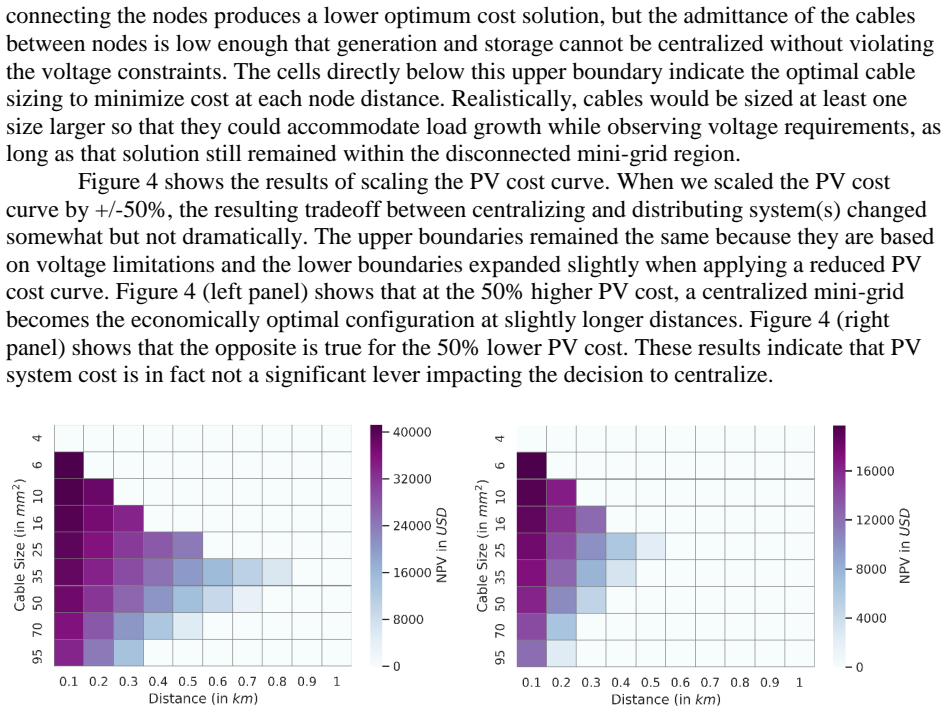
The central claim is that the extended model can find an optimal distributed-energy resource mix, sizing, and dispatch on a node-by-node basis while honoring power-quality requirements, and that in the three-village case the centralized-versus-decentralized choice is bounded by two distinct diagonal frontiers. The lower frontier is economic: when villages are close or cables are thick, connecting them into one system is cheaper because a central plant captures economies of scale; beyond that frontier, line cost makes separate mini-grids cheaper. The upper frontier exists only when voltage constraints are enforced: even where a central design is cheaper, long thin lines have too little admittance to hold node voltages within $\pm10\%$ of nominal while all generation sits at the central node. With voltage limits disabled, the upper frontier disappears, while scaling PV costs by $\pm50\%$ moves the economic frontier only modestly and leaves the voltage frontier unchanged.
Load-bearing premise
The model's load-bearing premise is that the linearized power-flow coefficients, calibrated at one known operating point, remain accurate for every candidate design, including long, thin-cable connections where voltages sit far from that point; if that accuracy breaks down, the case study's voltage-driven boundary could be misplaced.
Editorial extensions
If this is right
- Centralizing a multi-village mini-grid is optimal only inside a diagonal band: short lines or thick cables make connection economical, while beyond the economic frontier line cost outweighs economies of scale.
- There is a separate upper frontier that exists only under voltage enforcement: even when a central design is cheaper, long thin lines cannot hold node voltages within tolerance, so designers must upsize cables or keep local generation.
- Choosing cables one size larger than the cost-optimal value near the economic frontier can push a project into the region where separate mini-grids are cheaper, so future load growth must be weighed against this boundary.
- PV cost uncertainty of $\pm50\%$ does not materially shift the centralization decision; the voltage-determined boundary stays fixed, meaning power quality, not solar cost, is the binding constraint in the upper region.
- Ignoring voltage constraints in the planning phase can recommend a cheaper-looking design that fails operational voltage requirements, incurring later retrofits; the extended model removes this gap.
Reading between the lines
- Extension: the same single-point linearization that makes the model tractable is also its main risk; checking near-boundary cells against a full nonlinear power-flow solution would confirm the voltage frontier is physical rather than numerical.
- Extension: the constant-power-factor assumption rules out reactive-power support from smart inverters; adding reactive injection as a decision variable would probably move the voltage frontier and could make some centralized designs feasible on thinner, cheaper cables.
- Extension: the binary connect/disconnect choice could be relaxed to multi-stage or radial partial interconnection, which would reshape the economic frontier when villages are asymmetric in distance or load.
- Extension: because the model prices voltage feasibility hour by hour, it creates a direct valuation path for storage and demand response as voltage-support services rather than only as energy-balance services.
Signed reviews
Editorial analysis
A structured set of objections, weighed in public.
Referee Report
Summary. The paper extends the REopt mixed-integer linear program for microgrid design to model multiple electrical nodes with power-flow-derived voltage constraints. A fixed-point linearization of AC power flow (Eqs. (1)-(2)) is incorporated into the MILP, and voltage limits are enforced via Eq. (5). The extended model is validated on a grid-connected Italy microgrid against single-node REopt and against nonlinear Matpower, achieving an average voltage error of 0.002%. The model is then applied to a three-village isolated system in sub-Saharan Africa, where a binary decision variable (Eq. (7)) chooses between centralized generation at a central node and decentralized mini-grids at each node. The main result is a two-boundary region of cost-optimal centralization in the line-distance/cable-size plane (Figure 3); the upper boundary is attributed to voltage limits. The paper concludes that the model can identify optimal distributed-energy-resource mix, sizing, and dispatch while respecting power quality constraints.
Significance. If the approach is sound, it addresses a real gap by integrating techno-economic optimization with power-quality constraints in mini-grid planning, and it demonstrates a practical sensitivity analysis for a relevant developing-world context. The validation against Matpower on the Italy microgrid provides credible evidence that the linearization works well near nominal voltage. The finding that voltage constraints create a distinct upper boundary for the economic feasibility of centralization is a useful qualitative insight for planners. However, the significance is tempered because the case-study conclusions rest on the accuracy of the linearized power flow in operating regimes far from the validated one, and the slack-node constraint in Eq. (6) raises a potential power-balance issue.
major comments (3)
- [Section 3.1, Section 3.3.2, and Figure 3] The linearized power flow is validated only on the Italy microgrid, where voltage deviations from the linearization point are small (average Matpower error 0.002%). In the sub-Saharan Africa case study, the upper boundary in Figure 3 is defined by voltage deviations of approximately 10% (V_min), and beyond it the model declares infeasibility. The footnote in Section 4 reporting a negative voltage magnitude for a 1 km, 4 mm2 connection shows that the linear model is physically invalid in exactly the regime that determines the boundary. The authors should validate the linear model against Matpower for candidate solutions near the boundary (e.g., for a range of line lengths and cable sizes) and either demonstrate acceptable accuracy in that regime or re-linearize at appropriate operating points. Without this, the location of the upper boundary in Figure 3 and the associated feasibility conclusions are not supported.
- [Section 3.1] The coefficients K, b, F, and d in Eqs. (1)-(2) are computed from a single 'known solution' (v, x-hat) of the nonlinear power flow, but the manuscript does not specify how that point is chosen for the sub-Saharan Africa case study, nor does it state the range of injections over which the approximation is accurate. Because the optimization can select designs with line lengths and admittances very different from the linearization point (as evidenced by the negative voltage noted in Section 4), the choice of linearization point is load-bearing. The authors should state the linearization point used for the case study and test the sensitivity of the optimal topology boundaries to that choice, for example by re-linearizing at worst-case low-voltage operating points and re-solving.
- [Section 3.2, Eq. (6)] The slack-node real power constraint is formulated as an inequality (LHS ≤ P_h^o). Physically, in an isolated microgrid, the net real power injection at the slack node must equal the value P_h^o computed from the power-flow equation (2), including line losses; otherwise, energy balance is violated. The inequality would allow the optimizer to set the actual slack injection lower than required, potentially understating generation costs and altering the voltage magnitudes computed from injections. The authors should explain why an inequality is used, or change it to an equality if that is the correct physical condition.
minor comments (6)
- [Section 4] The footnote in the right panel of Figure 3 about negative voltage should be explained in the main text; the fact that the linear model produces a negative voltage magnitude indicates the linearization is being used outside its valid range, and the model should probably flag such cases as infeasible rather than rely on the non-negativity of a decision variable.
- [Section 3.4] The 30-day optimization horizon with a single 24-hour load profile repeated exactly is a strong simplification. The authors justify it on limited seasonal variation, but the same profile is used for all three nodes, which may not capture diversity in village load patterns. A sensitivity analysis with perturbed load profiles would increase confidence in the results.
- [Appendix D] The cable admittance values are listed in Ohms, but admittance is normally expressed in Siemens. Please verify the units and, if the values are impedances, clarify the notation.
- [Appendix C] The PV cost curve is shown graphically but not tabulated or described as a piecewise linear approximation. For reproducibility, the breakpoints and slopes used in the MILP should be provided.
- [Section 3.3.1] The validation against single-node REopt states that system sizes and cost were 'equal,' but no numerical values are reported. Please provide quantitative comparison results, such as the differences in size and cost.
- [References] Several references are duplicated (e.g., [31]/[32] are the same IRENA report, [33]/[35] are the same DOE microgrid initiative reference, and [34]/[36] are the same Navigant Research article). The reference list should be cleaned up.
Circularity Check
No significant circularity: the linearized power-flow coefficients are derived from network admittance and a known solution, then checked against Matpower; the voltage-constrained boundary is a model output, not a fitted or self-cited input.
full rationale
The paper's derivation chain is self-contained against external benchmarks. The linear voltage equation (1) and slack-power equation (2) use coefficients K, b, F, and d computed from the admittance matrix and a single known power-flow solution (Section 3.1), i.e., from the physical network data and an operating point; these coefficients are not fitted to the quantities being predicted (optimal sizing/topology or the voltage boundary). The voltage model is validated against the non-linear solver Matpower (Section 3.3.2), which is an independent external benchmark, so the central power-flow claim does not reduce to the paper's own assumptions. The self-citations to REopt [14][15] and to the Power Africa load data [30] are normal tool/data citations and are not load-bearing for the novel claim; no uniqueness theorem or prior result by the same authors is invoked to forbid alternatives. The observation that the upper boundary in Figure 3 'is a result of enforcing voltage limits' is a direct consequence of including constraint (5) and removing it in the right panel; this is an intended sensitivity result, not circular. The remaining concern, that the fixed-point linearization is validated only near the Italy operating point and may be inaccurate at the ~10% voltage deviations that define the sub-Saharan Africa boundary (including the footnote that the 1 km, 4 mm2 case produces negative voltages), is an accuracy/validity limitation, not circularity, because the coefficients are still derived from first principles and checked externally rather than tuned to reproduce the boundary. Therefore the score is 0: no circular step is present.
Assumptions & free parameters
free parameters (3)
- PV cost curve values =
IRENA 2017 cost curve, piecewise, scaled by +/-50% in sensitivity
- Site power factor =
not specified in paper
- Optimization horizon =
30 days
assumptions (6)
- domain assumption Single-iteration fixed-point linearization about a known solution is accurate over the range of optimized operating points.
- domain assumption Reactive power at each node can be derived from real power using a constant power factor.
- ad hoc to paper A single 24-hour load profile repeated for 30 days represents annual operation of the sub-Saharan Africa villages.
- domain assumption PV and battery systems must be co-located to share an inverter, and connected nodes cannot host their own generation or storage.
- domain assumption The underlying REopt cost and performance data are accurate for the case study.
- domain assumption The network can be represented by a single admittance matrix and a single slack node with a known nominal voltage.
Cite this review
Pith. "Pith review of Evaluation of Centralized and Distributed Microgrid Topologies Considering Power Quality Constraints." pith.science (2026). https://pith.science/paper/FAX7KQQR
@misc{pith2026190800642,
  author       = {Pith},
  title        = {Pith review of: Evaluation of Centralized and Distributed Microgrid Topologies Considering Power Quality Constraints},
  year         = {2026},
  howpublished = {\url{https://pith.science/paper/FAX7KQQR}},
  note         = {Machine review of arXiv:1908.00642}
}
read the original abstract
Integration of renewable generation and energy storage technologies with conventional generation supports increased resilience, lower-costs, and clean energy goals. Traditionally, energy supply needs of rural off-grid communities have been addressed with diesel-generation. But with rapidly falling renewable generation costs, mini-grids are transforming into hybrid systems with a mix of renewables, energy storage, and diesel-generation. Optimal design of hybrid mini-grid requires an understanding of both the economic and power quality impacts of different designs. Existing approaches to modeling distributed energy resources address the economic viability and power quality impacts via separate/loosely coupled models. Here, we extend REopt - a techno-economic optimization model developed at National Renewable Energy Laboratory - to consider both within a single model. REopt formulates the design problem as a mixed-integer linear program that solves a deterministic optimization problem for a site's optimal technology mix, sizing, and operation to minimize life cycle cost. REopt has traditionally not constrained the power injection based on power quality. In the work presented here, we expand the REopt platform to consider multiple connected nodes. In order to do this, we model power flow using a fixed-point linear approximation method. Resulting system sizes and voltage magnitudes are validated against the base REopt model, and solutions of established power flow models respectively. We then use the model to explore design considerations of mini-grids in Sub-Saharan Africa. Specifically, we evaluate under what combinations of line length and line capacity it is economically beneficial (or technically required based on voltage limits) to build isolated mini-grids versus an interconnected system that benefits from the economies of scale associated with a single, centralized generation system.
Figures

Reference graph
Works this paper leans on
- [1]
-
[2]
Energy Access in Africa: Challenges Ahead,
B.-H. Abeeku, "Energy Access in Africa: Challenges Ahead," Energy Policy, vol. vol. 38, no. no. 5, pp. pp. 2291-2301, 2010. 0 50000 100000 150000 200000 250000 300000 350000 400000 0 40 80 System Cost ($) System Size (kW) PV Cost Curve 15
work page 2010
-
[3]
Rural Electrification Porgramme in Kenya,
Z. O. Ayieko, "Rural Electrification Porgramme in Kenya," in AEI Practitioners Workshop, Dakar, Senegal, 2011
work page 2011
-
[4]
The case for microgrids in electrifying Sub-Saharan Africa,
J. P. Murenzi and T. S. Ustun, "The case for microgrids in electrifying Sub-Saharan Africa," in IREC2015 The Sixth International Renewable Energy Congress, Sousse, Tunisia, 2015
work page 2015
-
[5]
Renewable decentralized in developing countries: Appraisal from microgrids project in Senegal,
D.-R. Thiam, "Renewable decentralized in developing countries: Appraisal from microgrids project in Senegal," Renewable Energy, Elsevier, vol. vol. 35, no. no. 8, pp. pp. 1615-1623, 2010
work page 2010
-
[6]
K. Q.Nguyen, "Alternatives to grid extension for rural electrification: Decentralized renewable energy technologies in Vietnam," Energy Policy, vol. vol. 35, no. no. 4, pp. pp. 2579-2589, 2007
work page 2007
-
[7]
Economic evaluation of a stand-alone residential photovoltaic power system in Bangladesh,
M. Bhuiyan, M. Asgar, R. Mazumder and M. Hussain, "Economic evaluation of a stand-alone residential photovoltaic power system in Bangladesh," Renewable Energy, vol. vol. 21, no. no. 3- 4, pp. pp. 403-410, 2000
work page 2000
-
[8]
Remote area power supply in Nigeria: the prospects of solar energy,
I. Bugaje, "Remote area power supply in Nigeria: the prospects of solar energy," Renewable Energy, vol. vol. 18, no. no. 4, pp. pp. 491-500, 1999
work page 1999
Show all 35 references
-
[9]
Quality Assurance Framework for Mini- Grids,
I. Baring-Gould, K. Burman, M. Singh and S. Esterly, "Quality Assurance Framework for Mini- Grids," National Renewable Energy Labratory, Golden, CO, 2016
2016
-
[10]
Quality Assurance Framework Implementation Guide for Isolated Community Power Systems,
I. Baring-Gould, S. Esterly, K. Burman and C. Greacen, "Quality Assurance Framework Implementation Guide for Isolated Community Power Systems," National Renewable Energy Labratory, Golden, CO, 2017
2017
-
[11]
Nigerian Electricity Regulatory Commission,
NERC, "Nigerian Electricity Regulatory Commission," 2016. [Online]. Available: https://www.iea.org/media/pams/nigeria/Nigeria_PAMS_NERCMiniGridRegulation_2016.pdf. [Accessed 2019]
2016
-
[12]
Draft Tanzania Standard - Mini-Grid Systems,
TBS, "Draft Tanzania Standard - Mini-Grid Systems," 2017. [Online]. Available: http://www.puntofocal.gov.ar/notific_otros_miembros/tza122_t.pdf. [Accessed 2019]
2017
-
[13]
NREL, Spark Meter Data, 2018
2018
-
[14]
REopt: Renewable Energy Integration and Optimization,
NREL, "REopt: Renewable Energy Integration and Optimization," National Renewable Energy Laboratory, [Online]. Available: https://reopt.nrel.gov/about/. [Accessed 2018]. 16
2018
-
[15]
REopt: A Platform for Energy System Integration and Optimization,
D. Cutler, D. Olis, X. L. Emma Elgqvist, N. Laws, N. DiOrio, A. Walker and K. Anderson, "REopt: A Platform for Energy System Integration and Optimization," National Renewable Energy Laboratory, Golden, CO, 2017
2017
-
[16]
IEEE guide for design, operation, and integration of distributed resource island systems with electric power systems,
IEEE, "IEEE guide for design, operation, and integration of distributed resource island systems with electric power systems," IEEE Std 1547.4-2011, vol. no. July 2011, pp. pp. 1-54, 2011
2011
-
[17]
Economic evaluation of microgrids,
H. Asano and S. Bando, "Economic evaluation of microgrids," in Power and energy society general meeting - conversion and delivery of electrical energy. 21st century, PES, IEEE, Pittsburgh, PA, USA, 2008
2008
-
[18]
Methodology to design the capacity of a microgrid,
H. Asano, S. Bando and H. Watanabe, "Methodology to design the capacity of a microgrid," in Proceedings of the 2007 IEEE International conference on system of systems engineering SOSE, University of Tokyo, Tokyo, 2007
2007
-
[19]
Computational optimization techniques applied to microgrids planning: A review,
C. Gamarra and J. M. Guerrero, "Computational optimization techniques applied to microgrids planning: A review," Renewable and Sustainable Energy Reviews, vol. vol. 48, pp. pp. 413-424, 2015
2015
-
[20]
A review of computer tools for analysing the integration of renewable energy into various energy systems,
D. Connolly, H. Lund, B. V. Mathiesen and M. Leahy, "A review of computer tools for analysing the integration of renewable energy into various energy systems," Applied Energy, vol. vol. 87, no. no. 4, pp. pp. 1059-1082, 2010
2010
-
[21]
On the planning and analysis of Integrated Community Energy Systems: A review and survey of available tools,
G. Mendes, C. Loakimidis and P. Ferrão, "On the planning and analysis of Integrated Community Energy Systems: A review and survey of available tools," Renewable and Sustainable Energy Reviews, vol. vol. 15, no. no. 9, pp. pp. 4836 - 4854, 2011
2011
-
[22]
Optimum Microgrid Design for Enhancing Reliability and Supply-Security,
S. A. Arefifar, Y. A.-R. Mohamed and T. H. M. EL-Fouly, "Optimum Microgrid Design for Enhancing Reliability and Supply-Security," in IEEE Transactions on Smart Grid, 2013
2013
-
[23]
DG Mix, Reactive Sources and Energy Storage Units for Optimizing Microgrid Reliability and Supply Security,
S. A. Arefifar and Y. A.-R. L. Mohamed, "DG Mix, Reactive Sources and Energy Storage Units for Optimizing Microgrid Reliability and Supply Security," in IEEE Transactions on Smart Grid, 2014
2014
-
[24]
Planning of Microgrid considering power quality constraints,
P. Hu, H. Chen and X. Zhu, "Planning of Microgrid considering power quality constraints," in 17th International Conference on Harmonics and Quality of Power (ICHQP), Belo Horizonte, Brazil, 2016. 17
2016
-
[25]
Quality Assurance Framework for Mini-Grids,
I. Baring-Goould, K. Burman, M. Singh, S. Esterly, R. Mutiso and C. McGregor, "Quality Assurance Framework for Mini-Grids," National Renewable Energy Laboratory, 2017
2017
-
[26]
National Renewable Energy Laboratory REopt: Renewable Energy Integration and Optimization,
NREL, "National Renewable Energy Laboratory REopt: Renewable Energy Integration and Optimization," [Online]. Available: https://reopt.nrel.gov/about/. [Accessed 2018]
2018
-
[27]
Linear Power-Flow Models in Multiphase Distribution Networks,
A. Bernstein and E. Dall'Anese, "Linear Power-Flow Models in Multiphase Distribution Networks," in IEEE International Conference on Innovative Smart Grid Technologies, Europe, 2017
2017
-
[28]
Load Flow in Multiphase Distribution Networks: Existence, Uniqueness, Non-Singularity and Linear Models,
A. Bernstein, C. Wang, E. Dall'Anese, J.-Y. L. Boudec and C. Zhao, "Load Flow in Multiphase Distribution Networks: Existence, Uniqueness, Non-Singularity and Linear Models," IEEE Transactions on Power Systems, vol. vol. 33, no. no. 6, pp. pp. 5832-5843, 2018
2018
-
[29]
REopt Case Studies,
"REopt Case Studies," [Online]. Available: https://reopt.nrel.gov/projects/case-study-usag- italy.html. [Accessed 6 May 2019]
2019
-
[30]
Tariff Considerations for Micro-grids in Sub- saharan Africa,
T. Reber, S. Booth, D. Cutler, X. Li and J. Salasovich, "Tariff Considerations for Micro-grids in Sub- saharan Africa," National Renewable Energy Labratory;Power Africa;USAID, 2018
2018
-
[31]
Renewable Power Generation Costs in 2017,
IRENA, "Renewable Power Generation Costs in 2017," IRENA, 2018
2017
-
[32]
Renewable Power Generation Costs in 2017,
I. R. E. Agency, "Renewable Power Generation Costs in 2017," IRENA, 2018
2017
-
[34]
Energy Access Practitioner Network, United Nations Foundation,
P. Asmus and A. Wilson, "Energy Access Practitioner Network, United Nations Foundation," 31 July 2017. [Online]. Available: http://energyaccess.org/news/recent-news/microgrids-mini- grids-and-nanogrids-an-emerging-energy-access-solution-ecosystem/. [Accessed 13 November 2018]
2017
-
[35]
The U.S. Department of Energy's Microgrid Initiative,
D. T. Ton and M. A. Smith, "The U.S. Department of Energy's Microgrid Initiative," The Electricity Journal, vol. vol. 25, no. no. 8, pp. pp. 84-94, Nov 2012
2012
-
[36]
Energy Access Practitioner Network, United Nations Foundation,
P. Asmus and A. Wilson, "Energy Access Practitioner Network, United Nations Foundation," 31 July 2017. [Online]. Available: http://energyaccess.org/news/recent-news/microgrids-mini- grids-and-nanogrids-an-emerging-energy-access-solution-ecosystem/. [Accessed 13 November 2018]. 18
2017
Reviewed August 14, 2026 · model on record in the stance chip above.
Discussion (0). Continue with ORCID to comment.