Fail-Closed Lowering of Resident KV Claims onto LLM Serving Runtimes
Pith reviewed 2026-06-28 16:17 UTC · model grok-4.3
The pith
A conformant lowering of resident KV claims requires binding to claim identity, materialization predicate, ordered lifecycle events, and claim-scoped outcomes.
A machine-rendered reading of the paper's core claim, the machinery that carries it, and where it could break.
Core claim
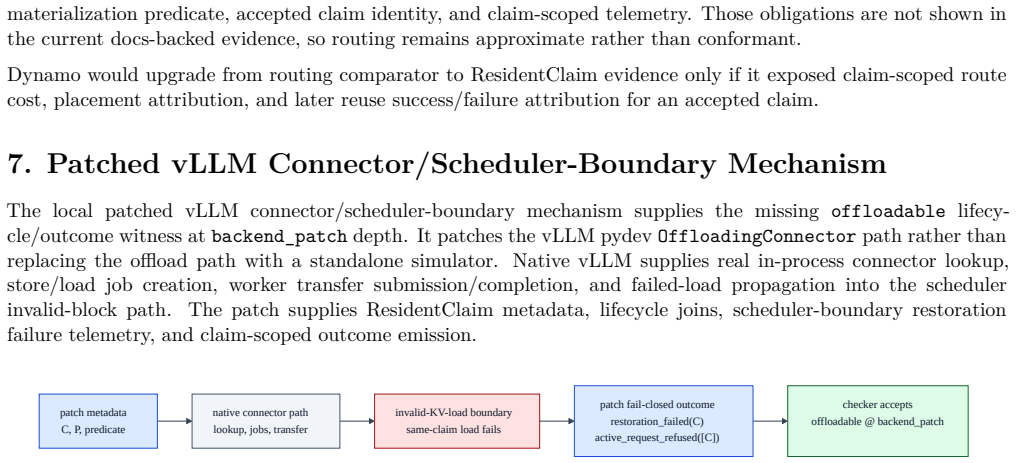
The central discovery is the fail-closed lowering relation for ResidentClaim onto LLM serving runtimes. A runtime primitive satisfies an accepted future-KV obligation only when its behavior is bound to the claim identity, a materialization predicate, ordered lifecycle events, and claim-scoped outcomes. The relation classifies mappings as native conformance, adapter evidence, or rejected, and the checker validates descriptors against obligation bundles without proving unaudited behavior. A positive example is a local patched vLLM where claim metadata flows through offload/load and restoration failure hits the invalid-KV-load path as an ordered claim-scoped outcome.
What carries the argument
The fail-closed lowering relation that enforces binding of runtime behavior to accepted claim identity, materialization predicate, ordered lifecycle events, and claim-scoped outcomes for satisfying future KV reuse obligations.
If this is right
- Primitives like priority and offload without the bindings do not accept responsibility for future KV reuse.
- The checker can classify runtime/mode mappings into native, adapter-observational, policy evidence, approximation, rejected, or unknown.
- Public systems like TensorRT-LLM and SGLang expose strong substrates but lack native ResidentClaim conformance.
- A patched vLLM connector demonstrates conformance via in-process offload with claim metadata and fail-closed restoration failure.
Where Pith is reading between the lines
- This semantics boundary could inform the design of future KV management standards across serving frameworks.
- Applying the descriptor format to additional runtimes might reveal more approximation substrates or policy evidence cases.
- Extending the fail-closed approach to other resource claims like memory or compute in distributed systems may be possible.
Load-bearing premise
Runtime primitives, trusted adapters, or patches can be treated as satisfying an accepted claim about future KV reuse when the binding conditions of identity, predicate, events, and outcomes are met.
What would settle it
Demonstration of a runtime primitive that satisfies all listed binding conditions yet permits a claimed KV to be lost without triggering a claim-scoped fail-closed outcome would falsify the definition of conformant lowering.
Figures
read the original abstract
LLM serving runtimes increasingly expose KV-cache primitives that resemble future-reuse controls: retention priority, TTL-like duration, host or storage offload, block events, active no-evict scheduling, and KV-aware routing. This paper argues that such primitives are weaker than accepted future-KV obligations. A runtime can expose priority, offload, events, and routing without accepting responsibility for a future reuse claim. We study ResidentClaim lowering: when a runtime primitive, trusted adapter, or patch can be treated as satisfying an accepted claim about future KV reuse. A conformant lowering must bind behavior to accepted claim identity, a materialization predicate, ordered lifecycle events, and claim-scoped outcomes. We contribute a fail-closed lowering relation, checker, descriptor format, and bad-lowering suite that classify runtime/mode mappings as native conformance, adapter-observational evidence, adapter-policy evidence under controlled pressure, approximation substrate, rejected mapping, or unknown evidence. The checker validates manually curated, anchored runtime descriptors against obligation bundles; it does not prove that unaudited runtime behavior is complete. Public TensorRT-LLM, SGLang/HiCache, and Dynamo expose strong substrates and selected adapter positives, but not native ResidentClaim conformance. The positive systems witness is a local patched vLLM connector/scheduler-boundary mechanism: claim metadata flows through real in-process offload/load behavior, and controlled same-claim restoration failure reaches vLLM's invalid-KV-load path and becomes an ordered claim-scoped fail-closed outcome. The result is a calibrated semantics boundary, not a production performance claim or a compatibility survey.
Editorial analysis
A structured set of objections, weighed in public.
Referee Report
Summary. The paper argues that KV-cache primitives in LLM serving runtimes (priority, offload, events, routing) are weaker than accepted future-KV reuse obligations. It defines ResidentClaim lowering and states that a conformant lowering must bind to accepted claim identity, a materialization predicate, ordered lifecycle events, and claim-scoped outcomes. Contributions include a fail-closed lowering relation, an obligation-bundle checker operating on manually curated runtime descriptors, a descriptor format, and a bad-lowering suite that classifies mappings into native conformance, adapter-observational evidence, adapter-policy evidence, approximation substrate, rejected mapping, or unknown. Several systems (TensorRT-LLM, SGLang/HiCache, Dynamo) are classified as exposing strong substrates but lacking native conformance; a patched vLLM connector is presented as a positive witness where claim metadata flows through offload/load and restoration failure reaches an invalid-KV-load path as an ordered claim-scoped outcome. The checker validates against proposed bundles but explicitly disclaims proving runtime completeness.
Significance. If the framework holds, it supplies a calibrated semantics boundary for fail-closed KV-reuse claims in distributed LLM serving, distinguishing native conformance from various evidence levels. The explicit disclaimer on checker scope and the concrete vLLM patch example (showing in-process offload/load behavior and claim-scoped failure) are strengths that make the contribution falsifiable and practically grounded rather than purely abstract.
major comments (1)
- [Abstract (definition of conformant lowering)] Abstract (definition of conformant lowering): The claim that a conformant lowering 'must bind behavior to accepted claim identity, a materialization predicate, ordered lifecycle events, and claim-scoped outcomes' is introduced by stipulation rather than derived from a formal semantics of accepted future-KV claims or supported by counterexamples showing that omitting any one binding permits non-fail-closed behavior. This is load-bearing for the fail-closed lowering relation and the subsequent classification scheme.
Simulated Author's Rebuttal
We thank the referee for the detailed review and the recommendation for major revision. We address the single major comment below and agree that the definition requires additional grounding.
read point-by-point responses
-
Referee: [Abstract (definition of conformant lowering)] Abstract (definition of conformant lowering): The claim that a conformant lowering 'must bind behavior to accepted claim identity, a materialization predicate, ordered lifecycle events, and claim-scoped outcomes' is introduced by stipulation rather than derived from a formal semantics of accepted future-KV claims or supported by counterexamples showing that omitting any one binding permits non-fail-closed behavior. This is load-bearing for the fail-closed lowering relation and the subsequent classification scheme.
Authors: We acknowledge that the definition is presented as a working definition motivated by the semantics of accepted future-KV reuse obligations rather than derived from a fully formal model or accompanied by explicit counterexamples in the current manuscript. Each binding is intended to enforce that violations produce observable, claim-scoped failure rather than silent incorrect reuse. In revision we will add a dedicated subsection (likely in Section 2 or 3) that (1) derives the four bindings from the requirement that an accepted claim must produce fail-closed outcomes under any violation and (2) supplies short counterexamples for each omitted binding (e.g., missing identity permits cross-claim pollution; missing materialization predicate allows stale KV to be treated as valid; unordered events can mask restoration failures; non-scoped outcomes allow side effects outside the claim). This will make the load-bearing relation and classification scheme more rigorously supported while preserving the existing empirical classification results. revision: yes
Circularity Check
No circularity; definitional framework with no reduction to inputs or self-referential equations
full rationale
The paper introduces the concept of ResidentClaim lowering and states that a conformant lowering must bind to four specific elements (claim identity, materialization predicate, lifecycle events, claim-scoped outcomes). This is presented as part of the definitional contribution of the fail-closed lowering relation and checker, not as a derived result from a prior model or equations that would reduce by construction. No fitted parameters are renamed as predictions, no self-citations are invoked as load-bearing uniqueness theorems, and no ansatz or renaming of known results occurs. The checker is explicitly limited to validating curated descriptors against the proposed bundles without claiming to prove runtime completeness or necessity of the bindings via counterexamples or formal semantics. The vLLM patch is described as a positive witness satisfying the conditions, not as establishing minimality. The overall contribution is a classification scheme and semantics boundary, which is self-contained against external benchmarks.
Axiom & Free-Parameter Ledger
Reference graph
Works this paper leans on
-
[1]
Fail-Closed Lowering of Resident KV Claims onto LLM Serving Runtimes
Introduction KV-cache reuse has become an explicit systems surface in LLM serving. Production and research runtimes expose token-range retention priorities, duration fields, block stored/removed events, GPU/host/storage cache tiers, load- back paths, active no-evict modes, and KV-aware routing. These mechanisms are real and important. They also create a t...
work page internal anchor Pith review Pith/arXiv arXiv 2026
-
[2]
Contributions This paper makes four concrete contributions
-
[3]
It defines an obligation-based lowering model for ResidentClaim modes: best_effort, soft_priority, hard_ protected, demotable, expiring, offloadable, and routed_reuse
-
[4]
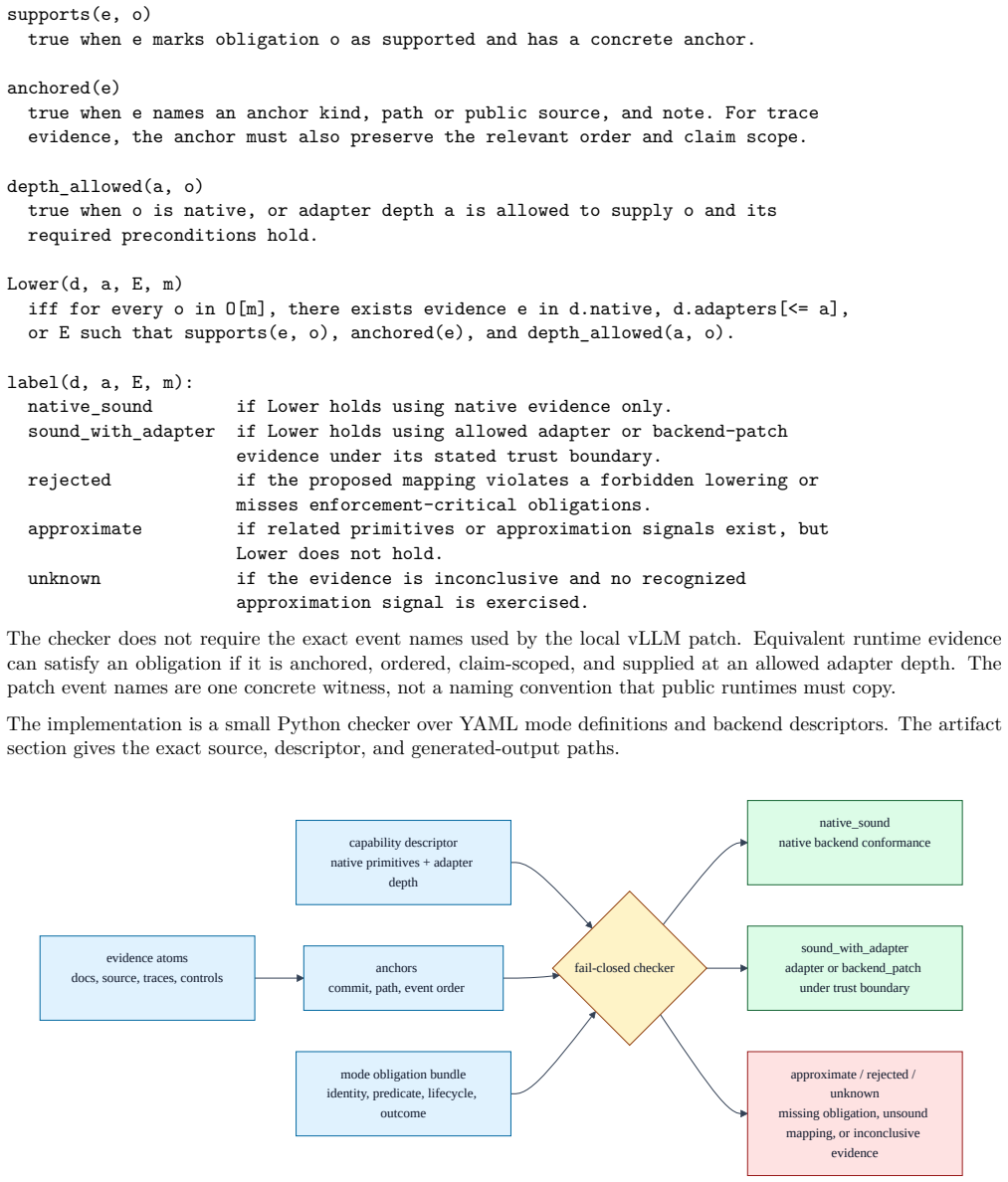
The checker counts obligations only when evidence is supported and anchored, requires anchored observed evidence atoms, and keeps adapter depth separate from classification
It implements a fail-closed checker and false-positive suite over machine-readable runtime descriptors. The checker counts obligations only when evidence is supported and anchored, requires anchored observed evidence atoms, and keeps adapter depth separate from classification. Descriptor and evidence mutation controls fail closed in 16/16 cases
-
[5]
The resulting matrix distinguishes adapter-observational evidence, adapter-policy evidence under controlled pressure, approximation substrates, rejected lowerings, and unknown rows
It studies the boundary of public TensorRT-LLM, SGLang/HiCache, Dynamo-style KV routing, and vLLM surfaces. The resulting matrix distinguishes adapter-observational evidence, adapter-policy evidence under controlled pressure, approximation substrates, rejected lowerings, and unknown rows
-
[6]
It demonstrates a local patched vLLM connector/scheduler-boundary mechanism at backend_patch depth. The repeated scheduler-boundary evaluation records 131/131 completed subprocesses, 131/131 valid event sequences, 30/30 successful observation passes, 30/30 same-claim scheduler-boundary failure-outcome passes, and fail-closed rejection of wrong-claim, uncl...
-
[7]
acceptance
ResidentClaim Obligations ResidentClaim lowering is strict because accepted responsibility is strict. The obligations are not arbitrary hurdles for existing systems; they define a conservative audit boundary for deciding whether a future-reuse claim was satisfied, 3 demoted, expired, restored, refused, harmed, or simply never accepted. Each obligation blo...
-
[8]
Missing required obligations fail closed
Lowering Relation and Checker The core judgment is: backend + adapter + evidence |= ResidentClaim mode A backend/adapter/evidence tuple lowers a mode only if every required obligation for that mode is represented by the native backend or by an adapter whose depth and preconditions allow it to supply that obligation. Missing required obligations fail close...
-
[9]
The current depth ladder is: T able 4: Adapter depths and trust boundaries
Adapter Depths and Trust Boundaries The adapter boundary is part of the result because an adapter is part of the trusted computing base for any adapter-scoped row. The current depth ladder is: T able 4: Adapter depths and trust boundaries. Adapter depth Meaning in this study none Only native backend obligations count. telemetry_join External registry and ...
-
[10]
It summarizes the generated matrix and the boundary memos without treating feature names as conformance
External Runtime Boundary Studies The central result is a semantic lowering table, not a feature compatibility chart. It summarizes the generated matrix and the boundary memos without treating feature names as conformance. T able 6: Runtime boundary study summary . Substrate Best current evidence Fail-closed boundary Patched vLLM connector/scheduler bound...
2026
-
[11]
accepted
Patched vLLM Connector/Scheduler-Boundary Mechanism The local patched vLLM connector/scheduler-boundary mechanism supplies the missing offloadable lifecy- cle/outcome witness at backend_patch depth. It patches the vLLM pydev OffloadingConnector path rather than replacing the offload path with a standalone simulator. Native vLLM supplies real in-process co...
-
[12]
Evaluation The evaluation answers four questions. The first two are matrix questions: does the checker reject false positives, and do studied runtimes natively satisfy the obligations under current public evidence? The second two are mechanism questions: can the missing offloadable semantics be implemented in a real runtime path, and is the mechanism stab...
-
[13]
Each case is checked against the same obligation relation as the main matrix
False Positive Counterexamples The bad-lowering suite records feature-table inferences that a less strict study might accidentally call supported. Each case is checked against the same obligation relation as the main matrix. T able 9: F alse-positive counterexamples. Naive inference Checker result Why it fails priority_value_in_event -> soft_priority appr...
-
[14]
Limitation Consequence No native conformance is shown for public TensorRT-LLM, SGLang/HiCache, Dynamo, or upstream vLLM evidence
Limitations and Threats to Validity T able 10: Limitations and consequences. Limitation Consequence No native conformance is shown for public TensorRT-LLM, SGLang/HiCache, Dynamo, or upstream vLLM evidence. The positive claims are adapter-scoped or patch-scoped, not native backend support. The patched vLLM connector result is local backend_ patch evidence...
-
[15]
Related Work and Prior-Art Boundary TensorRT-LLM is the closest primitive-level comparator. Its versioned KV-cache documentation describes cross-request reuse, prioritized LRU, retention priority/duration fields, and secondary-memory offload ( NVIDIA TensorRT-LLM KV Cache System, commit 06cff70502). This paper treats those mechanisms as serious substrates...
-
[16]
Artifact A vailability and Reproducibility Notes The audit surface for this paper is the curated artifact repository resident-kv-lowering-artifact at commit b9f82f456e56e48454a9b4e0c608c2c783d0cbdb: https://github.com/gustavgauge/resident-kv-lowering-artifact.git The curated snapshot contains the checker, capability descriptors, generated matrix, bad-lowe...
-
[17]
Conclusion ResidentClaim lowering is an obligation problem, not a feature-name problem. TensorRT-LLM, SGLang/HiCache, Dynamo-style routing, and vLLM connector paths all expose useful KV mechanisms, but useful mechanisms do not automatically become accepted future-KV obligations. The fail-closed checker and boundary studies show how the artifact makes that...
-
[18]
Proceedings of the 29th Symposium on Operating Systems Principles , pages =
References • Woosuk Kwon et al. “Efficient Memory Management for Large Language Model Serving with PagedAttention. ” SOSP 2023. DOI: https://doi.org/10.1145/3600006.3613165. • NVIDIA. “TensorRT-LLM KV Cache System. ” Versioned documentation at commit 06cff70502, accessed 2026-05-23. https://github.com/NVIDIA/TensorRT-LLM/blob/06cff70502/docs/source/feature...
-
[19]
Pie: A Programmable Serving System for Emerging LLM Applications,
https://doi.org/10.48550/arXiv.2510.24051. • Ruoyu Qin et al. “Mooncake: A KVCache-centric Disaggregated Architecture for LLM Serving. ” ACM Trans- actions on Storage, 2025. https://doi.org/10.1145/3773772. • Yuhan Liu et al. “LMCache: An Efficient KV Cache Layer for Enterprise-Scale LLM Inference. ” arXiv:2510.09665, 2025. https://doi.org/10.48550/arXiv.2...
-
[20]
https://doi.org/10.48550/arXiv.2504.03775. • Shi Qiu et al. “Tutti: Making SSD-Backed KV Cache Practical for Long-Context LLM Serving. ” arXiv:2605.03375, 2026. https://doi.org/10.48550/arXiv.2605.03375. • NVIDIA. “FlexKV. ” Dynamo documentation, accessed 2026-05-23. https://docs.nvidia.com/dynamo/integra tions/flex-kv. 24
discussion (0)
Sign in with ORCID, Apple, or X to comment. Anyone can read and Pith papers without signing in.