REVIEW 4 major objections 3 minor 30 references
Another Simple but Faster Method for 2D Line Clipping
T0 review · 4 major / 3 minor · reviewed 2026-08-14 · deepseek-v4-flash
Pith's one-line read A simplified 2D line-clipping algorithm is faster than six established methods in benchmark tests.
desk verdict A clean, teachable KWC variant; the algorithm is plausible and even handles axis-aligned lines, but the 'better than all' speed claim rests on a benchmark that is too thin to believe as stated. read the letter →
The pith
A machine-rendered reading of the paper's core claim, the machinery that carries it, and where it could break.
The reading
What carries the argument
The central object is the two-point form of the line equation, written as $y = y_1 + \frac{y_2-y_1}{x_2-x_1}(x-x_1)$ and $x = x_1 + \frac{x_2-x_1}{y_2-y_1}(y-y_1)$. The algorithm uses these identities to compute the intersection of the line with a window boundary: when a coordinate of an endpoint lies outside the window, that coordinate is replaced by the boundary value ($x_{min}$, $x_{max}$, $y_{min}$, or $y_{max}$) and the equation gives the matching other coordinate. This direct boundary-replacement step is what carries the argument, because it eliminates the region-encoding comparisons of Cohen-Sutherland, the parameter-interval solves of Liang-Barsky and Cyrus-Beck, and the many subcase branches of Nicholl-Lee-Nicholl. The proposed method also drops the dot and axis-parallel checks that the Kodituwakku-Wijeweera-Chamikara algorithm includes, relying on a preliminary same-side rejection test and a final inside test to decide what to draw.
What would settle it
Run the published pseudocode on a vertical line, such as $x_1 = x_2$, or a horizontal line, such as $y_1 = y_2$, against a window that partially overlaps the line; the Step 2 expressions $(y_2-y_1)/(x_2-x_1)$ or $(x_2-x_1)/(y_2-y_1)$ divide by zero, so the algorithm will crash or produce undefined output.
Extended reading notes
Core claim
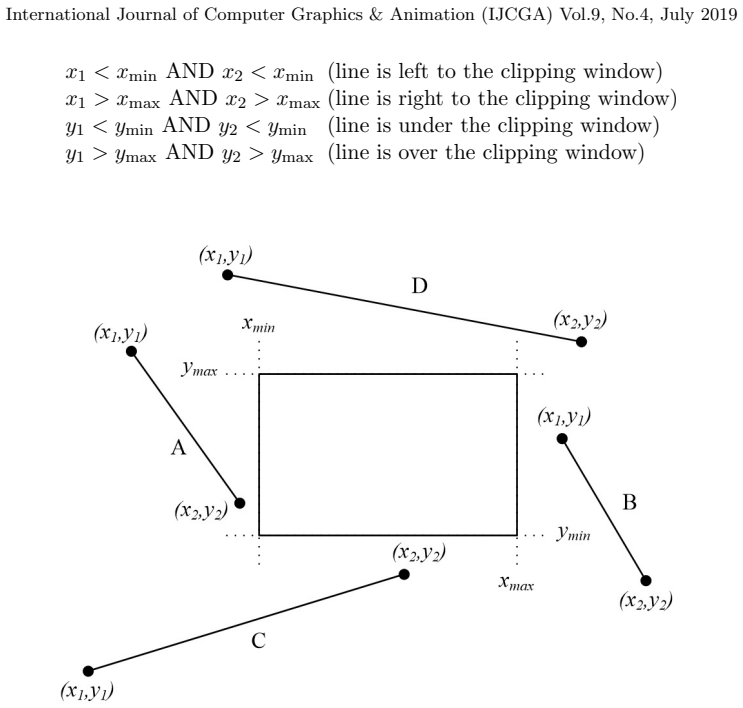
The paper's central claim is that its new line-clipping algorithm outperforms six established methods in speed and simplicity for the classic task of clipping a line segment against a rectangle. The algorithm first rejects lines whose two endpoints lie on the same side of the window. For each endpoint that crosses a boundary, it sets the offending coordinate to the boundary value and solves the two-point line equation for the other coordinate, producing the clipped endpoint in one step. The same procedure is applied to both endpoints, and a final test verifies the result before the line is drawn. Experiments in C++ with OpenGL on 1,000,000 and 10,000,000 random lines show the proposed method with the lowest average execution time among all seven algorithms tested; the margins range from 6.78% faster than Kodituwakku-Wijeweera-Chamikara to 26.95% faster than Cyrus-Beck on the smaller set, with similar margins on the larger set.
Load-bearing premise
The load-bearing premise is that the line is neither vertical nor horizontal, since the algorithm's Step 2 divides by $(x_2-x_1)$ and $(y_2-y_1)$ and the pseudocode removes the axis-parallel checks, so vertical or horizontal lines cause division by zero.
Editorial extensions
If this is right
- If the reported timings are reproducible, the method gives a faster default for 2D line clipping in software rasterizers and interactive graphics.
- Because it avoids bitwise region codes, the algorithm ports cleanly to languages like Scratch where Cohen-Sutherland's AND operations are difficult to implement.
- The speed advantage persists when the workload grows from one million to ten million lines, suggesting the improvement is stable rather than a small-sample artifact.
- The small number of variables and branches makes the method simpler to teach and to verify by hand in introductory computer graphics courses.
- The authors note the approach may extend to 3D clipping, where the same boundary-replacement idea could replace the plane-intersection bookkeeping of 3D Liang-Barsky.
Reading between the lines
- The benchmark uses a fixed screen-to-window size ratio and random lines with a uniform distribution in the drawing space; a different ratio or a biased distribution (for example, mostly axis-aligned lines) could change both the rejection rate and the ranking, since the proposed method has no early exit for axis-aligned segments.
- The claimed speedups depend on the cost model of C++ floating-point division and comparison; on platforms with slow division or fixed-point arithmetic, the two division-heavy intersection formulas may erode the advantage over comparison-heavy alternatives.
- A natural testable extension is to modify the algorithm to detect vertical and horizontal lines first and handle them with the trivial $x = x_1$ or $y = y_1$ intersection, then re-measure the speed against the same six baselines to see whether the guard costs more than the axis-parallel branch it replaces.
Signed reviews
Editorial analysis
A structured set of objections, weighed in public.
Referee Report
Summary. The paper proposes a new 2D line-clipping algorithm against an axis-aligned rectangular window. The method tests four trivial rejection conditions first, then for each endpoint substitutes the window boundaries into the slope-intercept form of the line to compute clipped coordinates, and finally validates the new endpoints before drawing. The authors compare it with Cohen-Sutherland, Liang-Barsky, Cyrus-Beck, Nicholl-Lee-Nicholl, Skala, and Kodituwakku-Wijeweera-Chamikara, using wall-clock times for clipping and drawing 1,000,000 and 10,000,000 randomly generated lines in C++/OpenGL, averaged over ten runs per condition. They report that the proposed method is faster than all six competitors (for example, 6.78% faster than Kodituwakku-Wijeweera-Chamikara at 1M lines and 6.80% at 10M lines) and conclude that it is simpler, faster, and uses fewer operations and variables.
Significance. The proposed algorithm is very easy to describe and implement, which is genuinely useful for computer graphics education; the early trivial-rejection step is a sound design choice, and the number of variables appears small. If the speed advantage were established by a rigorous, reproducible benchmark, the paper would offer a practical alternative for workloads with many trivially rejected lines. However, the contribution is incremental: line clipping is a mature topic, the algorithm is closely related to Kodituwakku-Wijeweera-Chamikara with the parallel-line and dot checks removed, and the central 'better than all' claim currently rests on an underpowered, unreplicated benchmark. The paper credits no machine-checked proofs, releases no code, and provides no operation-count table, so the significance of the contribution will remain modest until the empirical evidence is strengthened.
major comments (4)
- [Section 3, Tables 1 and 2] The reported statistics do not support the central speed claim. Ten runs per condition are summarized only by their average, with no standard deviation, confidence interval, or paired significance test. This is load-bearing for the decisive comparison against Kodituwakku-Wijeweera-Chamikara, the fastest competitor: the 1M-line averages differ by only 6.78%, and the individual runs overlap substantially (e.g., Table 1 shows KWC run 3 at 1.196 s versus proposed runs 6 and 8 at 1.216 s and 1.209 s). A paired test on the raw run data, or at minimum an error bar per condition, is needed before the claim that the method is 'better than all' competitors can be accepted.
- [Section 3, 'The experiment'] The random-line generation is underspecified. The text states that lines are 'randomly generated anywhere in the 2D space' but does not give the distribution, the random seed, or whether endpoints are independent and uniform over the 1920x1440 area. If endpoints are uniform, the great majority of segments will miss the 200x150 central window and be rejected in Step 1, so the measured time would mostly reflect trivial-rejection overhead rather than general clipping cost. The authors should specify the generation procedure, report the proportion of lines that actually intersect the window, and add a benchmark in which most lines cross the window.
- [Abstract and Section 3] The abstract claims a comparison 'with respect to the number of operations performed', but no operation-count table, formula, or per-case count is provided anywhere in Section 3. The only quantitative evidence is wall-clock time, which conflates clipping cost with drawing cost. Without an explicit count of comparisons, divisions, and assignments for typical cases, the abstract's operational claim and the conclusion that the method uses the minimum number of variables are unsupported.
- [Section 3, benchmark reproducibility] The implementations of the six competing algorithms are not made available, and the paper does not describe how the OpenGL drawing call is timed or whether the reported times include the drawing itself. This makes the comparison impossible to reproduce and complicates interpretation, since drawing overhead can mask differences in clipping cost. Providing source code and a precise timing protocol is necessary for the empirical comparison to be verifiable.
minor comments (3)
- [Section 2.2, bullets after Eq. (3)] In the bullets for 'If yi < ymin' and 'If yi > ymax', the terms '(ymin−x1)' and '(ymax−x1)' should read '(ymin−y1)' and '(ymax−y1)'; the pseudocode in Section 2.3 is correct.
- [Section 2.3] The algorithm does not explicitly state its treatment of zero-length or degenerate segments. For ordinary horizontal or vertical segments that cross the window, the divisions by (x2−x1) and (y2−y1) are not reached, so the division-by-zero concern largely does not land for such inputs; an explicit sentence about the intended domain of the algorithm would nevertheless prevent confusion.
- [General] The spelling of the Kodituwakku-Wijeweera-Chamikara algorithm is inconsistent (e.g., 'Wijeweere' in the text versus 'Wijeweera' in reference [13]); please unify the spelling, and also unify the journal volume numbering on the first and subsequent pages.
Circularity Check
No circularity: the speed claim rests on independent benchmark measurements, not on a derivation from the paper's own fitted inputs.
full rationale
The proposed algorithm is derived directly from the slope form of the line equation, Eq. (2) and Eq. (3), which are algebraic restatements of y = mx + b rather than assumptions containing the clipping result. Step 1 uses only boundary inequalities, and Step 2 substitutes window boundaries into the line equation; no parameter is fitted to the timing data and no output quantity is fed back as an input. The Section 3 and Section 4 performance claim is an empirical comparison against six external algorithms, with percentages computed directly from the measured averages in Tables 1 and 2, so there is no 'predicted' quantity that was used to generate the same benchmark. The only self-citation, ref. [17], appears in the introduction as 'see also [17]' and is not load-bearing for the algorithm's correctness or for the speed comparison. Potential concerns about division by zero for axis-aligned lines, the unspecified random-line distribution, or the absence of confidence intervals are correctness and empirical-support issues, not circularity under the stated criteria. The derivation chain is therefore self-contained, and no Eq. X = Eq. Y by construction or fitted parameter renamed as prediction is present.
Assumptions & free parameters
assumptions (1)
- domain assumption The line is not vertical or horizontal (x1 != x2 and y1 != y2).
Cite this review
Pith. "Pith review of Another Simple but Faster Method for 2D Line Clipping." pith.science (2026). https://pith.science/paper/FBVTGSD2
@misc{pith2026190801350,
  author       = {Pith},
  title        = {Pith review of: Another Simple but Faster Method for 2D Line Clipping},
  year         = {2026},
  howpublished = {\url{https://pith.science/paper/FBVTGSD2}},
  note         = {Machine review of arXiv:1908.01350}
}
read the original abstract
The majority of methods for line clipping make a rather large number of comparisons and involve a lot of calculations compared to modern ones. Most of the times, they are not so efficient as well as not so simple and applicable to the majority of cases. Besides the most popular ones, namely, Cohen-Sutherland, Liang-Barsky, Cyrus-Beck and Nicholl-Lee-Nicholl, other line-clipping methods have been presented over the years, each one having its own advantages and disadvantages. In this paper a new computation method for 2D line clipping against a rectangular window is introduced. The proposed method has been compared with the afore-mentioned ones as well as with two others; namely, Skala and Kodituwakku-Wijeweera-Chamikara, with respect to the number of operations performed and the computation time. The performance of the proposed method has been found to be better than all of the above-mentioned methods and it is found to be very fast, simple and can be implemented easily in any programming language or integrated development environment.
Figures


Figures from the paper (6 more)



Reference graph
Works this paper leans on
-
[1]
R. Andreev and Elena Sofianska. New algorithm for two-dimensional line clipping. Comput. Graph., 15(4):519–526, 1991
work page 1991
-
[2]
M. Cyrus and J. Beck. Generalized two- and three-dimensional clipping. Comput. Graph., 3:23–28, 1978
work page 1978
-
[3]
J. D. Day. An algorithm for clipping lines in object and image space. Comput. Graph. , 16(4):421–426, 1992
work page 1992
-
[4]
S. C. Dimri. A simple and efficient algorithm for line and polygon clipping in 2-D computer graphics. International Journal of Computer Applications , 127(3):31–34, 2015
work page 2015
-
[5]
M. D¨ orr. A new approach to parametric line clipping. Comput. Graph. , 14(3/4):449–464, 1990
work page 1990
-
[6]
J. D. Foley, A. van Dam, S. K. Feiner, and J. F. Hughes. Computer Graphics Principles and Practice. Addison-Wesley, Reading, MA, 2nd edition, 1990
work page 1990
-
[7]
A. P. Godse and Deepali A. Godse. Computer Graphics. Technical Publications, 2008
work page 2008
-
[8]
D. Hearn and M. P. Baker. Computer Graphics C Version . Prentice Hall, 2nd edition, 1997
work page 1997
Show all 30 references
-
[9]
Hearn, M
D. Hearn, M. Pauline Baker, and W. R. Carithers. Computer Graphics with Open GL. Pearson Education Limited, Edinburgh Gate, Harlow, Essex CM20 2JE, 4th edition, 2014
2014
-
[10]
M. S. Iraji, A. Mazandarami, and H. Motameni. An efficient line clipping algorithm based on Cohen-Sutherland line clipping algorithm. American Journal of Scientific Research, 14:65–71, 2011
2011
-
[11]
Kaijian, J
S. Kaijian, J. A. Edwards, and D. C. Cooper. An efficient line clipping algorithm. Comput. Graph., 14(2):297–301, 1990. 13 International Journal of Computer Graphics & Animation (IJCGA) Vol.9, No.4, July 2019
1990
-
[12]
S. R. Kodituwakku, K. R. Wijeweera, and M. A. P. Chamikara. An efficient line clipping algorithm for 3D space. International Journal of Advanced Research in Computer Science and Software Engineering, 2(5):96–101, 2012
2012
-
[13]
S. R. Kodituwakku, K. R. Wijeweera, and M. A. P. Chamikara. An efficient algorithm for line clipping in computer graphics programming. Ceylon Journal of Science (Physical Sciences) , 1(17):1–7, 2013
2013
-
[14]
An efficient line clipping algorithm for circular windows using vector calculus and parallelization.International Journal of Computer Graphics & Animation (IJCGA) , 8(1/2):1–8, 2018
Prastut Kumar, Fenil Patel, and Rajesh Kanna. An efficient line clipping algorithm for circular windows using vector calculus and parallelization.International Journal of Computer Graphics & Animation (IJCGA) , 8(1/2):1–8, 2018
2018
-
[15]
Liang and B
Y-D. Liang and B. A. Barsky. A new concept and method for line clipping. tog, 3(1):1–22, 1984
1984
-
[16]
G. Lu, X. Wu, and Q. Peng. An efficient line clipping algorithm based on adaptive line rejection. Computers and Graphics , 26:409–415, 2002
2002
-
[17]
Matthes and V
D. Matthes and V. Drakopoulos. A simple and fast line-clipping method as a scratch extension for computer graphics education. Computer Science and Information Technology , 7(2):40–47, 2019
2019
-
[18]
Nicholl, D.T
Tina M. Nicholl, D.T. Lee, and Robin A. Nicholl. An effective new algorithm for 2-D line clipping: Its development and analysis. Comput. Graph., 21(4):253–262, 1987
1987
-
[19]
Comparison of various line clipping algorithms: Review
Nisha. Comparison of various line clipping algorithms: Review. International Journal of Advanced Research in Computer Science and Software Engineering , 7(1):68–71, 2017
2017
-
[20]
A review: Comparison of line clipping algorithms in 3D space
Nisha. A review: Comparison of line clipping algorithms in 3D space. International Journal of Advanced Research, 5(1):2377–2379, 2017
2017
-
[21]
Pandey and S
A. Pandey and S. Jain. Comparison of various line clipping algorithms for improvement. International Journal of Modern Engineering Research , 3(1):69–74, 2013
2013
-
[22]
B. K. Ray. An alternative algorithm for line clipping. Journal of Graphic Tools, 16(1):12–24, 2012
2012
-
[23]
B. K. Ray. A line segment clipping algorithm in 2D. International Journal of Computer Graphics, 3(2):51–76, 2012
2012
-
[24]
N. C. Sharma and S. Manohar. Line clipping revisited: Two efficient algorithms based on simple geometric observations. Comput. Graph., 16(1):51–54, 1992
1992
-
[25]
V. Skala. An efficient algorithm for line clipping by convex polygon. Comput. Graph. , 17(4):417–421, 1993
1993
-
[26]
V. Skala. O(lg N) line clipping algorithm in E2. Comput. Graph., 18(4):517–524, 1994
1994
-
[27]
V. Skala. A new approach to line and line segment clipping in homogeneous coordinates. Visual Comput., 21:905–914, 2005
2005
-
[28]
Mel Slater and Brian A. Barsky. 2d line and polygon clipping based on space subdivision. Visual Comput., 10:407–422, 1994
1994
-
[29]
Information Technology with Management
M. S. Sobkow, P. Pospisil, and Y. Yang. A fast two-dimensional line clipping algorithm via line encoding. Comput. Graph., 11(4):459–467, 1987. Authors Vasileios Drakopoulos received a B.S. degree in Mathematics, an M.S. degree in Informatics & Operations Research and a doctora...
1987
-
[2005]
He has also worked as a part time teacher in several universities and institutes
From 2005 onwards he works as a teacher of Informatics in secondary educa- tion. He has also worked as a part time teacher in several universities and institutes. Currently, he is pursuing his Ph.D. degree in Computer Science and Biomedical In- formatics from the University of...
2005
Reviewed August 14, 2026 · model on record in the stance chip above.
Discussion (0). Continue with ORCID to comment.