REVIEW 2 major objections 5 minor 36 references
High-NA vectorial hologram optimization
T0 review · 2 major / 5 minor · reviewed 2026-08-03 · deepseek-v4-flash
Pith's one-line read Optimizing holograms with a differentiable Richards-Wolf vector-field model achieves 99.98 percent uniformity at NA=0.9.
desk verdict RW-in-the-loop CGH is a genuinely useful numerical idea, but the headline uniformities are model-self-consistency numbers, and the paper needs perturbation sensitivity before claiming to reframe high-NA CGH. read the letter →
The pith
A machine-rendered reading of the paper's core claim, the machinery that carries it, and where it could break.
The reading
What carries the argument
The workhorse is an FFT-based, differentiable implementation of the Richards-Wolf focusing integral, with the aplanatic apodization factor 1/sqrt(cos theta), the pupil-to-spatial-frequency mapping, and the 3x3 polarization transformation matrix that mixes the incident transverse polarization into cross-polarized and longitudinal focal components. Because the model is differentiable, the squared-error loss between target and simulated intensity (or simulated optical potential) is minimized directly by a quasi-Newton optimizer using automatic differentiation. The same model supplies the full local field E, so the loss can include vector and tensor light-shift terms that depend on Im(E* x E) an
What would settle it
Measure the same 10x10 tweezer array and flat-top on a real NA=0.9 aplanatic objective with a phase-only SLM: if RW-optimized holograms do not visibly outperform Fraunhofer-optimized ones in measured uniformity and ellipticity, or if feeding an independently measured pupil amplitude and aberration map into the same RW loss does not preserve the reported fidelities, the central claim is falsified.
Extended reading notes
Core claim
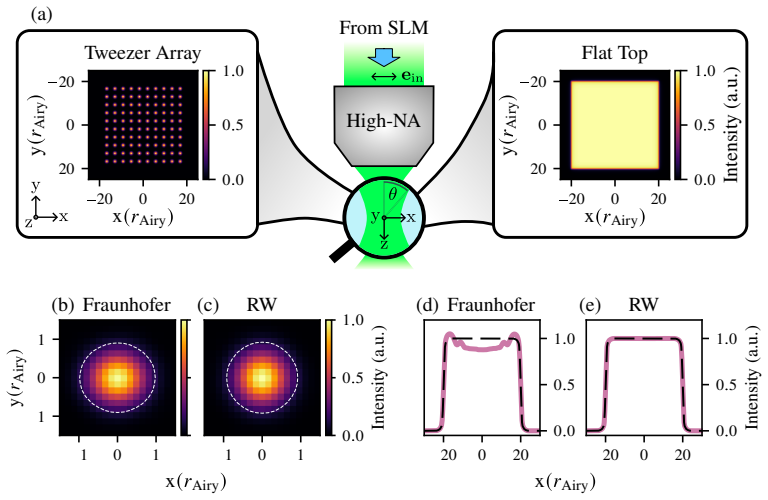
The central discovery is that gradient-based phase retrieval, when driven by an FFT-accelerated Richards-Wolf forward model rather than scalar Fraunhofer or Debye propagation, produces holograms whose RW-evaluated total-intensity profiles are essentially uniform in the deep non-paraxial regime. At NA=0.9 the flat-top uniformity reaches 99.97% (peak-to-valley variation 0.29%) and the 10x10 tweezer array reaches 99.98% with mean ellipticity 1.007. The same vectorial field enables a previously unavailable objective: optimizing the polarization-dependent optical dipole potential directly, which the paper demonstrates reduces the mean normalized potential-shape residual by about a factor of 11 co
Load-bearing premise
All fidelity values are computed with the same Richards-Wolf model that is being optimized, under ideal assumptions—uniform pupil amplitude, phase-only SLM, refractive index 1, and an aplanatic objective obeying the sine condition—so the numbers are model self-consistency, not a measured property of a real optical system.
Editorial extensions
If this is right
- At NA=0.9, RW-optimized holograms achieve flat-top uniformity 99.97% with 0.29% peak-to-valley variation and tweezer-array uniformity 99.98% with mean ellipticity 1.007, under RW evaluation.
- Fraunhofer-based design loses flat-top fidelity mainly because it omits the aplanatic pupil weighting; scalar Debye restores the flat-top but leaves diffraction-scale tweezers elliptical (about 1.16 at NA=0.9) because it ignores focal polarization mixing.
- RW optimization keeps the favorable FFT scaling of the forward propagation; the full vectorial gradient computation costs roughly 2.4 times the scalar per-call time, and the full quasi-Newton optimization about 1.7 times, so the vectorial model does not change the asymptotic complexity.
- For polarization-sensitive optical dipole traps, optimizing the full RW potential rather than an intensity proxy reduces the mean normalized residual from 2.0e-2 to 1.8e-3 (roughly 11x) and raises the Pearson correlation from 0.9780 to 0.9998.
- The reported fidelities are computational benchmarks for an ideal phase-only SLM, uniform pupil illumination, and an aplanatic objective; experimental use requires calibration of aberrations, pupil amplitude, SLM pixel response, and polarization optics.
Reading between the lines
- If the ideal-aplanatic assumption holds, the same differentiable vectorial pipeline could be dropped into other high-NA beam-shaping tasks—STED, two-photon, or optical trapping—where scalar optimization currently produces focal-spot asymmetry.
- The framework's loss is a template: substituting measured pupil amplitude and aberration maps from a real objective would turn the simulation-based benchmarks into a calibration-aware hologram generator, effectively testing whether model mismatch or optimization error dominates in practice.
- Because the polarization-overlap factor is quadratic in intensity spatial frequency and anisotropic along the incident polarization, the largest fidelity gain from RW optimization should appear for targets with fine features oriented along the polarization direction; a systematic orientation sweep of an asymmetric target would probe this.
- For neutral-atom platforms, the same loss could be re-targeted to minimize differential light shifts between atomic states, which the paper names as the natural next step.
Editorial analysis
A structured set of objections, weighed in public.
Referee Report
Summary. The paper introduces a differentiable Richards-Wolf (RW) forward model for gradient-based phase-only CGH optimization. It compares RW, scalar Debye, and Fraunhofer optimization under a common RW evaluation for two targets (extended flat-top and 10×10 tweezer array), showing that at NA=0.9 RW optimization achieves 99.97% flat-top uniformity and 99.98% tweezer uniformity with mean ellipticity ε=1.007, while scalar-optimized phases exhibit target-dependent degradation (flat-top error from aplanatic weighting; tweezer ellipticity from polarization mixing). The paper further optimizes a polarization-dependent optical dipole potential directly from the RW field, reducing the mean normalized residual by about 11× compared with intensity-proxy optimization. The Supplement provides extensive internal validation: low-NA scalar-limit convergence, analytic component-energy fractions, dense Fourier-sum cross-check, zero-padding convergence, and optimizer/normalization sensitivity.
Significance. If the numerical results are robust, this is a useful contribution: it demonstrates a computationally efficient (FFT-based) vectorial propagation model in an automatic-differentiation CGH pipeline and clearly separates two distinct scalar-model errors. The validation is unusually careful for a computational optics paper, including analytic component-energy checks and a dense-matrix cross-validation of the FFT implementation. However, the headline fidelity numbers are self-consistent within the ideal RW model; no perturbation study shows how they degrade under realistic SLM/objective non-idealities. The paper explicitly acknowledges these limitations, so the main uncertainty is the practical reach of the claims, not their internal consistency.
major comments (2)
- [§3, Table 1 and Eq. (1)] All reported fidelities in Table 1 (99.97% flat-top, 99.98% tweezer uniformity, ε=1.007 at NA=0.9) are computed with the same differentiable RW operator used for optimization. With ~1.2×10^5 phase DOF, the optimizer may fit model-specific degrees of freedom (pupil apodization, exact PSF shape, high-frequency phase). The Supplement's validation checks are internal-consistency tests (low-NA limit, analytic component energies, dense Fourier sum, zero-padding) and do not probe sensitivity to deviations from the ideal assumptions stated in §2: uniform pupil amplitude, ideal phase-only SLM, n=1, and aplanatic objective. Since the paper frames the method as addressing a critical limitation in high-NA optical systems, please add a perturbation study (e.g., low-order aberrations, pupil apodization/clipping, SLM phase quantization, or an independent vectorial propagator) and report the resulting T
- [§4, Eq. (11)] The factor-of-11 reduction in mean normalized potential residual (§4) is the key demonstration for polarization-sensitive targets, but the axial-stationarity weight Λ_z=0.4 in Eq. (11) is fixed ad hoc. No sensitivity of the reported residual (2.0×10^-2 to 1.8×10^-3) to Λ_z is shown. If the improvement over the scalar-only RW control is robust only for a narrow Λ_z range, the claim of direct RW-potential optimization is weakened. Please include a Λ_z sweep (or a justification of the chosen value) for the three optimizations compared.
minor comments (5)
- [§2.1, Eqs. (6)-(8)] The flat-top uniformity and PV metrics are evaluated only over SRflat, which excludes the steep target edges by construction. A solution with a perfect central plateau but wrong edge profile would score 99.97% uniformity. Although the full target enters the loss in Eq. (5), the reported headline metrics do not measure edge fidelity. Please report a full-region metric (e.g., RMSE over the entire 40 r_Airy mask) alongside the plateau metrics to substantiate the flat-top generation claim.
- [Data availability] Data availability states that data are not publicly available but may be obtained from the authors. For a computational methods paper, releasing the JAX implementation and the optimization scripts would substantially improve reproducibility and allow readers to test the sensitivity concerns raised above.
- [Fig. 2] The legend contains a stray '1' at the bottom right, apparently a LaTeX artifact. Please correct.
- [Supplement 1, §6] The vortex-removal restart in Supplement §6 is described only briefly and is not used in the main benchmarks. The heuristic scalar-proxy inverse-FFT initialization works well for the asymmetric split flat-top, but its general applicability should be discussed, or the main-text claims should be limited to the target classes studied.
- [Eq. (10)] The axial scale z0 = λ/(2 NA^2) is introduced without explanation; it is the Rayleigh-like axial scale of the focal field. Please define it explicitly to aid readability.
Circularity Check
No significant circularity: the paper's headline metrics are self-consistent numerical benchmarks within an explicitly stated ideal Richards-Wolf model, with independent validation of the implementation, not predictions derived from fitted inputs or self-citations.
full rationale
The paper's central claims are numerical optimization demonstrations, not empirical predictions extracted from fitted parameters. The RW forward model is used both for optimization and evaluation, but this is a deliberate, clearly stated modeling protocol rather than a definitional equivalence: the optimized phase is a free variable, the loss in Eq. (5) is not identical to the uniformity metric in Eq. (6), and the reported 99.97% / 99.98% values are contingent on successful L-BFGS convergence, not forced by construction. No parameter is fitted to external data, and no closely related fitted quantity is later renamed as a prediction. The RW implementation is independently checked in Supplement 1 via the low-NA scalar limit, analytic phase-independent component-energy fractions, dense-matrix Fourier-sum comparison (relative complex-field error ~2e-14), and zero-padding convergence; these are external internal-consistency checks that support the numerical machinery. The conclusions explicitly frame the results as 'computational benchmarks for an ideal phase-only SLM, uniform pupil illumination, and an aplanatic objective' and state that 'experimental use will require calibration,' candidly acknowledging that the ideal-model assumption defines the scope of the claim. There are no load-bearing self-citations, no imported uniqueness theorems, and no ansatz smuggled in via prior work by the same authors. The concern that physical-optics deviations could degrade the reported uniformities is a model-realism caveat, not a logical circularity, and the paper itself flags it.
Assumptions & free parameters
free parameters (5)
- Axial-stationarity regularization weight Λ_z =
0.4
- Tweezer target Gaussian width ratio σ_tar/σ_PSF,maj =
1.05
- Polarizability test-case parameters =
αs=αv=αt=1, mJ=1, J=1, quantization axis (x̂+ŷ)/√2
- Focal-plane loss mask radius =
250 pixels (~40 r_Airy)
- Initialization protocol (Zernike defocus pre-optimization) =
not quantitatively specified
assumptions (5)
- domain assumption Richards-Wolf aplanatic focusing model: Leutenegger coordinate mapping, Abbe sine apodization 1/√cosθ, and polarization matrix M
- domain assumption Ideal phase-only SLM with uniform pupil amplitude, n=1, and fixed linear input polarization
- domain assumption Optical dipole potential formula Eq. (9) with scalar, vector, and tensor polarizabilities
- ad hoc to paper Targets are achievable by construction
- ad hoc to paper Vortex-removal restart via inverse-FFT scalar-proxy backpropagation
Cite this review
Pith. "Pith review of High-NA vectorial hologram optimization." pith.science (2026). https://pith.science/paper/FCTLO3MA
@misc{pith2026260729505,
  author       = {Pith},
  title        = {Pith review of: High-NA vectorial hologram optimization},
  year         = {2026},
  howpublished = {\url{https://pith.science/paper/FCTLO3MA}},
  note         = {Machine review of arXiv:2607.29505}
}
abstract
We present a vectorial phase-only framework for the gradient-based optimization of computer-generated holograms. Our approach addresses a critical limitation in high numerical aperture (NA) optical systems, where standard scalar approximations often experience significant fidelity degradation. We highlight the limitations of scalar diffraction models (Fraunhofer and Debye) at high NA for representative classes of target intensities, namely tweezer arrays and extended flat-top profiles. Using a differentiable Richards-Wolf forward model, we numerically demonstrate stable algorithmic convergence and the generation of highly uniform intensity profiles in the deep non-paraxial regime. At NA=0.9, Richards-Wolf (RW) optimization reaches flat-top and tweezer uniformities of 99.97 % and 99.98 %, respectively, with a mean tweezer ellipticity of $\varepsilon=$1.007, while scalar forward models show target-dependent degradation in plateau fidelity or focal geometry. Furthermore, because the RW model returns the full vectorial field, the same framework can optimize objectives that depend on local polarization. We demonstrate this for a polarization-sensitive optical-dipole-potential target, where direct RW-potential optimization reduces the mean normalized residual by more than an order of magnitude when including vector and tensor light-shift terms.
Figures


Figures from the paper (1 more)

Reference graph
Works this paper leans on
-
[1]
An atom-by-atom assembler of defect-free arbitrary two-dimensional atomic arrays,
D. Barredo, S. de Léséleuc, V. Lienhard,et al., “An atom-by-atom assembler of defect-free arbitrary two-dimensional atomic arrays,” Science354, 1021–1023 (2016)
2016
-
[2]
Logical quantum processor based on reconfigurable atom arrays,
D. Bluvstein, S. J. Evered, A. A. Geim,et al., “Logical quantum processor based on reconfigurable atom arrays,” Nature626, 58–65 (2024)
2024
-
[3]
Parallel assembly of neutral atom arrays with an SLM using linear phase interpolation,
I. Knottnerus, Y. C. Tseng, A. Urech,et al., “Parallel assembly of neutral atom arrays with an SLM using linear phase interpolation,” SciPost Phys.19, 118 (2025)
2025
-
[4]
Holographic photolysis of caged neurotransmitters,
C. Lutz, T. S. Otis, V. DeSars,et al., “Holographic photolysis of caged neurotransmitters,” Nat. Methods5, 821–827 (2008)
2008
-
[5]
Wave front engineering for microscopy of living cells,
V. Emiliani, D. Cojoc, E. Ferrari,et al., “Wave front engineering for microscopy of living cells,” Opt. Express13, 1395–1405 (2005)
2005
-
[6]
Full phase and amplitude control of holographic optical tweezers with high efficiency,
A. Jesacher, C. Maurer, A. Schwaighofer,et al., “Full phase and amplitude control of holographic optical tweezers with high efficiency,” Opt. Express16, 4479–4486 (2008)
2008
-
[7]
Phase retrieval with application to optical imaging: a contemporary overview,
Y. Shechtman, Y. C. Eldar, O. Cohen,et al., “Phase retrieval with application to optical imaging: a contemporary overview,” IEEE Signal Process. Mag.32, 87–109 (2015)
2015
-
[8]
A practical algorithm for the determination of phase from image and diffraction plane pictures,
R. W. Gerchberg and W. O. Saxton, “A practical algorithm for the determination of phase from image and diffraction plane pictures,” Optik35, 237–246 (1972)
1972
Show all 36 references
-
[9]
Holographic phase retrieval via Wirtinger flow: Cartesian form with auxiliary amplitude,
I. Uchiyama, C. Tsutake, K. Takahashi, and T. Fujii, “Holographic phase retrieval via Wirtinger flow: Cartesian form with auxiliary amplitude,” Opt. Express32, 20600–20617 (2024)
2024
-
[10]
Phase retrieval via Wirtinger flow: Theory and algorithms,
E. J. Candès, X. Li, and M. Soltanolkotabi, “Phase retrieval via Wirtinger flow: Theory and algorithms,” IEEE Trans. on Inf. Theory61, 1985–2007 (2015)
1985
-
[11]
Optimization of phase-only computer-generated holograms based on the gradient descent method,
S. Liu and Y. Takaki, “Optimization of phase-only computer-generated holograms based on the gradient descent method,” Appl. Sci.10, 4283 (2020)
2020
-
[12]
Vectorial beam shaping,
T. G. Jabbour and S. M. Kuebler, “Vectorial beam shaping,” Opt. Express16, 7203–7213 (2008)
2008
-
[13]
Intensitycontrolofthefocalspotbyvectorialbeamshaping,
K.JahnandN.Bokor,“Intensitycontrolofthefocalspotbyvectorialbeamshaping,”Opt.Commun.283,4859–4865 (2010)
2010
-
[14]
Differentiable optimization of the Debye-Wolf integral for light shaping and adaptive optics in two-photon microscopy,
I. Vishniakou and J. D. Seelig, “Differentiable optimization of the Debye-Wolf integral for light shaping and adaptive optics in two-photon microscopy,” Opt. Express31, 9526–9542 (2023)
2023
-
[15]
Dynamical polarizability of atoms in arbitrary light fields: general theory and application to cesium,
F. Le Kien, P. Schneeweiss, and A. Rauschenbeutel, “Dynamical polarizability of atoms in arbitrary light fields: general theory and application to cesium,” The Eur. Phys. J. D67, 92 (2013)
2013
-
[16]
Atom camera: super-resolution scanning microscope of a light pattern with a single ultracold atom,
T. Tomita, Y. T. Chew, R. A. Villela,et al., “Atom camera: super-resolution scanning microscope of a light pattern with a single ultracold atom,” Nat. Commun.17, 4727 (2026)
2026
-
[17]
Electromagnetic diffraction in optical systems, II. structure of the image field in an aplanatic system,
B. Richards and E. Wolf, “Electromagnetic diffraction in optical systems, II. structure of the image field in an aplanatic system,” Proc. Royal Soc. London. Ser. A. Math. Phys. Sci.253, 358–379 (1959)
1959
-
[18]
Fast focus field calculations,
M. Leutenegger, R. Rao, R. A. Leitgeb, and T. Lasser, “Fast focus field calculations,” Opt. Express14, 11277–11291 (2006)
2006
-
[19]
Gu,Advanced Optical Imaging Theory(Springer Berlin Heidelberg, 2000)
M. Gu,Advanced Optical Imaging Theory(Springer Berlin Heidelberg, 2000)
2000
-
[20]
Inversion of the Debye-Wolf diffraction integral using an eigenfunction representation of the electric fields in the focal region,
M. R. Foreman, S. S. Sherif, P. R. T. Munro, and P. Török, “Inversion of the Debye-Wolf diffraction integral using an eigenfunction representation of the electric fields in the focal region,” Opt. Express16, 4901–4917 (2008)
2008
-
[21]
JAX: composable transformations of Python+NumPy programs,
J. Bradbury, R. Frostig, P. Hawkins,et al., “JAX: composable transformations of Python+NumPy programs,” (2018)
2018
-
[22]
On the limited memory BFGS method for large scale optimization,
D. C. Liu and J. Nocedal, “On the limited memory BFGS method for large scale optimization,” Math. Program.45, 503–528 (1989)
1989
-
[23]
Spatial shaping for generating arbitrary optical dipole traps for ultracold degenerate gases,
J. G. Lee and W. T. Hill, “Spatial shaping for generating arbitrary optical dipole traps for ultracold degenerate gases,” Rev. Sci. Instruments85, 103106 (2014)
2014
-
[24]
Flattening a trapped atomic gas using a programmable optical potential in a feedback loop,
S. Kim, K. Lee, J. Kim, and Y. Shin, “Flattening a trapped atomic gas using a programmable optical potential in a feedback loop,” Phys. Rev. A110, 033326 (2024)
2024
-
[25]
Atom-by-atom assembly of defect-free one-dimensional cold atom arrays,
M. Endres, H. Bernien, A. Keesling,et al., “Atom-by-atom assembly of defect-free one-dimensional cold atom arrays,” Science354, 1024–1027 (2016)
2016
-
[26]
The focus of light–linear polarization breaks the rotational symmetry of the focal spot,
R. Dorn, S. Quabis, and G. Leuchs, “The focus of light–linear polarization breaks the rotational symmetry of the focal spot,” J. Mod. Opt.50, 1917–1926 (2003)
1917
-
[27]
AnisotropicpolarizabilityofDyat532nmontheintercombinationtransition,
D.Bloch,B.Hofer,S.R.Cohen,etal.,“AnisotropicpolarizabilityofDyat532nmontheintercombinationtransition,” Phys. Rev. A110, 033103 (2024)
2024
-
[28]
Coherent control of the fine-structure qubit in a single alkaline-earth atom,
G. Unnikrishnan, P. Ilzhöfer, A. Scholz,et al., “Coherent control of the fine-structure qubit in a single alkaline-earth atom,” Phys. Rev. Lett.132, 150606 (2024)
2024
-
[29]
Adam: A method for stochastic optimization,
D. P. Kingma and J. Ba, “Adam: A method for stochastic optimization,” in3rd International Conference on Learning Representations (ICLR),(2015)
2015
-
[30]
Conjugate gradient minimisation approach to generating holographic traps for ultracold atoms,
T. Harte, G. D. Bruce, J. Keeling, and D. Cassettari, “Conjugate gradient minimisation approach to generating holographic traps for ultracold atoms,” Opt. Express22, 26548–26558 (2014). High-NA vectorial hologram optimization: supplemental document This supplemental document p...
2014
-
[31]
Numerical Implementation Validation The mainresults arebasedon FFT-based implementationsof the scalarand vectorialpropagation models. Thissectionvalidatesthenumericalimplementationratherthanthephysicalapplicability of the RW model itself, which follows from the standard high-N...
2000
-
[32]
Gaussian Tweezer Target Size We choose the Gaussian tweezer target width used in the main text based on the width sweep shown in Fig. S2. For each value of𝜎tar/𝜎PSF,maj, we optimize the tweezer-array phase with the RW forward model atNA=0.9 and evaluate the mean fitted tweezer...
-
[33]
Here we give the corresponding short derivation
Intensity Spectrum Analysis The main text uses the intensity spectrum to interpret why scalar Debye propagation remains accurateforbroadflat-toptotal-intensityfeatures,whilediffraction-scaletweezershapesaremore sensitive to the full vectorial RW model. Here we give the corresp...
-
[34]
Propagation, loss, and loss-plus-gradient timings are measured after just-in-time (JIT) compilation and explicit device synchronization
Timings The timed results for the flat-top benchmark are shown in Table S1. Propagation, loss, and loss-plus-gradient timings are measured after just-in-time (JIT) compilation and explicit device synchronization. For each entry, we report the mean per-call time over three oute...
-
[35]
Optimizer and Normalization Sensitivity The primary article uses L-BFGS with the Frobenius-normalized squared-error objective defined in Eq.(5) of the primary article. To check that the reported RW hologram fidelities are not specific to this optimizer or normalization, we rep...
-
[36]
Suppression of Phase Vortices in High-NA CGH The main text focuses on connected flat-top profiles and regular tweezer arrays. As a stress test for less symmetric target geometries, we additionally consider an asymmetric split flat-top target obtained by removing the central cr...
Reviewed August 3, 2026 · model on record in the stance chip above.
Discussion (0). Continue with ORCID to comment.