REVIEW 4 major objections 5 minor 77 references
Design Patterns of Human-AI Interfaces in Healthcare
T0 review · 4 major / 5 minor · reviewed 2026-08-06 · deepseek-v4-flash
Pith's one-line read Fifteen information entities and twelve design patterns give healthcare designers a concrete path from clinician needs to interface sketches, with workshop evidence that they help ground designs and simplify layouts.
desk verdict A useful pattern catalog for healthcare human-AI interfaces whose workshop evaluation is too weak to back the causal claims; worth engaging for the synthesis. read the letter →
The pith
A machine-rendered reading of the paper's core claim, the machinery that carries it, and where it could break.
The reading
What carries the argument
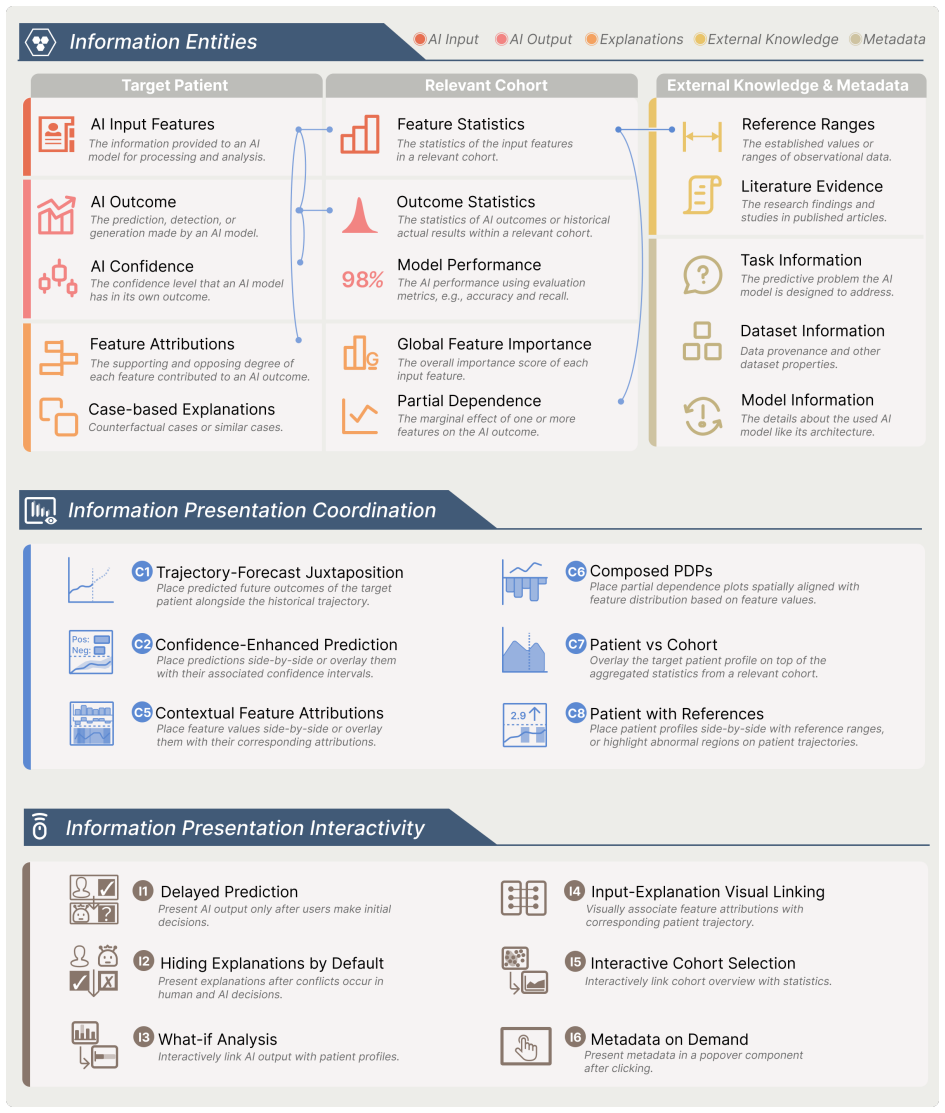
The central object is the two-layer pattern catalog: 15 information entities serve as the intermediate vocabulary, and 12 design patterns prescribe how those entities should be visually arranged and manipulated. The mechanism that makes the guidance actionable is the entity-first design step, where a designer decomposes an abstract user need into concrete information types before choosing a presentation or interaction pattern. Each pattern follows a problem-solution-rationale structure, with usage conditions distilled from both the reviewed systems and the clinician interviews, such as cautions about cohort-selection bias, feature correlations in what-if analysis, and the AI literacy required to read composed partial-dependence plots.
What would settle it
A controlled experiment would settle this: assign designers of comparable experience to sketch the same healthcare scenario with the pattern catalog, with general human-AI guidelines, or with no guidance, keeping tutorial time equal; if blind clinical and UI experts find no difference in sketch completeness, clinical appropriateness, or breadth of alternatives, the claimed benefit of the patterns is contradicted.
Extended reading notes
Core claim
On the paper's own terms, the discovery is a structured design language for healthcare human-AI interfaces: a taxonomy of 15 information entities organized by their role in the AI pipeline—input features, feature statistics, AI outcomes, AI confidence, outcome statistics, model performance, feature attributions, case-based explanations, global feature importance, partial dependence, reference ranges, literature evidence, and task, dataset, and model metadata—together with 12 design patterns that coordinate these entities. Six patterns govern visual presentation coordination, such as juxtaposing a patient's trajectory with forecasts, overlaying predictions with confidence intervals, placing feature values next to their attributions, and overlaying an individual patient on cohort statistics. Six patterns govern interaction, including delaying AI predictions until clinicians commit, hiding explanations by default, visually linking inputs to explanations, supporting what-if simulation, offering metadata on demand, and enabling interactive cohort selection. The paper claims this catalog is not merely descriptive: the workshop evidence is offered to show that designers who apply the patterns translate abstract clinician needs into concrete entities, generate and compare more alternatives, and simplify cluttered layouts while uncovering needs clinicians had not articulated.
Load-bearing premise
The evaluation assumes that the 14 workshop participants' self-reported gains—grounding, broader alternatives, simplified interfaces—reflect the design patterns themselves rather than the effect of the 30-minute tutorial and 20-minute familiarization that preceded the sketching task, since no control group received equally detailed alternative guidance.
Editorial extensions
If this is right
- Designers can use the 15 information entities as a first-step selection checklist that covers not only AI inputs, outputs, and explanations but also external knowledge such as reference ranges and literature evidence, plus metadata about the task, dataset, and model.
- Six presentation coordination patterns give concrete arrangements, including trajectory-and-forecast juxtaposition, confidence-enhanced prediction, contextual feature attributions, composed partial dependence plots, patient-versus-cohort overlays, and patient data shown alongside reference ranges.
- Six interaction patterns address bias and cognitive load, including delaying AI predictions until clinicians form their own judgment, hiding explanations by default, visually linking inputs to explanations, supporting what-if simulation, offering metadata on demand, and enabling interactive cohort selection.
- Workshop participants reported that the patterns helped ground abstract needs, generate and compare a wider range of design alternatives, simplify interfaces, and reveal needs clinicians had not explicitly stated, such as showing reference ranges or mitigating anchoring bias.
- Each pattern is documented with when-to-use and when-to-avoid conditions derived from clinician interviews, so the catalog is intended not as a rigid prescription but as a combinable set of options with explicit trade-offs.
Reading between the lines
- The paper's workshop does not separate the value of the catalog from the value of the structured 30-minute tutorial that preceded it; a matched control condition that gives designers equally detailed non-pattern guidance would isolate the catalog's specific contribution.
- Because the patterns are keyed to data roles rather than screen widgets, the entity-first structure suggests the catalog could transfer to other AI-assisted decision domains by re-mapping entity types, a route the paper sketches but does not evaluate.
- The entity-first mapping step could be encoded in software, for example an LLM that takes a stated user need and suggests candidate information entities and patterns; the paper discusses this possibility as future work but does not build or test it.
- If the catalog holds up, it could serve as a shared vocabulary in co-design with clinicians, letting stakeholders point at named patterns and entities instead of trying to articulate interface needs from scratch.
Editorial analysis
A structured set of objections, weighed in public.
Referee Report
Summary. This paper reports a systematic review of 43 papers on human-AI interfaces for health professionals, from which the authors extract 15 information entities and 12 design patterns (6 information-presentation coordination patterns and 6 interaction-design patterns). Each pattern is documented with a problem statement, a solution, and justifications drawn from the reviewed literature and from semi-structured interviews with 12 healthcare professionals. The patterns were then evaluated in an online workshop with 14 UI designers, who produced interface sketches in Miro after a tutorial and familiarization session. Based on thematic analysis of workshop transcripts, notes, and sketches, the paper claims that the patterns helped participants ground designs in user needs, generate a wider range of design alternatives, and simplify complex interface structures. The paper also reports four usage strategies and presents a case study of one participant's design process.
Significance. If the central claims hold, the proposed catalog would be a valuable, concrete complement to general human-AI guidelines: it is domain-specific, organized around information entities, and explicitly links each pattern to usage contexts and rationales. The study's strengths include a systematic paper-selection procedure following Kitchenham's protocol, triangulation of literature-derived patterns with interviews from two stakeholder groups (healthcare professionals and UI designers), detailed pattern documentation, and a publicly accessible coding artifact. The workshop provides rich qualitative insight into how designers might use such patterns, and the case study usefully illustrates the design workflow. However, the evaluation as reported does not substantiate causal claims of effectiveness; at present the evidence supports only a claim about participants' perceptions and usage strategies.
major comments (4)
- [Section 7 / Abstract] The abstract and Section 7.1 assert that the patterns "helped participants ground their designs in user needs, generate a wider range of design alternatives, and simplify complex interface structures," but the workshop is a single-arm study: all 14 participants received a 30-minute tutorial and 20-minute familiarization and were then asked to sketch "using our design patterns as guidance." Observing that participants used the patterns is therefore tautological, and there is no control condition (e.g., general guidelines such as Amershi et al. [11]) to distinguish the effect of the catalog from the effect of structured reflection or demand characteristics. Moreover, the claimed outcome "generate a wider range of design alternatives" is not measured at the artifact level: each participant produced one final sketch (plus stickers), and the "range" is inferred from retrospective self-reports by 7 of 14 participants in Section 7.1.1. Similarly, "simplify complex interface structures" rests on participants' statements rather than on any pre/post measure of sketch complexity or cognitive load. The causal wording should be tempered to perceived usefulness and usage strategies, or the evaluation should be redesigned with a control group and objective artifact-based measures.
- [Section 8.3] The limitations section acknowledges reliance on literature rather than deployed systems and the limited coverage of healthcare scenarios, but it does not flag the absence of a control condition or of objective outcome measures in the workshop. Because the abstract's central claim is causal, the omission of these methodological limitations makes the paper present the workshop as supporting stronger conclusions than the design permits. The limitations section should explicitly state that the workshop was qualitative, single-arm, and based on self-reported perceptions, and should list the corresponding threats to internal validity.
- [Section 3.2 / 3.4] The paper states that three authors independently coded the collected papers and the interview transcripts, and that discrepancies were resolved through discussion, but no inter-rater reliability or agreement statistics are reported for the extraction of the 15 information entities and 12 design patterns or for the thematic analysis. Since the composition of the catalog is the central contribution, the reliability of this coding is load-bearing; the authors should report agreement measures (e.g., Cohen's kappa or percentage agreement) for the coding stages, or provide a clear justification for why such measures are not applicable to this qualitative synthesis.
- [Section 7.2] The case study of participant "Jack" is presented as an illustration of how the patterns were applied, which is appropriate, but the selection of this single example is not described as systematic and the narrative should not be read as evidence of effectiveness. Please explicitly label the case study as illustrative and separate it from the claims of beneficial outcomes, which currently rely on the same qualitative self-report data discussed in Section 7.1.
minor comments (5)
- [Section 1] In the introduction, "thorough literature interview" should read "thorough literature review."
- [Section 7.1.1] The phrase "considered relevant deign patterns" contains a typo; it should be "design patterns."
- [Section 5.2] The system name "Propesor" (also appearing as "Propestor") should be "Prospector" to match reference [61].
- [Table 2] The column headings "K(AI)" and "K(Med)" are not defined; please state the rating scale (e.g., 1 to 5) in the table caption and explain what each column measures.
- [Section 3.2] The coding data are shared via a Notion link; for archival reproducibility, please deposit the coding materials and analysis outputs in a persistent repository with a stable identifier.
Circularity Check
No significant circularity: the pattern catalog is a literature synthesis, and the workshop claim is a single-arm qualitative evaluation rather than a prediction forced by construction.
full rationale
The paper's central derivation is a systematic literature review: it codes 43 published systems, extracts 15 information entities and 12 design patterns, and then illustrates each pattern with examples from those same papers. This is the normal epistemology of a design-pattern catalog; the contribution is the synthesis and the organization, and the cited systems are not being used as independent empirical confirmation of a quantitative prediction. The second strand of evidence is the workshop, where 14 designers were taught the patterns and then asked to sketch using them. The paper's claim that the patterns 'helped participants ground their designs in user needs, generate a wider range of design alternatives, and simplify complex interface structures' rests on self-reports and a single-arm protocol, which is a methodological validity limitation, not circularity: the paper does not fit a parameter to workshop outcomes and then rename that fit as a prediction. The self-citations that appear (e.g., VBridge, RuleMatrix, earlier work by Qu and Cheng) are used as example systems among dozens of external references, and no uniqueness theorem or load-bearing argument is imported from the authors' prior work. No equation equates an output to an input by construction, and no fitted quantity is relabeled as a finding. The limitations section explicitly acknowledges reliance on literature rather than deployed systems, further confirming that the authors do not conflate the source corpus with an independent test. A reader may reasonably doubt the causal strength of the workshop evidence, but that doubt is about study design and external validity, not about the derivation being circular. I therefore find no exhibitable circular step.
Assumptions & free parameters
assumptions (3)
- domain assumption The 43 selected papers represent best-practice examples of human-AI interface design for health professionals.
- domain assumption Recurring design solutions in the literature, combined with clinician interviews, can be validly generalized as reusable design patterns.
- domain assumption Workshop participants' self-reported usefulness of the patterns reflects actual improvements in design process.
Cite this review
Pith. "Pith review of Design Patterns of Human-AI Interfaces in Healthcare." pith.science (2026). https://pith.science/paper/FD6P762B
@misc{pith2026250712721,
  author       = {Pith},
  title        = {Pith review of: Design Patterns of Human-AI Interfaces in Healthcare},
  year         = {2026},
  howpublished = {\url{https://pith.science/paper/FD6P762B}},
  note         = {Machine review of arXiv:2507.12721}
}
read the original abstract
Human-AI interfaces play a pivotal role in integrating clinicians' expertise with artificial intelligence to enhance both healthcare practice and research. However, designing effective interfaces in this domain remains a significant challenge. The inherent complexity of medical data, the influence of domain-specific conventions, and the diverse needs of clinical users compound the challenge of developing practical and usable solutions. In this study, we review existing solutions and synthesize a set of design patterns - recurring approaches that support the design of human-AI interfaces in clinical settings. We conducted a comprehensive literature review of human-AI interaction designs in clinical contexts, through which we identified 15 information entities commonly presented to users and 12 design patterns used to organize and communicate this information effectively. For each design pattern, we summarize the underlying design problem, the proposed solution, and the rationale for when the pattern should or should not be applied, based on insights from both the literature and semi-structured interviews with 12 healthcare professionals. We evaluated the proposed design patterns through an online workshop involving 14 experienced UI designers. During the workshop, participants were asked to create interface sketches for healthcare-related scenarios drawn from their own professional experience, using our design patterns as guidance. Our findings show that the proposed design patterns helped participants ground their designs in user needs, generate a wider range of design alternatives, and simplify complex interface structures. We further analyzed and summarized the participants' usage strategies and feedback regarding the applicability and usefulness of the design patterns.
Figures


Figures from the paper (7 more)




Reference graph
Works this paper leans on
-
[1]
F. M. Calisto, N. Nunes, J. C. Nascimento, Modeling Adoption of Intelligent Agents in Medical Imaging, Inter- national Journal of Human-Computer Studies 168 (2022) 102922. URL:https://www.sciencedirect.com/ science/article/pii/S1071581922001422. doi:https://doi.org/10.1016/j.ijhcs.2022.102922
arXiv 2022
-
[2]
X. Du, P. An, J. Leung, A. Li, L. E. Chapman, J. Zhao, Deepthink: Designing and Probing Human-AI Co-Creation in Digital Art Therapy, International Journal of Human-Computer Studies 181 (2024) 103139. URL:https://www.sciencedirect.com/science/article/pii/S1071581923001489. doi:https:// doi.org/10.1016/j.ijhcs.2023.103139
arXiv 2024
-
[3]
H. Gu, C. Yang, S. Magaki, N. Zarrin-Khameh, N. S. Lakis, I. Cobos, N. Khanlou, X. R. Zhang, J. Assi, J. T. Byers, et al., Majority V oting of Doctors Improves Appropriateness of AI Reliance in Pathology, Interna- tional Journal of Human-Computer Studies 190 (2024) 103315. URL:https://www.sciencedirect.com/ science/article/pii/S1071581924000995. doi:https...
-
[4]
Y . Jiang, X. Ding, D. Liu, X. Gui, W. Zhang, W. Zhang, Designing Intelligent Self-Checkup Based Tech- nologies for Everyday Healthy Living, International Journal of Human-Computer Studies 166 (2022) 102866. URL:https://www.sciencedirect.com/science/article/pii/S1071581922000921. doi:https:// doi.org/10.1016/j.ijhcs.2022.102866
arXiv 2022
-
[5]
L. Seitz, S. Bekmeier-Feuerhahn, K. Gohil, Can We Trust A Chatbot Like A Physician? A Qualitative Study on Understanding the Emergence of Trust toward Diagnostic Chatbots, International Journal of Human- Computer Studies 165 (2022) 102848. URL:https://www.sciencedirect.com/science/article/pii/ S1071581922000751. doi:https://doi.org/10.1016/j.ijhcs.2022.102848
-
[6]
K. Stawarz, D. Katz, A. Ayobi, P. Marshall, T. Yamagata, R. Santos-Rodriguez, P. Flach, A. A. O’Kane, Co-Designing Opportunities for Human-Centred Machine Learning in Supporting Type 1 Diabetes Decision- Making, International Journal of Human-Computer Studies 173 (2023) 103003. URL:https://www. sciencedirect.com/science/article/pii/S1071581923000095. doi:...
arXiv 2023
- [7]
-
[8]
M. H. Lee, D. P. Siewiorek, A. Smailagic, A. Bernardino, S. B. i. Badia, Learning to Assess the Quality of Stroke Rehabilitation Exercises, in: Proceedings of the 24th International Conference on Intelligent User Inter- faces, 2019, pp. 218–228. URL:https://doi.org/10.1145/3301275.3302273. doi:10.1145/3301275. 3302273
arXiv 2019
Show all 77 references
-
[9]
Lindvall, C
M. Lindvall, C. Lundström, J. Löwgren, Rapid Assisted Visual Search: Supporting Digital Pathologists with Imperfect AI, in: Proceedings of the 26th International Conference on Intelligent User Interfaces, 2021, pp. 504–513. URL:https://doi.org/10.1145/3397481.3450681. doi:10.1...
2021
-
[10]
Y . Xie, M. Chen, D. Kao, G. Gao, X. A. Chen, CheXplain: Enabling Physicians to Explore and Understand Data-Driven, AI-Enabled Medical Imaging Analysis, in: Proceedings of the 2020 CHI Conference on Hu- man Factors in Computing Systems, 2020, pp. 1–13. URL:https://doi.org/10.1...
2020
-
[12]
Mandel, The Elements of User Interface Design, 1997
T. Mandel, The Elements of User Interface Design, 1997. 24
1997
-
[13]
Shneiderman, C
B. Shneiderman, C. Plaisant, Designing the User Interface: Strategies for Effective Human-Computer Interac- tion, Pearson Education India, 2010
2010
-
[14]
Alexander, A Pattern Language: Towns, Buildings, Construction, Oxford university press, 1977
C. Alexander, A Pattern Language: Towns, Buildings, Construction, Oxford university press, 1977
1977
-
[15]
Gamma, R
E. Gamma, R. Helm, R. Johnson, J. Vlissides, Design Patterns: Abstraction and Reuse of Object-Oriented Design, in: European Conference on Object-Oriented Programming, Springer, 1993, pp. 406–431. URL:https: //link.springer.com/chapter/10.1007/3-540-47910-4_21
1993 doi
-
[16]
J. Heer, M. Agrawala, Software Design Patterns for Information Visualization, IEEE Transactions on Visu- alization and Computer Graphics 12 (2006) 853–860. URL:https://doi.org/10.1109/TVCG.2006.178. doi:10.1109/TVCG.2006.178
2006 doi
-
[17]
Tidwell, Designing Interfaces: Patterns for Effective Interaction Design, O’Reilly Media, Inc., 2010
J. Tidwell, Designing Interfaces: Patterns for Effective Interaction Design, O’Reilly Media, Inc., 2010
2010
-
[18]
Van Welie, G
M. Van Welie, G. C. Van Der Veer, A. Eliëns, Patterns as Tools for User Interface Design, in: Tools for Working with Guidelines: Annual Meeting of the Special Interest Group, Springer, 2001, pp. 313–324
2001
-
[20]
E. R. Burgess, I. Jankovic, M. Austin, N. Cai, A. Kapu ´sci´nska, S. Currie, J. M. Overhage, E. S. Poole, J. Kaye, Healthcare AI Treatment Decision Support: Design Principles to Enhance Clinician Adoption and Trust, in: Proceedings of the 2023 CHI Conference on Human Factors i...
2023
-
[21]
Eulzer, F
P. Eulzer, F. von Deylen, W.-C. Hsu, R. Wickenhöfer, C. M. Klingner, K. Lawonn, A Fully Integrated Pipeline for Visual Carotid Morphology Analysis, Computer Graphics Forum 42 (2023) 25–37. URL: https://onlinelibrary.wiley.com/doi/abs/10.1111/cgf.14808. doi:https://doi.org/10.1...
2023 doi
-
[22]
Jadhav, G
S. Jadhav, G. Deng, M. Zawin, A. E. Kaufman, COVID-view: Diagnosis of COVID-19 using Chest CT, IEEE Transactions on Visualization and Computer Graphics 28 (2022) 227–237. URL:https://ieeexplore.ieee. org/abstract/document/9552241. doi:10.1109/TVCG.2021.3114851
2022
-
[23]
Murray, D
L. Murray, D. Gopinath, M. Agrawal, S. Horng, D. Sontag, D. R. Karger, MedKnowts: Unified Documentation and Information Retrieval for Electronic Health Records, in: The 34th Annual ACM Symposium on User Interface Software and Technology, Association for Computing Machinery, 20...
2021
-
[24]
J. Wang, H. Tang, T. Kantor, T. Soltani, V . Popov, X. Wang, Surgment: Segmentation-enabled Semantic Search and Creation of Visual Question and Feedback to Support Video-Based Surgery Learning, in: Proceedings of the 2024 CHI Conference on Human Factors in Computing Systems, 2...
2024
-
[25]
Q. Yang, A. Steinfeld, J. Zimmerman, Unremarkable AI: Fitting Intelligent Decision Support into Critical, Clin- ical Decision-Making Processes, in: Proceedings of the 2019 CHI conference on human factors in computing systems, 2019, pp. 1–11. URL:https://doi.org/10.1145/3290605...
2019
-
[26]
Q. Yang, Y . Hao, K. Quan, S. Yang, Y . Zhao, V . Kuleshov, F. Wang, Harnessing Biomedical Literature to Calibrate Clinicians’ Trust in AI Decision Support Systems, in: Proceedings of the 2023 CHI Conference on Human Factors in Computing Systems, 2023, pp. 1–14. URL:https://do...
2023
-
[27]
C. J. Cai, E. Reif, N. Hegde, J. Hipp, B. Kim, D. Smilkov, M. Wattenberg, F. Viegas, G. S. Corrado, M. C. Stumpe, M. Terry, Human-Centered Tools for Coping with Imperfect Algorithms During Medical Decision- Making, in: Proceedings of the 2019 CHI Conference on Human Factors in...
2019
-
[28]
H. Gu, C. Yang, M. Haeri, J. Wang, S. Tang, W. Yan, S. He, C. K. Williams, S. Magaki, X. A. Chen, Augmenting Pathologists with NaviPath: Design and Evaluation of A Human-AI Collaborative Navigation System, in: Proceedings of the 2023 CHI Conference on Human Factors in Computin...
2023
-
[29]
If I Had All the Time in the World
A. K. P. Bach, T. M. Nørgaard, J. C. Brok, N. van Berkel, “If I Had All the Time in the World”: Ophthal- mologists’ Perceptions of Anchoring Bias Mitigation in Clinical AI Support, in: Proceedings of the 2023 CHI Conference on Human Factors in Computing Systems, 2023, pp. 1–14...
2023
-
[30]
Sivaraman, L
V . Sivaraman, L. A. Bukowski, J. Levin, J. M. Kahn, A. Perer, Ignore, Trust, or Negotiate: Understanding Clinician Acceptance of AI-Based Treatment Recommendations in Health Care, in: Proceedings of the 2023 CHI Conference on Human Factors in Computing Systems, 2023, pp. 1–18...
2023
-
[31]
Zhang, J
S. Zhang, J. Yu, X. Xu, C. Yin, Y . Lu, B. Yao, M. Tory, L. M. Padilla, J. Caterino, P. Zhang, D. Wang, Re- thinking Human-AI Collaboration in Complex Medical Decision Making: A Case Study in Sepsis Diagnosis, in: Proceedings of the 2024 CHI Conference on Human Factors in Comp...
2024
-
[32]
It’s like a glimpse into the future
C.-M. Barth, J. Bernard, E. M. Huang, “It’s like a glimpse into the future”: Exploring the Role of Blood Glucose Prediction Technologies for Type 1 Diabetes Self-Management, in: Proceedings of the 2024 CHI Conference on Human Factors in Computing Systems, 2024, pp. 1–21. URL:h...
2024
-
[33]
E. G. Mitchell, E. M. Heitkemper, M. Burgermaster, M. E. Levine, Y . Miao, M. L. Hwang, P. M. Desai, A. Cassells, J. N. Tobin, E. G. Tabak, D. J. Albers, A. M. Smaldone, L. Mamykina, From Reflection to Action: Combining Machine Learning with Expert Knowledge for Nutrition Goal...
2021
-
[34]
Floricel, N
C. Floricel, N. Nipu, M. Biggs, A. Wentzel, G. Canahuate, L. Van Dijk, A. Mohamed, C. Fuller, G. Marai, THALIS: Human-Machine Analysis of Longitudinal Symptoms in Cancer Therapy, IEEE Transactions on Vi- sualization and Computer Graphics 28 (2022) 151–161. URL:https://ieeexplo...
2022
-
[35]
Floricel, A
C. Floricel, A. Wentzel, A. Mohamed, C. Fuller, G. Canahuate, G. Marai, Roses Have Thorns: Understanding the Downside of Oncological Care Delivery Through Visual Analytics and Sequential Rule Mining, IEEE Transactions on Visualization and Computer Graphics 30 (2024) 1227–1237....
2024
-
[36]
Jiang, H
Z. Jiang, H. Chen, R. Zhou, J. Deng, X. Zhang, R. Zhao, C. Xie, Y . Wang, E. C. Ngai, HealthPrism: A Visual Analytics System for Exploring Children’s Physical and Mental Health Profiles with Multimodal Data, IEEE Transactions on Visualization and Computer Graphics (2023). URL:...
2023
-
[37]
Q. Wang, K. Huang, P. Chandak, M. Zitnik, N. Gehlenborg, Extending the Nested Model for User-Centric XAI: A Design Study on GNN-based Drug Repurposing, IEEE Transactions on Visualization and Computer Graphics 29 (2023) 1266–1276. URL:https://ieeexplore.ieee.org/document/991658...
2023
-
[38]
H. Wang, Y . Ouyang, Y . Wu, C. Jiang, L. Jin, Y . Cao, Q. Li, KMTLabeler: An Interactive Knowledge-Assisted Labeling Tool for Medical Text Classification, IEEE Transactions on Visualization and Computer Graph- ics (2024). URL:https://ieeexplore.ieee.org/abstract/document/1054...
2024
-
[40]
C. Xu, T. Neuroth, T. Fujiwara, R. Liang, K.-L. Ma, A Predictive Visual Analytics System for Studying Neu- rodegenerative Disease Based on DTI Fiber Tracts, IEEE Transactions on Visualization and Computer Graphics 29 (2023) 2020–2035. URL:https://doi.org/10.1109/TVCG.2021.3137...
2023
- [41]
-
[42]
Gomez, S
C. Gomez, S. M. Cho, C.-M. Huang, M. Unberath, Designing AI Support for Human Involvement in AI- assisted Decision Making: A Taxonomy of Human-AI Interactions from A Systematic Review, arXiv preprint arXiv:2310.19778 (2023)
2023 arXiv
-
[43]
V . Lai, C. Chen, A. Smith-Renner, Q. V . Liao, C. Tan, Towards A Science of Human-AI Decision Making: An Overview of Design Space in Empirical Human-Subject Studies, in: Proceedings of the 2023 ACM Con- ference on Fairness, Accountability, and Transparency, 2023, pp. 1369–138...
2023
-
[44]
Momose, R
K. Momose, R. Mehta, J. Moukpe, T. R. Weekes, T. C. Eskridge, Human-AI Teamwork Interface Design Using Patterns of Interactions, International Journal of Human-Computer Interaction 0 (2024) 1–24. URL:https: //www.tandfonline.com/doi/abs/10.1080/10447318.2024.2389350. doi:10.10...
2024
-
[45]
Subramonyam, J
H. Subramonyam, J. Im, C. Seifert, E. Adar, Solving Separation-of-Concerns Problems in Collaborative De- sign of Human-AI Systems through Leaky Abstractions, in: Proceedings of the 2022 CHI Conference on Hu- man Factors in Computing Systems, 2022, pp. 1–21. URL:https://doi.org...
2022
-
[46]
T. A. Schoonderwoerd, W. Jorritsma, M. A. Neerincx, K. van den Bosch, Human-Centered XAI: De- veloping Design Patterns for Explanations of Clinical Decision Support Systems, International Journal of Human-Computer Studies 154 (2021) 1–25. URL:https://doi.org/10.1016/j.ijhcs.20...
2021
-
[47]
B. Bach, E. Freeman, A. Abdul-Rahman, C. Turkay, S. Khan, Y . Fan, M. Chen, Dashboard Design Patterns, IEEE Transactions on Visualization and Computer Graphics 29 (2023) 342–352. URL:https://ieeexplore. ieee.org/document/9903550. doi:10.1109/TVCG.2022.3209448
2023
-
[48]
Gamma, Design Patterns: Elements of Reusable Object-Oriented Software, 1995
E. Gamma, Design Patterns: Elements of Reusable Object-Oriented Software, 1995
1995
-
[49]
Brehmer, B
M. Brehmer, B. Lee, B. Bach, N. H. Riche, T. Munzner, Timelines Revisited: A Design Space and Considera- tions for Expressive Storytelling, IEEE Transactions on Visualization and Computer Graphics 23 (2017) 2151–
2017
-
[50]
B. Bach, Z. Wang, M. Farinella, D. Murray-Rust, N. Henry Riche, Design Patterns for Data Comics, in: Proceedings of the 2018 CHI Conference on Human Factors in Computing Systems, 2018, pp. 1–12. URL: https://doi.org/10.1145/3173574.3173612. doi:10.1145/3173574.3173612. 27
2018
-
[51]
T. A. Schoonderwoerd, E. M. van Zoelen, K. van den Bosch, M. A. Neerincx, Design Patterns for Human-AI Co- Learning: A Wizard-of-OZ Evaluation in An Urban-Search-and-Rescue Task, International Journal of Human- Computer Studies 164 (2022) 102831. URL:https://www.sciencedirect....
2022
-
[52]
Kitchenham, et al., Procedures for performing systematic reviews, Keele, UK, Keele University 33 (2004) 1–26
B. Kitchenham, et al., Procedures for performing systematic reviews, Keele, UK, Keele University 33 (2004) 1–26
2004
-
[53]
A. Wu, Y . Wang, X. Shu, D. Moritz, W. Cui, H. Zhang, D. Zhang, H. Qu, AI4VIS: Survey on Artificial Intelligence Approaches for Data Visualization, IEEE Transactions on Visualization and Computer Graphics 28 (2022) 5049–5070. URL:https://ieeexplore.ieee.org/abstract/document/9...
2022
-
[54]
H. Li, Y . Wang, H. Qu, Where are we so far? understanding data storytelling tools from the perspective of human-ai collaboration, in: Proceedings of the 2024 CHI Conference on Human Factors in Computing Systems, CHI ’24, Association for Computing Machinery, New York, NY , USA...
2024
- [55]
-
[56]
B. X. Tran, G. T. Vu, G. H. Ha, Q.-H. Vuong, M.-T. Ho, T.-T. Vuong, V .-P. La, M.-T. Ho, K.-C. P. Nghiem, H. L. T. Nguyen, C. A. Latkin, W. W. S. Tam, N.-M. Cheung, H.-K. T. Nguyen, C. S. H. Ho, R. C. M. Ho, Global Evolution of Research in Artificial Intelligence in Health and...
2019 doi
-
[57]
Liang, H
Y . Liang, H. W. Fan, Z. Fang, L. Miao, W. Li, X. Zhang, W. Sun, K. Wang, L. He, X. A. Chen, OralCam: Enabling Self-Examination and Awareness of Oral Health Using A Smartphone Camera, in: Proceedings of the 2020 CHI Conference on Human Factors in Computing Systems, 2020, pp. 1...
2020
-
[58]
Müller-Sielaff, S
J. Müller-Sielaff, S. B. Beladi, S. W. Vrede, M. Meuschke, P. J. F. Lucas, J. M. A. Pijnenborg, S. Oeltze-Jafra, Visual Assistance in Development and Validation of Bayesian Networks for Clinical Decision Support, IEEE Transactions on Visualization and Computer Graphics 29 (202...
2023
-
[59]
Z. Jin, S. Cui, S. Guo, D. Gotz, J. Sun, N. Cao, CarePre: An Intelligent Clinical Decision Assistance System, ACM Transactions on Computing for Healthcare 1 (2020) 1–20. URL:https://doi.org/10.1145/3344258. doi:10.1145/3344258
2020 doi
-
[60]
Cheng, D
F. Cheng, D. Liu, F. Du, Y . Lin, A. Zytek, H. Li, H. Qu, K. Veeramachaneni, VBridge: Connecting the Dots Between Features and Data to Explain Healthcare Models, IEEE Transactions on Visualization and Com- puter Graphics 28 (2022) 378–388. URL:https://ieeexplore.ieee.org/abstr...
2022
-
[61]
Krause, A
J. Krause, A. Perer, K. Ng, Interacting with Predictions: Visual Inspection of Black-Box Machine Learning Models, in: Proceedings of the 2016 CHI Conference on Human Factors in Computing Systems, 2016, pp. 5686–5697. URL:https://doi.org/10.1145/2858036.2858529. doi:10.1145/285...
2016
-
[62]
M. H. Lee, D. P. Siewiorek, A. Smailagic, A. Bernardino, S. Bermúdez i Badia, Towards Efficient Annotations for A Human-AI Collaborative, Clinical Decision Support System: A Case Study on Physical Stroke Rehabil- itation Assessment, in: Proceedings of the 27th International Co...
2022
-
[63]
Jacobs, J
M. Jacobs, J. He, M. F. Pradier, B. Lam, A. C. Ahn, T. H. McCoy, R. H. Perlis, F. Doshi-Velez, K. Z. Gajos, Designing AI for Trust and Collaboration in Time-Constrained Medical Decisions: A Sociotechnical Lens, in: Proceedings of the 2021 CHI Conference on Human Factors in Com...
2021
-
[64]
M. H. Lee, D. P. Siewiorek, A. Smailagic, A. Bernardino, S. Bermúdez i Badia, Co-Design and Evaluation of An Intelligent Decision Support System for Stroke Rehabilitation Assessment, Proceedings of the ACM on Human- Computer Interaction 4 (2020) 1–27. URL:https://doi.org/10.11...
2020 doi
-
[65]
M. H. Lee, D. P. Siewiorek, A. Smailagic, A. Bernardino, S. B. Bermúdez i Badia, A Human-AI Collabora- tive Approach for Clinical Decision Making on Rehabilitation Assessment, in: Proceedings of the 2021 CHI Conference on Human Factors in Computing Systems, 2021, pp. 1–14. URL...
2021
-
[66]
B. C. Kwon, M.-J. Choi, J. T. Kim, E. Choi, Y . B. Kim, S. Kwon, J. Sun, J. Choo, RetainVis: Visual Analytics with Interpretable and Interactive Recurrent Neural Networks on Electronic Medical Records, IEEE Transactions on Visualization and Computer Graphics 25 (2019) 299–309....
2019
-
[67]
Dmitriev, J
K. Dmitriev, J. Marino, K. Baker, A. E. Kaufman, Visual Analytics of A Computer-Aided Diagnosis System for Pancreatic Lesions, IEEE Transactions on Visualization and Computer Graphics 27 (2021) 2174–2185. doi:10.1109/TVCG.2019.2947037
2021
-
[68]
F. M. Calisto, C. Santiago, N. Nunes, J. C. Nascimento, Introduction of Human-Centric AI Assistant to Aid Radiologists for Multimodal Breast Image Classification, International Journal of Human-Computer Studies 150 (2021) 102607. URL:https://www.sciencedirect.com/science/artic...
2021
-
[69]
Wentzel, S
A. Wentzel, S. Attia, X. Zhang, G. Canahuate, C. D. Fuller, G. E. Marai, DITTO: A Visual Digital Twin for Interventions and Temporal Treatment Outcomes in Head and Neck Cancer, IEEE Transactions on Visualization and Computer Graphics 31 (2025) 65–75. URL:https://ieeexplore.iee...
2025
-
[70]
Y . Ming, H. Qu, E. Bertini, RuleMatrix: Visualizing and Understanding Classifiers with Rules, IEEE Transac- tions on Visualization and Computer Graphics 25 (2019) 342–352. URL:https://ieeexplore.ieee.org/ abstract/document/8440085. doi:10.1109/TVCG.2018.2864812
2019
-
[71]
Ouyang, Y
Y . Ouyang, Y . Wu, H. Wang, C. Zhang, F. Cheng, C. Jiang, L. Jin, Y . Cao, Q. Li, Leveraging Historical Medical Records as A Proxy via Multimodal Modeling and Visualization to Enrich Medical Diagnostic Learning, IEEE Transactions on Visualization and Computer Graphics 30 (202...
2023
-
[72]
Gattupalli, D
S. Gattupalli, D. Ebert, M. Papakostas, F. Makedon, V . Athitsos, CogniLearn: A Deep Learning-Based Interface for Cognitive Behavior Assessment, in: Proceedings of the 22nd International Conference on Intelligent User Interfaces, Association for Computing Machinery, 2017, pp. ...
2017
-
[73]
H. L. Goh, T. Y . Lu, L. Zou, C. P. Y . Ngoh, Z. Wang, J. Z. Koh, C. G. L. Ang, Z. Fu, A. Wee, A. Ta, et al., AI Prognostication Tool for Severe Community-Acquired Pneumonia and Covid-19 Respiratory Infections, Special Interest Group on Knowledge Discovery and Data Mining (2020)
2020
-
[74]
H. Gu, Y . Liang, Y . Xu, C. K. Williams, S. Magaki, N. Khanlou, H. Vinters, Z. Chen, S. Ni, C. Yang, W. Yan, X. R. Zhang, Y . Li, M. Haeri, X. A. Chen, Improving Workflow Integration with xPath: Design and Evaluation of A Human-AI Diagnosis System in Pathology, Proceedings of...
2023 doi
-
[75]
Horák, K
J. Horák, K. Furmanová, B. Kozlíková, T. Brázdil, P. Holub, M. Kacenga, M. Gallo, R. Nenutil, J. Byška, V . Rusnak, xOpat: eXplainable Open Pathology Analysis Tool, Computer Graphics Forum (2023). URL: https://onlinelibrary.wiley.com/doi/full/10.1111/cgf.14812. doi:10.1111/cgf.14812
2023 doi
-
[76]
Javed, N
W. Javed, N. Elmqvist, Exploring the Design Space of Composite Visualization, in: 2012 IEEE Pa- cific Visualization Symposium, 2012, pp. 1–8. URL:https://ieeexplore.ieee.org/document/6183556. doi:10.1109/PacificVis.2012.6183556
2012
-
[77]
Ayobi, J
A. Ayobi, J. Hughes, C. J. Duckworth, J. J. Dylag, S. James, P. Marshall, M. Guy, A. Kumaran, A. Chapman, M. Boniface, A. A. O’Kane, Computational Notebooks as Co-Design Tools: Engaging Young Adults Living with Diabetes, Family Carers, and Clinicians with Machine Learning Mode...
2023
-
[78]
Yin, P.-Y
C. Yin, P.-Y . Chen, B. Yao, D. Wang, J. Caterino, P. Zhang, SepsisLab: Early Sepsis Prediction with Uncertainty Quantification and Active Sensing, in: Proceedings of the 30th ACM SIGKDD Conference on Knowledge Discovery and Data Mining, 2024, pp. 6158–6168. URL:https://doi.or...
2024
-
[79]
H. Li, W. Kam-Kwai, Y . Luo, J. Chen, C. Liu, Y . Zhang, A. K. H. Lau, H. Qu, D. Liu, Save It for the “Hot” Day: An LLM-Empowered Visual Analytics System for Heat Risk Management, IEEE Transactions on Visu- alization and Computer Graphics 31 (2025) 8928–8943. URL:https://ieeex...
2025
-
[2164]
doi:10.1109/TVCG.2016.2614803
URL:https://ieeexplore.ieee.org/document/7581076. doi:10.1109/TVCG.2016.2614803
2016
Reviewed August 6, 2026 · model on record in the stance chip above.
Discussion (0). Sign in to comment.