Parametric Channel Estimation with Hardware Impaired Hybrid Beamformers: Sensing, Communications, and Power Efficiency Tradeoffs
Pith reviewed 2026-06-27 09:00 UTC · model grok-4.3
The pith
Medium-resolution ADCs give the strongest power-performance tradeoff across most hybrid beamforming setups with hardware impairments.
A machine-rendered reading of the paper's core claim, the machinery that carries it, and where it could break.
Core claim
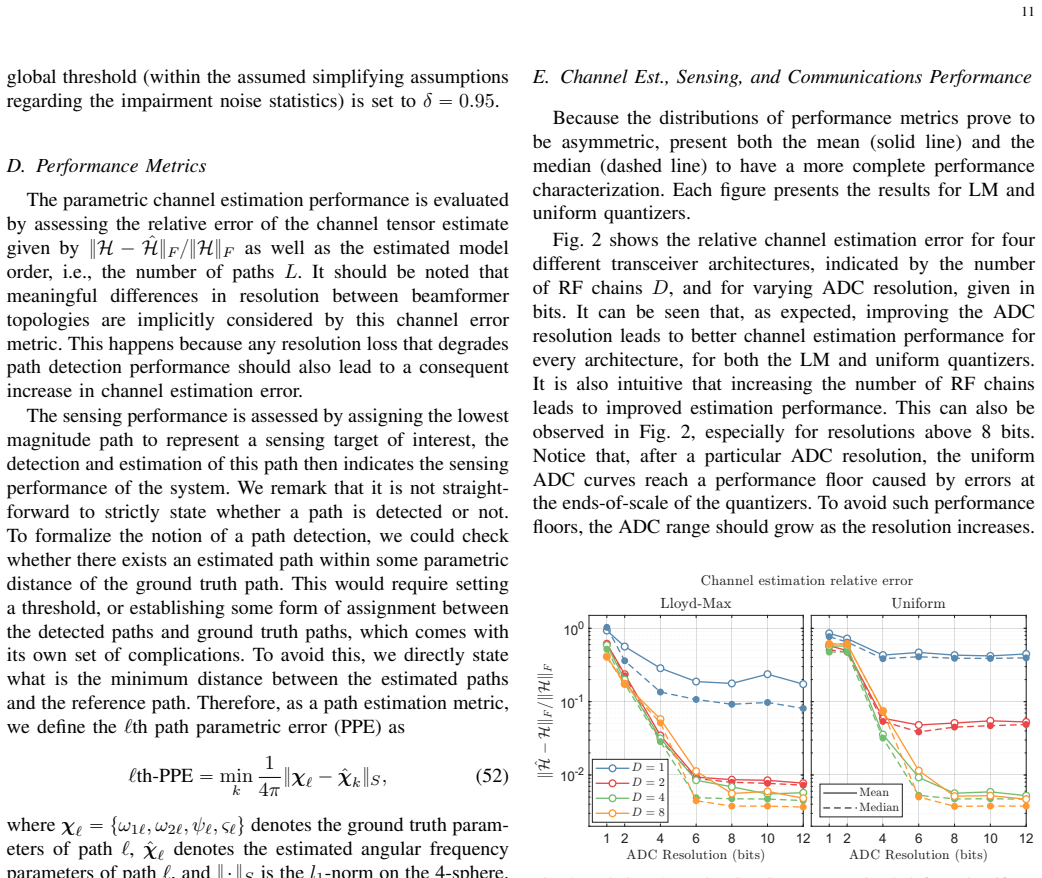
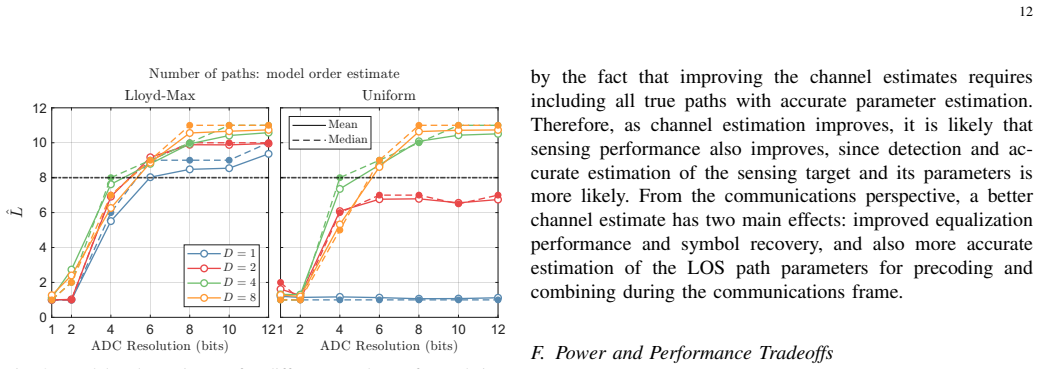
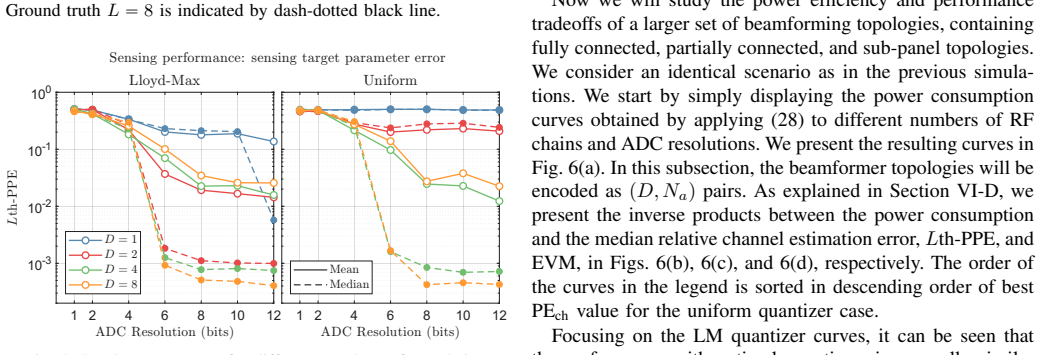
In hybrid beamformed systems impaired by power-amplifier and low-noise-amplifier nonlinearities plus finite-resolution ADC quantization, medium-resolution ADCs produce the most power-efficient operating points and the best performance-power tradeoff for the majority of beamforming architectures; fully digital high-resolution arrays can frequently be replaced by hybrid medium-resolution configurations with negligible loss in parametric channel estimation quality but materially lower power draw and hardware cost.
What carries the argument
The double-isotropy condition on pilot-combiner pairs, which enforces equal received energy across all beam directions, together with the multiple-start SAGE algorithm that mitigates local-optima issues in parametric channel estimation under hybrid beamforming and hardware impairments.
If this is right
- Medium-resolution ADCs are the preferred choice for power efficiency in the majority of hybrid beamforming architectures.
- Hybrid beamformers paired with medium-resolution converters can replace fully digital high-resolution arrays with only minor performance degradation.
- The performance impact of the modeled impairments is comparable for sensing and communications tasks under the double-isotropy condition.
- The MS-SAGE algorithm enables reliable parametric channel estimation even when the hybrid combiner and pilot design must satisfy double-isotropy.
Where Pith is reading between the lines
- The same medium-resolution preference may hold in time-varying channels if the double-isotropy condition can be maintained dynamically.
- Power savings identified here could allow higher array densities in dense deployments without increasing total energy budget.
- The substitution result suggests that cost models for 6G base stations can be revised to favor hybrid medium-resolution designs over fully digital ones.
Load-bearing premise
The chosen mathematical models of power-amplifier and low-noise-amplifier nonlinearities and of ADC quantization noise accurately capture the dominant impairment effects across the operating regimes examined.
What would settle it
A set of over-the-air measurements on real RF hardware that shows the optimal ADC resolution for power efficiency shifts away from the medium-resolution regime predicted by the simulations.
Figures
read the original abstract
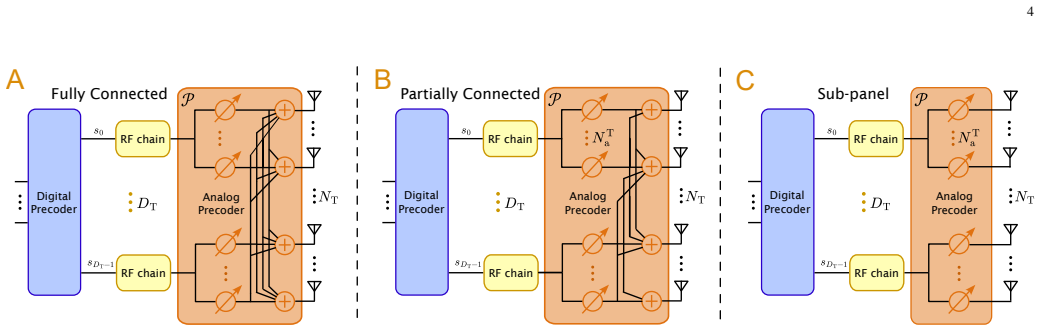
Due to high power consumption and hardware costs of fully digital arrays, hybrid beamformers are often considered as a more economic alternative. Furthermore, using high resolution analog to digital converters (ADCs) can also have prohibitive power consumption, which leads to lower resolution converters being considered for radio frequency (RF) front end design. The finite quantization resolution as well as the nonlinearities caused by the power amplifiers (PAs) and low noise amplifiers (LNAs) can have a substantial impact on system performance. While widely studied for communications, the impact of hardware impairments on sensing performance is considerably less explored. In this work, we study the interplay between hybrid beamforming architectures, hardware impairments, and sensing and communications performance. Additionally, we define the concept of double-isotropy for pilot-combiner pairs, formalizing the notion of a perfectly energy-fair beam sweep. The multiple start (MS) space alternating generalized expectation maximization algorithm (SAGE) is also introduced, aimed at addressing the optimization issues arising from parametric channel estimation (PCE) in hybrid beamformed systems. We then provide a set of numerical results assessing the impacts of beamformer architecture and ADC resolution on PCE, sensing, and communications performance. The results show that medium resolution ADCs lead to the most power efficient configurations, with the best tradeoff between power consumption and performance for the majority of beamforming architectures. Additionally, fully digital beamforming architectures with high resolution converters can often be substituted for a hybrid beamformer setup with medium resolution converters without significant performance loss at a lower power consumption and overall hardware cost.
Editorial analysis
A structured set of objections, weighed in public.
Referee Report
Summary. The manuscript studies the interplay of hybrid beamforming architectures, ADC quantization, and PA/LNA nonlinearities on parametric channel estimation (PCE) performance for both sensing and communications. It introduces the double-isotropy condition for pilot-combiner pairs (formalizing energy-fair beam sweeps) and the multiple-start SAGE (MS-SAGE) algorithm to mitigate optimization issues in hybrid PCE. Numerical results are presented to argue that medium-resolution ADCs yield the best power-performance tradeoff across most architectures and that hybrid medium-resolution setups can often substitute fully-digital high-resolution ones with negligible performance loss at lower power and hardware cost.
Significance. If the numerical findings prove robust, the work supplies practical design guidelines for power-constrained mmWave/THz systems that integrate sensing and communications. The double-isotropy definition and MS-SAGE algorithm constitute concrete algorithmic contributions that address real implementation constraints in hybrid arrays.
major comments (2)
- [Numerical results] Numerical results section: the headline claim that medium-resolution ADCs produce the most power-efficient configurations (and can substitute fully-digital high-resolution arrays) rests exclusively on simulations that employ fixed models for PA/LNA nonlinearities, specific ADC quantization functions, and particular channel/SNR conditions. No sensitivity analysis or ablation over these modeling choices is reported; modest changes to nonlinearity coefficients or array size could alter the ranking of architectures, directly undermining the general tradeoff conclusions.
- [MS-SAGE and double-isotropy definitions] Section introducing MS-SAGE and double-isotropy: performance comparisons are conducted only under the double-isotropy pilot-combiner assumption. The paper does not quantify degradation when this isotropy condition is violated (e.g., non-uniform energy distribution across beams), which is load-bearing for the recommendation that hybrid medium-resolution designs are broadly preferable.
minor comments (2)
- [Abstract] Abstract and numerical results: the number of Monte Carlo trials, confidence intervals, or error bars on the plotted curves are not stated, making it difficult to judge the statistical reliability of the reported performance gaps.
- Notation for the impairment models (quantization noise, PA/LNA distortion functions) should be collected in a single table or appendix for quick reference when interpreting the simulation parameters.
Simulated Author's Rebuttal
We thank the referee for the detailed and constructive report. The comments highlight important aspects of robustness in our numerical evaluation and the scope of the double-isotropy assumption. We address each major comment below and outline the revisions we will make.
read point-by-point responses
-
Referee: [Numerical results] Numerical results section: the headline claim that medium-resolution ADCs produce the most power-efficient configurations (and can substitute fully-digital high-resolution arrays) rests exclusively on simulations that employ fixed models for PA/LNA nonlinearities, specific ADC quantization functions, and particular channel/SNR conditions. No sensitivity analysis or ablation over these modeling choices is reported; modest changes to nonlinearity coefficients or array size could alter the ranking of architectures, directly undermining the general tradeoff conclusions.
Authors: We agree that the numerical claims would be strengthened by explicit sensitivity analysis. The models employed (standard memoryless PA/LNA nonlinearity and uniform mid-rise quantization) follow common literature choices, yet the absence of ablation over coefficient ranges and array sizes is a limitation. In the revision we will add a dedicated subsection with additional Monte-Carlo trials that vary the PA/LNA nonlinearity coefficients by ±20 % and repeat the architecture ranking for array sizes N=32, 64 and 128. This will allow readers to assess the stability of the medium-resolution preference. revision: yes
-
Referee: [MS-SAGE and double-isotropy definitions] Section introducing MS-SAGE and double-isotropy: performance comparisons are conducted only under the double-isotropy pilot-combiner assumption. The paper does not quantify degradation when this isotropy condition is violated (e.g., non-uniform energy distribution across beams), which is load-bearing for the recommendation that hybrid medium-resolution designs are broadly preferable.
Authors: The double-isotropy condition is presented as a design criterion that guarantees energy fairness; all reported comparisons are performed under this condition to isolate the effect of hardware impairments. We acknowledge that the manuscript does not quantify performance loss when the condition is violated. In the revision we will include a new figure and accompanying text that deliberately relaxes the isotropy constraint (by introducing controlled amplitude tapering across the analog beams) and reports the resulting degradation in NMSE and achievable rate for both the proposed MS-SAGE and the baseline estimators. This will clarify the practical range over which the reported conclusions hold. revision: yes
Circularity Check
No circularity; simulation-driven tradeoffs are self-contained
full rationale
The paper defines double-isotropy and introduces the MS-SAGE algorithm as new constructs, then evaluates performance via numerical simulations of the modeled system (PA/LNA nonlinearities, ADC quantization, hybrid beamformers) under stated channel conditions. No derivation step reduces by construction to its own inputs, fitted parameters, or self-citation chains; central claims follow directly from the forward simulation of the impairment models and estimator, which remain externally falsifiable and independent of the target conclusions.
Axiom & Free-Parameter Ledger
free parameters (2)
- ADC resolution levels
- Impairment model parameters
axioms (1)
- domain assumption The channel model and impairment models accurately represent real hardware behavior.
Reference graph
Works this paper leans on
-
[1]
Enabling joint communication and radar sensing in mobile networks—a survey,
J. A. Zhang, M. L. Rahman, K. Wu, X. Huang, Y . J. Guo, S. Chen, and J. Yuan, “Enabling joint communication and radar sensing in mobile networks—a survey,”IEEE Commun. Surveys Tuts., vol. 24, no. 1, pp. 306–345, 2022
2022
-
[2]
Integrated sensing and communications: Toward dual-functional wire- less networks for 6G and beyond,
F. Liu, Y . Cui, C. Masouros, J. Xu, T. X. Han, Y . C. Eldar, and S. Buzzi, “Integrated sensing and communications: Toward dual-functional wire- less networks for 6G and beyond,”IEEE J. Sel. Areas Commun., vol. 40, no. 6, pp. 1728–1767, 2022
2022
-
[3]
A survey on integrated sensing, communication, and computation,
D. Wen, Y . Zhou, X. Li, Y . Shi, K. Huang, and K. B. Letaief, “A survey on integrated sensing, communication, and computation,”IEEE Commun Surveys Tuts., pp. 1–1, 2024
2024
-
[4]
6G integrated sensing and communication: From vision to realization,
T. Wild, A. Grudnitsky, S. Mandelli, M. Henninger, J. Guan, and F. Schaich, “6G integrated sensing and communication: From vision to realization,” in2023 20th European Radar Conference (EuRAD), 2023, pp. 355–358
2023
-
[5]
Millimeter wave communication: A comprehensive survey,
X. Wang, L. Kong, F. Kong, F. Qiu, M. Xia, S. Arnon, and G. Chen, “Millimeter wave communication: A comprehensive survey,”IEEE Commun. Surveys Tuts., vol. 20, no. 3, pp. 1616–1653, 2018
2018
-
[6]
Enabling 6G performance in the upper mid-band by transitioning from massive to gigantic MIMO,
E. Bj ¨ornson, F. Kara, N. Kolomvakis, A. Kosasih, P. Ramezani, and M. B. Salman, “Enabling 6G performance in the upper mid-band by transitioning from massive to gigantic MIMO,”IEEE Open J. Commun. Soc., vol. 6, pp. 5450–5463, 2025
2025
-
[7]
An overview of signal processing techniques for joint communication and radar sensing,
J. A. Zhang, F. Liu, C. Masouros, R. W. Heath, Z. Feng, L. Zheng, and A. Petropulu, “An overview of signal processing techniques for joint communication and radar sensing,”IEEE J. Sel. Topics Signal Process., vol. 15, no. 6, pp. 1295–1315, 2021
2021
-
[8]
Radar and communi- cation coexistence: An overview: A review of recent methods,
L. Zheng, M. Lops, Y . C. Eldar, and X. Wang, “Radar and communi- cation coexistence: An overview: A review of recent methods,”IEEE Signal Process. Mag., vol. 36, no. 5, pp. 85–99, 2019
2019
-
[9]
Joint radar and communication design: Applications, state-of-the-art, and the road ahead,
F. Liu, C. Masouros, A. P. Petropulu, H. Griffiths, and L. Hanzo, “Joint radar and communication design: Applications, state-of-the-art, and the road ahead,”IEEE Trans. Commun., vol. 68, no. 6, pp. 3834–3862, 2020
2020
-
[10]
Sparse Bayesian learning for basis selection,
D. Wipf and B. Rao, “Sparse Bayesian learning for basis selection,” IEEE Trans. Signal Process., vol. 52, no. 8, pp. 2153–2164, 2004
2004
-
[11]
Adaptive sparseness for supervised learning,
M. Figueiredo, “Adaptive sparseness for supervised learning,”IEEE Trans. Pattern Anal. Mach. Intell., vol. 25, no. 9, pp. 1150–1159, 2003
2003
-
[12]
A sparse signal reconstruction perspective for source localization with sensor arrays,
D. Malioutov, M. Cetin, and A. Willsky, “A sparse signal reconstruction perspective for source localization with sensor arrays,”IEEE Trans. Signal Process., vol. 53, no. 8, pp. 3010–3022, 2005
2005
-
[13]
5G positioning and mapping with diffuse multipath,
F. Wen, J. Kulmer, K. Witrisal, and H. Wymeersch, “5G positioning and mapping with diffuse multipath,”IEEE Trans. Wireless Commun., vol. 20, no. 2, pp. 1164–1174, 2021
2021
-
[14]
Tensor decompositions in wireless communications and MIMO radar,
H. Chen, F. Ahmad, S. V orobyov, and F. Porikli, “Tensor decompositions in wireless communications and MIMO radar,”IEEE J. Sel. Topics Signal Process., vol. 15, no. 3, pp. 438–453, 2021
2021
-
[15]
Channel parameter estimation in mobile radio environ- ments using the SAGE algorithm,
B. Fleury, M. Tschudin, R. Heddergott, D. Dahlhaus, and K. Inge- man Pedersen, “Channel parameter estimation in mobile radio environ- ments using the SAGE algorithm,”IEEE J. Sel. Areas Commun., vol. 17, no. 3, pp. 434–450, 1999
1999
-
[16]
Sparse variational bayesian SAGE algo- rithm with application to the estimation of multipath wireless channels,
D. Shutin and B. H. Fleury, “Sparse variational bayesian SAGE algo- rithm with application to the estimation of multipath wireless channels,” IEEE Trans. Signal Process., vol. 59, no. 8, pp. 3609–3623, 2011
2011
-
[17]
Robust OFDM-SAGE channel estimation algorithm with adaptive model order,
E. T. R. Pinto and M. Juntti, “Robust OFDM-SAGE channel estimation algorithm with adaptive model order,”IEEE Trans. Wireless Commun., vol. 25, pp. 5275–5290, 2026
2026
-
[18]
Estimation of radio channel parameters,
A. Richter, “Estimation of radio channel parameters,” Ph.D. dissertation, Technische Universit¨at Ilmenau, Nov 2005
2005
-
[19]
Fundamentals for energy-efficient massive MIMO,
E. McCune, “Fundamentals for energy-efficient massive MIMO,” in 2017 IEEE Wireless Communications and Networking Conference Work- shops (WCNCW), 2017, pp. 1–6
2017
-
[20]
Hybrid beamforming for mm-Wave massive MIMO sys- tems with partially connected RF architecture,
M. Majidzadeh, J. Kaleva, N. Tervo, H. Pennanen, A. T ¨olli, and M. Latva-aho, “Hybrid beamforming for mm-Wave massive MIMO sys- tems with partially connected RF architecture,”Wirel. Pers. Commun., vol. 136, no. 4, p. 1947–1979, Jul. 2024
1947
-
[21]
Hybrid beamforming for massive MIMO: A survey,
A. F. Molisch, V . V . Ratnam, S. Han, Z. Li, S. L. H. Nguyen, L. Li, and K. Haneda, “Hybrid beamforming for massive MIMO: A survey,” IEEE Commun. Mag., vol. 55, no. 9, pp. 134–141, 2017
2017
-
[22]
Channel estimation and hybrid precoding for millimeter wave cellular systems,
A. Alkhateeb, O. El Ayach, G. Leus, and R. W. Heath, “Channel estimation and hybrid precoding for millimeter wave cellular systems,” IEEE J. Sel. Top. Signal Process., vol. 8, no. 5, pp. 831–846, 2014
2014
-
[23]
Energy efficiency and asymptotic perfor- mance evaluation of beamforming structures in doubly massive MIMO mmWave systems,
S. Buzzi and C. D’Andrea, “Energy efficiency and asymptotic perfor- mance evaluation of beamforming structures in doubly massive MIMO mmWave systems,”IEEE Trans. Green Commun. Netw., vol. 2, no. 2, pp. 385–396, 2018. 16
2018
-
[24]
Energy-efficient hybrid beamforming design for intelligent reflecting surface-assisted mmWave massive MU-MISO systems,
J.-C. Chen, “Energy-efficient hybrid beamforming design for intelligent reflecting surface-assisted mmWave massive MU-MISO systems,”IEEE Trans. Green Commun. Netw., vol. 8, no. 1, pp. 330–344, 2024
2024
-
[25]
Analog-to-digital converter survey and analysis,
R. Walden, “Analog-to-digital converter survey and analysis,”IEEE J. Sel. Areas Commun., vol. 17, no. 4, pp. 539–550, 1999
1999
-
[26]
Capacity analysis of one-bit quantized MIMO systems with transmitter channel state information,
J. Mo and R. W. Heath, “Capacity analysis of one-bit quantized MIMO systems with transmitter channel state information,”IEEE Trans. Signal Process., vol. 63, no. 20, pp. 5498–5512, 2015
2015
-
[27]
Channel estimation and data detection analysis of massive MIMO with 1-bit ADCs,
I. Atzeni and A. T ¨olli, “Channel estimation and data detection analysis of massive MIMO with 1-bit ADCs,”IEEE Trans. Wireless Commun., vol. 21, no. 6, pp. 3850–3867, 2022
2022
-
[28]
Near maximum-likelihood detector and channel estimator for uplink multiuser massive MIMO systems with one-bit ADCs,
J. Choi, J. Mo, and R. W. Heath, “Near maximum-likelihood detector and channel estimator for uplink multiuser massive MIMO systems with one-bit ADCs,”IEEE Trans. Commun., vol. 64, no. 5, pp. 2005–2018, 2016
2005
-
[29]
The Bussgang decomposition of nonlin- ear systems: Basic theory and MIMO extensions [lecture notes],
O. T. Demir and E. Bjornson, “The Bussgang decomposition of nonlin- ear systems: Basic theory and MIMO extensions [lecture notes],”IEEE Signal Process. Mag., vol. 38, no. 1, pp. 131–136, 2021
2021
-
[30]
Alternating minimization algorithms for hybrid precoding in millimeter wave MIMO systems,
X. Yu, J.-C. Shen, J. Zhang, and K. B. Letaief, “Alternating minimization algorithms for hybrid precoding in millimeter wave MIMO systems,” IEEE J. Sel Topics Signal Process., vol. 10, no. 3, pp. 485–500, 2016
2016
-
[31]
Energy-efficient hybrid analog and digital precoding for mmWave MIMO systems with large antenna arrays,
X. Gao, L. Dai, S. Han, C.-L. I, and R. W. Heath, “Energy-efficient hybrid analog and digital precoding for mmWave MIMO systems with large antenna arrays,”IEEE J. Sel. Areas in Commun., vol. 34, no. 4, pp. 998–1009, 2016
2016
-
[32]
Unequally sub-connected architecture for hybrid beamforming in massive MIMO systems,
N. T. Nguyen and K. Lee, “Unequally sub-connected architecture for hybrid beamforming in massive MIMO systems,”IEEE Trans. on Wireless Commun., vol. 19, no. 2, pp. 1127–1140, 2020
2020
-
[33]
Hybrid analog and digital beamforming design for channel estimation in correlated massive MIMO systems,
J. Mirzaei, S. ShahbazPanahi, F. Sohrabi, and R. Adve, “Hybrid analog and digital beamforming design for channel estimation in correlated massive MIMO systems,”IEEE Trans. on Signal Process., vol. 69, pp. 5784–5800, 2021
2021
-
[34]
Joint beamforming design and bit allocation in massive MIMO with resolution-adaptive ADCs,
M. Ma, N. Thanh Nguyen, I. Atzeni, and M. Juntti, “Joint beamforming design and bit allocation in massive MIMO with resolution-adaptive ADCs,”IEEE Trans. on Wireless Commun., vol. 24, no. 10, pp. 8711– 8726, 2025
2025
-
[35]
On the optimization of ADC resolution in multi-antenna systems,
Q. Bai, A. Mezghani, and J. A. Nossek, “On the optimization of ADC resolution in multi-antenna systems,” inISWCS 2013; The Tenth International Symposium on Wireless Communication Systems, 2013, pp. 1–5
2013
-
[36]
Some lower bounds on signal parameter esti- mation,
J. Ziv and M. Zakai, “Some lower bounds on signal parameter esti- mation,”IEEE Transactions on Information Theory, vol. 15, no. 3, pp. 386–391, 1969
1969
-
[37]
A lower bound on the mean-square error in random parameter estimation (corresp.),
A. Weiss and E. Weinstein, “A lower bound on the mean-square error in random parameter estimation (corresp.),”IEEE Transactions on Information Theory, vol. 31, no. 5, pp. 680–682, 1985
1985
-
[38]
Characterizing quantization errors in OFDM parametric channel estimation for ISAC,
E. T. R. Pinto, M. Henninger, S. Mandelli, and M. Juntti, “Characterizing quantization errors in OFDM parametric channel estimation for ISAC,” in2025 IEEE 26th International Workshop on Signal Processing and Artificial Intelligence for Wireless Communications (SPAWC), 2025, pp. 1–5
2025
-
[39]
Further elaboration on 7-24 GHz phase noise for different example frequencies,
Ericsson, “Further elaboration on 7-24 GHz phase noise for different example frequencies,” 2019, R4- 1906185. [Online]. Available: https://www.3gpp.org/ftp/TSG RAN/WG4 Radio/TSGR4 91/Docs
2019
-
[40]
Study on new radio access technology: Radio Frequency (RF) and co-existence aspects,
3GPP, “Study on new radio access technology: Radio Frequency (RF) and co-existence aspects,” July 2024, TR 38.803 version 14.4.0 Release 14. [Online]. Available: https://portal.3gpp.org/desktopmodules/ Specifications/SpecificationDetails.aspx?specificationId=3069
2024
-
[41]
Energy efficiency of massive MIMO downlink WPT with mixed-ADCs,
F. Zhao, C. Zhong, X. Chen, H. Lin, and Z. Zhang, “Energy efficiency of massive MIMO downlink WPT with mixed-ADCs,”IEEE Commun. Lett., vol. 23, no. 12, pp. 2316–2320, 2019
2019
-
[42]
Energy efficiency maximization for 5G multi-antenna receivers,
Q. Bai and J. A. Nossek, “Energy efficiency maximization for 5G multi-antenna receivers,”Transactions on Emerging Telecommunications Technologies, vol. 26, no. 1, pp. 3–14, 2015. [Online]. Available: https://onlinelibrary.wiley.com/doi/abs/10.1002/ett.2892
-
[43]
S. M. Kay,Fundamentals of statistical signal processing: estimation theory. USA: Prentice-Hall, Inc., 1993
1993
-
[44]
5G;NR;Physical Channels and Modulation,
3GPP, “5G;NR;Physical Channels and Modulation,” March 2024, TS 38.211 version 18.2.0 Release 18
2024
-
[45]
5G mm-Wave link range estimation based on over-the-air measured system EVM performance,
M. E. Leinonen, N. Tervo, M. Jokinen, O. Kursu, and A. P ¨arssinen, “5G mm-Wave link range estimation based on over-the-air measured system EVM performance,” in2019 IEEE MTT-S International Microwave Symposium (IMS), 2019, pp. 476–479
2019
discussion (0)
Sign in with ORCID, Apple, or X to comment. Anyone can read and Pith papers without signing in.