HiPR: Hierarchical Progressive Rendering for Immediate Feedback
Pith reviewed 2026-06-26 02:08 UTC · model grok-4.3
The pith
HiPR builds a hierarchy of light-path dependencies from changed scene elements to prioritize pixel updates by perceptual impact in path tracing.
A machine-rendered reading of the paper's core claim, the machinery that carries it, and where it could break.
Core claim
HiPR is a dynamic render-scheduling algorithm that amortizes rendering costs by organizing pixels into a hierarchy of light-path dependencies from changed elements outward. It prioritizes updates by perceptual impact to deliver instant visual feedback. The process eventually converges to an unbiased result without relying on error-driven or temporal reuse heuristics.
What carries the argument
A hierarchy of light-path dependencies constructed outward from changed scene elements, used to order pixel updates according to perceptual priority.
If this is right
- Scene changes produce visible updates faster than full-frame recomputation.
- The final image after enough updates matches the quality of unbiased path tracing.
- The method applies to arbitrary scene modifications without needing temporal data.
- Unaffected pixels remain unchanged until their position in the hierarchy is reached.
Where Pith is reading between the lines
- The same dependency structure could be tested in other global-illumination algorithms that trace paths across the scene.
- Perceptual ordering might combine with eye-tracking hardware to further reduce perceived latency.
- Dependency hierarchies offer an alternative to many existing heuristics for deciding which pixels to refresh first.
Load-bearing premise
The hierarchy of light-path dependencies can be built and traversed at interactive rates without introducing bias or requiring more computation than the pixels it saves.
What would settle it
Apply a small localized scene change, record the time until the first visible update appears, and compare the final converged image against a reference image produced by full unbiased path tracing to check for bias or artifacts.
Figures
read the original abstract
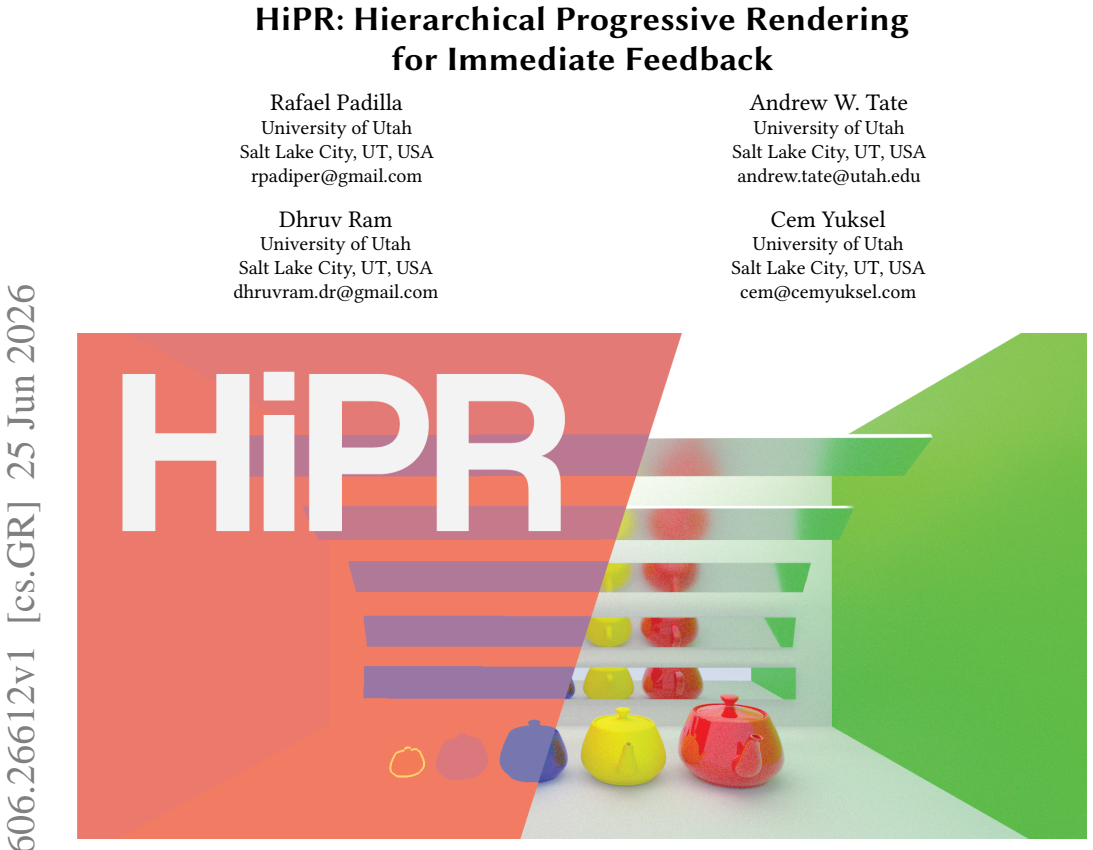
Hierarchical Progressive Rendering (HiPR) is a dynamic render-scheduling algorithm that makes interactive path tracing finally feel real-time. While most renderers recompute the entire frame after any change to the scene, our method updates some of the pixels based on a priority order while keeping the others unchanged. Rather than relying on error-driven or temporal reuse heuristics, it amortizes rendering costs by organizing pixels into a hierarchy of light-path dependencies from changed elements outward, prioritizing by perceptual impact and delivering instant visual feedback, while eventually converging to an unbiased result.
Editorial analysis
A structured set of objections, weighed in public.
Referee Report
Summary. The paper introduces Hierarchical Progressive Rendering (HiPR), a dynamic render-scheduling algorithm for interactive path tracing. It updates only some pixels after scene changes according to a priority order derived from a hierarchy of light-path dependencies originating from changed elements and propagating outward; pixels are prioritized by perceptual impact to deliver instant visual feedback while the renderer eventually converges to an unbiased result, avoiding reliance on error-driven or temporal-reuse heuristics.
Significance. If the core scheduling mechanism can be realized without bias and with net computational savings, HiPR would constitute a meaningful advance in making unbiased path tracing feel interactive by replacing full-frame recomputation with dependency-driven partial updates. The approach is conceptually distinct from existing heuristics and could influence real-time rendering pipelines if the hierarchy construction and traversal prove tractable.
major comments (2)
- Abstract: the central claim that a hierarchy of light-path dependencies can be constructed and traversed at interactive rates while amortizing cost and preserving unbiased convergence is stated without any algorithm, data structure, pseudocode, or complexity bound for dependency identification in stochastic path tracing; this absence leaves the load-bearing assumption unexamined.
- Abstract: no analysis is supplied showing that the cost of building and maintaining the dependency hierarchy is less than the pixels it saves, nor that traversal avoids introducing bias; without such a demonstration the claim that the method 'amortizes rendering costs' cannot be evaluated.
Simulated Author's Rebuttal
We thank the referee for the detailed and constructive report. We address each major comment below, focusing on the abstract as noted.
read point-by-point responses
-
Referee: Abstract: the central claim that a hierarchy of light-path dependencies can be constructed and traversed at interactive rates while amortizing cost and preserving unbiased convergence is stated without any algorithm, data structure, pseudocode, or complexity bound for dependency identification in stochastic path tracing; this absence leaves the load-bearing assumption unexamined.
Authors: We agree that the abstract, as a concise summary, does not contain pseudocode, explicit data structures, or complexity bounds. These elements are presented in the body of the manuscript (dependency hierarchy construction in Section 3, traversal in Section 4, and complexity analysis in Section 5). To address the concern, we will revise the abstract to include a brief reference to the core data structure and the established bounds, while keeping the abstract length appropriate. revision: yes
-
Referee: Abstract: no analysis is supplied showing that the cost of building and maintaining the dependency hierarchy is less than the pixels it saves, nor that traversal avoids introducing bias; without such a demonstration the claim that the method 'amortizes rendering costs' cannot be evaluated.
Authors: The abstract itself does not contain the analysis, which is a valid observation. The manuscript supplies both theoretical arguments (Section 5) establishing that hierarchy traversal preserves unbiased convergence and empirical results (Section 6) quantifying net computational savings. We will revise the abstract to reference these sections and results more explicitly so that the amortization claim is better supported at the summary level. revision: yes
Circularity Check
No circularity: algorithmic scheduling with no derivation chain or fitted predictions
full rationale
The paper presents HiPR as a dynamic render-scheduling algorithm that organizes pixels into a hierarchy of light-path dependencies for priority updates. No equations, fitted parameters, predictions of derived quantities, or self-citations appear in the abstract or description. The central claim is an engineering procedure for amortizing costs while preserving unbiased convergence, not a first-principles derivation that reduces to its own inputs. No load-bearing steps match any enumerated circularity pattern; the method is self-contained as a scheduling heuristic without mathematical reduction.
Axiom & Free-Parameter Ledger
Reference graph
Works this paper leans on
-
[1]
The Computational Geometry Algorithms Library , author =
-
[2]
Menelaos Karavelas , subtitle =
-
[3]
The Computational Geometry Algorithms Library , subtitle =
Menelaos Karavelas , editor =. The Computational Geometry Algorithms Library , subtitle =
-
[4]
The Parmap library , author =
-
[5]
Christopher Anderson and Sophia Drossopoulou , title =
-
[6]
Automated Prioritization for Context-Aware Re-rendering in Editing , author =. SN Computer Science , volume =. 2025 , articleno =. doi:10.1007/s42979-025-03863-z , publisher =
discussion (0)
Sign in with ORCID, Apple, or X to comment. Anyone can read and Pith papers without signing in.