REVIEW 2 major objections 6 minor 27 references
Overcoming logarithmic singularities in the Cahn-Hilliard equation with Flory-Huggins potential: An unconditionally convergent ADMM approach
T0 review · 2 major / 6 minor · reviewed 2026-08-07 · deepseek-v4-flash
Pith's one-line read This paper introduces an ADMM iterative solver for the Cahn-Hilliard equation with Flory-Huggins potential and proves it converges unconditionally for any time step and mesh while keeping iterates inside $(-1,1)$.
desk verdict Solid first-order ADMM convergence proof for the logarithmic Cahn-Hilliard equation, but the second-order claims are asserted, not proved, and the numerics lack baselines. read the letter →
The pith
A machine-rendered reading of the paper's core claim, the machinery that carries it, and where it could break.
The reading
What carries the argument
The load-bearing object is the ADMM iteration for the equivalent constrained minimax problem, together with the Lyapunov functional $\Psi^{(k)}=\frac{1}{\rho_u}\|e_{u_3}^{(k)}\|_2^2+\frac{1}{\rho_w}\|e_{w_3}^{(k)}\|_2^2+\rho_u\|e_{u_2}^{(k)}\|_2^2+\rho_w\|e_{w_2}^{(k)}\|_2^2$, which measures weighted squared distances to a stationary point. Lemma 4.2 shows that one ADMM sweep strictly decreases this functional by the residuals of the splitting, and Proposition 4.3 combines this monotone decrease with subsequential convergence to obtain full convergence to the unique solution. The same machinery gives bound preservation through the singular logarithm and the mass-conservation bound of Proposition 4.5.
What would settle it
Run the second-order Algorithm 2 on a small periodic two-dimensional domain (for instance $N=32$, $L=1$) with $\theta_0=3$, $\epsilon=0.01$, a deliberately large time step such as $\tau=0.05$, and random initial data in $(-0.05,0.05)$, tracking whether the natural analogue of the Lyapunov functional is nonincreasing and whether $\|u_2^{(k)}-u^{n+1}\|_2$ decreases to the set tolerance. If the monotonicity fails at any positive $\tau$ and $h$, or if the iterates stop decreasing before tolerance, the unconditional-convergence claim for the second-order scheme is refuted; the first-order claim can be tested the same way at extreme $\tau$.
Extended reading notes
Core claim
The central discovery is that the nonlinear system from the convex-splitting scheme can be rewritten as a saddle-point minimax problem, min over $u$ and max over $w$ of an energy $Z(u,w)$, and then solved by a variant of the alternating direction method of multipliers (ADMM). The splitting separates a linear component, which becomes a constant-coefficient system solvable by fast Fourier transform, from the logarithmic nonlinearity, which reduces to independent scalar equations with monotone derivatives solvable by Newton's method. Theorem 4.4 establishes $\lim_{k\to\infty}\|u_2^{(k)}-u^{n+1}\|_2=0$ for the first-order scheme with no condition on the time step $\tau$ or mesh size $h$; Theorem 4.7 states the same for the second-order scheme. Because the nonlinear subproblem retains the full logarithm $\log(1+u)-\log(1-u)$, every iterate lies in $(-1,1)$ without regularization, and the change in total mass is bounded by a quantity that vanishes with the stopping tolerance.
Load-bearing premise
The second-order convergence theorem and its mass bound are asserted with the proof omitted as similar to the first-order argument, so the claim for the second-order scheme stands on the unproven assumption that the same Lyapunov monotonicity holds for the modified energy of the second-order scheme.
Editorial extensions
If this is right
- The nonlinear solve inside each convex-splitting step can be driven to arbitrary accuracy, so the unconditional solvability of convex splitting is no longer undermined by solver restrictions.
- Users can take large time steps without a convergence condition from the solver, as demonstrated by the three-dimensional run with $\tau=0.01$.
- The method is stated for second-order temporal discretizations and for three-dimensional problems, extending beyond solvers that were limited to first-order schemes.
- All iterates stay inside $(-1,1)$, so the logarithmic singularities are handled directly rather than by truncation or regularization.
- Mass is preserved up to the stopping tolerance, making the solver compatible with conservative formulations of the phase-field dynamics.
Reading between the lines
- Editorial inference: the same minimax-ADMM splitting should transfer to other phase-field models whose chemical potential contains a convex singular term plus a concave polynomial part, because the proof only uses monotonicity of the scalar subproblem and positivity of the discrete bilaplacian.
- Editorial inference: with time-step restrictions removed, the practical bottleneck becomes iteration count; tuning $\rho_u$ and $\rho_w$ adaptively could reduce the observed number of iterations near late-stage coarsening.
- Editorial inference: a direct testable extension is whether the contraction rate of the Lyapunov functional depends on the ratio $\rho_u/\rho_w$; if it does, simple closed-form rate estimates could guide parameter choice without extra computation.
Editorial analysis
A structured set of objections, weighed in public.
Referee Report
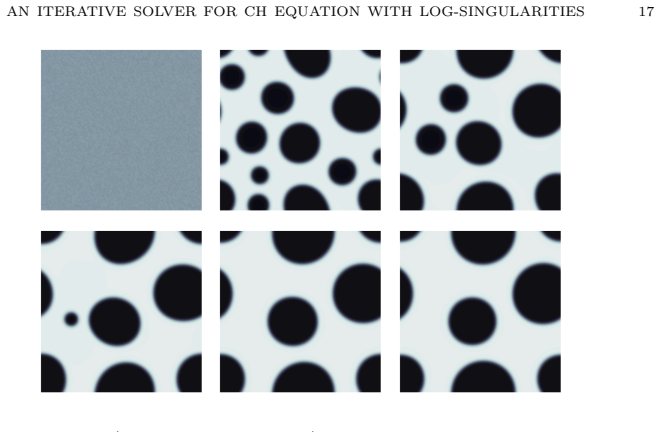
Summary. The paper presents an ADMM-based iterative solver for the nonlinear systems arising from convex-splitting finite-difference schemes for the Cahn-Hilliard equation with the Flory-Huggins logarithmic potential. The solver splits the discrete energy into linear and nonlinear parts, uses FFT-based solves for the linear subproblem and scalar Newton solves for the singular logarithmic subproblem, and updates Lagrange multipliers in the standard ADMM fashion. The authors claim that the solver is unconditionally convergent with no restrictions on the time step tau or mesh size h, that it preserves the pointwise bound (-1,1) throughout the iterations, and that it nearly conserves mass. A detailed convergence proof is given for the first-order-in-time convex-splitting scheme (Lemma 4.2, Proposition 4.3, Theorem 4.4). The corresponding theorems for the second-order-in-time scheme (Theorems 4.7 and 4.8) are stated without proof, with the comment that the proofs are 'similar' and omitted. Numerical experiments include a convergence test and 2D/3D coarsening simulations, which use the second-order scheme.
Significance. The first-order convergence proof is a genuine contribution: it avoids the strict separation property, holds for arbitrary positive step sizes, and keeps the output iterates in the physical interval (-1,1). The algorithm is simple and practical, and the numerical results are consistent with the claimed robustness. However, the central 'unconditional convergence' claim is rigorously established only for the first-order scheme; the second-order scheme, which is the one used in the numerical sections, lacks proof. This gap is substantial because the second-order algorithm contains additional terms that are not covered by the first-order argument. With a complete second-order analysis, this would be a strong paper; without it, the main advertised claim is not fully proven. The mass-conservation statement for the second-order scheme also appears to be incorrect as stated.
major comments (2)
- [Section 4, Theorems 4.7 and 4.8] The convergence and mass-conservation theorems for the second-order scheme are asserted without proof. The text in Section 4 states 'the proofs for the second-order scheme are similar, and thus we omit it here.' This is not sufficient because Algorithm 2, equations (3.13)-(3.15), differs from Algorithm 1 in several load-bearing ways: the BDF2 combination (4/3)u^n - (1/3)u^{n-1}, the factor 2/3 in front of tau Delta_h w1, and the extra stabilization term A tau theta0^2 Delta_h(u^{n+1}-u^n) in (2.12b). These changes alter the energy (3.12) and the subproblems, and it is not demonstrated that the analogue of Lemma 4.2 holds. Since the numerical experiments in Section 5 use the second-order scheme, the central claim of unconditional convergence for the scheme actually used in the experiments is not supported by the analysis. Please provide a complete proof of Theorems 4.7 and 4.8, or explicitly limit the claim to the first-order scheme.
- [Section 4, Proposition 4.8] The stated mass bound (4.25) does not follow from Algorithm 2. Summing (3.13b) and (3.14b) gives u2^(k+1) - (4/3)u^n + (1/3)u^{n-1} = (2 tau/3) Delta_h w1^(k+1) + rho_w (w2^(k) - w2^(k+1)). Taking the mass M defined in (4.20) yields M(u2^(k+1)) - (4/3)M(u^n) + (1/3)M(u^{n-1}) = rho_w M(w2^(k)-w2^(k+1)), which is not the bound (4.25) involving M(u^n). The proposition should be corrected to reflect the BDF2 mass relation, or the statement of the claim should be revised.
minor comments (6)
- [Equation (1.1) and (5.1)] The gradient term in the energy appears as (epsilon^2/2) |nabla u|, which is missing the square; it should be (epsilon^2/2) |nabla u|^2.
- [Equation (4.2b)] The first equality in (4.2b) should have theta0 u^n, not theta0 u*, to be consistent with (2.11b) and the verification of (4.3c).
- [Section 2, equations (2.9)] For the 3D periodic grid, the inner products should include h^3 (or h^d in d dimensions) rather than h^2 as written; with N^3 summation points, h^2 is dimensionally inconsistent for a 3D domain.
- [Section 5, stopping criteria (5.5), (5.9), (5.13)] The stopping criteria include an explicit h^2 factor in front of the squared discrete norms. Since the discrete L2 norm defined in (2.9) already includes the mesh-size factor, the criterion should be clarified or written in terms of the actual vector norms used in the implementation.
- [Section 4, Proposition 4.3] The uniqueness of the stationary point is invoked in (4.15) but not proved. A short argument that any stationary point of L must satisfy (2.11) via (4.3), and hence uniqueness follows from the known unique solvability of the convex-splitting scheme, would make the proof complete.
- [Section 5.1, Table 1] The convergence rate for the second-order scheme at the first refinement is 0.630, which is far from the expected second order; a brief comment on this transient behavior would be helpful.
Circularity Check
No circular reduction found; the convergence proof is self-contained relative to the external convex-splitting scheme, with only minor non-load-bearing self-citations and an omitted second-order proof that is a completeness gap, not circularity.
full rationale
The convergence target u^{n+1} is the solution of the convex splitting system (2.11)/(2.12), whose existence and uniqueness are cited from the external work [5], not from the present authors. Lemma 4.1 constructs a stationary point of the ADMM Lagrangian from that solution, and Lemma 4.2 derives the descent inequality for Ψ^(k) algebraically from the algorithm equations (3.9)-(3.11) using only positivity of -Δ_h and monotonicity of the logarithm; no fitted parameter or posterior data enters. The limit is identified with u^{n+1} through the KKT equations, which are equivalent to the original scheme by construction, but that equivalence is the intended target of the solver being proved, not a circular input. The only self-citations ([12], [24], involving Z. Qiao) appear in introductory survey lists of discretization methods and do not carry the convergence claim. One genuine caveat is not circularity but an omitted proof: Section 4 states 'Here, we only consider the first-order scheme; the proofs for the second-order scheme are similar, and thus we omit it here,' yet Theorem 4.7 and Section 5's experiments rely on the second-order Algorithm 2, whose additional BDF2 terms and Aτθ0^2Δ_h(u^{n+1}-u^n) stabilization are not analyzed. This is a completeness/correctness risk, not a circular reduction. Score 2 reflects the minor self-citation/content gap rather than any equivalence between inputs and outputs.
Assumptions & free parameters
free parameters (3)
- ρ_u =
user-selected (e.g., τ^{-1/2} or 1)
- ρ_w =
user-selected (e.g., τ^{1/2} or 1)
- α =
1/2 in all numerical tests
assumptions (3)
- domain assumption The first-order convex splitting scheme (2.11) has a unique solution u* in (-1,1) for all τ and h (cited from [5]).
- standard math The scalar equations (3.10) have a unique solution in (-1,1) at each grid point because log(1+u)-log(1-u) is strictly increasing from -∞ to +∞ and the linear terms have nonnegative coefficients.
- ad hoc to paper The convergence analysis for the second-order scheme (Theorems 4.7, 4.8) is analogous to the first-order analysis.
Cite this review
Pith. "Pith review of Overcoming logarithmic singularities in the Cahn-Hilliard equation with Flory-Huggins potential: An unconditionally convergent ADMM approach." pith.science (2026). https://pith.science/paper/FFAGPCN3
@misc{pith2026250609361,
  author       = {Pith},
  title        = {Pith review of: Overcoming logarithmic singularities in the Cahn-Hilliard equation with Flory-Huggins potential: An unconditionally convergent ADMM approach},
  year         = {2026},
  howpublished = {\url{https://pith.science/paper/FFAGPCN3}},
  note         = {Machine review of arXiv:2506.09361}
}
abstract
The Cahn-Hilliard equation with Flory-Huggins potential serves as a fundamental phase field model for describing phase separation phenomena. Due to the presence of logarithmic singularities at $u=\pm 1$, the solution $u$ is constrained within the interval $(-1,1)$. While convex splitting schemes are commonly employed to preserve this bound and guarantee unconditional unique solvability, their practical implementation requires solving nonlinear systems containing singular logarithmic terms at each time step. This introduces significant challenges in both ensuring convergence of iterative solvers and maintaining the solution bounds throughout the iterations. Existing solvers often rely on restrictive conditions -- such as the strict separation property or small time step sizes -- to ensure convergence, which can limit their applicability. In this work, we introduce a novel iterative solver that is specifically designed for singular nonlinear systems, with the use of a variant of the alternating direction method of multipliers (ADMM). By developing a tailored variable splitting strategy within the ADMM framework, our method efficiently decouples the challenging logarithmic nonlinearity, enabling effective handling of singularities. Crucially, we rigorously prove the unconditional convergence of our ADMM-based solver, which removes the need for time step constraints or strict separation conditions. This allows us to fully leverage the unconditional solvability offered by convex splitting schemes. Comprehensive numerical experiments demonstrate the superior efficiency and robustness of our ADMM variant, strongly validating both our algorithmic design and theoretical results.
Figures


Figures from the paper (8 more)



Reference graph
Works this paper leans on
-
[5]
W. Chen, C. Wang, X. Wang, and S. M. Wise,Positivity-preserving, energy stable numerical schemes for the Cahn-Hilliard equation with logarithmic potential, Journal of Computational Physics: X3(2019), 100031
work page 2019
-
[9]
A. E. Diegel, C. Wang, and S. M. Wise,Convergence analysis of a preconditioned steepest descent solver for the Cahn-Hilliard equation with logarithmic potential, International Journal of Numerical Analysis and Modeling22(2025), 483–509
work page 2025
-
[1]
H. Abels and M. Wilke,Convergence to equilibrium for the Cahn-Hilliard equation with a logarithmic free energy, Nonlinear Analysis: Theory, Methods & Applications67(2007), 3176–3193
work page 2007
-
[2]
D. P. Bertsekas and J. N. Tsitsiklis,Parallel and distributed computation: Numerical methods, Athena Scientific, 1997. 20 RUO LI, SHENGTONG LIANG, AND ZHONGHUA QIAO 0 0.5 1 1.5 220 40 60 80 100 0.5 1 1.5 210-10 10-5 Figure 10.(3D coarsening process) Left: the number of iterations over timet, middle: the variation in total mass over timet. 0.5 1 1.5 210-2 ...
work page 1997
-
[3]
J. W. Cahn and J. E. Hilliard,Free energy of a nonuniform system. i. interfacial free energy, The Journal of Chemical Physics28(1958), 258–267
work page 1958
-
[4]
L. Q. Chen and J. Shen,Applications of semi-implicit Fourier-spectral method to phase field equations, Computer Physics Communications108(1998), 147–158
work page 1998
-
[6]
L. Cherfils, A. Miranville, and S. Zelik,The Cahn-Hilliard equation with logarithmic poten- tials, Milan Journal of Mathematics79(2011), 561–596
work page 2011
-
[7]
M. I. M. Copetti and C. M. Elliott,Numerical analysis of the Cahn-Hilliard equation with a logarithmic free energy, Numerische Mathematik63(1992), 39–65
work page 1992
Show all 27 references
-
[8]
Debussche and L
A. Debussche and L. Dettori,On the Cahn-Hilliard equation with a logarithmic free energy, Nonlinear Analysis: Theory, Methods & Applications24(1995), 1491–1514
1995
-
[10]
Doi,Soft matter physics, Oxford University Press, 2013
M. Doi,Soft matter physics, Oxford University Press, 2013
2013
-
[11]
Du and X
Q. Du and X. Feng,Chapter 5 - the phase field method for geometric moving interfaces and their numerical approximations, Geometric partial differential equations - part i, 2020, pp. 425–508
2020
-
[12]
Q. Du, L. Ju, X. Li, and Z. Qiao,Maximum bound principles for a class of semilinear parabolic equations and exponential time-differencing schemes, SIAM Review63(2021), no. 2, 317– 359. AN ITERATIVE SOL VER FOR CH EQUATION WITH LOG-SINGULARITIES 21
2021
-
[13]
C. M. Elliott and S. Larsson,Error estimates with smooth and nonsmooth data for a finite element method for the Cahn-Hilliard equation, Mathematics of Computation58(1992), 603–630
1992
-
[14]
Fazel, K
M. Fazel, K. T. Pong, D. Sun, and P. Tseng,Hankel matrix rank minimization with ap- plications to system identification and realization, SIAM Journal on Matrix Analysis and Applications34(2013), 946–977
2013
-
[15]
Furihata,A stable and conservative finite difference scheme for the Cahn-Hilliard equa- tion, Numerische Mathematik87(2001), 675–699
D. Furihata,A stable and conservative finite difference scheme for the Cahn-Hilliard equa- tion, Numerische Mathematik87(2001), 675–699
2001
-
[16]
Hochbruck and A
M. Hochbruck and A. Ostermann,Exponential integrators, Acta Numerica19(2010), 209–286
2010
-
[17]
M. O. Karabag, D. Fridovich-Keil, and U. Topcu,Alternating direction method of multipliers for decomposable saddle-point problems, 2022 58th Annual Allerton Conference on Commu- nication, Control, and Computing (Allerton), 2022, pp. 1–8
2022
-
[18]
M. O. Karabag, M. Ornik, and U. Topcu,Deception in supervisory control, IEEE Transactions on Automatic Control67(2021), 738–753
2021
-
[19]
Li and T
D. Li and T. Tang,Stability of the semi-implicit method for the Cahn-Hilliard equation with logarithmic potentials, Annals of Applied Mathematics37(2021), 31–60
2021
-
[20]
Miranville,On a phase-field model with a logarithmic nonlinearity, Applications of Math- ematics57(2012), 215–229
A. Miranville,On a phase-field model with a logarithmic nonlinearity, Applications of Math- ematics57(2012), 215–229
2012
-
[21]
,The Cahn-Hilliard equation: Recent advances and applications, Society for Industrial and Applied Mathematics, 2019
2019
-
[22]
Miranville and S
A. Miranville and S. Zelik,Robust exponential attractors for the Cahn-Hilliard type equations with singular potentials, Mathematical Methods in the Applied Sciences27(2004), 545–582
2004
-
[23]
Tang,On effective numerical methods for phase-field models, Proceedings of the interna- tional congress of mathematicians: Rio de janeiro 2018, 2018, pp
T. Tang,On effective numerical methods for phase-field models, Proceedings of the interna- tional congress of mathematicians: Rio de janeiro 2018, 2018, pp. 3669–3690
2018
-
[24]
Tang and Z
T. Tang and Z. Qiao,Efficient numerical methods for phase-field equations (in Chinese), Scientia Sinica Mathematica50(2020), 775–794
2020
-
[25]
S. M. Wise, C. Wang, and J. S. Lowengrub,An energy-stable and convergent finite-difference scheme for the phase field crystal equation, SIAM Journal on Numerical Analysis47(2009), 2269–2288
2009
-
[26]
Wodo and B
O. Wodo and B. Ganapathysubramanian,Modeling morphology evolution during solvent- based fabrication of organic solar cells, Computation Materials Science55(2012), 113–126
2012
-
[27]
M. Yuan, W. Chen, C. Wang, S. Wise, and Z. Zhang,A second order accurate in time, energy stable finite element scheme for the Flory-Huggins-Cahn-Hilliard equation, Advances in Applied Mathematics and Mechanics14(2022), 1477–1508. CAPT, LMAM and School of Mathematical Sciences,...
2022
Reviewed August 7, 2026 · model on record in the stance chip above.
Discussion (0). Sign in to comment.