Stellar Population Spectra Incorporating Detailed Binary Evolution using POSYDON
Pith reviewed 2026-06-27 05:40 UTC · model grok-4.3
The pith
Binary interactions cause stripped stars to dominate the ionizing spectra of stellar populations after about 16 million years.
A machine-rendered reading of the paper's core claim, the machinery that carries it, and where it could break.
Core claim
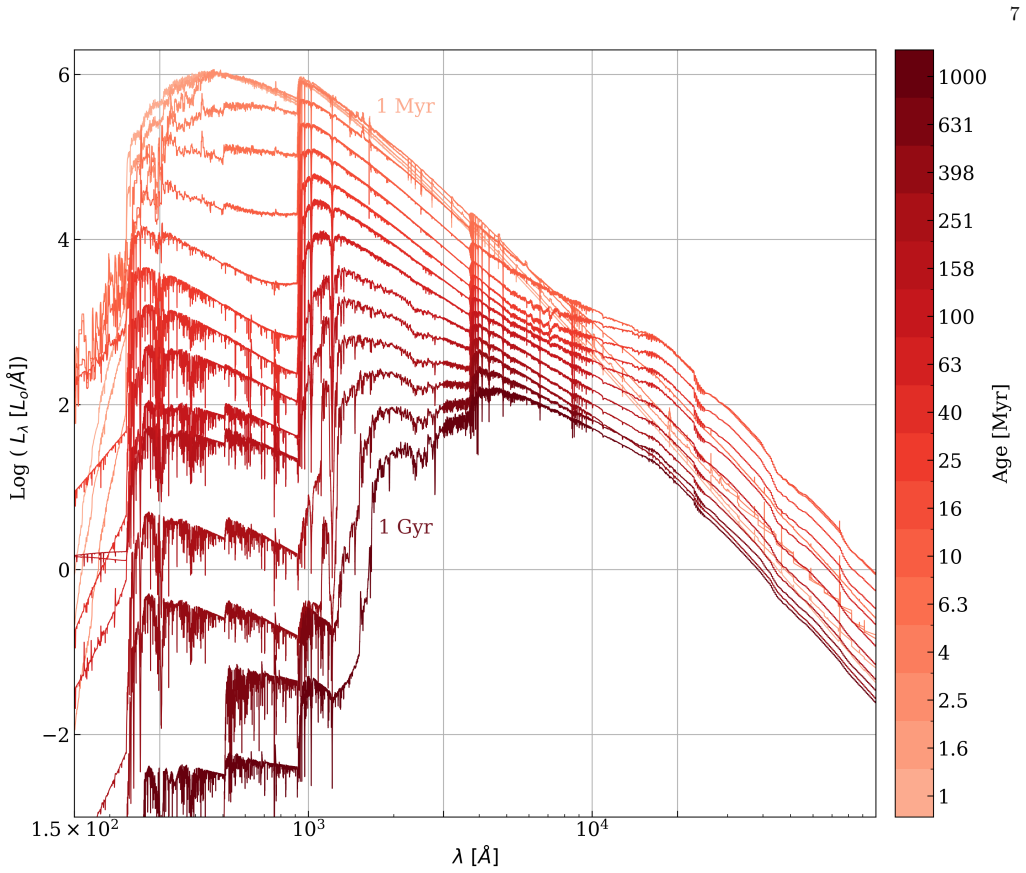
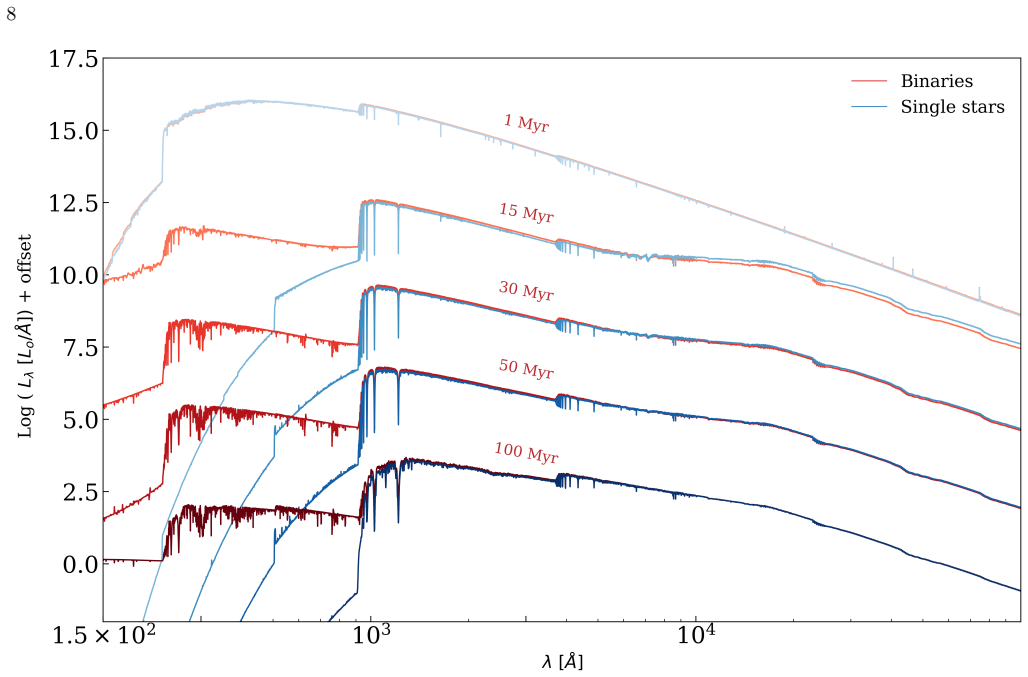
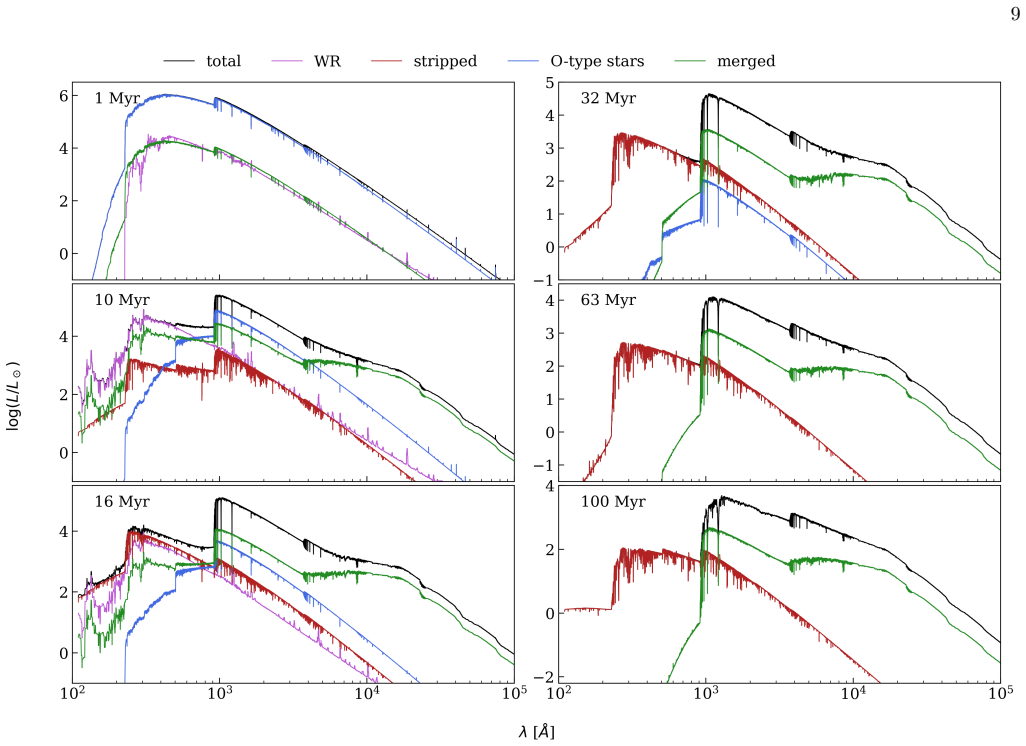
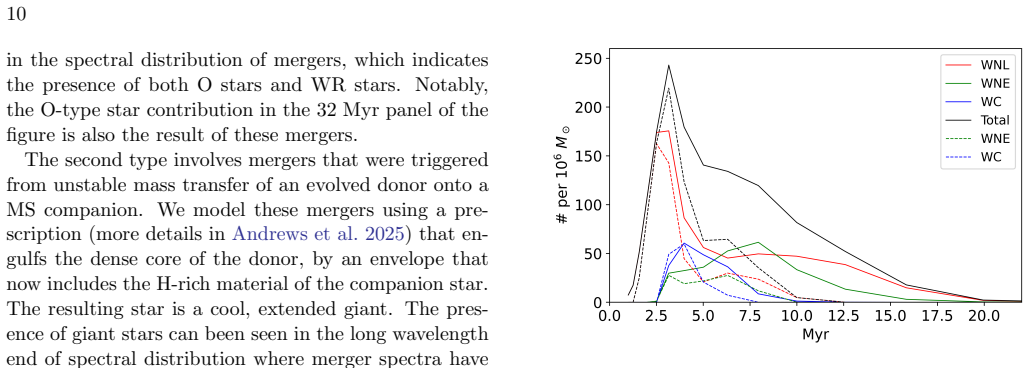
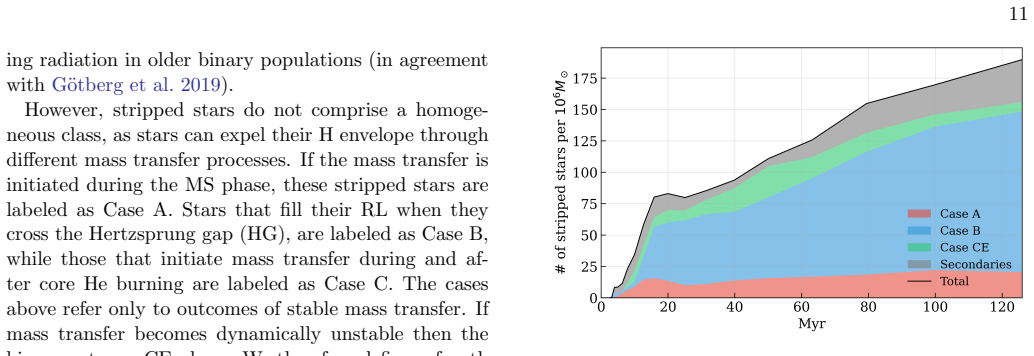
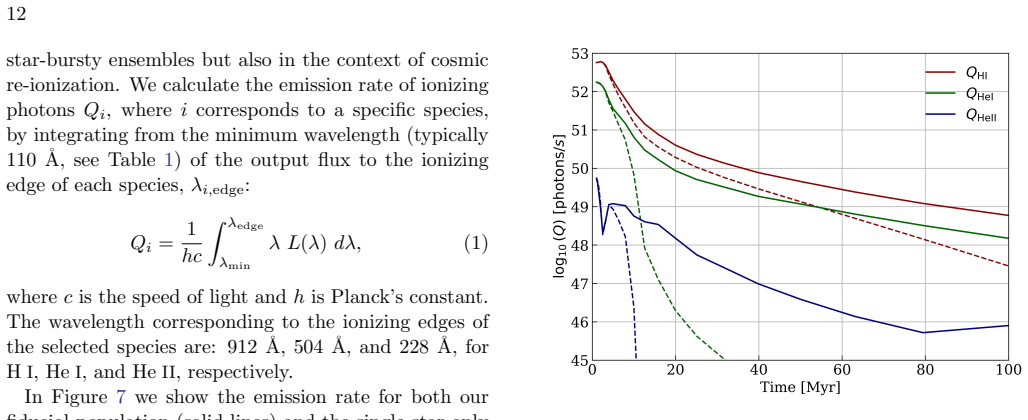
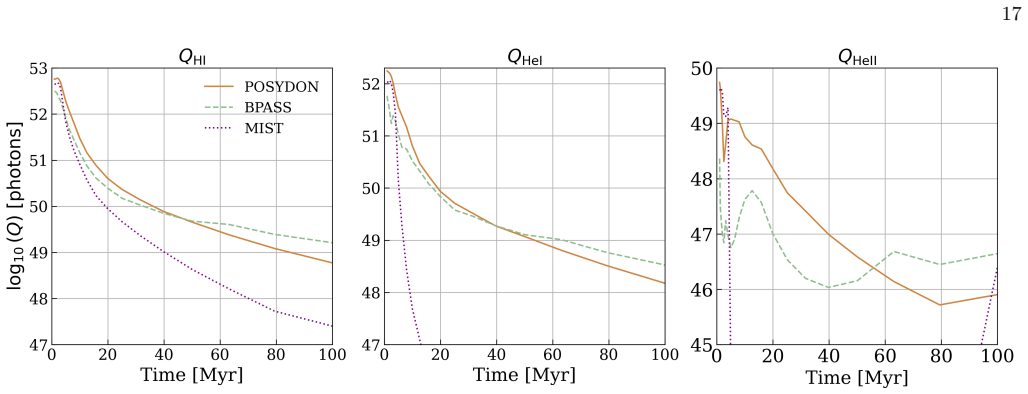
The inclusion of binary interactions has a significant effect on the UV and ionizing regime of the integrated spectrum. Wolf-Rayet and massive stars dominate the production of ionizing radiation at earlier times, but after about 16 million years stripped stars produced through mass transfer begin to dominate. The production of ionizing He II photons is especially sensitive to the underlying population of stripped stars.
What carries the argument
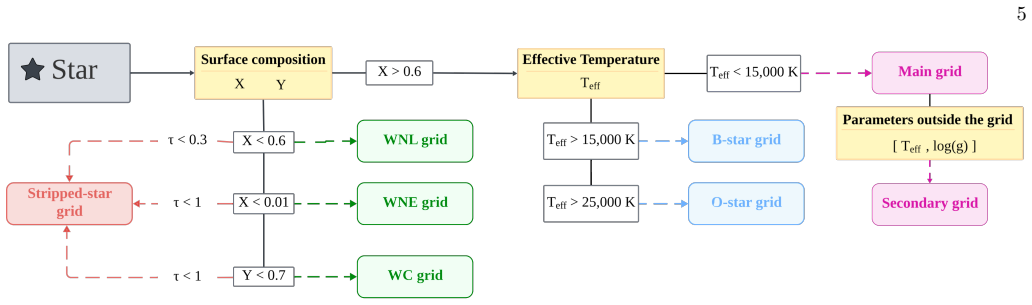
Spectral synthesis using binary population synthesis that incorporates dedicated libraries for Wolf-Rayet stars, stripped helium stars from mass transfer, and stellar mergers.
Load-bearing premise
The binary population synthesis code and selected spectral libraries correctly represent the evolutionary outcomes and spectra of massive stars undergoing binary interactions at solar metallicity.
What would settle it
Spectroscopic observations of star-forming regions with ages between 15 and 30 million years that show no excess in He II ionizing flux compared to single-star predictions would indicate that the stripped-star contribution is overstated.
Figures
read the original abstract
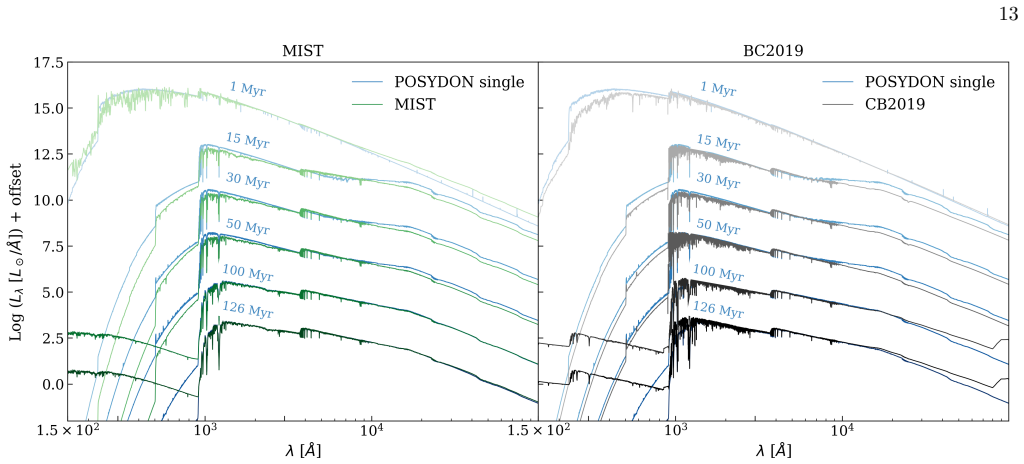
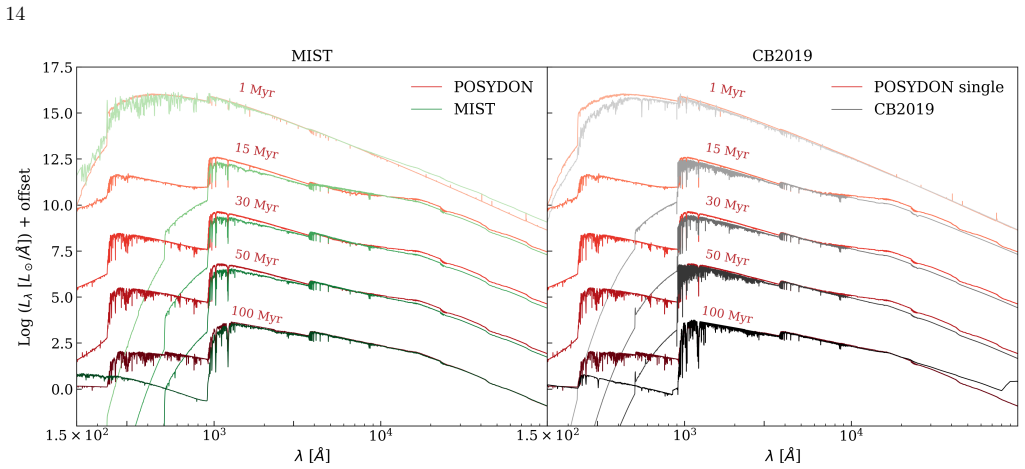
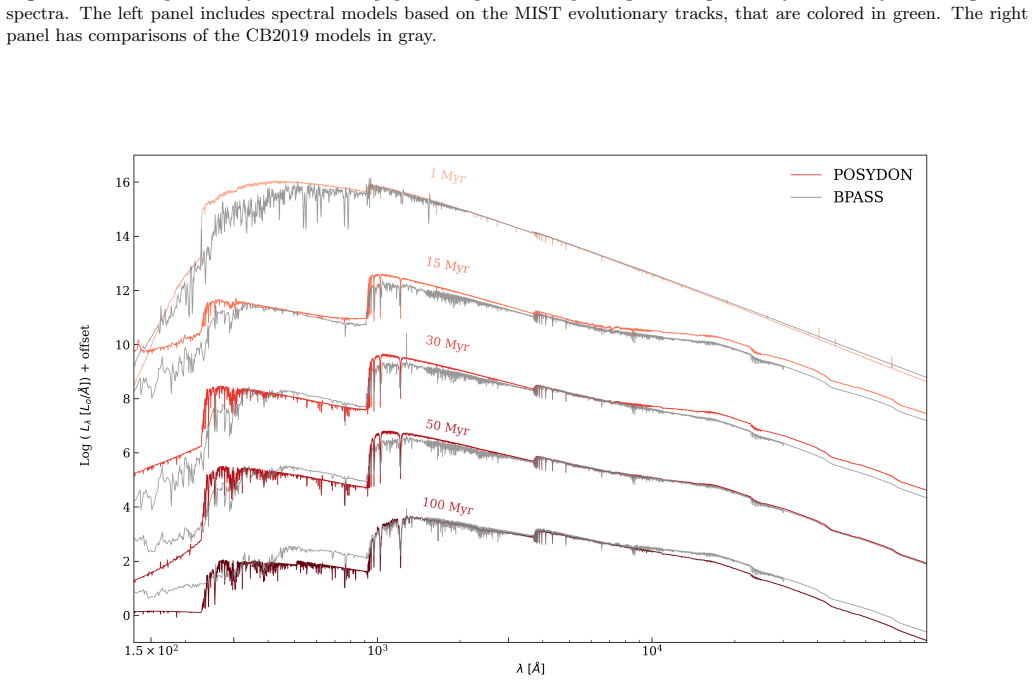
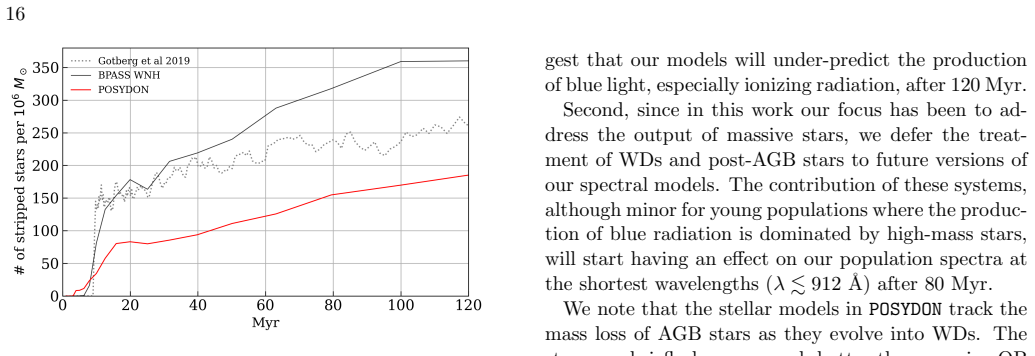
The accuracy of stellar population properties inferred through spectral energy distribution fitting hinges on the reliability of the underlying spectral models. Binary interactions are fundamental for massive star evolution, and ignoring their spectral contribution can lead to incorrect results. We use the POSYDON binary population synthesis code to generate spectral models of stellar populations that include binaries at solar metallicity. Our framework incorporates a collection of spectral libraries that is designed to address key outcomes of binary stellar evolution like Wolf-Rayet stars, stripped helium stars, and a treatment for stellar mergers. Our models confirm previous results showing that the inclusion of binary interactions has a significant effect on the UV and ionizing regime of the integrated spectrum. In particular we find that Wolf-Rayet stars and other massive stars dominate the production of ionizing radiation at earlier times, but after $\simeq$16 Myr stripped stars produced through mass transfer begin to dominate. Furthermore, we show that the production of ionizing He II photons is especially sensitive to the underlying population of stripped stars. While our results currently focus on high-mass stars ($\ge4~M_{\odot}$) at Solar metallicity, they provide the framework for binary spectral synthesis across a range of metallicities and masses and lay the foundation for calculations of the emergent emission-line spectra in the UV, optical, and IR regimes. We make the spectral models from this work publicly available for use in a format that can be integrated into fitting codes.
Editorial analysis
A structured set of objections, weighed in public.
Referee Report
Summary. The paper presents new spectral synthesis models for stellar populations at solar metallicity generated with the POSYDON binary population synthesis code. These models incorporate dedicated spectral libraries to account for binary-evolution outcomes including Wolf-Rayet stars, stripped helium stars, and merger products. The work confirms that binary interactions substantially alter the UV and ionizing portions of the integrated spectrum, with Wolf-Rayet and massive stars dominating ionizing output at early times but stripped stars produced via mass transfer becoming dominant after ≃16 Myr; He II ionizing photons are shown to be particularly sensitive to the stripped-star population. The models are released publicly in a format suitable for integration into SED-fitting codes, and the framework is positioned for future extension to other metallicities and mass ranges.
Significance. If the POSYDON-derived populations and attached spectral libraries are reliable, the work supplies a concrete, publicly available set of binary-inclusive population spectra that directly addresses a known limitation in current stellar-population modeling. The explicit timeline for the shift in ionizing-photon sources and the demonstrated sensitivity of He II output constitute falsifiable predictions that can be tested against observations of young clusters. The provision of a modular framework for additional metallicities and masses further increases the potential utility for both theoretical studies and observational interpretation.
major comments (2)
- [Abstract] Abstract and results section: The headline result that stripped stars overtake Wolf-Rayet/massive stars at ≃16 Myr and dominate He II production is load-bearing on the accuracy of POSYDON’s mass-transfer, common-envelope, and merger prescriptions for stars ≥4 M⊙ at solar metallicity. No direct validation of the predicted stripped-helium-star number densities, lifetimes, or UV/He II continua against observed samples or independent binary codes is reported, leaving the central claim without the quantitative cross-checks required to assess its robustness.
- [Methods] Methods: The manuscript states that a “collection of spectral libraries” is used to treat Wolf-Rayet stars, stripped helium stars, and mergers, yet provides no quantitative assessment of how uncertainties in the library assignments (e.g., effective-temperature or wind prescriptions for stripped stars) propagate into the integrated ionizing-photon budgets or the reported 16 Myr transition time.
minor comments (2)
- [Abstract] The abstract refers to “high-mass stars (≥4 M⊙)” while the title and introduction emphasize the full binary population; a brief clarification of the mass cut and its justification would improve readability.
- Figure captions and text should explicitly state the assumed initial mass function, binary fraction, and period distribution so that readers can reproduce the population synthesis setup without consulting the POSYDON documentation.
Simulated Author's Rebuttal
We thank the referee for their constructive and detailed report. Below we provide point-by-point responses to the two major comments. We have revised the manuscript to strengthen the discussion of model assumptions and limitations while preserving the scope of the present work.
read point-by-point responses
-
Referee: [Abstract] Abstract and results section: The headline result that stripped stars overtake Wolf-Rayet/massive stars at ≃16 Myr and dominate He II production is load-bearing on the accuracy of POSYDON’s mass-transfer, common-envelope, and merger prescriptions for stars ≥4 M⊙ at solar metallicity. No direct validation of the predicted stripped-helium-star number densities, lifetimes, or UV/He II continua against observed samples or independent binary codes is reported, leaving the central claim without the quantitative cross-checks required to assess its robustness.
Authors: We agree that the reported 16 Myr transition depends on the fidelity of POSYDON’s binary-evolution prescriptions. Those prescriptions were validated against both observations and other binary population synthesis codes in the series of POSYDON methodology papers (explicit citations will be added). The present manuscript applies the already-validated POSYDON populations to spectral synthesis; it does not repeat those validation exercises. In the revised text we will (i) add a dedicated paragraph in the Discussion that explicitly references the prior POSYDON validation studies for stars ≳4 M⊙ at solar metallicity and (ii) state that the timeline and He II sensitivity are predictions that can be tested once the models are compared with observations or other codes. We therefore regard the central claim as resting on published validations rather than being unanchored. revision: partial
-
Referee: [Methods] Methods: The manuscript states that a “collection of spectral libraries” is used to treat Wolf-Rayet stars, stripped helium stars, and mergers, yet provides no quantitative assessment of how uncertainties in the library assignments (e.g., effective-temperature or wind prescriptions for stripped stars) propagate into the integrated ionizing-photon budgets or the reported 16 Myr transition time.
Authors: The referee is correct that no quantitative uncertainty propagation from the spectral-library choices is presented. A full Monte-Carlo error budget lies beyond the scope of this first solar-metallicity paper. In the revision we will insert a new subsection (Methods or Discussion) that (a) lists the specific libraries and their adopted T_eff and wind prescriptions for each evolutionary channel, (b) qualitatively discusses how plausible variations in those prescriptions would affect the ionizing-photon budgets, and (c) notes that the 16 Myr transition time is most sensitive to the lifetimes and temperatures assigned to the stripped-helium-star population. This addition will allow readers to gauge the robustness of the reported results without requiring new numerical experiments. revision: yes
Circularity Check
No significant circularity; forward models from established codes
full rationale
The paper generates integrated spectra by feeding POSYDON binary population synthesis outputs and attached spectral libraries (for WR stars, stripped He stars, mergers) into a population synthesis framework at solar metallicity for M≥4 M⊙. All reported results, including the transition at ≃16 Myr and He II sensitivity, are direct simulation outputs rather than quantities fitted to the target observables or redefined by construction. No equations, parameter fits, or self-citations are shown that reduce the central claims to their own inputs; the work is self-contained forward modeling whose validity rests on the external accuracy of POSYDON and the libraries, not on internal loops.
Axiom & Free-Parameter Ledger
axioms (2)
- domain assumption POSYDON binary population synthesis code accurately models binary evolution at solar metallicity for stars ≥4 M⊙
- domain assumption The selected spectral libraries correctly represent the spectra of Wolf-Rayet stars, stripped helium stars, and merger products
Reference graph
Works this paper leans on
-
[1]
R., Langer, N., Antoniadis, J., et al
Aguilera-Dena, D. R., Langer, N., Antoniadis, J., et al. 2022, A&A, 661, A60, doi: 10.1051/0004-6361/202142895
-
[2]
Andrews, J. J., Bavera, S. S., Briel, M., et al. 2025, ApJS, 281, 3, doi: 10.3847/1538-4365/adfb78 Astropy Collaboration, Robitaille, T. P., Tollerud, E. J., et al. 2013, A&A, 558, A33, doi: 10.1051/0004-6361/201322068 Astropy Collaboration, Price-Whelan, A. M., Sip˝ ocz, B. M., et al. 2018, AJ, 156, 123, doi: 10.3847/1538-3881/aabc4f Astropy Collaboratio...
-
[3]
Bailyn, C. D. 1995, ARA&A, 33, 133, doi: 10.1146/annurev.aa.33.090195.001025
-
[4]
2019, A&A, 622, A103, doi: 10.1051/0004-6361/201834156 24
Boquien, M., Burgarella, D., Roehlly, Y., et al. 2019, A&A, 622, A103, doi: 10.1051/0004-6361/201834156 24
-
[5]
J., Smit, R., Labb´ e, I., et al
Bouwens, R. J., Smit, R., Labb´ e, I., et al. 2016, ApJ, 831, 176, doi: 10.3847/0004-637X/831/2/176
-
[6]
2012, MNRAS, 427, 127, doi: 10.1111/j.1365-2966.2012.21948.x
Bressan, A., Marigo, P., Girardi, L., et al. 2012, MNRAS, 427, 127, doi: 10.1111/j.1365-2966.2012.21948.x
-
[7]
2007, in Astronomical Society of the Pacific Conference Series, Vol
Bruzual, G. 2007, in Astronomical Society of the Pacific Conference Series, Vol. 374, From Stars to Galaxies: Building the Pieces to Build Up the Universe, ed. A. Vallenari, R. Tantalo, L. Portinari, & A. Moretti, 303, doi: 10.48550/arXiv.astro-ph/0702091
-
[8]
2003, MNRAS, 344, 1000, doi: 10.1046/j.1365-8711.2003.06897.x
Bruzual, G., & Charlot, S. 2003, MNRAS, 344, 1000, doi: 10.1046/j.1365-8711.2003.06897.x
-
[9]
Carnall, A. C., McLure, R. J., Dunlop, J. S., & Dav´ e, R. 2018, MNRAS, 480, 4379, doi: 10.1093/mnras/sty2169
-
[10]
2015, MNRAS, 452, 1068, doi: 10.1093/mnras/stv1281
Chen, Y., Bressan, A., Girardi, L., et al. 2015, MNRAS, 452, 1068, doi: 10.1093/mnras/stv1281
-
[11]
2016, MNRAS, 462, 1415, doi: 10.1093/mnras/stw1756
Chevallard, J., & Charlot, S. 2016, MNRAS, 462, 1415, doi: 10.1093/mnras/stw1756
-
[12]
2017, ApJ, 838, 159, doi: 10.3847/1538-4357/aa679f
Choi, J., Conroy, C., & Byler, N. 2017, ApJ, 838, 159, doi: 10.3847/1538-4357/aa679f
-
[13]
2013, ARA&A, 51, 393, doi: 10.1146/annurev-astro-082812-141017
Conroy, C. 2013, ARA&A, 51, 393, doi: 10.1146/annurev-astro-082812-141017
-
[14]
Conroy, C., Graves, G. J., & van Dokkum, P. G. 2014, ApJ, 780, 33, doi: 10.1088/0004-637X/780/1/33
-
[15]
Conroy, C., & Gunn, J. E. 2010, FSPS: Flexible Stellar Population Synthesis, Astrophysics Source Code Library, record ascl:1010.043. http://ascl.net/1010.043
2010
-
[16]
Conroy, C., Gunn, J. E., & White, M. 2009, ApJ, 699, 486, doi: 10.1088/0004-637X/699/1/486
-
[17]
Conti, P. S., Garmany, C. D., De Loore, C., & Vanbeveren, D. 1983, ApJ, 274, 302, doi: 10.1086/161447
doi:10.1086/161447 1983
-
[18]
Crowther, P. A. 2007, ARA&A, 45, 177, doi: 10.1146/annurev.astro.45.051806.110615 de Koter, A., Heap, S. R., & Hubeny, I. 1997, ApJ, 477, 792, doi: 10.1086/303736 de Mink, S. E., & Mandel, I. 2016, MNRAS, 460, 3545, doi: 10.1093/mnras/stw1219
-
[19]
Demir, U., Srivastava, P. M., Katsaggelos, A., et al. 2026, arXiv e-prints, arXiv:2604.13604, doi: 10.48550/arXiv.2604.13604
-
[20]
2016, ApJS, 222, 8, doi: 10.3847/0067-0049/222/1/8
Dotter, A. 2016, ApJS, 222, 8, doi: 10.3847/0067-0049/222/1/8
-
[21]
2024, A&A, 687, A215, doi: 10.1051/0004-6361/202349065
Dutta, D., & Klencki, J. 2024, A&A, 687, A215, doi: 10.1051/0004-6361/202349065
-
[22]
Eggleton, P. P. 1971, MNRAS, 151, 351, doi: 10.1093/mnras/151.3.351
-
[23]
Eldridge, J. J., & Stanway, E. R. 2012, MNRAS, 419, 479, doi: 10.1111/j.1365-2966.2011.19713.x
-
[24]
Eldridge, J. J., Stanway, E. R., Xiao, L., et al. 2017, PASA, 34, e058, doi: 10.1017/pasa.2017.51
-
[25]
Eldridge, J. J., & Tout, C. A. 2004, MNRAS, 353, 87, doi: 10.1111/j.1365-2966.2004.08041.x
-
[26]
Endsley, R., Stark, D. P., Whitler, L., et al. 2023, MNRAS, 524, 2312, doi: 10.1093/mnras/stad1919
-
[27]
1997, A&A, 326, 950, doi: 10.48550/arXiv.astro-ph/9707017 —
Fioc, M., & Rocca-Volmerange, B. 1997, A&A, 326, 950, doi: 10.48550/arXiv.astro-ph/9707017 —. 1999, arXiv e-prints, astro, doi: 10.48550/arXiv.astro-ph/9912179
-
[28]
Fletcher, T. J., Tang, M., Robertson, B. E., et al. 2019, ApJ, 878, 87, doi: 10.3847/1538-4357/ab2045
-
[29]
Fragos, T., Andrews, J. J., Bavera, S. S., et al. 2023, ApJS, 264, 45, doi: 10.3847/1538-4365/ac90c1
-
[30]
Ghodla, S., Eldridge, J. J., Stanway, E. R., & Stevance, H. F. 2023, MNRAS, 518, 860, doi: 10.1093/mnras/stac3177 Gonz´ alez Delgado, R. M., Cervi˜ no, M., Martins, L. P.,
-
[31]
Leitherer, C., & Hauschildt, P. H. 2005, MNRAS, 357, 945, doi: 10.1111/j.1365-2966.2005.08692.x G¨ otberg, Y., de Mink, S. E., & Groh, J. H. 2017, A&A, 608, A11, doi: 10.1051/0004-6361/201730472 G¨ otberg, Y., de Mink, S. E., Groh, J. H., et al. 2018, A&A, 615, A78, doi: 10.1051/0004-6361/201732274 G¨ otberg, Y., de Mink, S. E., Groh, J. H., Leitherer, C., &
-
[32]
2019, A&A, 629, A134, doi: 10.1051/0004-6361/201834525 G¨ otberg, Y., de Mink, S
Norman, C. 2019, A&A, 629, A134, doi: 10.1051/0004-6361/201834525 G¨ otberg, Y., de Mink, S. E., McQuinn, M., et al. 2020, A&A, 634, A134, doi: 10.1051/0004-6361/201936669 G¨ otberg, Y., Drout, M. R., Ji, A. P., et al. 2023, ApJ, 959, 125, doi: 10.3847/1538-4357/ace5a3 Gr¨ afener, G., Koesterke, L., & Hamann, W.-R. 2002, A&A, 387, 244, doi: 10.1051/0004-6...
-
[33]
2016, MNRAS, 462, 1757, doi: 10.1093/mnras/stw1716
Gutkin, J., Charlot, S., & Bruzual, G. 2016, MNRAS, 462, 1757, doi: 10.1093/mnras/stw1716
-
[34]
Hamann, W. R., & Gr¨ afener, G. 2004, A&A, 427, 697, doi: 10.1051/0004-6361:20040506
-
[35]
Harris, C. R., Millman, K. J., van der Walt, S. J., et al. 2020, Nature, 585, 357, doi: 10.1038/s41586-020-2649-2
-
[36]
2025, ApJS, 280, 5, doi: 10.3847/1538-4365/adddb6
Hawcroft, C., Leitherer, C., Arangur´ e, O., et al. 2025, ApJS, 280, 5, doi: 10.3847/1538-4365/adddb6
-
[37]
Hillier, D. J. 1990, A&A, 231, 116
1990
-
[38]
Hillier, D. J., & Miller, D. L. 1998, ApJ, 496, 407, doi: 10.1086/305350
doi:10.1086/305350 1998
-
[39]
Hunter, J. D. 2007, Computing in Science & Engineering, 9, 90, doi: 10.1109/MCSE.2007.55
-
[40]
Hurley, J. R., Pols, O. R., & Tout, C. A. 2000, MNRAS, 315, 543, doi: 10.1046/j.1365-8711.2000.03426.x
-
[41]
Hurley, J. R., Tout, C. A., & Pols, O. R. 2002, MNRAS, 329, 897, doi: 10.1046/j.1365-8711.2002.05038.x
-
[42]
2023, MNRAS, 524, 426, doi: 10.1093/mnras/stad1630 25
Iorio, G., Mapelli, M., Costa, G., et al. 2023, MNRAS, 524, 426, doi: 10.1093/mnras/stad1630 25
-
[43]
D., Leja, J., Conroy, C., & Speagle, J
Johnson, B. D., Leja, J., Conroy, C., & Speagle, J. S. 2021, ApJS, 254, 22, doi: 10.3847/1538-4365/abef67
-
[44]
Kennicutt, Jr., R. C. 1998, ARA&A, 36, 189, doi: 10.1146/annurev.astro.36.1.189
-
[45]
Kewley, L. J., Nicholls, D. C., & Sutherland, R. S. 2019, ARA&A, 57, 511, doi: 10.1146/annurev-astro-081817-051832
-
[46]
1969, A&A, 3, 83
Kippenhahn, R. 1969, A&A, 3, 83
1969
-
[47]
Kobulnicky, H. A., Kiminki, D. C., Lundquist, M. J., et al. 2014, ApJS, 213, 34, doi: 10.1088/0067-0049/213/2/34
-
[48]
Kurucz, R. L. 1970, SAO Special Report, 309 —. 1993, SYNTHE spectrum synthesis programs and line data
1970
-
[49]
2003, ApJS, 146, 417, doi: 10.1086/374373 —
Lanz, T., & Hubeny, I. 2003, ApJS, 146, 417, doi: 10.1086/374373 —. 2007, ApJS, 169, 83, doi: 10.1086/511270 Le Borgne, D., Rocca-Volmerange, B., Prugniel, P., et al. 2004, A&A, 425, 881, doi: 10.1051/0004-6361:200400044
doi:10.1086/374373 2003
-
[50]
2024, MNRAS, 527, 9480, doi: 10.1093/mnras/stad3838
Lecroq, M., Charlot, S., Bressan, A., et al. 2024, MNRAS, 527, 9480, doi: 10.1093/mnras/stad3838
-
[51]
Lehmer, B. D., Monson, E. B., Eufrasio, R. T., et al. 2024, ApJ, 977, 189, doi: 10.3847/1538-4357/ad8de7
-
[52]
2014, ApJS, 212, 14, doi: 10.1088/0067-0049/212/1/14
Leitherer, C., Ekstr¨ om, S., Meynet, G., et al. 2014, ApJS, 212, 14, doi: 10.1088/0067-0049/212/1/14
-
[53]
Leitherer, C., Ortiz Ot´ alvaro, P. A., Bresolin, F., et al. 2010, ApJS, 189, 309, doi: 10.1088/0067-0049/189/2/309
-
[54]
Leitherer, C., Schaerer, D., Goldader, J. D., et al. 1999, ApJS, 123, 3, doi: 10.1086/313233
doi:10.1086/313233 1999
-
[55]
2017, ApJ, 837, 170, doi: 10.3847/1538-4357/aa5ffe
Byler, N. 2017, ApJ, 837, 170, doi: 10.3847/1538-4357/aa5ffe
-
[56]
2012, ApJ, 751, 67, doi: 10.1088/0004-637X/751/1/67
Schaerer, D. 2012, ApJ, 751, 67, doi: 10.1088/0004-637X/751/1/67
-
[57]
Ma, X., Hopkins, P. F., Kasen, D., et al. 2016, MNRAS, 459, 3614, doi: 10.1093/mnras/stw941
-
[58]
2014, ARA&A, 52, 415, doi: 10.1146/annurev-astro-081811-125615
Madau, P., & Dickinson, M. 2014, ARA&A, 52, 415, doi: 10.1146/annurev-astro-081811-125615
-
[59]
Marchant, P., Langer, N., Podsiadlowski, P., Tauris, T. M., & Moriya, T. J. 2016, A&A, 588, A50, doi: 10.1051/0004-6361/201628133
-
[60]
Marigo, P., Girardi, L., Weiss, A., Groenewegen, M. A. T., & Chiosi, C. 2004, A&A, 423, 995, doi: 10.1051/0004-6361:20040234
-
[61]
Mateo, M., Harris, H. C., Nemec, J., & Olszewski, E. W. 1990, AJ, 100, 469, doi: 10.1086/115530 M´ esz´ aros, S., Bohlin, R., Allende Prieto, C., et al. 2024, A&A, 688, A197, doi: 10.1051/0004-6361/202449306
doi:10.1086/115530 1990
-
[62]
2017, ApJS, 230, 15, doi: 10.3847/1538-4365/aa6fb6 O’Connell, R
Moe, M., & Di Stefano, R. 2017, ApJS, 230, 15, doi: 10.3847/1538-4365/aa6fb6 O’Connell, R. W. 1999, ARA&A, 37, 603, doi: 10.1146/annurev.astro.37.1.603 pandas development team, T. 2020, pandas-dev/pandas: Pandas, latest, Zenodo, doi: 10.5281/zenodo.3509134
-
[63]
Pauldrach, A. W. A. 2012, WM-basic: Modeling atmospheres of hot stars, Astrophysics Source Code Library, record ascl:1204.001. http://ascl.net/1204.001
2012
-
[64]
2022, A&A, 667, A58, doi: 10.1051/0004-6361/202243965
Marchant, P. 2022, A&A, 667, A58, doi: 10.1051/0004-6361/202243965
-
[65]
2011, ApJS, 192, 3, doi: 10.1088/0067-0049/192/1/3
Paxton, B., Bildsten, L., Dotter, A., et al. 2011, ApJS, 192, 3, doi: 10.1088/0067-0049/192/1/3
-
[66]
2013, ApJS, 208, 4, doi: 10.1088/0067-0049/208/1/4
Paxton, B., Cantiello, M., Arras, P., et al. 2013, ApJS, 208, 4, doi: 10.1088/0067-0049/208/1/4
-
[67]
2015, ApJS, 220, 15, doi: 10.1088/0067-0049/220/1/15
Paxton, B., Marchant, P., Schwab, J., et al. 2015, ApJS, 220, 15, doi: 10.1088/0067-0049/220/1/15
-
[68]
Paxton, B., Schwab, J., Bauer, E. B., et al. 2018, ApJS, 234, 34, doi: 10.3847/1538-4365/aaa5a8
-
[69]
2019, ApJS, 243, 10, doi: 10.3847/1538-4365/ab2241
Paxton, B., Smolec, R., Schwab, J., et al. 2019, ApJS, 243, 10, doi: 10.3847/1538-4365/ab2241
-
[70]
2019, MNRAS, 490, 978, doi: 10.1093/mnras/stz2616
Plat, A., Charlot, S., Bruzual, G., et al. 2019, MNRAS, 490, 978, doi: 10.1093/mnras/stz2616
-
[71]
Podsiadlowski, P., Joss, P. C., & Hsu, J. J. L. 1992, ApJ, 391, 246, doi: 10.1086/171341
doi:10.1086/171341 1992
-
[72]
Pols, O. R., Tout, C. A., Eggleton, P. P., & Han, Z. 1995, MNRAS, 274, 964, doi: 10.1093/mnras/274.3.964
-
[73]
Ramachandran, V., Klencki, J., Sander, A. A. C., et al. 2023, A&A, 674, L12, doi: 10.1051/0004-6361/202346818
-
[74]
2018, MNRAS, 479, 994, doi: 10.1093/mnras/sty1655
Rosdahl, J., Katz, H., Blaizot, J., et al. 2018, MNRAS, 479, 994, doi: 10.1093/mnras/sty1655
-
[75]
Salim, S., Rich, R. M., Charlot, S., et al. 2007, ApJS, 173, 267, doi: 10.1086/519218
doi:10.1086/519218 2007
-
[76]
Sana, H., de Mink, S. E., de Koter, A., et al. 2012, Science, 337, 444, doi: 10.1126/science.1223344
-
[77]
Sander, A., Hamann, W. R., & Todt, H. 2012, A&A, 540, A144, doi: 10.1051/0004-6361/201117830
-
[78]
Sander, A. A. C. 2022, arXiv e-prints, arXiv:2211.05424, doi: 10.48550/arXiv.2211.05424
-
[79]
Sander, A. A. C., & Vink, J. S. 2020, MNRAS, 499, 873, doi: 10.1093/mnras/staa2712
-
[80]
Sander, A. A. C., Vink, J. S., Higgins, E. R., et al. 2022, in IAU Symposium, Vol. 366, The Origin of Outflows in Evolved Stars, ed. L. Decin, A. Zijlstra, & C. Gielen, 21–26, doi: 10.1017/S1743921322000400
discussion (0)
Sign in with ORCID, Apple, or X to comment. Anyone can read and Pith papers without signing in.