REVIEW 3 major objections 4 minor 26 references
Curvature at Infinity Governs the Topology of Complete Non-Compact Surfaces Admitting Schr\"odinger Operators of Finite Index
T0 review · 3 major / 4 minor · reviewed 2026-08-15 · deepseek-v4-flash
Pith's one-line read A curvature invariant at infinity controls surface topology and ends.
desk verdict A credible finite-index extension of Fischer-Colbrie's classification, with one load-bearing proof left implicit. read the letter →
The pith
A machine-rendered reading of the paper's core claim, the machinery that carries it, and where it could break.
The reading
What carries the argument
The load-bearing object is the curvature at infinity $\lambda^*_\infty(\Sigma):=2\pi\chi(\Sigma)-c^*(\Sigma)$ of the Fischer-Colbrie metric, together with the identity (1.4) that identifies it with $4\alpha^*\pi$ times the limiting ratio of ball areas in $(\Sigma,g^*)$ and in a model surface of revolution (a surface with metric $dt^2 + f(t)^2\,d\theta^2$ and radial curvature $\tilde K$). The identity comes from the isoperimetric inequality on complete open surfaces and a volume comparison for radial curvature. The topological conclusions follow by feeding this identity into a radial-curvature comparison theorem, Grove–Shiohama critical-point theory for distance functions, and Shiohama's total-curvature criterion for Busemann functions.
What would settle it
Construct a complete non-compact surface satisfying $\operatorname{Ind}(L_g)<\infty$ and $q\ge 0$ whose Fischer-Colbrie metric has a sequence of Grove–Shiohama critical points of $d^*_p$ with $d^*_p(q_i)\to\infty$; that would directly refute Theorem 1.3(4). A more targeted check is to verify the quoted proof of the comparison theorem used there and see whether the model surface built in Theorem 1.3 satisfies every hypothesis, since the paper only asserts that the Cartan–Hadamard condition makes the sector condition automatic.
Extended reading notes
Core claim
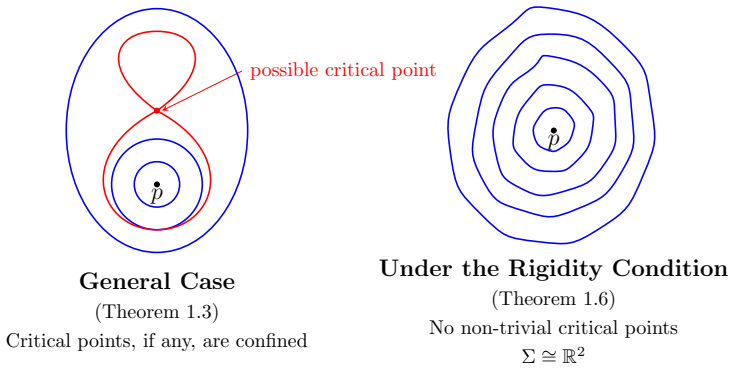
The central discovery is a structure theorem for the Fischer-Colbrie metric $g^* = u^2 g$, the complete conformal metric obtained from a positive solution $u$ of the Schrödinger equation outside a compact set. For any base point $p$ in that compact set, there is a model surface of revolution with non-positive, compactly supported radial curvature $\tilde K$ such that the radial curvature of $(\Sigma,g^*)$ is bounded below by $\tilde K$. The curvature at infinity $\lambda^*_\infty(\Sigma) = 2\pi\chi(\Sigma) - c^*(\Sigma)$ satisfies $\lambda^*_\infty(\Sigma) = 4\alpha^*\pi \lim_{t\to\infty} \operatorname{Area}(B^*_t(p))/\operatorname{Area}(B_t(\tilde p))$ for a constant $\alpha^* \in [1/2,\infty)$, the model has total curvature $2\pi(1-2\alpha^*)$, and every Grove–Shiohama critical point of $d^*_p$ lies in a single bounded ball. From this, the paper derives the bound $\#\mathrm{Ends}(\Sigma)\le 4\alpha^*$, a rigidity criterion in which a quantitative lower bound on $\lambda^*_\infty$ forces $\Sigma\cong\mathbb R^2$, and, for one-ended surfaces, conditions on $\beta^*$ under which Busemann functions are exhaustions.
Load-bearing premise
The proof that critical points of $d^*_p$ cannot escape to infinity invokes a comparison-geometric theorem that is quoted rather than restated; if that theorem requires hypotheses beyond a radial lower curvature bound with $\int_0^\infty t\tilde K(t)\,dt>-\infty$, the boundedness conclusion in Theorem 1.3(4) could fail.
Editorial extensions
If this is right
- The number of ends of the surface is at most $4\alpha^*$, a quantitative bound coming directly from the identity (1.4).
- If $\lambda^*_\infty(\Sigma)\ge 2\alpha^*\pi\{2-\exp(\int_0^\infty t\tilde K(t)\,dt)\}$, then the distance function has no critical points away from the base point and $\Sigma$ is diffeomorphic to $\mathbb R^2$.
- On a one-ended surface with $\lambda^*_\infty(\Sigma)>0$ and $\beta^*\in(0,1/4)$, every Busemann function is an exhaustion, and the measure of ray directions converges to $\lambda^*_\infty(\Sigma)$ uniformly outside a compact set.
- If $\beta^*\in(0,\chi(\Sigma)/2-1/4)$, the surface is homeomorphic to $\mathbb R^2$ and the same Busemann exhaustion holds.
Reading between the lines
- A natural testable extension is to compute the sharp threshold in Theorem 1.6 by constructing model surfaces whose radial curvature crosses inequality (1.5) and checking whether critical points reappear just below the threshold.
- The identity (1.4) suggests that the curvature at infinity measures the asymptotic opening angle of the surface, so the bound $\#\mathrm{Ends}\le 4\alpha^*$ may be improvable if the packing argument in Corollary 1.4 is sharpened using the actual distribution of rays.
- For higher-dimensional versions of the problem, the comparison machinery underlying Theorem 2.8 is dimension-independent, so a partial analogue of the area-growth identity may hold even where a Fischer-Colbrie conformal metric is not available.
Signed reviews
Editorial analysis
A structured set of objections, weighed in public.
Referee Report
Summary. The paper studies complete non-compact Riemannian 2-manifolds Σ admitting a Schrödinger operator L_g = Δ_g - K_g + q with q ≥ 0 and finite Morse index. Following Fischer-Colbrie, the authors fix a conformal metric g* = u^2 g and define the curvature at infinity λ*∞(Σ) = 2πχ(Σ) - c*(Σ). The main structural theorem constructs a non-compact model surface of revolution whose radial curvature bounds K* from below, derives the area-growth identity λ*∞(Σ) = 4πα* lim_t Area(B*_t(p))/Area(B_t(p̃)), proves that all critical points of the distance function d*_p lie in a compact ball, and gives the end bound #E(Σ) ≤ 4α*. Two further theorems distinguish a regime forcing Σ to be diffeomorphic to R^2 and a one-ended regime in which Busemann functions are exhaustions. The proofs combine radial-curvature comparison, a Toponogov-type theorem, total-curvature results for open surfaces, and estimates of ray measures.
Significance. If the structural claims are correct, the framework is a genuine extension of Fischer-Colbrie's stability classification to finite-index operators without imposing vanishing index. The identity (1.4) is a clean quantitative link between the curvature at infinity and the area growth of the Fischer-Colbrie metric relative to an explicit model, and Corollary 1.4 gives a concrete and checkable bound on the number of ends. The proof of Corollary 1.4 is a substantial comparison-geometric argument that explicitly claims to correct a gap in the earlier paper [15]; this is a valuable contribution in itself. At the same time, the paper delegates several load-bearing steps to unstated or informally stated results from the authors' prior work, and one of the two advertised regimes in Theorem 1.8(2) is essentially a tautological consequence of its own hypothesis rather than a curvature-governed conclusion. These issues substantially temper the strength of the paper's broad claims.
major comments (3)
- [§3.1, proof of Theorem 1.3(4)] The proof of boundedness of critical points consists of the statement that, because K̃ ≤ 0, the model surface is Cartan–Hadamard and the sector condition in [16, Theorem 5.3] is automatic, and then 'the argument in the proof of [16, Theorem 2.2]' rules out a sequence of critical points tending to infinity. Neither [16, Theorem 2.2] nor the internal lemma used there is stated, and no verification of its hypotheses is given for the particular model constructed in this paper. This is load-bearing: the model K̃ = κ0η is compactly supported and non-positive, hence non-decreasing in t when κ0 < 0, so any von Mangoldt-type hypothesis requiring monotone non-increasing K̃ would fail. Please state the cited theorem, verify all of its hypotheses for this model, and then derive the bounded-critical-point conclusion in full.
- [§3.4, Theorem 1.8(2)] The hypothesis β* ∈ (0, χ(Σ)/2 − 1/4) is satisfiable only when χ(Σ) = 1. Indeed β* > 0 forces χ(Σ) > 1/2, and for a one-ended surface of finite topology we have χ(Σ) ≤ 1; since χ(Σ) is an integer, χ(Σ) = 1 follows. The proof itself makes this explicit in Eqs. (3.27)–(3.28). Consequently the conclusion 'Σ is homeomorphic to R^2' follows immediately from the existence of the interval, with no quantitative use of λ*∞ beyond its positivity. As stated, this is a tautological reformulation of the topological hypothesis rather than a curvature-governed rigidity result. Please either reformulate the theorem so that the hypothesis is a genuine condition on curvature at infinity or explicitly present it as an observation about the admissibility of the interval.
- [§3.3 and Remark 2.9] Theorem 1.6 concludes not only that Σ is diffeomorphic to R^2 but also that d*_p has no non-trivial critical points. This stronger conclusion is obtained by applying Theorem 2.8 together with Remark 2.9, where the no-critical-point statement is asserted as an extension of the proof of [18, Corollary 3.5]. Since the absence of critical points is the mechanism behind the main rigidity conclusion and also feeds into the estimate (1.6), Remark 2.9 should be promoted to a formal lemma with a complete proof under explicitly stated hypotheses, or Theorem 2.8's statement should be amended to include the critical-point conclusion.
minor comments (4)
- [§2.1, Lemma 2.7] The proof of Lemma 2.7 invokes [16, Lemma 4.10] without stating it; because this lemma is used in the proof of Corollary 1.4, please include its statement or a precise reference with the hypotheses needed.
- [§3.2, after Eq. (3.17)] The appeal to the 'generalized first variation formula of Itoh–Tanaka [13, Lemma 2.1]' states neither the lemma's hypotheses nor its conclusion; given that this is the point where the paper claims to correct a gap in [15], the lemma should be stated.
- [Throughout] The notation for the model surface is inconsistent: it appears as eΣ in Theorem 1.3, as fM in Section 2, and as (eΣ, g̃) in later sections. Please unify the notation.
- [Various displayed formulas] Several displayed formulas contain typographical artifacts, for example 'Schr¨ odinger' in the abstract, '∠(x py)' in Eq. (3.13), and inconsistent spacing in 'Bρ0+T (˜p)'. Please proofread the LaTeX carefully.
Circularity Check
No significant circularity: the main identities are derived from Fischer-Colbrie's theorem and external comparison results, not assumed through the conclusions.
full rationale
The paper's derivation chain is not circular in the sense of reducing a claimed prediction to its own inputs. The Fischer-Colbrie metric g* is produced by Theorem 1.1 from [8], an external classical result. The model surface Σ~ in Section 3.1 is explicitly constructed from the curvature of g* on a compact ball, and the identity λ*_∞(Σ) = 4α*π lim Area(B*_t(p))/Area(B_t(ṝ)) is proved using the isoperimetric inequality [22, Theorem 5.2.1] and l'Hospital's rule, not taken as a definition. The critical-point confinement in Theorem 1.3(4) is delegated to “the argument in the proof of [16, Theorem 2.2]”, a prior published result by Kondo and Tanaka; although this is a self-citation and the hypotheses are not restated in full, it is an appeal to an external theorem rather than an assumption equivalent to the conclusion. Similarly, Theorem 1.6 applies Theorem 2.8 from [18] after translating the curvature-at-infinity condition into the volume-growth hypothesis via Eq. (1.4), which is a genuine reduction to a known theorem. Theorem 1.8(2) does rely on the hypothesis interval forcing χ(Σ)=1 by elementary topology, but that is a valid logical implication, not a circular one. No fitted parameter is renamed as a prediction, and no quantity is defined in terms of the target topological conclusion. The paper's reliance on earlier work raises possible rigor or exposition concerns, but not circularity.
Assumptions & free parameters
assumptions (7)
- domain assumption Fischer-Colbrie structure theorem (Theorem 1.1): for Ind(L_g)<infinity and q>=0, there exist compact C and positive u with L_g u=0 on Sigma\C, and g*=u^2 g is complete with K*>=0 outside C, finite topology, and finite total curvature.
- standard math Cohn-Vossen theorem: lambda_infty >= 0.
- standard math Gauss-Bonnet theorem and classification of compact surfaces.
- domain assumption Toponogov comparison theorem for radial curvature (Theorem 2.5) and the volume-growth rigidity theorem (Theorem 2.8), both from Kondo-Tanaka.
- domain assumption The unstated critical-point boundedness argument from [16, Theorem 2.2] used in the proof of Theorem 1.3(4).
- domain assumption Shiohama's exhaustion criterion (Theorem 2.10) and the ray-mass results (Proposition 2.11, Theorem 2.12) from [21] and [22].
- domain assumption Bishop-Gromov volume comparison for radial curvature [19] and the isoperimetric inequality [22, Theorem 5.2.1].
invented entities (1)
-
Non-compact model surface of revolution (tilde-Sigma, tilde-p, tilde-g) with radial curvature tilde-K = kappa_0 eta
independent evidence
Cite this review
Pith. "Pith review of Curvature at Infinity Governs the Topology of Complete Non-Compact Surfaces Admitting Schr\"odinger Operators of Finite Index." pith.science (2026). https://pith.science/paper/FGUPZO25
@misc{pith2026260810518,
  author       = {Pith},
  title        = {Pith review of: Curvature at Infinity Governs the Topology of Complete Non-Compact Surfaces Admitting Schr\"odinger Operators of Finite Index},
  year         = {2026},
  howpublished = {\url{https://pith.science/paper/FGUPZO25}},
  note         = {Machine review of arXiv:2608.10518}
}
abstract
In this article, we investigate the global topology of a complete non-compact Riemannian $2$-manifold $\Sigma$ admitting a Schr\"odinger operator with non-negative potential and finite Morse index. While classical results of Fischer-Colbrie classify such manifolds under the assumption of vanishing index or geometric stability as immersed minimal surfaces in a Riemannian $3$-manifold, we show that the curvature at infinity $\lambda_\infty^*(\Sigma)$ of the Fischer-Colbrie metric $g^*$---a complete conformal metric determined by a positive function furnished by Fischer-Colbrie's theorem---governs the global topology and geometric rigidity of $\Sigma$ without imposing either assumption. More precisely, we derive a fundamental identity relating $\lambda_\infty^*(\Sigma)$ to the area growth of $(\Sigma,g^*)$, show that all critical points of the distance function $d_p^*$ from a fixed base point $p$ are confined to a bounded region, and, as a corollary, obtain a quantitative bound for the number of ends. We further distinguish two complementary geometric viewpoints. On the one hand, a quantitative condition on $\lambda_\infty^*(\Sigma)$ forces $\Sigma$ to be diffeomorphic to the Euclidean plane $\mathbb{R}^2$. On the other hand, when $\Sigma$ has exactly one end, another condition on $\lambda_\infty^*(\Sigma)$ guarantees that every Busemann function on $(\Sigma,g^*)$ is an exhaustion. By clarifying the relationship between these two regimes---the critical-point structure of distance functions relative to a base point and the global behavior of Busemann functions at infinity---we exhibit two complementary manifestations of how $\lambda_\infty^*(\Sigma)$ controls the global geometry and topology of $\Sigma$.
Figures


Figures from the paper (1 more)

Reference graph
Works this paper leans on
-
[15]
K. Kondo and S. Ohta,Topology of complete manifolds with radial curvature bounded from below, GAFA, Geom. Funct. Anal.17(2007), no. 4, 1237–1247
work page 2007
- [1]
-
[2]
O. Chodosh and C. Li,Stable minimal hypersurfaces inR 4, Acta Math.233 (2024), no. 1, 1–31
work page 2024
-
[3]
O. Chodosh, C. Li, P. Minter, and D. Stryker,Stable minimal hypersurfaces inR 5, arXiv:2401.01492, to appear in Ann. of Math
-
[4]
Cohn-Vossen,K¨ urzeste Wege und Totalkr¨ ummung auf Fl¨ achen, Composi- tio Math.2(1935), 69–133
S. Cohn-Vossen,K¨ urzeste Wege und Totalkr¨ ummung auf Fl¨ achen, Composi- tio Math.2(1935), 69–133
work page 1935
-
[5]
S. Cohn-Vossen,Totalkr¨ ummung und geod¨ atische Linien auf einfach zusam- menh¨ angenden offenen volst¨ andigen Fl¨ achenst¨ ucken, Recueil Math. Moscow 43(1936), 139–163
work page 1936
-
[6]
do Carmo, Riemannian Geometry, Birkh¨ auser, Boston, MA, 1992
M.P. do Carmo, Riemannian Geometry, Birkh¨ auser, Boston, MA, 1992. Translated from the second Portuguese edition by F. Flaherty
work page 1992
-
[7]
M.P. do Carmo and C.K. Peng,Stable complete minimal surfaces inR 3 are planes, Bull. Amer. Math. Soc.1(1979), no. 6, 903–906
work page 1979
Show all 26 references
-
[8]
Fischer-Colbrie,On complete minimal surfaces with finite Morse index in three-manifolds, Invent
D. Fischer-Colbrie,On complete minimal surfaces with finite Morse index in three-manifolds, Invent. Math.82(1985), no. 1, 121–132
1985
-
[9]
Fischer-Colbrie and R
D. Fischer-Colbrie and R. Schoen,The structure of complete stable minimal surfaces in3-manifolds of nonnegative scalar curvature, Comm. Pure Appl. Math.33(1980), no. 2, 199–211
1980
-
[10]
Grove and K
K. Grove and K. Shiohama,A generalized sphere theorem, Ann. of Math. (2) 106(1977), 201–211
1977
-
[11]
Harumoto,Topology of complete non-compact surfaces with the finite in- dex of the Schr¨ odinger operator, Master’s thesis, Okayama University, 2026
H. Harumoto,Topology of complete non-compact surfaces with the finite in- dex of the Schr¨ odinger operator, Master’s thesis, Okayama University, 2026. 31
2026
-
[12]
Huber,On subharmonic functions and differential geometry in the large, Comment
A. Huber,On subharmonic functions and differential geometry in the large, Comment. Math. Helv.32(1957), 13–72
1957
-
[13]
Itoh and M
J. Itoh and M. Tanaka,The Lipschitz continuity of the distance function to the cut locus, Trans. Amer. Math. Soc.353(2001), 21–40
2001
-
[14]
N. N. Katz and K. Kondo,Generalized space forms, Trans. Amer. Math. Soc. 354(2002), 2279–2284
2002
-
[16]
Kondo and M
K. Kondo and M. Tanaka,Total curvatures of model surfaces control topology of complete open manifolds with radial curvature bounded below. II, Trans. Amer. Math. Soc.362(2010), 6293–6324
2010
-
[17]
Kondo and M
K. Kondo and M. Tanaka,Total curvatures of model surfaces control topology of complete open manifolds with radial curvature bounded below. I, Math. Ann.351(2011), no. 2, 251–266
2011
-
[18]
Kondo and M
K. Kondo and M. Tanaka,Sufficient conditions for open manifolds to be dif- feomorphic to Euclidean spaces, Differ. Geom. Appl.29(2011), 597–605
2011
-
[19]
Mao,Volume comparison theorems for manifolds with radial curvature bounded, Czechoslovak Math
J. Mao,Volume comparison theorems for manifolds with radial curvature bounded, Czechoslovak Math. J.66 (141)(2016), no. 1, 71–86
2016
-
[20]
Mazet,Stable minimal hypersurfaces inR 6, arXiv:2405.14676
L. Mazet,Stable minimal hypersurfaces inR 6, arXiv:2405.14676
-
[21]
Shiohama,The role of total curvature on complete noncompact Rieman- nian2-manifolds, Illinois J
K. Shiohama,The role of total curvature on complete noncompact Rieman- nian2-manifolds, Illinois J. Math.28(1984), 597–620
1984
-
[22]
Shiohama, T
K. Shiohama, T. Shioya, and M. Tanaka, The Geometry of Total Curvature on Complete Open Surfaces, Cambridge Tracts in Mathematics159, Cam- bridge University Press, Cambridge, 2003
2003
-
[23]
Shiohama and M
K. Shiohama and M. Tanaka,Compactification and maximal diameter theo- rem for noncompact manifolds with radial curvature bounded below, Math. Z.241(2002), 341–351
2002
-
[24]
Shioya,The ideal boundaries of complete open surfaces, Tohoku Math
T. Shioya,The ideal boundaries of complete open surfaces, Tohoku Math. J. 43(1991), 37–59
1991
-
[25]
Tanaka,On the cut loci of a von Mangoldt’s surface of revolution, J
M. Tanaka,On the cut loci of a von Mangoldt’s surface of revolution, J. Math. Soc. Japan44(1992), 631–641
1992
-
[26]
Tanaka and K
M. Tanaka and K. Kondo,The topology of an open manifold with radial cur- vature bounded from below by a model surface with finite total curvature and examples of model surfaces, Nagoya Math. J.209(2013), 23–34. 32 H. Harumoto e-mail:pfai1uqx@s.okayama-u.ac.jp K. Kondo Departme...
2013
Reviewed August 15, 2026 · model on record in the stance chip above.
Discussion (0). Continue with ORCID to comment.