REVIEW 2 major objections 4 minor 23 references
Nests and Chains of Hofstadter Butterflies
T0 review · 2 major / 4 minor · reviewed 2026-08-14 · deepseek-v4-flash
Pith's one-line read Every open sub-image of the Hofstadter butterfly is fixed by a four-integer rule, and its nested descendants shrink by an exact quadratic-irrational factor.
desk verdict Clean derivation of exact self-similarity rules for Hofstadter sub-images, conditional on an honest empirical open-gap premise. read the letter →
The pith
A machine-rendered reading of the paper's core claim, the machinery that carries it, and where it could break.
The reading
What carries the argument
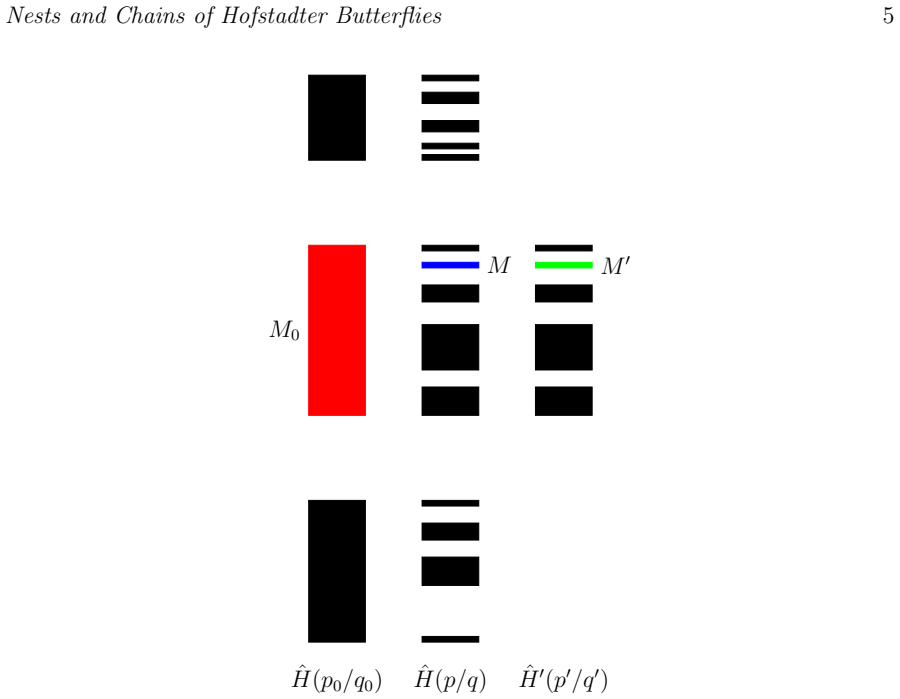
The central object is the exact renormalisation-group mapping for the Harper equation, written as $\phi' = (q_0\phi - p_0)/(N_0\phi + M_0)$, with integers satisfying $1 = q_0M_0 + p_0N_0$; it is a Möbius transformation that converts the spectrum near a rational flux into a sub-spectrum at a shifted flux. The paper packages the iteration of this map as multiplication of unimodular $2\times2$ matrices, $B^L_{j+1} = C_L B^L_j$, and the eigenvalues of $C_L$ yield the scaling factor of equation (33). For chains, the opposite-edge formula iterates by simple addition, giving $\phi_j = (p_0 + jM_0)/(q_0 - jN_0)$. The machinery works by turning geometric self-similarity into an algebraic recursion on four integers, so all quantitative predictions, edge positions, centres, scaling factors, and accumulation points, follow exactly from the recursion rather than from numerical fitting.
What would settle it
Compute the Harper spectrum along a dense set of flux values between a candidate left edge and the predicted right edge, for example between $\phi = 1/3$ and $\phi = 2/5$ for the centre band with $M = 1$, $N = -2$, and look for an intermediate flux at which either bounding gap closes; if such a flux exists, the open-sub-image criterion and the formulas built on it fail for that band, and if it never occurs, the premise survives.
Extended reading notes
Core claim
The central discovery is that every open sub-image of the Hofstadter butterfly is labelled by four integers $(p_L, q_L, M, N)$: a rational flux edge $p_L/q_L$ and the Hall-conductance integers of the edge band. From those four integers, the other edge follows from $\phi_R = (p_L + M)/(q_L - N)$ (equation (16)), and the centre follows from the Farey sum $\phi_c = (p_L + p_R)/(q_L + q_R)$ (equation (18)); the three rationals are Farey neighbours, with unit-determinant relations. Nested sub-images are generated by repeated application of the renormalisation transformation, which acts on the label quadruple as multiplication by a unimodular $2\times2$ matrix. The eigenvalues of that matrix give an exact asymptotic scaling factor $\lambda_*$, so that successive nested butterflies shrink horizontally by $1/\lambda_*^2$, while the numerators and denominators of the edge fluxes grow like $\lambda_*$. Adjacent sub-images sharing a vertical edge form chains whose successive flux positions follow the additive sequence $\phi_j = (p_0 + jM_0)/(q_0 - jN_0)$; the chains are infinite in one direction and terminate at an accumulation point, while the other end is where a spectral gap closes. The same formalism yields exact expressions for accumulation points, which are quadratic irrationals.
Load-bearing premise
The construction works only if the two spectral gaps bounding the chosen band remain open all the way from the left edge to the right edge of the sub-image; the paper verifies this by numerical inspection rather than proving it.
Editorial extensions
If this is right
- For any open sub-image, knowing the four integers $(p_L, M, q_L, N)$ determines the opposite edge and the centre exactly, so predictions can be made without solving for the whole spectrum.
- Successive generations of nested sub-images have horizontal widths shrinking by the exact factor $1/\lambda_*^2$, where $\lambda_*$ depends only on $\tilde q_L + \tilde M$; no numerical fit is needed.
- The recursive construction converges to irrational accumulation points, and in the self-similar case those points are quadratic irrationals given by the fixed-point formula.
- Chains of sub-images are semi-infinite: they terminate at one end because a spectral gap closes, and extend to an accumulation point at $\phi = -M_0/N_0$ at the other end.
- The Farey-neighbour relations between the edge and centre fractions follow from the rational-arithmetic rules, explaining the number-theoretic patterns seen empirically.
Reading between the lines
- A consequence the paper does not draw: because $\lambda_*$ depends only on $\tilde q_L + \tilde M$, the same nesting ratios should occur in any model that shares Harper's gap-labelling integers, so the scaling law is likely universal within the family of Harper-like Hamiltonians.
- The paper leaves open a proof of when gaps close; a rigorous classification of open versus closed edges would convert the chain construction from an empirical into a fully proven statement.
- The same unimodular-matrix recursion could be used to compute the asymptotic growth of band counts in nested sequences, connecting the butterfly's fractal dimension to the distribution of integer sums $\tilde q_L + \tilde M$; the paper does not compute this.
- One testable extension is to check whether the exact edge formula (16) holds for the symmetry-related counterpart of the butterfly in the perturbed-Bloch-band picture, where $\phi$ is inverted; the paper fixes one picture but predicts the same arithmetic.
Signed reviews
Editorial analysis
A structured set of objections, weighed in public.
Referee Report
Summary. This paper develops a renormalisation-group description of the sub-images of the Hofstadter butterfly. The authors show that the edges of a sub-image are related by simple rational transformations (equations 15–18), that the edge and centre fluxes form Farey neighbours, that recursive nesting of sub-images can be represented by products of 2×2 unimodular matrices whose eigenvalues give exact irrational scaling factors (equations 33–36), and that chains of sub-images follow a linear formula (equation 54) ending in a gap-closure edge on one side and an accumulation point on the other. The main results are derived from the exact renormalisation group of [7] together with a newly derived recursion for the Hall-conductance integers (equation 12), and are illustrated with several numerical examples.
Significance. If the underlying premise holds, this is an elegant and parameter-free explanation of the exact self-similar structure of the Hofstadter butterfly: the scaling factors are derived from the renormalisation group rather than fitted, and the Farey-sum centre rule (equation 18) explains earlier empirical observations. The recursive rule for Hall integers (equation 12) is a useful new ingredient. The paper is also careful to present worked examples that reproduce the stated flux values. The main weakness is that the universality of the results rests on an empirically asserted property of gap persistence, which is not proven and is explicitly acknowledged in Section 5 as a potential failure mode.
major comments (2)
- [Section 5 (after equation 54)] The derivation of the right-edge formula (16), and consequently the centre formula (18), the nesting scaling factors (33)–(36), and the chain formula (54), all require that the two gaps bounding a band remain open as the renormalised flux is extrapolated from φ′=0 to φ′=1. As the authors state, 'the results in [7] do not guarantee that extrapolation to φ′ = 1 is possible', and gap closure in the interior of (0,1) would invalidate these equations for that band. The paper treats the persistence of the gaps as an empirical finding, but this property is load-bearing for the universal form of the claims. Please either provide a proof that the bounding gaps stay open for the bands used in the constructions, or state the results explicitly as conditional on an open-sub-image assumption and adjust the Summary accordingly.
- [Section 5] The classification of sub-images as 'open' or 'closed', and the assertion 'we find empirically that this occurs when |φ′| = 1', are not accompanied by any numerical evidence or a description of how the classification was performed. Since a single counterexample with a gap closing inside (0,1) would invalidate the formulas for that band, the paper should include a systematic numerical test (for example, over all bands up to some maximal denominator q) or a theoretical argument establishing that gap closure can only occur at the endpoint φ′=±1. Without such evidence, the claim that every rational band is an edge of at least one open sub-image remains unverified.
minor comments (4)
- [Table 1] In Table 1, the rows for C_{1/2→0,1+} and C_{0→1/2,1+,2−} appear to be indexed inconsistently with the caption: with j=0 giving the closed edge, the first row gives p_0/q_0=1 rather than 1/2, and the second row gives p_0/q_0=1 rather than 0. Please check the indexing or the labels.
- [Section 4.5] In the first sentence of the paragraph after equation (45), the phrase 'where we the parameters of the initial sub-images' is missing a verb; it should read 'where we use the parameters' or similar.
- [Section 4.4, first paragraph] The description 'we follow a nested sequence of sub-images of the red sub-image of figure 1, with φ_L = 1/3' is ambiguous, because φ_L=1/3 is the internal left edge of the nested sub-image, not the global left edge of the red sub-image (which is 3/8). Please clarify to avoid confusion.
- [Section 2.2] The derivation of the Hall-integer recursion (12) uses multiplicative filling fractions, which implicitly requires that the cluster of bands considered is isolated by gaps. It would be helpful to note this condition explicitly, since it ties directly to the open-sub-image assumption discussed in Section 5.
Circularity Check
No significant circularity: all derived edge, centre, nesting, and chain formulae are algebraic consequences of the exact RG transformation from [7] plus the paper's own recursion for Hall integers; no fitted parameter is relabeled as a prediction.
full rationale
The derivation is self-contained in the relevant sense. Equation (3) is imported from [7] as an exact renormalization of the flux parameter; the paper then obtains the right-edge formula (16) by setting phi'=1 in the inverse transformation (15), and obtains the centre formula (18) and Farey-neighbour relations (19) from phi'=1/2 and the identity (4). The recursion for Hall integers, equation (12), is derived in the paper from Streda's formula and the gap-labelling theorem rather than being fitted to spectra. The nesting matrices (22)-(25) are exact matrix representations of these recursions, and the scaling factors (33)-(36) are eigenvalues of the resulting unimodular matrices, again not numerical fits. The chain formula (54) is the direct iteration of (53). The paper explicitly identifies the one non-deductive premise: continuing the renormalized flux to phi'=1 requires that the bounding gaps remain open, and Section 5 states that [7] does not guarantee this and that the open/closed classification is empirical. That is a correctness and robustness caveat, not a circularity: the open/closed status is not used to define the edge, centre, nesting, or chain formulas; it is checked against the spectrum. The self-citations ([5], [7], [10]) supply prior exact RG and Farey-tree context, but the target equations are not assumed through those citations. No load-bearing step reduces, by construction, to its own input.
Assumptions & free parameters
assumptions (3)
- domain assumption The exact renormalization-group transformation of Wilkinson (1987) correctly describes the spectrum of Harper's equation near rational flux values.
- standard math The Streda formula and the Claro-Wannier gap-labelling theorem apply to the Harper spectrum and relate Hall integers to gap-labelling integers.
- ad hoc to paper For an open sub-image, the spectrum transforms continuously from a band at the left edge to a single band at the right edge, with the bounding gaps remaining open at phi-prime = 1.
Cite this review
Pith. "Pith review of Nests and Chains of Hofstadter Butterflies." pith.science (2026). https://pith.science/paper/FGVJIDII
@misc{pith2026190808470,
  author       = {Pith},
  title        = {Pith review of: Nests and Chains of Hofstadter Butterflies},
  year         = {2026},
  howpublished = {\url{https://pith.science/paper/FGVJIDII}},
  note         = {Machine review of arXiv:1908.08470}
}
read the original abstract
The \lq Hofstadter butterfly', a plot of the spectrum of an electron in a two-dimensional periodic potential with a uniform magnetic field, contains subsets which resemble small, distorted images of the entire plot. We show how the sizes of these sub-images are determined, and calculate scaling factors describing their self-similar nesting, revealing an un-expected simplicity in the fractal structure of the spectrum. We also characterise semi-infinite chains of sub-images, showing one end of the chain is a result of gap closure, and the other end is at an accumulation point.
Figures


Figures from the paper (2 more)


Reference graph
Works this paper leans on
-
[5]
Satija, I I, 2016, Butterfly in the Quantum World: The story of the most fascinating quantum Nests and Chains of Hofstadter Butterflies 19 fractal, Bristol, Morgan & Claypool, ISBN: 978-1-6817-4053-9
work page 2016
-
[10]
Satija, I I, 2016, A tale of two fractals: The Hofstadter butterfly and the integral Apollonian gaskets, Eur. Phys. J. - Special Topics , 225, 2533-47
work page 2016
-
[7]
Wilkinson, M, 1987, An Exact Renormalisation Group for Bloch Electrons in a Magnetic Field , J. Phys., A, 20, 4337-4354
work page 1987
-
[1]
Hofstadter, D R, 1976, Energy-levels and Wave-functions for Bloch electrons in Rational and Irrational Magnetic Fields, Phys.Rev.B, 14, 2239-49
work page 1976
-
[2]
Peierls, R, 1933, On the theory of diamagnetism of conduction electrons , Z.Phys., 80, 763-91
work page 1933
-
[3]
Harper P G, 1955, Single Band Motion of Conduction Electrons in a Uniform Magnetic Field , Proc.Phys.Soc.A, 68, 879
work page 1955
-
[4]
Azbel M Ya, 1964, Zh. Eksp. Teor. Fiz., 46, 929. (Engl. Transl. Energy Spectrum of a Conduction Electron in a Magnetic Field , Sov. Phys. JETP , 19, 634-45)
work page 1964
-
[6]
Hardy G H and Wright E M, 1979, An Introduction to the Theory of Numbers (Fifth Edition). Oxford University Press. ISBN 0-19-853171-0
work page 1979
Show all 23 references
-
[8]
Phys.: Condensed Matter, 10, 7407-27, (1998)
Wilkinson, M, 1998, Wannier Functions for Lattices in a Magnetic Field , J. Phys.: Condensed Matter, 10, 7407-27, (1998)
1998
-
[9]
Phys.: Condensed Matter , 12, 4993-5009
Wilkinson M, 2000, Wannier Functions for Lattices in a Magnetic Field II: Extension to Irrational Fields, J. Phys.: Condensed Matter , 12, 4993-5009
2000
-
[11]
Satija, I I, 2018, Pythagorean Triplets, Integral Apollonians and The Hofstadter Butterfly, arXiv:1802.04585v3 [nlin.CD]
2018 arXiv
-
[12]
Wiegmann, P and Zabrodin, A V, 1994, Quantum group and magnetic translations Bethe ansatz for the Asbel-Hofstadter problem , Nuc. Phys. B , 422, 495-514
1994
-
[13]
Last, Y, 1994, Zero Measure Spectrum for the Almost Mathieu Operator , Commun. Math. Phys. , 164, 421-32
1994
-
[14]
Osadchy, D and Avron, J E, 2001, Hofstadter butterfly as quantum phase diagram, J. Math. Phys., 42, 5665-71
2001
-
[15]
Schellnhuber H J, Obermair G M and Rauh A, 1981, First-Principles Calculation of Dimagnetic Band-Structure II: Spectrum and Wave-Functions, Phys. Rev. B , 23, 5191-202
1981
-
[16]
Wilkinson, M, 1987, An exact effective Hamiltonian for a perturbed Landau level , J. Phys. A , 20, 1761-71
1987
-
[17]
Roth, L M, 1962, Theory of Bloch Electrons in a Magnetic Field , J. Phys. Chem. Solids , 23, 433
1962
-
[18]
Thouless D J , Kohmoto M, Nightingale M P and den Nijs M, 1982, Quantised Hall Conductance in a Two-Dimensional Periodic Potential , Phys. Rev. Lett., 49, 405-8
1982
-
[19]
Wilkinson M and Kay R J, 1996, Semiclassical Limits of the Spectrum of Harper’s Equation, Phys. Rev. Lett., 76, 1896-99
1996
-
[20]
Suslov, I M, 1982, Zh. Eksp. Teor. Fiz., 83, 1079-88. (Engl. Transl.Localisation in One-Dimensional Incommensurable Systems, Sov. Phys. JETP , 56, 612-7)
1982
-
[21]
Wilkinson M, 1984, Critical Properties of Electron Eigenstates in Incommensurate Systems , Proc. Roy. Soc. Lond., A391, 305-50
1984
-
[22]
Strˇ eda P, 1981,Theory of Quantised Hall Conductivity in Two Dimensions, J. Phys. C: Solid State Phys., 15, L717-21
1981
-
[23]
Claro F H and Wannier G H, 1979,Magnetic Subband Structure of Electrons in Hexagonal Lattices, Phys. Rev. B , 19, 6068-74
1979
Reviewed August 14, 2026 · model on record in the stance chip above.
Discussion (0). Continue with ORCID to comment.