REVIEW 2 major objections 6 minor 7 references
Polynomials on cyclic monotone elements with applications to random matrices with discrete spectrum
T0 review · 2 major / 6 minor · reviewed 2026-08-14 · deepseek-v4-flash
Pith's one-line read Arizmendi and Celestino extend Collins-Hasebe-Sakuma spectral formulas to a broad class of matrix-embeddable polynomials in cyclically monotone variables, with applications to limiting eigenvalues of random matrices with discrete spectrum.
desk verdict Good matrix-corner trick for cyclic monotone independence, but the main eigenvalue theorem overreaches by applying a selfadjoint-only result to non-selfadjoint operators. read the letter →
The pith
A machine-rendered reading of the paper's core claim, the machinery that carries it, and where it could break.
The reading
The main observation is that many polynomials in such cyclically monotone variables can be embedded as the corner of a block matrix product. Once embedded, a short trace computation shows the outer factors only enter through their expectations. So instead of tracking the full joint distribution of the outer operators, one replaces each by a scalar, or a matrix of scalars, equal to its average, and the eigenvalues of the original polynomial coincide with the eigenvalues of this simpler object.
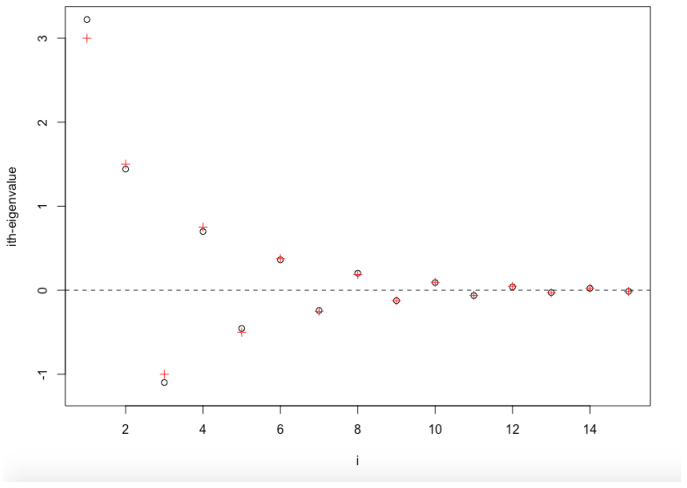
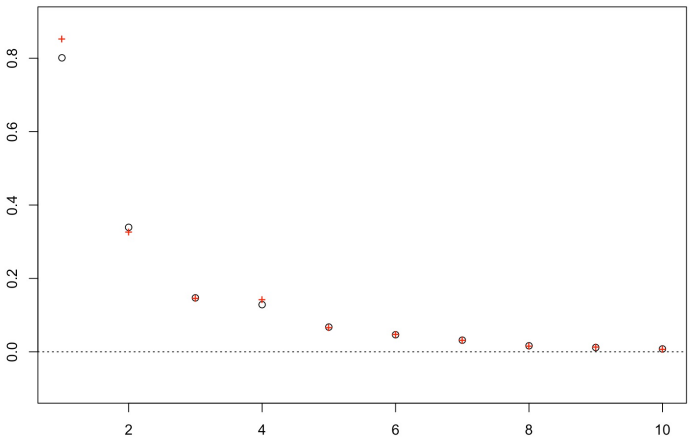
The authors use this to reprove earlier formulas of Collins, Hasebe and Sakuma for commutators and anticommutators, and to derive new formulas for sums like b1 a c1 plus ... plus bk a ck and for the polynomial a plus b a b a b. The last part of the paper runs numerical simulations at matrix size 300 and compares the predicted limiting eigenvalues to actual realizations. The matches are visually good and the first three moments agree, though no error bars or code are provided.
Extended reading notes
Core claim
The central result is Theorem 12: under cyclic monotone independence, EV(B0A1B1...AkBk) = EV(A1B'1...Ak(BkB0)'), where each B' is the entrywise expectation id⊗τ(B). If correct, this gives a general reduction of spectral computations for matrix-embeddable polynomials in cyclically monotone families, and, combined with CHS Theorem 9, yields limiting eigenvalue formulas for the corresponding random matrix polynomials.
Load-bearing premise
The paper relies on Proposition 5 (from CHS Corollary 2.6): if trace class selfadjoint elements have the same moments, they have the same eigenvalue multiset. This is used to turn moment equalities into eigenvalue equalities, and in some intermediate steps, such as A1B0*B0 in the proof of Theorem 7 part 1 or B0A1B1 in part 4, the element whose eigenvalues are inferred is not manifestly self-adjoint. If Proposition 5 fails or does not apply to those non-self-adjoint products, the eigenvalue conclusions would not follow from the trace identities. The paper cites this proposition but does not prove it.
Signed reviews
Editorial analysis
A structured set of objections, weighed in public.
Referee Report
Summary. The paper studies cyclically monotone independence, introduced by Collins, Hasebe and Sakuma (CHS), and aims to generalize their spectral formulas for polynomials in cyclically monotone elements. The main technique is a matrix-embedding argument: a product A1B1...AkBk has the same moments as the product with each Bp replaced by its entrywise expectation B'p (Proposition 10), which leads to an eigenvalue reduction theorem (Theorem 12). The paper then gives new proofs of CHS Theorem 7, a result on conjugation invariance (Proposition 14), a theorem on replacing an element b by τ(b) in certain positions (Theorem 17), and several numerical random matrix examples. The intended contribution is a general method for computing spectra of cyclic monotone polynomials.
Significance. If the central reduction were fully justified, this would be a useful and elegant extension of the CHS results: Proposition 10 is a clean moment identity, the random matrix examples are concrete and illustrative, and the paper explicitly shows which information about the B-family enters the limiting spectrum. The paper is clearly written and builds on CHS without introducing ad-hoc parameters. However, the main eigenvalue theorem (Theorem 12) is not proved as stated, because it passes from moment equality to eigenvalue equality for non-selfadjoint operators, where the invoked criterion does not apply. Since this gap is load-bearing for the paper's main general claim, the manuscript needs substantive revision.
major comments (2)
- [Section 3.1 (Theorem 12)] The proof of Theorem 12 is not valid. After Corollary 11 the text says 'By applying Proposition 5', but Proposition 5, stated in Section 2.1, applies only to selfadjoint trace-class elements. Neither X = B0A1B1...AkBk nor Y = A1B'1...Ak(BkB0)' is shown to be selfadjoint, and in general they are not. Moreover, Definition 4(3) does not give a well-defined eigenvalue multiset for non-selfadjoint X: the moment sequence of a trace-class operator does not determine the multiplicity of the eigenvalue 0. For example, the zero matrix and a nilpotent Jordan block of larger size have identical moment sequences but different eigenvalue multisets. Thus the equality EV(X) = EV(Y) does not follow from the moment equality of Corollary 11. This is a load-bearing gap because Theorem 12 is the central general reduction and is invoked in the proof of Theorem 7(1).
- [Section 3.1 (proof of Theorem 7(1))] The proof of Theorem 7(1) contains the same error at the step 'due to Corollary 5, B0A1B0* and A1B0*B0 must have the same eigenvalues'. Here A1B0*B0 is not selfadjoint in general, so Proposition 5 cannot be applied to it. Even if Theorem 12 were repaired, this particular step needs a separate argument: one would have to compare moments of the selfadjoint element B0A1B0* directly with those of the selfadjoint element √B diag(a1,...,ak)√B, or use a similarity argument after replacing B0*B0 by its expectation. As written, part 1 of Theorem 7 is not proven.
minor comments (6)
- [Section 3.1 (proof of Theorem 7(4))] In the first lines of the proof, the text writes 'ω(((i(ab+ba))^m)' where the polynomial should be i(ab−ba); this typo appears twice.
- [Section 3.1 (proof of Theorem 7(1))] The reference 'Corollary 5' should be 'Proposition 5', and the notation 'AB' is introduced without definition; the intended meaning is likely 'A1B' with A1 = diag(a1,...,ak) and B = (τ(b_i* b_j)).
- [Section 3.1 (proof of Theorem 7(1))] The sentence 'Since B is positive definite' should say 'positive semidefinite', since the matrix (τ(b_i* b_j)) is only positive semidefinite in general.
- [Section 3.3 (Theorem 17)] The statement uses both ℓ and k for the number of b-variables, and the proof only treats the case k = ℓ; the indexing should be made consistent.
- [Section 4 (Example 21)] The displayed limiting matrix has off-diagonal entries 1, but for independent centered GUE matrices B and C one expects trn(CB) and trn(BC) to converge to 0; the example needs a correction or a clarification of the normalization and correlation of B and C.
- [Section 2.1 (Definition 4)] In part 1, the moment set is described with inconsistent indices (m, n, and ϵ_n); the notation should be made uniform.
Assumptions & free parameters
assumptions (5)
- domain assumption Cyclic monotone independence definition (Eq. 2): ω(a1b1...anbn)=ω(a1...an)τ(b1)...τ(bn).
- domain assumption Moment-to-eigenvalue identification (Proposition 5, from CHS Corollary 2.6).
- domain assumption Asymptotic cyclic monotone independence for Haar-unitarily conjugated deterministic matrices (CHS Theorem 4.3, stated here as Theorem 9).
- standard math Traciality of ω and τ, and trace-class assumptions on the A family.
- domain assumption In numerical examples, GUE and Haar unitary ensembles converge to the appropriate free or semicircular limits with deterministic expectations.
Cite this review
Pith. "Pith review of Polynomials on cyclic monotone elements with applications to random matrices with discrete spectrum." pith.science (2026). https://pith.science/paper/FIBFXSQ3
@misc{pith2026190800562,
  author       = {Pith},
  title        = {Pith review of: Polynomials on cyclic monotone elements with applications to random matrices with discrete spectrum},
  year         = {2026},
  howpublished = {\url{https://pith.science/paper/FIBFXSQ3}},
  note         = {Machine review of arXiv:1908.00562}
}
read the original abstract
We provide a generalization and new proofs of the formulas of Collins, Hasebe and Sakuma for the spectrum of polynomials in cyclic monotone elements. This is applied to random matrices with discrete spectrum.
Figures

Reference graph
Works this paper leans on
-
[1]
S.T. Belinschi, D. Shlyakhtenko. (2012) , Free probability of type B: analytic aspects and applications, American Journal of Mathematics Vol. 134, 193--234
work page 2012
-
[2]
B. Collins, T. Hasebe, N. Sakuma, (2018) . Free probability for purely discrete eigenvalues of random matrices , Journal of the Mathematical Society of Japan, No. 3 1111--1150
work page 2018
-
[3]
R. Lenczewski , (2016). Matricial circular systems and random matrices, Random Matrices: Theory and Applications, 5(04), 1650012
work page 2016
-
[4]
C. Male . Traffic distributions and independence: permutation invariant random matrices and the three notions of independence. To appear in Memors of the AMS, ArXiv:1111.4662
-
[5]
J. A. Mingo, P. Sniady, R. Speicher , (2007). Second order freeness and fluctuations of random matrices: II. Unitary random matrices. Advances in Mathematics, 209(1), 212-240
work page 2007
-
[6]
Free probability of type B and asymptotics of finite-rank perturbations of random matrices
D. Shlyakhtenko, (2015) . Free probability of type B and asymptotics of finite-rank perturbations of random matrices. Preprint. arXiv:1509.08841
work page Pith review arXiv 2015
-
[7]
D. Voiculescu , (1991). Limit laws for random matrices and free products. Inventiones Mathematicae, 104(1), 201--220
work page 1991
Reviewed August 14, 2026 · model on record in the stance chip above.
Discussion (0). Continue with ORCID to comment.