REVIEW 3 major objections 4 minor 3 references
Universal precursor seismicity pattern before locked-segment rupture
T0 review · 3 major / 4 minor · reviewed 2026-08-14 · deepseek-v4-flash
Pith's one-line read The paper claims that two adjacent characteristic earthquakes reliably occur at the volume-expansion and peak-stress points of locked fault segments, a pattern found in 62 seismic zones that permits long-term prediction of certain major…
desk verdict A bold universal precursor claim that fails on circular validation—CE selection and magnitude revisions use the model itself, so the 62-zone confirmation is not an independent test. read the letter →
The pith
A machine-rendered reading of the paper's core claim, the machinery that carries it, and where it could break.
The reading
What carries the argument
The load-bearing object is the 'locked segment': a strong, less-brittle patch on a fault (for example an asperity, a rock bridge, or a locked patch in a creeping fault) that stores elastic strain and breaks in characteristic earthquakes. The mechanism is the pair of critical states, the volume-expansion point (VEP) and the peak-stress point (PSP), which are standard in rock mechanics. The quantitative core is a coupled renormalization-group and strain-softening model based on a Weibull heterogeneity parameter $m$, which yields a nearly constant strain ratio $\varepsilon_f/\varepsilon_c \approx 1.48$ for $m$ between 1 and 4. Substituting cumulative Benioff strain for shear strain turns this into the prediction rule $S_f(k) = 1.48^k S_c$, together with magnitude constraint conditions that identify which events in a catalogue are characteristic earthquakes and which are pre-shocks.
What would settle it
Pick a seismic zone with at least three well-recorded characteristic earthquakes that were identified without using equation [4]; use the first pair to fix the initial CBS error $\Delta$, then check whether the third event's cumulative Benioff strain equals $1.48^2 S_c$ within measurement uncertainty. A systematic miss, or a miss in any single zone, would falsify the claimed universality.
Extended reading notes
Core claim
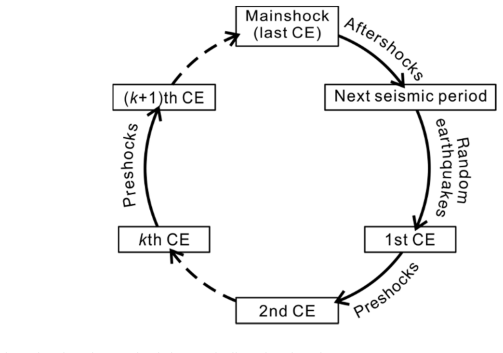
The central discovery is a deterministic relation between the damage states at which successive large earthquakes are born. The paper identifies a sequence of locked segments within a seismic zone that fail in ascending order of bearing capacity. A characteristic earthquake occurs when one segment reaches its volume-expansion point, and the next characteristic earthquake occurs when the same segment or the next in the chain reaches its peak-stress point. Because the ratio between the shear strains at those two points is nearly constant, the cumulative Benioff strain at the $k$-th characteristic earthquake is predicted by $S_f(k) = 1.48^k S_c$. The authors report that this relation holds in 62 seismic zones for earthquakes of various focal depths, and they take this as evidence that the pattern is universal and that characteristic earthquakes are predictable.
Load-bearing premise
The claim rests on being able to recognise the characteristic earthquakes in a catalogue before applying the model, and on cumulative Benioff strain faithfully representing the shear strain of a single locked segment.
Editorial extensions
If this is right
- For any well-defined seismic zone, once a characteristic earthquake is identified at a volume-expansion point, the cumulative Benioff strain of the next characteristic earthquake can be computed from $S_f(k) = 1.48^k S_c$.
- The last characteristic earthquake in a seismic period can be recognised by the condition $M_n - M_{n-1} > 0.5$, so a zone nearing the end of its sequence can be flagged for heightened hazard.
- Magnitudes of future characteristic earthquakes and of large pre-shocks are bracketed by constraints (equations [6]-[8]), giving a forecast magnitude range as well as a strain target.
- Because the pattern holds for shallow, intermediate, and deep events in both intraplate and interplate zones, the underlying locked-segment mechanism is claimed to apply broadly across tectonic settings.
- The quiet interval after the first foreshock offers an operational window: when recorded CBS approaches the predicted value, the time to the next characteristic earthquake can be estimated from lag times in the zone's history.
Reading between the lines
- The strongest test of the claim would be a prospective one: pick a seismic zone from the published catalogue, identify at least three characteristic earthquakes using only the magnitude rules, and use only the first pair to fix the initial error before checking the third; the paper's retrospective fits do not yet provide this out-of-sample check.
- If the 1.48 ratio is truly independent of the Weibull parameter over the stated range, the same scaling may reappear in other damage-and-failure processes, such as volcanic flank collapse or induced seismicity, where a locked patch stores strain before a main rupture.
- The paper's revision of historical magnitudes with its own constraint conditions makes the magnitudes partially model-dependent; an external dataset of well-instrumented characteristic earthquakes would let future work test the constraints without revision.
- Combining the CBS target with first-foreshock lag times could be turned into a probabilistic long-term forecast product for specific zones, but only after the false-alarm rate of VEP identification is measured on zones that did not produce a later characteristic earthquake.
Signed reviews
Editorial analysis
A structured set of objections, weighed in public.
Referee Report
Summary. The paper proposes a universal precursor seismicity pattern for locked-segment rupture. In a defined seismic zone, a characteristic earthquake (CE) occurring at the volume-expansion point (VEP) of a locked segment is followed by smaller pre-shocks and then another CE at the peak-stress point (PSP), with the cumulative Benioff strain (CBS) of successive CEs following Sf(k) = 1.48^k Sc (Eq. 4). The constant 1.48 is derived from a Weibull-renormalization-group model (Eqs. 1–2). The paper claims to have corroborated Eq. 4 retrospectively in 62 seismic zones worldwide, using magnitude constraint conditions (Eqs. 6–9) to revise catalog magnitudes and a per-zone initial CBS error delta fitted through Eq. 5. The authors conclude that the pattern is universal and permits prediction of certain characteristic earthquakes.
Significance. If the central claim were established by independent evidence, the paper would represent a major advance in long-term earthquake prediction, offering a deterministic rule with a physical mechanism grounded in rock-mechanics experiments. The derivation of a strain ratio of 1.48 from a Weibull model is an interesting theoretical contribution, and the large number of zones analyzed is superficially impressive. However, the significance is almost entirely undermined by the validation design: the CEs are selected and their magnitudes revised using constraint conditions derived from the same model framework, and a per-zone free parameter (delta) is fitted to the first CE pair. Consequently, the reported confirmation of Eq. 4 is not an independent test of the hypothesis. The paper also provides no statistical significance test, no null-model comparison, and no prospective or holdout prediction. As it stands, the paper does not establish the claimed universality.
major comments (3)
- [Materials and Methods / Case studies (Eqs. 5–9)] The validation loop is closed using the model itself. The manuscript states that magnitudes of CEs and pre-shocks are revised using constraint conditions (Eqs. 6–9) that are derived from the same locked-segment framework, and that the initial error delta is fitted via Eq. 5 so that the first CE pair satisfies Eq. 4. Thus the 'recorded' CBS values in Table 2 are not raw catalog measurements but post-hoc adjusted quantities. The identification of which earthquakes are CEs is also guided by the expected pattern, so the agreement with Eq. 4 in 62 zones is an in-sample fit, not a corroboration.
- [Equation 5 and per-zone fitting] Equation 5 introduces a free parameter delta per seismic zone, fitted so that the first two CEs exactly satisfy the geometric relation. With one free parameter per zone and flexible CE selection, obtaining a good fit to a geometric progression is not surprising. The paper does not report how many events per zone, how many alternative CE choices were considered, or how the fit degrades if delta is fixed or estimated from independent data. The claimed universality of the 1.48 ratio therefore rests on unfalsifiable in-sample fitting.
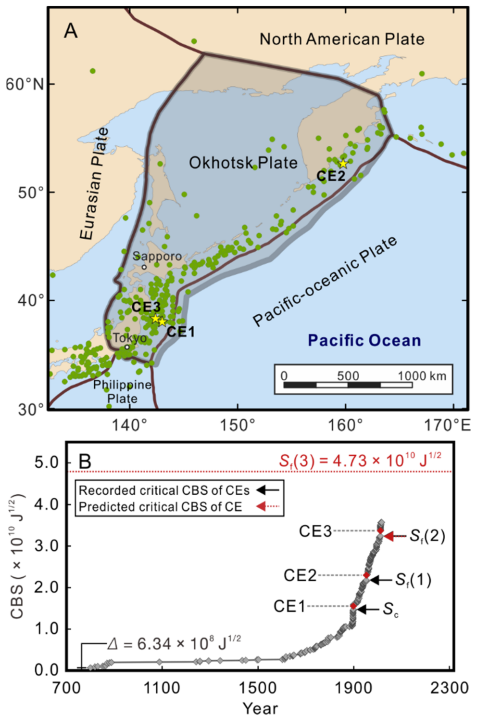
- [Case studies and statistics] No statistical test is provided for the agreement between recorded and predicted CBS values. For example, Table 2 shows three Tangshan and one Hokkaido predicted values, but no confidence intervals, no misfit measure, and no comparison to a null model (e.g., random selection of large earthquakes with a fitted delta). The statement that the pattern applies regardless of focal depth and 'has occurred in 62 seismic zones' is an assertion without supporting statistical analysis or detailed results beyond a few figures and references to earlier Chinese-language papers.
minor comments (4)
- [Materials and Methods] The definitions of Mv and the procedure for setting Mv are vague ('an analysis determines the threshold magnitude'); the paper should specify how Mv is chosen in each of the 62 zones and whether the choice was made before or after CE identification.
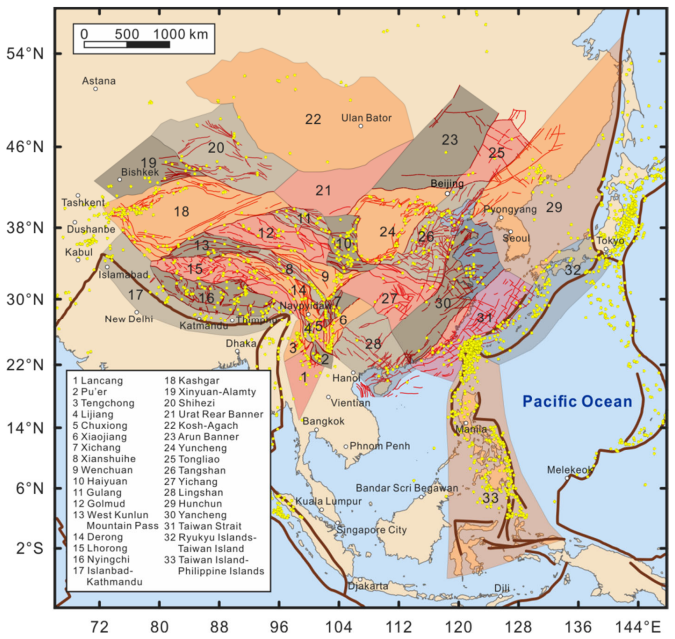
- [Figure S1 and S2] The supplementary figures are hard to read in the provided version: zone labels and earthquake symbols are small, and only a few representative CBS plots are shown. Readers cannot independently verify the 62-zone claim without the data and a complete table of CEs and fitted parameters.
- [Equations 6–9] The derivation of the magnitude constraint conditions is not shown; the paper cites references (37, 41–43) but the constraints appear to be empirical. The lower-limit inequality (Eq. 6) and upper-limit (Eq. 7) are presented without uncertainty quantification, and the 'comprehensive statistical analysis' is not summarized.
- [Main text, page 8] The sentence 'We revised the magnitudes of several large historical events ... using the aforementioned revision rules' is a key methodological step but is stated without detail on which events were revised, by how much, and based on which independent evidence. This is essential for assessing circularity.
Circularity Check
Circular validation: CEs and magnitudes are selected and revised using the model's own constraints, and a per-zone error is fitted, so the 62-zone confirmation of Eq. 4 is not an independent test.
-
fitted input called prediction
[Case studies (Tangshan), after Eqs. [4] and [5]; Fig. 4C and Table 2]
"The initial error of CBS was determined using equation [5]. Then, the correlation of critical CBS values among CEs in the seismic zone can be quantified using equation [4]. The data in Fig. 4 C and Table 2 show that the evolutions of these CEs match equation [4] very well, confirming our hypothesis."
Equation [5] is constructed from equation [4] so that the uncorrected CBS values at the VEP and PSP of the first locked segment are made to satisfy the 1.48 relation with a per-zone error delta. Solving for delta from the first pair forces that pair onto the geometric progression by construction. The same delta shifts every later CBS value, so the apparent agreement of CE2-CE5 in Fig. 4C and the 'predicted' values in Table 2 inherit the fitted initial condition rather than providing an independent, out-of-sample test of Eq. [4].
-
self definitional
[Mechanical model, magnitude constraint conditions, and identification criterion for mainshock (Eqs. [6]-[9]); Case studies (Tangshan)]
"Once the magnitude scale has been standardized (see Materials and Methods), formulas [6] and [7] can be used to revise and predict the magnitudes of CEs (except for a mainshock), whereas formula [8] can be used to revise and predict the magnitudes of large pre-shocks. Herein, these formulas are referred to as the magnitude constraint conditions."
The CBS values used to test Eq. [4] are computed from magnitudes that were altered with Eqs. [6]-[9], the same CE/PSP/locked-segment framework whose validity the paper claims to demonstrate. The magnitude revision rules are justified by the authors' prior classifications (41-43), not by an independent external standard. Thus the 'recorded' CBS values in Table 2 are model-adjusted quantities, and applying Eq. [4] to data reshaped by Eqs. [6]-[9] makes the confirmation at least partly self-fulfilling.
2 more flagged steps
-
self definitional
[Precursor seismicity pattern of locked segment; Case studies (Tangshan)]
"Twelve MS ≥ 7.0 earthquakes (Table 1) have been recorded in this zone, five of which qualify as CEs under the definition proposed above (Fig. 4B)... If these earthquakes are CEs that indicate VEPs and PSPs of locked segments, their evolutions should match equation [4]."
The paper's definition of a CE already presupposes the VEP-to-PSP pairing: a characteristic earthquake and a sequence of pre-shocks always arise prior to another CE, and the paper states that it hypothesizes CEs occur at VEPs and PSPs of locked segments. Selecting five of twelve large events as CEs, excluding or demoting non-fitting events to pre-shocks via Eq. [8], and then checking whether the selected events obey Eq. [4] tests the selection rule against itself. It does not independently establish that the pattern is universal.
-
self citation load bearing
[Mechanical model, magnitude constraint conditions, and identification criterion for mainshock, derivation of Eqs. [6]-[8]]
"According to the energy conversion and allocation principle during the damage process of a locked segment (37) and comprehensive statistical analysis (41-43) of all the earthquake cases conducted worldwide, we found that the lower-limit constraints for the magnitudes of two adjacent CEs or several successive CEs from the ith to the (i + j)th satisfy..."
The magnitude constraint conditions that are used to revise the catalog data before validation rest on references (37) and (41-43), which are the authors' own prior works (Qin et al., Progress in Geophysics, and a thesis by Yang). These self-citations supply the rules that reshape the magnitudes that are then used to confirm Eq. [4]. No externally checked, independent derivation of Eqs. [6]-[8] is provided, so the validation loop closes through a load-bearing self-citation chain.
full rationale
The derivation of the 1.48 ratio in Eq. [2] is not itself circular: it comes from a Weibull-based mechanical model with a stated heterogeneity range m in [1,4], and the constant is not fitted to earthquake CBS data. If the CEs were specified a priori from an independent catalog and the magnitudes were raw measurements, the agreement of later CBS values with Eq. [4] would be a substantive test. However, the empirical core of the paper is the claim that the pattern 'has occurred in 62 seismic zones worldwide.' That claim is validated through a closed loop: (i) a per-zone initial error delta is solved from Eq. [5] so that the first CE pair satisfies Eq. [4]; (ii) catalog magnitudes are revised using constraint conditions Eqs. [6]-[9], which are themselves derived from the same CE/locked-segment framework and from the authors' own prior publications; and (iii) CEs are selected after the fact from large earthquakes using the VEP/PSP definition, with non-fitting events demoted to pre-shocks. Consequently, the 'recorded' CBS values in Table 2 and the corresponding figures are not independent observations, and the agreement with Eq. [4] is substantially built into the data-processing choices. No prospective or holdout test is presented. The central load-bearing claim therefore reduces, in large part, to a fitted and self-defined validation loop. Score 8 reflects that the paper's main empirical claim is forced by construction and by self-citation, even though the mechanical 1.48 ratio itself retains independent content.
Assumptions & free parameters
free parameters (4)
- Strain ratio 1.48 =
1.48
- Initial CBS error delta per seismic zone =
Not specified numerically per zone
- Minimum validity magnitude Mv =
e.g., MS5.0 for Tangshan, MW7.0 for Hokkaido
- Magnitude revisions =
Various
assumptions (5)
- domain assumption Seismogenic locked segments are the dominant structures that generate tectonic earthquakes and rupture one-by-one in ascending order of bearing capacity.
- ad hoc to paper A characteristic earthquake occurs at the VEP of a locked segment and the next at the PSP, with load transfer bringing the next segment to its VEP.
- domain assumption Cumulative Benioff strain (CBS) can be substituted for shear strain in equation 3.
- standard math The ratio epsilon_f / epsilon_c is insensitive to the Weibull shape parameter m and equals 1.48 on average.
- ad hoc to paper The magnitude constraint conditions (equations 6 to 9) follow from an energy conversion and allocation principle.
Cite this review
Pith. "Pith review of Universal precursor seismicity pattern before locked-segment rupture." pith.science (2026). https://pith.science/paper/FJD2LMXG
@misc{pith2026190801929,
  author       = {Pith},
  title        = {Pith review of: Universal precursor seismicity pattern before locked-segment rupture},
  year         = {2026},
  howpublished = {\url{https://pith.science/paper/FJD2LMXG}},
  note         = {Machine review of arXiv:1908.01929}
}
read the original abstract
Despite the enormous efforts towards searching for precursors, no precursors have exhibited real predictive power with respect to an earthquake thus far. Seismogenic locked segments that can accumulate adequate strain energy to cause major earthquakes are very heterogeneous and less brittle; progressive failures of the locked segments with these properties can produce an interesting seismic phenomenon: a characteristic earthquake and a sequence of smaller subsequent earthquakes (pre-shocks) always arise prior to another characteristic earthquake within a well-defined seismic zone and its current seismic period. Applying a mechanical model and magnitude constraint conditions, we show that two adjacent characteristic earthquakes reliably occur at the volume-expansion and peak-stress points of a locked segment. Such a seismicity pattern has occurred in 62 seismic zones worldwide, suggesting that the pattern applies universally. Both the precursor pattern and the model quantifying it permit the prediction of certain characteristic earthquakes in a seismic zone.
Figures



Figures from the paper (4 more)

Reference graph
Works this paper leans on
-
[1]
S. Qin, B. Yang, X. Wu, L. Xue, P. Li, The identification of mainshock events for some seismic zones in mainland China (II). Prog Geophys 31, 115-142 (2016)
work page 2016
-
[2]
S. Qin, P. Li, B. Yang, L. Xue, X. Wu, The identification of mainshock events for main seismic zones in seismic belts of the Circum Pacific, ocean ridge and continental rift. Prog Geophys 31, 574-588 (2016)
work page 2016
-
[3]
Q. Deng, Y. Ran, X. Yang, W. Min, Q. Chu, Map of Active Tectonics in China (1:4000000) (Seismological Press, Beijing, 2007)
work page 2007
Reviewed August 14, 2026 · model on record in the stance chip above.
Discussion (0). Continue with ORCID to comment.