REVIEW 4 major objections 6 minor 3 cited by
Energized simplicial complexes
T0 review · 4 major / 6 minor · reviewed 2026-08-14 · deepseek-v4-flash
Pith's one-line read For any energy function on a finite simplicial complex, the connection-matrix determinant is the product of the energies, total energy is a matrix sum and a super trace, and eigenvalue sign counts match the signs of the energies.
desk verdict The determinant/energy/eigenvalue package is a plausible extension of Knill's earlier work, but the advertised inversion theorem for arbitrary sets of sets is false as stated and the proofs are too sketchy for the claims made. read the letter →
The pith
A machine-rendered reading of the paper's core claim, the machinery that carries it, and where it could break.
The reading
What carries the argument
The machinery is the stable/unstable decomposition of each set: the core W^-(x) (all sets in G contained in x) and the star W^+(x) (all sets in G containing x), whose intersection energies fill the matrices $L^{{--}}$ and $L^{{++}}$. The sign matrix S = diag((-1)^{dim x}) defines the super trace str(A) = tr(SA) and forms g = S $L^{{++}}$ S. The arguments run on four devices: a pairing/cancellation identity showing Lg is lower triangular with diagonal h(x)^2, which gives inversion for {−1, 1}-valued h; a path-pairing argument in the determinant that isolates the last set and cancels interacting paths, yielding det(L) = ∏ h(x) for arbitrary sets of sets; a t-deformation of one entry showing a linear determinant cannot pass through zero, proving the sign-count theorem; and a two-parameter deformation (throttling the outgoing energy T and varying the energy H of a newly added cell) that keeps the characteristic polynomials palindromic, establishing isospectrality of L and g in the constant-energy case. The spectral energy identity E[G] = str(g) is obtained by moving energy down along the dimension function, a discrete Morse/Gauss-Bonnet step.
What would settle it
Take the family G = {{1,2},{1}} with h ≡ 1: the energy equation ∑ g(x,y) = E[G] is already known to fail, showing where the simplicial-complex condition is essential. To test the broadest claim, enumerate all collections of non-empty subsets of {1,2,3} and for each compare the characteristic polynomials of $L^{{--}}$ and g; a single mismatch would refute the spectral-symmetry theorem as stated for arbitrary sets of sets.
Extended reading notes
Core claim
On the paper's own terms, the discovery is a family of four interlaced theorems. For any finite abstract simplicial complex G and any energy function h : G → R, the matrices L(x,y) = E[W^-(x) ∩ W^-(y)] and g = S $L^{{++}}$ S with S(x,y) = δ_{xy}(-1)^{dim x} satisfy det(L) = det(g) = ∏_x h(x); the total energy E[G] = ∑_x h(x) equals ∑_{x,y} g(x,y); E[G] = str(g) = tr(Sg); and the Morse index of L, g, and $L^{{++}}$ — the number of negative eigenvalues — coincides with the number of negative values of h. The paper also proves refinements: for h with values in {−1, 1} the matrices are unimodular and g = $L^{{-1}}$ even when G is only a set of sets; for constant h = 1, L and g are positive definite, inverse, isospectral integer matrices in SL(n, Z), producing isospectral multigraphs with matching spectral and Ihara zeta functions; for h(x) = ω(x) the energy is the Euler characteristic and ∏_x ω(x) is a product identity; and for h(x) = $t^{{|x|}}$ the identity becomes the sum over entries of g equals 1 − f_G(t), with g = $L^{{-1}}$.
Load-bearing premise
The load-bearing premise is that G is closed under taking subsets (a simplicial complex), because the cancellation pairings that prove inversion and the energy theorem require every intermediate subset of a set in G to be present; if G is merely an arbitrary set of sets those arguments can fail, the paper only claims the full energy theorem for simplicial complexes, and the final induction step of the spectral-symmetry proof is left sketched rather than written out.
Editorial extensions
If this is right
- For any simplicial complex and any choice of h, the determinant identity det(L) = ∏ h(x) gives a multiplicative Poincaré–Hopf relation, and the sign-count theorem means the numbers of positive and negative energies can be read off the spectrum of L or g.
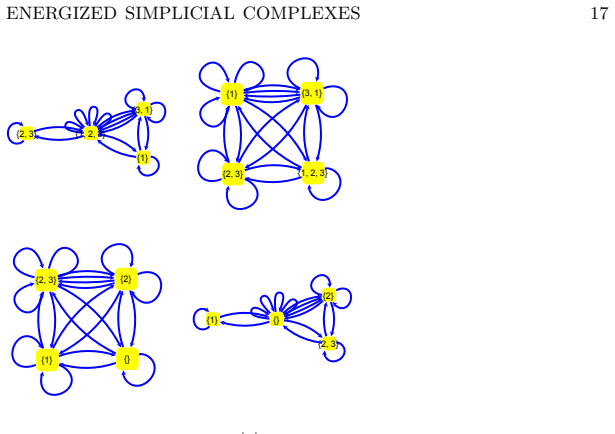
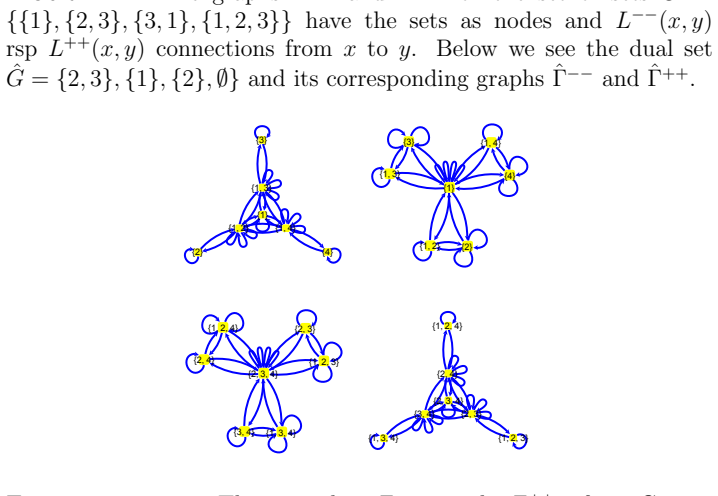
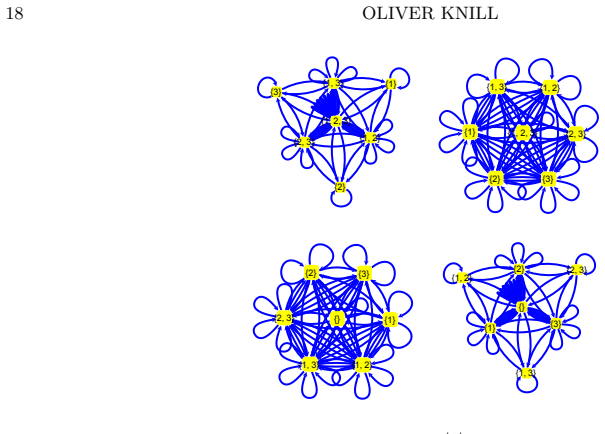
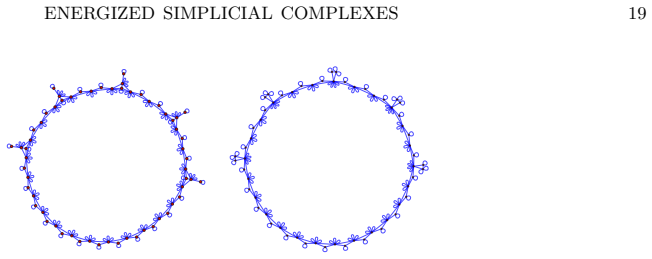
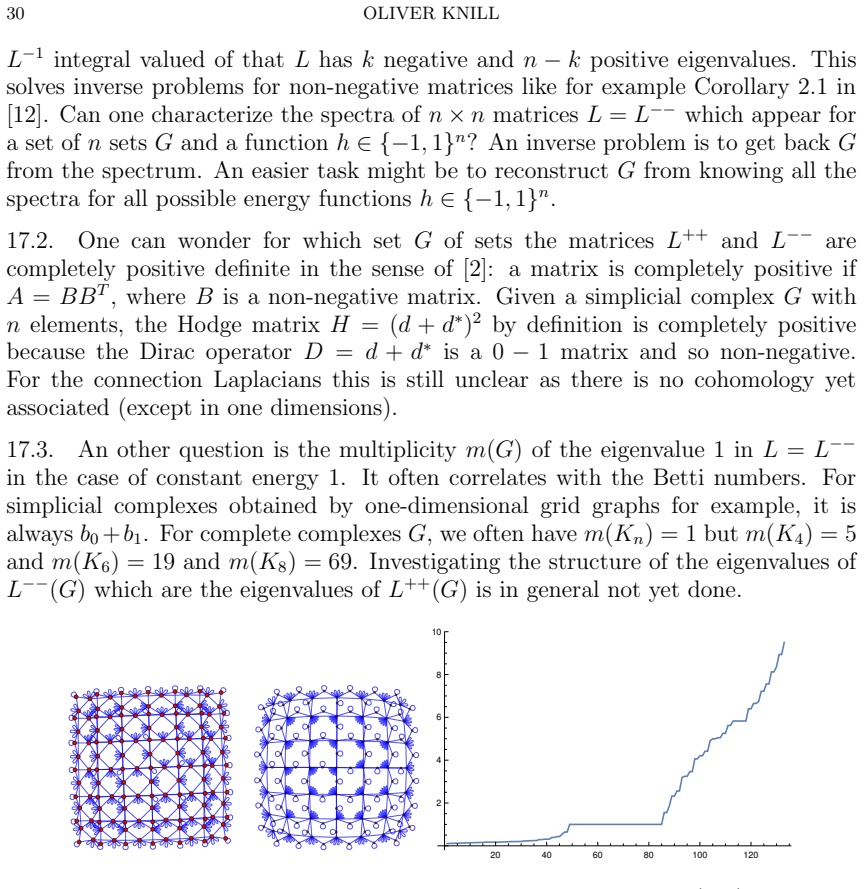
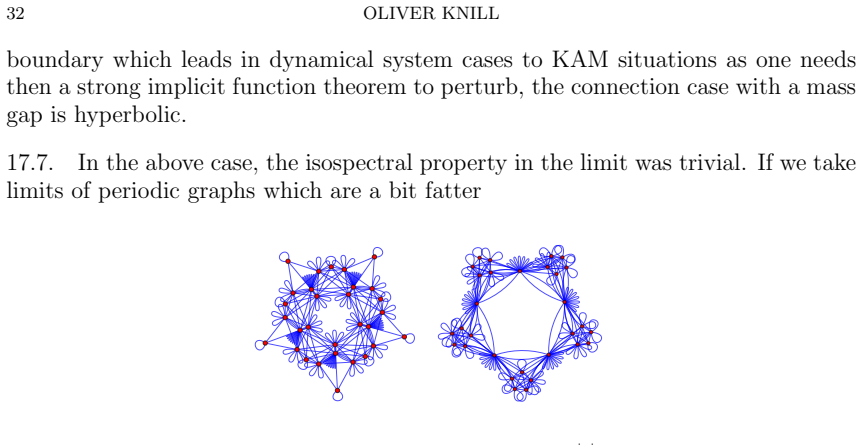
- In the constant-energy case, every finite set of sets yields two isospectral multigraphs Γ^{--} and Γ^{++} with identical spectral zeta and Ihara zeta functions, giving a flexible construction of isospectral graphs, including periodic and almost-periodic families in the large-size limit.
- The h(x) = (-1)^{dim x} specialization recovers the Euler characteristic as both the trace and the total potential of g, and the Fermi-characteristic product ∏ ω(x) as the determinant, now stated for arbitrary sets of sets.
- The parameterized case h(x) = t^{|x|} packages the entire f-vector polynomial through ∑_{x,y} g(x,y) = 1 − f_G(t), with g = L^{-1}, providing a rational Green function for the connection matrix.
- For h > 0 the matrices L and g are positive definite, so every set of sets defines a unimodular integral lattice, with consequences for lattice packings and the universality of the associated quadratic forms.
Reading between the lines
- Because the sign-count theorem holds at fixed h, deforming h continuously should move eigenvalues through zero one at a time, so the identities imply a spectral-flow picture where crossings are counted by changes in the number of negative energies — a topological index that the paper does not explicitly develop.
- The super-trace identity E[G] = str(g) is stated at the level of the Green matrix, but the McKean–Singer analogy suggests testing whether a one-parameter family str(e^{-tL}) or a heat-kernel version remains equal to E[G], which would give a dynamical refinement of the energy theorem.
- The isospectral multigraph construction is a factory for cospectral examples; one testable extension is whether random set-of-sets families produce unimodular lattices with systematically different packing or universality behaviour, a question the paper only opens in its final section.
- The multiplicative ring structure on energized complexes in Section 13 suggests that energy functions of the form h(x) = ∏_{i ∈ x} a_i (element-wise multiplicative) might preserve the inverse and energy identities, which would generalize the t^{|x|} case to multivariate parameters.
Signed reviews
Editorial analysis
A structured set of objections, weighed in public.
Referee Report
Summary. The paper proposes a framework of 'energized simplicial complexes': for a finite set of sets G and an integer-valued energy function h on G, it defines matrices L(x,y)=E[W^-(x)∩W^-(y)] and g=SL^{++}S, and claims that for any h the identities det(L)=det(g)=∏_x h(x), E[G]=∑_{x,y}g(x,y)=str(g), and the eigenvalue-sign count hold; for h∈{-1,1} it further claims L^{-1}=g even when G is merely a set of sets, and for constant h=1 it claims L and g are positive definite, unimodular, and isospectral for arbitrary sets of sets. The paper also discusses parametrized (t-dependent) versions, isospectral multigraph constructions, and connections to Riemann-Roch and divisor theory. The core results for simplicial complexes are presented as theorems with proof sketches, while the set-of-sets extensions are stated as additional theorems and illustrated with examples and Mathematica code.
Significance. If the simplicial-complex results are correct, the paper gives a clean and fairly general unification: the earlier unimodularity and energy identities for connection Laplacians are extended to arbitrary energy functions h, with determinant, supertrace, and eigenvalue-sign statements that hold without parameter fitting. The parametrized version and the construction of isospectral multigraphs from a single set of sets are attractive and potentially useful, and the paper ships reproducible code plus many explicit worked examples, which is a genuine strength. However, the advertised extension to arbitrary sets of sets is not uniformly correct: one of the central claims (L^{-1}=g for h∈{-1,1}) is false outside the simplicial-complex setting, and the proof of spectral symmetry for sets of sets is incomplete. The true scope is therefore narrower than the abstract states, and the paper needs substantial revision before its claims can be relied upon.
major comments (4)
- [Theorem 2 / Section 2.4 (and Abstract, item A)] The claim that g=SL^{++}S is the inverse of L=L^{--} whenever h takes values in {-1,1}, even for arbitrary sets of sets, is false. A concrete counterexample is G={{1},{1,2},{1,2,3}} with h(x)=1. Then L=[[1,1,1],[1,2,2],[1,2,3]], g=[[3,-2,1],[-2,2,-1],[1,-1,1]], and Lg is not the identity; indeed L^{-1}=[[2,-1,0],[-1,2,-1],[0,-1,1]] differs from g. The proof of Theorem 1(c) uses the 'complete complex formed by the complement of z in x', which exists only when G is closed under taking subsets; for an arbitrary set of sets that cancellation is not available. This is load-bearing because the abstract and Theorem 2 explicitly advertise the inverse identity 'even if G is a set of sets'.
- [Section 8.9 / Theorem 7] The proof of spectral symmetry for arbitrary sets of sets is incomplete. The text ends with 'This is shown if Tp(T,1/T)' and stops, without supplying the final argument that the quadratic polynomial is palindromic. The two-parameter deformation (T,H) is described qualitatively, but the crucial preservation of the palindromic property is asserted rather than proved; the claimed reduction via Laplace expansion and induction on n is not written out. Since Theorem 7 underpins the isospectral-multigraph corollaries in Section 10 and the positive-definite-lattice claims in Section 9, this gap must be filled or the theorem restricted to simplicial complexes.
- [Section 4.1 / Theorem 4] The eigenvalue-sign-count induction is not rigorous as written. The proof asserts that scaling the last entry by t makes the determinant linear in t, but the displayed deformation appears to scale both the last row and the last column, which would make the determinant quadratic in t unless only one side is scaled or the matrix is placed in a specific form. Moreover, the sentence 'A linear function between two positive values is never 0' handles only the case where the endpoint determinants have the same sign; when the previous product E and the new value h(x) have opposite signs, one must show that the crossing is simple and that the number of negative eigenvalues changes by exactly one. Please provide a complete continuity/interlacing argument.
- [Section 3.1 / Theorem 3] The determinant identity for arbitrary sets of sets is stated with a proof sketch that is not a derivation. Phrases such as 'interaction paths come in pairs' and 'these pairs cancel' describe a combinatorial cancellation, but no bijection or sign-counting is given, and the claim that 'if x is gone ... W^+(y)∩W^-(y)=0' does not by itself establish the determinant formula for a general set of sets. The result may be true, but the proof should be made complete or the theorem restricted to the simplicial-complex setting where the closure property holds.
minor comments (6)
- [Throughout] The manuscript contains many typos and infelicities (for example, 'even-so', 'we have also seen', 'simplicial complex complex', and inconsistent use of 'spin case' in the code comments in Section 16.1). A careful proofreading pass is needed.
- [Section 2.4] The proof of Theorem 1 silently uses the closure property of simplicial complexes; this should be stated explicitly at the start of the theorem, because the subsequent set-of-sets claim depends exactly on this point.
- [Section 8.7] The coefficient list for T=0,H=1 is printed as identical to the list for T=0,H=0; please verify the entries, since the surrounding text suggests the two should differ.
- [Section 12.2 / Theorem 8] The proof of the parametrized determinant formula is a single sentence ('Proceed by induction ... Every time we add a cell, the determinant gets multiplied by (-t)^|x|') and should be expanded to make the induction step explicit.
- [Section 5.2] The proof of Theorem 5 is cryptic: the reduction to the spectral-energy theorem is stated in a few lines and refers to an equivalence that is not fully explained. Please rewrite this argument with all definitions spelled out.
- [Section 15] The references to the author's earlier preprints [7,9,10] are used for the h=1 and h=ω cases; the novelty of the present paper relative to those works should be stated more clearly, and published versions should be cited if they exist.
Circularity Check
No by-construction circularity: the main determinant, energy, and eigenvalue theorems are derived for arbitrary h from the definitions, while the cited self-papers are only invoked for special cases and are not load-bearing for the general results.
full rationale
The central claims (Theorems 3, 5, 6, and 4) are stated for an arbitrary energy function h and are derived from the definitions of L, L++, g, and the basic simplicial-complex identity sum_{x subseteq y} omega(x) = 1. No parameter is fitted to a subset of data and then renamed as a prediction; h is not chosen after the fact. The determinant identity det(L) = det(g) = prod_x h(x) is proved by a cancellation pairing, and the energy and supertrace identities reduce to the same combinatorial identity rather than to the cited special cases. Citations [9] and [10] are used only for the special cases h = 1 and h = omega, and those cases are consequences of the general theorems, not inputs to them. The only potentially load-bearing self-citation is attached to Theorem 7 (constant-energy isospectrality): Section 7.1 says the result was 'mentioned in [9] already', and the paper's own deformation proof is left incomplete at Section 8.9, which ends with 'This is shown if Tp(T,1/T)' and no concluding argument. That is a missing proof or correctness risk, not a by-construction circularity, because the statement is not built into the definitions of L or g and no equation from [9] is substituted as an unexamined premise. Similarly, the advertised extension of L^{-1} = g to arbitrary sets of sets is false (e.g., G = {{1},{1,2},{1,2,3}} with h = 1 gives L and g that are not inverse), but a false generalization is a correctness defect, not a circular reduction. Overall, no prediction reduces to its inputs by construction; at most there is a minor self-citation for a special-case theorem whose proof in this paper is unfinished.
Assumptions & free parameters
assumptions (3)
- domain assumption G is a finite abstract simplicial complex, closed under taking non-empty subsets, whenever the energy theorem and inversion theorem are invoked.
- standard math A finite set of sets can be ordered so that inclusion respects the order and a maximal cell can be appended last.
- standard math For a positive definite matrix, palindromic characteristic polynomial coefficients are equivalent to reciprocal eigenvalue symmetry.
Cite this review
Pith. "Pith review of Energized simplicial complexes." pith.science (2026). https://pith.science/paper/FJI5X7DT
@misc{pith2026190806563,
  author       = {Pith},
  title        = {Pith review of: Energized simplicial complexes},
  year         = {2026},
  howpublished = {\url{https://pith.science/paper/FJI5X7DT}},
  note         = {Machine review of arXiv:1908.06563}
}
read the original abstract
For a simplicial complex with n sets, let W^-(x) be the set of sets in G contained in x and W^+(x) the set of sets in G containing x. An integer-valued function h on G defines for every A subset G an energy E[A]=sum_x in A h(x). The function energizes the geometry similarly as divisors do in the continuum, where the Riemann-Roch quantity chi(G)+deg(D) plays the role of the energy. Define the n times n matrices L=L^--(x,y)=E[W^-(x) cap W^-(y)] and L^++(x,y) = E[W^+(x) cap W^+(y)]. With the notation S(x,y)=1_n omega(x) =delta(x,y) (-1)dim(x) and str(A)=tr(SA) define g=S L^++ S. The results are: det(L)=det(g) = prod_x in G h(x) and E[G] = sum_x,y g(x,y) and E[G]=str(g). The number of positive eigenvalues of g is equal to the number of positive energy values of h. In special cases, more is true: A) If h(x) in -1, 1}, the matrices L=L^--,L^++ are unimodular and L^-1 = g, even if G is a set of sets. B) In the constant energy h(x)=1 case, L and g are isospectral, positive definite matrices in SL(n,Z). For any set of sets G we get so isospectral multi-graphs defined by adjacency matrices L^++ or L^-- which have identical spectral or Ihara zeta function. The positive definiteness holds for positive divisors in general. C) In the topological case h(x)=omega(x), the energy E[G]=str(L) = str(g) = sum_x,y g(x,y)=chi(G) is the Euler characteristic of G and phi(G)=prod_x omega(x), a product identity which holds for arbitrary set of sets. D) For h(x)=t^|x| with some parameter t we have E[H]=1-f_H(t) with f_H(t)=1+f_0 t + cdots + f_d t^d+1 for the f-vector of H and L(x,y) = (1-f_W^-(x) cap W^-(y)(t)) and g(x,y)=omega(x) omega(y) (1-f_W^+(x) cap W^+(y)(t)). Now, the inverse of g is g^-1(x,y) = 1-f_W^-(x) cap W^-(y)(t)/t^dim(x cap y) and E[G] = 1-f_G(t)=sum_x,y g(x,y).
Figures

Figures from the paper (12 more)




Forward citations
Cited by 3 Pith papers
-
Dehn Sommerville Manifolds
Dehn-Sommerville manifolds form a broad class of finite simplicial complexes that the paper claims to endow with Dehn-Sommerville face symmetries, level-set closure, chromatic bound 2q+2, and monoid closure under joins.
-
Euler Characteristics of Random Manifolds
For a random codimension-1 level set H in a simplicial complex G, E[χ(H)] equals 2−2K(G)−χ(G), with K the curvature functional built from the f-vector.
-
Elements of finite geometry I
A review-style snapshot of twelve finite-geometry theorems, each claiming a discrete analogue of a well-known continuum result.
Reference graph
Works this paper leans on
-
[9]
O. Knill. The counting matrix of a simplicial complex. https://arxiv.org/abs/1907.09092, 2019
arXiv 1907
-
[10]
O. Knill. The energy of a simplicial complex. https://arxiv.org/abs/1907.03369, 2019
arXiv 1907
-
[1]
M. Baker and S. Norine. Riemann-Roch and Abel-Jacobi theory on a finite graph. Advances in Mathematics , 215:766–788, 2007
work page 2007
-
[2]
A. Berman and N. Shaked-Monderer. Completely Positive Matrices . World Scientific, 2003
work page 2003
-
[3]
Cycon, R.G.Froese, W.Kirsch, and B.Simon
H.L. Cycon, R.G.Froese, W.Kirsch, and B.Simon. Schr¨ odinger Operators—with Application to Quantum Mechanics and Global Geometry . Springer-Verlag, 1987
work page 1987
-
[4]
L. Halbeisen and N. Hungerb¨ uhler. Generation of isospectral graphs. J. Graph Theory , 31(3):255–265, 1999
work page 1999
-
[5]
R. James and R. Miranda. A riemann-roch theorem for edge-weighted graphs. Proceedings of the AMS , 141:3793–3802, 2013
work page 2013
-
[6]
O. Knill. Universality for Barycentric subdivision. http://arxiv.org/abs/1509.06092, 2015. ENERGIZED SIMPLICIAL COMPLEXES 33
arXiv 2015
Show all 12 references
-
[7]
O. Knill. One can hear the Euler characteristic of a simplicial complex. https://arxiv.org/abs/1711.09527, 2017
2017 arXiv
-
[8]
O. Knill. The amazing world of simplicial complexes. https://arxiv.org/abs/1804.08211, 2018
2018 arXiv
-
[11]
M. Novic M. Randic and D. Plavsic. Solved and Unsolved Problems of Structural Chemistry . CRC Press, 2016
2016
-
[12]
H. Minc. Nonnegative Matrices. John Wiley and Sons, 1988. Department of Mathematics, Harvard University, Cambridge, MA, 02138
1988
Reviewed August 14, 2026 · model on record in the stance chip above.
Discussion (0). Continue with ORCID to comment.