REVIEW 3 major objections 3 minor 1 cited by
Hall--Littlewood expansions of chromatic quasisymmetric polynomials using linked rook placements
T0 review · 3 major / 3 minor · reviewed 2026-08-06 · deepseek-v4-flash
Pith's one-line read Linked rook placements give a Hall–Littlewood expansion of chromatic quasisymmetric functions.
desk verdict The main Hall-Littlewood expansion is false for γ=N^2E^2; the linked rook model is promising but the paper's central theorems fail in the simplest case. read the letter →
The pith
A machine-rendered reading of the paper's core claim, the machinery that carries it, and where it could break.
The reading
What carries the argument
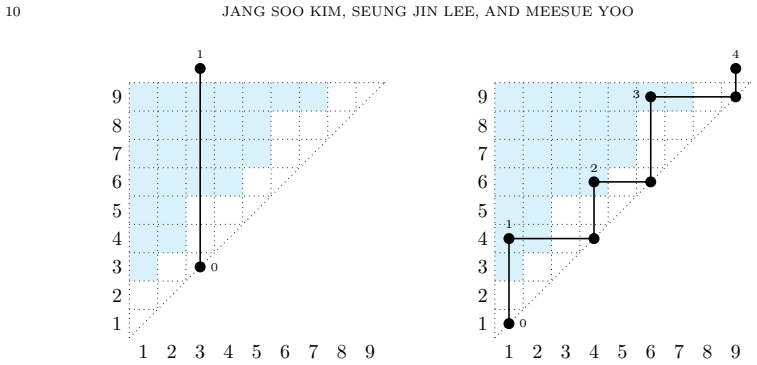
The central object is the linked rook placement: a set of chains of non-attacking rooks on the Ferrers board under a Dyck path, where consecutive rooks $(i,j)$ and $(j,k)$ in a chain share the middle coordinate. The extended linked rook placement adds one diagonal cell per chain and an extra row, and the rank of an extended rook in its column or row decides whether a cell above the path is free; a free cell is encoded as an fc-pair. The coefficient $r_{\gamma,\mu}(q)=\sum_{P}q^{\operatorname{fc}_\gamma(P)}$ over placements of type μ is what carries the argument, since it supplies the Hall–Littlewood coefficients up to the factor $q^{\operatorname{area}(\gamma)-n(\mu)}\prod_i[m_i(\mu)]_q!$. The proof mechanism is the modular-law criterion for functions on Dyck paths, together with explicit bijections that keep track of free-cell counts when rows or columns are exchanged, and a multiplicativity bijection for concatenating a Dyck path with $N^kE^k$.
What would settle it
Compare both sides of Theorem 3.6 coefficient by coefficient in the Hall–Littlewood basis for a small non-complete Dyck path such as $\gamma=N^3E^3$; any mismatch localizes an error in the modular-law bijections. For Theorem 3.8, evaluate the stated expansion at $\gamma=N^2E^2$ and check whether the identity holds; this single path settles the validity of the plethystic application.
Extended reading notes
Core claim
The central claim, stated as Theorem 3.6, is that $X_\gamma(x;q)=\sum_{\mu\vdash n} q^{\operatorname{area}(\gamma)-n(\mu)}r_{\gamma,\mu}(q)\left(\prod_i [m_i(\mu)]_q!\right)P_\mu(x;q)$, where $r_{\gamma,\mu}(q)$ is the generating function over linked rook placements of type μ weighted by the number of free cells. The linked rook placement is a chain of rooks $(a_1,b_1),\ldots,(a_\ell,b_\ell)$ with $b_i=a_{i+1}$, and the free cells are defined through an extended placement that adds diagonal cells and an extra row; the statistics are tracked by ranks and fc-pairs. The paper proves the identity by verifying the modular law, multiplicativity under concatenation with $N^kE^k$, and the complete graph value $[n]_q!e_n$, and then invoking the modular-law criterion to conclude the right-hand side coincides with $X_\gamma$. The $q=1$ specialization recovers the classical rook expansion, and the coefficients refine $q$-rook polynomials. A further theorem derives unicellular LLT expansions from the plethystic relation; the paper presents these as consequences of the same coefficients.
Load-bearing premise
The proof of the main expansion hangs on the modular-law and multiplicativity bijections for linked rook placements; separately, the LLT corollary hangs on the plethystic relation $X_\gamma(x;q)=(q-1)^{-n}\mathrm{LLT}_\gamma[(q-1)X;q]$, whose application appears to break down for the Dyck path $\gamma=N^2E^2$.
Editorial extensions
If this is right
- At $q=1$ the formula recovers the ordinary rook-counting monomial expansion of $X_\gamma$, so the main theorem is a genuine $q$-analogue of that classical identity.
- Summing the linked-rook coefficients by length gives $R_{n-k}(\gamma;q)=\sum_{\ell(\mu)=k} r_{\gamma,\mu}(q)$, so the new coefficients refine $q$-rook polynomials by partition type.
- The principal specialization $X_\gamma(1,q,\ldots,q^{\alpha-1};q)=q^{\operatorname{area}(\gamma)}\prod_i[\alpha-a_i(\gamma)]_q$ is recovered, connecting the coefficients to $q$-rook and $q$-hit polynomial data.
- Where the plethystic relation is valid, the same linked-rook coefficients give a combinatorial description of unicellular LLT polynomials in the modified transformed Hall–Littlewood basis.
- The modular-law proof provides an independent construction of a function on Dyck paths determined by complete-graph values, so the same coefficients can be tested against other expansions of chromatic quasisymmetric functions.
Reading between the lines
- If the main expansion is correct for every Dyck path, the coefficients $r_{\gamma,\mu}(q)$ form a partition-type refinement of the $q$-rook polynomial, and the principal-specialization comparison suggests a natural refinement of $q$-hit polynomials that the paper does not construct.
- The apparent failure of the LLT corollary on $\gamma=N^2E^2$ indicates that the plethystic relation, or its application after substituting $X/(q-1)$, may require correction; because the main theorem is proved independently through the modular law, the two results stand or fall separately.
- A direct bijection between linked rook placements and the pairs of P-tableaux and semistandard Young tableaux that appear in the Schur expansion would give a transparent proof of the Hall–Littlewood coefficients and would test whether the free-cell statistic has a simpler equivalent description.
Editorial analysis
A structured set of objections, weighed in public.
Referee Report
Summary. The paper introduces linked rook placements and defines a generating function r_{\gamma,\mu}(q) over them. It claims in Theorem 3.6 that the chromatic quasisymmetric function X_\gamma(x;q) of a natural unit interval order has a Hall--Littlewood expansion whose coefficients are q^{area(\gamma)-n(\mu)} r_{\gamma,\mu}(q) \prod_i [m_i(\mu)]_q!. The proof follows the Abreu--Nigro modular-law criterion, with the bulk of the work in Lemmas 4.6 and 4.7, which are verified by diagrams. Applying the Carlsson--Mellit relation (Proposition 2.5), the paper then derives Theorem 3.8, a modified Hall--Littlewood expansion for unicellular LLT polynomials. The paper also gives a refinement of q-rook polynomials and poses several open problems.
Significance. If correct, the linked-rook description would be a natural q-analogue of the Stanley--Stembridge rook formula and would provide a new combinatorial model for Hall--Littlewood coefficients of chromatic quasisymmetric functions. The modular-law strategy is reasonable and the paper is self-contained. However, the manuscript contains internal counterexamples to its advertised theorems: Theorem 3.8 fails for a two-vertex path under the paper's own definitions, and a direct n=2 computation indicates that Theorem 3.6 itself is false as stated. The proofs are not machine-checked, and the main combinatorial lemmas rely on unformalized figure-based case checks. The claimed results therefore cannot be accepted in their current form.
major comments (3)
- [Section 4, Proposition 4.3 and Theorem 3.6, Eq. (3.1)] Proposition 4.3 is false for n=2 under the definitions as written. For \gamma=N^2E^2, the singleton linked rook ((1,2)) is a valid linked rook placement; its unique extension is the extended linked rook (1,1),(1,2),(2,2),(2,3), which covers both diagonal cells, so its type is (2). There are no cells above \gamma, hence no free cells, and r_{\gamma,(2)}=1. This directly contradicts the assertion in the proof of Proposition 4.3 that LRP(\gamma,\mu)=\emptyset unless \mu=(1^n). Substituting into (3.1), with area(N^2E^2)=1, n((2))=0, n((1,1))=1, P_{(2)}=h_2-q e_2 and [2]_q! P_{(1,1)}=(1+q)e_2, gives q(h_2-q e_2)+(1+q)e_2, whereas Definition 2.1 gives X_\gamma=(1+q)e_2. Thus the main theorem fails for n=2 unless a different notion of type or extension is intended, which is not stated.
- [Section 2.6 and Section 3, Proposition 2.5 and Theorem 3.8] Theorem 3.8 is false for \gamma=N^2E^2. Definition 2.4 gives LLT_\gamma=h_2+q e_2 for this path, while Definition 2.1 gives X_\gamma=(1+q)e_2. Since both are homogeneous of degree 2, the plethysm in (2.6) would force X_\gamma=h_2+q e_2, a contradiction. Independently, the proof of Theorem 3.8 inserts the factor (1-q)^{n-\ell(\mu)} outside the sum over \mu without justification: using [m]_q!=(q;q)_m/(1-q)^m and homogeneity of P_\mu, the factors (q-1)^n and (q-1)^{-n} cancel globally, and no \mu-dependent power of (1-q) remains. The statement is also ill-formed because the exponent n-\ell(\mu) depends on the summation variable \mu. For n=2, the first identity predicts h_2 and the second predicts e_2, both disagreeing with Definition 2.4.
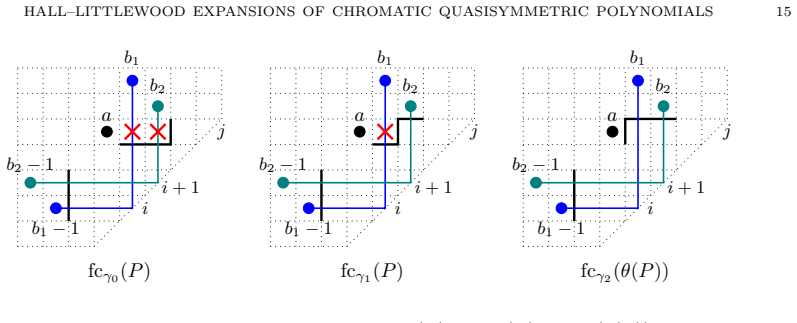
- [Section 4.1, Lemmas 4.6 and 4.7] The proofs of Lemmas 4.6 and 4.7 are not formal. In each case, after defining a bijection, the equality of free-cell generating functions is asserted by reference to Figures 8--17 (e.g., "by Figure 8, we have...") without a written argument that cells away from the displayed local configuration are unaffected or that the displayed ranks determine the counts. Since these two lemmas constitute the entire proof of Proposition 4.1, the modular law for Y_\gamma is not established as a verifiable proof. This is a rigor gap independent of the counterexamples above.
minor comments (3)
- [Section 2.3, Eq. (2.5)] Equation (2.5) is written with the product \prod_{i=1}^{\ell(\mu)}(q;q)_{m_i(\mu)}; this indexing is inconsistent with the factors needed, since for \mu=(3,1) it would omit the multiplicity m_3. The product should be over all i with m_i(\mu)>0 or over all i\ge 1. The identity should also be checked for consistency with (2.4), since for \mu=(2) the two sides appear to differ.
- [Section 3, Theorem 3.8] The first displayed equation in Theorem 3.8 places (1-q)^{n-\ell(\mu)} outside the summation over \mu, but \ell(\mu) is not defined until the summation variable is specified; the factor must either be moved inside the sum or the theorem restated. The same issue appears in the proof.
- [Throughout] There are several smaller presentation issues: the abstract and introduction refer to Theorem 1.4 while the body states the result as Theorem 3.8; the phrase "row counted from the left" in the definition of a_i(\gamma) is ambiguous; and Definition 3.2 allows cells (i,j) with i\le j but then places u_{2\ell} in the extended row, whose coordinates have j=n+1, so the formal scope of j should be clarified.
Circularity Check
No significant circularity: Theorem 3.6 is proved from independent external inputs, and the LLT corollary is a derived consequence rather than an assumed conclusion.
full rationale
The central derivation is self-contained against independent external results. Theorem 3.6 defines the linked-rook coefficient r_{γ,μ}(q) purely combinatorially (Definition 3.5), then proves the expansion by verifying the Abreu–Nigro modular-law criterion (Theorem 2.3): Proposition 4.1 checks the modular law for Y_γ, Proposition 4.2 checks multiplicativity via the Pieri rule and the bijection in Lemma 4.12, and Proposition 4.3 checks the complete-graph case using only P_{(1^n)}=e_n and the definition of LRP. No parameter is fitted to X_γ, and no occurrence of the target expansion is used as an input. The Hall–Littlewood identity (2.5) and the Pieri rule are standard external facts. The LLT corollary (Theorem 3.8) is obtained by applying the cited Carlsson–Mellit relation (2.6) to Theorem 3.6; it is a transformation of the same expansion, not a circular reuse. The only self-citation visible is [HOY25] in Section 5.2, a concluding remark on q-rook refinements that is not load-bearing. The noted failure of Theorem 3.8 for γ=N^2E^2 is a substantive correctness problem in the plethystic computation or the quoted relation, but it is not an instance of a conclusion reducing to its premises by construction, so it does not change the circularity score.
Assumptions & free parameters
assumptions (5)
- domain assumption Abreu-Nigro theorem: a function on Dyck paths satisfying the modular law is determined by its values on disjoint unions of complete graphs (Theorem 2.3)
- domain assumption The chromatic quasisymmetric function X_γ satisfies the modular law (from AN21)
- domain assumption Carlsson-Mellit relation X_γ(x;q) = (q-1)^{-n} LLT_γ[(q-1)X;q] (Proposition 2.5)
- standard math Pieri rule for Hall-Littlewood polynomials
- standard math Kostka-Foulkes expansion (2.5)
Cite this review
Pith. "Pith review of Hall--Littlewood expansions of chromatic quasisymmetric polynomials using linked rook placements." pith.science (2026). https://pith.science/paper/FJNHJPKY
@misc{pith2026250623082,
  author       = {Pith},
  title        = {Pith review of: Hall--Littlewood expansions of chromatic quasisymmetric polynomials using linked rook placements},
  year         = {2026},
  howpublished = {\url{https://pith.science/paper/FJNHJPKY}},
  note         = {Machine review of arXiv:2506.23082}
}
read the original abstract
In this work, we obtain a Hall--Littlewood expansion of the chromatic quasisymmetric function arising from a natural unit interval order and describe the coefficients in terms of linked rook placements. Applying the Carlsson--Mellit relation between chromatic quasisymmetric functions and unicellular LLT polynomials, we also obtain a combinatorial description for the coefficients of the unicellular LLT polynomials expanded in terms of the modified transformed Hall--Littlewood polynomials.
Figures


Figures from the paper (15 more)




Forward citations
Cited by 1 Pith paper
-
A tableaux formula for $q$-rook numbers
A weighted sum over standard Young tableaux computes Garsia-Remmel q-rook numbers, and this reconnects them to LLT function coefficients.
Reference graph
Works this paper leans on
-
[2]
Fred Butler, James Haglund, and Jeffrey B. Remmel. Notes on rook polynomials. unpublished manuscript
-
[1]
Chromatic symmetric functions from the modular law
Alex Abreu and Antonio Nigro. Chromatic symmetric functions from the modular law. J. Combin. Theory Ser. A , 180:Paper No. 105407, 30, 2021
work page 2021
-
[3]
Augustin Louis Cauchy. M\' e moire sur les fonctions qui ne peuvent obtenir que deux valeurs \' e gales et de signes contraires par suite des transpositions op\' e r\' e es entre les variables qu'elles renferment. 10(17):29--112, 1815
-
[4]
A proof of the shuffle conjecture
Erik Carlsson and Anton Mellit. A proof of the shuffle conjecture. J. Amer. Math. Soc. , 31(3):661--697, 2018
work page 2018
-
[5]
Laura Colmenarejo, Alejandro H. Morales, and Greta Panova. Chromatic symmetric functions of D yck paths and q -rook theory. European J. Combin. , 107:Paper No. 103595, 36, 2023
work page 2023
-
[6]
An interpretation for G arsia and R emmel's q -hit numbers
Morris Dworkin. An interpretation for G arsia and R emmel's q -hit numbers. J. Combin. Theory Ser. A , 81(2):149--175, 1998
work page 1998
-
[7]
Incomparability graphs of (3+1) -free posets are s -positive
Vesselin Gasharov. Incomparability graphs of (3+1) -free posets are s -positive. Discrete Math. , 157(1-3):193--197, 1996
work page 1996
-
[8]
Ian P. Goulden and David M. Jackson. Immanants of combinatorial matrices . J. Algebra , 148(2):305--324, 1992
work page 1992
Show all 28 references
-
[9]
Griffin, Anton Mellit, Marino Romero, Kevin Weigl, and Joshua Jeishing Wen
Sean T. Griffin, Anton Mellit, Marino Romero, Kevin Weigl, and Joshua Jeishing Wen. On Macdonald expansions of q -chromatic symmetric functions and the Stanley-Stembridge Conjecture . Preprint , arXiv:2504.06936 https://arxiv.org/abs/2504.06936, 2025
2025 arXiv
-
[10]
A modular relation for the chromatic symmetric functions of (3+1)-free posets
Mathieu Guay-Paquet. A modular relation for the chromatic symmetric functions of (3+1)-free posets . Preprint , arXiv:1306.2400 https://arxiv.org/abs/1306.2400, 2013
2013 arXiv
-
[11]
Morales, and Eric Rowland
Mathieu Guay-Paquet, Alejandro H. Morales, and Eric Rowland. Structure and enumeration of (3+1) -free posets. Ann. Comb. , 18(4):645--674, 2014
2014
-
[12]
Garsia and Jeffrey B
Adriano M. Garsia and Jeffrey B. Remmel. Q -counting rook configurations and a formula of F robenius. J. Combin. Theory Ser. A , 41(2):246--275, 1986
1986
-
[13]
Proof of a conjecture on immanants of the J acobi-- T rudi matrix
Curtis Greene. Proof of a conjecture on immanants of the J acobi-- T rudi matrix. Linear Algebra Appl. , 171:65--79, 1992
1992
-
[14]
q -rook polynomials and matrices over finite fields
James Haglund. q -rook polynomials and matrices over finite fields. Adv. in Appl. Math. , 20(4):450--487, 1998
1998
-
[15]
The q , t - C atalan numbers and the space of diagonal harmonics , volume 41 of University Lecture Series
James Haglund. The q , t - C atalan numbers and the space of diagonal harmonics , volume 41 of University Lecture Series . American Mathematical Society, Providence, RI, 2008. With an appendix on the combinatorics of Macdonald polynomials
2008
-
[16]
Hecke algebra characters and immanant conjectures
Mark Haiman. Hecke algebra characters and immanant conjectures . J. Amer. Math. Soc. , 6(3):569--595, 1993
1993
-
[17]
Remmel, and Anatoly Ulyanov
James Haglund, Mark Haiman, Nick Loehr, Jeffrey B. Remmel, and Anatoly Ulyanov. A combinatorial formula for the character of the diagonal coinvariants. Duke Math. J. , 126(2):195--232, 2005
2005
-
[18]
A proof of the S tanley-- S tembridge conjecture
Tatsuyuki Hikita. A proof of the S tanley-- S tembridge conjecture. preprint, arXiv:2410.12758 , 2024
2024
-
[19]
- C hromatic S ymmetric F unctions
James Haglund, Jaeseong Oh, and Meesue Yoo. - C hromatic S ymmetric F unctions. Int. Math. Res. Not. IMRN , (11):rnaf144--, 2025
2025
-
[20]
Ueber den Z usammenhang zwischen einigen F ormen von symmetrischen F unctionen
Carl Kostka. Ueber den Z usammenhang zwischen einigen F ormen von symmetrischen F unctionen. J. Reine Angew. Math. , 93:89--123, 1882
-
[21]
Ribbon tableaux, H all-- L ittlewood functions, quantum affine algebras, and unipotent varieties
Alain Lascoux, Bernard Leclerc, and Jean-Yves Thibon. Ribbon tableaux, H all-- L ittlewood functions, quantum affine algebras, and unipotent varieties. J. Math. Phys. , 38(2):1041--1068, 1997
1997
-
[22]
Macdonald
Ian G. Macdonald. Symmetric functions and H all polynomials . Oxford Mathematical Monographs. The Clarendon Press Oxford University Press, New York, second edition, 1995. With contributions by A. Zelevinsky, Oxford Science Publications
1995
-
[23]
Total nonnegativity and (3+1) -free posets
Mark Skandera and Brian Reed. Total nonnegativity and (3+1) -free posets. J. Combin. Theory Ser. A , 103(2):237--256, 2003
2003
-
[24]
Stanley and John R
Richard P. Stanley and John R. Stembridge. On immanants of J acobi-- T rudi matrices and permutations with restricted position. J. Combin. Theory Ser. A , 62(2):261--279, 1993
1993
-
[25]
Richard P. Stanley. A symmetric function generalization of the chromatic polynomial of a graph. Adv. Math. , 111(1):166--194, 1995
1995
-
[26]
Richard P. Stanley. Enumerative Combinatorics. V ol. 1, second ed. Cambridge University Press, New York/Cambridge, 2011
2011
-
[27]
Stembridge
John R. Stembridge. Some conjectures for immanants. Canad. J. Math. , 44(5):1079--1099, 1992
1992
-
[28]
John Shareshian and Michelle L. Wachs. Chromatic quasisymmetric functions. Adv. Math. , 295:497--551, 2016
2016
Reviewed August 6, 2026 · model on record in the stance chip above.
Discussion (0). Continue with ORCID to comment.