REVIEW 4 major objections 5 minor 78 references
Cognitive and non-cognitive efficiency gaps between private and public schools in the Latin America region-a hybrid DEA and machine learning approach based on PISA 2022
T0 review · 4 major / 5 minor · reviewed 2026-08-15 · deepseek-v4-flash
Pith's one-line read Private schools in Latin America turn resources into learning more efficiently than public schools, the paper estimates.
desk verdict The first post-pandemic regional private-public school efficiency benchmark for LAC, but the headline 0.10 gap is not identified as stated because the DEA frontiers are estimated separately by school type and never compared on a common technology. read the letter →
The pith
A machine-rendered reading of the paper's core claim, the machinery that carries it, and where it could break.
The reading
What carries the argument
The carrying machinery is output-oriented Data Envelopment Analysis (DEA) under variable returns to scale—a nonparametric linear-programming method that builds a best-practice frontier from the observed schools and scores each school by how far it falls short of the maximum output attainable from its inputs—run separately for private and public schools and for cognitive and non-cognitive outputs, with 2,000-repetition bootstrap bias correction. Efficiency is then converted into a binary indicator (above or below the regional mean) and modelled with gradient-boosted trees, an ensemble of decision trees that captures nonlinearities and interactions, with SHAP values used to rank and sign the contribution of 42 student-, school-, and COVID-related covariates. The DEA scores carry the efficiency claim; the SHAP analysis carries the attribution of which factors separate high- from low-efficiency schools.
What would settle it
Re-estimate the DEA with all schools pooled into one frontier and move average family SES from the input set to a non-discretionary environment variable. If the bias-corrected cognitive efficiency gap between private and public schools drops below roughly 0.05 or reverses, the reported gap is an artifact of the modeling choice; if it stays near 0.10, the paper's central claim is supported.
Extended reading notes
Core claim
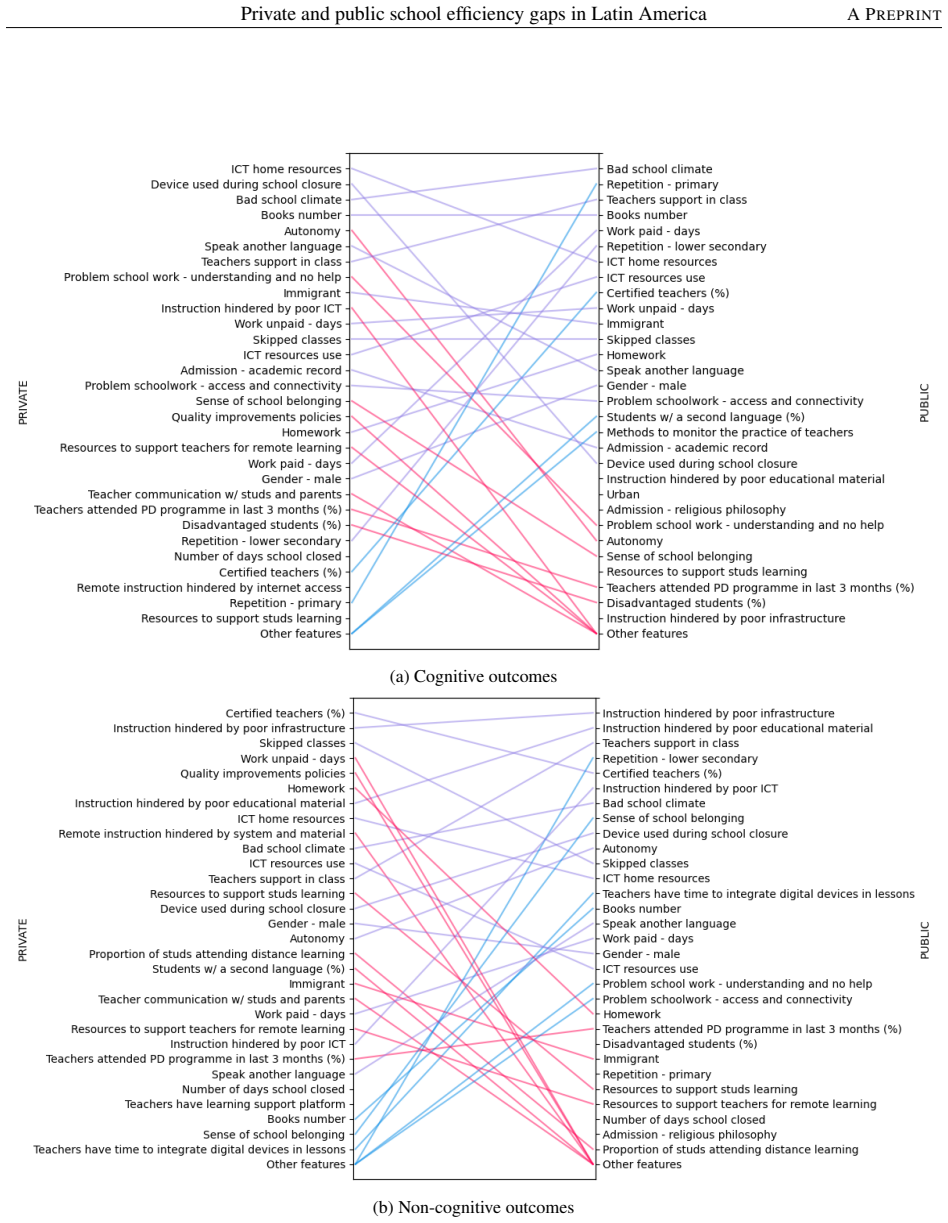
On the paper's own terms, the central discovery is a private-school efficiency advantage that holds across the whole distribution, not just at the mean. Bias-corrected technical efficiency for cognitive outputs is 0.865 for private schools and 0.768 for public schools; for the non-cognitive output it is 0.685 versus 0.640. Stochastic dominance tests accept first- and second-order dominance of private over public efficiency profiles, meaning an education planner who values higher efficiency and lower between-school dispersion would prefer the private-school profile. Within the region the cognitive gap is positive in every country, ranging from about 0.08 to 0.11, while non-cognitive gaps are positive in all nine countries though not statistically significant in four. The interpretable-machine-learning stage shows that high-efficiency private schools are characterized by more books and computers at home, little student paid work, and high school autonomy, while low-efficiency public schools are marked by poor climate, high repetition and truancy, intense paid work, few books, and COVID-era homework barriers. The paper also reports a positive correlation between cognitive and non-cognitive efficiency that is stronger for public schools.
Load-bearing premise
The load-bearing premise is that a school's average family wealth is an input the school can control and that private and public schools each have their own production technology; if either premise fails, the estimated efficiency gap is a modeling artifact.
Editorial extensions
If this is right
- Public schools' average cognitive efficiency of 0.768 implies they could increase learning outcomes by about 23 percent while holding inputs constant, if the frontier estimate is correct.
- Because private schools also dominate in non-cognitive efficiency by 0.045, the private advantage is not confined to test scores; it extends to the well-being/soft-skills output measured in PISA.
- Lower dispersion in private-school efficiency (IQR 0.083 versus 0.117 for cognitive outcomes) means the private advantage is not driven by a few outliers; the whole distribution is shifted and compressed.
- The SHAP ranking suggests different policy levers for the two sectors: in private schools the high-efficiency profile is tied to home educational resources and autonomy, while in public schools the low-efficiency profile is tied to repetition, truancy, paid work, and poor climate.
- The positive correlation between cognitive and non-cognitive efficiency, stronger for public schools, implies that policies improving soft skills could also help close the cognitive efficiency gap.
Reading between the lines
- The paper's separate-frontier design leaves open whether a single pooled technology would shrink the 0.10 cognitive gap; testing that specification directly would show how much of the gap is genuine production efficiency rather than sector-specific technology.
- Because the PISA soft-skills score is a school average over self-reported personality domains, the non-cognitive gap may reflect reporting or composition; disaggregating the index by domain would test whether the private advantage is uniform across traits like empathy, perseverance, and emotional control.
- The cross-sectional design cannot establish that autonomy, books, or homework support cause efficiency; a pilot that transfers the high-efficiency private-school profile to public schools and tracks cognitive and non-cognitive efficiency would be the natural test of the paper's policy story.
- Future waves of PISA or a value-added panel of schools could separate the persistent efficiency gap from selection into private schooling, since the current data contain only one cross-section.
Signed reviews
Editorial analysis
A structured set of objections, weighed in public.
Referee Report
Summary. Using PISA 2022 data on 2,034 schools in nine Latin American countries, the paper estimates school-level technical efficiency separately for private and public schools, with cognitive outputs (math, reading, science) and a non-cognitive output (a soft-skills composite), via output-oriented VRS Data Envelopment Analysis with bootstrap bias correction. It reports a mean bias-corrected efficiency gap of about 0.10 in cognitive efficiency (0.865 vs. 0.768) and 0.045 in non-cognitive efficiency (0.685 vs. 0.640), with lower dispersion among private schools, and interprets these as private-sector technical superiority. In a second stage, the paper dichotomizes efficiency at the regional mean and uses gradient-boosted trees with SHAP values to rank 42 school and student covariates associated with high efficiency, profiling the highest-efficiency private school and the lowest-efficiency public school. The paper claims to be the first post-pandemic regional LAC study of school-type efficiency gaps and to extend DEA-plus-interpretable-ML to cross-country education efficiency.
Significance. If the headline gap withstands specification scrutiny, the paper would supply timely regional evidence on private-public school efficiency after the pandemic, and its combination of DEA with SHAP-based second-stage explanations is a useful addition to the emerging DEA-ML literature. The analysis is careful in several respects that deserve credit: bias-corrected radial efficiency with bootstrap confidence intervals, a robustness check for outliers (Appendix C), stochastic dominance comparisons, and detailed tables reporting country-level efficiency scores. The central empirical claim, however, rests on two untested specification choices: separate production frontiers for private and public schools, and the treatment of average family SES as a school input. Because the estimated gap is defined as the difference between each sector's distance to its own frontier, it is not yet established that the gap reflects a real technological or managerial advantage rather than a mechanical consequence of sample size, frontier estimation noise, or the SES-as-input assumption.
major comments (4)
- [Section 4.1 and Section 5.1] The main private-public efficiency gap is computed from four separate VRS DEA frontiers, one per school type and outcome, without any test of whether private and public schools operate under a common technology. With separate frontiers, the reported gap of 0.10 (cognitive) and 0.045 (non-cognitive) measures each sector's average distance to its own estimated best practice; under a common technology, different sample sizes (1,584 public vs. 486 private) and finite-sample noise can alone produce a mechanical gap, while if the technologies genuinely differ, the scalar gap does not identify which technology is more productive. Please add a pooled-frontier re-estimation or a formal test of technology equality (for example, a bootstrap test of the equality of the two frontiers, or a meta-frontier analysis with a technology gap ratio) and report whether the gap persists in that specification.
- [Section 3.1 and Table 1] Average family SES is included as one of the four DEA inputs, and the summary statistics show a 1.12 difference in SES between private and public schools. If SES is an environmental or non-discretionary factor rather than a school-controlled resource, then treating it as a regular input can bias the efficiency scores in favor of high-SES private schools, because the frontier can 'explain' higher outputs by the more favorable student mix. The paper should report a robustness analysis that either omits SES from the input set or treats it as an external/non-discretionary variable; without this, the headline 0.10 cognitive gap remains dependent on a contestable modeling assumption.
- [Section 3 and Tables 3-4] There is a numerical inconsistency in the reported sample sizes. Section 3 states that the working sample contains 2,034 schools, of which 1,548 are public and 486 are private, but Tables 3 and 4 report N = 1,584 public schools and the country-level public-school rows sum to 1,584, giving a total of 2,070. Please reconcile these numbers and clarify which sample is used for the DEA estimation and which is used for the second-stage analysis; if 36 additional schools enter the DEA sample, the estimates and standard errors would need to be re-checked.
- [Section 5.1.1 and Table 5] The stochastic dominance tests are reported with p-values of 1.0000 and 0.9450 for the first-order tests, and the null hypothesis is written as 'bθ_private ⪯_s bθ_public'. As written, acceptance of this null does not transparently establish that private schools dominate public schools; the notation is ambiguous about whether '⪯' orders the CDFs (so private CDF below public CDF means private dominance) or orders the efficiency levels. Please restate the null in terms of the cumulative distribution functions and explain whether a failure to reject in these tests is being treated as affirmative evidence in favor of private dominance, since failure to reject a null is not normally evidence for it.
minor comments (5)
- [Title, Abstract, Introduction] There are several typographical errors, including 'INLATIN AMERICA—ACOMBINEDDEAAND', '˘interpreable' in Section 4.2, and 'loosing around lost around 0.9-1.1 years' in the Introduction; these should be corrected throughout.
- [Section 4.1 and Note 5] The VRS-versus-CRS tests are said to be 'available from the author upon request'; for a central modeling choice, the tests and their p-values should be reported in the appendix or a table rather than left to request.
- [Section 4.2 and Figure 3] The binary dependent variable is defined as efficiency above the regional mean, separately within each school type, so the second-stage results describe predictors of being above the sector-specific average, not predictors of reaching an absolute efficiency standard. This should be stated more explicitly in the text, and the SHAP-based comparisons between private and public schools should be interpreted accordingly.
- [Appendix C and Table C1] The outlier robustness check is a welcome addition, but the country-level proportional differences in Table C1 are large in some cases (e.g., -9.53% for Dominican Republic non-cognitive private efficiency and +3.01% for Chile), so the statement that the estimates 'are not as different' should be softened or the country-level outlier sensitivity should be discussed directly.
- [Tables 3 and 4 notes] Table 3 notes state that all private-public differences are statistically significant at 10%, while the text and Figure 1c report that four non-cognitive country gaps are not statistically significant; the table notes should be aligned with the reported significance pattern.
Circularity Check
No circularity: DEA scores are computed from observed inputs/outputs; the gap is a descriptive comparison, not a fitted prediction.
full rationale
The core derivation is self-contained. DEA scores are computed by solving the output-oriented VRS linear program (Eq. 2) using observed school-level outputs (PISA cognitive scores; soft-skills index) and inputs (family SES, school infrastructure indices, inverse student-teacher ratio) for each school type separately. The headline private-public gap is the difference of the sample means of these bias-corrected nonparametric scores (Tables 3 and 4); no equation defines a parameter in terms of the gap and then reuses that parameter to produce the gap. The second-stage ML models use a binary transformation of the same DEA scores (equal to one if the score exceeds the regional mean for that school type) as the dependent variable and 42 covariates as predictors. This is a standard two-stage descriptive design: the SHAP attributions explain the fitted model, but the fitted model is not used to construct the DEA scores, nor is any DEA input parameter fitted to the gap. The paper's self-citations (Delprato and Antequera 2021a, 2021b, 2025; Delprato 2025) are prior published empirical studies cited for context and comparison; no load-bearing uniqueness theorem or ansatz is imported from them. The separate-frontier comparison may be sensitive to the assumption that private and public schools have distinct technologies and that family SES is a controllable input, but that is a modelling and identification concern, not a circular reduction: the comparison does not define its conclusion into its inputs. I therefore find no significant circularity.
Assumptions & free parameters
free parameters (4)
- Outlier detection order-alpha values =
95.33 (public, cognitive), 75.98 (private, cognitive), 89.39 (public, non-cognitive), 21.77 (private, non-cognitive)
- GBT hyperparameters per model =
e.g., cognitive private: estimators=100, subsample=0.7, depth=5, learning rate=0.1; see Table A1 for all four models
- Regional-mean efficiency threshold =
sample mean of the corresponding DEA efficiency distribution (not reported numerically)
- Non-cognitive factor loadings
assumptions (5)
- standard math Education production technology has convexity, free disposability, and variable returns to scale (VRS).
- domain assumption School-level averages of student characteristics adequately represent the school's production inputs and outputs.
- domain assumption Private and public schools operate under different production frontiers.
- domain assumption Family SES and school infrastructure are legitimate DEA inputs, not environmental factors.
- domain assumption PISA 2022 school and student samples are representative within each country and measurement error in the constructed indices is negligible.
Cite this review
Pith. "Pith review of Cognitive and non-cognitive efficiency gaps between private and public schools in the Latin America region-a hybrid DEA and machine learning approach based on PISA 2022." pith.science (2026). https://pith.science/paper/FJQVDEW2
@misc{pith2026250925353,
  author       = {Pith},
  title        = {Pith review of: Cognitive and non-cognitive efficiency gaps between private and public schools in the Latin America region-a hybrid DEA and machine learning approach based on PISA 2022},
  year         = {2026},
  howpublished = {\url{https://pith.science/paper/FJQVDEW2}},
  note         = {Machine review of arXiv:2509.25353}
}
read the original abstract
Latin America's education systems are fragmented and segregated, with substantial differences by school type. The concept of school efficiency (the ability of school to produce the maximum level of outputs given available resources) is policy relevant due to scarcity of resources in the region. Knowing whether private and public schools are making an efficient use of resources --and which are the leading drivers of efficiency-- is critical, even more so after the learning crisis brought by the COVID-19 pandemic. In this paper, relying on data of 2,034 schools and nine Latin American countries from PISA 2022, I offer new evidence on school efficiency (both on cognitive and non-cognitive dimensions) using Data Envelopment Analysis (DEA) by school type and, then, I estimate efficiency leading determinants through interpretable machine learning methods (IML). This hybrid DEA-IML approach allows to accommodate the issue of big data (jointly assessing several determinants of school efficiency). I find a cognitive efficiency gap of nearly 0.10 favouring private schools and of 0.045 for non-cognitive outcomes, and with a lower heterogeneity in private than public schools. For cognitive efficiency, leading determinants for the chance of a private school of being highly efficient are higher stock of books and PCs at home, lack of engagement in paid work and school's high autonomy; whereas low-efficient public schools are shaped by poor school climate, large rates of repetition, truancy and intensity of paid work, few books at home and increasing barriers for homework during the pandemic.
Figures


Figures from the paper (1 more)

Reference graph
Works this paper leans on
-
[1]
author Agasisti, T. , author Antequera, G. , author Delprato, M. , year 2023 . title Technological resources, ict use and schools efficiency in latin america--insights from oecd pisa 2018 . journal International Journal of Educational Development volume 99 , pages 102757
work page 2023
-
[2]
author Agasisti, T. , author Ferraro, S. , year 2024 . title Measuring the efficiency of private schools: Conceptual issues and empirical evidence , in: booktitle Privatization in and of Public Education . publisher Oxford University Press , pp. pages 61--84
work page 2024
-
[3]
, author de Oliveira Ribeiro, C
author Agasisti, T. , author de Oliveira Ribeiro, C. , author Montemor, D.S. , year 2022 . title The efficiency of brazilian elementary public schools . journal International Journal of Educational Development volume 93 , pages 102627
work page 2022
-
[4]
author Agasisti, T. , author Zoido, P. , year 2018 . title Comparing the efficiency of schools through international benchmarking: Results from an empirical analysis of oecd pisa 2012 data . journal Educational Researcher volume 47 , pages 352--362
work page 2018
-
[5]
author Agasisti, T. , author Zoido, P. , year 2019 . title The efficiency of schools in developing countries, analysed through pisa 2012 data . journal Socio-Economic Planning Sciences volume 68 , pages 100711
work page 2019
-
[6]
author Almlund, M. , author Duckworth, A.L. , author Heckman, J. , author Kautz, T. , year 2011 . title Personality psychology and economics , in: booktitle Handbook of the Economics of Education . publisher Elsevier . volume volume 4 , pp. pages 1--181
work page 2011
-
[7]
author Antequera, G.O. , year 2019 . title Eficiencia t \'e cnica y eficacia como indicadores de desempe \ n o de instituciones educativas . journal Universidad NAcional de C \'o rdova
work page 2019
-
[8]
author Aparicio, J. , author Perelman, S. , author Sant \' n, D. , year 2022 . title Comparing the evolution of productivity and performance gaps in education systems through dea: an application to latin american countries . journal Operational Research volume 22 , pages 1443--1477
work page 2022
Show all 78 references
-
[9]
, author Daouia, A
author Aragon, Y. , author Daouia, A. , author Thomas-Agnan, C. , year 2005 . title Nonparametric frontier estimation: a conditional quantile-based approach . journal Econometric Theory volume 21 , pages 358--389
2005
-
[10]
, author Gim \'e nez, V
author Arbona, A. , author Gim \'e nez, V. , author L \'o pez-Estrada, S. , author Prior, D. , year 2022 . title Efficiency and quality in colombian education: An application of the metafrontier malmquist-luenberger productivity index . journal Socio-economic planning sciences...
2022
-
[11]
, author Bos, M
author Arias Ortiz, E. , author Bos, M. , author Giambruno, C. , author Zoido, P. , year 2023 . title Latin America and the Caribbean in PISA 2022: How Many Students are Low Performers? type Technical Report . Inter-American Development Bank
2023
-
[12]
, author Bos, M.S
author Arias Ortiz, E. , author Bos, M.S. , author Chen Peraza, J. , author Giambruno, C. , author Levin, V. , author Oubi \ n a, V. , author Pineda, J.A. , author Zoido, P. , year 2024 . title Learning Can’t Wait [El aprendizaje no puede esperar] . type World Bank Publication...
2024
-
[13]
, author Bouhlila, D.S
author Asadullah, M. , author Bouhlila, D.S. , author Chan, S.J. , author Draxler, A. , author Ha, W. , author Heyneman, S.P. , author Luschei, T.F. , author Semela, T. , author Yemini, M. , year 2023 . title A year of missed opportunity: Post-covid learning loss--a renewed ca...
2023
-
[14]
, author Hasan, A
author Azevedo, J.P. , author Hasan, A. , author Goldemberg, D. , author Geven, K. , author Iqbal, S.A. , year 2021 . title Simulating the potential impacts of covid-19 school closures on schooling and learning outcomes: A set of global estimates . journal The World Bank Resea...
2021
-
[15]
, author Mozharovskyi, P
author Badunenko, O. , author Mozharovskyi, P. , year 2016 . title Nonparametric frontier analysis using stata . journal The Stata Journal volume 16 , pages 550--589
2016
-
[16]
, author Ben \' tez, R
author Bol \'o s, V.J. , author Ben \' tez, R. , author Coll-Serrano, V. , year 2023 . title Continuous models combining slacks-based measures of efficiency and super-efficiency . journal Central European Journal of Operations Research volume 31 , pages 363--391
2023
-
[17]
, author Belle \" , C
author Bonal, X. , author Belle \" , C. , year 2020 . title Understanding school segregation: patterns, causes and consequences of spatial inequalities in education . publisher Bloomsbury Publishing
2020
-
[18]
, author Le, T.D
author Boubaker, S. , author Le, T.D. , author Ngo, T. , author Manita, R. , year 2025 . title Predicting the performance of msmes: A hybrid dea-machine learning approach . journal Annals of Operations Research volume 350 , pages 555--577
2025
-
[19]
, author Docken, G
author Boyd, T. , author Docken, G. , author Ruggiero, J. , year 2016 . title Outliers in data envelopment analysis . journal Journal of Centrum Cathedra volume 9 , pages 168--183
2016
-
[20]
, author Ciaschi, M
author Bracco, J. , author Ciaschi, M. , author Gasparini, L. , author Marchionni, M. , author Neidh \"o fer, G. , year 2025 . title The impact of covid-19 on education in latin america: Long-run implications for poverty and inequality . journal Review of Income and Wealth vol...
2025
-
[21]
, author Ferreira, F.H
author Brunori, P. , author Ferreira, F.H. , author Neidh \"o fer, G. , year 2024 . title Inequality of opportunity and intergenerational persistence in Latin America . type Technical Report number 17202 . IZA Discussion Papers
2024
-
[22]
, author Gim \'e nez, G
author Castro Aristizabal, G. , author Gim \'e nez, G. , author P \'e rez Xim \'e nez-de Emb \'u n, D. , year 2017 . title Educational inequalities in latin america, 2012 pisa: Causes of differences in school performance between public and private schools desigualdades educati...
2017
-
[23]
, author Vilca, L.W
author Caycho-Rodr \' guez, T. , author Vilca, L.W. , author Valencia, P.D. , author Carbajal-Le \'o n, C. , author Reyes-Bossio, M. , author White, M. , author Rojas-Jara, C. , author Polanco-Carrasco, R. , author Gallegos, M. , author Cervigni, M. , et al., year 2023 . title...
2023
-
[24]
, author Covert, I.C
author Chen, H. , author Covert, I.C. , author Lundberg, S.M. , author Lee, S.I. , year 2023 . title Algorithms to estimate shapley value feature attributions . journal Nature Machine Intelligence volume 5 , pages 590--601
2023
-
[25]
, author Guestrin, C
author Chen, T. , author Guestrin, C. , year 2016 . title Xgboost: A scalable tree boosting system , in: booktitle Proceedings of the 22nd acm sigkdd international conference on knowledge discovery and data mining , pp. pages 785--794
2016
-
[26]
, author Tsionas, M.G
author Chen, Y. , author Tsionas, M.G. , author Zelenyuk, V. , year 2021 . title Lasso+ dea for small and big wide data . journal Omega volume 102 , pages 102419
2021
-
[27]
, author Sicilia, G
author Cordero, J.M. , author Sicilia, G. , author Simancas, R. , year 2025 . title Educational efficiency across spanish regions: a comparative analysis over time . journal International Transactions in Operational Research volume 32 , pages 2645--2676
2025
-
[28]
, author Patrinos, H.A
author Crato, N. , author Patrinos, H.A. , year 2025 . title Improving National Education Systems After COVID-19: Moving Forward After PIRLS 2021 and PISA 2022 . publisher Springer Nature
2025
-
[29]
, author Pedraja-Chaparro, F
author Crespo-Cebada, E. , author Pedraja-Chaparro, F. , author Sant \' n, D. , year 2014 . title Does school ownership matter? an unbiased efficiency comparison for regions of spain . journal Journal of Productivity Analysis volume 41 , pages 153--172
2014
-
[30]
, author Simar, L
author Daraio, C. , author Simar, L. , author Wilson, P.W. , et al., year 2010 . title Testing whether two-stage estimation is meaningful in non-parametric models of production . journal ISBA discuss. Pap. Google Sch
2010
-
[31]
, author Rossel Odriozola, C
author De La O, A.L. , author Rossel Odriozola, C. , author Manzi, P. , year 2023 . title Opting out from public services and the social contract in Latin America . type Technical Report . IDB Working Paper Series
2023
-
[32]
, author L \'o pez-Torres, L
author De Witte, K.D. , author L \'o pez-Torres, L. , year 2017 . title Efficiency in education: a review of literature and a way forward . journal Journal of the Operational Research Society volume 68 , pages 339--363
2017
-
[33]
, year 2025
author Delprato, M. , year 2025 . title Pedagogic engagement in argentina for students attending primary and secondary levels--an empirical analysis of main barriers during the covid-19 pandemic . journal OSF Preprints https://doi.org/10.31219/osf.io/37hfb_v1
2025 doi
-
[34]
, author Antequera, G
author Delprato, M. , author Antequera, G. , year 2021 a. title Public and private school efficiency and equity in latin america: New evidence based on pisa for development . journal International Journal of Educational Development volume 84 , pages 102404
2021
-
[35]
, author Antequera, G
author Delprato, M. , author Antequera, G. , year 2021 b. title School efficiency in low and middle income countries: An analysis based on pisa for development learning survey . journal International Journal of Educational Development volume 80 , pages 102296
2021
-
[36]
, author Antequera, G
author Delprato, M. , author Antequera, G. , year 2025 . title School efficiency in latin america before and after the covid-19 pandemic: New evidence from pisa 2018 and 2022 . journal International Journal of Educational Research volume 129 , pages 102493
2025
-
[37]
, author K \"o seleci, N
author Delprato, M. , author K \"o seleci, N. , author Antequera, G. , year 2015 . title Educaci \'o n para todos en am \'e rica latina: Evoluci \'o n del impacto de la desigualdad escolar en los resultados educativos . journal Revista Latinoamericana de Educaci \'o n Comparad...
2015
-
[38]
, year 2016
author Dufrechou, P.A. , year 2016 . title The efficiency of public education spending in latin america: A comparison to high-income countries . journal International Journal of Educational Development volume 49 , pages 188--203
2016
-
[39]
, year 2018
author Elacqua, G. , year 2018 . title Private schooling in latin america: Trends and public policies
2018
-
[40]
, author Figueroa, N
author Elacqua, G. , author Figueroa, N. , author Fontaine, A. , author Margitic, J. , author M \'e ndez, C. , year 2025 . title The pandemic exodus: What drives private-to-public school migration in peru . journal Economics of Education Review volume 108 , pages 102685
2025
-
[41]
, author Taheri, S
author Ersozlu, Z. , author Taheri, S. , author Koch, I. , year 2024 . title A review of machine learning methods used for educational data . journal Education and Information Technologies , pages 1--21
2024
-
[42]
, year 1957
author Farrell, M.J. , year 1957 . title The measurement of productive efficiency . journal Journal of the Royal Statistical Society: Series A (General) volume 120 , pages 253--281
1957
-
[43]
, author Pag \'e s, C
author Fern \'a ndez, R. , author Pag \'e s, C. , author Szekely, M. , author Acevedo, I. , year 2024 . title Education inequalities in Latin America and the Caribbean . type Technical Report . National Bureau of Economic Research
2024
-
[44]
, author Andr \'e s Uz \' n P, G
author G \'o mez, G.M. , author Andr \'e s Uz \' n P, G. , year 2022 . title Effects of covid-19 on education and schools’ reopening in latin america , in: booktitle COVID-19 and international development . publisher Springer , pp. pages 119--135
2022
-
[45]
, author Jerrim, J
author Guti \'e rrez, G. , author Jerrim, J. , author Torres, R. , year 2020 . title School segregation across the world: Has any progress been made in reducing the separation of the rich from the poor? journal The Journal of Economic Inequality volume 18 , pages 157--179
2020
-
[46]
, year 2020
author Hanushek, E.A. , year 2020 . title Education production functions , in: booktitle The economics of education . publisher Elsevier , pp. pages 161--170
2020
-
[47]
, author Tibshirani, R
author Hastie, T. , author Tibshirani, R. , author Friedman, J. , year 2009 . title The Elements of Statistical Learning: Data Mining, Inference, and Prediction . publisher Springer
2009
-
[48]
, author Chavez, J
author Henriques, C. , author Chavez, J. , author Gouveia, M. , author Marcenaro-Gutierrez, O. , year 2022 . title Efficiency of secondary schools in ecuador: A value based dea approach . journal Socio-Economic Planning Sciences volume 82 , pages 101226
2022
-
[49]
, author Gajderowicz, T
author Jakubowski, M. , author Gajderowicz, T. , author Patrinos, H.A. , year 2025 . title Covid-19, school closures, and student learning outcomes. new global evidence from pisa . journal npj Science of Learning volume 10 , pages 5
2025
-
[50]
, year 2004
author Johnes, J. , year 2004 . title Efficiency Measurement . publisher Edward Elgar Publishing
2004
-
[51]
, author D \' az Castro, J
author de Jorge-Moreno, J. , author D \' az Castro, J. , author Rodr \' guez Vega, D.V. , author Segura Guti \'e rrez, J.M. , year 2018 . title An \'a lisis de la eficiencia educativa y sus factores explicativos considerando el efecto de la titularidad en colombia con datos pi...
2018
-
[52]
, year 2015
author Khezrimotlagh, D. , year 2015 . title How to detect outliers in data envelopment analysis by kourosh and arash method . journal arXiv preprint arXiv:1503.02548
2015 arXiv
-
[53]
, author Do, X.A
author Krauss, C. , author Do, X.A. , author Huck, N. , year 2017 . title Deep neural networks, gradient-boosted trees, random forests: Statistical arbitrage on the s&p 500 . journal European Journal of Operational Research volume 259 , pages 689--702
2017
-
[54]
, author Srivastava, S.K
author Kumari, R. , author Srivastava, S.K. , year 2017 . title Machine learning: A review on binary classification . journal International Journal of Computer Applications volume 160
2017
-
[55]
, author Alonso Ishihara, M
author Lagones, J. , author Alonso Ishihara, M. , year 2024 . title Special noncognitive skill activities (tokkatsu) during the covid-19 pandemic in latin america: the osoji japan project as sdg-4 in peru . journal Cogent Education volume 11 , pages 2398858
2024
-
[56]
, author Whang, Y.J
author Lee, K. , author Whang, Y.J. , year 2024 . title Pysdtest: a python/stata package for stochastic dominance tests . journal arXiv preprint arXiv:2307.10694v2
2024 arXiv
-
[57]
, author Xue, E
author Li, J. , author Xue, E. , author Zhou, W. , author Guo, S. , author Zheng, Y. , year 2025 . title Students’ subjective well-being, school bullying, and belonging during the covid-19 pandemic: Comparison between pisa 2018 and pisa 2022 . journal Humanities and Social Sci...
2025
-
[58]
, author Erion, G
author Lundberg, S.M. , author Erion, G. , author Chen, H. , author DeGrave, A. , author Prutkin, J.M. , author Nair, B. , author Katz, R. , author Himmelfarb, J. , author Bansal, N. , author Lee, S.I. , year 2020 . title From local explanations to global understanding with ex...
2020
-
[59]
, author Lee, S.I
author Lundberg, S.M. , author Lee, S.I. , year 2017 . title A unified approach to interpreting model predictions . journal Advances in neural information processing systems volume 30
2017
-
[60]
, author Calero, J
author Manceb \'o n, M.J. , author Calero, J. , author Choi, \'A . , author Xim \'e nez-de Emb \'u n, D.P. , year 2012 . title The efficiency of public and publicly subsidized high schools in spain: Evidence from pisa-2006 . journal Journal of the operational research Society ...
2012
-
[61]
, author Oggioni, G
author Mujiya Ulkhaq, M. , author Oggioni, G. , author Riccardi, R. , year 2025 . title How efficient are schools in south-east asia? an analysis through oecd pisa 2018 data . journal Educational Research and Evaluation volume 30 , pages 212--243
2025
-
[62]
, author Martinez-Garrido, C
author Murillo, F.J. , author Martinez-Garrido, C. , year 2017 . title Estimating the magnitude of school segregation in latin america . journal Magis volume 9 , pages 11
2017
-
[63]
, author Zuva, T
author Naidu, G. , author Zuva, T. , author Sibanda, E.M. , year 2023 . title A review of evaluation metrics in machine learning algorithms , in: booktitle Computer Science On-line Conference , organization Springer . pp. pages 15--25
2023
-
[64]
, author Lustig, N
author Neidh \"o fer, G. , author Lustig, N. , author Tommasi, M. , year 2021 . title Intergenerational transmission of lockdown consequences: prognosis of the longer-run persistence of covid-19 in latin america . journal The Journal of Economic Inequality volume 19 , pages 571--598
2021
-
[65]
title PISA 2022 Results (Volume I)
author OECD , year 2023 a. title PISA 2022 Results (Volume I) . https://doi.org/https://doi.org/10.1787/53f23881-en
2023 doi
-
[66]
title PISA 2022 Results (Volume II)
author OECD , year 2023 b. title PISA 2022 Results (Volume II) . https://doi.org/https://doi.org/10.1787/a97db61c-en
2023 doi
-
[67]
, year 2025
author Pagliarani, S. , year 2025 . title Improving the performance of public schools: Evidence from latin american countries in pisa 2022 . journal Journal of Latinos and Education , pages 1--14
2025
-
[68]
, year 2020
author Salas-Velasco, M. , year 2020 . title Assessing the performance of spanish secondary education institutions: distinguishing between transient and persistent inefficiency, separated from heterogeneity . journal The Manchester School volume 88 , pages 531--555
2020
-
[69]
, year 1953
author Shapley, L.S. , year 1953 . title A value for n-person games . journal Contribution to the Theory of Games volume 2
1953
-
[70]
, author Wilson, P.W
author Simar, L. , author Wilson, P.W. , year 2007 . title Estimation and inference in two-stage, semi-parametric models of production processes . journal Journal of econometrics volume 136 , pages 31--64
2007
-
[71]
, author Wilson, P.W
author Simar, L. , author Wilson, P.W. , et al., year 2013 . title Estimation and inference in nonparametric frontier models: Recent developments and perspectives . journal Foundations and trends in econometrics volume 5 , pages 183--337
2013
-
[72]
, year 2012
author Tauchmann, H. , year 2012 . title Partial frontier efficiency analysis . journal The Stata Journal volume 12 , pages 461--478
2012
-
[73]
, author De Witte, K
author Thanassoulis, E. , author De Witte, K. , author Johnes, J. , author Johnes, G. , author Karagiannis, G. , author Portela, C.S. , year 2016 . title Applications of data envelopment analysis in education , in: booktitle Data envelopment analysis . publisher Springer , pp....
2016
-
[74]
, author Gertel, H
author Vera, M.L. , author Gertel, H. , author Giuliodori, R. , year 2008 . title Productividad educativa en las escuelas argentinas: Una aplicaci \'o n de fronteras estoc \'a sticas . journal Investigaciones de Econom \' a de la Educaci \'o n , pages 71
2008
-
[75]
, author Bennett, K.M
author Windle, G. , author Bennett, K.M. , author Noyes, J. , year 2011 . title A methodological review of resilience measurement scales . journal Health and quality of life outcomes volume 9 , pages 8
2011
-
[76]
, year 2001
author Worthington, A.C. , year 2001 . title An empirical survey of frontier efficiency measurement techniques in education . journal Education economics volume 9 , pages 245--268
2001
-
[77]
, author Wenhui, K
author Xu, F. , author Wenhui, K. , author Pei, J. , year 2025 . title Exploring the effect of digitization on education: An empirical analysis based on pisa 2022 . journal Education and Information Technologies , pages 1--39
2025
-
[78]
, author Cai, Y
author Zhoc, K.C. , author Cai, Y. , author Yeung, S.S. , author Shan, J. , year 2022 . title Subjective wellbeing and emotion regulation strategies: How are they associated with student engagement in online learning during covid-19? journal British Journal of Educational Psyc...
2022
Reviewed August 15, 2026 · model on record in the stance chip above.
Discussion (0). Continue with ORCID to comment.