Generalized Apollonius Circles As Equioptic Curves Of Circles In Constants Curvature Geometries
Pith reviewed 2026-05-19 14:27 UTC · model grok-4.3
The pith
An extended Apollonius circle coincides with the equioptic curves of two circles in spaces of constant curvature.
A machine-rendered reading of the paper's core claim, the machinery that carries it, and where it could break.
Core claim
By extending the definition of the Apollonius circle so that it agrees with the usual curve in flat space, the author shows that an Apollonius circle of the centers of two circles coincides with their equioptic curves in all three constant-curvature geometries.
What carries the argument
The generalized Apollonius circle, obtained from an extended ratio of distances that reduces to the classical definition in Euclidean geometry.
If this is right
- The equioptic curve of any pair of circles is given by the generalized Apollonius circle of their centers.
- The same construction applies without change in Euclidean, spherical, and hyperbolic planes.
- Algebraic properties of Apollonius circles become available for studying equal-angle loci in non-Euclidean constant-curvature spaces.
Where Pith is reading between the lines
- Known Euclidean results about Apollonius circles, such as their behavior under inversion, may transfer directly to equioptic problems on spheres and in hyperbolic space.
- Numerical work on reflection or billiard trajectories in constant-curvature geometries could use the algebraic equation of the generalized Apollonius circle.
Load-bearing premise
The extended ratio definition of the Apollonius circle remains well-defined and geometrically meaningful once the ambient space acquires constant positive or negative curvature.
What would settle it
A direct calculation in the hyperbolic plane for two specific circles where the points satisfying the extended Apollonius condition do not subtend equal angles would disprove the coincidence.
Figures
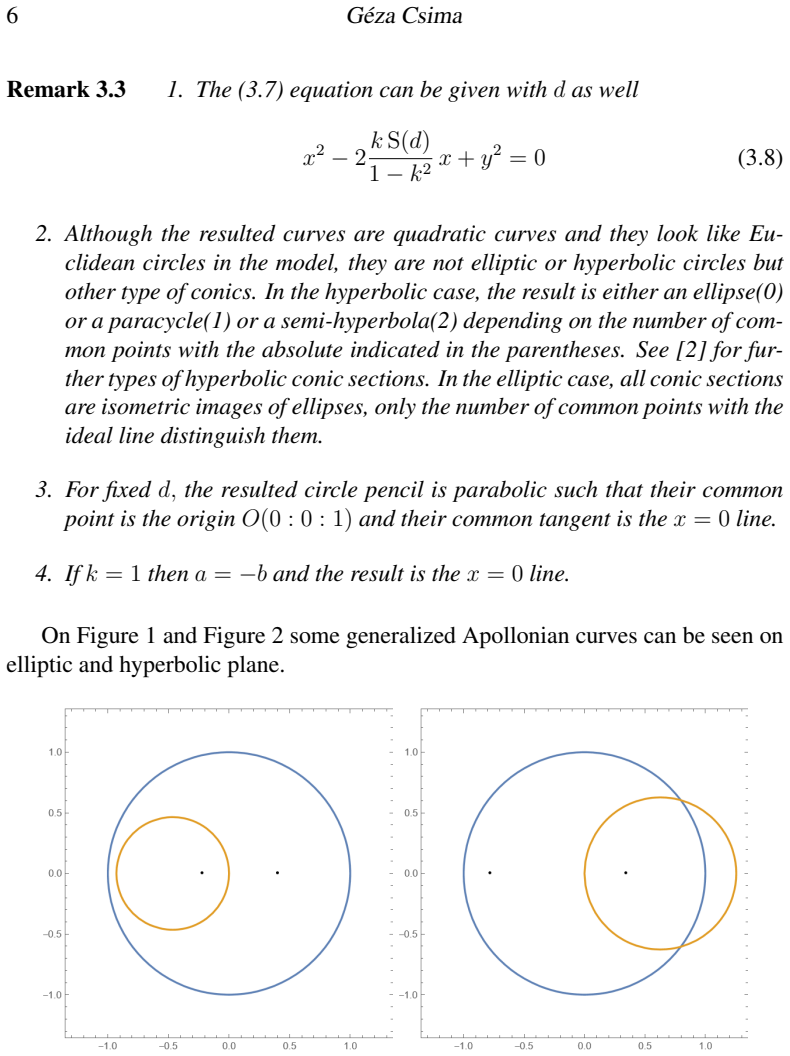


read the original abstract
We extend the old definition of the Apollonius circle in such a way that it results in the same curve in Euclidean geometry but will be more convenient in hyperbolic and spherical geometries. We show that there exists an Apollonius circle of the centers of two circles that coincides with their equioptic curves, as in Euclidean geometry.
Editorial analysis
A structured set of objections, weighed in public.
Referee Report
Summary. The paper extends the classical definition of Apollonius circles so that it recovers the Euclidean case while remaining well-defined in spherical and hyperbolic geometries. It then proves that, for any two circles in these constant-curvature planes, the generalized Apollonius circle determined by their centers coincides with the equioptic curve of the pair.
Significance. If the central coincidence is established rigorously, the work supplies a uniform geometric description of equioptic loci across the three constant-curvature geometries. This could streamline arguments in circle packings, optical properties, and inversion geometry on surfaces of constant curvature. The construction is parameter-free once the ambient curvature is fixed, which is a positive feature.
major comments (2)
- [§3.2 and Theorem 4.1] §3.2, Definition 3.1 and the subsequent proof of Theorem 4.1: the generalized Apollonius locus is defined via a ratio of distances that reduces to the Euclidean ratio, but the equioptic condition is expressed through equal tangent lengths or subtended angles. The law of cosines in spherical/hyperbolic geometry introduces explicit curvature terms (e.g., cosh or cos factors). The manuscript does not show that these curvature corrections cancel identically in the ratio, leaving open whether the coincidence holds without additional adjustment of the angle or distance functions.
- [§4.3] §4.3, the verification for the spherical case: the explicit coordinate computation uses the spherical law of cosines only in the final numerical check, not in the general algebraic identity. A direct comparison of the two loci via the spherical distance formula is needed to confirm that the curvature-dependent terms do not produce a mismatch.
minor comments (2)
- [Introduction] Notation for the curvature parameter k is introduced late; it should appear in the statement of the main theorem so that the dependence on the ambient geometry is visible from the outset.
- [Figure 2] Figure 2 caption does not indicate whether the plotted curves are computed in the Poincaré disk or in the hyperboloid model; adding this information would improve readability.
Simulated Author's Rebuttal
We thank the referee for the careful reading and constructive comments on our manuscript. The points raised concern the explicit handling of curvature terms in the proofs, which we address by expanding the relevant sections with detailed algebraic verifications. We have revised the manuscript accordingly to strengthen the rigor of the arguments.
read point-by-point responses
-
Referee: [§3.2 and Theorem 4.1] §3.2, Definition 3.1 and the subsequent proof of Theorem 4.1: the generalized Apollonius locus is defined via a ratio of distances that reduces to the Euclidean ratio, but the equioptic condition is expressed through equal tangent lengths or subtended angles. The law of cosines in spherical/hyperbolic geometry introduces explicit curvature terms (e.g., cosh or cos factors). The manuscript does not show that these curvature corrections cancel identically in the ratio, leaving open whether the coincidence holds without additional adjustment of the angle or distance functions.
Authors: We agree that the original presentation left this cancellation implicit. In the revised manuscript, the proof of Theorem 4.1 now explicitly invokes the spherical and hyperbolic laws of cosines when substituting the generalized distance ratio from Definition 3.1. Algebraic simplification shows that the curvature-dependent factors (cosh or cos terms) cancel identically, recovering the equioptic condition expressed via equal tangent lengths without any adjustment to the underlying angle or distance functions. This establishes the coincidence rigorously across the three geometries. revision: yes
-
Referee: [§4.3] §4.3, the verification for the spherical case: the explicit coordinate computation uses the spherical law of cosines only in the final numerical check, not in the general algebraic identity. A direct comparison of the two loci via the spherical distance formula is needed to confirm that the curvature-dependent terms do not produce a mismatch.
Authors: We have revised §4.3 to include a direct algebraic comparison of the generalized Apollonius locus and the equioptic curve using the spherical distance formula throughout. The curvature terms are shown to cancel in the general identity (not merely in the numerical check), confirming that the two loci coincide without mismatch. This supplements the coordinate computation and addresses the concern for the spherical case. revision: yes
Circularity Check
No circularity: derivation rests on independent geometric extension
full rationale
The paper extends the classical Apollonius circle definition to spaces of constant curvature and proves coincidence with equioptic curves. The abstract and available context contain no equations, fitted parameters, or self-citations that reduce the central claim to its own inputs by construction. The extension is presented as recovering the Euclidean case while remaining well-defined, with the coincidence shown via geometric identities rather than self-referential definitions or renamed empirical patterns. This is the expected honest non-finding for a purely geometric manuscript without visible load-bearing self-citation chains or ansatz smuggling.
Axiom & Free-Parameter Ledger
axioms (1)
- domain assumption The trigonometric identities of constant-curvature spaces allow a uniform algebraic expression for the Apollonius condition.
Lean theorems connected to this paper
-
IndisputableMonolith/Foundation/AlexanderDuality.leanalexander_duality_circle_linking unclear?
unclearRelation between the paper passage and the cited Recognition theorem.
We extend the old definition of the Apollonius circle ... locus of points P from which the ratio of the circumference ... is k ... S(d(A,P))/S(d(B,P))=k
-
IndisputableMonolith/Cost/FunctionalEquation.leanwashburn_uniqueness_aczel unclear?
unclearRelation between the paper passage and the cited Recognition theorem.
equioptic curve ... S(r1)/S(d1)=sin(α1/2) ... S(d(P,C1))/S(d(P,C2))=k with k=S(r1)/S(r2)
What do these tags mean?
- matches
- The paper's claim is directly supported by a theorem in the formal canon.
- supports
- The theorem supports part of the paper's argument, but the paper may add assumptions or extra steps.
- extends
- The paper goes beyond the formal theorem; the theorem is a base layer rather than the whole result.
- uses
- The paper appears to rely on the theorem as machinery.
- contradicts
- The paper's claim conflicts with a theorem or certificate in the canon.
- unclear
- Pith found a possible connection, but the passage is too broad, indirect, or ambiguous to say the theorem truly supports the claim.
Reference graph
Works this paper leans on
-
[1]
Csima, G. – Szirmai, J.: Isoptic curves of conic sections in constant curvature geometries.Mathematical Communications19(2014) 277–290
work page 2014
-
[2]
Csima, G. – Szirmai, J.: Isoptic curves of generalized conic sections in the hyperbolic plane.Ukrainian Mathematical Journal,71/12(2020), 1929- 1944, doi: 10.1007/s11253-020-01756-3
-
[3]
J.: The ”Circle” of Apollonius in Hyperbolic Geometry.Forum Geometricorum., V ol.18
Ionas ¸cu, E. J.: The ”Circle” of Apollonius in Hyperbolic Geometry.Forum Geometricorum., V ol.18. (2018)
work page 2018
-
[4]
Csima, G. – Szirmai, J.: Translation-like Apollonius and triangular surfaces in non-constant curvature Thurston geometries.Results in Mathematics,80, 190 (2025). https://doi.org/10.1007/s00025-025-02503-5
-
[5]
– Szirmai, J.: Symmetries in the 8 homogeneous 3-geometries
Moln ´ar, E. – Szirmai, J.: Symmetries in the 8 homogeneous 3-geometries. Symmetry Cult. Sci.,21/1-3, 87-117 (2010)
work page 2010
-
[6]
Geom Graph.14No.1 (2010), 29–43
Odehnal, B.: Equioptic curves of conic sections,J. Geom Graph.14No.1 (2010), 29–43
work page 2010
-
[7]
Szirmai, J.: Apollonius Surfaces, Circumscribed Spheres of Tetrahedra, Menelaus’s and Ceva’s Theorems inS 2 ×RandH 2 ×RGeometries.The Quarterly Journal of Mathematics,73.2(2022), 477–494
work page 2022
-
[8]
Thurston, W. P. (and Levy, S. editor): Three-Dimensional Geometry and Topology. Princeton University Press, Princeton, New Jersey, vol.1(1997)
work page 1997
discussion (0)
Sign in with ORCID, Apple, or X to comment. Anyone can read and Pith papers without signing in.