REVIEW 3 major objections 4 minor 54 references
FRB 20200428 and potentially associated hard X-ray bursts: Maser emission and synchrotron radiation of electrons in a weakly magnetized plasma?
T0 review · 3 major / 4 minor · reviewed 2026-08-05 · deepseek-v4-flash
Pith's one-line read FRB 20200428 and its hard X-ray burst can come from one weakly magnetized, fast-moving plasma blob, with radio from plasma synchrotron maser emission and X-rays from synchrotron radiation.
desk verdict A credible post-hoc consistency check that the weakly magnetized maser/synchrotron model can reproduce the FRB 20200428 radio and X-ray spectra, but the predictive framing and the delta-function electron distribution are the two things to push on in review. read the letter →
The pith
A machine-rendered reading of the paper's core claim, the machinery that carries it, and where it could break.
The reading
What carries the argument
The plasma synchrotron maser mechanism in a weakly magnetized relativistic blob. Each blob is characterized by four parameters: bulk Lorentz factor Γ, electron Lorentz factor γ_e,s (assumed monoenergetic), magnetization σ=B^2/(4π m_e c^2 γ_e n_e)=(ν_B/ν_P)^2, and plasma frequency ν_P. The radio emission is computed from the modified single-electron synchrotron power in a dispersive medium (Eq. 1), with a refractive index n^2=1-(ν_P/ν)^2, and the maser gain emerges from the negative absorption coefficient for a delta-function electron distribution (Eq. 6). The X-ray flux comes from the same emissivity formula at much higher frequencies. The observed radio peak frequency is tied to the blob pa
What would settle it
A future simultaneous radio + hard X-ray burst from SGR 1935+2154 where the X-ray spectrum peaks well away from the synchrotron frequency predicted by the radio burst's parameters—or a radio burst with no hard X-ray counterpart despite sensitive coverage—would break the shared-blob picture.
Extended reading notes
Core claim
The central claim is that FRB 20200428 and the two narrow hard X-ray peaks of the SGR 1935+2154 burst are two frequency windows on the same weakly magnetized, relativistically moving plasma blob population. The radio burst is attributed to plasma synchrotron maser emission—a coherent radiation process that works when the electron distribution is sharply piled up at one energy—while the X-ray peaks are attributed to the ordinary synchrotron radiation of those same electrons. Fine-tuned parameter sets (bulk Lorentz factor Γ=15, electron Lorentz factor γ_e,s=2.4×10^4, magnetization σ~6×10^-5 to 1.8×10^-4, plasma frequency ν_P~5–12 MHz) reproduce the observed peak frequencies and flux densities
Load-bearing premise
The whole calculation assumes that all electrons in a blob have one identical energy (a sharp, monoenergetic distribution); if the real electron spread is wider, the maser gain, the predicted spectra, and every inferred blob parameter would shift.
Editorial extensions
If this is right
- If the model is right, future radio and hard X-ray observations of SGR 1935+2154 should catch more simultaneous bursts, and their relative brightness will directly probe the blob's σ and ν_P.
- The derived distance of ~10^12–10^14 cm places the emission far from the magnetar surface, supporting 'far-away' FRB scenarios over near-magnetosphere ones.
- Because the maser flux can swing by 10 orders of magnitude while the synchrotron flux moves only 1–2 orders, the same mechanism naturally predicts rare bright radio bursts alongside common faint ones.
- The model implies that short optical and X-ray flashes can accompany FRBs, so multi-wavelength follow-up of nearby FRB sources is a concrete prediction.
- The parameter ranges (Γ=5–30, γ_e,s~10^4, σ~10^-4) provide a testable fingerprint: a detected FRB with simultaneous X-rays should show spectra consistent with these narrow ranges or the model would need revision.
Reading between the lines
- A testable extension is to recompute the spectra with a power-law or kappa electron distribution instead of a delta function; the resulting maser gain and peak flux would show how finely tuned the particle pile-up must be for the model to work.
- The sensitivity of maser flux to σ and ν_P suggests that monitoring campaigns on SGR 1935+2154 should prioritize simultaneous radio and hard X-ray coverage, because even one joint detection with a measured X-ray spectral peak would constrain blob parameters far better than radio alone.
- If the same mechanism operates in extragalactic FRBs, the nondetection of X-ray counterparts in most FRBs is not evidence against it: at distances of ~1 Gpc the predicted X-ray flux falls below current detector sensitivities, so only nearby events (≲40 Mpc) are viable targets.
Editorial analysis
A structured set of objections, weighed in public.
Referee Report
Summary. The paper proposes that FRB 20200428 and the two hard X-ray peaks of the SGR 1935+2154 burst are produced by the same weakly magnetized, relativistically moving plasma blobs: radio from plasma synchrotron maser emission and X-rays from synchrotron radiation. It uses the Sagiv & Waxman emission formalism with a monoenergetic electron distribution, runs a Monte Carlo sample over {Γ, γe,s, σ, νP}, retains sets whose radio peak frequency and flux and X-ray peak frequency and flux match the observed values, and quotes the resulting ranges. Three fine-tuned parameter sets reproduce the three radio bursts and the X-ray spectra in Fig. 1. The paper also argues that the strong sensitivity of the maser peak flux to σ and νP explains sub-energetic bursts and giant radio pulses.
Significance. If the central claim were established, this would be a useful unified model: it ties a coherent maser mechanism at radio frequencies to the synchrotron X-ray counterpart in a single weakly magnetized far-away blob, and it makes concrete, testable statements about blob size, location, and parameter sensitivity. The paper builds on an established emission formalism and provides reproducible-looking numerical expressions. However, the validation is currently circular in a way that undermines the 'prediction' language: the parameter ranges are obtained by filtering on the observed radio and X-ray quantities, and the maser calculation assumes a delta-function electron distribution whose robustness is not tested. The work is therefore more a proof-of-principle fit than a model validation.
major comments (3)
- [§3, Steps 1–3 and Fig. 2] The Monte Carlo acceptance is conditioned on the observed properties at every stage: Step 1 sets νpk equal to 0.475, 0.64, or 1.37 GHz via Eq. (11); Step 2 keeps only models with F_sim between 0.11 and 2.5 MJy; Step 3 keeps only models with the synchrotron peak in the observed X-ray band and flux. Consequently the histograms in Fig. 2 and the ranges quoted in the abstract are posterior samples of a fit, not independent predictions. The abstract's claim that the model 'can predict observable fast radio burst outbursts and associated hard X-ray bursts' and the 'constrained' language in Sect. 5 overstate the evidential weight. Please reframe as model fitting, or provide an out-of-sample test (e.g., predicted spectra across the full band for a parameter set not tuned to a given burst, or a test on later SGR 1935+2154 bursts).
- [§2, Eqs. (4)–(9); §4] The maser calculation assumes dne/dγe=δ(γe−γe,s). The gain coefficient in Eq. (5) involves d/dγe(γe^{-2} dne/dγe), and Eq. (6) is the delta-function limit, which maximizes the negative-absorption term. The Discussion's justification via pile-up (Schlickeiser 1984) is qualitative: no finite-width calculation is provided. Because the Step 2 acceptance tests only peak frequency and peak flux, not the full spectral shape, a broader electron distribution could yield different gain and different accepted parameter ranges. Please quantify the sensitivity, e.g., using a power law with an exponential cutoff or a narrow but finite-width distribution, and demonstrate that the inferred Γ, σ, γe,s, νP ranges are robust.
- [§3, blob size; §4] The quoted blob size ~10^9–10 cm is not inferred from the data: it follows from the assumed variability timescale δt=1 ms via Δ=Γcδt (Sect. 3). The location estimate in §4 also depends on the assumed b∼(E_XRB/E_B)^{1/2} and the fiducial distance of 10 kpc. These should be stated explicitly as assumptions entering the estimates, not as independent constraints from the Monte Carlo sample. The abstract's 'inferred size' and 'located ...' are therefore stronger than the procedure supports.
minor comments (4)
- [§3, Step 3] The condition reads 'ν∈[2,8]×10^18 GHz'; the unit should presumably be Hz, since the quoted Insight-HXMT/KW energies are ~1–500 keV and the figure axes are in Hz. As written, the acceptance window is off by a factor 10^9 and the procedure is not reproducible.
- [Eq. (10)] The volume V' in the flux equation is not defined in the text. Please state explicitly that it is the comoving volume of the blob (and, if so, how it is obtained from Δ and the blob geometry).
- [Eq. (11)] The first expression 'νpk = 0.70 Hz ...' has an inconsistent unit; the second equality shows the coefficient is dimensionless. Please correct the units consistently.
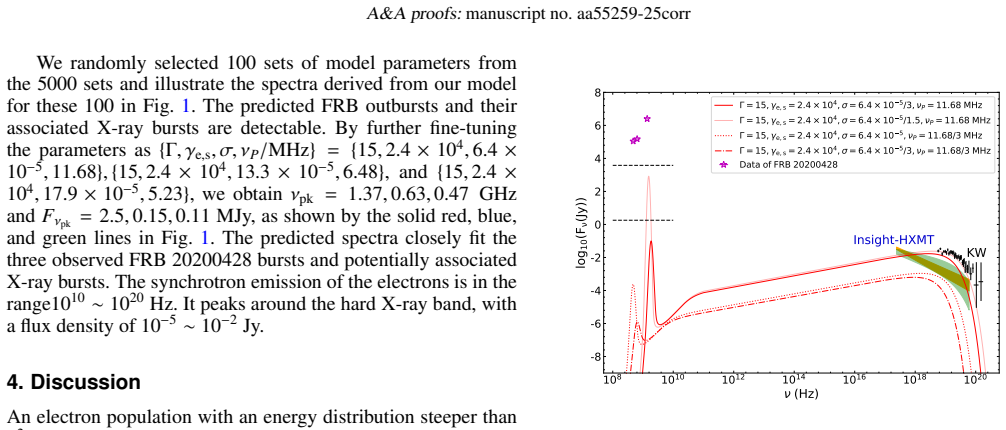
- [Fig. 1 caption] The '100 randomly selected model parameter sets' are selected from the accepted Monte Carlo sample, not from an unconstrained prior. Please make this explicit in the caption to avoid implying that any random parameter choice produces the plotted spectra.
Circularity Check
Monte Carlo 'prediction' is an inverse filter on observed peaks and fluxes; 'fine-tuning' fits the same data.
-
fitted input called prediction
[Section 3, 'Numerical calculation results' (Monte Carlo procedure, Steps 1-3); abstract]
"We fixed the νpk value at 0.475, 0.64, or 1.37 GHz, as observed by CHIME and STARE2 ... We first calculated the νP value with Eq. (11) ... and then calculated the simulated peak flux density (Fsimνpk) at νpk with Eq. (10)... We checked whether the Fsimνpk value is in the range 0.11 < Fsimν < 2.5 MJy, as observed with CHIME and STARE2."
The acceptance filter is the observed data: νpk is fixed to the measured radio peak frequencies and νP is solved from Eq. (11), so the radio peak frequencies in the 'predicted' spectra are inputs, not model predictions. The surviving parameter sets are then further required to place the synchrotron peak and flux inside the observed X-ray ranges. The resulting histograms are a posterior of parameters consistent with the data, not an independent prediction. The abstract's claim that the model 'can predict observable FRB outbursts and associated hard X-ray bursts' is therefore a restatement of the selection criteria.
-
fitted input called prediction
[Section 3 (fine-tuning paragraph) and Section 5 (Conclusions)]
"By further fine-tuning the parameters as {Γ,γe,s,σ,νP/MHz} = {15, 2.4×10⁴, 6.4×10⁻⁵, 11.68}, {15, 2.4×10⁴, 13.3×10⁻⁵, 6.48}, and {15, 2.4×10⁴, 17.9×10⁻⁵, 5.23}, we obtain νpk = 1.37, 0.63, 0.47 GHz and Fνpk = 2.5, 0.15, 0.11 MJy, as shown by the solid red, blue, and green lines in Fig. 1."
These 'fine-tuned' sets are chosen so that the model peak frequencies and peak flux densities equal the observed values for the three bursts. The statement that the 'predicted spectra closely fit' is a fit to the data used in the selection; the parameter values are the result of matching the measured peaks, so reproducing those peaks is by construction, not a test of the model.
full rationale
The central circularity is terminological: the Monte Carlo analysis is a rejection-sampling inversion of the observed FRB and X-ray values. Step 1 fixes νpk to the observed frequencies and uses Eq. (11) to set νP; Steps 2-3 demand that the radio flux and the X-ray peak frequency/flux fall in the observed ranges. Thus the claimed 'prediction' of observable FRB+X-ray bursts is an output of the selection criteria, not a forecast. However, the paper does contain non-circular content: it is not guaranteed a priori that any parameter set satisfying the radio peak-frequency constraint will also place the synchrotron component in the hard X-ray band with the observed flux, and the recovered parameter region (Γ=5-30, σ~1e-4, etc.) is a real inversion. The delta-function electron distribution is an explicit assumption justified by Schlickeiser (1984) and Sagiv & Waxman (2002), and the self-citations to Li et al. (2025) for Eqs. (6) and (11) are to a genuine antecedent, so I do not treat those as independently circular. The score of 6 reflects that the headline 'predict' claim reduces by construction, while the underlying parameter inference retains some independent content.
Assumptions & free parameters
free parameters (6)
- Bulk Lorentz factor Gamma =
5-30 (median 13)
- Electron Lorentz factor gamma_e,s =
1.8e4 - 3.3e4
- Magnetization sigma =
6e-5 to 1.8e-4; log sigma peaks at -4.21, -3.95, -3.88
- Plasma frequency nu_P =
2.48 - 42.61 MHz
- Pitch angle chi =
pi/4
- Blob variability timescale delta_t =
1 ms
assumptions (6)
- domain assumption The plasma refractive index in a weakly magnetized relativistic plasma is n^2 = 1 - (nu_P/nu)^2 for a monoenergetic electron distribution.
- domain assumption Weakly magnetized relativistic shocks generate plasma synchrotron maser emission.
- domain assumption Electrons in each blob follow an isotropic monoenergetic (delta-function) distribution.
- domain assumption The comoving blob size is Delta = Gamma c delta_t with delta_t = 1 ms.
- domain assumption The radio bursts and hard X-ray peaks of FRB 20200428 are associated and arise from the same blobs.
- domain assumption Synchrotron and absorption formulas (Eqs. 1-8) are the standard ones for a monoenergetic population, and the observer-frame flux transforms as Eq. 10.
Cite this review
Pith. "Pith review of FRB 20200428 and potentially associated hard X-ray bursts: Maser emission and synchrotron radiation of electrons in a weakly magnetized plasma?." pith.science (2026). https://pith.science/paper/FKINQW7J
@misc{pith2026250819315,
  author       = {Pith},
  title        = {Pith review of: FRB 20200428 and potentially associated hard X-ray bursts: Maser emission and synchrotron radiation of electrons in a weakly magnetized plasma?},
  year         = {2026},
  howpublished = {\url{https://pith.science/paper/FKINQW7J}},
  note         = {Machine review of arXiv:2508.19315}
}
abstract
The temporal and spatial coincidence between FRB 20200428 and hard peaks of the X-ray burst from SGR 1935+2154 suggests their potential association. We attributed them to the plasma synchrotron maser emission and synchrotron radiation of electrons in weakly magnetized, relativistically moving plasma blobs, and Monte Carlo simulation analysis shows that our model can predict observable fast radio burst outbursts and associated hard X-ray bursts with current telescopes. We constrained the properties of the blobs, including the Lorentz factor $\Gamma=5-30$, the magnetization factor $\sigma=6\times10^{-5}\sim 2\times 10^{-4}$, the electron Lorentz factor $\gamma_{\rm e,s}=(1.8-3.3)\times10^4$, and the plasma frequency $\nu_P=2.48 -42.61$ MHz. The inferred size of the blobs is $\sim 10^{9-10}$ cm, and it is located $\sim 10^{12-14}$ cm from the central engine. By adopting fine-tuned parameter sets, the observed spectra of both the FRB 20200428 outbursts and X-ray bursts can be well represented. The peak flux density ($F_{\rm\nu_{ pk}}$) of plasma maser emission is sensitive to $\sigma$ and $\nu_P$. Variation in $F_{\rm \nu_{pk}}$ can be more than 10 orders of magnitude, while the flux density of the synchrotron emission only varies by $1-2$ orders of magnitude. This can account for the observed sub-energetic radio bursts or giant radio pulses from SGR 1935+2154.
Figures

Reference graph
Works this paper leans on
-
[1]
Aleksandrov, A. F., Bogdankevich, L. S., & Rukhadze, A. A. 1984, in Berlin and New York, V ol. 9, 2444
work page 1984
-
[2]
Beloborodov, A. M. 2017, ApJ, 843, L26
work page 2017
-
[3]
Beloborodov, A. M. 2020, ApJ, 896, 142
work page 2020
-
[4]
E., Aggarwal, K., et al
Bhandari, S., Heintz, K. E., Aggarwal, K., et al. 2022, AJ, 163, 69
2022
-
[5]
Bhardwaj, M., Gaensler, B. M., Kaspi, V . M., et al. 2021, ApJ, 910, L18
work page 2021
-
[6]
Bochenek, C. D., Ravi, V ., Belov, K. V ., et al. 2020, Nature, 587, 59 CHIME/FRB Collaboration, Amiri, M., Andersen, B. C., et al. 2021, ApJS, 257, 59 Chime/Frb Collaboration, Amiri, M., Andersen, B. C., et al. 2020, Nature, 582, 351 Chime/Frb Collaboration, Andersen, B. C., Bandura, K., et al. 2023, ApJ, 947, 83 CHIME/FRB Collaboration, Andersen, B. C.,...
work page 2020
-
[7]
Cordes, J. M. & Chatterjee, S. 2019, ARA&A, 57, 417
work page 2019
-
[8]
Dai, Z. G. 2020, ApJ, 897, L40
work page 2020
Show all 54 references
-
[9]
C., Bhardwaj, M., et al
Fonseca, E., Andersen, B. C., Bhardwaj, M., et al. 2020, ApJ, 891, L6
2020
-
[10]
Gaensler, B. M. 2014, GRB Coordinates Network, 16533, 1
2014
-
[11]
2020, ApJ, 898, L55
Geng, J.-J., Li, B., Li, L.-B., et al. 2020, ApJ, 898, L55
2020
-
[12]
Ginzburg, V . L. 1989, Applications of electrodynamics in theoretical physics and astrophysics
1989
-
[13]
C., Chawla, P., et al
Giri, U., Andersen, B. C., Chawla, P., et al. 2023, arXiv e-prints, arXiv:2310.16932
2023 arXiv
-
[14]
& Waxman, E
Gruzinov, A. & Waxman, E. 2019, ApJ, 875, 126
2019
-
[15]
E., Prochaska, J
Heintz, K. E., Prochaska, J. X., Simha, S., et al. 2020, ApJ, 903, 152
2020
-
[16]
L., Esposito, P., Rea, N., et al
Israel, G. L., Esposito, P., Rea, N., et al. 2016, MNRAS, 457, 3448
2016
-
[17]
Katz, J. I. 2014, Phys. Rev. D, 89, 103009
2014
-
[18]
2022, Nature, 602, 585
Kirsten, F., Marcote, B., Nimmo, K., et al. 2022, Nature, 602, 585
2022
-
[19]
P., Jenkins, M., et al
Kirsten, F., Snelders, M. P., Jenkins, M., et al. 2021, Nature Astronomy, 5, 414
2021
-
[20]
2018, ApJ, 852, 54
Kothes, R., Sun, X., Gaensler, B., & Reich, W. 2018, ApJ, 852, 54
2018
-
[21]
2017, MNRAS, 468, 2726
Kumar, P., Lu, W., & Bhattacharya, M. 2017, MNRAS, 468, 2726
2017
-
[22]
K., Lin, L., Xiong, S
Li, C. K., Lin, L., Xiong, S. L., et al. 2021, Nature Astronomy, 5, 378
2021
-
[23]
M., Deng, C.-M., & Liang, E.-W
Li, X., Lyu, F., Zhang, H. M., Deng, C.-M., & Liang, E.-W. 2025, A&A, 695, A100
2025
-
[24]
F., Wang, P., et al
Lin, L., Zhang, C. F., Wang, P., et al. 2020, Nature, 587, 63
2020
-
[25]
R., Bailes, M., McLaughlin, M
Lorimer, D. R., Bailes, M., McLaughlin, M. A., Narkevic, D. J., & Crawford, F. 2007, Science, 318, 777
2007
-
[26]
2020, MNRAS, 498, 1397
Lu, W., Kumar, P., & Zhang, B. 2020, MNRAS, 498, 1397
2020
-
[27]
2014, MNRAS, 442, L9
Lyubarsky, Y . 2014, MNRAS, 442, L9
2014
-
[28]
2021, Universe, 7, 56
Lyubarsky, Y . 2021, Universe, 7, 56
2021
-
[29]
Margalit, B., Beniamini, P., Sridhar, N., & Metzger, B. D. 2020, ApJ, 899, L27
2020
-
[30]
& Metzger, B
Margalit, B. & Metzger, B. D. 2018, ApJ, 868, L4
2018
-
[31]
2020, ApJ, 898, L29
Mereghetti, S., Savchenko, V ., Ferrigno, C., et al. 2020, ApJ, 898, L29
2020
-
[32]
D., Margalit, B., & Sironi, L
Metzger, B. D., Margalit, B., & Sironi, L. 2019, MNRAS, 485, 4091
2019
-
[33]
& CHIME /FRB Collaboration
Ng, M. & CHIME /FRB Collaboration. 2025, The Astronomer’s Telegram, 17081, 1
2025
-
[34]
D., Jameson, A., et al
Petroff, E., Barr, E. D., Jameson, A., et al. 2016, PASA, 33, e045
2016
-
[35]
Petroff, E., Hessels, J. W. T., & Lorimer, D. R. 2022, A&A Rev., 30, 2 Planck Collaboration, Ade, P. A. R., Aghanim, N., et al. 2016, A&A, 594, A13
2022
-
[36]
2019, Phys
Platts, E., Weltman, A., Walters, A., et al. 2019, Phys. Rep., 821, 1
2019
-
[37]
2021, Nature Astronomy, 5, 372
Ridnaia, A., Svinkin, D., Frederiks, D., et al. 2021, Nature Astronomy, 5, 372
2021
-
[38]
Rybicki, G. B. & Lightman, A. P. 1986, Radiative Processes in Astrophysics
1986
-
[39]
& Waxman, E
Sagiv, A. & Waxman, E. 2002, ApJ, 574, 861
2002
-
[40]
1984, A&A, 136, 227
Schlickeiser, R. 1984, A&A, 136, 227
1984
-
[41]
2008, ApJ, 682, L5
Spitkovsky, A. 2008, ApJ, 682, L5
2008
-
[42]
2021, Nature Astronomy, 5, 401
Tavani, M., Casentini, C., Ursi, A., et al. 2021, Nature Astronomy, 5, 401
2021
-
[43]
2020, ApJ, 899, 109
Wang, W.-Y ., Xu, R., & Chen, X. 2020, ApJ, 899, 109
2020
-
[44]
Q., Wang, F
Wu, Q., Zhang, G. Q., Wang, F. Y ., & Dai, Z. G. 2020, ApJ, 900, L26
2020
-
[45]
& Dai, Z.-G
Xiao, D. & Dai, Z.-G. 2020, ApJ, 904, L5
2020
-
[46]
2021, Science China Physics, Mechanics, and Astronomy, 64, 249501
Xiao, D., Wang, F., & Dai, Z. 2021, Science China Physics, Mechanics, and Astronomy, 64, 249501
2021
-
[47]
& Zhang, B
Yang, Y .-P. & Zhang, B. 2018, ApJ, 868, 31
2018
-
[48]
2020, ApJ, 901, L13
Yang, Y .-P., Zhu, J.-P., Zhang, B., & Wu, X.-F. 2020, ApJ, 901, L13
2020
-
[49]
2021, MNRAS, 500, 2704
Yu, Y .-W., Zou, Y .-C., Dai, Z.-G., & Yu, W.-F. 2021, MNRAS, 500, 2704
2021
-
[50]
2020, Nature, 587, 45
Zhang, B. 2020, Nature, 587, 45
2020
-
[51]
2023, Reviews of Modern Physics, 95, 035005
Zhang, B. 2023, Reviews of Modern Physics, 95, 035005
2023
-
[52]
B., Wang, J
Zhang, S. B., Wang, J. S., Yang, X., et al. 2024, Nature Communications, 15, 7454
2024
-
[53]
2020, ApJ, 898, L5
Zhong, S.-Q., Dai, Z.-G., Zhang, H.-M., & Deng, C.-M. 2020, ApJ, 898, L5
2020
-
[54]
2020, ApJ, 905, 99 Article number, page 5 of 5
Zhou, P., Zhou, X., Chen, Y ., et al. 2020, ApJ, 905, 99 Article number, page 5 of 5
2020
Reviewed August 5, 2026 · model on record in the stance chip above.
Discussion (0). Continue with ORCID to comment.