REVIEW 3 major objections 8 minor 35 references
Recommendation with Attribute-aware Product Networks: A Representation Learning Model
T0 review · 3 major / 8 minor · reviewed 2026-08-14 · deepseek-v4-flash
Pith's one-line read By splitting the co-purchase network into attribute-specific subgraphs, eRAN learns personalized item representations that rank more accurately and explain why an item is recommended, including for cold-start items with attributes only.
desk verdict A plausible attribute-network idea with an unjustified cold-start scoring rule and evaluation gaps; worth a look in peer review, but not citable as is. read the letter →
The pith
A machine-rendered reading of the paper's core claim, the machinery that carries it, and where it could break.
The reading
What carries the argument
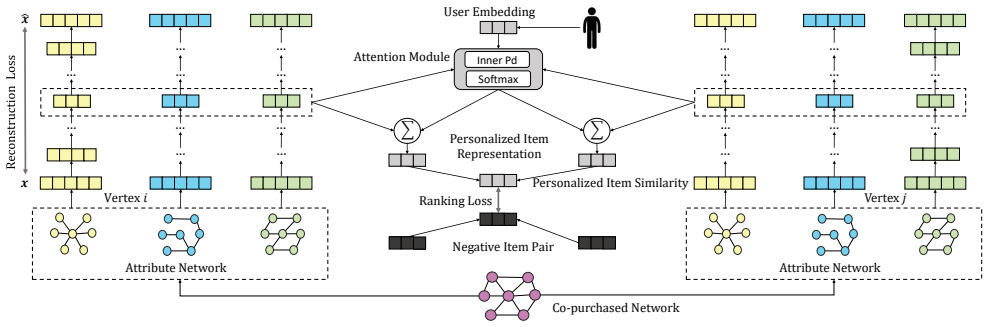
The attribute network is the central object: for each attribute k, keep only co-purchase edges e_{ij} where items i and j share the same value of attribute k, giving an induced subgraph G_k. Each node's adjacency vector in G_k is fed into a deep autoencoder with a reconstruction loss that penalizes errors on non-zero entries more heavily, producing a low-dimensional embedding h_i^k for every item in every attribute space. An attention module scores attribute k for user u as the inner product of the user embedding z_u with h_i^k, then softmax-normalizes across attributes to form a personalized item representation h_{u,i}; a pairwise ranking loss with negative sampling pulls co-purchased item pairs closer and pushes away non-purchased items. Similarity between personalized item representations is measured by negative L2 distance rather than inner product, and a new item with attributes but no purchase history can be connected to the attribute networks and embedded using the learned autoencoder parameters, giving the cold-start path.
What would settle it
Take a purchase dataset where the true drivers of co-purchase are known, for example from surveys or from a synthetic environment, and compare eRAN's attention weights and rank accuracy when the listed attributes are the true drivers versus when they are irrelevant or incomplete. If eRAN's advantage over item-based collaborative filtering disappears or its attention weights diverge from the known reasons, the central claim that co-purchases can be decomposed by listed attributes fails; a controlled experiment in which co-purchase edges are generated by a hidden attribute not included in the model would show this directly.
Extended reading notes
Core claim
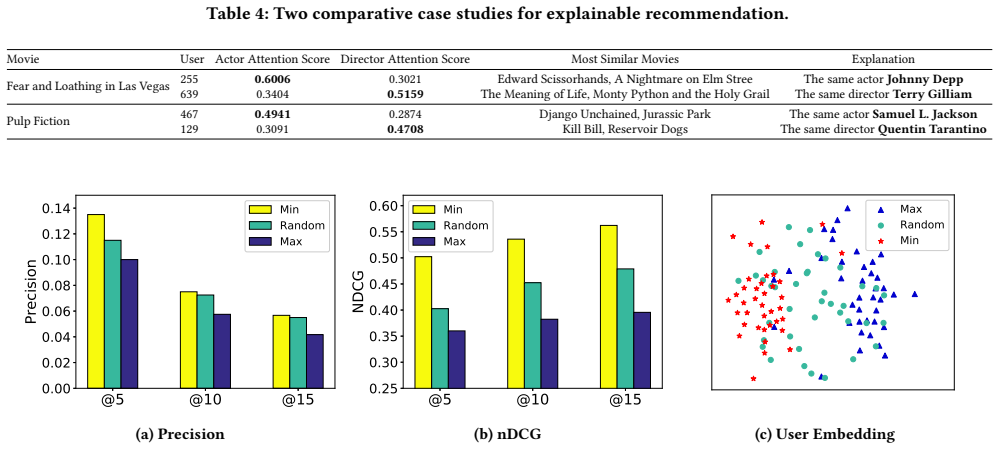
On its own terms, the paper establishes that eRAN is consistently better than all eight baselines on the three datasets (Kaggle-Movie, Goodreads-Potery, Amazon-Music) in Precision@K and nDCG@K, and that in the cold-start simulation it consistently outperforms other attribute-based recommendation methods. The mechanism behind the improvement is the attribute network: each attribute value induces a subgraph of co-purchase edges, the nodes of each subgraph are embedded by a deep autoencoder, and a user-specific attention weight combines these embeddings into a personalized item vector. Co-purchased items are required to be closer to each other than to negatively sampled non-purchased items under an L2 distance, which yields both ranking accuracy and interpretable attention scores. The paper also shows that removing the network for an attribute hurts the users whose attention scores favor that attribute most, and that the learned user embeddings separate users by their dominant attribute preferences.
Load-bearing premise
The load-bearing premise is the paper's stated assumption that the reason two items are co-purchased can be attributed to one or several of the listed attributes; if co-purchases are actually driven by unobserved factors such as promotions, seasonality, packaging, or missing attributes, the attribute-network edges do not faithfully represent user preferences.
Editorial extensions
If this is right
- Cold-start items with attribute metadata can be ranked for existing users without any purchase history for those items.
- Recommendations come with attribute-level explanations, such as 'similar to a movie you watched because of the same actor or director,' grounded in learned attention weights.
- On sparse interaction data, decomposing item relationships by attributes may yield larger gains than feature-based baselines.
- The learned user embeddings separate users by dominant attribute preferences, so the same user representation can serve profiling or explanation tasks.
- If the attribute-network assumption holds, item-based collaborative filtering can be generalized from a single global item similarity to user-specific, attribute-specific similarities.
Reading between the lines
- The attribute-network decomposition could transfer to other edge types, such as complement or substitute relations, extending explainability beyond shared attributes.
- A natural test is to compare eRAN's attention weights against explicit user-stated preferences or against the attributes highlighted in user reviews; agreement would validate the explanations beyond ranking accuracy.
- Because the model relies on attribute completeness, adding or removing an attribute field should visibly change both accuracy and explanations; this gives a practical diagnostic for whether the attribute set covers the true drivers of co-purchase.
- The same embedding-plus-attention architecture could be applied to knowledge graphs, where edges are typed relations rather than attribute sharing.
Signed reviews
Editorial analysis
A structured set of objections, weighed in public.
Referee Report
Summary. The paper proposes eRAN, a representation-learning model for top-N recommendation that combines item co-purchase networks with item attributes. It constructs one attribute network per attribute by keeping only co-purchase edges between items that share the attribute value, embeds nodes of each network with a deep autoencoder, and then uses an attention mechanism to weight attributes differently for each user. A pairwise ranking loss with negative sampling is added to the autoencoder reconstruction loss, and recommendation scores are computed from negative L2 distances between personalized item representations (Eq. 13). The paper evaluates eRAN on three real-world datasets against eight baselines, reports a cold-start experiment, and provides attention-based explanations and case studies. The central claims are that eRAN is consistently better than all baselines on all three datasets and that it has a unique advantage for cold-start items when attributes are available.
Significance. If the results hold, the paper offers a useful combination of attribute-aware network embeddings, user attention, and pairwise ranking for explainable and cold-start recommendation. The idea of decomposing the co-purchase graph into attribute-specific subnetworks is simple and plausible, and the qualitative validation in Section 5.3, including the attention-ablation experiment and the two case studies, is a strength. The paper also tests on three real datasets with several strong baselines and gives a clear account of the model architecture. However, the experimental support has important gaps: there is no uncertainty quantification, the cold-start evaluation uses a single dataset and an unjustified scoring rule, and the ranking-loss formulation needs correction or clarification. As written, the central claims are not yet established.
major comments (3)
- [Section 3.3, Eq. (11)] With sim_u(i,j) defined as -||h_{u,i}-h_{u,j}||^2 in Eq. (8), the inequality sim_u(i,j) > sim_u(i,n) is equivalent to ||h_{u,i}-h_{u,j}||^2 < ||h_{u,i}-h_{u,n}||^2. The negative log-likelihood for this pairwise ordering is -log sigma(||h_{u,i}-h_{u,n}||^2 - ||h_{u,i}-h_{u,j}||^2). Equation (11) instead writes +log sigma(||h_{u,i}-h_{u,j}||^2 - ||h_{u,i}-h_{u,n}||^2). As a term to be minimized in Eq. (12), this is the log-probability of the wrong ordering and is unbounded below, driving the margin to +infinity; as a term to be maximized, it enforces the opposite ordering. The paper should state whether L_rank is minimized or maximized and correct Eq. (11) to the standard BPR loss; the experimental results must be confirmed under the corrected objective.
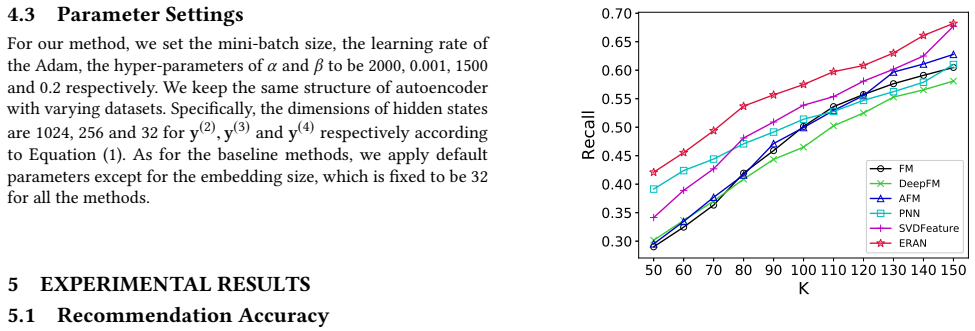
- [Section 3.4 and Section 5.2, Eq. (14)] The cold-start score in Eq. (14) replaces the sum over the user's purchased items in Eq. (13) by the minimum over j of -||h_{u,x}-h_{u,j}||^2. Since squared distances are non-negative, this minimum corresponds to the user's single least-similar purchased item, so ranking users by Eq. (14) ignores all other purchase-history evidence. No justification is given for using a different aggregation for cold-start items, and the evaluation in Figure 3 uses this rule exclusively. In addition, Figure 3 reports cold-start Recall only for Kaggle-Movie, so the statement that eRAN 'consistently outperform[s]' attribute-based methods on cold-start items is not supported. Please justify or replace the min-aggregation (e.g., with a sum or a max/closest-match rule), report results for all three datasets, and check whether the claimed cold-start advantage survives.
- [Section 5.1 and Section 5.2, Tables 2-3 and Figure 3] All accuracy numbers are point estimates without standard deviations, confidence intervals, or significance tests. Several margins over the best baseline are small; for example, in Table 2, Kaggle-Movie P@5 is 0.1289 for eRAN versus 0.1219 for SVDFeature, and in Table 3, Amazon-Music P@5 is 0.1104 for eRAN versus 0.0951 for FISM. Because the evaluation uses random negative sampling (Section 5.1), the reported gains could change with different samples. Please run repeated experiments over multiple negative samples and/or train/test splits, report mean and standard deviation, and apply a paired significance test when claiming consistent superiority.
minor comments (8)
- [Throughout] 'Goodreads-Potery' appears to be a misspelling of 'Goodreads-Poetry' (or should be defined as a dataset name); please correct or clarify.
- [Section 5.1] The sentence 'eRNA outperforms eRAN-L1' should read 'eRAN outperforms eRAN-L1'.
- [Figure 3] The legend uses 'ERAN' instead of 'eRAN'.
- [Table 2] The column header 'Precision' is misspelled.
- [Section 5.3] The text says 'user 225' while Table 4 lists user 255 in the same case study; please make these consistent.
- [Section 5.4, Figure 5b] The sensitivity analysis for alpha uses values 10, 10^2, 10^3, and 10^4, but the chosen alpha in Section 4.3 is 1500; please include the chosen value or justify the interpolation, since the claim that performance drops for alpha > 1000 does not directly validate 1500.
- [Section 6] The related-work text refers to 'AMF [26]' while the baseline list and reference [26] use 'AFM'.
- [Section 3.3, Eq. (9)] The text says the loss maximizes aggregate personalized similarity, but Eq. (9) is written as a loss; please clarify the sign and minimization convention there as well.
Circularity Check
No significant circularity: the ranking objective and recommendation score share the same metric by design, but evaluation is on held-out items and no fitted parameter is renamed as a prediction.
full rationale
The derivation chain in eRAN is self-contained. The recommendation score in Eq. (13) sums the same negative squared-L2 personalized similarity that the ranking loss in Eq. (11) is trained to maximize, but that is the intended objective of a representation-learning recommender rather than a circular prediction: under the leave-one-out protocol the held-out item is excluded from the set R+u\{i} in the score, and the item embeddings come from an autoencoder over attribute-network adjacency vectors with the ranking loss as a regularizer, not from the test label. The cold-start score in Eq. (14) uses a different min aggregation, which is a debatable evaluation choice and could affect the reported cold-start advantage, but it is not a step in which an output is equivalent to an input by construction. No load-bearing self-citation or imported uniqueness theorem appears: the only theory citation, [9], is an external result about inner products violating the triangle inequality, and the empirical comparisons are against standard external baselines on public datasets. The attention ablation in Section 5.3 and parameter sensitivity in Section 5.4 further show that the ranking loss and attribute networks do real work rather than merely re-stating the evaluation metric. Therefore no fitted input is called a prediction and no claimed derivation reduces to its own inputs.
Assumptions & free parameters
free parameters (2)
- alpha =
1500
- beta =
0.2
assumptions (3)
- domain assumption Co-purchase edges can be attributed to one or several shared item attributes.
- domain assumption A user's co-purchased items are more similar to each other than to unobserved items.
- standard math The deep autoencoder can reconstruct the adjacency matrix of each attribute network well enough to produce useful embeddings.
Cite this review
Pith. "Pith review of Recommendation with Attribute-aware Product Networks: A Representation Learning Model." pith.science (2026). https://pith.science/paper/FL2AT6W5
@misc{pith2026190805928,
  author       = {Pith},
  title        = {Pith review of: Recommendation with Attribute-aware Product Networks: A Representation Learning Model},
  year         = {2026},
  howpublished = {\url{https://pith.science/paper/FL2AT6W5}},
  note         = {Machine review of arXiv:1908.05928}
}
read the original abstract
With the prosperity of business intelligence, recommender systems have evolved into a new stage that we not only care about what to recommend, but why it is recommended. Explainability of recommendations thus emerges as a focal point of research and becomes extremely desired in e-commerce. Existent studies along this line often exploit item attributes and correlations from different perspectives, but they yet lack an effective way to combine both types of information for deep learning of personalized interests. In light of this, we propose a novel graph structure, \emph{attribute network}, based on both items' co-purchase network and important attributes. A novel neural model called \emph{eRAN} is then proposed to generate recommendations from attribute networks with explainability and cold-start capability. Specifically, eRAN first maps items connected in attribute networks to low-dimensional embedding vectors through a deep autoencoder, and then an attention mechanism is applied to model the attractions of attributes to users, from which personalized item representation can be derived. Moreover, a pairwise ranking loss is constructed into eRAN to improve recommendations, with the assumption that item pairs co-purchased by a user should be more similar than those non-paired with negative sampling in personalized view. Experiments on real-world datasets demonstrate the effectiveness of our method compared with some state-of-the-art competitors. In particular, eRAN shows its unique abilities in recommending cold-start items with higher accuracy, as well as in understanding user preferences underlying complicated co-purchasing behaviors.
Figures

Figures from the paper (2 more)

Reference graph
Works this paper leans on
-
[1]
Gediminas Adomavicius and Alexander Tuzhilin. 2005. Toward the next gen- eration of recommender systems: A survey of the state-of-the-art and possible extensions. IEEE Transactions on Knowledge & Data Engineering6 (2005), 734–749
work page 2005
-
[2]
Linas Baltrunas, Bernd Ludwig, and Francesco Ricci. 2011. Matrix factorization techniques for context aware recommendation. In Proceedings of the fifth ACM conference on Recommender systems . ACM, 301–304
work page 2011
-
[3]
Tianqi Chen, Weinan Zhang, Qiuxia Lu, Kailong Chen, Zhao Zheng, and Yong Yu. 2012. SVDFeature: a toolkit for feature-based collaborative filtering. Journal of Machine Learning Research 13, Dec (2012), 3619–3622
2012
-
[4]
Xu Chen, Zheng Qin, Yongfeng Zhang, and Tao Xu. 2016. Learning to rank features for recommendation over multiple categories. In Proceedings of the 39th International ACM SIGIR conference on Research and Development in Information Retrieval. ACM, 305–314
work page 2016
-
[5]
Xu Chen, Yongfeng Zhang, Hongteng Xu, Yixin Cao, Zheng Qin, and Hongyuan Zha. 2018. Visually Explainable Recommendation.arXiv preprint arXiv:1801.10288 (2018)
work page Pith review arXiv 2018
-
[6]
Evangelia Christakopoulou and George Karypis. 2016. Local item-item mod- els for top-n recommendation. In Proceedings of the 10th ACM Conference on Recommender Systems. ACM, 67–74
work page 2016
-
[7]
Huifeng Guo, Ruiming Tang, Yunming Ye, Zhenguo Li, and Xiuqiang He. 2017. Deepfm: a factorization-machine based neural network for ctr prediction. arXiv preprint arXiv:1703.04247 (2017)
arXiv 2017
-
[8]
Xiangnan He, Lizi Liao, Hanwang Zhang, Liqiang Nie, Xia Hu, and Tat-Seng Chua. 2017. Neural collaborative filtering. In Proceedings of the 26th International Conference on World Wide Web . International World Wide Web Conferences Steering Committee, 173–182
2017
Show all 35 references
-
[9]
Cheng Kang Hsieh, Longqi Yang, Yin Cui, Tsung Yi Lin, Serge Belongie, and Deborah Estrin. 2017. Collaborative Metric Learning
2017
-
[10]
Santosh Kabbur, Xia Ning, and George Karypis. 2013. Fism: factored item simi- larity models for top-n recommender systems. In Proceedings of the 19th ACM SIGKDD international conference on Knowledge discovery and data mining . ACM, 659–667
2013
-
[11]
David C Liu, Stephanie Rogers, Raymond Shiau, Dmitry Kislyuk, Kevin C Ma, Zhigang Zhong, Jenny Liu, and Yushi Jing. 2017. Related pins at pinterest: The evolution of a real-world recommender system. In Proceedings of the 26th International Conference on World Wide Web Companio...
2017
-
[12]
Julian McAuley and Jure Leskovec. 2013. Hidden factors and hidden topics: understanding rating dimensions with review text. In Proceedings of the 7th ACM conference on Recommender systems . ACM, 165–172
2013
-
[13]
Julian McAuley, Christopher Targett, Qinfeng Shi, and Anton Van Den Hengel
-
[14]
Xia Ning and George Karypis. 2011. Slim: Sparse linear methods for top-n recommender systems. In 2011 11th IEEE International Conference on Data Mining . IEEE, 497–506
2011
-
[15]
Pentti Paatero and Unto Tapper. 2010. Positive matrix factorization: A non- negative factor model with optimal utilization of error estimates of data values. Environmetrics 5, 2 (2010), 111–126
2010
-
[16]
Yanru Qu, Han Cai, Kan Ren, Weinan Zhang, Yong Yu, Ying Wen, and Jun Wang
-
[17]
Zhaochun Ren, Shangsong Liang, Piji Li, Shuaiqiang Wang, and Maarten de Rijke
-
[18]
Steffen Rendle. 2010. Factorization machines. In Data Mining (ICDM), 2010 IEEE 10th International Conference on . IEEE, 995–1000
2010
-
[19]
Steffen Rendle, Christoph Freudenthaler, Zeno Gantner, and Lars Schmidt-Thieme
-
[20]
Badrul Sarwar, George Karypis, Joseph Konstan, and John Riedl. 2001. Item-based collaborative filtering recommendation algorithms. In Proceedings of the 10th international conference on World Wide Web. ACM, 285–295
2001
-
[21]
Sungyong Seo, Jing Huang, Hao Yang, and Yan Liu. 2017. Interpretable convo- lutional neural networks with dual local and global attention for review rating prediction. In Proceedings of the Eleventh ACM Conference on Recommender Sys- tems. ACM, 297–305
2017
-
[22]
Laurens van der Maaten and Geoffrey E. Hinton. 2008. Visualizing High- Dimensional Data Using t-SNE. JMLR 9 (2008), 2579–2605
2008
-
[23]
Mengting Wan and Julian McAuley. 2018. Item recommendation on monotonic behavior chains. In Proceedings of the 12th ACM Conference on Recommender Systems. ACM, 86–94
2018
-
[24]
Daixin Wang, Peng Cui, and Wenwu Zhu. 2016. Structural deep network em- bedding. In Proceedings of the 22nd ACM SIGKDD international conference on Knowledge discovery and data mining . ACM, 1225–1234
2016
-
[25]
Yao Wu and Martin Ester. 2015. Flame: A probabilistic model combining aspect based opinion mining and collaborative filtering. In Proceedings of the Eighth ACM International Conference on Web Search and Data Mining . ACM, 199–208
2015
-
[26]
Jun Xiao, Hao Ye, Xiangnan He, Hanwang Zhang, Fei Wu, and Tat-Seng Chua
-
[27]
Yongfeng Zhang and Xu Chen. 2018. Explainable Recommendation: A Survey and New Perspectives. arXiv preprint arXiv:1804.11192 (2018)
2018 arXiv
-
[28]
Yongfeng Zhang, Guokun Lai, Min Zhang, Yi Zhang, Yiqun Liu, and Shaoping Ma. 2014. Explicit factor models for explainable recommendation based on phrase-level sentiment analysis. In Proceedings of the 37th international ACM SIGIR conference on Research & development in informa...
2014
-
[29]
Wayne Xin Zhao, Sui Li, Yulan He, Edward Y Chang, Ji-Rong Wen, and Xiaoming Li. 2016. Connecting social media to e-commerce: Cold-start product recommen- dation using microblogging information. IEEE Transactions on Knowledge and Data Engineering 28, 5 (2016), 1147–1159
2016
-
[30]
Xin Wayne Zhao, Yanwei Guo, Yulan He, Han Jiang, Yuexin Wu, and Xiaoming Li. 2014. We know what you want to buy: a demographic-based system for product recommendation on microblogs. In Proceedings of the 20th ACM SIGKDD international conference on Knowledge discovery and data ...
2014
-
[31]
arXiv preprint arXiv:1708.04617 (2017)
Attentional factorization machines: Learning the weight of feature interac- tions via attention networks. arXiv preprint arXiv:1708.04617 (2017)
2017 arXiv
-
[2009]
In Proceedings of the twenty-fifth conference on uncertainty in artificial intelligence
BPR: Bayesian personalized ranking from implicit feedback. In Proceedings of the twenty-fifth conference on uncertainty in artificial intelligence . AUAI Press, 452–461
-
[2015]
In Proceedings of the 38th International ACM SIGIR Conference on Research and Development in Information Retrieval
Image-based recommendations on styles and substitutes. In Proceedings of the 38th International ACM SIGIR Conference on Research and Development in Information Retrieval. ACM, 43–52
-
[2016]
InData Mining (ICDM), 2016 IEEE 16th International Conference on
Product-based neural networks for user response prediction. InData Mining (ICDM), 2016 IEEE 16th International Conference on . IEEE, 1149–1154
2016
-
[2017]
In Proceedings of the tenth ACM international conference on web search and data mining
Social collaborative viewpoint regression with explainable recommenda- tions. In Proceedings of the tenth ACM international conference on web search and data mining. ACM, 485–494
Reviewed August 14, 2026 · model on record in the stance chip above.
Discussion (0). Continue with ORCID to comment.