REVIEW 3 major objections 3 minor 55 references
Cross frequency coupling in next generation inhibitory neural mass models
T0 review · 3 major / 3 minor · reviewed 2026-08-14 · deepseek-v4-flash
Pith's one-line read Two bidirectionally coupled inhibitory neural populations with fast and slow GABA_A-like synaptic kinetics can generate theta–gamma cross-frequency coupling.
desk verdict The phase-phase CFC result in an exact inhibitory neural mass model is solid and worth knowing, but the advertised phase-amplitude coupling claim is not quantitatively supported and should be either measured or toned down. read the letter →
The pith
A machine-rendered reading of the paper's core claim, the machinery that carries it, and where it could break.
The reading
What carries the argument
The central object is the exact mean-field reduction of QIF neurons with exponential synapses: for each population the collective state is described by three variables, the firing rate, the mean membrane potential, and the mean synaptic activity, whose evolution (Eq. 5) is closed and exact in the infinite-population limit under a Lorentzian distribution of excitabilities and the Ott-Antonsen ansatz. This six-dimensional system lets the authors locate Hopf and torus bifurcations analytically or numerically, compute Lyapunov spectra to identify chaos, and quantify n:m locking with the Kuramoto order parameter for the phase difference between populations. The same reduction makes direct comparison between spiking network simulations and mean-field predictions possible.
What would settle it
Run the spiking QIF network at finite $N$ (say 10,000 neurons per population) with Gaussian or uniform excitability distributions for the parameters of Figs. 8–10 and measure whether the 3:1 locking order parameter and the phase-amplitude modulation at $\Delta=0.2$ survive; alternatively, test the same fast/slow GABA_A kinetics in a conductance-based interneuron model and check whether the CFC region and its enlargement under $\theta$ drive match the mean-field prediction.
Extended reading notes
Core claim
Two bidirectionally coupled inhibitory populations of quadratic integrate-and-fire neurons, with synaptic decay times 9 ms and 50 ms, spontaneously produce $\theta$ and gamma collective oscillations locked in a 3:1 ratio. In the exact mean-field limit, the fast population's gamma bursts are phase-locked to the slow population's $\theta$ rhythm when the disorder in single-neuron excitabilities is low ($\Delta=0.05$); for larger disorder ($\Delta=0.2$), the fast population's firing becomes nearly asynchronous but its firing rate is strongly amplitude-modulated by the slow rhythm, reproducing $\theta$-nested gamma. Driving the slow population with a 10 Hz inhibitory sinusoidal current increases $\theta$-band power, broadens the 3:1 locking region in the cross-coupling plane, and extends the locked state to $\Delta\approx 0.2$–$0.3$. The paper also shows that a single population self-oscillates via a supercritical Hopf bifurcation, with frequency controlled chiefly by the synaptic time constant, and that unidirectionally coupled populations with very different synaptic time scales can exhibit quasi-periodicity and low-dimensional chaos.
Load-bearing premise
The whole picture rests on the mean-field reduction being exact: excitabilities drawn from a Lorentzian distribution, all-to-all coupling, the Ott-Antonsen closure, and the infinite-population limit, so if finite-size effects or another excitability distribution change the collective dynamics, the predicted CFC regions—especially phase-amplitude coupling at $\Delta=0.2$, near the loss of synchronization—would not be robust.
Editorial extensions
If this is right
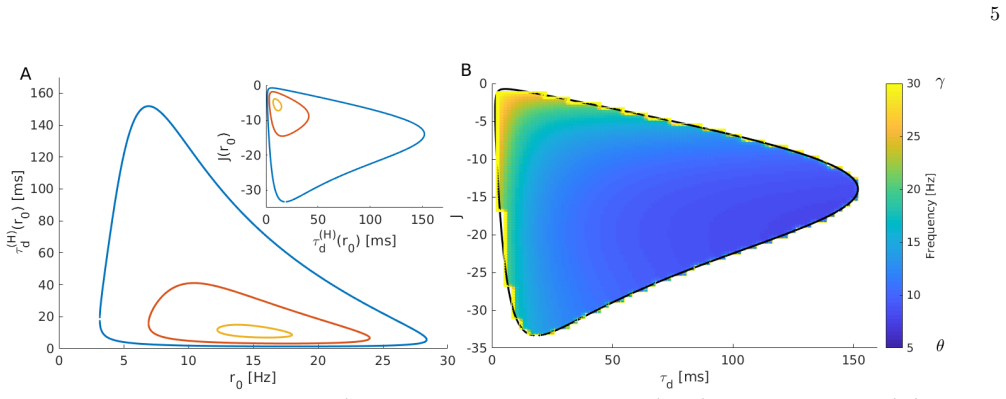
- A single inhibitory QIF population with exponential synapses self-sustains collective oscillations through a supercritical Hopf bifurcation, with frequency set mainly by the synaptic decay time across roughly 5–30 Hz.
- In a master-slave configuration with sufficiently different synaptic time scales, two inhibitory populations produce quasi-periodic tori and, for a 1:32 time-scale ratio, low-dimensional chaos with a single positive Lyapunov exponent.
- Without external drive, bidirectionally coupled fast and slow inhibitory populations show 3:1 theta–gamma phase locking only in a narrow cross-coupling region and only for heterogeneity $\Delta \lesssim 0.1$.
- Adding a 10 Hz inhibitory drive to the slow population enlarges the 3:1 locking region and raises the disorder threshold to about $\Delta \approx 0.2$–$0.3$, converting the coupling from phase-phase to phase-amplitude as disorder grows.
- The two resulting CFC modes match experimentally reported theta–gamma phase-phase coupling in behaving rats and theta-nested gamma under optogenetic stimulation, but arise here in a purely inhibitory exact mean-field model.
Reading between the lines
- If the mean-field scenario survives contact with finite-size networks, it implies that theta-nested gamma can be a purely local inhibitory phenomenon; excitatory feedback loops may be an additional pathway rather than a necessary one.
- The exact reduction makes the CFC region a good candidate for analytical phase-response analysis: a macroscopic phase-resetting curve for the two-population system could predict where 3:1 locking is most stable without dense parameter scans.
- A testable extension of the disorder transition is that raising heterogeneity in the fast population should convert phase-phase into phase-amplitude coupling continuously, so experiments combining optogenetic theta drive with manipulations of interneuron heterogeneity could look for the same transition.
- The same two-timescale mechanism may produce other integer locking ratios in narrow parameter stripes, which could appear as harmonic CFC in recordings if synaptic kinetics are pharmacologically tuned.
Signed reviews
Editorial analysis
A structured set of objections, weighed in public.
Referee Report
Summary. The manuscript studies an exactly reduced neural mass model for networks of QIF neurons with exponential synapses, obtained via the Ott-Antonsen ansatz in the infinite-N limit. It first characterizes self-sustained collective oscillations in a single inhibitory population, deriving an explicit parametrization of the Hopf boundaries. It then analyzes a single population under harmonic forcing, reporting Arnold tongues, devil's staircases, and low-dimensional chaos. Two coupled populations are studied in a master-slave configuration, where quasi-periodicity and chaos are found for sufficiently disparate synaptic time scales. Finally, bidirectionally coupled fast and slow inhibitory populations are shown to exhibit 3:1 phase-phase locking at low heterogeneity, and the paper claims phase-amplitude theta-gamma CFC at larger heterogeneity, with an external theta drive enlarging and stabilizing the locking region.
Significance. If the claims hold, the paper provides a substantial step toward understanding theta-gamma cross-frequency coupling in a mathematically tractable, exact neural mass model, showing that purely inhibitory circuits with fast and slow GABA_A-like synaptic kinetics can generate both phase-phase and phase-amplitude CFC. The strengths of the paper are its explicit Hopf boundary calculation (Appendix), the use of Lyapunov spectra and Kaplan-Yorke dimension to characterize chaos, quantitative phase-phase locking via the order parameter rho_nm, and direct network-to-mean-field comparisons for several key regimes. The central weakness is that the phase-amplitude CFC claim rests entirely on visual inspection of raster plots and rate traces, without any quantitative CFC metric or control analysis.
major comments (3)
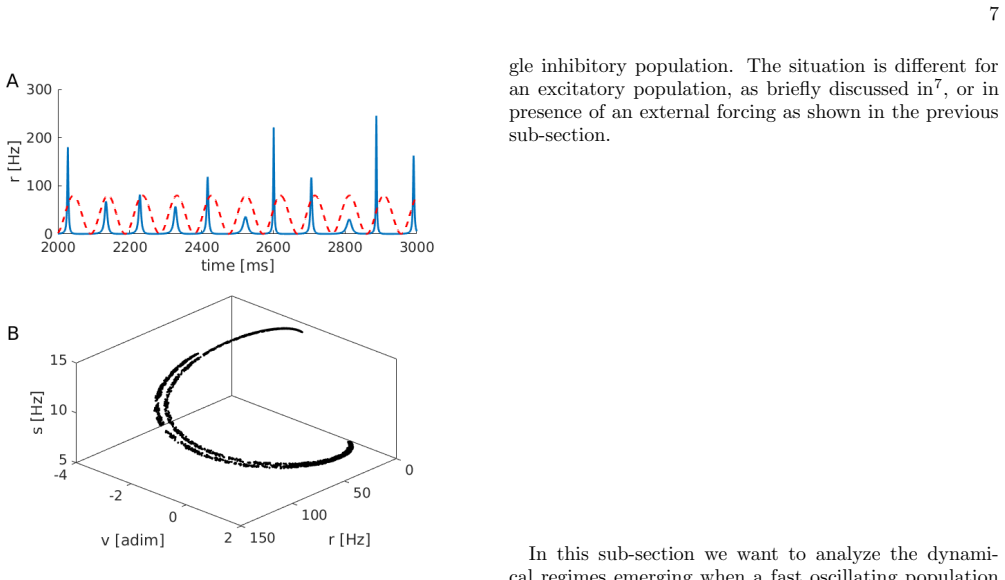
- [Section III.D, Fig. 10] The phase-amplitude CFC claim is not supported by any quantitative measure. The paper states that at Delta=0.2 the fast population fires 'almost asynchronously with a really low firing rate', yet the slow envelope of r(A) is interpreted as theta-nested gamma oscillations. Because the slow population is directly forced by I(B)=I0 sin(2*pi*nu_theta*t), the observed modulation could be a direct response to the driving current rather than cross-frequency coupling between two internally generated rhythms. Please compute a standard phase-amplitude coupling metric (e.g., a modulation index or phase-amplitude histogram) and compare against a control where the fast population's intrinsic oscillation is absent or decoupled.
- [Section III.D, Figs. 9-10] For the phase-amplitude scenario at Delta=0.2, only network simulations are shown; no comparison with the mean-field model (5) is provided for this regime. Since the paper's central claim is based on the exactness of the mean-field reduction, the P-A case should be validated with a network-versus-mean-field overlay analogous to Fig. 8(C). Without this, the reader cannot assess whether the claimed P-A coupling is a robust feature of the reduced model or an artifact of finite-size network behavior.
- [Section II.C, Eq. (6)] The linearized equation for delta r^(l) contains the term v^(A) delta r^(A) in the numerator for both populations. This appears to be a typo: for l=B the second term should be v^(B) delta r^(B). Since the Lyapunov spectrum is used to characterize chaos and quasi-periodicity, this equation should be corrected and the numerical results checked for consistency.
minor comments (3)
- [Fig. 2 caption and Section III.A] The caption of Fig. 2(B) and the corresponding text state 'for Delta = 0.5'; based on the figure and surrounding discussion, this should read 'Delta = 0.05'.
- [Section III.D, Eq. (13) vs. Fig. 9-10] The harmonic drive in the single-population study is strictly negative, I(t) = -I0(1+sin(2*pi*nu_0*t)), but the theta forcing in the bidirectional case is written as I(B)=I0 sin(2*pi*nu_theta*t), which has positive and negative phases. Please clarify whether the theta drive in the CFC section is meant to be purely inhibitory and, if so, adjust the sign/notation consistently.
- [Fig. 8 caption] The caption states 'tau = 10' without units; it should read 'tau = 10 ms' for consistency with the rest of the paper.
Circularity Check
No load-bearing circularity: Hopf boundaries are derived in-paper and the CFC results are numerical observations; only minor peripheral self-citations and an unquantified phase-amplitude claim merit note.
full rationale
The central derivation chain is not circular. The mean-field model, Eq. (5), is adopted from Montbrió, Pazó, and Roxin (2015) and Devalle, Roxin, and Montbrió (2017), which are external derivations, and the paper uses that model as its working substrate rather than claiming to derive it from its own results. The Hopf bifurcation boundaries, Eqs. (11)-(12), are obtained explicitly in the Appendix from the characteristic polynomial, Eq. (18), so they are not imported as fitted or cited constraints. The master-slave phase diagrams, Lyapunov spectra, and chaotic windows are numerical results of the six-dimensional reduced system, and they are not re-projections of fitted parameters. The cross-frequency-coupling claims are also numerical: phase-phase locking is quantified via the order parameter rho_nm, Eq. (10), and the enlargement of the 3:1 locking region under theta drive is computed rather than imposed. Self-citations appear (e.g., refs. 7, 21, 40, 50), but they are peripheral and are not load-bearing for the main CFC conclusion. One caveat is explicit in the text but is a support gap, not circularity: in the phase-amplitude scenario at Delta = 0.2, the paper relies on visual inspection of Fig. 10, and the text itself says 'the neurons in population (A) fire almost asynchronously with a really low firing rate,' so no quantitative phase-amplitude coupling metric is computed; this weakens the empirical support without making the result equivalent to its inputs by construction. Overall score 2 reflects minor self-citation presence without load-bearing circularity.
Assumptions & free parameters
free parameters (8)
- Fast synaptic time constant tau_d^(A) =
9 ms
- Slow synaptic time constant tau_d^(B) =
50 ms
- Excitability medians eta_bar_A, eta_bar_B =
2, 1.5
- Self-inhibitory couplings J_AA, J_BB =
-2, -18
- Cross-couplings J_AB, J_BA =
-1, -6.63
- Heterogeneity Delta =
0.05 (low), 0.2 (high)
- Theta forcing amplitude and frequency I_0^B, nu_theta =
0.5, 10 Hz
- Master-slave parameter set C2 synaptic times =
tau_d^A = 2.5 ms, tau_d^B = 80 ms
assumptions (5)
- domain assumption The population excitabilities are Lorentzian distributed, and the Ott-Antonsen ansatz provides an exact closure for the macroscopic dynamics (Eq. 5).
- domain assumption Neurons are QIF with exponential synapses and all-to-all coupling within each population (Eq. 1).
- ad hoc to paper External theta drive is modeled as a purely inhibitory sinusoidal current on the slow population (I^B = I0 sin(2 pi nu_theta t)).
- domain assumption The fast and slow synaptic time constants map to GABA_A,fast and GABA_A,slow receptor kinetics.
- standard math Hilbert transform provides a valid phase for the firing-rate oscillations.
Cite this review
Pith. "Pith review of Cross frequency coupling in next generation inhibitory neural mass models." pith.science (2026). https://pith.science/paper/FLCAR7M4
@misc{pith2026190807954,
  author       = {Pith},
  title        = {Pith review of: Cross frequency coupling in next generation inhibitory neural mass models},
  year         = {2026},
  howpublished = {\url{https://pith.science/paper/FLCAR7M4}},
  note         = {Machine review of arXiv:1908.07954}
}
read the original abstract
Coupling among neural rhythms is one of the most important mechanisms at the basis of cognitive processes in the brain. In this study we consider a neural mass model, rigorously obtained from the microscopic dynamics of an inhibitory spiking network with exponential synapses, able to autonomously generate collective oscillations (COs). These oscillations emerge via a super-critical Hopf bifurcation, and their frequencies are controlled by the synaptic time scale, the synaptic coupling and the excitability of the neural population. Furthermore, we show that two inhibitory populations in a master-slave configuration with different synaptic time scales can display various collective dynamical regimes: namely, damped oscillations towards a stable focus, periodic and quasi-periodic oscillations, and chaos. Finally, when bidirectionally coupled the two inhibitory populations can exhibit different types of theta-gamma cross-frequency couplings (CFCs): namely, phase-phase and phase-amplitude CFC. The coupling between theta and gamma COs is enhanced in presence of a external theta forcing, reminiscent of the type of modulation induced in Hippocampal and Cortex circuits via optogenetic drive.
Figures


Figures from the paper (8 more)


Reference graph
Works this paper leans on
-
[1]
GABA (gamma-Aminobutyric acid) is the main inhibitory neurotransmitter in the adult mammalian brain, GABA performs its action by binding to GABA _A or GABA _B receptors
-
[2]
Akam, T., Oren, I., Mantoan, L., Ferenczi, E., and Kullmann, D. M. (2012). Oscillatory dynamics in the hippocampus support dentate gyrus--ca3 coupling. Nature neuroscience , 15(5):763
work page 2012
-
[3]
Angulo-Garcia, D. and Torcini, A. (2014). Stable chaos in fluctuation driven neural circuits. Chaos, Solitons & Fractals , 69(0):233 -- 245
work page 2014
-
[4]
Banks, M. I., Li, T.-B., and Pearce, R. A. (1998). The synaptic basis of gabaa, slow. Journal of Neuroscience , 18(4):1305--1317
work page 1998
-
[5]
A., Mizuseki, K., Schmidt, R., Kempter, R., and Buzs \'a ki, G
Belluscio, M. A., Mizuseki, K., Schmidt, R., Kempter, R., and Buzs \'a ki, G. (2012). Cross-frequency phase--phase coupling between theta and gamma oscillations in the hippocampus. Journal of Neuroscience , 32(2):423--435
work page 2012
-
[6]
Benettin, G., Galgani, L., Giorgilli, A., and Strelcyn, J.-M. (1980). Lyapunov characteristic exponents for smooth dynamical systems and for hamiltonian systems; a method for computing all of them. part 1: Theory. Meccanica , 15(1):9--20
work page 1980
-
[7]
Bi, H., Segneri, M., di Volo, M., and Torcini, A. (2019). Coexistence of fast and slow gamma oscillations in one population of inhibitory spiking neurons. arXiv preprint arXiv:1907.00230
work page Pith review arXiv 2019
-
[8]
Brunel, N. (2000). Dynamics of sparsely connected networks of excitatory and inhibitory spiking neurons. J. Comput. Neurosci. , 8(3):183--208
work page 2000
Show all 55 references
-
[9]
and Hakim, V
Brunel, N. and Hakim, V. (1999). Fast global oscillations in networks of integrate-and-fire neurons with low firing rates. Neural. Comput. , 11(1):1621--1671
1999
-
[10]
L., Hay, Y
Butler, J. L., Hay, Y. A., and Paulsen, O. (2018). Comparison of three gamma oscillations in the mouse entorhinal--hippocampal system. European Journal of Neuroscience , 48(8):2795--2806
2018
-
[11]
L., Mendon c a, P
Butler, J. L., Mendon c a, P. R., Robinson, H. P., and Paulsen, O. (2016). Intrinsic cornu ammonis area 1 theta-nested gamma oscillations induced by optogenetic theta frequency stimulation. Journal of Neuroscience , 36(15):4155--4169
2016
-
[12]
Buzs \'a ki, G. (2002). Theta oscillations in the hippocampus. Neuron , 33(3):325--340
2002
-
[13]
Buzsaki, G. (2006). Rhythms of the Brain . Oxford University Press, USA, 1 edition
2006
-
[14]
and Wang, X.-J
Buzs \'a ki, G. and Wang, X.-J. (2012). Mechanisms of gamma oscillations. Annual review of neuroscience , 35:203
2012
-
[15]
Canolty, R. T. and Knight, R. T. (2010). The functional role of cross-frequency coupling. Trends in cognitive sciences , 14(11):506--515
2010
-
[16]
and Ricciardi, L
Capocelli, R. and Ricciardi, L. (1971). Diffusion approximation and first passage time problem for a model neuron. Kybernetik , 8(6):214--223
1971
-
[17]
L., Denninger, T., Fyhn, M., Hafting, T., Bonnevie, T., Jensen, O., Moser, M.-B., and Moser, E
Colgin, L. L., Denninger, T., Fyhn, M., Hafting, T., Bonnevie, T., Jensen, O., Moser, M.-B., and Moser, E. I. (2009). Frequency of gamma oscillations routes flow of information in the hippocampus. Nature , 462(7271):353
2009
-
[18]
and Byrne, \'A
Coombes, S. and Byrne, \'A . (2019). Next generation neural mass models. In Corinto, F. and Torcini, A., editors, Nonlinear Dynamics in Computational Neuroscience , PoliTO Springer Series, pages 1--16. Springer, Cham
2019
-
[19]
and Friston, K
David, O. and Friston, K. J. (2003). A neural mass model for meg/eeg:: coupling and neuronal dynamics. NeuroImage , 20(3):1743--1755
2003
-
[20]
Devalle, F., Roxin, A., and Montbri \'o , E. (2017). Firing rate equations require a spike synchrony mechanism to correctly describe fast oscillations in inhibitory networks. PLoS computational biology , 13(12):e1005881
2017
-
[21]
and Torcini, A
di Volo, M. and Torcini, A. (2018). Transition from asynchronous to oscillatory dynamics in balanced spiking networks with instantaneous synapses. Physical review letters , 121(12):128301
2018
-
[22]
B., and Gutkin, B
Dumont, G., Ermentrout, G. B., and Gutkin, B. (2017). Macroscopic phase-resetting curves for spiking neural networks. Physical Review E , 96(4):042311
2017
-
[23]
F., and Varga, V
Hangya, B., Borhegyi, Z., Szil \'a gyi, N., Freund, T. F., and Varga, V. (2009). Gabaergic neurons of the medial septum lead the hippocampal network during theta activity. Journal of Neuroscience , 29(25):8094--8102
2009
-
[24]
M., Glennon, M., Prendergast, K., and Sauseng, P
Holz, E. M., Glennon, M., Prendergast, K., and Sauseng, P. (2010). Theta--gamma phase synchronization during memory matching in visual working memory. Neuroimage , 52(1):326--335
2010
-
[25]
Hyafil, A., Giraud, A.-L., Fontolan, L., and Gutkin, B. (2015). Neural cross-frequency coupling: connecting architectures, mechanisms, and functions. Trends in neurosciences , 38(11):725--740
2015
-
[26]
Jahnke, S., Memmesheimer, R.-M., and Timme, M. (2008). Stable irregular dynamics in complex neural networks. Phys. Rev. Lett. , 100:048102
2008
-
[27]
Jansen, B. H. and Rit, V. G. (1995). Electroencephalogram and visual evoked potential generation in a mathematical model of coupled cortical columns. Biological cybernetics , 73(4):357--366
1995
-
[28]
and Colgin, L
Jensen, O. and Colgin, L. L. (2007). Cross-frequency coupling between neuronal oscillations. Trends in cognitive sciences , 11(7):267--269
2007
-
[29]
and Yorke, J
Kaplan, J. and Yorke, J. (1979). Functional differential equations and approximation of fixed points. Lecture notes in mathematics , 730:204--227
1979
-
[30]
Kuramoto, Y. (2012). Chemical oscillations, waves, and turbulence , volume 19. Springer Science & Business Media
2012
-
[31]
Kuznetsov, Y. A. (2013). Elements of applied bifurcation theory , volume 112. Springer Science & Business Media
2013
-
[32]
K., and Shea-Brown, E
Lajoie, G., Lin, K. K., and Shea-Brown, E. (2013). Chaos and reliability in balanced spiking networks with temporal drive. Phys. Rev. E , 87:052901
2013
-
[33]
Lega, B., Burke, J., Jacobs, J., and Kahana, M. J. (2014). Slow-theta-to-gamma phase--amplitude coupling in human hippocampus supports the formation of new episodic memories. Cerebral Cortex , 26(1):268--278
2014
-
[34]
Lisman, J. E. and Jensen, O. (2013). The theta-gamma neural code. Neuron , 77(6):1002--1016
2013
-
[35]
London, M., Roth, A., Beeren, L., H\" a usser, M., and Latham, P. E. (2010). Sensitivity to perturbations in vivo implies high noise and suggests rate coding in cortex. Nature. , 466:123--127
2010
-
[36]
B., Barreto, E., and So, P
Luke, T. B., Barreto, E., and So, P. (2013). Complete classification of the macroscopic behavior of a heterogeneous network of theta neurons. Neural computation , 25(12):3207--3234
2013
-
[37]
B., Barreto, E., and So, P
Luke, T. B., Barreto, E., and So, P. (2014). Macroscopic complexity from an autonomous network of networks of theta neurons. Frontiers in computational neuroscience , 8:145
2014
-
[38]
Montbri \'o , E., Paz \'o , D., and Roxin, A. (2015). Macroscopic description for networks of spiking neurons. Physical Review X , 5(2):021028
2015
-
[39]
and Parga, N
Moreno-Bote, R. and Parga, N. (2010). Response of integrate-and-fire neurons to noisy inputs filtered by synapses with arbitrary timescales: Firing rate and correlations. Neural Computation , 22(6):1528--1572
2010
-
[40]
Olmi, S., Angulo-Garcia, D., Imparato, A., and Torcini, A. (2017). Exact firing time statistics of neurons driven by discrete inhibitory noise. Scientific Reports , 7(1):1577
2017
-
[41]
and Antonsen, T
Ott, E. and Antonsen, T. M. (2008). Low dimensional behavior of large systems of globally coupled oscillators. Chaos: An Interdisciplinary Journal of Nonlinear Science , 18(3):037113
2008
-
[42]
C., and Nolan, M
Pastoll, H., Solanka, L., van Rossum, M. C., and Nolan, M. F. (2013). Feedback inhibition enables theta-nested gamma oscillations and grid firing fields. Neuron , 77(1):141--154
2013
-
[43]
and Montbri \'o , E
Paz \'o , D. and Montbri \'o , E. (2014). Low-dimensional dynamics of populations of pulse-coupled oscillators. Physical Review X , 4(1):011009
2014
-
[44]
Pikovsky, A., Zaks, M., Rosenblum, M., Osipov, G., and Kurths, J. (1997). Phase synchronization of chaotic oscillations in terms of periodic orbits. Chaos: An Interdisciplinary Journal of Nonlinear Science , 7(4):680--687
1997
-
[45]
Richardson, M. J. and Swarbrick, R. (2010). Firing-rate response of a neuron receiving excitatory and inhibitory synaptic shot noise. Physical review letters , 105(17):178102
2010
-
[46]
ROSENBLUM, M., TASS, P., Kurths, J., VOLKMANN, J., SCHNITZLER, A., and FREUND, H.-J. (2000). Detection of phase locking from noisy data: application to magnetoencephalography. In Chaos In Brain? , pages 34--51. World Scientific
2000
-
[47]
Sceniak, M. P. and MacIver, M. B. (2008). Slow gaba a mediated synaptic transmission in rat visual cortex. BMC neuroscience , 9(1):8
2008
-
[48]
Sirota, A., Montgomery, S., Fujisawa, S., Isomura, Y., Zugaro, M., and Buzs \'a ki, G. (2008). Entrainment of neocortical neurons and gamma oscillations by the hippocampal theta rhythm. Neuron , 60(4):683--697
2008
-
[49]
Treves, A. (1993). Mean-field analysis of neuronal spike dynamics. Network: Computation in Neural Systems , 4(3):259--284
1993
-
[50]
Ullner, E., Politi, A., and Torcini, A. (2019). Self-consistent analysis of asynchronous neural activity. in preparation
2019
-
[51]
Van Vreeswijk, C., Abbott, L., and Ermentrout, G. B. (1994). When inhibition not excitation synchronizes neural firing. Journal of computational neuroscience , 1(4):313--321
1994
-
[52]
Varela, F., Lachaux, J.-P., Rodriguez, E., and Martinerie, J. (2001). The brainweb: phase synchronization and large-scale integration. Nature reviews neuroscience , 2(4):229
2001
-
[53]
Wang, X.-J. (2010). Neurophysiological and computational principles of cortical rhythms in cognition. Physiological reviews , 90(3):1195--1268
2010
-
[54]
A., Banks, M
White, J. A., Banks, M. I., Pearce, R. A., and Kopell, N. J. (2000). Networks of interneurons with fast and slow -aminobutyric acid type a (gabaa) kinetics provide substrate for mixed gamma-theta rhythm. Proceedings of the National Academy of Sciences , 97(14):8128--8133
2000
-
[55]
Wilson, H. R. and Cowan, J. D. (1972). Excitatory and inhibitory interactions in localized populations of model neurons. Biophysical journal , 12(1):1--24
1972
Reviewed August 14, 2026 · model on record in the stance chip above.
Discussion (0). Continue with ORCID to comment.