REVIEW 4 major objections 5 minor 1 cited by
Time-translation invariance symmetry breaking hidden by finite-scale singularities
T0 review · 4 major / 5 minor · reviewed 2026-08-11 · deepseek-v4-flash
Pith's one-line read The finite-scale singularities in the RG flow of this quantum glass conceal a phase transition that breaks time-translation invariance, visible in the Landau potential built from the Luttinger-Ward functional.
desk verdict A plausible mechanism that finite-scale RG singularities hide a time-translation-symmetry-breaking transition, but the central claim outruns the evidence until the unverified mass neglect is resolved. read the letter →
The pith
A machine-rendered reading of the paper's core claim, the machinery that carries it, and where it could break.
The reading
What carries the argument
The load-bearing object is the replicated 2PI (two-particle-irreducible) effective action whose last term is the Luttinger-Ward functional, evaluated on the on-shell normal-phase propagator; the Luttinger-Ward functional is the sum of two-particle-irreducible diagrams that generates the self-energy. Its Landau expansion in the time-translation-breaking couplings $\Delta$, delta_1, and q yields the potentials U($\Delta$), V(q), U-tilde($\Delta$), V-tilde(q), and U(Q), whose coefficients are one-loop integrals of the on-shell propagator weighted by the Wigner spectral density. The flow that produces the singular trajectories comes from the Wetterich equation with a modified Litim regulator, coarse-graining over the Wigner spectrum; the scale-dependent canonical dimensions make the flow non-autonomous and prevent global fixed points, which is why the finite-scale singularities appear instead.
What would settle it
Integrate the full flow including the mass equation with the paper's initial conditions and strong disorder, and check whether $u_2/(k^2 f(k))$ becomes of order one before the singularity time $t_c \approx 1.83$; if it does, the on-shell propagator used for the Landau potentials is not reliable. A second check is to solve the 2PI gap equations with the back-reaction of $\Delta$ and q included and see whether the non-zero minima of U($\Delta$) and U-tilde($\Delta$) survive.
Extended reading notes
Core claim
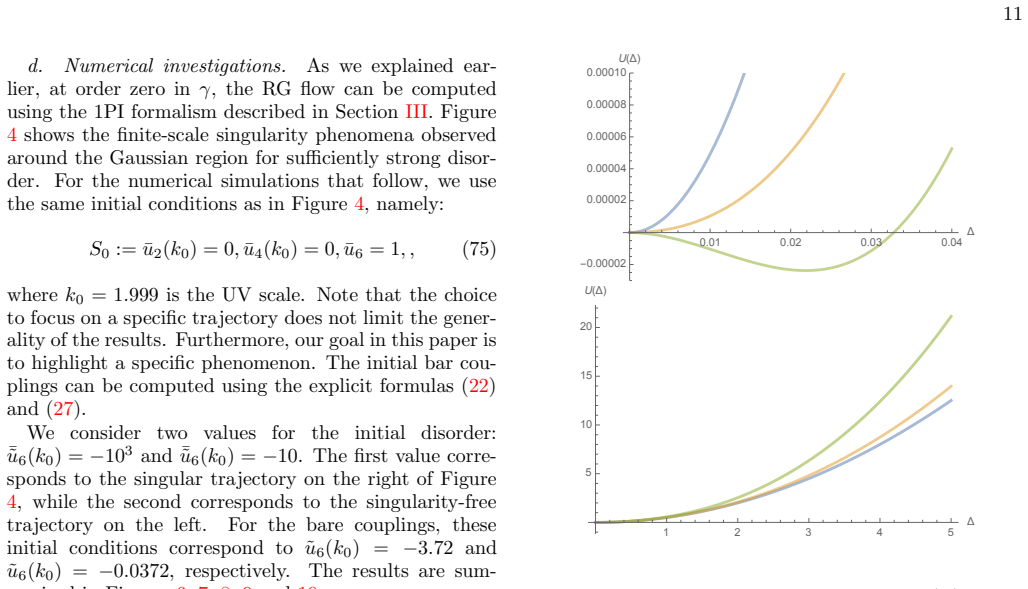
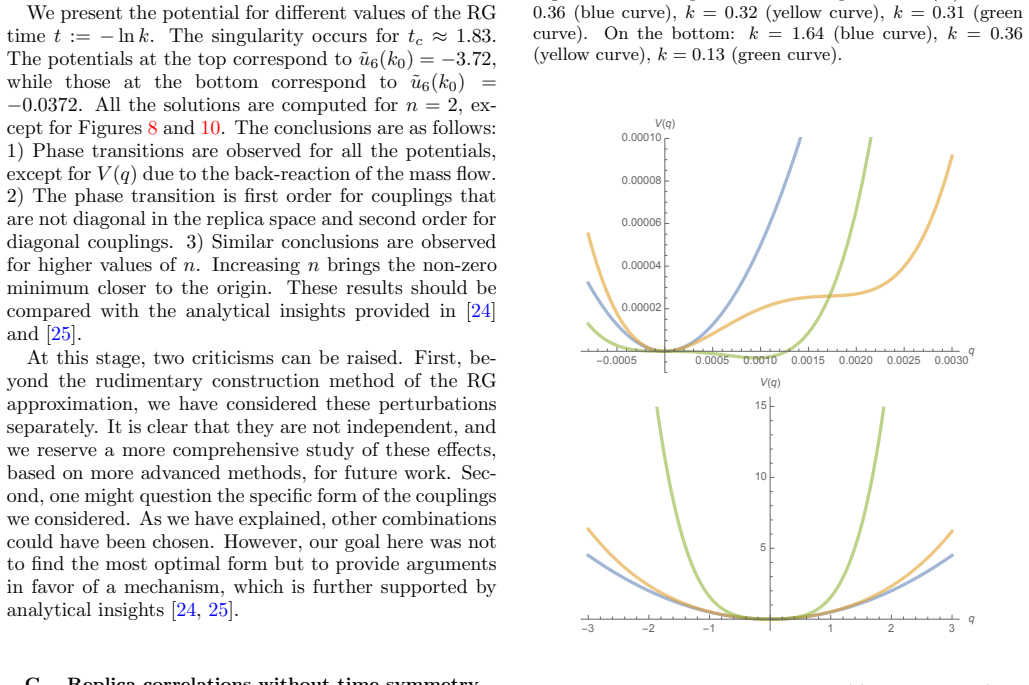
The central claim is that the finite-scale singularities found in the Wigner-spectrum RG flow of the large-N (2+p) quantum spin glass are resolved by a phase transition that breaks time-translation invariance. Along trajectories that diverge at a finite scale, such as the strong-disorder initial condition with dimensionless non-local coupling -$10^{3}$, the paper computes the Landau potentials for the frequency-dependent self-energy couplings $\Delta$, delta_1, and q from the replicated two-particle-irreducible (2PI) effective action. The potentials U($\Delta$) and U-tilde($\Delta$) develop a stable non-zero minimum as the singularity is approached, around k between 0.36 and 0.31, indicating a second-order transition for couplings diagonal in replica space; the replica-off-diagonal versions V-tilde(q) and U(Q) show a first-order transition, consistent with earlier results for replica correlations. The potential V(q) for the q $\beta$ (delta_{omega 0} + delta_{omega' 0}) interaction does not acquire such a minimum because of the back-reaction of the mass flow. In the regions explored, the time-translation-breaking transition appears before the replica-correlation transition, though the order can change with the region of phase space.
Load-bearing premise
The argument assumes that along the singular trajectories the squared mass $u_2$ stays small enough to be neglected in the one-loop integrals; if the mass grows instead, the singularity location and the Landau potentials built on the on-shell propagator would change.
Editorial extensions
If this is right
- Divergent RG trajectories in this model should be read as proximity to a time-translation-broken phase, not as a breakdown of the approximation, in the regime where the mass stays small.
- The transition is continuous for replica-diagonal time-translation-breaking couplings, making a Landau expansion reliable there; it is first order for replica-off-diagonal couplings.
- Time-translation symmetry breaking sets in before replica-correlation ordering in the explored region, so aging-like behavior should be the first nonequilibrium signature seen when disorder is increased.
- Increasing the number of replicas n moves the metastable minimum closer to the origin and appears to reach a finite limit as n goes to infinity, so replica-number dependence should not change the qualitative conclusion.
- Including the time-translation-breaking interactions appears to resolve the finite-scale singularity in at least part of the phase space, the same mechanism previously found for local replica couplings.
Reading between the lines
- If the singularity-hiding mechanism is generic, the same 2PI analysis applied to the frequency-coarse-grained version of this model should also produce a time-translation-broken minimum at the scale where its singular flow appears, extending the result beyond Wigner-spectrum coarse-graining.
- A testable consequence is that real-time or long-time correlation functions of the quantum p-spin model should show aging or non-equilibrium behavior at disorder strengths above the critical value, even near zero temperature, which could be checked numerically with quantum TAP-type or Monte Carlo computations.
- The exceptional behavior of V(q) suggests that the basis of time-translation-breaking operators may be incomplete; including higher-frequency kernels or the full frequency dependence of the self-energy could turn that exception into a transition and should be examined in a full 2PI treatment.
- Because canonical dimensions run with scale, the critical disorder separating singular and regular trajectories might shift under a less truncated truncation, so the stability of the singularity boundary under added operators is a quantitative question worth checking.
Editorial analysis
A structured set of objections, weighed in public.
Referee Report
Summary. The paper studies the large-N quantum (2+p)-spin glass via a functional RG built on coarse-graining over the Wigner spectrum. The authors recall that, for sufficiently strong rank-p disorder, the 1PI flow exhibits finite-scale singularities near the Gaussian region. Using the 2PI Luttinger-Ward formalism, they compute Landau potentials for time-translation-symmetry-breaking order parameters — the replica-diagonal couplings Δ and δ₁, and the frequency-local coupling q — along singular RG trajectories. They report that these potentials develop nonzero minima: second-order for replica-diagonal couplings, first-order for replica off-diagonal couplings, with V(q) an exception. From this they claim that the finite-scale singularities "hide (and should be resolved by)” a phase transition that breaks time-translation invariance.
Significance. If the central claim is correct, the paper provides a concrete mechanism by which singular RG trajectories in a disordered quantum model are resolved by order parameters that are nonlocal in time and forbidden in naive perturbation theory. The numerical evidence comes with reproducible code for Figure 5, and the appendices give explicit integral formulas for the Landau coefficients. The authors are also unusually candid about the limitations: they acknowledge treating the perturbations separately, using a specific ansatz for the self-energy, and truncating the Landau expansion. However, these caveats mean the strongest statement — that the singularity is actually resolved by the TTI-breaking transition — is not yet demonstrated; the paper currently establishes only that certain on-shell Landau potentials acquire minima along singular trajectories under an unverified assumption about the mass.
major comments (4)
- [§III.B, Eqs. (23)–(25)] The neglect of the mass u₂, announced in §III.B with "(which we will verify in our simulations)", is never verified anywhere in the paper. The flow equation for τ̄₂ contains the source −̄₄/18, and Eq. (24) sources ̄₄ from −̄̃₆/(15π), which is positive when ̄̃₆ < 0, exactly the singular regime. Thus ̄₄ grows and drives ̄₂ negative, possibly making u₂ non-negligible compared with k² near the singularity. The on-shell propagator in Eq. (37) has denominator p² + R_k + u₂, and every Landau coefficient in Eqs. (61)–(68) depends on integrals of this propagator. If u₂ is not tiny, the singularity location and the potentials shown in Figs. 6–10 could change substantially, or even be an artifact of the u₂ ≈ 0 assumption used in deriving the beta functions themselves. The authors must integrate the full coupled flow including u₂ along the singular trajectories and show that u₂ remains small, or recompute the Landau coefficients without neglecting u₂.
- [§IV.B.d and §V] The abstract's claim that the singularities "should be resolved by" a TTI-breaking phase transition requires demonstrating that the inclusion of the Δ, δ₁, and q perturbations removes the singularity in the coupled flow. The paper explicitly states in §IV.B.d that "we have considered these perturbations separately. It is clear that they are not independent." Showing that each individual potential acquires a minimum along the unperturbed 1PI trajectory is weaker than showing that the closed 2PI flow with these perturbations is singularity-free. The concluding section acknowledges this is left for future work, but then the central claim is not yet supported. A concrete test would be to extend the 1PI flow with the TTI-breaking operators and check whether the divergence is cut off when they are included.
- [§IV.A, Eq. (42)] The specific form of the TTI-breaking self-energy in Eq. (42) is an ansatz, and the authors themselves note (in §IV.A) that "these approximations are by no means exhaustive" and that a term ∝ β²δ_{0ω}δ_{0ω′} is not considered. Since the conclusion that the singularities are hidden by TTI breaking depends on which order parameters are included, the analysis should at least scan over the most relevant operator classes (replica-diagonal vs. off-diagonal, frequency-local vs. derivative-type) and show that the chosen ones are the relevant ones by power counting. Without this, the possibility remains that a different TTI-breaking operator removes the singularity in a different way, or that the minima found here are an artifact of the restricted ansatz.
- [§IV.B, Eqs. (60)–(62)] The Landau potentials are truncated at low order (order Δ³, q⁴), but the nonzero minima in Figs. 6–10 occur at finite values (e.g., Δ ≈ 0.02, q ≈ 0.001–0.003). The paper does not test whether including the next order in Δ or q changes the location or existence of the minima. For a phase-transition claim, a stability check of the truncation is load-bearing; the authors should estimate the next-order coefficients or verify numerically that the minima are stable under an extension of the expansion.
minor comments (5)
- [§III.B, Eq. (22)] The definition of ̄u₂ₙ is written without parentheses: it should read ̄u₂ₙ = u₂ₙ k⁻² (Ω(k)/k³)ⁿ⁻¹. Please add the parentheses to avoid ambiguity.
- [§IV.B.d, Eq. (75)] In the initial conditions, ̄u₆ is written as "̄u₆ = 1" without "(k₀)", unlike the other couplings. Also "The initial bar couplings" should be "bare couplings".
- [§IV.B.b, Eq. (70)] There is a typo in Eq. (70): "ↄV (q) :=:" should be "ↄV (q) :=". Please correct the double colon.
- [§I and §III.B] The flow equations (23)–(29) are taken from Refs. [18,19], which are unpublished preprints. Since these equations are central to the paper, the manuscript should include a self-contained derivation or an appendix summarizing the derivation of the beta functions, so that the reader can verify the subsequent claims without relying on non-peer-reviewed sources.
- [§IV.C, bottom of Figure 11] The text says "for som value of k" (missing 'e'), and the caption of Figure 11 describes the bottom panel as comparing U(Q) and ↄV(q) at k ≈ 0.321, but the text in §IV.C does not specify the exact value; it would be clearer to state the value directly.
Circularity Check
No circularity: the TTI-breaking Landau potentials are computed from flow-generated couplings via explicit 2PI diagrams; the only self-cited inputs are the RG flow equations, which are reproduced numerically and are not equivalent to the target conclusion.
full rationale
The derivation of the time-translation-invariance (TTI) breaking transition does not reduce to its own inputs. The Landau coefficients a1, a2, c1, c2, and the replica-off-diagonal analogues are computed from explicit 2PI/Luttinger-Ward diagrams (Eqs. 45-68 and 71-74) using the on-shell propagator G_{k,N} and the running couplings u4, u6, and tilde-u6; no parameter is fitted to produce the nonzero minima shown in Figs. 6-11. The RG flows (Eqs. 23-29) and the finite-scale singularities are taken from the authors' prior work [18,19], but this is independent support rather than circular loading: the paper restates the beta functions explicitly, reproduces the singular trajectories in Fig. 4, and supplies code for Fig. 5, and the assumptions of those prior papers do not already contain the TTI-breaking order parameter. The main weakness is an unfulfilled verification promise: Sec. III B states that the mass will be neglected 'which we will verify in our simulations', and no such verification appears in the paper or figures. Since Eq. (23) sources u2 from u4, which grows on singular trajectories, this is a genuine correctness risk for the on-shell propagator near the singularity, but it is an approximation/justification gap rather than a definitional, fitted-input, or self-citation circularity. The paper also flags its own limitations ('good enough does not mean ideal'; the perturbations are considered separately), which are acknowledged weaknesses rather than circular steps.
Assumptions & free parameters
free parameters (3)
- Initial dimensionful coupling u6(k0) =
1 (dimensionless bar-u6 = 1)
- Initial non-local disorder strength u6tilde(k0) =
-3.72 and -0.0372 (dimensionless -10^3 and -10)
- Initial mass u2(k0) and quartic coupling u4(k0) =
0
assumptions (6)
- standard math Wigner semicircle distribution for the eigenvalues of the random matrix disorder in the large N limit (Eq. 5).
- domain assumption The replicated field theory with n replicas and analytic continuation n to 0 describes the quenched disorder average (Eqs. 9-10).
- domain assumption The truncation (Eq. 20) keeps only local u2, u4, u6 and one non-local u6tilde coupling; the non-local disorder interaction does not renormalize at leading order in 1/N.
- ad hoc to paper The mass u2 remains small enough along the singular trajectories to be neglected in the one-loop integrals.
- ad hoc to paper The time-translation-symmetry-breaking self-energy has the specific form (Eq. 42) with parameters Delta, delta1, q; other combinations are not considered.
- ad hoc to paper The perturbations Delta, delta1, q can be treated independently in the Landau expansion.
invented entities (2)
-
Delta (time-translation-symmetry-breaking order parameter, diagonal in replica space)
-
q (frequency-local TTI-breaking coupling with replica diagonal and off-diagonal variants)
Cite this review
Pith. "Pith review of Time-translation invariance symmetry breaking hidden by finite-scale singularities." pith.science (2026). https://pith.science/paper/FNPK6K7F
@misc{pith2026241211619,
  author       = {Pith},
  title        = {Pith review of: Time-translation invariance symmetry breaking hidden by finite-scale singularities},
  year         = {2026},
  howpublished = {\url{https://pith.science/paper/FNPK6K7F}},
  note         = {Machine review of arXiv:2412.11619}
}
abstract
In this paper, we consider a renormalization group perspective on the quantum dynamics of a particle moving in the Euclidean $\mathbb{R}^N$ space through the complex landscape provided by a disordered Hamiltonian of type $2+p$. We focus on the large $N$ limit, where the coarse-graining procedure is unconventional: it is based on the Wigner spectrum of the rank-2 disorder. The main consequence of this choice is that canonical dimensions depend on the scale, and the flow equations fail to become autonomous, preventing the existence of global fixed points. One of the main features of the underlying renormalization group flow is the existence of finite-scale singularities for initial conditions sufficiently close to the Gaussian region and for rank-$p$ disorder intensity large enough. Using the Luttinger-Ward formalism, we show that these finite-scale singularities hide (and should be resolved by) a phase transition that breaks time-translation invariance.
Figures


Figures from the paper (6 more)



Forward citations
Cited by 1 Pith paper
-
Stochastic dynamics for group field theories II: Methods for nonequilibrium renormalization group
Extending a stochastic renormalization-group method for tensor group field theories to non-equilibrium, this paper finds that fluctuation-dissipation-violating couplings become large near finite-scale singularities, i...
Reference graph
Works this paper leans on
-
[1]
The canonical dimensions for couplings depend on the scale, but the theory behaves as a standard 4D non-local field theory in the deep infrared (IR)
-
[2]
Finite-scale singularities appear in the RG flow near the Gaussian fixed point for sufficiently large rank-p disorder
-
[3]
A second non-vanishing minimum appears for the Luttinger-Ward functional associated with the 2- point correlation qαβ between replicas for divergent trajectories, suggesting a first-order phase transi- tion
-
[4]
Divergences are canceled in some regions of the full phase space as truncations are “enhanced” by local interactions coupling different replicas. The last point was the main focus of our previous work [19]. On the other hand, we considered the p-spin quan- tum spin glass from a more conservative perspective. In [20], we constructed a coarse-graining over ...
-
[5]
3) Fields interacting at the same time are enclosed within a dash-dotted closed path
Fields sharing the same replica index are represented by nodes of the same color. 3) Fields interacting at the same time are enclosed within a dash-dotted closed path. Thus, the octic vertex v3,2, depicted in Figure 1, is ex- plicitly written as: v3,2 := ˆ 3Y ℓ=1 dtℓ X α,β Mα(t1) · Mα(t1) × Mα(t2) · Mβ(t2) × Mβ(t2) · Mβ(t3) × Mβ(t3) · Mβ(t3) , (19) the do...
-
[6]
Phase transitions are observed for all the potentials, except for V (q) due to the back-reaction of the mass flow
-
[7]
3) Similar conclusions are observed for higher values of n
The phase transition is first order for couplings that are not diagonal in the replica space and second order for diagonal couplings. 3) Similar conclusions are observed for higher values of n. Increasing n brings the non-zero minimum closer to the origin. These results should be compared with the analytical insights provided in [24] and [25]. At this sta...
-
[8]
Dotsenko, V. S. (1993). Physics of the spin-glass state. Physics-Uspekhi, 36(6), 455
work page 1993
Show all 47 references
-
[9]
and Cavagna, A
Castellani, T. and Cavagna, A. (2005). Spin-glass theory for pedestrians. Journal of Statistical Mechanics: Theory 14 and Experiment, 2005(05), P05012
2005
-
[10]
and Virasoro, M
M´ ezard, M., Parisi, G. and Virasoro, M. A. (1987). Spin glass theory and beyond: An Introduction to the Replica Method and Its Applications (Vol. 9). World Scientific Publishing Company
1987
-
[11]
M´ ezard, M. (2024). Spin glass theory and its new chal- lenge: structured disorder. Indian Journal of Physics, 98(11), 3757-3768
2024
-
[12]
and Giardina, I
De Dominicis, C. and Giardina, I. (2006). Random fields and spin glasses: a field theory approach. Cambridge Uni- versity Press
2006
-
[13]
and Ottaviani, G
Agliari, E., Albanese, L., Barra, A. and Ottaviani, G. (2020). Replica symmetry breaking in neural networks: a few steps toward rigorous results. Journal of Physics A: Mathematical and Theoretical, 53(41), 415005
2020
-
[14]
and Leuzzi, L
Crisanti, A. and Leuzzi, L. (2006). Spherical 2+ p spin- glass model: An analytically solvable model with a glass- to-glass transition. Physical Review B—Condensed Mat- ter and Materials Physics, 73(1), 014412
2006
-
[15]
and Bouchaud, J
Potters, M. and Bouchaud, J. P. (2020). A first course in random matrix theory: for physicists, engineers and data scientists. Cambridge University Press
2020
-
[16]
R., Temesv´ ari, T
Pimentel, I. R., Temesv´ ari, T. and De Dominicis, C. (2002). Spin-glass transition in a magnetic field: A renormalization group study. Physical Review B, 65(22), 224420
2002
-
[17]
Castellana, M. (2011). Real-space renormalization group analysis of a non-mean-field spin-glass. Europhysics Let- ters, 95(4), 47014
2011
-
[18]
Banavar, J. R. and Bray, A. J. (1988). Heisenberg and Potts spin glasses: A renormalization-group study. Phys- ical Review B, 38(4), 2564
1988
-
[19]
and Parisi, G
Castellana, M. and Parisi, G. (2010). Renormalization group computation of the critical exponents of hierarchi- cal spin glasses. Physical Review E—Statistical, Nonlin- ear, and Soft Matter Physics, 82(4), 040105
2010
-
[20]
Angelini, M. C. and Biroli, G. (2017). Real space renormalization group theory of disordered models of glasses. Proceedings of the National Academy of Sciences, 114(13), 3328-3333
2017
-
[21]
and Tissier, M
Tarjus, G. and Tissier, M. (2008). Nonperturbative func- tional renormalization group for random field models and related disordered systems. I. Effective average action for- malism. Physical Review B—Condensed Matter and Ma- terials Physics, 78(2), 024203
2008
-
[22]
and Tarjus, G
Tissier, M. and Tarjus, G. (2008). Nonperturbative func- tional renormalization group for random field models and related disordered systems. II. Results for the random field O (N) model. Physical Review B—Condensed Mat- ter and Materials Physics, 78(2), 024204
2008
-
[23]
and Tarjus, G
Tissier, M. and Tarjus, G. (2012). Nonperturbative func- tional renormalization group for random field models and related disordered systems. III. Superfield formalism and ground-state dominance. Physical Review B—Condensed Matter and Materials Physics, 85(10), 104202
2012
-
[24]
and Tissier, M
Balog, I., Tarjus, G. and Tissier, M. (2018). Criticality of the random field Ising model in and out of equilibrium: A nonperturbative functional renormalization group de- scription. Physical Review B, 97(9), 094204
2018
-
[25]
and Radpay, P
Lahoche, V., Ousmane Samary, D. and Radpay, P. (2024). Large time effective kinetics β-functions for quan- tum (2+ p)-spin glass. arXiv preprint arXiv:2408.02602
2024
-
[26]
Natta, B. B. B., Lahoche, V., Ousmane Samary, D. and Radpay, P. (2024). Ward identities and local potential approximation for large time quantum (2+ p)-spin glass dynamics. arXiv preprint arXiv:2411.11089
2024 arXiv
-
[27]
Radpay, P
Lahoche, V., Ousmane Samary, D. Radpay, P. (2024). Frequency regulator for quantum p-spin renormalization group in the large N limit. To appear
2024
-
[28]
and Ouerfelli, M
Lahoche, V., Ousmane Samary, D. and Ouerfelli, M. (2022). Functional renormalization group for multilinear disordered Langevin dynamics I Formalism and first nu- merical investigations at equilibrium. Journal of Physics Communications, 6(5), 055002
2022
-
[29]
and Tamaazousti, M
Lahoche, V., Ousmane Samary, D. and Tamaazousti, M. (2023). Functional renormalization group for multilinear disordered Langevin dynamics II: Revisiting the p= 2 spin dynamics for Wigner and Wishart ensembles. Jour- nal of Physics Communications, 7(5), 055005
2023
-
[30]
Baldwin, C. L. and Laumann, C. R. (2018). Quantum al- gorithm for energy matching in hard optimization prob- lems. Physical Review B, 97(22), 224201
2018
-
[31]
and Cugliandolo, L
Biroli, G. and Cugliandolo, L. F. (2001). Quantum Thouless-Anderson-Palmer equations for glassy systems. Physical Review B, 64(1), 014206
2001
-
[32]
F., Grempel, D
Cugliandolo, L. F., Grempel, D. R. and da Silva Santos, C. A. (2001). Imaginary-time replica formalism study of a quantum spherical p-spin-glass model. Physical Review B, 64(1), 014403
2001
-
[33]
Cugliandolo, L. F. and Mueller, M. (2022). Quantum Glasses–a review. arXiv preprint arXiv:2208.05417
2022 arXiv
-
[34]
and Wetterich, C
Berges, J., Tetradis, N. and Wetterich, C. (2002). Non- perturbative renormalization flow in quantum field the- ory and statistical physics. Physics Reports, 363(4-6), 223-386
2002
-
[35]
M., Tissier, M
Dupuis, N., Canet, L., Eichhorn, A., Metzner, W., Pawlowski, J. M., Tissier, M. and Wschebor, N. (2021). The nonperturbative functional renormalization group and its applications. Physics Reports, 910, 1-114
2021
-
[36]
Delamotte, B. (2012). An introduction to the nonpertur- bative renormalization group. In Renormalization group and effective field theory approaches to many-body sys- tems (pp. 49-132). Berlin, Heidelberg: Springer Berlin Heidelberg
2012
-
[37]
and Dornic, I
Gredat, D., Chat´ e, H., Delamotte, B. and Dornic, I. (2014). Finite-scale singularity in the renormalization group flow of a reaction-diffusion system. Physical Re- view E, 89(1), 010102
2014
-
[38]
and Daviet, R
Dupuis, N. and Daviet, R. (2020). Bose-glass phase of a one-dimensional disordered Bose fluid: Metastable states, quantum tunneling, and droplets. Physical Re- view E, 101(4), 042139
2020
-
[39]
Weinberg, S. (1995). The quantum theory of fields (Vol. 2). Cambridge university press
1995
-
[40]
N., Kim, H., Poirel, C
Ritz, A., Tegge, A. N., Kim, H., Poirel, C. L. and Murali, T. M. (2014). Signaling hypergraphs. Trends in biotech- nology, 32(7), 356-362
2014
-
[41]
A., Patinet, S., D´ emery, V
Rodney, D., Geslin, P. A., Patinet, S., D´ emery, V. and Rosso, A. (2024). Does the Larkin length exist?. Mod- elling and Simulation in Materials Science and Engineer- ing, 32(3), 035007
2024
-
[42]
Larkin, A. I. and Ovchinnikov, Y. N. (1979). Pinning in type II superconductors. Journal of Low Temperature Physics, 34, 409-428
1979
-
[43]
P., Pawlowski, J
Blaizot, J. P., Pawlowski, J. M. and Reinosa, U. (2021). Functional renormalization group and 2PI effective ac- tion formalism. Annals of Physics, 431, 168549
2021
-
[44]
and Gurau, R
Benedetti, D. and Gurau, R. (2018). 2PI effective action 15 for the SYK model and tensor field theories. Journal of High Energy Physics, 2018(5), 1-38
2018
-
[45]
M., Ankerhold, J
Zhang, Y., Gosner, J., Girvin, S. M., Ankerhold, J. and Dykman, M. I. (2017). Time-translation-symmetry breaking in a driven oscillator: From the quantum coher- ent to the incoherent regime. Physical Review A, 96(5), 052124
2017
-
[46]
Van Wezel, J. (2010). Broken time translation symmetry as a model for quantum state reduction. Symmetry, 2(2), 582-608
2010
-
[47]
This does not, however, qualitatively change the results
There in an overall factor 2π regarding the beta-functions considered in [18], due to the convention used in the ref- erence, which multiplied the flow equations by such a factor implicitly because of the definition of canonical dimension. This does not, however, qualitatively...
Reviewed August 11, 2026 · model on record in the stance chip above.
Discussion (0). Continue with ORCID to comment.