REVIEW 2 major objections 5 minor 17 references
DeepRT Engine: A Unified GPU-Parallel Ray-Tracing Framework with Hybrid SBR-IM Path Search for 6G Digital Twin Channel
T0 review · 2 major / 5 minor · reviewed 2026-07-14 · grok-4.5
Pith's one-line read A three-stage GPU ray-tracing pipeline cuts multipath search time by 96% while matching exact image-method accuracy for digital twin channels.
desk verdict Solid systems letter: integrated BVH + parallel SBR pruning + batched IM on GPU, with clear speed/accuracy numbers on one indoor scene; completeness of pruning is empirical, not proved. read the letter →
The pith
A machine-rendered reading of the paper's core claim, the machinery that carries it, and where it could break.
The reading
What carries the argument
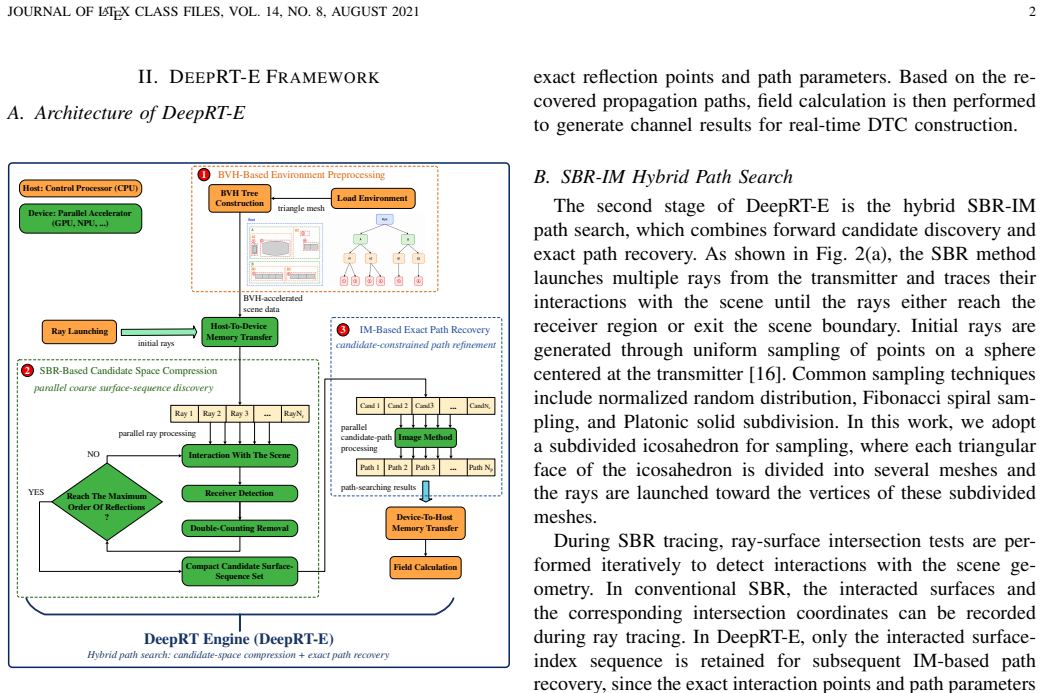
The hybrid SBR-IM pipeline under a two-level GPU hierarchy: BVH-accelerated parallel SBR produces a compact candidate surface-sequence set C_SBR; a subsequent batched image-method kernel recovers exact specular paths only on that set, yielding complexity O(x N log M + |C_SBR|) instead of O(M^N).
What would settle it
On a scene with known high-order specular paths, compare the candidate surface sequences retained by SBR (at the subdivision level used for the 0.001 dB claim) against the complete set enumerated by pure image method; any missing valid sequence that changes received power by more than 0.001 dB falsifies the completeness claim.
Extended reading notes
Core claim
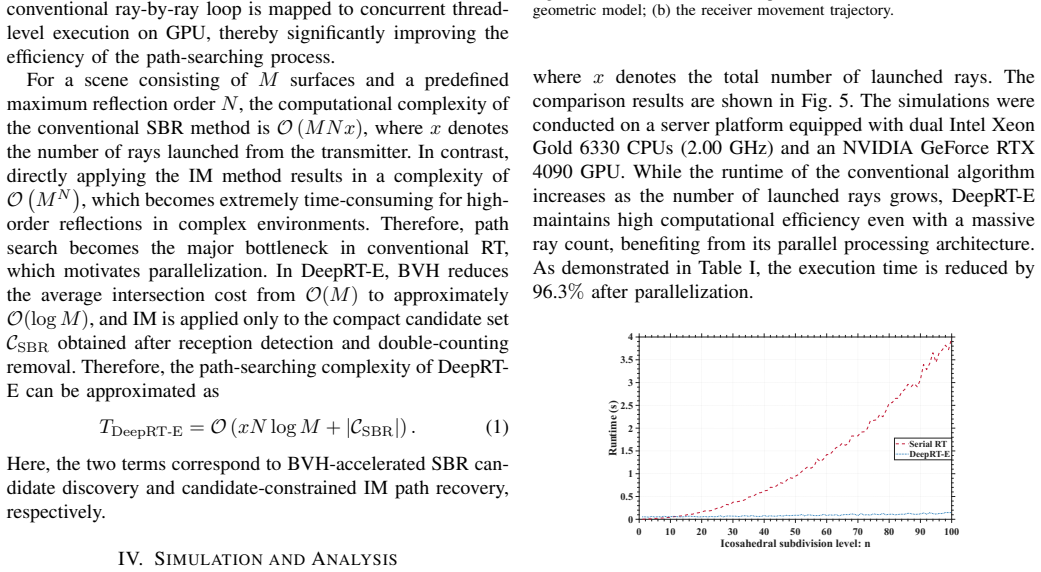
DeepRT-E shows that hybrid SBR-IM path search, when restructured as a three-stage physically ordered pipeline and executed with fine-grained GPU parallelism, simultaneously delivers a 96.3 % wall-clock reduction over serial hybrid ray tracing and a post-convergence absolute power error of only 0.001 dB relative to pure image method, outperforming Wireless InSite residual error and matching or beating Sionna while remaining on the same order of runtime.
Load-bearing premise
The compact list of surface sequences kept after reception-sphere detection and double-counting removal still contains every specular multipath that pure image method would have found, so later exact recovery never misses power-relevant paths.
Editorial analysis
A structured set of objections, weighed in public.
Referee Report
Summary. The manuscript proposes DeepRT Engine (DeepRT-E), a GPU-parallel ray-tracing pipeline for real-time digital twin channel (DTC) construction. It combines BVH scene partitioning, ray-level parallel SBR to discover and compact candidate surface-index sequences (with reception-sphere detection and double-counting removal), and a batched parallel IM solver applied only to the retained candidates for exact specular path recovery and field calculation. Complexity is approximated as O(x N log M + |C_SBR|) in Eq. (1). On a single indoor mesh at 28 GHz, the authors report a 96.3% runtime reduction versus serial hybrid RT (0.148 s vs 3.981 s), post-convergence absolute error of 0.001 dB versus pure IM, and favorable comparisons to Wireless InSite and Sionna in Tables I–II and Figs. 5–7.
Significance. If the reported efficiency–accuracy tradeoff holds beyond the tested scene, DeepRT-E would be a useful systems contribution for 6G DTC: it integrates known SBR-IM hybridization with BVH and fine-grained GPU kernels into a DTC-oriented engine that is competitive with (and in residual error better than) established tools. Strengths include clear three-stage architecture (Fig. 1), explicit complexity accounting (Eq. 1), and direct wall-clock and power comparisons against serial hybrid RT, pure IM, Wireless InSite, and Sionna on the same platform. The work is engineering-oriented rather than theoretically novel, but the joint pipeline and empirical ranking are of practical interest for real-time channel generation.
major comments (2)
- [Section II-B, Table II, Fig. 7] Section II-B and the 0.001 dB claim (Table II, Fig. 7): accuracy rests on the unproved assumption that the SBR reception-sphere stage (r = α d / √3 with α from icosahedral n) plus double-counting removal yields a candidate set C_SBR that retains every power-relevant specular sequence pure IM would find. For finite n, angular gaps can miss valid high-order or grazing paths. Empirical match on the single indoor mesh of Fig. 4 with n ≳ 10 is necessary but not sufficient; without a completeness argument, path-miss rate, or results on additional geometries (outdoor, larger M, higher N), the joint claim of “accurate propagation-path recovery” and superiority over Wireless InSite/Sionna is only scene-specific.
- [Section IV, Figs. 4–7, Tables I–II] Section IV evaluation scope: all runtime and accuracy results (Figs. 5–7, Tables I–II) use one static indoor geometry and a single trajectory. No multi-scene suite, no variation of M or N, and no statistical characterization (seeds, multiple Tx/Rx placements, or error bars). The 96.3% speedup and convergence ranking are therefore not yet shown to be robust for the “complex scenarios” and “high-order reflections” emphasized in the introduction. At least one additional, more complex scene or a controlled scaling study in M and N is needed to support the DTC real-time claim.
minor comments (5)
- [Section III, Eq. (1)] Eq. (1) writes O(x N log M + |C_SBR|); the second term should reflect the cost of IM on sequences of length up to N (e.g., |C_SBR| · poly(N)), not merely set cardinality. Clarify the IM kernel cost.
- [Fig. 2] Fig. 2 caption and body text use “3nd order”; correct to “3rd order.”
- [Table II] Table II leaves Wireless InSite average error blank and reports post-convergence residuals only; state explicitly how the residual is computed (mean absolute error vs IM over the trajectory after n ≥ n_conv) for all methods.
- [Section IV] Sionna comparison notes bouncing-depth filtering for fairness; report the exact depth and reflection/transmission orders used for DeepRT-E and Wireless InSite so the path sets are reproducible.
- [Abstract, Section V] Abstract and conclusion state “outperforming … Sionna in efficiency and accuracy”; Table I shows DeepRT-E faster (0.148 s vs 0.286 s) and Table II slightly better residual (0.001 vs 0.028 dB), but the wording should be qualified as “on the evaluated indoor scene.”
Circularity Check
No load-bearing circularity; runtime and error claims are empirical measurements against independent baselines (serial hybrid, pure IM, Wireless InSite, Sionna).
-
self citation load bearing
[Section I, paragraph 2 / reference [8]]
"Our previous DeepRT work uses RT-derived channel data as physical priors for artificial intelligence (AI)-based DTC generation, motivating an efficient RT engine to provide low-latency and physics-consistent ray-level data [8]."
The citation is to overlapping authors and supplies the application motivation, yet it is not used to justify any numerical claim, complexity bound, or completeness argument of the present engine; therefore it is a minor, non-load-bearing self-citation only.
full rationale
The paper’s strongest quantitative claims (96.3 % runtime cut, 0.001 dB post-convergence residual) are obtained by direct wall-clock and power comparisons on a fixed indoor mesh (Tables I–II, Figs. 5–7). Complexity is written T_DeepRT-E = O(x N log M + |C_SBR|) from standard BVH and enumeration costs, not fitted to the reported metrics. No free parameter is calibrated on a data subset and then re-labeled a “prediction.” The single self-citation ([8]) is purely motivational for the DTC use-case and does not underwrite the efficiency or accuracy numbers. Completeness of the SBR candidate set is an empirical assumption for the tested geometry, not a definitional identity that forces the residual to zero. Hence the derivation chain is self-contained; the only minor circularity flag is the non-load-bearing self-citation, scoring 1.
Assumptions & free parameters
free parameters (3)
- icosahedral subdivision level n
- reception-sphere scale factor α (via n)
- maximum reflection order N
assumptions (3)
- domain assumption Specular geometric-optics reflection (image principle) is an adequate model for the multipath power of interest; diffraction, diffuse scattering and transmission are omitted or secondary.
- standard math BVH reduces average ray–surface intersection cost from O(M) to O(log M).
- ad hoc to paper After reception-sphere detection and double-counting removal, the retained surface-sequence set C_SBR is a sufficient superset of all valid IM paths up to order N.
invented entities (1)
-
DeepRT Engine (DeepRT-E) three-stage pipeline
Cite this review
Pith. "Pith review of DeepRT Engine: A Unified GPU-Parallel Ray-Tracing Framework with Hybrid SBR-IM Path Search for 6G Digital Twin Channel." pith.science (2026). https://pith.science/paper/FOUMNG7D
@misc{pith2026260711743,
  author       = {Pith},
  title        = {Pith review of: DeepRT Engine: A Unified GPU-Parallel Ray-Tracing Framework with Hybrid SBR-IM Path Search for 6G Digital Twin Channel},
  year         = {2026},
  howpublished = {\url{https://pith.science/paper/FOUMNG7D}},
  note         = {Machine review of arXiv:2607.11743}
}
read the original abstract
Digital twin channel (DTC) aims to establish a real-time digital counterpart of physical wireless channels for reproducing and predicting site-specific propagation characteristics. As a high-precision channel computation method for realistic propagation scenarios, ray tracing (RT) serves as a key enabler for DTC construction. However, conventional RT suffers from high complexity under serial path-searching workflows. This letter proposes DeepRT Engine (DeepRT-E), a parallel RT acceleration architecture with a three-stage physically-inspired pipeline for real-time DTC construction. Firstly, DeepRT-E constructs a bounding volume hierarchy (BVH) to partition the scene and reduce redundant ray-surface intersections. Secondly, the shooting and bouncing rays (SBR) algorithm is executed through a ray-level parallel tracing framework to identify candidate surface sequences and prune the search space of the image method (IM). Finally, a parallel batched IM solver refines the retained candidates for accurate propagation-path recovery. Simulation results show that DeepRT-E reduces runtime by 96.3% and achieves a converged error of only 0.001 dB, outperforming Wireless InSite and Sionna in efficiency and accuracy.
Figures


Figures from the paper (4 more)



Reference graph
Works this paper leans on
-
[1]
Wireless environmental information theory: A new paradigm toward 6G online and proactive environment intelligence communication,
J. Zhang, L. Yu, S. Liu, Y . Cai, Y . Zhang, H. Xing, and T. Jiang, “Wireless environmental information theory: A new paradigm toward 6G online and proactive environment intelligence communication,” Engineering, vol. 56, no. 1, pp. 186–200, 2026
2026
-
[2]
Digital twin channel for 6G: Concepts, architectures and potential applications,
H. Wang, J. Zhang, G. Nie, L. Yu, Z. Yuan, T. Li, J. Wang, and G. Liu, “Digital twin channel for 6G: Concepts, architectures and potential applications,”IEEE Communications Magazine, vol. 63, no. 3, pp. 24– 30, 2025
2025
-
[3]
Radio environment knowledge pool for 6G digital twin channel,
J. Wang, J. Zhang, Y . Zhang, Y . Sun, G. Nie, L. Shi, P. Zhang, and G. Liu, “Radio environment knowledge pool for 6G digital twin channel,”IEEE Communications Magazine, vol. 63, no. 5, pp. 158–164, May 2025
2025
-
[4]
6G wireless systems: Vision, require- ments, challenges, insights, and opportunities,
H. Tataria, M. Shafi, A. F. Molisch, M. Dohler, H. Q. Ngo, G. C. Alexan- dropoulos, and R. W. Heath, “6G wireless systems: Vision, require- ments, challenges, insights, and opportunities,”Proceedings of the IEEE, vol. 109, no. 7, pp. 1166–1199, Jul. 2021
2021
-
[5]
ChannelGPT: A large model toward real-world channel foundation model for 6G environment intelligence communication,
L. Yu, L. Shi, J. Zhang,et al., “ChannelGPT: A large model toward real-world channel foundation model for 6G environment intelligence communication,”IEEE Communications Magazine, vol. 63, no. 10, pp. 68–74, 2025
2025
-
[6]
Site-specific propagation prediction for wireless in-building personal communication system design,
S. Y . Seidel and T. S. Rappaport, “Site-specific propagation prediction for wireless in-building personal communication system design,”IEEE Transactions on V ehicular Technology, vol. 43, no. 4, pp. 879–891, Nov. 1994
1994
-
[7]
Deterministic ray tracing: A promising approach to THz channel modeling in 6G deployment scenarios,
J. Zhang, J. Lin, P. Tang,et al., “Deterministic ray tracing: A promising approach to THz channel modeling in 6G deployment scenarios,”IEEE Communications Magazine, vol. 62, no. 2, pp. 48–54, Feb. 2024
2024
-
[8]
DeepRT: A hybrid framework combining large model architectures and ray tracing principles for 6G digital twin channels,
M. Li, T. Wu, Z. Dong,et al., “DeepRT: A hybrid framework combining large model architectures and ray tracing principles for 6G digital twin channels,”Electronics, vol. 14, no. 9, Art. no. 1849, May 2025
2025
Show all 17 references
-
[9]
Wireless InSite
Remcom, “Wireless InSite.” Accessed: Jun. 29, 2026. [Online]. Avail- able: https://www.remcom.com/wireless-insite
2026
-
[10]
Learning radio envi- ronments by differentiable ray tracing,
J. Hoydis, F. A ¨ıt Aoudia, S. Cammerer,et al., “Learning radio envi- ronments by differentiable ray tracing,”IEEE Transactions on Machine Learning in Communications and Networking, vol. 2, pp. 1527–1539, 2024
2024
-
[11]
A GPU-based radio wave propagation prediction with progressive processing on point cloud,
M. Pang, H. Wang, K. Lin,et al., “A GPU-based radio wave propagation prediction with progressive processing on point cloud,”IEEE Antennas and Wireless Propagation Letters, vol. 20, no. 6, pp. 1078–1082, Jun. 2021
2021
-
[12]
Propagation characteristics of suburban environments using hybrid ray-tracing simulation,
K. G. Lee, S. J. Oh, J. S. Woo,et al., “Propagation characteristics of suburban environments using hybrid ray-tracing simulation,” inProc. IEEE 84th V ehicular Technology Conf. (VTC-Fall), Montreal, QC, Canada, 2016, pp. 1–5
2016
-
[13]
An accelerated shooting and bouncing ray method based on GPU and virtual ray tube for fast RCS prediction,
J. Huo, L. Xu, X. Shi,et al., “An accelerated shooting and bouncing ray method based on GPU and virtual ray tube for fast RCS prediction,” IEEE Antennas and Wireless Propagation Letters, vol. 20, no. 9, pp. 1839–1843, Sep. 2021
2021
-
[14]
Parallel GPU optimization of the shooting and bouncing ray tracing methodology for propagation modeling,
S. Kasdorf, B. Troksa, C. Key,et al., “Parallel GPU optimization of the shooting and bouncing ray tracing methodology for propagation modeling,”IEEE Transactions on Antennas and Propagation, vol. 72, no. 1, pp. 174–182, Jan. 2024
2024
-
[15]
GPU-based combination of GO and PO for electromagnetic scattering of satellite,
P. B. Wei, M. Zhang, W. Niu,et al., “GPU-based combination of GO and PO for electromagnetic scattering of satellite,”IEEE Transactions on Antennas and Propagation, vol. 60, no. 11, pp. 5278–5285, Nov. 2012
2012
-
[16]
Comparison of three sampling methods for shooting-bouncing ray tracing using a simple waveguide model,
C. Key, B. Troksa, F. Kunkel,et al., “Comparison of three sampling methods for shooting-bouncing ray tracing using a simple waveguide model,” inProc. 2018 IEEE International Symposium on Antennas and Propagation & USNC/URSI National Radio Science Meeting, Boston, MA, USA, 2018...
2018
-
[17]
Advancing accuracy of shooting and bouncing rays method for ray-tracing propagation modeling based on novel approaches to ray cone angle calculation,
S. Kasdorf, B. Troksa, C. Key,et al., “Advancing accuracy of shooting and bouncing rays method for ray-tracing propagation modeling based on novel approaches to ray cone angle calculation,”IEEE Transactions on Antennas and Propagation, vol. 69, no. 8, pp. 4808–4815, Aug. 2021
2021
Reviewed July 14, 2026 · model on record in the stance chip above.
Discussion (0). Sign in to comment.