Pith. sign in

REVIEW 2 major objections 6 minor 210 references

LEGGOS I: The JWST LEGGOS Survey -- LEnsing and Galaxy Growth: Observing Substructures -- Unpacks the Nature of Clumpy Star Formation and Quenching in Gravitationally Lensed Galaxies beyond Cosmic Noon

T0 review · 2 major / 6 minor · reviewed 2026-08-02 · deepseek-v4-flash

Pith's one-line read This paper establishes that JWST spectroscopy of gravitationally lensed galaxies can resolve individual star-forming clumps and identify recently quenched, post-starburst regions that photometry alone would classify as star-forming.

desk verdict A well-executed survey overview with genuinely new resolved spectrophotometric data and an intriguing quenching claim; the claim is plausible but not yet fully demonstrated because the degeneracy tests are asserted, not shown. read the letter →

arxiv 2606.20845 v2 pith:FOWGO3BO submitted 2026-06-18 astro-ph.GA astro-ph.CO

classification astro-ph.GAastro-ph.CO
keywords gravitationallensingJWSTclumpystarformationpost-starburstgalaxiesintegralfieldspectroscopyquenchinggalaxyevolution
verification ladder T0 review T1 audit T2 compute T3 formal

The pith

A machine-rendered reading of the paper's core claim, the machinery that carries it, and where it could break.

The reading

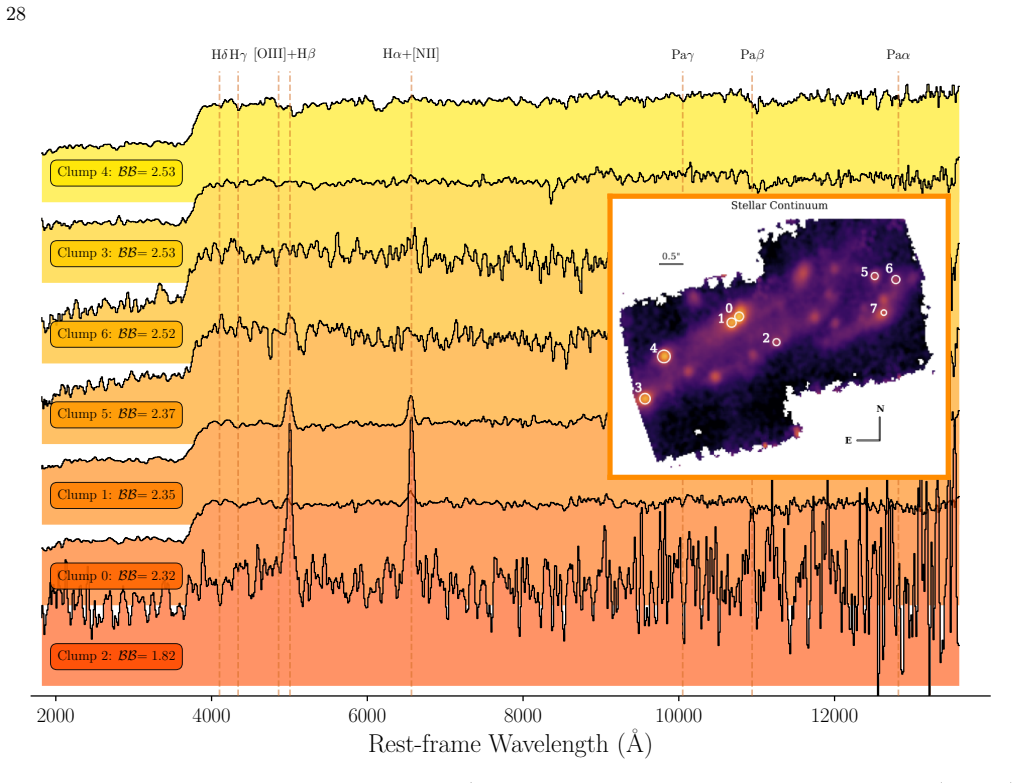
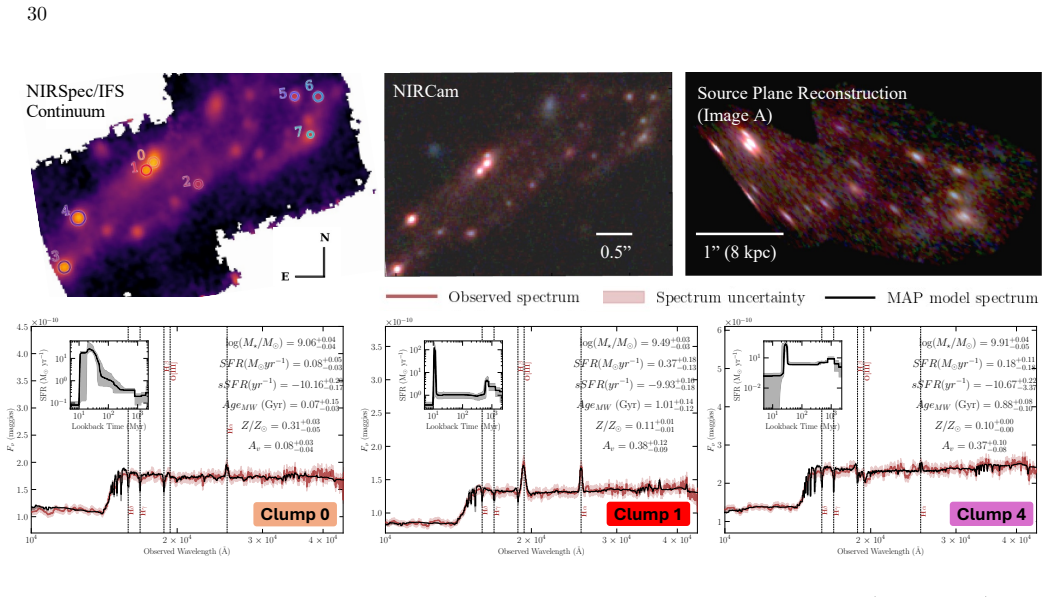
LEGGOS pairs JWST NIRSpec integral-field spectroscopy with NIRCam imaging of eight strongly lensed galaxies at z≈2–4, reaching physical scales of 10–200 pc. The central demonstration is that spectroscopy separates the light of individual clumps into stellar generations: three clumps in SGAS2111 show strong Balmer breaks, no detectable emission lines, and modeled star-formation histories with a starburst 50–150 Myr ago that shut off roughly 20 Myr ago. If correct, these are resolved post-starburst regions—recently quenched neighborhoods inside a galaxy whose integrated light is UV-bright and star-forming—a class that photometry-only surveys would miss. The survey also maps ionization and gas-phase metallicity at ~100 pc scales, revealing both uniform and clump-enhanced enrichment patterns, and delivers a uniformly processed dataset for clump-scale galaxy assembly studies.

What carries the argument

Strong gravitational lensing (median magnification ~15) turns 10–200 pc clumps into resolved sources; NIRSpec integral-field spectroscopy supplies stellar continuum and nebular lines; NIRCam supplies multiband photometry; and a forward model places King-profile clumps (centrally concentrated light profiles with a finite truncation radius) in the source plane, ray-traces them through the lens, convolves with the instrument PSF, and compares to the images. A Bayesian non-parametric star-formation-history model then fits the combined spectra and photometry. The Balmer break—the ratio of median continuum flux just redward to just blueward of 4000 Å rest—serves as the fast diagnostic that flags q

What would settle it

Take one of the strong-Balmer-break clumps in SGAS2111 and obtain deeper medium-resolution NIRSpec spectroscopy around Hα and Hβ, plus longer-wavelength photometry (e.g., MIRI or submillimeter) to measure dust emission. If Hα or Hβ is detected at a level implying star formation substantially above the modeled post-quench SFR, or if the dust luminosity implies an obscured older population with attenuation large enough to produce the Balmer break without a recent burst, then the 'recently quenched' interpretation collapses.

Watch

Extended reading notes

Core claim

On the paper's own terms, NIRSpec IFS spectroscopy breaks key degeneracies inherent to photometry-only clump studies by revealing that some UV-bright, apparently star-forming clumps are actually recently quenched. In the z=2.858 galaxy SGAS2111, clumps 0, 1, and 4 have strong Balmer breaks, weak or absent nebular emission lines, and spectrophotometric fits implying a burst 50–150 Myr before observation followed by quenching roughly 20 Myr ago. These appear to be resolved post-starburst 'napper' regions embedded in a galaxy whose integrated light is UV-bright and star-forming. The same joint analysis of lensing reconstruction, multiband photometry, and integral-field spectra produces maps of

Load-bearing premise

The quenching claim rests on the Bayesian star-formation-history model—specifically its dust attenuation law, with extra attenuation around stars younger than about 10 million years, and its fixed infrared dust templates—being able to separate age from dust and metallicity using prism-resolution spectra; if a dusty, older stellar population can mimic the observed strong Balmer break, UV upturn, and weak emission lines, the ~20 Myr quenching episode would not be required.

Editorial extensions

If this is right

  • Photometry-only clump surveys misclassify recently quenched regions as active star formers; spectroscopy is required to recover true active fractions at cosmic noon.
  • Resolved post-starburst clumps can coexist with actively star-forming clumps within a single galaxy, implying quenching operates on sub-kpc scales and may be driven by mergers.
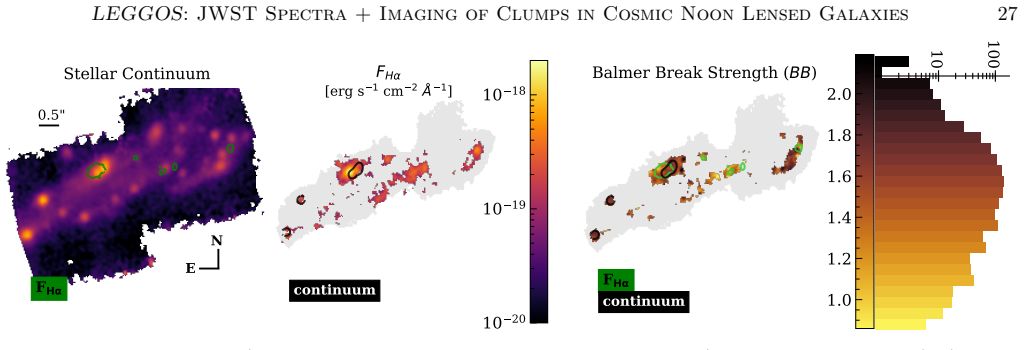
  • Balmer-break maps can identify quenched subregions even when the integrated galaxy light is UV-bright and star-forming.
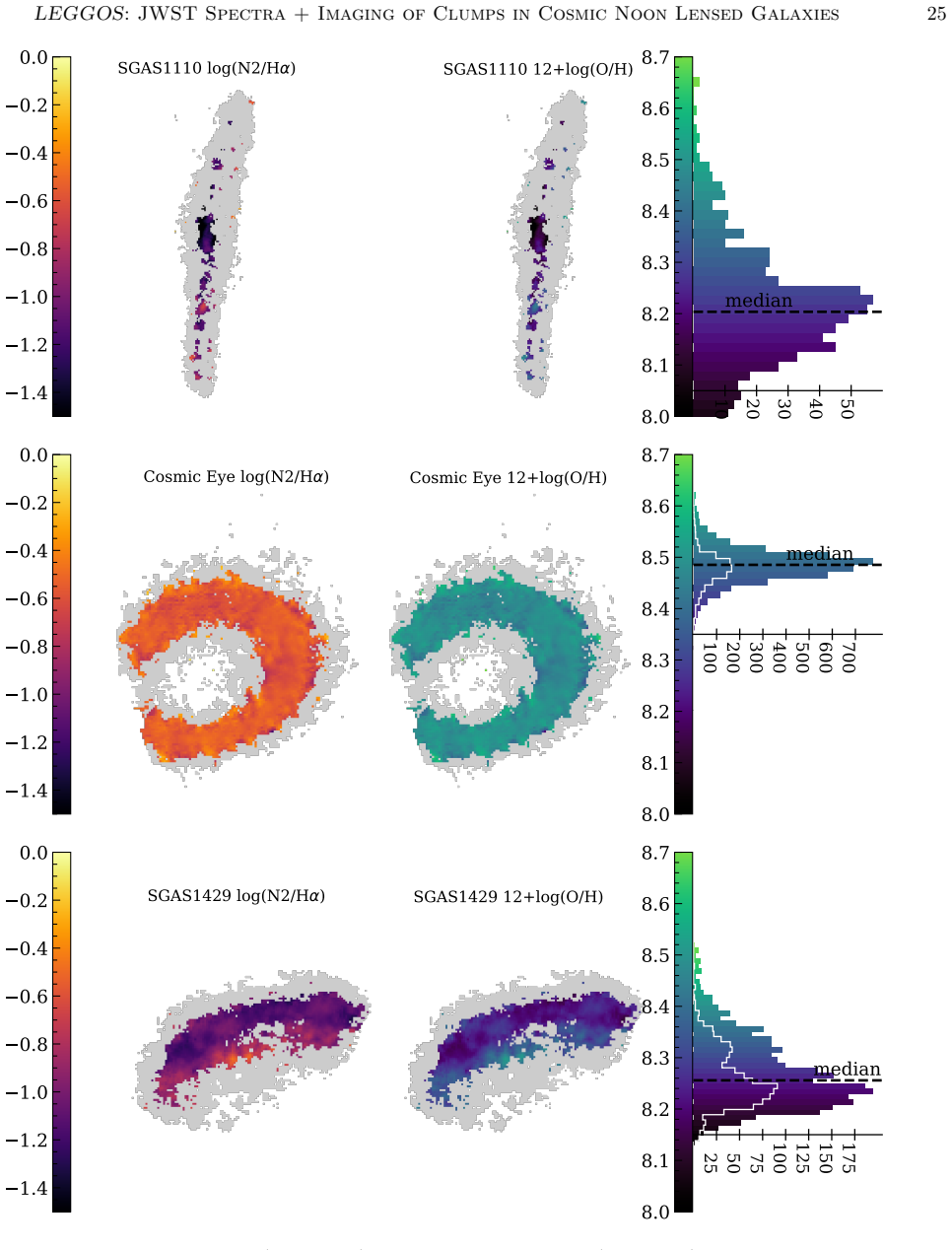
  • N2-based metallicity maps reveal qualitatively different enrichment structures—uniform, clump-enhanced, and broad—providing new constraints on metal mixing and feedback at high redshift.
  • The survey's public dataset of lens models, photometry, spectra, and star-formation-history posteriors offers a benchmark for deciphering clumpy star formation in the first galaxies.

Reading between the lines

Editorial extensions of the paper, not claims the author makes directly.

  • If verified, photometric clump demographics from other JWST surveys may need re-derivation: the fraction of 'active' clumps at z≈2–4 could be systematically overestimated by the presence of such napper clumps.
  • A direct test would be higher-resolution spectroscopy of the same clumps to resolve Balmer absorption features like Hδ; the paper's ~20 Myr quenching timescale predicts strong post-starburst absorption that a dusty older population would not reproduce.
  • The recovered King-profile clump sizes and fluxes could be used, once validated, to test whether the local giant-molecular-cloud size–mass relation extends to 10–200 pc clumps at cosmic noon.
Share X Bluesky LinkedIn Reddit HN

Editorial analysis

A structured set of objections, weighed in public.

Desk editor's note, referee report, and a circularity audit.

Referee Report

2 major / 6 minor

Summary. The paper introduces the JWST LEGGOS survey, a program combining NIRCam imaging and NIRSpec IFS spectroscopy for eight strongly lensed galaxies at z ≈ 2.3–3.7, with the goal of resolving star-forming and recently quenched clumps at 10–200 pc scales. It describes the survey design, data reduction, lens modeling, PSF construction, clump photometry (including a forward-modeling approach), Prospector-based non-parametric SFH fitting, and emission-line diagnostics. Early results include [N II]-BPT classifications for two galaxies, N2-based metallicity maps for three galaxies, and a demonstration that three clumps in SGAS2111 show strong Balmer breaks, weak/no emission lines, and Prospector SFHs consistent with bursts 50–150 Myr ago followed by quenching ~20 Myr ago. The abstract claims that NIRSpec spectroscopy 'breaks key degeneracies inherent to photometry-only clump studies' and identifies recent quenching in previously UV-star-forming systems.

Significance. If the central claims hold, the paper would be significant in several ways. The survey dataset itself is valuable: eight bright lensed arcs, magnification factors of 10–100, source-plane resolutions of 10–200 pc, multi-band NIRCam coverage, and NIRSpec IFS at low and medium resolution. The emphasis on simultaneous imaging and IFU spectroscopy, lensing-invariant line ratios, and a uniform forward-modeling framework are strengths. The detailed treatment of background subtraction, PSF creation, and cross-comparison of photometric methods is commendable and increases confidence in the data products. The most novel scientific claim—resolved post-starburst 'napper' clumps in a UV-bright galaxy at z = 2.858—would be an important advance if fully supported. However, the manuscript currently presents this result as established while the key model-degeneracy tests are asserted but not shown. The early metallicity and BPT results are useful but preliminary. Overall, the survey architecture is sound, but the paper's headline claim needs additional support before it can be accepted at face value.

major comments (2)
  1. [§5.3, Fig. 13; §4.3] The abstract and §5.3 claim that NIRSpec IFS spectroscopy identifies recent quenching in SGAS2111 clumps 0, 1, and 4. This rests entirely on the Prospector/FSPS non-parametric SFH fits shown in Fig. 13, with the Kriek & Conroy (2013) dust law, doubled attenuation for young stars, and fixed/marginalized Draine IR parameters. At prism resolution (R ≈ 30–120) and with NIRCam photometry reaching only rest-frame ~1.15 μm, the observed strong Balmer break, UV upturn, and weak emission lines are not uniquely post-starburst; an older stellar population with a particular dust geometry or a dusty continuous SFH may produce similar spectrophotometry. The manuscript states in §4.3 that 'multiple flavors of SED models' were fit to rule out the age–metallicity–dust degeneracy, but no such fits, residuals, posterior comparisons, or quantitative model-selection metrics are presented. Furthermore, the as
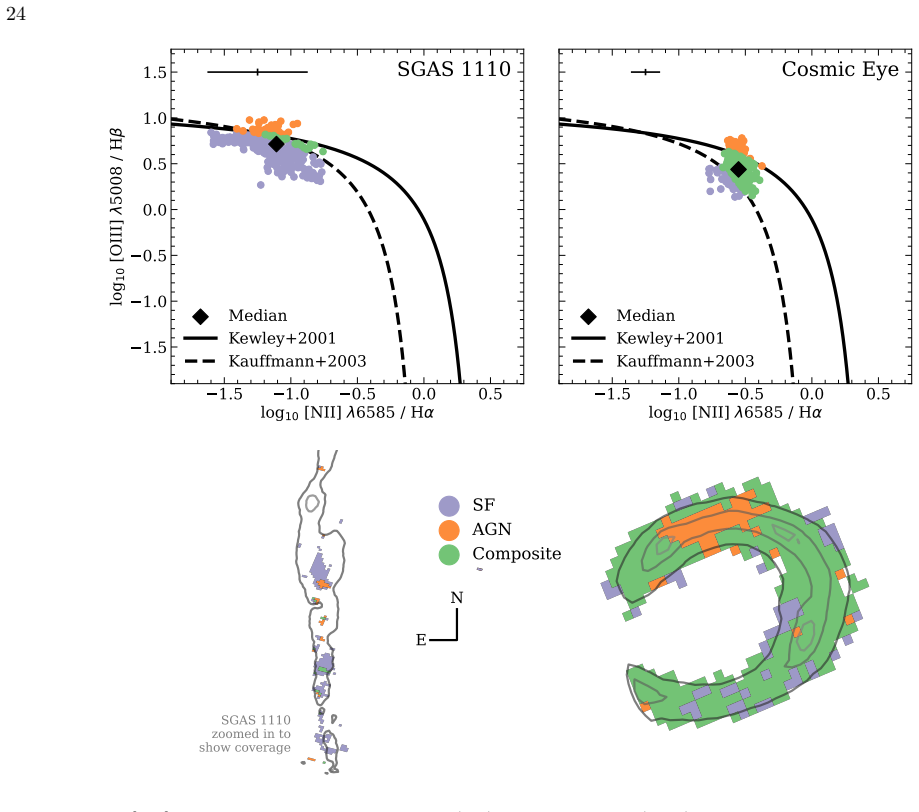
  2. [§5.2.2, Fig. 10] The N2-based metallicity maps include all spaxels with detected [N II]λ6585 and Hα, with no explicit exclusion based on the [N II]-BPT classifications presented in §5.2.1. In SGAS1110, 14% of classified spaxels are AGN-like and 6% composite; in the Cosmic Eye, 73% are composite. Since [N II]/Hα is elevated in non-star-forming ionizing conditions, the claimed clump-to-diffuse metallicity enhancement in SGAS1429 and the apparent uniformity in the Cosmic Eye could be partially or wholly driven by ionization parameter or AGN/shock contamination rather than abundance. The paper is appropriately cautious in places, but the maps and the summary statement that 'LEGGOS galaxies range from uniform metallicities... to higher clump metallicities' need to be robust to this effect. Please restrict the metallicity analysis to spaxels classified as star-forming (or otherwise demonstrate that the conclus
minor comments (6)
  1. [§3.3] The text says all images were 'resampled to a 0.03 grid, using Gaussian kernels.' Please specify the kernel size/FWHM used, as this affects PSF matching and photometry.
  2. [§4.2.1] The Gaussian smoothing sigma of 0.4717 pixels is quoted to four significant figures without an uncertainty or a sensitivity test. Since this PSF model is used for photometry and source-plane flux estimates, please report how sigma was optimized and how fluxes change when sigma is varied by ±0.1 pixels.
  3. [§4.3] The sentence 'We fix the shape of the IR SED following the Draine et al. (2007) dust emission templates, with Umin = 1.0, γe = 0.01, and qPAH = 2.0., and marginalize over these parameters' is internally contradictory: are the Draine parameters fixed or marginalized? Clarify, since this affects the interpretation of the dust attenuation constraints.
  4. [§4.3] The prose says 'we also fit for both stellar and gas-phase metallicity' but it is not explained how gas-phase metallicity enters the Prospector model when the fiducial setup only marginalizes over nebular emission. If gas-phase metallicity is only constrained via Cloudy-like nebular models, state this explicitly.
  5. [§5.2.1] The BPT classification fractions (80%/6%/14% and 14%/73%/13%) are quoted without uncertainties. Since the classifications are made on correlated spaxels, please report bootstrap or binomial uncertainties.
  6. [§5.3, Eq. (4)] The Balmer break values (BB ≈ 2.3–2.5) in Fig. 12 are reported as point values. Include uncertainties, and state how sensitive Eq. (4) is to the choice of continuum windows, redshift uncertainties, and the prism line-spread function.

Circularity Check

0 steps flagged · score 0.0 of 10

No significant circularity: the quenching inference is a model fit to independent spectrophotometric data, not an input assumed by construction.

full rationale

The paper's central claim—that NIRSpec IFS spectroscopy identifies recently quenched clumps 0, 1, and 4 in SGAS2111—is a Bayesian SED fit to independently observed prism spectra, G235M line measurements, and NIRCam photometry using Prospector with non-parametric star formation histories. The Balmer break defined in Eq. 4 is a purely observational flux ratio; the paper uses it to select and display clumps, but the inferred burst age (~50–150 Myr) and quenching time (~20 Myr) are free parameters of the SPS model, not quantities defined by the break. Line ratios used elsewhere are magnification-invariant and rely on external calibrations (Marino et al. 2013; Kewley et al. 2001; Kauffmann et al. 2003). The PSF smoothing (sigma=0.4717) is a calibration derived from stars in the same NIRCam images, but this is a standard calibration step and the forward-modeled photometry is cross-checked against GALFIT and aperture methods, so no prediction is forced by construction. Self-citations to prior lens-model papers (e.g., Sharon et al. 2020) and companion works in preparation concern lens-model and survey infrastructure, not the quenching result; the SED fitting is explicitly done in the image plane with magnification applied only afterward (Sec. 4.3), so lens models are not load-bearing for the spectral inference. The asserted but not shown tests against age-metallicity-dust degeneracy are a completeness/correctness concern, not evidence of circularity. No equation or fitted parameter in this paper reduces to its own input.

Assumptions & free parameters 5 free parameters · 8 assumptions · 0 invented entities

Most assumptions are standard domain assumptions of the field: SPS libraries, dust laws, strong-line calibrations, and parametric lens models. The central quenching claim adds fitted SFH/dust parameters and a data-calibrated PSF kernel. No new physical entities are introduced; 'Godzilla' and 'napper' are labels drawn from or built on prior literature.

free parameters (5)
  • PSF Gaussian smoothing sigma = 0.4717 px
    STPSF models were smoothed with a Gaussian of this width to match real stars; this calibrated kernel is then used for all clump size/flux measurements (Sec. 4.2.1).
  • Non-parametric SFH bin formation masses = burst at 50-150 Myr and quenching at ~20 Myr for clumps 0/1; older/longer quenching for clump 4
    Prospector fits these from spectra and photometry; they directly produce the post-starburst 'napper' interpretation (Fig. 13).
  • Dust attenuation Av and dust index = Av ~0.08-0.38 for clumps 0/1/4
    Fitted simultaneously with the SFH; the assumed dust model affects whether old+dusty stellar populations can mimic quenched spectra (Sec. 4.3).
  • Stellar and gas-phase metallicities = Z/Zsun ~0.10 (clumps 0/1), 0.31 (clump 4)
    SPS model parameters fitted to the data; they affect spectral shape and are degenerate with age and dust (Sec. 4.3).
  • Lens model mass parameters (Lenstool) = median clump magnification ~15; 10-20% magnification uncertainties
    Parametric lens models are fit to multiply imaged features and are required for source-plane sizes and demagnified fluxes (Sec. 4.1).
assumptions (8)
  • domain assumption Kriek & Conroy dust law with doubled attenuation around stars younger than 10^7 yr accurately describes dust in high-z clumps.
    Invoked in Sec. 4.3; if false, inferred SFH ages and quenching timescales are biased.
  • domain assumption FSPS stellar population models with MILES and MIST and a Chabrier IMF accurately represent high-redshift stellar populations.
    Used for all SPS fits in Sec. 4.3; assumptions about stellar libraries and isochrones are adopted from the models.
  • domain assumption The Marino et al. (2013) N2 metallicity calibration applies to individual high-z HII regions; extrapolation is acceptable for spaxels below the calibrated range.
    Sec. 5.2.2 uses this calibration and extrapolates for 18/679 SGAS1110 spaxels, accepting systematic uncertainty.
  • domain assumption BPT demarcation lines from Kewley et al. (2001) and Kauffmann et al. (2003) apply at z~2-4.
    Sec. 5.2.1 classifies spaxels as SF/composite/AGN with these local-universe boundaries.
  • domain assumption Parametric Lenstool lens models and their magnification maps correctly map image-plane pixels to the source plane.
    Used throughout for source-plane sizes, clump fluxes, and magnifications (Sec. 4.1); models are mostly HST-era with added JWST constraints for some fields.
  • domain assumption Visually identified 'clumps' are physical substructures rather than chance line-of-sight alignments or PSF artifacts.
    Sec. 4.2.2 notes clump is a 'colloquial term'; visual selection is acknowledged to be biased toward bright knots.
  • domain assumption NIRSpec IFS background subtraction using off-target spaxels and fixed slits leaves no significant residual contamination.
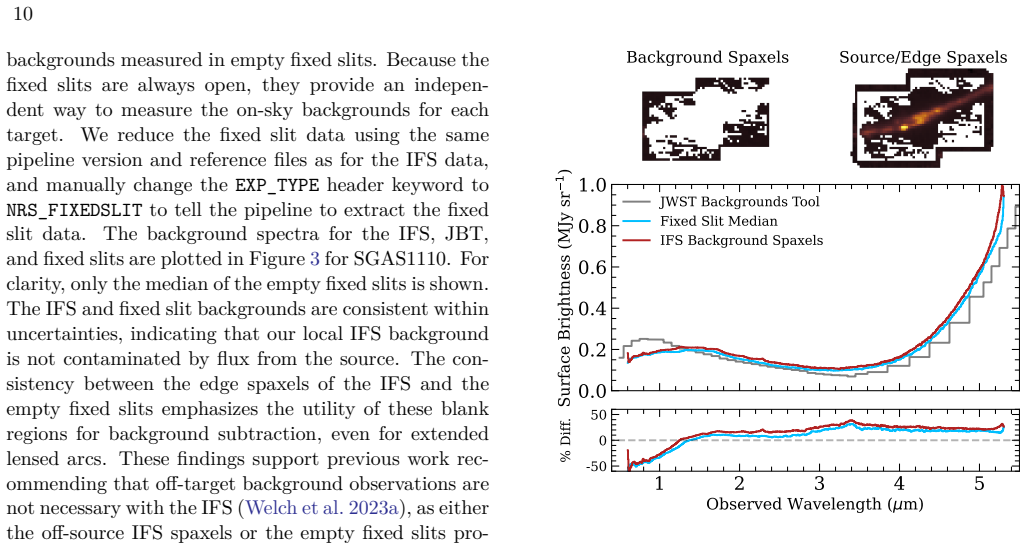
    Sec. 3.1 describes the background method and consistency checks, but relies on blank-sky regions being uncontaminated by extended arc light.
  • ad hoc to paper STPSF models smoothed by a Gaussian with sigma=0.4717 capture the true NIRCam PSF in level-3 images.
    Sec. 4.2.1 fits the smoothing kernel to real stars; this is a data-calibrated choice rather than a derived quantity, and it is used for all clump measurements.

how reviews work

0 comments
Cite this review

Pith. "Pith review of LEGGOS I: The JWST LEGGOS Survey -- LEnsing and Galaxy Growth: Observing Substructures -- Unpacks the Nature of Clumpy Star Formation and Quenching in Gravitationally Lensed Galaxies beyond Cosmic Noon." pith.science (2026). https://pith.science/paper/FOWGO3BO

@misc{pith2026260620845,
  author       = {Pith},
  title        = {Pith review of: LEGGOS I: The JWST LEGGOS Survey -- LEnsing and Galaxy Growth: Observing Substructures -- Unpacks the Nature of Clumpy Star Formation and Quenching in Gravitationally Lensed Galaxies beyond Cosmic Noon},
  year         = {2026},
  howpublished = {\url{https://pith.science/paper/FOWGO3BO}},
  note         = {Machine review of arXiv:2606.20845}
}
abstract

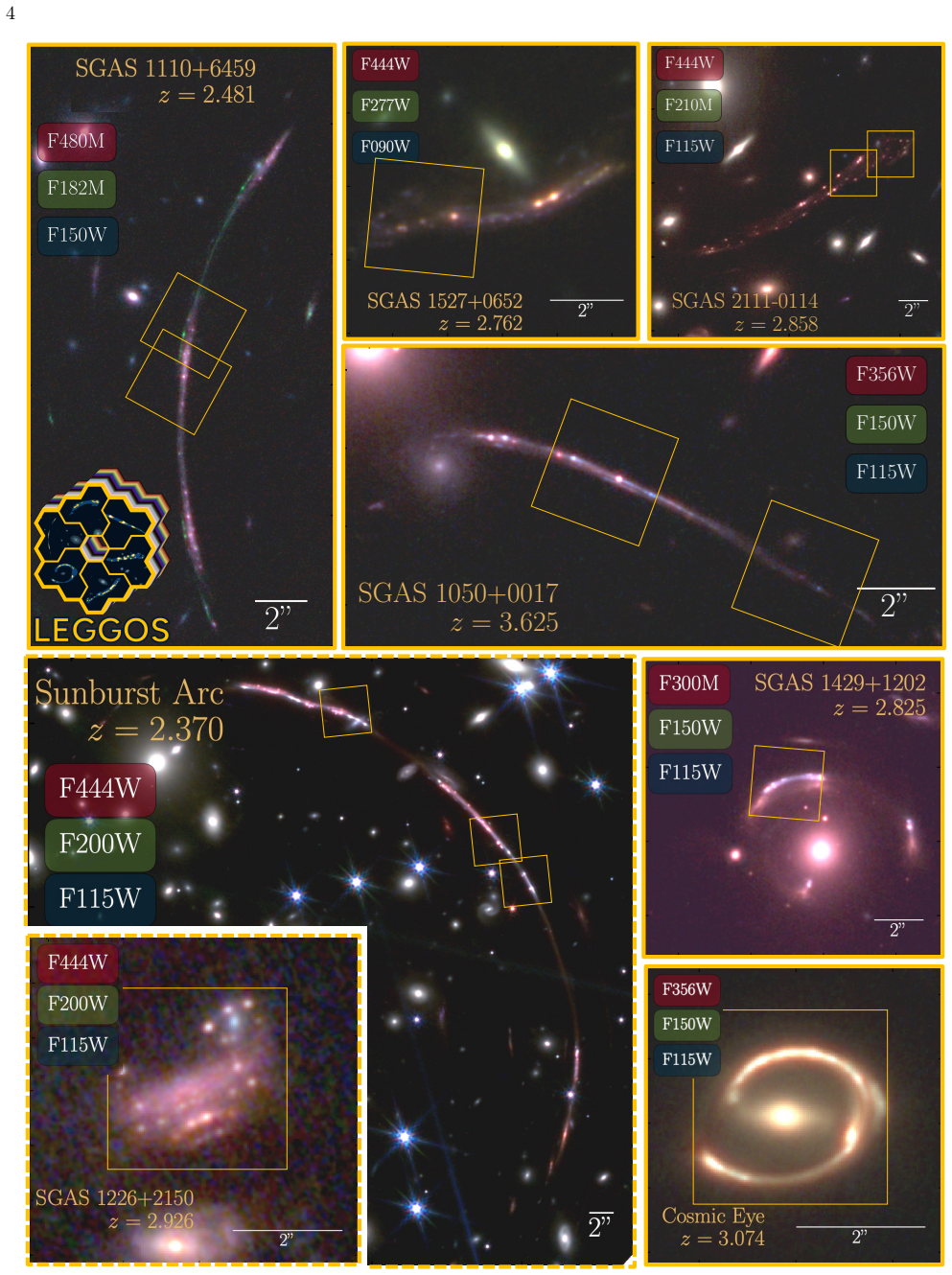
We present first results from the JWST LEGGOS Survey (LEnsing and Galaxy Growth: Observing Substructures), aimed at studying the physics of clumpy star formation and quenching in eight lensed galaxies at $z\sim2$--4. LEGGOS combines multiple Cycle 2 JWST GO programs (GO 4125, GO 3843) and Cycle 1 archival data, and utilizes strong gravitational lensing with NIRCam imaging and NIRSpec integral-field spectroscopy. LEGGOS targets UV-bright, highly magnified systems to resolve $\sim$10--200 pc regions in both rest-frame optical continuum and nebular emission. This overview paper describes the survey design, data reduction and calibration strategy, and science-quality data products, and highlights early examples demonstrating how spectroscopy breaks key degeneracies inherent to photometry-only clump studies, including identifying recent quenching in previously-thought UV star forming galaxies. We introduce a uniform analysis framework that jointly models lensing reconstruction, multi-band photometry, and integral field spectroscopy to disentangle multiple stellar populations within individual clumps and their surrounding diffuse regions. Using maps of Balmer recombination lines and key emission line diagnostic ratios, we connect star formation histories, dust attenuation, and nebular conditions on sub-kpc scales -- LEGGOS galaxies range from uniform metallicities across the whole galaxy, to having higher clump metallicities and harder ionization conditions relative to diffuse regions. The full survey dataset, with simultaneous flux and morphology constraints on clumpy source-plane regions, and a flexible spectrophotometric SPS modeling approach, provides a direct bridge between parsec-scale star formation physics and galaxy assembly at and beyond cosmic noon, offering a robust and efficient means of resolving star formation in the first galaxies.

Figures

Figures reproduced from arXiv: 2606.20845 by the authors.

Figure 1
Figure 1. RGB mosaics of JW ST LEGGOS Survey targets. Each subplot notes the filters that make up the synthetic RGB image, the target name and spectroscopic redshift. Tens of clumpy regions are detected in each ”primary” lensed arc, with half being sampled spectroscopically with NIRSpec/IFS (FOV in gold squares). (Bottom Right) The survey logo, highlighting the six new observed targets and the IFS component of the survey – on… view at source ↗
Figure 2
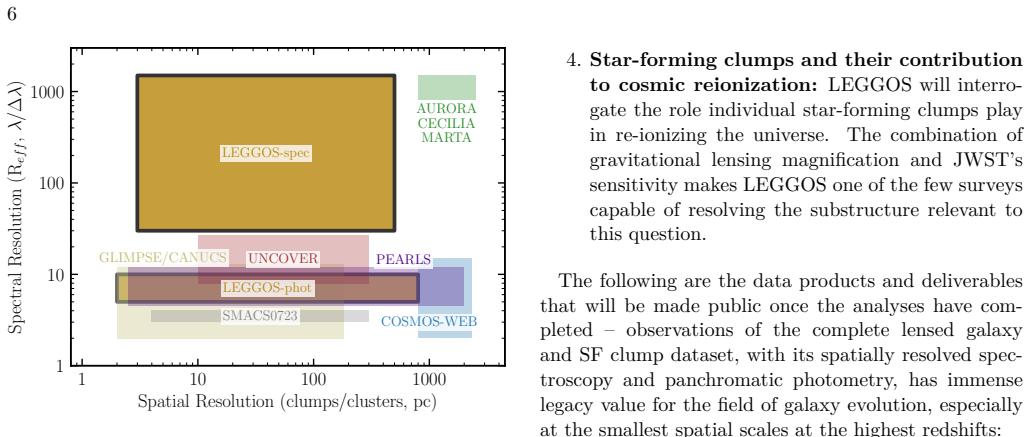
Figure 2. Effective Spectral vs Spatial Resolution for clump/star cluster-like observations in JWST surveys. uniquely positioned to answer given its resolved, high-S/N spectrophotometric coverage. 2. Stellar populations, physical conditions, and chemical conditions of clumpy star￾forming galaxies: Resolved star formation his￾tories encode the cumulative record of how galax￾ies have assembled their mass; LEGGOS will use these … view at source ↗
Figure 3
Figure 3. Backgrounds are measured locally in the NIR￾Spec/PRISM IFS data, as described in Section 3.1. The top panels show maps of [O iii] for SGAS1110, with the top left panel including only the spaxels used to measure the local background, while the top right panel shows the source and edge spaxels which are not used in background estimation. The middle panel shows the extracted background spectrum from the IFS cube in red… view at source ↗
Figures from the paper (10 more)
Figure 4
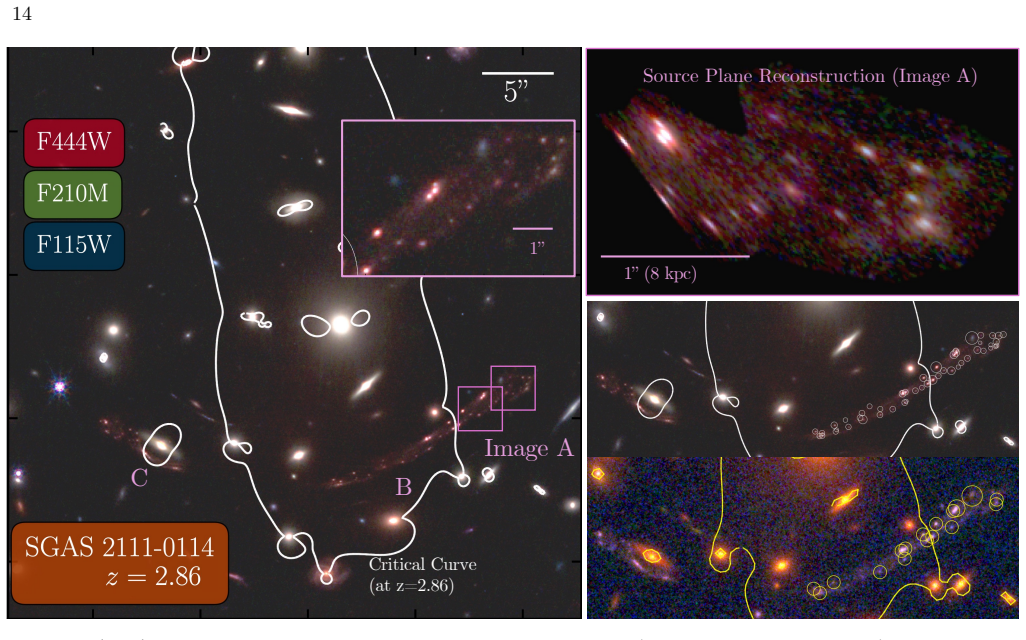
Figure 4. Figure 4: (Left) Gravitational Lens model for SGAS2111, with critical curve (locus of infinite magnification) at z = 2.86. Also shown in purple squares (and the zoomed in top inset) is the primary image of the arc, sampled with NIRSpec/IFS. (Right) (Top right) Source plane recon…
Figure 5
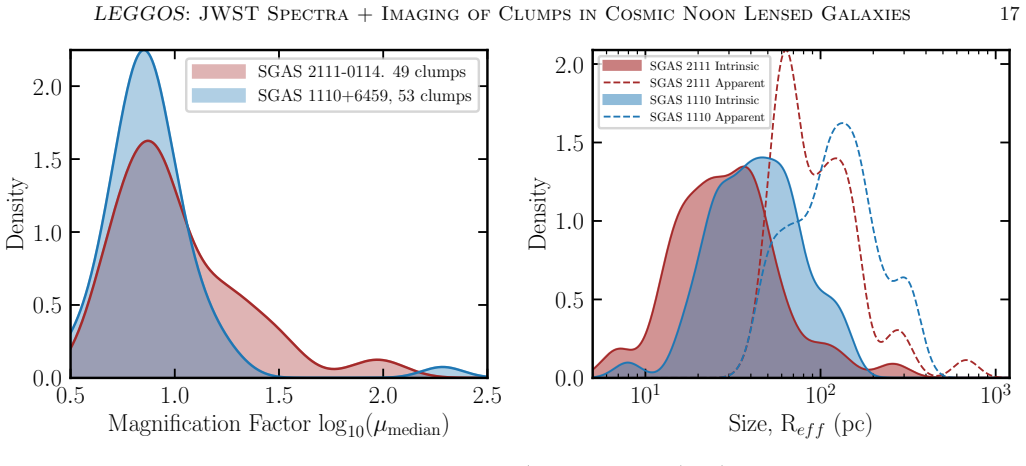
Figure 5. Figure 5: Probability distributions of magnification and intrinsic/source-plane sizes (Reff ) of clumps across galaxies SGAS2111 (red) and SGAS1110 (blue), estimated after Monte Carlo sampling the probability distributions of lens-model based magnifica￾tion and effective radii i…
Figure 6
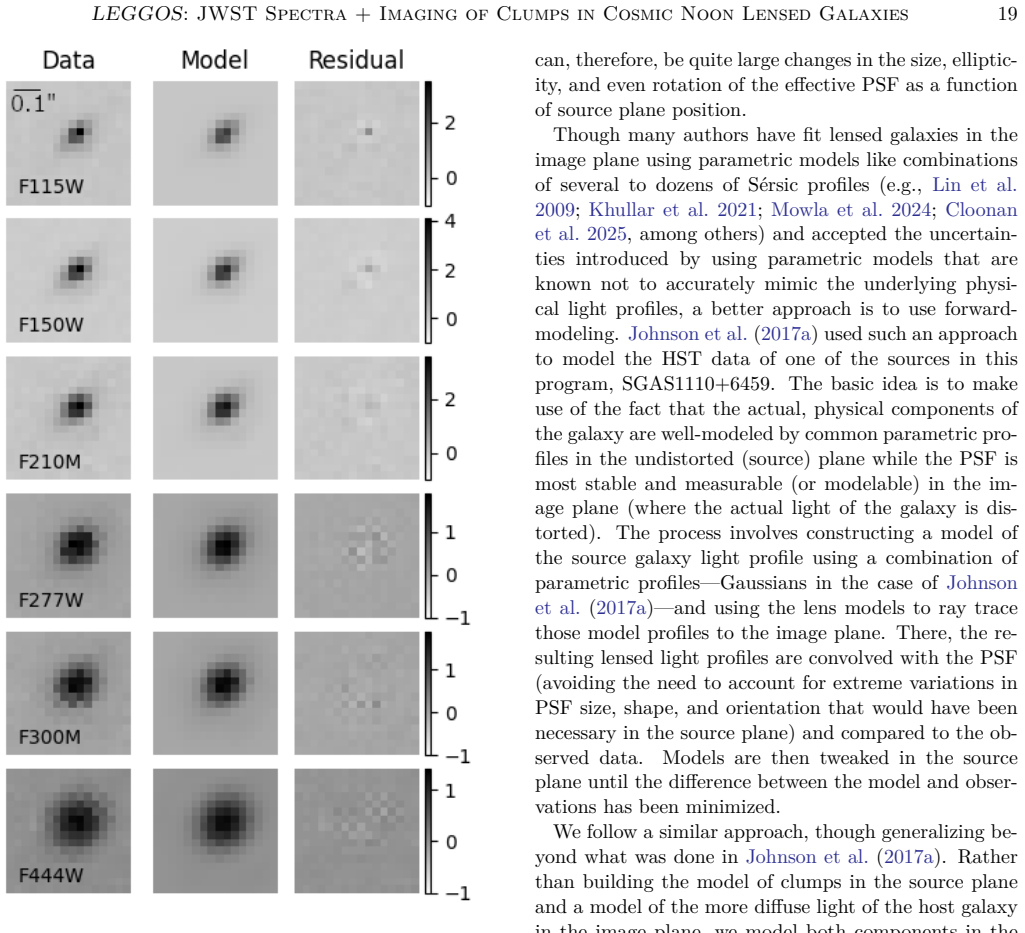
Figure 6. Figure 6: From left to right: The observed image plane NIRCam data for Clump 4 in SGAS2111, the forward￾modeled image plane, and the residual (colorbar units in MJy sr−1 ). At z=2.86, 0.1” corresponds to ∼750 pc, and a nominal magnification of 20× allows us to observe ∼ 150 pc r…
Figure 7
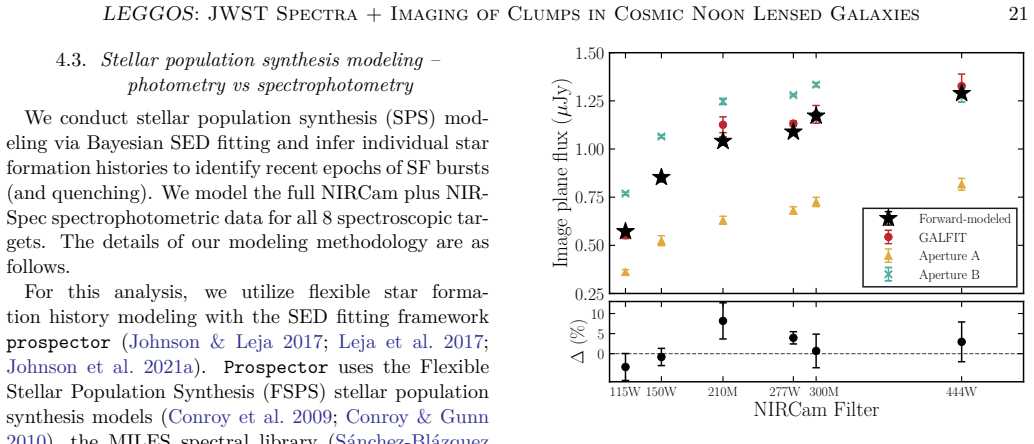
Figure 7. Figure 7: Comparison of photometry for Clump 4 in SGAS2111 derived from various aperture and model photom￾etry methods The bottom panel shows the percentage differ￾ence between GALFIT-based model photometry vs. forward modeled measurements; the fiducial methodology matches the G…
Figure 8
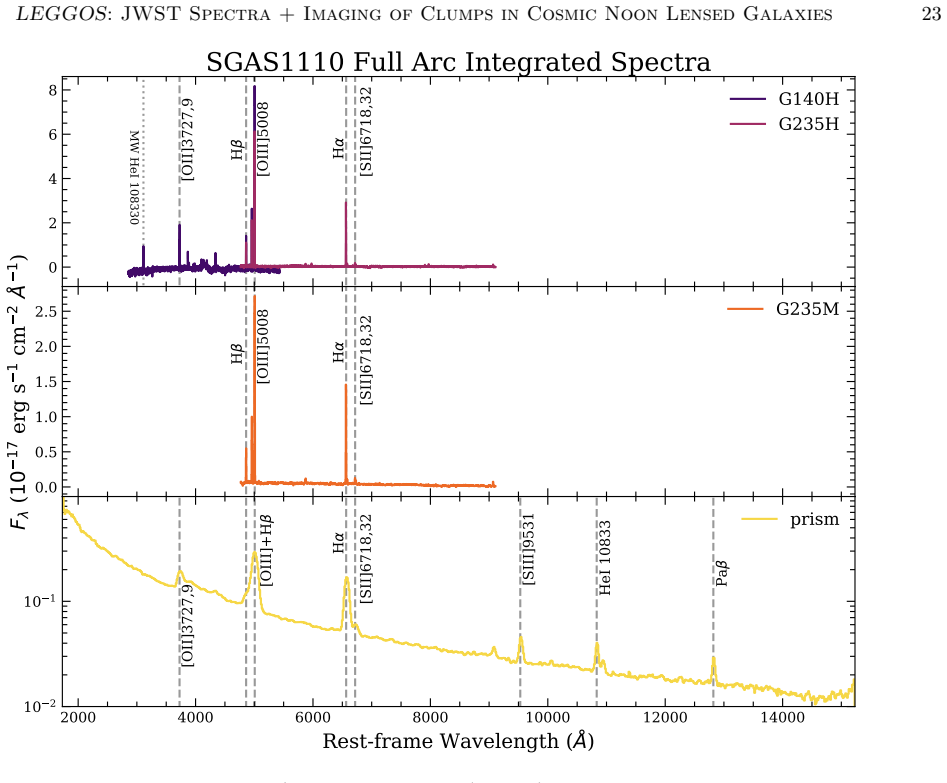
Figure 8. Figure 8: Integrated spectra from NIRSpec/IFS across the central (primary) image of the lensed arc; this is one of the highest redshift legacy dataset comprising observations from all NIRSpec modes – high-resolution H grating (top), medium-resolution M grating (middle), and low-…
Figure 9
Figure 9. Figure 9: The [N ii]-BPT diagrams for the SGAS1110 (left) and Cosmic Eye (right). The top panels show the pixel-by-pixel [N ii]-BPT diagrams, with both galaxies exhibiting line ratios consistent with star forming (purple), composite (green), and AGN (orange) regions as defined b…
Figure 10
Figure 10. Figure 10: Maps of the N2 line ratio (left column) and N2-derived metallicity (right panel) are shown for three LEGGOS targets: SGAS1110 (top row), the Cosmic Eye (middle row), and SGAS1429 (bottom row). Histograms to the right of each metallicity map show the distribution of me…
Figure 11
Figure 11. Figure 11: Selecting clumps/star clusters for investigation with LEGGOS NIRSpec/IFS prism observations. (left) Stellar continuum image of SGAS 2111 from IFS pointings. The green contours represent regions of higher Hα emission (FHα = 3×10⁻¹⁹ erg s−1 cm−2 Å −1 ). (center) Flux ma…
Figure 12
Figure 12. Figure 12: A gallery of spatially resolved JWST NIRSpec/prism spectra of visually identified ”clumps” in SGAS2111 (z = 2.86), plotted in decreasing order of Balmer break strength. Dotted vertical lines show prominent emission and absorption features from rest-frame 0.4−1.3µm. In…
Figure 13
Figure 13. Figure 13: SED Fitting example of quenched “clumpy” regions within SGAS2111 - Clump 0, 1 and 4 (see [PITH_FULL_IMAGE:figures/full_fig_p030_13.png]

Discussion (0). Continue with ORCID to comment.

Reference graph

Works this paper leans on

210 extracted references · 19 canonical work pages

  1. [1]

    , " * write output.state after.block = add.period write newline

    ENTRY address archivePrefix author booktitle chapter doi edition editor eprint howpublished institution journal key month number organization pages publisher school series title misctitle type volume year version url label extra.label sort.label short.list INTEGERS output.state before.all mid.sentence after.sentence after.block FUNCTION init.state.consts ...

  2. [2]

    write newline

    " write newline "" before.all 'output.state := FUNCTION format.url url empty "" new.block "" url * "" * if FUNCTION format.eprint eprint empty "" archivePrefix empty "" archivePrefix "arXiv" = new.block " " eprint * " " * new.block " " eprint * " " * if if if FUNCTION format.doi doi empty "" " " doi * " " * if FUNCTION format.pid doi empty eprint empty ur...

  3. [3]

    Astrophysics of gaseous nebulae and active galactic nuclei

    thebibliography [1] 20pt to REFERENCES 6pt =0pt 10pt plus 3pt =0pt =0pt =1pt plus 1pt =0pt =0pt -12pt =13pt plus 1pt =20pt =13pt plus 1pt \@M =10000 =-1.0em =0pt =0pt 0pt =0pt =1.0em @enumiv\@empty 10000 10000 `\.\@m \@noitemerr \@latex@warning Empty `thebibliography' environment \@ifnextchar \@reference \@latexerr Missing key on reference command Each re...

  4. [4]

    2021, , 254, 15, 10.3847/1538-4365/abebe2

    Abdurro'uf , Lin , Y.-T., Wu , P.-F., & Akiyama , M. 2021, , 254, 15, 10.3847/1538-4365/abebe2

  5. [5]

    2026, arXiv e-prints, arXiv:xxxx.xxxx, 10.48550/arXiv.xxxx.xxxx

    Abedi , P., Sharon , K., & et al. 2026, arXiv e-prints, arXiv:xxxx.xxxx, 10.48550/arXiv.xxxx.xxxx

  6. [6]

    D., Vanzella , E., et al

    Adamo , A., Bradley , L. D., Vanzella , E., et al. 2024, , 632, 513, 10.1038/s41586-024-07703-7

  7. [7]

    B., et al

    Adamo , A., Atek , H., Bagley , M. B., et al. 2025, Nature Astronomy, 9, 1134, 10.1038/s41550-025-02624-5

  8. [8]

    2020, , 249, 3, 10.3847/1538-4365/ab929e

    Ahumada , R., Allende Prieto , C., Almeida , A., et al. 2020, , 249, 3, 10.3847/1538-4365/ab929e

Show all 210 references
  1. [9]

    S., Tucker , D

    Allam , S. S., Tucker , D. L., Lin , H., et al. 2007, , 662, L51, 10.1086/519495

  2. [10]

    2024, , 534, L7, 10.1093/mnrasl/slae074

    Almada Monter , S., & Gronke , M. 2024, , 534, L7, 10.1093/mnrasl/slae074

  3. [11]

    P., Tollerud , E

    Astropy Collaboration , Robitaille , T. P., Tollerud , E. J., et al. 2013, , 558, A33, 10.1051/0004-6361/201322068

  4. [12]

    M., Sip o cz , B

    Astropy Collaboration , Price-Whelan , A. M., Sip o cz , B. M., et al. 2018, , 156, 123, 10.3847/1538-3881/aabc4f

  5. [13]

    2025, arXiv e-prints, arXiv:2511.07542, 10.48550/arXiv.2511.07542

    Atek , H., Chisholm , J., Kokorev , V., et al. 2025, arXiv e-prints, arXiv:2511.07542, 10.48550/arXiv.2511.07542

  6. [14]

    E., Trump , J

    Backhaus , B. E., Trump , J. R., Pirzkal , N., et al. 2024, , 962, 195, 10.3847/1538-4357/ad1520

  7. [15]

    E., Cleri , N

    Backhaus , B. E., Cleri , N. J., Trump , J. R., et al. 2025, arXiv e-prints, arXiv:2502.03519, 10.48550/arXiv.2502.03519

  8. [16]

    A., Phillips , M

    Baldwin , J. A., Phillips , M. M., & Terlevich , R. 1981, , 93, 5, 10.1086/130766

  9. [18]

    B., Hennawi, J

    Bayliss, M. B., Hennawi, J. F., Gladders, M. D., et al. 2011, , 193, 8, 10.1088/0067-0049/193/1/8

  10. [19]

    B., Johnson, T., Gladders, M

    Bayliss, M. B., Johnson, T., Gladders, M. D., Sharon, K., & Oguri, M. 2014, , 783, 41, 10.1088/0004-637X/783/1/41

  11. [21]

    2014 b , , 790, 144, 10.1088/0004-637X/790/2/144

    ---. 2014 b , , 790, 144, 10.1088/0004-637X/790/2/144

  12. [22]

    B., Sharon , K., & Johnson , T

    Bayliss , M. B., Sharon , K., & Johnson , T. 2015, , 802, L9, 10.1088/2041-8205/802/1/L9

  13. [23]

    Behrens , C., Dijkstra , M., & Niemeyer , J. C. 2014, , 563, A77, 10.1051/0004-6361/201322949

  14. [24]

    H., Hearin , A

    Behroozi , P., Wechsler , R. H., Hearin , A. P., & Conroy , C. 2019, , 488, 3143, 10.1093/mnras/stz1182

  15. [25]

    W., Moiseev , A., et al

    Belokurov , V., Evans , N. W., Moiseev , A., et al. 2007, , 671, L9, 10.1086/524948

  16. [26]

    A., Erb , D

    Berg , D. A., Erb , D. K., Auger , M. W., Pettini , M., & Brammer , G. B. 2018, , 859, 164, 10.3847/1538-4357/aab7fa

  17. [27]

    A., Chisholm , J., Prochaska , J

    Berg , M. A., Chisholm , J., Prochaska , J. X., et al. 2025, , 544, 1085, 10.1093/mnras/staf1788

  18. [28]

    M., McCleary , J

    Berman , E. M., McCleary , J. E., Koekemoer , A. M., et al. 2024, , 168, 174, 10.3847/1538-3881/ad6a0f

  19. [29]

    E., et al

    Bezanson , R., Labbe , I., Whitaker , K. E., et al. 2024, , 974, 92, 10.3847/1538-4357/ad66cf

  20. [30]

    E., Stalder , B., de Haan , T., et al

    Bleem , L. E., Stalder , B., de Haan , T., et al. 2015, , 216, 27, 10.1088/0067-0049/216/2/27

  21. [31]

    E., Bocquet , S., Stalder , B., et al

    Bleem , L. E., Bocquet , S., Stalder , B., et al. 2020, , 247, 25, 10.3847/1538-4365/ab6993

  22. [32]

    o ker , T., Arribas , S., L \

    B \"o ker , T., Arribas , S., L \"u tzgendorf , N., et al. 2022, , 661, A82, 10.1051/0004-6361/202142589

  23. [33]

    , Bocchio, M

    Boucaud, A. , Bocchio, M. , Abergel, A. , et al. 2016, A&A, 596, A63, 10.1051/0004-6361/201629080

  24. [34]

    2014, , 780, 57, 10.1088/0004-637X/780/1/57

    Bournaud , F., Perret , V., Renaud , F., et al. 2014, , 780, 57, 10.1088/0004-637X/780/1/57

  25. [35]

    2025, JWST Calibration Pipeline , 1.20.2, Zenodo, 10.5281/zenodo.17515973

    Bushouse , H., Eisenhamer , J., Dencheva , N., et al. 2025, JWST Calibration Pipeline , 1.20.2, Zenodo, 10.5281/zenodo.17515973

  26. [36]

    M., Kartaltepe , J

    Casey , C. M., Kartaltepe , J. S., Drakos , N. E., et al. 2023, , 954, 31, 10.3847/1538-4357/acc2bc

  27. [37]

    Castelli , F., & Kurucz , R. L. 2004, , 419, 725, 10.1051/0004-6361:20040079

  28. [38]

    2024, , 692, A215, 10.1051/0004-6361/202451892

    Cat \'a n , V., Gonz \'a lez-L \'o pez , J., Solimano , M., et al. 2024, , 692, A215, 10.1051/0004-6361/202451892

  29. [39]

    2026, , 1001, 60, 10.3847/1538-4357/ae41b0

    Cerny , C., Mahler , G., Sharon , K., et al. 2026, , 1001, 60, 10.3847/1538-4357/ae41b0

  30. [40]

    2003, , 115, 763, 10.1086/376392

    Chabrier , G. 2003, , 115, 763, 10.1086/376392

  31. [41]

    R., Bayliss , M., et al

    Chisholm , J., Rigby , J. R., Bayliss , M., et al. 2019, , 882, 182, 10.3847/1538-4357/ab3104

  32. [42]

    2025, , 698, A16, 10.1051/0004-6361/202450685

    Choe , S., Emil Rivera-Thorsen , T., Dahle , H., et al. 2025, , 698, A16, 10.1051/0004-6361/202450685

  33. [43]

    2016, , 823, 102, 10.3847/0004-637X/823/2/102

    Choi , J., Dotter , A., Conroy , C., et al. 2016, , 823, 102, 10.3847/0004-637X/823/2/102

  34. [44]

    2025, , 537, 2535, 10.1093/mnras/staf058

    Claeyssens , A., Adamo , A., Messa , M., et al. 2025, , 537, 2535, 10.1093/mnras/staf058

  35. [45]

    2023, , 520, 2180, 10.1093/mnras/stac3791

    Claeyssens , A., Adamo , A., Richard , J., et al. 2023, , 520, 2180, 10.1093/mnras/stac3791

  36. [46]

    2026, arXiv e-prints, arXiv:2601.16281, 10.48550/arXiv.2601.16281

    Claeyssens , A., Adamo , A., Kokorev , V., et al. 2026, arXiv e-prints, arXiv:2601.16281, 10.48550/arXiv.2601.16281

  37. [47]

    E., et al

    Clarke , L., Lam , N., Shapley , A. E., et al. 2026, arXiv e-prints, arXiv:2601.11092, 10.48550/arXiv.2601.11092

  38. [48]

    J., Olivier , G

    Cleri , N. J., Olivier , G. M., Backhaus , B. E., et al. 2025, , 994, 146, 10.3847/1538-4357/ae0f17

  39. [49]

    J., Lewis , Z

    Cleri , N. J., Lewis , Z. J., Leja , J., et al. 2026, arXiv e-prints, arXiv:2605.30410, 10.48550/arXiv.2605.30410

  40. [50]

    P., Khullar , G., Napier , K

    Cloonan , A. P., Khullar , G., Napier , K. A., et al. 2025, , 987, 194, 10.3847/1538-4357/addabf

  41. [51]

    2019, , 884, 85, 10.3847/1538-4357/ab412b

    Coe , D., Salmon , B., Bradac , M., et al. 2019, , 884, 85, 10.3847/1538-4357/ab412b

  42. [52]

    Conroy , C., & Gunn , J. E. 2010, , 712, 833, 10.1088/0004-637X/712/2/833

  43. [53]

    E., & White , M

    Conroy , C., Gunn , J. E., & White , M. 2009, , 699, 486, 10.1088/0004-637X/699/1/486

  44. [54]

    Coppin , K. E. K., Swinbank , A. M., Neri , R., et al. 2007, , 665, 936, 10.1086/519789

  45. [55]

    A., Bolton , A

    Cornachione , M. A., Bolton , A. S., Shu , Y., et al. 2018, , 853, 36, 10.3847/1538-4357/aaa025

  46. [56]

    2020 a , , 491, 944, 10.1093/mnras/stz2910

    Curti , M., Mannucci , F., Cresci , G., & Maiolino , R. 2020 a , , 491, 944, 10.1093/mnras/stz2910

  47. [57]

    2020 b , , 492, 821, 10.1093/mnras/stz3379

    Curti , M., Maiolino , R., Cirasuolo , M., et al. 2020 b , , 492, 821, 10.1093/mnras/stz3379

  48. [58]

    2016, , 590, L4, 10.1051/0004-6361/201628297

    Dahle , H., Aghanim , N., Guennou , L., et al. 2016, , 590, L4, 10.1051/0004-6361/201628297

  49. [59]

    2009, , 703, 785, 10.1088/0004-637X/703/1/785

    Dekel , A., Sari , R., & Ceverino , D. 2009, , 703, 785, 10.1088/0004-637X/703/1/785

  50. [61]

    2022 b , , 665, A134, 10.1051/0004-6361/202243605

    ---. 2022 b , , 665, A134, 10.1051/0004-6361/202243605

  51. [62]

    2016, , 222, 8, 10.3847/0067-0049/222/1/8

    Dotter , A. 2016, , 222, 8, 10.3847/0067-0049/222/1/8

  52. [63]

    T., Dale , D

    Draine , B. T., Dale , D. A., Bendo , G., et al. 2007, , 663, 866, 10.1086/518306

  53. [64]

    M., Ebeling , H., & Edge , A

    Dye , S., Smail , I., Swinbank , A. M., Ebeling , H., & Edge , A. C. 2007, , 379, 308, 10.1111/j.1365-2966.2007.11960.x

  54. [65]

    G., Bournaud , F., & Elmegreen , D

    Elmegreen , B. G., Bournaud , F., & Elmegreen , D. M. 2008, , 688, 67, 10.1086/592190

  55. [66]

    2011, , 532, A95, 10.1051/0004-6361/201116842

    Falc \'o n-Barroso , J., S \'a nchez-Bl \'a zquez , P., Vazdekis , A., et al. 2011, , 532, A95, 10.1051/0004-6361/201116842

  56. [67]

    2026, , 1001, 128, 10.3847/1538-4357/ae523f

    Faustino Vieira , H., Adamo , A., Shane , N., et al. 2026, , 1001, 128, 10.3847/1538-4357/ae523f

  57. [68]

    K., Rigby , J

    Florian , M. K., Rigby , J. R., Acharyya , A., et al. 2021, , 916, 53, 10.3847/1538-4357/abf4a6

  58. [69]

    R., Jaskot , A

    Flury , S. R., Jaskot , A. E., Ferguson , H. C., et al. 2022, , 260, 1, 10.3847/1538-4365/ac5331

  59. [70]

    A., & Romanowsky , A

    Forbes , D. A., & Romanowsky , A. J. 2023, , 520, L58, 10.1093/mnrasl/slac162

  60. [71]

    W., Lang , D., & Goodman , J

    Foreman-Mackey , D., Hogg , D. W., Lang , D., & Goodman , J. 2013, , 125, 306, 10.1086/670067

  61. [72]

    S., & et al

    Fruchter , A. S., & et al. 2010, in 2010 Space Telescope Science Institute Calibration Workshop, 382--387

  62. [73]

    B., Sharon , K., et al

    Gassis , R., Bayliss , M. B., Sharon , K., et al. 2025, arXiv e-prints, arXiv:2511.22661, 10.48550/arXiv.2511.22661

  63. [74]

    B., McDonald , M., et al

    Gassis , R., Bayliss , M. B., McDonald , M., et al. 2026, , 997, 221, 10.3847/1538-4357/ae27c6

  64. [75]

    2012, in The DrizzlePac Handbook, ed

    Gonzaga , S., Hack , W., Fruchter , A., & Mack , J. 2012, in The DrizzlePac Handbook, ed. S. Gonzaga , W. Hack , A. Fruchter , & J. Mack , 1

  65. [76]

    R., Millman , K

    Harris , C. R., Millman , K. J., van der Walt , S. J., et al. 2020, , 585, 357, 10.1038/s41586-020-2649-2

  66. [77]

    S., Torrey , P., Qi , J., et al

    Hemler , Z. S., Torrey , P., Qi , J., et al. 2021, , 506, 3024, 10.1093/mnras/stab1803

  67. [78]

    F., Gladders , M

    Hennawi , J. F., Gladders , M. D., Oguri , M., et al. 2008, , 135, 664, 10.1088/0004-6256/135/2/664

  68. [79]

    2013, , 208, 19, 10.1088/0067-0049/208/2/19

    Hinshaw , G., Larson , D., Komatsu , E., et al. 2013, , 208, 19, 10.1088/0067-0049/208/2/19

  69. [80]

    L., Mack , J., Avila , R., et al

    Hoffmann , S. L., Mack , J., Avila , R., et al. 2021, in American Astronomical Society Meeting Abstracts, Vol. 53, American Astronomical Society Meeting Abstracts, 216.02

  70. [82]

    Hunter , J. D. 2007, Computing in Science and Engineering, 9, 90, 10.1109/MCSE.2007.55

  71. [83]

    A., Welch , B

    Hutchison , T. A., Welch , B. D., Rigby , J. R., et al. 2024, , 136, 044503, 10.1088/1538-3873/ad34fd

  72. [84]

    A., Khullar , G., Rigby , J

    Hutchison , T. A., Khullar , G., Rigby , J. R., et al. 2025, arXiv e-prints, arXiv:2512.02000, 10.48550/arXiv.2512.02000

  73. [85]

    J., Richard , J., Biggs , A

    Ivison , R. J., Richard , J., Biggs , A. D., et al. 2020, , 495, L1, 10.1093/mnrasl/slaa046

  74. [86]

    I., Worseck , G., Schaerer , D., et al

    Izotov , Y. I., Worseck , G., Schaerer , D., et al. 2018, , 478, 4851, 10.1093/mnras/sty1378

  75. [87]

    L., Pettini , M., Christensen , L., et al

    James , B. L., Pettini , M., Christensen , L., et al. 2014, , 440, 1794, 10.1093/mnras/stu287

  76. [88]

    2024 a , arXiv e-prints, arXiv:2404.04148

    Ji , X., \"U bler , H., Maiolino , R., et al. 2024 a , arXiv e-prints, arXiv:2404.04148. 2404.04148

  77. [89]

    C., Tacchella , S., et al

    Ji , Z., Williams , C. C., Tacchella , S., et al. 2024 b , , 974, 135, 10.3847/1538-4357/ad6e7f

  78. [90]

    2017, Bd-J/Prospector: Initial Release , v0.1, Zenodo, 10.5281/zenodo.1116491

    Johnson , B., & Leja , J. 2017, Bd-J/Prospector: Initial Release , v0.1, Zenodo, 10.5281/zenodo.1116491

  79. [91]

    2021 a , dfm/python-fsps: python-fsps v0.4.0 , v0.4.0, Zenodo, 10.5281/zenodo.4577191

    Johnson , B., Foreman-Mackey , D., Sick , J., et al. 2021 a , dfm/python-fsps: python-fsps v0.4.0 , v0.4.0, Zenodo, 10.5281/zenodo.4577191

  80. [92]

    D., Leja , J., Conroy , C., & Speagle , J

    Johnson , B. D., Leja , J., Conroy , C., & Speagle , J. S. 2021 b , , 254, 22, 10.3847/1538-4365/abef67

  81. [93]

    L., Sharon , K., Bayliss , M

    Johnson , T. L., Sharon , K., Bayliss , M. B., et al. 2014, , 797, 48, 10.1088/0004-637X/797/1/48

  82. [94]

    2017 a , , 843, 78, 10.3847/1538-4357/aa7756

    ---. 2017 a , , 843, 78, 10.3847/1538-4357/aa7756

  83. [95]

    L., Rigby , J

    Johnson , T. L., Rigby , J. R., Sharon , K., et al. 2017 b , , 843, L21, 10.3847/2041-8213/aa7516

  84. [96]

    2007, New Journal of Physics, 9, 447, 10.1088/1367-2630/9/12/447

    Jullo, E., Kneib, J.-P., Limousin, M., et al. 2007, New Journal of Physics, 9, 447, 10.1088/1367-2630/9/12/447

  85. [97]

    M., Tremonti , C., et al

    Kauffmann , G., Heckman , T. M., Tremonti , C., et al. 2003, , 346, 1055, 10.1111/j.1365-2966.2003.07154.x

  86. [98]

    Kere s , D., Katz , N., Fardal , M., Dav \'e , R., & Weinberg , D. H. 2009, , 395, 160, 10.1111/j.1365-2966.2009.14541.x

  87. [99]

    J., Heisler , C

    Kewley , L. J., Heisler , C. A., Dopita , M. A., & Lumsden , S. 2001, , 132, 37, 10.1086/318944

  88. [100]

    J., Nicholls , D

    Kewley , L. J., Nicholls , D. C., & Sutherland , R. S. 2019, , 57, 511, 10.1146/annurev-astro-081817-051832

  89. [101]

    J., et al

    Khullar , G., Gozman , K., Lin , J. J., et al. 2021, , 906, 107, 10.3847/1538-4357/abcb86

  90. [102]

    J., Bayliss , M

    Kim , K. J., Bayliss , M. B., Rigby , J. R., et al. 2023, , 955, L17, 10.3847/2041-8213/acf0c5

  91. [103]

    1962, , 67, 471, 10.1086/108756

    King , I. 1962, , 67, 471, 10.1086/108756

  92. [104]

    King , I. R. 1966, , 71, 64, 10.1086/109857

  93. [105]

    2024, , 963, 44, 10.3847/1538-4357/ad22de

    Klein , M., Sharon , K., Napier , K., et al. 2024, , 963, 44, 10.3847/1538-4357/ad22de

  94. [106]

    2025, , 993, 13, 10.3847/1538-4357/ae018c

    Knutas , A., Adamo , A., Pedrini , A., et al. 2025, , 993, 13, 10.3847/1538-4357/ae018c

  95. [107]

    P., Gladders , M

    Koester , B. P., Gladders , M. D., Hennawi , J. F., et al. 2010, , 723, L73, 10.1088/2041-8205/723/1/L73

  96. [108]

    2013, , 775, L16, 10.1088/2041-8205/775/1/L16

    Kriek , M., & Conroy , C. 2013, , 775, L16, 10.1088/2041-8205/775/1/L16

  97. [109]

    M., Allam , S

    Kubo , J. M., Allam , S. S., Drabek , E., et al. 2010, , 724, L65, 10.1088/2041-8205/724/1/L65

  98. [110]

    2026, , 999, 189, 10.3847/1538-4357/ae3a92

    Lapeer , D., Calzetti , D., Grasha , K., et al. 2026, , 999, 189, 10.3847/1538-4357/ae3a92

  99. [111]

    Law , D. R., E. Morrison , J., Argyriou , I., et al. 2023, , 166, 45, 10.3847/1538-3881/acdddc

  100. [112]

    M., Hayes , M

    Le Reste , A., Cannon , J. M., Hayes , M. J., et al. 2024, , 528, 757, 10.1093/mnras/stad3910

  101. [113]

    D., Conroy , C., van Dokkum , P

    Leja , J., Johnson , B. D., Conroy , C., van Dokkum , P. G., & Byler , N. 2017, , 837, 170, 10.3847/1538-4357/aa5ffe

  102. [114]

    S., et al

    Lin , H., Buckley-Geer , E., Allam , S. S., et al. 2009, , 699, 1242, 10.1088/0004-637X/699/2/1242

  103. [115]

    C., Jones , T

    Livermore , R. C., Jones , T. A., Richard , J., et al. 2015, , 450, 1812, 10.1093/mnras/stv686

  104. [116]

    F., et al

    Lopez , S., Tejos , N., Barrientos , L. F., et al. 2020, , 491, 4442, 10.1093/mnras/stz3183

  105. [117]

    2024, , 691, A356, 10.1051/0004-6361/202451200

    Lopez , S., Afruni , A., Zamora , D., et al. 2024, , 691, A356, 10.1051/0004-6361/202451200

  106. [118]

    M., Koekemoer , A., Coe , D., et al

    Lotz , J. M., Koekemoer , A., Coe , D., et al. 2017, , 837, 97, 10.3847/1538-4357/837/1/97

  107. [119]

    F., Feldmann , R., et al

    Ma , X., Hopkins , P. F., Feldmann , R., et al. 2017, , 466, 4780, 10.1093/mnras/stx034

  108. [120]

    2014, , 52, 415, 10.1146/annurev-astro-081811-125615

    Madau , P., & Dickinson , M. 2014, , 52, 415, 10.1146/annurev-astro-081811-125615

  109. [121]

    R., Chisholm , J., et al

    Mainali , R., Rigby , J. R., Chisholm , J., et al. 2022, , 940, 160, 10.3847/1538-4357/ac9cd6

  110. [122]

    A., Rosales-Ortega , F

    Marino , R. A., Rosales-Ortega , F. F., S \'a nchez , S. F., et al. 2013, , 559, A114, 10.1051/0004-6361/201321956

  111. [123]

    2017, , 834, L18, 10.3847/2041-8213/834/2/L18

    Marques-Chaves , R., P \'e rez-Fournon , I., Shu , Y., et al. 2017, , 834, L18, 10.3847/2041-8213/834/2/L18

  112. [124]

    2024, , 691, A345, 10.1051/0004-6361/202450407

    Mazzolari , G., \"U bler , H., Maiolino , R., et al. 2024, , 691, A345, 10.1051/0004-6361/202450407

  113. [125]

    2022, , 516, 2420, 10.1093/mnras/stac2189

    Messa , M., Dessauges-Zavadsky , M., Richard , J., et al. 2022, , 516, 2420, 10.1093/mnras/stac2189

  114. [126]

    2023, , 673, A50, 10.1051/0004-6361/202345895

    Me s tri \'c , U., Vanzella , E., Upadhyaya , A., et al. 2023, , 673, A50, 10.1051/0004-6361/202345895

  115. [127]

    J., Greene , J

    Mintz , A., Setton , D. J., Greene , J. E., et al. 2026, , 998, 257, 10.3847/1538-4357/ae328c

  116. [128]

    G., Desprez , G., et al

    Mowla , L., Iyer , K. G., Desprez , G., et al. 2022, , 937, L35, 10.3847/2041-8213/ac90ca

  117. [129]

    2024, , 636, 332, 10.1038/s41586-024-08293-0

    Mowla , L., Iyer , K., Asada , Y., et al. 2024, , 636, 332, 10.1038/s41586-024-08293-0

  118. [130]

    2024, , 975, 238, 10.3847/1538-4357/ad7d0b

    Nakazato , Y., Ceverino , D., & Yoshida , N. 2024, , 975, 238, 10.3847/1538-4357/ad7d0b

  119. [131]

    R., Burgasser , A., et al

    Nardiello , D., Bedin , L. R., Burgasser , A., et al. 2022, , 517, 484, 10.1093/mnras/stac2659

  120. [132]

    B., et al

    Navarre , A., Khullar , G., Bayliss , M. B., et al. 2024, , 962, 175, 10.3847/1538-4357/ad10ad

  121. [133]

    1999, , 514, 77, 10.1086/306932

    Noguchi , M. 1999, , 514, 77, 10.1086/306932

  122. [134]

    B., Dahle , H., et al

    Oguri , M., Bayliss , M. B., Dahle , H., et al. 2012, , 420, 3213, 10.1111/j.1365-2966.2011.20248.x

  123. [135]

    F., Gladders , M

    Oguri , M., Hennawi , J. F., Gladders , M. D., et al. 2009, , 699, 1038, 10.1088/0004-637X/699/2/1038

  124. [136]

    F., Feldmann , R., et al

    Oklop c i \'c , A., Hopkins , P. F., Feldmann , R., et al. 2017, , 465, 952, 10.1093/mnras/stw2754

  125. [137]

    P., Naab , T., Johansson , P

    Oser , L., Ostriker , J. P., Naab , T., Johansson , P. H., & Burkert , A. 2010, , 725, 2312, 10.1088/0004-637X/725/2/2312

  126. [138]

    E., & Ferland , G

    Osterbrock , D. E., & Ferland , G. J. 2006, Astrophysics of gaseous nebulae and active galactic nuclei

  127. [139]

    E., Tran , H

    Osterbrock , D. E., Tran , H. D., & Veilleux , S. 1992, , 389, 305, 10.1086/171206

  128. [140]

    R., Kim , K

    Owens , M. R., Kim , K. J., Bayliss , M. B., et al. 2024, , 977, 234, 10.3847/1538-4357/ad9247

  129. [141]

    2024, , 976, 166, 10.3847/1538-4357/ad7732

    Pascale , M., & Dai , L. 2024, , 976, 166, 10.3847/1538-4357/ad7732

  130. [142]

    F., & Tsang , B

    Pascale , M., Dai , L., McKee , C. F., & Tsang , B. T. H. 2023, , 957, 77, 10.3847/1538-4357/acf75c

  131. [143]

    Y., Ho , L

    Peng , C. Y., Ho , L. C., Impey , C. D., & Rix , H.-W. 2002, , 124, 266, 10.1086/340952

  132. [144]

    2010, , 139, 2097, 10.1088/0004-6256/139/6/2097

    ---. 2010, , 139, 2097, 10.1088/0004-6256/139/6/2097

  133. [145]

    D., Soummer , R., Elliott , E

    Perrin , M. D., Soummer , R., Elliott , E. M., Lallo , M. D., & Sivaramakrishnan , A. 2012, in Society of Photo-Optical Instrumentation Engineers (SPIE) Conference Series, Vol. 8442, Space Telescopes and Instrumentation 2012: Optical, Infrared, and Millimeter Wave, ed. M. C. C...

  134. [146]

    C., Adelberger , K

    Pettini , M., Steidel , C. C., Adelberger , K. L., Dickinson , M., & Giavalisco , M. 2000, , 528, 96, 10.1086/308176

  135. [148]

    2021 b , , 655, A81, 10.1051/0004-6361/202141586

    ---. 2021 b , , 655, A81, 10.1051/0004-6361/202141586

  136. [149]

    Planck Collaboration , Ade , P. A. R., Aghanim , N., et al. 2014, , 571, A29, 10.1051/0004-6361/201321523

  137. [150]

    M., Barrientes , J., Blome , C., et al

    Pontoppidan , K. M., Barrientes , J., Blome , C., et al. 2022, , 936, L14, 10.3847/2041-8213/ac8a4e

  138. [151]

    Rauscher , B. J. 2024, , 136, 015001, 10.1088/1538-3873/ad1b36

  139. [152]

    2011, , 413, 643, 10.1111/j.1365-2966.2010.18161.x

    Richard , J., Jones , T., Ellis , R., et al. 2011, , 413, 643, 10.1111/j.1365-2966.2010.18161.x

  140. [153]

    T., Wels , J., Garofali , K., et al

    Richardson , C. T., Wels , J., Garofali , K., et al. 2025, arXiv e-prints, arXiv:2505.07749, 10.48550/arXiv.2505.07749

  141. [154]

    J., Kelly , D

    Rieke , M. J., Kelly , D. M., Misselt , K., et al. 2023, , 135, 028001, 10.1088/1538-3873/acac53

  142. [155]

    2023 a , , 135, 048001, 10.1088/1538-3873/acb293

    Rigby , J., Perrin , M., McElwain , M., et al. 2023 a , , 135, 048001, 10.1088/1538-3873/acb293

  143. [156]

    R., Bayliss , M

    Rigby , J. R., Bayliss , M. B., Chisholm , J., et al. 2018 a , , 853, 87, 10.3847/1538-4357/aaa2fc

  144. [157]

    R., Johnson , T

    Rigby , J. R., Johnson , T. L., Sharon , K., et al. 2017, , 843, 79, 10.3847/1538-4357/aa775e

  145. [158]

    R., Bayliss , M

    Rigby , J. R., Bayliss , M. B., Sharon , K., et al. 2018 b , , 155, 104, 10.3847/1538-3881/aaa2ff

  146. [159]

    R., Lightsey , P

    Rigby , J. R., Lightsey , P. A., Garc \' a Mar \' n , M., et al. 2023 b , , 135, 048002, 10.1088/1538-3873/acbcf4

  147. [160]

    R., Vieira , J

    Rigby , J. R., Vieira , J. D., Phadke , K. A., et al. 2025, , 978, 108, 10.3847/1538-4357/ad7501

  148. [161]

    Rivera-Thorsen , T. E. 2025, thriveth/CubeFitter.jl: Initialize DOI and add logo , v0.3.1, Zenodo, 10.5281/zenodo.15919371

  149. [162]

    E., Dahle , H., Gronke , M., et al

    Rivera-Thorsen , T. E., Dahle , H., Gronke , M., et al. 2017, , 608, L4, 10.1051/0004-6361/201732173

  150. [163]

    E., Dahle , H., Chisholm , J., et al

    Rivera-Thorsen , T. E., Dahle , H., Chisholm , J., et al. 2019, Science, 366, 738, 10.1126/science.aaw0978

  151. [164]

    E., Chisholm , J., Welch , B., et al

    Rivera-Thorsen , T. E., Chisholm , J., Welch , B., et al. 2024, , 690, A269, 10.1051/0004-6361/202450359

  152. [165]

    E., Welch , B., Hutchison , T., et al

    Rivera-Thorsen , T. E., Welch , B., Hutchison , T., et al. 2026, , 1000, 204, 10.3847/1538-4357/ae4c3a

  153. [166]

    Sachdeva , S., Saha , K., & Singh , H. P. 2017, , 840, 79, 10.3847/1538-4357/aa6c61

  154. [167]

    F., Jim \'e nez-Vicente , J., et al

    S \'a nchez-Bl \'a zquez , P., Peletier , R. F., Jim \'e nez-Vicente , J., et al. 2006, , 371, 703, 10.1111/j.1365-2966.2006.10699.x

  155. [168]

    L., Shapley , A

    Sanders , R. L., Shapley , A. E., Kriek , M., et al. 2016, , 816, 23, 10.3847/0004-637X/816/1/23

  156. [169]

    L., Shapley , A

    Sanders , R. L., Shapley , A. E., Topping , M. W., et al. 2025, arXiv e-prints, arXiv:2508.10099, 10.48550/arXiv.2508.10099

  157. [170]

    F., & Finkbeiner , D

    Schlafly , E. F., & Finkbeiner , D. P. 2011, , 737, 103, 10.1088/0004-637X/737/2/103

  158. [171]

    2025, , 697, A175, 10.1051/0004-6361/202348804

    Scholtz , J., Maiolino , R., D'Eugenio , F., et al. 2025, , 697, A175, 10.1051/0004-6361/202348804

  159. [172]

    J., Dey , B., Khullar , G., et al

    Setton , D. J., Dey , B., Khullar , G., et al. 2023, , 947, L31, 10.3847/2041-8213/acc9b5

  160. [173]

    E., Steidel , C

    Shapley , A. E., Steidel , C. C., Pettini , M., & Adelberger , K. L. 2003, , 588, 65, 10.1086/373922

  161. [174]

    R., et al

    Sharon , K., Cerny , C., Rigby , J. R., et al. 2022 a , arXiv e-prints, arXiv:2207.05709, 10.48550/arXiv.2207.05709

  162. [176]

    B., Dahle, H., et al

    Sharon, K., Bayliss, M. B., Dahle, H., et al. 2020, , 247, 12, 10.3847/1538-4365/ab5f13

  163. [177]

    E., et al

    Sharon , K., Mahler , G., Rivera-Thorsen , T. E., et al. 2022 b , , 941, 203, 10.3847/1538-4357/ac927a

  164. [178]

    M., et al

    Siana , B., Smail , I., Swinbank , A. M., et al. 2009, , 698, 1273, 10.1088/0004-637X/698/2/1273

  165. [179]

    M., Richard , J., et al

    Smail , I., Swinbank , A. M., Richard , J., et al. 2007, , 654, L33, 10.1086/510902

  166. [180]

    2026, arXiv e-prints, arXiv:2606.05284, 10.48550/arXiv.2606.05284

    Sok , V., Muzzin , A., Forrest , B., et al. 2026, arXiv e-prints, arXiv:2606.05284, 10.48550/arXiv.2606.05284

  167. [181]

    C., et al

    Solhaug , E., Chen , H.-W., Chen , M. C., et al. 2025, The Open Journal of Astrophysics, 8, 35, 10.33232/001c.134065

  168. [182]

    F., et al

    Solimano , M., Gonz \'a lez-L \'o pez , J., Barrientos , L. F., et al. 2021, , 655, A42, 10.1051/0004-6361/202141835

  169. [183]

    2020, Mutual Aid: Building Solidarity During This Crisis (and the Next) (Brooklyn, NY: Verso Books)

    Spade, D. 2020, Mutual Aid: Building Solidarity During This Crisis (and the Next) (Brooklyn, NY: Verso Books)

  170. [184]

    Speagle , J. S. 2020, , 493, 3132, 10.1093/mnras/staa278

  171. [185]

    P., Swinbank , A

    Stark , D. P., Swinbank , A. M., Ellis , R. S., et al. 2008, , 455, 775, 10.1038/nature07294

  172. [186]

    P., Auger , M., Belokurov , V., et al

    Stark , D. P., Auger , M., Belokurov , V., et al. 2013, , 436, 1040, 10.1093/mnras/stt1624

  173. [187]

    C., Strom , A

    Steidel , C. C., Strom , A. L., Pettini , M., et al. 2016, , 826, 159, 10.3847/0004-637X/826/2/159

  174. [188]

    J., & Zeippen , C

    Storey , P. J., & Zeippen , C. J. 2000, , 312, 813, 10.1046/j.1365-8711.2000.03184.x

  175. [189]

    L., Rudie , G

    Strom , A. L., Rudie , G. C., Trainor , R. F., et al. 2023, , 958, L11, 10.3847/2041-8213/ad07dc

  176. [190]

    A., Leja , J., Johnson , B

    Suess , K. A., Leja , J., Johnson , B. D., et al. 2022 a , , 935, 146, 10.3847/1538-4357/ac82b0

  177. [191]

    A., Kriek , M., Bezanson , R., et al

    Suess , K. A., Kriek , M., Bezanson , R., et al. 2022 b , , 926, 89, 10.3847/1538-4357/ac404a

  178. [192]

    2021, , 507, 663, 10.1093/mnras/stab2147

    Tejos , N., L \'o pez , S., Ledoux , C., et al. 2021, , 507, 663, 10.1093/mnras/stab2147

  179. [193]

    2022, , 935, 110, 10.3847/1538-4357/ac8158

    Treu , T., Roberts-Borsani , G., Bradac , M., et al. 2022, , 935, 110, 10.3847/1538-4357/ac8158

  180. [194]

    R., Arrabal Haro , P., Simons , R

    Trump , J. R., Arrabal Haro , P., Simons , R. C., et al. 2023, , 945, 35, 10.3847/1538-4357/acba8a

  181. [195]

    2023, , 677, A145, 10.1051/0004-6361/202346137

    \"U bler , H., Maiolino , R., Curtis-Lake , E., et al. 2023, , 677, A145, 10.1051/0004-6361/202346137

  182. [196]

    B., Calura , F., et al

    Vanzella , E., Caminha , G. B., Calura , F., et al. 2020 a , , 491, 1093, 10.1093/mnras/stz2286

  183. [197]

    2020 b , , 499, L67, 10.1093/mnrasl/slaa163

    Vanzella , E., Meneghetti , M., Pastorello , A., et al. 2020 b , , 499, L67, 10.1093/mnrasl/slaa163

  184. [198]

    2022, , 940, L53, 10.3847/2041-8213/ac8c2d

    Vanzella , E., Castellano , M., Bergamini , P., et al. 2022, , 940, L53, 10.3847/2041-8213/ac8c2d

  185. [199]

    Veilleux , S., & Osterbrock , D. E. 1987, , 63, 295, 10.1086/191166

  186. [200]

    2015, , 578, A7, 10.1051/0004-6361/201423978

    Verhamme , A., Orlitov \'a , I., Schaerer , D., & Hayes , M. 2015, , 578, A7, 10.1051/0004-6361/201423978

  187. [201]

    Vink , J. S. 2023, , 679, L9, 10.1051/0004-6361/202347827

  188. [203]

    2020 b , Nature Medicine, 17, 261, 10.1038/s41592-019-0686-2

    ---. 2020 b , Nature Medicine, 17, 261, 10.1038/s41592-019-0686-2

  189. [204]

    R., & Hutchison , T

    Welch , B., Rigby , J. R., & Hutchison , T. A. 2023 a , Research Notes of the American Astronomical Society, 7, 17, 10.3847/2515-5172/acb686

  190. [205]

    M., et al

    Welch, B., Coe, D., Diego, J. M., et al. 2022, Nature, 603, 815

  191. [206]

    2023 b , , 943, 2, 10.3847/1538-4357/aca8a8

    Welch , B., Coe , D., Zitrin , A., et al. 2023 b , , 943, 2, 10.3847/1538-4357/aca8a8

  192. [207]

    M., Hutchison , T

    Welch , B., Olivier , G. M., Hutchison , T. A., et al. 2024, , 975, 196, 10.3847/1538-4357/ad79ec

  193. [208]

    E., Rigby , J

    Welch , B., Rivera-Thorsen , T. E., Rigby , J. R., et al. 2025, , 980, 33, 10.3847/1538-4357/ada76c

  194. [209]

    E., Cutler , S

    Whitaker , K. E., Cutler , S. E., Chandar , R., et al. 2026, , 1001, 107, 10.3847/1538-4357/ae5177

  195. [210]

    2020, , 494, 529, 10.1093/mnras/staa674

    Wild , V., Taj Aldeen , L., Carnall , A., et al. 2020, , 494, 529, 10.1093/mnras/staa674

  196. [211]

    J., Doyon , R., Albert , L., et al

    Willott , C. J., Doyon , R., Albert , L., et al. 2022, , 134, 025002, 10.1088/1538-3873/ac5158

  197. [212]

    A., Cohen , S

    Windhorst , R. A., Cohen , S. H., Jansen , R. A., et al. 2023, , 165, 13, 10.3847/1538-3881/aca163

  198. [213]

    R., Gladders , M

    Wuyts , E., Rigby , J. R., Gladders , M. D., et al. 2012, , 745, 86, 10.1088/0004-637X/745/1/86

  199. [214]

    2016, , 817, 85, 10.3847/0004-637X/817/2/85

    Xu , B., Postman , M., Meneghetti , M., et al. 2016, , 817, 85, 10.3847/0004-637X/817/2/85

  200. [215]

    D., et al

    Zhang , Y., Manwadkar , V., Gladders , M. D., et al. 2023, , 950, 58, 10.3847/1538-4357/acc9be

  201. [216]

    2016, , 833, 25, 10.3847/0004-637X/833/1/25

    Zitrin , A., & Broadhurst , T. 2016, , 833, 25, 10.3847/0004-637X/833/1/25

  202. [217]

    ). However, because the observed light profile of the galaxy is the ``true

    textcomp makecell ./ commands.tex fontspec [english] babel punjabi [punjabi] rm [ Renderer=Harfbuzz, Script=Gurmukhi ] FreeSerif.otf [1] punjabi #1 english ApJ LEGGOS: JWST Spectra + Imaging of Clumps in Cosmic Noon Lensed Galaxies document LEGGOS I: The JWST LEGGOS Survey -- ...

Pith tools

Reviewed August 2, 2026 · model on record in the stance chip above.