REVIEW 3 major objections 4 minor 16 references
Joint Transmit and Receive Beamforming for Tri-directional Coil-Based Magnetic Induction Communications
T0 review · 3 major / 4 minor · reviewed 2026-08-07 · deepseek-v4-flash
Pith's one-line read Jointly optimizing transmit currents and receive weights cuts pathloss by up to 54% in tri-directional magnetic induction links while keeping angular pathloss swings under 2 dB.
desk verdict The receive-weight optimization step is mathematically invalid, so the paper's central claim of joint beamforming gains rests on a false derivation. read the letter →
The pith
A machine-rendered reading of the paper's core claim, the machinery that carries it, and where it could break.
The reading
What carries the argument
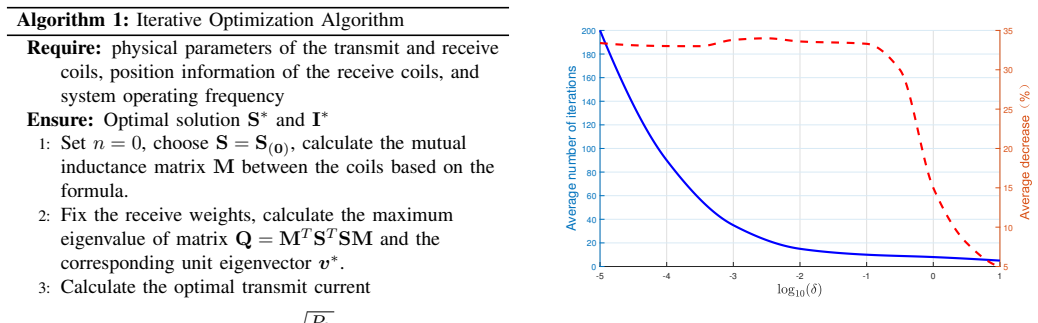
The argument is carried by the pathloss expression $L=-10\log_{10}\big(\frac{I^H M^H S^H S M I}{I^H R_t I}\cdot\frac{Z_L\omega^2}{(Z_r+Z_L)^2}\big)$, in which $M$ is the $3\times 3$ mutual-inductance matrix between the transmit and receive coils, $I$ is the transmit current vector, and $S=\mathrm{diag}(s_1,s_2,s_3)$ holds the receive weights. The joint optimization is decomposed into two subproblems: with $S$ fixed, maximizing the Rayleigh quotient $I^H Q I / I^H I$ pulls the optimal currents to the principal eigenvector of $Q$; with $I$ fixed, the paper invokes the Cauchy-Schwarz inequality to claim the optimal weights are $s_i\propto |m_i I|$. The alternating algorithm cycles these two closed-form updates until the pathloss change between iterations drops below a chosen threshold.
What would settle it
Compute the receive power at a geometry where the three coil couplings are unequal, for instance induced magnitudes $|m_1 I|=3$, $|m_2 I|=1$, $|m_3 I|=1$ under unit sum of squared weights. The paper's proportional allocation gives $s=(3,1,1)/\sqrt{11}$ and objective value $83/11\approx7.55$, whereas the one-hot allocation $s=(1,0,0)$ gives objective value $9$; since $9>83/11$, the claimed Cauchy-Schwarz optimality fails, and a corrected step would change the algorithm's output.
Extended reading notes
Core claim
The central claim is that the pathloss of a tri-directional coil-based magnetic induction link can be minimized by alternating between two simple closed-form updates. Given receive weights, the optimal transmit current is the principal eigenvector of the Hermitian matrix $Q=M^H S^H S M$, scaled to the transmit power budget. Given transmit currents, the paper claims the optimal receive weights are proportional to the induced voltage magnitudes $|m_i I|$ at the three coils. Iterating these two updates, the authors argue, approaches the jointly optimal point and delivers the reported 54% pathloss reduction over equal power allocation, with typical convergence in 13.6 iterations.
Load-bearing premise
The paper's reported gains all rest on the step that treats the best receive weights as proportional to each coil's induced signal magnitude; if a different weight split actually gives more receive power, the alternating algorithm and its pathloss numbers would no longer follow.
Editorial extensions
If this is right
- If the reported reductions hold, tri-directional MIC links could either tolerate larger coil separations or run at lower transmit power for the same link budget, which matters for battery-constrained underground and underwater sensors.
- The claimed sub-2 dB pathloss fluctuation across receiver orientation would relax antenna-alignment requirements for mobile or rotating magnetic induction devices.
- Average convergence in 13.6 iterations suggests the algorithm is light enough to re-optimize continuously as the receiver moves, provided coil geometry updates at a similar rate.
- The 45% reduction in fluctuation compared with single-parameter optimization implies that tuning both ends of the link is materially better than tuning transmit currents or receive weights alone.
- The same Rayleigh-quotient and weight-allocation structure extends directly to arrays with more than three coils by enlarging the mutual-inductance matrix.
Reading between the lines
- A mathematical check the paper does not include shows the receive-weight step is actually convex in the squared weights, so the true maximizer over the simplex is a one-hot vector selecting the strongest coil, not the proportional allocation reported; correcting this would change the algorithm and the reported numbers.
- With the proportional step replaced by a selection step, the alternating scheme becomes a kind of power iteration and its convergence behavior - and the 13.6-iteration count - would need to be re-measured.
- The angular-robustness claim is testable in a bench-top experiment: a tri-directional coil pair on a rotation stage, measuring pathloss versus rotation angle under the joint optimization, would directly confirm or refute the sub-2 dB fluctuation.
- The same joint optimization rationale should carry over to tri-directional magnetic wireless power transfer, where the receive 'weight' is a load or rectifier setting rather than a signal combiner; the paper's angle-robustness claim could then be checked against charging efficiency rather than pathloss.
Editorial analysis
A structured set of objections, weighed in public.
Referee Report
Summary. The manuscript studies tri-directional coil-based magnetic induction communication (TC-MIC), modeling the 3x3 mutual inductance matrix and receive power, and formulates a joint optimization of the transmit current vector I and a diagonal receive weight matrix S to minimize pathloss under constant transmit power and unit-norm receive weights. It proposes an alternating algorithm: for fixed S, optimize I via a Rayleigh quotient; for fixed I, optimize S via a Cauchy-Schwarz inequality; and it claims convergence in an average of 13.6 iterations, an average pathloss reduction of 34.7%, a peak reduction of 54%, and improved angular robustness. The transmit-side step is standard, but the receive-side step is not a maximizer of the stated objective, which invalidates the algorithm and all downstream performance claims.
Significance. If the proposed joint beamforming scheme were correct, it would provide a low-complexity way to improve TC-MIC link budgets and angular robustness, and the mutual inductance modeling and the Rayleigh quotient transmit solution in Eqs. (11)-(12) are useful building blocks. However, the receive-weight update is mathematically incorrect under the paper's own model in Eq. (7), and every numerical claim in Section V is produced by Algorithm 1, which contains that incorrect update. The central claim of approaching the joint optimum therefore fails as written, and the quantitative contributions are not reliable.
major comments (3)
- [Section IV, Eqs. (14)-(17)] The receive-weight subproblem is not solved. With S = diag(s), ||s||^2 = 1, and m_i the i-th row of M, the objective in (13) equals sum_i s_i^2 (m_i I)^2 = sum_i p_i a_i^2, where p_i = s_i^2 and a_i = |m_i I|. This is a linear function over the probability simplex in p, so its maximum is attained at a vertex p_k = 1 with k = argmax_i a_i^2, not at p_i proportional to a_i. The Cauchy-Schwarz bound in (15)-(16) is only an upper bound; equality in sum_i p_i a_i^2 <= (sum_i p_i)(sum_i a_i^2) requires the supports of p and a to overlap in at most one index, not proportionality. Moreover, the expression ||a s^T||_2^2 in (14) equals ||a||^2 ||s||^2, a constant under ||s||^2 = 1, so it is not the stated objective. Equation (17) also writes ||m_i|| rather than |m_i I|. Consequently Algorithm 1 step 4 does not maximize (13), and the reported 34.7% average reduction, 54% peak reduction, 13.6 iterations, and angular-fluctuation results are outputs of an invalid subproblem. If a coherent combination |s^H M I|^2 had been intended, a Cauchy-Schwarz step would be valid, but that is a different model from Eq. (7).
- [Section V-A] The convergence threshold delta = 2.5e-2 is selected from Fig. 2 without error bars or repeated-trial statistics, and the text itself says the average reduction fluctuates around 34% for a range of delta. The claims that the system 'converges within an average of 13.6 iterations' and achieves '34.7%' reduction are therefore single-point estimates with no variance characterization. This is a secondary concern relative to the invalid receive update, but it further weakens the quantitative claims.
- [Section III and Algorithm 1] The paper states that the alternating algorithm is used 'to approach the global optimum' (Section III) and repeats this claim in the abstract and conclusion, but no convergence proof or global optimality argument is provided. Even if each subproblem were solved exactly, alternating maximization of this nonconvex problem need not reach a global optimum; with the receive step as written, even monotone improvement is not established.
minor comments (4)
- [Section IV, Eq. (17) vs. Algorithm 1] Equation (17) uses ||m_i|| in the numerator while Algorithm 1 step 4 correctly uses |m_i I|; the two expressions are inconsistent and should be reconciled.
- [Section IV, Eq. (14)] The vector s is introduced in Eq. (14) alongside the diagonal matrix S = diag(s), but the objective is not written clearly in terms of s_i^2; this obscures the linearity of the problem in s_i^2.
- [Figure 4] The horizontal axis labels appear garbled ('0 /2 3 /2 2'); the intended multiples of pi are missing or rendered incorrectly.
- [Section I] There are grammatical slips such as 'concentrating maximizing the receive power' and 'thereby concentrating maximizing the receive power' that should be corrected.
Circularity Check
No significant circularity: the derivation is self-contained and does not reduce to its inputs or to self-citation.
full rationale
I examined the derivation chain from the system model (Eqs. 1-9) through the optimization problem (Eq. 10) and the alternating solution (Eqs. 11-17, Algorithm 1). The transmit-current update is a standard Rayleigh-quotient maximization; the receive-weight update is derived from the same objective, not from a separately fitted parameter. The reported pathloss reductions are computed by evaluating the paper's own model with and without the proposed algorithm; while this is a model-based simulation rather than external validation, it is not circular under the criteria here, because the baseline and the optimized system are both evaluated with the same stated equations and no parameter is fitted to the target result. The paper's self-citations ([15], [16]) describe related prior work by overlapping authors, but they are not used to justify the central optimization claims or to import a uniqueness theorem; the optimization is derived algebraically within the paper. The only notable issue is a mathematical error in the receive-weight subproblem: Eq. (14) defines J(S) = ||a s^T||_2^2, which is actually independent of s under ||s||=1, and Eq. (16) applies a Cauchy-Schwarz bound to a quantity that is already constant, so the claimed proportionality s_i proportional to |m_i I| does not follow. However, this is a correctness flaw, not a circularity flaw: the paper's conclusion does not reduce to its inputs by definition, nor does it rely on self-citation. Therefore the circularity score is 0.
Assumptions & free parameters
free parameters (1)
- Convergence threshold delta =
2.5e-2
assumptions (4)
- domain assumption Mutual inductance formulas (3)-(5) accurately describe the tri-directional coil channel.
- domain assumption Transmit coils are decoupled by resonant capacitors, so transmit power is simply I^H R_t I and currents are independent.
- ad hoc to paper The receive beamforming objective is a noncoherent sum of weighted receive coil powers (diagonal S), not a coherent combination.
- ad hoc to paper The alternating maximization converges to a globally optimal solution.
Cite this review
Pith. "Pith review of Joint Transmit and Receive Beamforming for Tri-directional Coil-Based Magnetic Induction Communications." pith.science (2026). https://pith.science/paper/FPSDKC2G
@misc{pith2026250524356,
  author       = {Pith},
  title        = {Pith review of: Joint Transmit and Receive Beamforming for Tri-directional Coil-Based Magnetic Induction Communications},
  year         = {2026},
  howpublished = {\url{https://pith.science/paper/FPSDKC2G}},
  note         = {Machine review of arXiv:2505.24356}
}
read the original abstract
In this paper, we enhance the omnidirectional coverage performance of tri-directional coil-based magnetic induction communication (TC-MIC) and reduce the pathloss with a joint transmit and receive magnetic beamforming method. An iterative optimization algorithm incorporating the transmit current vector and receive weight matrix is developed to minimize the pathloss under constant transmit power constraints. We formulate the mathematical models for the mutual inductance of tri-directional coils, receive power, and pathloss. The optimization problem is decomposed into Rayleigh quotient extremum optimization for transmit currents and Cauchy-Schwarz inequality-constrained optimization for receive weights, with an alternating iterative algorithm to approach the global optimum. Numerical results demonstrate that the proposed algorithm converges within an average of 13.6 iterations, achieving up to 54% pathloss reduction compared with equal power allocation schemes. The joint optimization approach exhibits superior angular robustness, maintaining pathloss fluctuation smaller than 2 dB, and reducing fluctuation of pathloss by approximately 45% compared with single-parameter optimization methods.
Figures


Figures from the paper (1 more)

Reference graph
Works this paper leans on
-
[1]
Survey on advances in magnetic induction-based wireless underground sensor networks,
S. Kisseleff, I. F. Akyildiz, and W. H. Gerstacker, “Survey on advances in magnetic induction-based wireless underground sensor networks,”IEEE Internet of Things Journal, vol. 5, no. 6, pp. 4843–4856, 2018
work page 2018
-
[2]
Wireless sensor networks: a survey,
I. F. Akyildiz, W. Su, Y . Sankarasubramaniam, and E. Cayirci, “Wireless sensor networks: a survey,”Computer networks, vol. 38, no. 4, pp. 393– 422, 2002
work page 2002
-
[3]
G. Liu, “Frequency-switchable routing protocol for dynamic magnetic induction-based wireless underground sensor networks,”IEEE Journal of Selected Areas in Sensors, vol. 1, pp. 1–8, 2024
work page 2024
-
[4]
Channel modeling of mi underwater communication using tri-directional coil antenna,
H. Guo, Z. Sun, and P. Wang, “Channel modeling of mi underwater communication using tri-directional coil antenna,” in2015 IEEE Global Communications Conference (GLOBECOM). IEEE, 2015, pp. 1–6
work page 2015
-
[5]
——, “Multiple frequency band channel modeling and analysis for mag- netic induction communication in practical underwater environments,” IEEE Transactions on V ehicular Technology, vol. 66, no. 8, pp. 6619– 6632, 2017
work page 2017
-
[6]
Investigation of surface wave propagation along a multi-coil wireless power transfer system,
B. Xu and Y . Li, “Investigation of surface wave propagation along a multi-coil wireless power transfer system,”Microwave and Optical Technology Letters, vol. 58, no. 9, pp. 2261–2265, 2016
work page 2016
-
[7]
S. B. Lee, C. Lee, and I. G. Jang, “Precise determination of the optimal coil for wireless power transfer systems through postprocessing in the smooth boundary representation,”IEEE Transactions on Magnetics, vol. 53, no. 6, pp. 1–4, 2017
work page 2017
-
[8]
Artificial noise assisted secure interference networks with wireless power transfer,
N. Zhao, Y . Cao, F. R. Yu, Y . Chen, M. Jin, and V . C. Leung, “Artificial noise assisted secure interference networks with wireless power transfer,”IEEE Transactions on V ehicular Technology, vol. 67, no. 2, pp. 1087–1098, 2017
work page 2017
Show all 16 references
-
[9]
Investigation of near-field wireless power transfer under multiple transmitters,
I.-J. Yoon and H. Ling, “Investigation of near-field wireless power transfer under multiple transmitters,”IEEE Antennas and Wireless Propagation Letters, vol. 10, pp. 662–665, 2011
2011
-
[10]
Effect of coupling between multiple transmitters or multiple receivers on wireless power transfer,
D. Ahn and S. Hong, “Effect of coupling between multiple transmitters or multiple receivers on wireless power transfer,”IEEE Transactions on Industrial Electronics, vol. 60, no. 7, pp. 2602–2613, 2012
2012
-
[11]
Magnetic mimo: How to charge your phone in your pocket,
J. Jadidian and D. Katabi, “Magnetic mimo: How to charge your phone in your pocket,” inProceedings of the 20th annual international conference on Mobile computing and networking, 2014, pp. 495–506
2014
-
[12]
Multiuser charging control in wireless power transfer via magnetic resonant coupling,
M. R. V . Moghadam and R. Zhang, “Multiuser charging control in wireless power transfer via magnetic resonant coupling,” in2015 IEEE International Conference on Acoustics, Speech and Signal Processing (ICASSP). IEEE, 2015, pp. 3182–3186
2015
-
[13]
Convex optimization-based beamforming,
A. B. Gershman, N. D. Sidiropoulos, S. Shahbazpanahi, M. Bengtsson, and B. Ottersten, “Convex optimization-based beamforming,”IEEE Signal Processing Magazine, vol. 27, no. 3, pp. 62–75, 2010
2010
-
[14]
Magnetic beamforming for wireless power transfer,
G. Yang, M. R. V . Moghadam, and R. Zhang, “Magnetic beamforming for wireless power transfer,” in2016 IEEE International Conference on Acoustics, Speech and Signal Processing (ICASSP). IEEE, 2016, pp. 3936–3940
2016
-
[15]
Multi- frequency access for magnetic induction-based swipt,
J. Wang, W. Cheng, W. Zhang, W. Zhang, and H. Zhang, “Multi- frequency access for magnetic induction-based swipt,”IEEE Journal on Selected Areas in Communications, vol. 40, no. 5, pp. 1679–1691, 2022
2022
-
[16]
Backscatter based bidirectional full-duplex magnetic induction communications,
J. Wang, W. Cheng, W. Zhang, and H. Zhang, “Backscatter based bidirectional full-duplex magnetic induction communications,”IEEE Transactions on Communications, vol. 71, no. 11, pp. 6258–6271, 2023
2023
Reviewed August 7, 2026 · model on record in the stance chip above.
Discussion (0). Sign in to comment.