On a re-examination of neutron star cooling in transient sources -- No shallow heating required?
Pith reviewed 2026-06-28 12:46 UTC · model grok-4.3
The pith
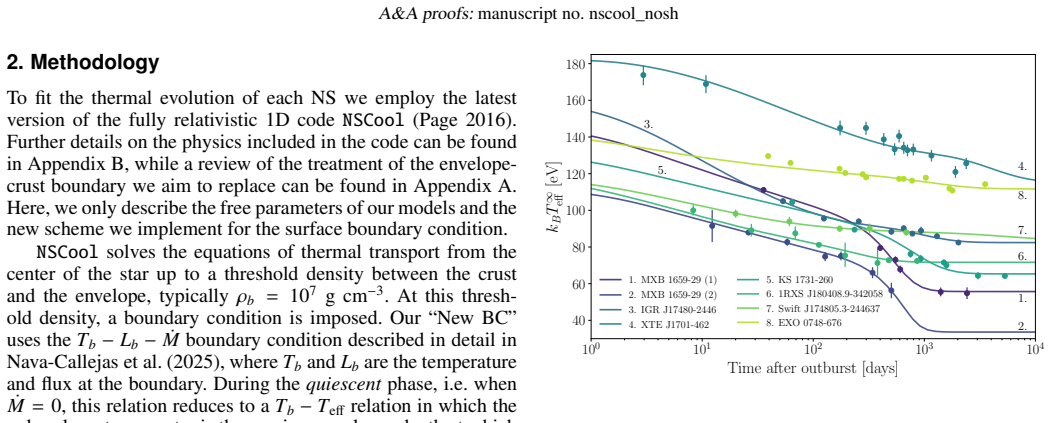
Neutron star cooling after seven of eight outbursts matches predictions from envelope heat leakage alone, without shallow heating.
A machine-rendered reading of the paper's core claim, the machinery that carries it, and where it could break.
Core claim
By equipping the nscool code with a new boundary condition at the envelope/crust transition that incorporates thermonuclear heating leakage from the envelope into the crust depending on mass accretion rate, the cooling curves of neutron stars in seven out of eight outburst episodes from seven sources can be explained without invoking ad hoc shallow heating. The model evolves the fully relativistic crust and core. For the remaining source, qualitative features of the cooling curve are captured but a good quantitative fit still requires additional physics.
What carries the argument
A new boundary condition at the envelope/crust transition that incorporates thermonuclear heating leakage from the envelope into the crust as a function of the mass accretion rate.
If this is right
- Observed post-outburst effective temperatures are reproduced using only thermonuclear burning and standard heat transport.
- Shallow heating is not required to explain cooling in seven of the eight cases examined.
- The amount of heat entering the crust is set by the accretion-rate-dependent leakage rather than an independent proportionality constant.
- For the source EXO, the boundary condition alone is insufficient for a quantitative fit and additional physics must be included.
Where Pith is reading between the lines
- The same boundary condition could be applied to other accretion-powered neutron-star systems to test whether their long-term temperatures also follow from envelope leakage.
- If the accretion-rate dependence holds, it would link variations in outburst history directly to differences in subsequent cooling without separate heating mechanisms.
- High-precision temperature measurements at late times in sources with extreme accretion rates could directly test the functional form of the leakage.
Load-bearing premise
The new boundary condition at the envelope/crust transition correctly captures the leakage of thermonuclear heating from the envelope into the crust as a function of mass accretion rate.
What would settle it
Cooling data from one of the modeled sources, or from a new outburst with a markedly different accretion rate, that deviates from the predicted temperature evolution while the accretion history is known.
Figures
read the original abstract
Context: For the typical modeling of neutron stars cooling after an accretion episode in Low-Mass X-ray Binaries, an extra heating source of unknown physical origin, \textit{the shallow heating}, is invoked in order to account for the inferred high effective temperatures of the star up to hundreds of days after the end of accretion. The amount of the shallow heating generated in the crust is usually taken to be proportional to the accretion rate, although the proportionality constant may change from source to source. Aims: In this paper, we intend to model the effective temperature data of eight outburst episodes from seven different sources (\mxb, \xte, \exo, \igr, \swift, \rxs\ and \ks) without {\it ad hoc} shallow heating but accounting for the presence of thermonuclear heating due to the burning of the accreted H/He. Methods: We employ the fully relativistic code \texttt{nscool}, which simulates both the crust and core of a neutron star, equipped with a new boundary condition at the envelope/crust transition which considers thermonuclear heating leakage from the envelope into the crust and depends on the mass accretion rate. Results: We find that the neutron star cooling for seven out of eight of these outbursts can be well explained with this new boundary condition and without the requirement of {\it ad hoc} shallow heating. While the qualitative features of \exo\ cooling curve can be explained, a good fitting still requires additional physics.
Editorial analysis
A structured set of objections, weighed in public.
Referee Report
Summary. The manuscript re-examines post-outburst cooling of neutron stars in seven LMXBs using the nscool code. It introduces a new boundary condition at the envelope/crust transition that incorporates thermonuclear heating leakage as a function of mass accretion rate, claiming this eliminates the need for ad hoc shallow heating in seven of eight outbursts. For the eighth source (EXO), only qualitative features are reproduced and additional physics is required for a good fit.
Significance. If the boundary condition is shown to be derived from first-principles envelope calculations without source-specific tuning or adjustable constants, the result would be significant: it replaces an empirical shallow-heating term with a physically motivated, accretion-rate-dependent boundary condition, reducing the number of free parameters in cooling models. The use of the established, fully relativistic nscool code is a strength for reproducibility. The work directly addresses a long-standing modeling issue in transient neutron-star cooling.
major comments (2)
- [Methods] Methods: The new boundary condition is stated to depend on accretion rate and to capture thermonuclear heating leakage, but no explicit functional form, derivation from envelope structure equations, or demonstration that it contains no adjustable constants fitted to the cooling data is provided. This is load-bearing for the central claim that shallow heating is unnecessary, as the result would otherwise relocate rather than eliminate ad hoc elements.
- [Results] Results: The assertion that seven of eight outbursts 'can be well explained' lacks any quantitative fit statistics (e.g., χ^{2} values, residuals, or uncertainties on model parameters) or details on data selection and error treatment. Without these, the goodness-of-fit cannot be assessed, particularly since the eighth case (EXO) still requires extra physics.
minor comments (1)
- Abstract and throughout: Source names appear as LaTeX placeholders (\mxb, \xte, etc.); replace with actual designations (e.g., MXB 1659-29) for clarity.
Simulated Author's Rebuttal
We thank the referee for their careful reading of the manuscript and for the constructive comments. We address each major comment below and will revise the manuscript to incorporate additional details and quantitative information as requested.
read point-by-point responses
-
Referee: [Methods] Methods: The new boundary condition is stated to depend on accretion rate and to capture thermonuclear heating leakage, but no explicit functional form, derivation from envelope structure equations, or demonstration that it contains no adjustable constants fitted to the cooling data is provided. This is load-bearing for the central claim that shallow heating is unnecessary, as the result would otherwise relocate rather than eliminate ad hoc elements.
Authors: We agree that the explicit functional form, derivation, and confirmation of no fitted constants are necessary to support the claim. The boundary condition is constructed from envelope calculations that incorporate thermonuclear heating leakage depending on accretion rate. In the revised version we will add a dedicated methods subsection (or appendix) providing the explicit functional form, its derivation from the envelope structure equations, and a demonstration that it introduces no adjustable constants tuned to the cooling curves themselves. This will clarify that the approach is physically motivated rather than relocating ad hoc elements. revision: yes
-
Referee: [Results] Results: The assertion that seven of eight outbursts 'can be well explained' lacks any quantitative fit statistics (e.g., χ^{2} values, residuals, or uncertainties on model parameters) or details on data selection and error treatment. Without these, the goodness-of-fit cannot be assessed, particularly since the eighth case (EXO) still requires extra physics.
Authors: We acknowledge that quantitative fit statistics and data-treatment details were omitted from the submitted manuscript. The revised version will include χ² values (or equivalent goodness-of-fit metrics), residual plots, parameter uncertainties, and explicit descriptions of data selection and error treatment for the seven outbursts that are reproduced. For the EXO case we will expand the discussion of the additional physics required and why a quantitative fit is not achieved with the present boundary condition. revision: yes
Circularity Check
New boundary condition replaces shallow heating with accretion-rate dependence; no reduction to fitted quantity by construction
full rationale
The paper introduces a new boundary condition at the envelope/crust transition that depends on mass accretion rate to encode thermonuclear heating leakage, then uses it in nscool to model cooling curves for eight outbursts. Seven are explained without additional shallow heating. No quoted equations or text show the BC functional form or constants being fitted to the target cooling data itself, nor any self-citation chain that bears the central claim, nor renaming of a known result. The derivation remains self-contained against the external cooling observations once the BC is accepted as an input motivated by envelope physics. This matches the normal non-circular case (score 0-2).
Axiom & Free-Parameter Ledger
axioms (2)
- domain assumption The nscool code provides an accurate fully relativistic simulation of neutron star crust and core cooling with standard microphysical inputs.
- domain assumption Thermonuclear heating from accreted H/He burning leaks into the crust according to a boundary condition that depends on the mass accretion rate.
Reference graph
Works this paper leans on
-
[1]
P., Abbott, R., Abbott, T
Abbott, B. P., Abbott, R., Abbott, T. D., et al. 2017, Phys. Rev. Lett., 119, 161101
2017
-
[2]
R., & Ravenhall , D
Akmal , A., Pandharipande , V. R., & Ravenhall , D. G. 1998, , 58, 1804
1998
-
[3]
O., Sivakoff, G
Bahramian, A., Heinke, C. O., Sivakoff, G. R., et al. 2013, The Astrophysical Journal, 780, 127
2013
-
[4]
Brown , E. F. & Cumming , A. 2009, , 698, 1020
2009
-
[5]
F., Cumming , A., Fattoyev , F
Brown , E. F., Cumming , A., Fattoyev , F. J., et al. 2018, , 120, 182701
2018
-
[6]
K., Heger , A., et al
Cavecchi , Y., Galloway , D. K., Heger , A., et al. 2026, , 998, 25
2026
-
[7]
1993, Nuclear Physics A, 555, 59
Chen, J., Clark, J., Dav \'e , R., & Khodel, V. 1993, Nuclear Physics A, 555, 59
1993
-
[8]
2016, Monthly Notices of the Royal Astronomical Society, 461, 4049
Degenaar, N., Altamirano, D., Parker, M., et al. 2016, Monthly Notices of the Royal Astronomical Society, 461, 4049
2016
-
[9]
2021, , 508, 882
Degenaar , N., Page , D., van den Eijnden , J., et al. 2021, , 508, 882
2021
-
[10]
& Wijnands, R
Degenaar, N. & Wijnands, R. 2011, Monthly Notices of the Royal Astronomical Society: Letters, 414, L50
2011
-
[11]
2015, , 451, 2071
Degenaar , N., Wijnands , R., Bahramian , A., et al. 2015, , 451, 2071
2015
-
[12]
F., et al
Degenaar, N., Wijnands, R., Brown, E. F., et al. 2013, The Astrophysical Journal, 775, 48
2013
-
[13]
Feigelson , E. D. & Babu , G. J. 2012, Modern Statistical Methods for Astronomy
2012
-
[14]
K., Homan , J., Wijnands , R., et al
Fridriksson , J. K., Homan , J., Wijnands , R., et al. 2011, , 736, 162
2011
-
[15]
Y., Hanawa , T., Iben , I., J., & Richardson , M
Fujimoto , M. Y., Hanawa , T., Iben , I., J., & Richardson , M. B. 1984, , 278, 813
1984
-
[16]
Y., Hanawa , T., Iben , Icko, J., & Richardson , M
Fujimoto , M. Y., Hanawa , T., Iben , Icko, J., & Richardson , M. B. 1987, , 315, 198
1987
-
[17]
K., Muno , M
Galloway , D. K., Muno , M. P., Hartman , J. M., Psaltis , D., & Chakrabarty , D. 2008, , 179, 360
2008
-
[18]
H., Pethick , C
Gudmundsson , E. H., Pethick , C. J., & Epstein , R. I. 1982, , 259, L19
1982
-
[19]
F., Schatz , H., M \"o ller , P., & Kratz , K.-L
Gupta , S., Brown , E. F., Schatz , H., M \"o ller , P., & Kratz , K.-L. 2007, , 662, 1188
2007
-
[20]
Gusakov , M. E. & Chugunov , A. I. 2020, , 124, 191101
2020
-
[21]
& Zdunik , J
Haensel , P. & Zdunik , J. L. 2008, , 480, 459
2008
-
[22]
& Fujimoto , M
Hanawa , T. & Fujimoto , M. Y. 1984, , 36, 199
1984
-
[23]
F., Schatz, H., et al
Jain, R., Brown, E. F., Schatz, H., et al. 2025, Phys. Rev. Lett., 135, 162701
2025
-
[24]
H., Ingram , A., Middleton , M., & Drake , J
Knight , A. H., Ingram , A., Middleton , M., & Drake , J. 2022, , 510, 4736
2022
-
[25]
R., et al
Lin , D., Strader , J., Carrasco , E. R., et al. 2018, Nature Astronomy, 2, 656
2018
-
[26]
2012, The Astrophysical Journal, 748, 82
Linares, M., Altamirano, D., Chakrabarty, D., Cumming, A., & Keek, L. 2012, The Astrophysical Journal, 748, 82
2012
-
[27]
L., Cackett , E
Merritt , R. L., Cackett , E. M., Brown , E. F., et al. 2016, , 833, 186
2016
-
[28]
1990, , 362, 572
Miralda-Escude , J., Haensel , P., & Paczynski , B. 1990, , 362, 572
1990
-
[29]
2024, RAS Techniques and Instruments, 3, 800
Nava-Callejas , M., Cavecchi , Y., & Page , D. 2024, RAS Techniques and Instruments, 3, 800
2024
-
[30]
2025, The Astrophysical Journal, 991, 62
Nava-Callejas, M., Page, D., & Cavecchi, Y. 2025, The Astrophysical Journal, 991, 62
2025
-
[31]
S., Page , D., Wijnands , R., & Degenaar , N
Ootes , L. S., Page , D., Wijnands , R., & Degenaar , N. 2016, , 461, 4400
2016
-
[32]
S., Vats , S., Page , D., et al
Ootes , L. S., Vats , S., Page , D., et al. 2019 a , , 487, 1447
2019
-
[33]
S., Wijnands , R., & Page , D
Ootes , L. S., Wijnands , R., & Page , D. 2019 b , , 630, A95
2019
-
[34]
2006, , 441, 1115
\"O zel , F. 2006, , 441, 1115
2006
-
[35]
O zel , F., Gould , A., & G \
\"O zel , F., Gould , A., & G \"u ver , T. 2012, , 748, 5
2012
-
[36]
2016, NSCool: Neutron star cooling code , Astrophysics Source Code Library, record ascl:1609.009
Page , D. 2016, NSCool: Neutron star cooling code , Astrophysics Source Code Library, record ascl:1609.009
2016
-
[37]
2022, The Astrophysical Journal, 933, 216
Page, D., Homan, J., Nava-Callejas, M., et al. 2022, The Astrophysical Journal, 933, 216
2022
-
[38]
& Reddy , S
Page , D. & Reddy , S. 2013, , 111, 241102
2013
-
[39]
S., Wijnands , R., Degenaar , N., Ootes , L., & Page , D
Parikh , A. S., Wijnands , R., Degenaar , N., Ootes , L., & Page , D. 2018, , 476, 2230
2018
-
[40]
S., Wijnands, R., Degenaar, N., et al
Parikh, A. S., Wijnands, R., Degenaar, N., et al. 2017, Monthly Notices of the Royal Astronomical Society, 466, 4074
2017
-
[41]
S., Wijnands , R., Homan , J., et al
Parikh , A. S., Wijnands , R., Homan , J., et al. 2020, , 638, L2
2020
-
[42]
S., Wijnands , R., Ootes , L
Parikh , A. S., Wijnands , R., Ootes , L. S., et al. 2019, , 624, A84
2019
-
[43]
Potekhin , A. Y. & Chabrier , G. 2021, , 645, A102
2021
-
[44]
Y., Chabrier, G., & Yakovlev, D
Potekhin, A. Y., Chabrier, G., & Yakovlev, D. G. 1997, Astron. Astrophys., 323, 415
1997
-
[45]
Y., Chugunov , A
Potekhin , A. Y., Chugunov , A. I., Shchechilin , N. N., & Gusakov , M. E. 2025, Journal of High Energy Astrophysics, 45, 116
2025
-
[46]
& Reddy , S
Roggero , A. & Reddy , S. 2016, , 94, 015803
2016
-
[47]
Schwenk, A., Friman, B., & Brown, G. E. 2003, Nuclear Physics A, 713, 191
2003
-
[48]
N., & Pons , J
Turlione , A., Aguilera , D. N., & Pons , J. A. 2015, , 577, A5
2015
-
[49]
2017, Journal of Astrophysics and Astronomy, 38, 49
Wijnands , R., Degenaar , N., & Page , D. 2017, Journal of Astrophysics and Astronomy, 38, 49
2017
-
[50]
P., Miller , J
Wijnands , R., Muno , M. P., Miller , J. M., et al. 2002, , 566, 1060
2002
-
[51]
L., Haensel , P., Paczynski , B., & Miralda-Escude , J
Zdunik , J. L., Haensel , P., Paczynski , B., & Miralda-Escude , J. 1992, , 384, 129
1992
-
[52]
A Solution to the Tension of Burning on Neutron Stars and Nuclear Physics. , keywords =. doi:10.3847/1538-4357/ae2ff3 , archivePrefix =. 2506.11966 , primaryClass =
-
[53]
Cooling of Accretion-Heated Neutron Stars
Cooling of Accretion-Heated Neutron Stars. Journal of Astrophysics and Astronomy , keywords =. doi:10.1007/s12036-017-9466-5 , archivePrefix =. 1709.07034 , primaryClass =
work page internal anchor Pith review Pith/arXiv arXiv doi:10.1007/s12036-017-9466-5
-
[54]
Allard, V. and Chamel, N. , date-added =. Gapless Neutron Superfluidity Can Explain the Late Time Cooling of Transiently Accreting Neutron Stars , url =. Phys. Rev. Lett. , month =. 2024 , bdsk-url-1 =. doi:10.1103/PhysRevLett.132.181001 , issue =
-
[55]
and Fattoyev, Farrukh J
Cumming, Andrew and Brown, Edward F. and Fattoyev, Farrukh J. and Horowitz, C. J. and Page, Dany and Reddy, Sanjay , doi =. Lower limit on the heat capacity of the neutron star core , url =. Phys. Rev. C , month =. 2017 , bdsk-url-1 =
2017
-
[56]
doi:10.1088/0004-637X/698/2/1020 , eprint =
, keywords =. doi:10.1088/0004-637X/698/2/1020 , eprint =
-
[57]
A change in the quiescent X-ray spectrum of the neutron star low-mass X-ray binary MXB 1659-29
doi:10.1088/0004-637X/774/2/131 , eid =. arXiv , author =:1306.1776 , journal =
work page internal anchor Pith review Pith/arXiv arXiv doi:10.1088/0004-637x/774/2/131
-
[58]
Quiescent thermal emission from neutron stars in LMXBs
doi:10.1051/0004-6361/201322690 , eid =. arXiv , author =:1309.3909 , journal =
work page internal anchor Pith review Pith/arXiv arXiv doi:10.1051/0004-6361/201322690
-
[59]
doi:10.1016/j.jheap.2024.11.017 , eprint =
Journal of High Energy Astrophysics , keywords =. doi:10.1016/j.jheap.2024.11.017 , eprint =
-
[60]
doi:10.1086/161851 , journal =
-
[61]
doi:10.1086/165124 , journal =
-
[62]
doi:10.1086/169295 , journal =
-
[63]
doi:10.1086/170858 , journal =
-
[64]
arXiv , author =:2001.08367 , journal =
doi:10.1093/ptep/ptaa010 , eid =. arXiv , author =:2001.08367 , journal =
-
[65]
arXiv , author =:2105.13958 , journal =
doi:10.3847/1538-4357/ac2821 , eid =. arXiv , author =:2105.13958 , journal =
-
[66]
arXiv , author =:2208.14622 , journal =
doi:10.3847/1538-4357/ac8dfe , eid =. arXiv , author =:2208.14622 , journal =
-
[67]
doi:10.1086/183840 , journal =
-
[68]
arXiv , author =:astro-ph/9706148 , journal =
-
[69]
, keywords =. doi:10.1086/517869 , eprint =
-
[70]
doi:10.1051/0004-6361:20078578 , eprint =
, keywords =. doi:10.1051/0004-6361:20078578 , eprint =
-
[71]
arXiv , author =:2004.04195 , journal =
doi:10.1103/PhysRevLett.124.191101 , eid =. arXiv , author =:2004.04195 , journal =
-
[72]
Long-term temperature evolution of neutron stars undergoing episodic accretion outbursts. , keywords =. doi:10.1051/0004-6361/201936035 , archivePrefix =. 1906.02554 , primaryClass =
-
[73]
Statistical Methods for Astronomy
Modern Statistical Methods for Astronomy. doi:10.48550/arXiv.1205.2064 , adsurl =
work page internal anchor Pith review Pith/arXiv arXiv doi:10.48550/arxiv.1205.2064 2064
-
[74]
ascl , author =:1609.009 , howpublished =
-
[75]
A luminous X-ray outburst from an intermediate-mass black hole in an off-centre star cluster
A luminous X-ray outburst from an intermediate-mass black hole in an off-centre star cluster. Nature Astronomy , keywords =. doi:10.1038/s41550-018-0493-1 , archivePrefix =. 1806.05692 , primaryClass =
work page internal anchor Pith review Pith/arXiv arXiv doi:10.1038/s41550-018-0493-1
-
[76]
Continued cooling of the accretion-heated neutron star crust in the X-ray transient IGR J17480-2446 located in the globular cluster Terzan 5. , keywords =. doi:10.1093/mnras/stz1406 , archivePrefix =. 1805.00610 , primaryClass =
work page internal anchor Pith review Pith/arXiv arXiv doi:10.1093/mnras/stz1406
-
[77]
Constraining the properties of dense neutron star cores: the case of the low-mass X-ray binary HETE J1900.1-2455. , keywords =. doi:10.1093/mnras/stab2202 , archivePrefix =. 2112.09711 , primaryClass =
-
[78]
Beznogov and Nathalie Degenaar and Rudy Wijnands and Aastha S
Dany Page and Jeroen Homan and Martin Nava-Callejas and Yuri Cavecchi and Mikhail V. Beznogov and Nathalie Degenaar and Rudy Wijnands and Aastha S. Parikh , doi =. A ``Hyperburst'' in the MAXI J0556--332 Neutron Star: Evidence for a New Type of Thermonuclear Explosion , url =. The Astrophysical Journal , month =. 2022 , bdsk-url-1 =
2022
-
[79]
doi:10.1093/rasti/rzae055 , eprint =
RAS Techniques and Instruments , keywords =. doi:10.1093/rasti/rzae055 , eprint =
-
[80]
Thermonuclear Heating of Accreting Neutron Stars , url =
Nava-Callejas, Mart. Thermonuclear Heating of Accreting Neutron Stars , url =. 2025 , bdsk-url-1 =. doi:10.3847/1538-4357/adf8e4 , journal =
discussion (0)
Sign in with ORCID, Apple, or X to comment. Anyone can read and Pith papers without signing in.