REVIEW 2 major objections 3 minor 221 references
Gaussian FSBP operators: Comparison and application to numerical methods for hyperbolic conservation laws
T0 review · 2 major / 3 minor · reviewed 2026-08-02 · deepseek-v4-flash
Pith's one-line read This paper shows that open generalized Gaussian quadrature constructs summation-by-parts operators for non-polynomial function spaces with exactly one fewer grid point than closed rules, and that with function-space-exact extrapolation they
desk verdict Open GGQs give a clean one-node saving over closed GGQs and hold up in nontrivial hyperbolic tests; the Bessel rank discrepancy is a verifiability problem, not a demonstrated error. read the letter →
The pith
A machine-rendered reading of the paper's core claim, the machinery that carries it, and where it could break.
The reading
What carries the argument
The central object is the (F^2)′-exact generalized Gaussian quadrature in its open form: m interior nodes and positive weights that integrate the 2m-dimensional space (F^2)′ exactly, hence with dim((F^2)′)=M requiring N=⌈M/2⌉ nodes, versus m+1 for the closed form. The companion mechanism is the F-exact extrapolation operator E, whose rows are the least-squares evaluation vectors t_L, t_R mapping interior function values to the endpoints; the boundary matrix is B = t_R t_R^T − t_L t_L^T, so that f^T B g = fg| boundaries, preserving the discrete integration-by-parts property on point sets that exclude the endpoints.
What would settle it
On the Bessel space spanned by J_0,…,J_9 on [0,25], independently recompute dim((F^2)′) and test the published 14-node rule for exactness on an L2-orthogonal basis of that space; if the true dimension is 48 (as a related study reported) rather than 27, or if any of the 27 exactness conditions fail by more than quadrature roundoff, the claimed 14-node exact open rule—and with it the one-fewer-node advantage in that example—collapses.
Extended reading notes
Core claim
The central claim is a counting statement plus an operationalization. For a finite-dimensional function space F ⊂ C^1, an FSBP operator exists exactly when a positive quadrature exact for (F^2)′ = {(fg)′ | f,g∈F} exists. Generalized Gaussian quadrature theory provides such quadratures with minimal node counts: an open GGQ has N = ⌈dim((F^2)′)/2⌉ nodes, and a closed GGQ has exactly one more. The paper constructs these open FSBP operators by first computing the open GGQ on (F^2)′, setting the norm matrix P to the quadrature weights, and recovering the antisymmetric part of Q from Q_A V = P V′ – BV/2; the boundary matrix B is built from least-squares F-exact extrapolation of the solution to the
Load-bearing premise
The load-bearing premise is that for each function space F, the derivative-product space (F^2)′ is (or can be enriched to) a Chebyshev set, so that a positive open generalized Gaussian quadrature with exactly ⌈dim((F^2)′)/2⌉ nodes exists and can actually be computed; the paper itself observes this can fail, as the standard algorithm did not converge for the Bessel space.
Editorial extensions
If this is right
- For any Chebyshev-admissible function space, open GGQs cut the node count for structure-preserving differentiation from N to N−1 relative to closed GGQs, narrowing the gap to the interpolatory ideal N = dim(F).
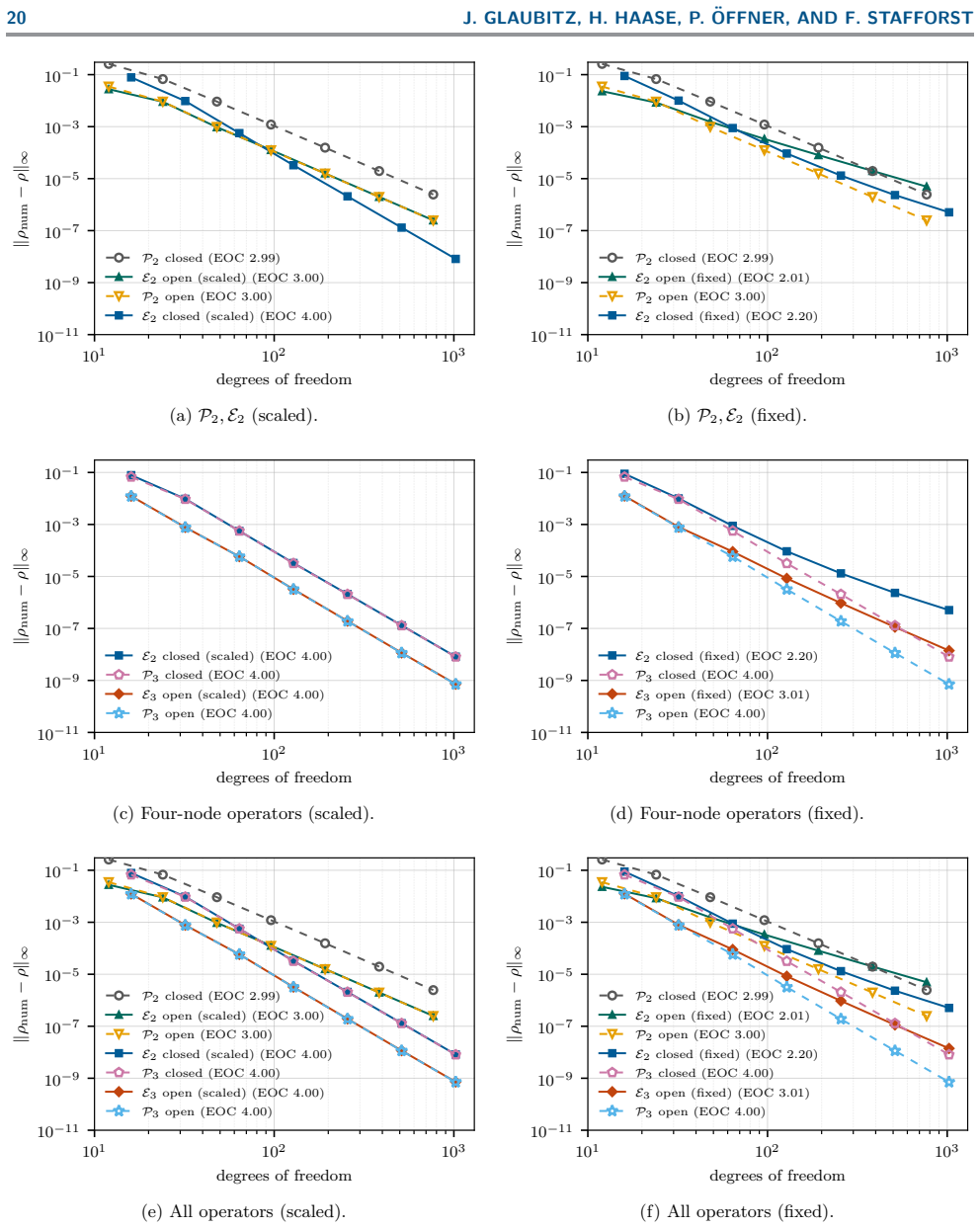
- Open Gaussian FSBP operators make non-polynomial spaces practical in time-dependent conservation-law solvers: in the Euler test, scaled exponential operators reached the same experimental order of convergence as polynomial operators with the same node count.
- The exactness gain is real: a four-node open operator can be exact on a larger space than a four-node closed operator, which translates into smaller errors at equal degrees of freedom (observed in the exponential boundary-layer advection test).
- Closed GGQs remain optimal among operators that include both boundary nodes, so the choice between open and closed is a trade-off between node efficiency and having boundary data directly available.
- The extrapolation step is the price of openness; without a stable F-exact extrapolation operator, the open construction does not yield a usable boundary or inter-element coupling.
Reading between the lines
- Editorial inference: the counting identity N = ⌈dim((F^2)′)/2⌉ suggests an information-theoretic floor for any F-exact FSBP operator: no discretization of a space whose derivative products span M dimensions can use fewer than ⌈M/2⌉ degrees of freedom and remain exact, so open GGQ constructions are optimal whenever they exist.
- Editorial inference: the same open-GGQ construction can be transplanted to other nodal methods—discontinuous Galerkin and flux-reconstruction schemes built on non-polynomial bases would inherit the node savings, though they would also inherit the need for extrapolated interface values.
- Editorial inference: the Bessel-space episode indicates that the practical bottleneck is not the counting but the computation: when the standard GGQ algorithm fails to converge, dimension determination by numerical rank becomes the deciding step; an independent check of exactness of the published 14-node rule on all 27 basis functions would settle whether the reported savings are realized.
- Editorial inference: a testable extension is to run adaptive local scaling for exponential spaces so that the basis is matched to element width (as the 'scaled' operators do) and check whether the node-order convergence persists for systems with shocks and non-smooth data.
Editorial analysis
A structured set of objections, weighed in public.
Referee Report
Summary. The paper develops generalized function-space summation-by-parts (FSBP) operators on grids that need not include the interval endpoints, constructs F-exact extrapolation/boundary operators for such grids, and builds FSBP operators from open and closed generalized Gaussian quadratures (GGQs). The central claim is that an open GGQ exact for a 2m-dimensional system uses m interior nodes, while a closed GGQ needs m+1 nodes, so open Gaussian FSBP operators are one node more efficient than closed ones whenever an open formulation is admissible. The authors compare the resulting operators with least-squares FSBP operators and the closed GGQ operators of [33], and apply them to linear advection, Burgers, and compressible Euler problems, reporting improved accuracy at equal degrees of freedom and experimental orders of convergence equal to the node count for scaled exponential spaces.
Significance. If the construction and the reported quadratures are sound, the paper makes a useful contribution: it provides a clean extension of the FSBP framework to open grids, introduces F-exact extrapolation operators in this setting, and demonstrates that open GGQ-based operators can match or beat closed ones on non-polynomial spaces in genuinely time-dependent nonlinear problems. The scaled-versus-fixed exponential study in Sec. 5.3 is a particularly honest and informative comparison. However, the theoretical counting claim is stated more generally than the construction supports, and the high-dimensional Bessel example, which is load-bearing for the efficiency claim, is not independently verifiable from the manuscript because no code or exactness residuals are supplied.
major comments (2)
- [Sec. 6 and Lemma 2.4] The summary statement that 'an open GGQ thus requires N=ceil(M/2) points and a closed GGQ exactly one point more' is only valid when the resulting node count satisfies N >= dim(F), as required for the Vandermonde matrix in Lemma 2.4 to have linearly independent columns (and for the orthonormalization step in Algorithm 2.1 to be possible). For polynomial spaces, F=P_d, one has M=dim((F^2)')=2d, so the minimal open GGQ has d nodes, strictly fewer than dim(P_d)=d+1; no F-exact FSBP operator exists at that node count (e.g., the 2-point Gauss rule on P_2 cannot satisfy the x^2 derivative condition). All examples in Secs. 4-5 satisfy M>=2K (after enrichment in the E_2 case), so the issue does not invalidate those operators, but the general claim in Sec. 6 is false as written. Please restrict the counting statement to M>=2K (or N>=dim(F)) and discuss the polynomial case explicitly.
- [Sec. 4.3, Remark 4.1, Tables 2-3] The Bessel example is load-bearing for the claimed one-node saving in a high-dimensional setting, but the reported dimension dim G=27 versus [33]'s 48 rests on a numerical SVD rank decision with a 10^-14 sigma_max threshold and on an approximate Gauss-Legendre Gram matrix. No code or scripts are provided, so the assertion that [33]'s value is 'incorrect' cannot be checked. If dim G were 48, a 14-node open rule with 28 parameters could not be exact for a 48-dimensional space, and Table 2 would not define an F-exact FSBP operator; the comparison in Table 3 would then be invalid. Please provide a reproducible script and report exactness residuals, e.g., max_{mu,nu} |∫ (J_mu J_nu)' dx - sum_i w_i (J_mu J_nu)'(x_i)| for all 55 pairs, computed in high precision and with a well-conditioned rank determination. It would also help to state whether the measure-continuation method [67] is known to g
minor comments (3)
- [Eq. (3.2)] In Definition 3.1, the closed GGQ formula sums from i=1 to m, but the rule has m+1 nodes and weights; the upper limit should be m+1. As written, the formula is internally inconsistent.
- [Sec. 4.3, Sec. 5.3, Sec. 6] There are several cross-reference errors: the text refers to 'Theorem 4.1 below' where the actual item is Remark 4.1; Sec. 6 cites 'Theorem 3.3' for the surplus-degrees-of-freedom discussion, but only Remark 3.3 exists; and Sec. 5.3 refers to 'Theorem 5.1' when it means Remark 5.1.
- [Sec. 4.3, Table 1 caption] The caption 'not exact for (F^2)' is a conclusion drawn from the authors' own rank computation. Since the table reports a rule from [33], it would be clearer to label it as 'claimed by [33] to be exact; the present authors find it not exact,' so that the reader can distinguish the data from the interpretation.
Circularity Check
No significant circularity; the efficiency claim is an acknowledged counting consequence and the numerical comparisons are self-contained.
full rationale
The derivation chain does not reduce to its inputs. The central existence result (Lemma 2.4) is quoted from the published FSBP theory in [28] and used as a building block; the generalized Gaussian quadrature construction is taken from external sources [39, 67]. The efficiency comparison between open and closed GGQs is explicitly acknowledged in Section 6 as a counting statement: an open GGQ uses m interior nodes for a 2m-dimensional system while a closed GGQ uses m+1 nodes. This is an immediate consequence of Definition 3.1 rather than a fitted prediction, and the paper presents it honestly as such. The numerical experiments compare open and closed Gaussian FSBP operators against least-squares FSBP operators and polynomial SBP operators, with errors and EOCs reported from actual computations; no parameter is fitted to the target convergence rates. The paper is also transparent about its fragile assumptions: the Chebyshev-set premise in Section 3.1, the failure of Huybrechs' algorithm for the Bessel space (Section 4.3), and the SVD rank threshold 10^-14 sigma_max in Remark 4.1. These are correctness risks, not circularity. Many FSBP references are by the same authors, but they serve as normal framework citations and the comparison to [33] is external. No load-bearing step reduces by construction to a fitted parameter or to an unverified self-citation chain.
Assumptions & free parameters
free parameters (4)
- enrichment function for even dimension =
x^2 for E_2; constant 1 for Bessel-space G
- SVD rank threshold =
10^-14 * sigma_max
- fine Gauss-Legendre rule for Gram matrix =
high-order Gauss-Legendre rule
- exponential scale b =
b=h (scaled) or b=1 (fixed)
assumptions (4)
- domain assumption (F^2)' forms a Chebyshev set
- standard math Existence of an F-exact FSBP operator iff there exists a positive (F^2)'-exact quadrature (Lemma 2.4, from [28, Cor 4.6])
- standard math Least-squares projection onto F evaluated at boundary gives an exact boundary operator
- domain assumption The GGQ construction algorithms ([39], [67]) produce the claimed positive and exact quadratures for the specific spaces
Cite this review
Pith. "Pith review of Gaussian FSBP operators: Comparison and application to numerical methods for hyperbolic conservation laws." pith.science (2026). https://pith.science/paper/FRLH46U2
@misc{pith2026260713224,
  author       = {Pith},
  title        = {Pith review of: Gaussian FSBP operators: Comparison and application to numerical methods for hyperbolic conservation laws},
  year         = {2026},
  howpublished = {\url{https://pith.science/paper/FRLH46U2}},
  note         = {Machine review of arXiv:2607.13224}
}
read the original abstract
Function-space summation-by-parts (FSBP) operators enable conservative and energy-stable numerical methods for hyperbolic conservation laws based on general, non-polynomial approximation spaces. Recent works show that using generalized Gaussian quadrature significantly reduces the number of grid points required compared to existing constructions that have mostly focused on equidistant grids. In this paper, we compare open and closed FSBP operators constructed with generalized Gaussian quadratures and apply them to numerically solve hyperbolic conservation laws. Furthermore, to support open node distributions, we extend the FSBP framework by introducing function-space exact extrapolation operators and operationalize them in numerical schemes for solving hyperbolic conservation laws. Our numerical experiments include the one-dimensional linear advection, non-viscous Burgers, and compressible Euler equations of gas dynamics. We observe that applying FSBP operators in numerical schemes can improve efficiency and accuracy. Notably, we demonstrate these advantages in more challenging time-dependent settings compared to other recent works on Gaussian FSBP operators.
Figures


Figures from the paper (2 more)

Reference graph
Works this paper leans on
-
[33]
Journal of Computational Physics , volume=
High-order entropy stable finite difference schemes for nonlinear conservation laws: Finite domains , author=. Journal of Computational Physics , volume=. 2013 , publisher=
2013
-
[4]
arXiv preprint arXiv:2602.10786 , year=
Why summation by parts is not enough , author=. arXiv preprint arXiv:2602.10786 , year=
-
[67]
Journal of Computational Physics , volume=
Encapsulated high order difference operators on curvilinear non-conforming grids , author=. Journal of Computational Physics , volume=. 2019 , publisher=
2019
-
[1]
Grant, Michael and Boyd, Stephen , year=
-
[2]
2021 , url =
Glaubitz, Jan , title =. 2021 , url =
2021
-
[3]
arXiv preprint arXiv:2604.23306 , year=
Summation-by-parts operators for general function spaces: optimal nodes , author=. arXiv preprint arXiv:2604.23306 , year=
-
[5]
, journal=
Bercik, Alex and Patrascu, Lisa and Zingg, David W. , journal=. Construction and Optimization of Summation-by-Parts Operators for General Function Spaces Using an Improved Generalized
-
[6]
arXiv preprint arXiv:2509.21442 , year=
Towards provable energy-stable overset grid methods using sub-cell summation-by-parts operators , author=. arXiv preprint arXiv:2509.21442 , year=
Show all 221 references
-
[7]
Journal of Scientific Computing , volume=
An Optimization-Based Construction Procedure for Function Space-Based Summation-by-Parts Operators on Arbitrary Grids , author=. Journal of Scientific Computing , volume=. 2025 , publisher=
2025
-
[8]
Journal of Scientific Computing , volume=
Energy-stable global radial basis function methods on summation-by-parts form , author=. Journal of Scientific Computing , volume=. 2024 , publisher=
2024
-
[9]
Journal of Computational Physics , volume=
Summation-by-parts operators for general function spaces: The second derivative , author=. Journal of Computational Physics , volume=. 2024 , publisher=
2024
-
[10]
Journal of Computational Physics , volume=
Multi-dimensional summation-by-parts operators for general function spaces: Theory and construction , author=. Journal of Computational Physics , volume=
-
[11]
SIAM Journal on Numerical Analysis , volume=
Summation-by-parts operators for general function spaces , author=. SIAM Journal on Numerical Analysis , volume=. 2023 , publisher=
2023
-
[12]
Malabar , year=
Difference methods for initial-value problems , author=. Malabar , year=
-
[13]
Mathematical Aspects of Finite Elements in Partial Differential Equations , pages=
Finite element and finite difference methods for hyperbolic partial differential equations , author=. Mathematical Aspects of Finite Elements in Partial Differential Equations , pages=. 1974 , publisher=
1974
-
[14]
1977 , publisher=
On the existence of energy estimates for difference approximations for hyperbolic systems , author=. 1977 , publisher=
1977
-
[15]
1977 , school=
On energy estimates for difference approximations to hyperbolic partial differential equations , author=. 1977 , school=
1977
-
[16]
Journal of Computational Physics , volume=
Summation by parts for finite difference approximations for d/dx , author=. Journal of Computational Physics , volume=. 1994 , publisher=
1994
-
[17]
Applied Numerical Mathematics , volume=
Finite volume approximations and strict stability for hyperbolic problems , author=. Applied Numerical Mathematics , volume=. 2001 , publisher=
2001
-
[18]
New Zealand J
Skew-adjoint finite difference methods on nonuniform grids , author=. New Zealand J. Math , volume=. 2003 , publisher=
2003
-
[19]
Applied Numerical Mathematics , volume=
Finite volume methods, unstructured meshes and strict stability for hyperbolic problems , author=. Applied Numerical Mathematics , volume=. 2003 , publisher=
2003
-
[20]
Journal of Scientific Computing , volume=
On coordinate transformations for summation-by-parts operators , author=. Journal of Scientific Computing , volume=. 2004 , publisher=
2004
-
[21]
Journal of Computational Physics , volume=
Summation by parts operators for finite difference approximations of second derivatives , author=. Journal of Computational Physics , volume=. 2004 , publisher=
2004
-
[22]
Journal of Computational Physics , volume=
Higher entropy conservation and numerical stability of compressible turbulence simulations , author=. Journal of Computational Physics , volume=. 2004 , publisher=
2004
-
[23]
Journal of Scientific Computing , volume=
Conservative finite difference formulations, variable coefficients, energy estimates and artificial dissipation , author=. Journal of Scientific Computing , volume=. 2006 , publisher=
2006
-
[24]
Journal of Scientific Computing , volume=
The construction of discretely conservative finite volume schemes that also globally conserve energy or entropy , author=. Journal of Scientific Computing , volume=. 2008 , publisher=
2008
-
[25]
Chiu, Edmond Kwan-Yu and Wang, Qiqi and Hu, Rui and Jameson, Antony , title =. SIAM J. Sci. Comput. , issn =. 2012 , language =. doi:10.1137/110842740 , keywords =
2012 doi
-
[26]
A systematic methodology for constructing high-order energy stable
Yamaleev, Nail K and Carpenter, Mark H , journal=. A systematic methodology for constructing high-order energy stable. 2009 , publisher=
2009
-
[27]
Journal of Computational Physics , volume=
Boundary closures for fourth-order energy stable weighted essentially non-oscillatory finite-difference schemes , author=. Journal of Computational Physics , volume=. 2011 , publisher=
2011
-
[28]
A comparison of the dispersion and dissipation errors of
Gassner, Gregor and Kopriva, David A , journal=. A comparison of the dispersion and dissipation errors of. 2011 , publisher=
2011
-
[29]
SIAM Journal on Scientific Computing , volume=
A conservative mesh-free scheme and generalized framework for conservation laws , author=. SIAM Journal on Scientific Computing , volume=. 2012 , publisher=
2012
-
[30]
Discretely conservative finite-difference formulations for nonlinear conservation laws in split form:
Fisher, Travis C and Carpenter, Mark H and Nordstr. Discretely conservative finite-difference formulations for nonlinear conservation laws in split form:. Journal of Computational Physics , volume=. 2013 , publisher=
2013
-
[31]
A skew-symmetric discontinuous
Gassner, Gregor J , journal=. A skew-symmetric discontinuous. 2013 , publisher=
2013
-
[32]
High-Order Entropy Stable Finite Difference Schemes for Nonlinear Conservation Laws:
Fisher, Travis C and Carpenter, Mark H , institution=. High-Order Entropy Stable Finite Difference Schemes for Nonlinear Conservation Laws:. 2013 , type=
2013
-
[34]
Journal of Computational Physics , volume=
Summation-by-parts in time , author=. Journal of Computational Physics , volume=. 2013 , publisher=
2013
-
[35]
Journal of Computational and Applied Mathematics , volume=
Summation-by-parts operators and high-order quadrature , author=. Journal of Computational and Applied Mathematics , volume=. 2013 , publisher=
2013
-
[36]
Lundquist, Tomas and Nordstr. The. Journal of Computational Physics , volume=. 2014 , publisher=
2014
-
[37]
Optimal diagonal-norm
Mattsson, Ken and Almquist, Martin and Carpenter, Mark H , journal=. Optimal diagonal-norm. 2014 , publisher=
2014
-
[38]
Journal of Computational Physics , volume=
Review of summation-by-parts schemes for initial--boundary-value problems , author=. Journal of Computational Physics , volume=. 2014 , publisher=
2014
-
[39]
2014 , volume=
Review of Summation-by-Parts Operators with Simultaneous Approximation Terms for the Numerical Solution of Partial Differential Equations , author=. 2014 , volume=. doi:10.1016/j.compfluid.2014.02.016 , journal=
2014 doi
-
[40]
Journal of Computational Physics , volume=
A generalized framework for nodal first derivative summation-by-parts operators , author=. Journal of Computational Physics , volume=. 2014 , publisher=
2014
-
[41]
Journal of Computational Physics , volume=
Diagonal-norm summation by parts operators for finite difference approximations of third and fourth derivatives , author=. Journal of Computational Physics , volume=. 2014 , publisher=
2014
-
[42]
Entropy stable spectral collocation schemes for the
Carpenter, Mark H and Fisher, Travis C and Nielsen, Eric J and Frankel, Steven H , journal=. Entropy stable spectral collocation schemes for the. 2014 , publisher=
2014
-
[43]
SIAM Journal on Scientific Computing , volume=
High-order implicit time-marching methods based on generalized summation-by-parts operators , author=. SIAM Journal on Scientific Computing , volume=. 2015 , publisher=
2015
-
[44]
Split form nodal discontinuous
Gassner, Gregor J and Winters, Andrew R and Kopriva, David A , journal=. Split form nodal discontinuous. 2016 , publisher=
2016
-
[45]
Journal of Computational Physics , volume=
Summation-by-parts operators for correction procedure via reconstruction , author=. Journal of Computational Physics , volume=. 2016 , publisher=
2016
-
[46]
2016 , note=
A provably stable, non-iterative domain decomposition technique for the advection-diffusion equation , author=. 2016 , note=
2016
-
[47]
Handbook of Numerical Analysis , volume=
Entropy stable summation-by-parts formulations for compressible computational fluid dynamics , author=. Handbook of Numerical Analysis , volume=. 2016 , publisher=
2016
-
[48]
SIAM Journal on Scientific Computing , volume=
Multidimensional summation-by-parts operators: general theory and application to simplex elements , author=. SIAM Journal on Scientific Computing , volume=. 2016 , publisher=
2016
-
[49]
An entropy stable nodal discontinuous
Wintermeyer, Niklas and Winters, Andrew R and Gassner, Gregor J and Kopriva, David A , journal=. An entropy stable nodal discontinuous. 2017 , publisher=
2017
-
[50]
Journal of Computational Physics , volume=
On conservation and stability properties for summation-by-parts schemes , author=. Journal of Computational Physics , volume=. 2017 , publisher=
2017
-
[51]
Entropy stable high order discontinuous
Chen, Tianheng and Shu, Chi-Wang , journal=. Entropy stable high order discontinuous. 2017 , publisher=
2017
-
[52]
Extended skew-symmetric form for summation-by-parts operators and varying
Ranocha, Hendrik and. Extended skew-symmetric form for summation-by-parts operators and varying. Journal of Computational Physics , volume=. 2017 , publisher=
2017
-
[53]
Diagonal-norm upwind
Mattsson, Ken , journal=. Diagonal-norm upwind. 2017 , publisher=
2017
-
[54]
Journal of Computational Physics , volume=
Energy stable and high-order-accurate finite difference methods on staggered grids , author=. Journal of Computational Physics , volume=. 2017 , publisher=
2017
-
[55]
ESAIM: Mathematical Modelling and Numerical Analysis , volume=
Stability of correction procedure via reconstruction with summation-by-parts operators for. ESAIM: Mathematical Modelling and Numerical Analysis , volume=. 2018 , publisher=
2018
-
[56]
On discretely entropy conservative and entropy stable discontinuous
Chan, Jesse , journal=. On discretely entropy conservative and entropy stable discontinuous. 2018 , publisher=
2018
-
[57]
Entropy-stable summation-by-parts discretization of the
Crean, Jared and Hicken, Jason E and Fern. Entropy-stable summation-by-parts discretization of the. Journal of Computational Physics , volume=. 2018 , publisher=
2018
-
[58]
SIAM Journal on Numerical Analysis , volume=
On the order of accuracy of finite difference operators on diagonal norm based summation-by-parts form , author=. SIAM Journal on Numerical Analysis , volume=. 2018 , publisher=
2018
-
[59]
Comparison of some entropy conservative numerical fluxes for the
Ranocha, Hendrik , journal=. Comparison of some entropy conservative numerical fluxes for the. 2018 , publisher=
2018
-
[60]
Applied Numerical Mathematics , volume=
Stability of artificial dissipation and modal filtering for flux reconstruction schemes using summation-by-parts operators , author=. Applied Numerical Mathematics , volume=. 2018 , publisher=
2018
-
[61]
2018 , publisher=
Generalised Summation-by-Parts operators and Entropy Stability of Numerical Methods for Hyperbolic Balance Laws , author=. 2018 , publisher=
2018
-
[62]
Journal of Scientific Computing , volume=
Error boundedness of discontinuous. Journal of Scientific Computing , volume=. 2019 , publisher=
2019
-
[63]
Skew-symmetric entropy stable modal discontinuous
Chan, Jesse , journal=. Skew-symmetric entropy stable modal discontinuous. 2019 , publisher=
2019
-
[64]
Efficient entropy stable
Chan, Jesse and Del Rey Fern. Efficient entropy stable. SIAM Journal on Scientific Computing , volume=. 2019 , publisher=
2019
-
[65]
Journal of Scientific Computing , volume=
Extension of tensor-product generalized and dense-norm summation-by-parts operators to curvilinear coordinates , author=. Journal of Scientific Computing , volume=. 2019 , publisher=
2019
-
[66]
Journal of Computational Physics , volume=
Staggered-grid entropy-stable multidimensional summation-by-parts discretizations on curvilinear coordinates , author=. Journal of Computational Physics , volume=. 2019 , publisher=
2019
-
[68]
Energy stable boundary conditions for the nonlinear incompressible
Nordstr. Energy stable boundary conditions for the nonlinear incompressible. Mathematics of Computation , volume=
-
[69]
Analysis of the
Abgrall, R. Analysis of the. Journal of Scientific Computing , volume=. 2020 , publisher=
2020
-
[70]
Journal of Scientific Computing , volume=
Entropy-stable, high-order summation-by-parts discretizations without interface penalties , author=. Journal of Scientific Computing , volume=. 2020 , publisher=
2020
-
[71]
Review of entropy stable discontinuous
Chen, Tianheng and Shu, Chi-Wang , journal=. Review of entropy stable discontinuous
-
[72]
Properties of
Linders, Viktor and Nordstr. Properties of. Journal of Computational Physics , volume=. 2020 , publisher=
2020
-
[73]
Ranocha, Hendrik , Title =. J. Comput. Phys. , ISSN =. 2018 , Language =. doi:10.1016/j.jcp.2018.02.021 , Keywords =
2018 doi
-
[74]
Relaxation
Ranocha, Hendrik and Sayyari, Mohammed and Dalcin, Lisandro and Parsani, Matteo and Ketcheson, David I , journal=. Relaxation. 2020 , publisher=
2020
-
[75]
Analysis of the
Abgrall, R. Analysis of the. Communications on Applied Mathematics and Computation , pages=. 2023 , publisher=
2023
-
[76]
Journal of Computational Physics , volume=
Learning to differentiate , author=. Journal of Computational Physics , volume=. 2021 , publisher=
2021
-
[77]
Communications in Computational Physics , year=
A Broad Class of Conservative Numerical Methods for Dispersive Wave Equations , author=. Communications in Computational Physics , year=
-
[78]
Journal of Scientific Computing , volume=
A New Class of A Stable Summation by Parts Time Integration Schemes with Strong Initial Conditions , author=. Journal of Scientific Computing , volume=. 2021 , publisher=
2021
-
[79]
A flux-differencing formulation with
Mateo-Gab. A flux-differencing formulation with. Journal of Computational Physics , volume=. 2023 , publisher=
2023
-
[80]
Journal of Computational Physics , volume=
Constructing stable, high-order finite-difference operators on point clouds over complex geometries , author=. Journal of Computational Physics , volume=. 2025 , publisher=
2025
-
[81]
2025 , eprint=
Stability of the Active Flux Method in the Framework of Summation-by-Parts Operators , author=. 2025 , eprint=
2025
-
[82]
Some new properties of the
Abgrall, R\'. Some new properties of the. 2025 , eprint=
2025
-
[83]
1973 , institution=
Triangular mesh methods for the neutron transport equation , author=. 1973 , institution=
1973
-
[84]
Cockburn, Bernardo and Shu, Chi-Wang , journal=. The. 1991 , publisher=
1991
-
[85]
Cockburn, Bernardo and Shu, Chi-Wang , journal=
-
[86]
1989 , publisher=
Cockburn, Bernardo and Lin, San-Yih and Shu, Chi-Wang , journal=. 1989 , publisher=
1989
-
[87]
Cockburn, Bernardo and Hou, Suchung and Shu, Chi-Wang , journal=. The
-
[88]
Cockburn, Bernardo and Shu, Chi-Wang , journal=. The. 1998 , publisher=
1998
-
[89]
Computers & Fluids , volume=
Residual distribution schemes: current status and future trends , author=. Computers & Fluids , volume=. 2006 , publisher=
2006
-
[90]
2007 , publisher=
Nodal discontinuous Galerkin methods: algorithms, analysis, and applications , author=. 2007 , publisher=
2007
-
[91]
2012 , publisher=
Discontinuous Galerkin Methods: Theory, Computation and Applications , author=. 2012 , publisher=
2012
-
[92]
A review of residual distribution schemes for hyperbolic and parabolic problems: The
Abgrall, Remi , journal=. A review of residual distribution schemes for hyperbolic and parabolic problems: The. 2012 , publisher=
2012
-
[93]
A review of flux reconstruction or correction procedure via reconstruction method for the
Wang, ZJ and Huynh, HT , journal=. A review of flux reconstruction or correction procedure via reconstruction method for the. 2016 , publisher=
2016
-
[94]
, Title =
Abgrall, R. , Title =. J. Sci. Comput. , ISSN =. 2017 , Language =. doi:10.1007/s10915-017-0498-4 , Keywords =
2017 doi
-
[95]
The study of building blocks for essentially non-oscillatory
Christofi, Stavros N , year=. The study of building blocks for essentially non-oscillatory
-
[96]
On the structure of function spaces in optimal recovery of point functionals for
Iske, Armin and Sonar, Thomas , journal=. On the structure of function spaces in optimal recovery of point functionals for. 1996 , publisher=
1996
-
[97]
Computers & Mathematics with Applications , volume=
Exponentially fitted spline in compression for the numerical solution of singular perturbation problems , author=. Computers & Mathematics with Applications , volume=. 2003 , publisher=
2003
-
[98]
Applied Mathematics and Computation , volume=
An exponentially fitted finite difference method for singular perturbation problems , author=. Applied Mathematics and Computation , volume=. 2004 , publisher=
2004
-
[99]
Locally divergence-free discontinuous
Cockburn, Bernardo and Li, Fengyan and Shu, Chi-Wang , journal=. Locally divergence-free discontinuous. 2004 , publisher=
2004
-
[100]
Locally divergence-free discontinuous
Li, Fengyan and Shu, Chi-Wang , journal=. Locally divergence-free discontinuous. 2005 , publisher=
2005
-
[101]
Discontinuous
Yuan, Ling and Shu, Chi-Wang , journal=. Discontinuous. 2006 , publisher=
2006
-
[102]
A discontinuous enrichment method for the finite element solution of high
Kalashnikova, Irina and Farhat, Charbel and Tezaur, Radek , journal=. A discontinuous enrichment method for the finite element solution of high. 2009 , publisher=
2009
-
[103]
2013 , publisher=
Zhu, Jun and Qiu, Jianxian , journal=. 2013 , publisher=
2013
-
[104]
A short note on the error estimates of
Yang, Hyoseon and Yoon, Jungho , journal=. A short note on the error estimates of. 2016 , publisher=
2016
-
[105]
A Sixth-Order Weighted Essentially Non-oscillatory Schemes Based on Exponential Polynomials for
Ha, Youngsoo and Kim, Chang Ho and Yang, Hyoseon and Yoon, Jungho , journal=. A Sixth-Order Weighted Essentially Non-oscillatory Schemes Based on Exponential Polynomials for. 2018 , publisher=
2018
-
[106]
Entropy stable essentially nonoscillatory methods based on
Hesthaven, Jan S and M. Entropy stable essentially nonoscillatory methods based on. ESAIM: Mathematical Modelling and Numerical Analysis , volume=. 2019 , publisher=
2019
-
[107]
Improving accuracy of the fifth-order
Ha, Youngsoo and Kim, Chang Ho and Yang, Hyoseon and Yoon, Jungho , journal=. Improving accuracy of the fifth-order. 2021 , publisher=
2021
-
[108]
On the Use of
Watson, Rob and Trojak, Will , journal=. On the Use of
-
[109]
Approximately well-balanced Discontinuous
Franck, Emmanuel and Michel-Dansac, Victor and Navoret, Laurent , journal=. Approximately well-balanced Discontinuous. 2024 , publisher=
2024
-
[110]
Acta Numerica , volume=
Radial basis functions , author=. Acta Numerica , volume=. 2000 , publisher=
2000
-
[111]
2003 , publisher=
Radial Basis Functions: Theory and Implementations , author=. 2003 , publisher=
2003
-
[112]
2004 , publisher=
Scattered Data Approximation , author=. 2004 , publisher=
2004
-
[113]
2007 , publisher=
Meshfree Approximation Methods with MATLAB , author=. 2007 , publisher=
2007
-
[114]
2015 , publisher=
A Primer on Radial Basis Functions With Applications to the Geosciences , author=. 2015 , publisher=
2015
-
[115]
Computers & Mathematics with Applications , volume=
Stable calculation of Gaussian-based RBF-FD stencils , author=. Computers & Mathematics with Applications , volume=. 2013 , publisher=
2013
-
[116]
Le Borne, Sabine and Leinen, Willi , Title =. J. Sci. Comput. , ISSN =. 2023 , Language =. doi:10.1007/s10915-023-02123-7 , Keywords =
2023 doi
-
[117]
Multiquadrics—A scattered data approximation scheme with applications to computational fluid-dynamics—II
Kansa, Edward J , journal=. Multiquadrics—A scattered data approximation scheme with applications to computational fluid-dynamics—II. 1990 , publisher=
1990
-
[118]
Proceedings of Chamonix , volume=
Solving partial differential equations by collocation with radial basis functions , author=. Proceedings of Chamonix , volume=. 1996 , organization=
1996
-
[119]
An efficient numerical scheme for
Hon, YC and Mao, XZ , journal=. An efficient numerical scheme for. 1998 , publisher=
1998
-
[120]
Circumventing the ill-conditioning problem with multiquadric radial basis functions:
Kansa, EJ and Hon, YC , journal=. Circumventing the ill-conditioning problem with multiquadric radial basis functions:. 2000 , publisher=
2000
-
[121]
A numerical study of some radial basis function based solution methods for elliptic
Larsson, Elisabeth and Fornberg, Bengt , journal=. A numerical study of some radial basis function based solution methods for elliptic. 2003 , publisher=
2003
-
[122]
International Journal for Numerical Methods in Fluids , volume=
Integrated radial basis functions-based differential quadrature method and its performance , author=. International Journal for Numerical Methods in Fluids , volume=. 2007 , publisher=
2007
-
[123]
Fornberg, Bengt and Flyer, Natasha , journal=. Solving. 2015 , publisher=
2015
-
[124]
Handbook of Geomathematics , year=
Radial basis function-generated finite differences: A mesh-free method for computational geosciences , author=. Handbook of Geomathematics , year=
-
[125]
finite difference mode
On using radial basis functions in a “finite difference mode” with applications to elasticity problems , author=. Computational Mechanics , year=
-
[126]
and Fasshauer, Gregory E
Mishra, Pankaj K. and Fasshauer, Gregory E. and Sen, Mrinal K. and Ling, Leevan , journal=. A stabilized radial basis-finite difference (. 2019 , volume=
2019
-
[127]
Natasha. J. of Comp. Phy. , ISSN =. 2016 , Publisher =. doi:10.1016/j.jcp.2016.05.026 , MSC2010 =
2016 doi
-
[128]
Enhancing finite differences with radial basis functions: experiments on the
Flyer, Natasha and Barnett, Gregory A and Wicker, Louis J , journal=. Enhancing finite differences with radial basis functions: experiments on the. 2016 , publisher=
2016
-
[129]
Continuum Mechanics, Applied Mathematics and Scientific Computing: Godunov's Legacy , pages=
Ten good reasons for using polyharmonic spline reconstruction in particle fluid flow simulations , author=. Continuum Mechanics, Applied Mathematics and Scientific Computing: Godunov's Legacy , pages=. 2020 , publisher=
2020
-
[130]
Journal of Scientific Computing , volume=
Stabilizing radial basis function methods for conservation laws using weakly enforced boundary conditions , author=. Journal of Scientific Computing , volume=. 2021 , publisher=
2021
-
[131]
Computers & Mathematics with Applications , volume=
Towards stable radial basis function methods for linear advection problems , author=. Computers & Mathematics with Applications , volume=. 2021 , publisher=
2021
-
[132]
SIAM Journal on Scientific Computing , volume=
A least squares radial basis function finite difference method with improved stability properties , author=. SIAM Journal on Scientific Computing , volume=. 2021 , publisher=
2021
-
[133]
Sokolov, Andriy and Davydov, Oleg and Kuzmin, Dmitri and Westermann, Alexander and Turek, Stefan , Title =. J. Numer. Math. , ISSN =. 2019 , Language =. doi:10.1515/jnma-2018-0097 , Keywords =
2019 doi
-
[134]
Nazarov, Murtazo , Title =. Comput. Math. Appl. , ISSN =. 2013 , Language =. doi:10.1016/j.camwa.2012.11.003 , Keywords =
2013 doi
-
[135]
and Turek, S
Kuzmin, D. and Turek, S. , Title =. J. Comput. Phys. , ISSN =. 2002 , Language =. doi:10.1006/jcph.2001.6955 , Keywords =
2002
-
[136]
arXiv preprint arXiv:2110.14548 , year=
Stability estimates for radial basis function methods applied to time-dependent hyperbolic PDEs , author=. arXiv preprint arXiv:2110.14548 , year=
-
[137]
Tominec, Igor and Nazarov, Murtazo , Title =. J. Sci. Comput. , ISSN =. 2023 , Language =. doi:10.1007/s10915-022-02055-8 , Keywords =
2023 doi
-
[138]
R. B. 2006 , Publisher =
2006
-
[139]
Arefian, Sara and Mirzaei, Davoud , Title =. Comput. Math. Appl. , ISSN =. 2022 , Language =. doi:10.1016/j.camwa.2022.09.029 , Keywords =
2022 doi
-
[140]
Mirzaei, Davoud , Title =. SIAM J. Sci. Comput. , ISSN =. 2021 , Language =. doi:10.1137/19M128911X , Keywords =
2021 doi
-
[141]
Nakatsukasa, Yuji and S. The. SIAM Journal on Scientific Computing , volume=. 2018 , publisher=
2018
-
[142]
Gopal, Abinand and Trefethen, Lloyd N , journal=. New. 2019 , publisher=
2019
-
[143]
Gopal, Abinand and Trefethen, Lloyd N , journal=. Solving. 2019 , publisher=
2019
-
[144]
Baddoo, Peter J , journal=. The. 2021 , publisher=
2021
-
[145]
Foundations of Computational Mathematics , volume=
On the stability and accuracy of least squares approximations , author=. Foundations of Computational Mathematics , volume=. 2013 , publisher=
2013
-
[146]
The SMAI Journal of Computational Mathematics , volume=
Optimal weighted least-squares methods , author=. The SMAI Journal of Computational Mathematics , volume=
-
[147]
SIAM Review , volume=
Constructing least-squares polynomial approximations , author=. SIAM Review , volume=. 2020 , publisher=
2020
-
[148]
Boundary and interface conditions for high-order finite-difference methods applied to the
Nordstr. Boundary and interface conditions for high-order finite-difference methods applied to the. Journal of Computational Physics , volume=. 1999 , publisher=
1999
-
[149]
A flux reconstruction approach to high-order schemes including discontinuous
Huynh, Hung T , booktitle=. A flux reconstruction approach to high-order schemes including discontinuous
-
[150]
Journal of Scientific Computing , volume=
A new class of high-order energy stable flux reconstruction schemes , author=. Journal of Scientific Computing , volume=. 2011 , publisher=
2011
-
[151]
Journal of Scientific Computing , volume=
On the non-linear stability of flux reconstruction schemes , author=. Journal of Scientific Computing , volume=. 2012 , publisher=
2012
-
[152]
, Title =
Abgrall, R. , Title =. J. Comput. Phys. , ISSN =. 2018 , Language =. doi:10.1016/j.jcp.2018.06.031 , Keywords =
2018 doi
-
[153]
A simple and general framework for the construction of thermodynamically compatible schemes for computational fluid and solid mechanics , FJournal =
Abgrall, R. A simple and general framework for the construction of thermodynamically compatible schemes for computational fluid and solid mechanics , FJournal =. Appl. Math. Comput. , ISSN =. 2023 , Language =. doi:10.1016/j.amc.2022.127629 , Keywords =
2023
-
[154]
Conservative scheme compatible with some other conservation laws: conservation of the local angular momentum , FJournal =
Abgrall, R. Conservative scheme compatible with some other conservation laws: conservation of the local angular momentum , FJournal =. Comput. Fluids , ISSN =. 2022 , Language =. doi:10.1016/j.compfluid.2022.105663 , Keywords =
2022
-
[155]
Journal of Computational Physics , volume=
A comment on the computation of non-conservative products , author=. Journal of Computational Physics , volume=. 2010 , publisher=
2010
-
[156]
Computational Methods in Applied Mathematics , volume=
Some remarks about conservation for residual distribution schemes , author=. Computational Methods in Applied Mathematics , volume=. 2018 , publisher=
2018
-
[157]
Reinterpretation and Extension of Entropy Correction Terms for Residual Distribution and Discontinuous
Abgrall, R. Reinterpretation and Extension of Entropy Correction Terms for Residual Distribution and Discontinuous. Journal of Computational Physics , pages=. 2022 , publisher=
2022
-
[158]
Communications on Applied Mathematics and Computation , volume=
The notion of conservation for residual distribution schemes (or fluctuation splitting schemes), with some applications , author=. Communications on Applied Mathematics and Computation , volume=. 2020 , publisher=
2020
-
[159]
Communications on Pure and Applied Mathematics , volume=
Systems of conservation laws , author=. Communications on Pure and Applied Mathematics , volume=. 1960 , publisher=
1960
-
[160]
Computers & Fluids , volume=
On local conservation of numerical methods for conservation laws , author=. Computers & Fluids , volume=. 2018 , publisher=
2018
-
[161]
SIAM Journal on Numerical Analysis , volume=
Necessary and sufficient conditions for equidistant quadrature formula , author=. SIAM Journal on Numerical Analysis , volume=. 1970 , publisher=
1970
-
[162]
Mathematics of Computation , volume=
Discrete least squares and quadrature formulas , author=. Mathematics of Computation , volume=
-
[163]
Quantitative Approximation , pages=
The approximation of multiple integrals by using interpolatory cubature formulae , author=. Quantitative Approximation , pages=. 1980 , publisher=
1980
-
[164]
1980 , publisher=
Numerical Quadrature and Cubature , author=. 1980 , publisher=
1980
-
[165]
Applied Mathematics and Computation , volume=
Gaussian quadrature for products of exponential functions , author=. Applied Mathematics and Computation , volume=. 1996 , publisher=
1996
-
[166]
1998 , publisher=
Computational Integration , author=. 1998 , publisher=
1998
-
[167]
TW Reports , year=
Cubature formulae that are exact for trigonometric polynomials , author=. TW Reports , year=
-
[168]
2006 , publisher=
Approximate Calculation of Integrals , author=. 2006 , publisher=
2006
-
[169]
2007 , publisher=
Methods of Numerical Integration , author=. 2007 , publisher=
2007
-
[170]
2011 , publisher=
Quadrature Theory: The Theory of Numerical Integration on a Compact Interval , author=. 2011 , publisher=
2011
-
[171]
Extensions of
Ryu, Ernest K and Boyd, Stephen P , journal=. Extensions of. 2015 , publisher=
2015
-
[172]
Computer Methods in Applied Mechanics and Engineering , volume=
Generation and application of multivariate polynomial quadrature rules , author=. Computer Methods in Applied Mechanics and Engineering , volume=. 2018 , publisher=
2018
-
[173]
SIAM Journal on Scientific Computing , volume=
Numerical integration in multiple dimensions with designed quadrature , author=. SIAM Journal on Scientific Computing , volume=. 2018 , publisher=
2018
-
[174]
Stable discretisations of high-order discontinuous
Glaubitz, Jan and. Stable discretisations of high-order discontinuous. Applied Numerical Mathematics , volume=. 2020 , publisher=
2020
-
[175]
Computing , volume=
Numerical cubature on scattered data by radial basis functions , author=. Computing , volume=. 2006 , publisher=
2006
-
[176]
Journal of Computational Physics , volume=
Numerical quadrature over smooth surfaces with boundaries , author=. Journal of Computational Physics , volume=. 2018 , publisher=
2018
-
[177]
2021 , publisher=
Sommariva, A and Vianello, M , journal=. 2021 , publisher=
2021
-
[178]
arXiv preprint arXiv:2108.06375 , year=
Towards stability of radial basis function based cubature formulas , author=. arXiv preprint arXiv:2108.06375 , year=
-
[179]
Nassajian Mojarrad, Fatemeh and Han Veiga, Maria and Hesthaven, Jan S. and. A new variable shape parameter strategy for. Comput. Math. Appl. , ISSN =. 2023 , Language =. doi:10.1016/j.camwa.2023.05.005 , Keywords =
2023 doi
-
[180]
Han Veiga, Maria and. J. Sci. Comput. , ISSN =. 2021 , Language =. doi:10.1007/s10915-020-01397-5 , Keywords =
2021 doi
-
[181]
Journal of Computational Physics , volume=
The continuous Galerkin method is locally conservative , author=. Journal of Computational Physics , volume=. 2000 , publisher=
2000
-
[182]
Annual review of fluid mechanics , volume=
Discrete conservation properties of unstructured mesh schemes , author=. Annual review of fluid mechanics , volume=. 2011 , publisher=
2011
-
[183]
Generalized
Ma, J and Rokhlin, V and Wandzura, Stephen , journal=. Generalized. 1996 , publisher=
1996
-
[184]
SIAM Journal on Optimization , volume=
Nonlinear optimization, quadrature, and interpolation , author=. SIAM Journal on Optimization , volume=. 1999 , publisher=
1999
-
[185]
Journal of Computational and Applied Mathematics , volume=
Stable high-order quadrature rules with equidistant points , author=. Journal of Computational and Applied Mathematics , volume=. 2009 , publisher=
2009
-
[186]
On generalized
Huybrechs, Daan and Cools, Ronald , journal=. On generalized. 2009 , publisher=
2009
-
[187]
A nonlinear optimization procedure for generalized
Bremer, James and Gimbutas, Zydrunas and Rokhlin, Vladimir , journal=. A nonlinear optimization procedure for generalized. 2010 , publisher=
2010
-
[188]
SIAM Journal on Numerical Analysis , volume=
Stable high order quadrature rules for scattered data and general weight functions , author=. SIAM Journal on Numerical Analysis , volume=. 2020 , publisher=
2020
-
[189]
Journal of Computational Physics , volume=
Stable high-order cubature formulas for experimental data , author=. Journal of Computational Physics , volume=. 2021 , publisher=
2021
-
[190]
IMA Journal of Numerical Analysis , volume=
Construction and application of provable positive and exact cubature formulas , author=. IMA Journal of Numerical Analysis , volume=. 2023 , publisher=
2023
-
[191]
On the computation of
Huybrechs, Daan , journal=. On the computation of. 2022 , publisher=
2022
-
[192]
SIAM Journal on Scientific and Statistical Computing , volume=
Total-variation-diminishing time discretizations , author=. SIAM Journal on Scientific and Statistical Computing , volume=. 1988 , publisher=
1988
-
[193]
Total variation diminishing
Gottlieb, Sigal and Shu, Chi-Wang , journal=. Total variation diminishing. 1998 , publisher=
1998
-
[194]
From Semidiscrete to Fully Discrete: Stability of
Levy, Doron and Tadmor, Eitan , journal=. From Semidiscrete to Fully Discrete: Stability of. 1998 , publisher=
1998
-
[195]
SIAM Review , volume=
Strong stability-preserving high-order time discretization methods , author=. SIAM Review , volume=. 2001 , publisher=
2001
-
[196]
Highly efficient strong stability-preserving
Ketcheson, David I , journal=. Highly efficient strong stability-preserving. 2008 , publisher=
2008
-
[197]
Strong stability preserving
Gottlieb, Sigal and Ketcheson, David I and Shu, Chi-Wang , year=. Strong stability preserving
-
[198]
Toro, E. F. and Spruce, M. and Speares, W. , year =. Restoration of the Contact Surface in the. Shock Waves , volume =
-
[199]
Boscheri, Walter and Dumbser, Michael and Gaburro, Elena , Title =. Commun. Comput. Phys. , ISSN =. 2022 , Language =. doi:10.4208/cicp.OA-2021-0235 , Keywords =
2022 doi
-
[200]
Gaburro, Elena and Boscheri, Walter and Chiocchetti, Simone and Klingenberg, Christian and Springel, Volker and Dumbser, Michael , Title =. J. Comput. Phys. , ISSN =. 2020 , Language =. doi:10.1016/j.jcp.2019.109167 , Keywords =
2020
-
[201]
2008 , Publisher =
de Berg, Mark and Cheong, Otfried and van Kreveld, Marc and Overmars, Mark , Title =. 2008 , Publisher =
2008
-
[202]
1966 , publisher=
Tchebycheff Systems: With Applications in Analysis and Statistics , author=. 1966 , publisher=
1966
-
[203]
1972 , publisher=
Handbook of Mathematical Functions With Formulas, Graphs, and Mathematical Tables , author=. 1972 , publisher=
1972
-
[204]
SIAM Review , volume=
_2 -Solutions to Underdetermined Linear Systems , author=. SIAM Review , volume=. 1976 , publisher=
1976
-
[205]
1977 , publisher=
Introductory Combinatorics , author=. 1977 , publisher=
1977
-
[206]
The numerical viscosity of entropy stable schemes for systems of conservation laws
Tadmor, Eitan , journal=. The numerical viscosity of entropy stable schemes for systems of conservation laws
-
[207]
Mathematics of computation , volume=
Why nonconservative schemes converge to wrong solutions: error analysis , author=. Mathematics of computation , volume=
-
[208]
1997 , publisher=
Numerical Linear Algebra , author=. 1997 , publisher=
1997
-
[209]
1997 , publisher=
Numerical Analysis , author=. 1997 , publisher=
1997
-
[210]
2002 , publisher=
Bessel Functions and their Applications , author=. 2002 , publisher=
2002
-
[211]
2003 , publisher=
Generalized Inverses: Theory and Applications , author=. 2003 , publisher=
2003
-
[212]
2012 , publisher=
Matrix Computations , author=. 2012 , publisher=
2012
-
[213]
2012 , publisher=
Matrix Analysis , author=. 2012 , publisher=
2012
-
[214]
2019 , publisher=
Linear Algebra and Learning From Data , author=. 2019 , publisher=
2019
-
[215]
2020 , publisher=
Shock Capturing and High-Order Methods for Hyperbolic Conservation Laws , author=. 2020 , publisher=
2020
-
[216]
2023 , publisher=
Approximation and Stability Properties of Numerical Methods for Hyperbolic Conservation Laws , author=. 2023 , publisher=
2023
-
[217]
Generalized
Yarvin, Norman and Rokhlin, Vladimir , journal=. Generalized. 1998 , publisher=
1998
-
[218]
Adaptive numerical simulations with
Ranocha, Hendrik and Schlottke-Lakemper, Michael and Winters, Andrew Ross and Faulhaber, Erik and Chan, Jesse and Gassner, Gregor , journal=. Adaptive numerical simulations with. 2022 , doi=. 2108.06476 , eprinttype=
2022 arXiv
-
[219]
A purely hyperbolic discontinuous
Schlottke-Lakemper, Michael and Winters, Andrew R and Ranocha, Hendrik and Gassner, Gregor J , journal=. A purely hyperbolic discontinuous. 2021 , month=. doi:10.1016/j.jcp.2021.110467 , eprint=
2021
-
[220]
and Kennedy, Christopher A
Carpenter, Mark H. and Kennedy, Christopher A. , year = 1994, month = jun, number =. Fourth-Order
1994
-
[221]
Journal of Open Research Software , volume=
Differentialequations.jl--a performant and feature-rich ecosystem for solving differential equations in julia , author=. Journal of Open Research Software , volume=. 2017 , publisher=
2017
Reviewed August 2, 2026 · model on record in the stance chip above.
Discussion (0). Sign in to comment.