REVIEW 4 major objections 4 minor 42 references
Turbulence driven by stellar jets, the possibility and the efficiency
T0 review · 4 major / 4 minor · reviewed 2026-08-14 · deepseek-v4-flash
Pith's one-line read Stellar jets can transfer turbulence to neighboring regions but are not sufficient drivers of the large-scale supersonic turbulence in molecular clouds, these simulations conclude.
desk verdict A competent but incremental parameter scan of jet-driven turbulence; the qualitative conclusion is probably right, but the main diagnostic does not separate the jet beam from actual turbulent fluctuations. read the letter →
The pith
A machine-rendered reading of the paper's core claim, the machinery that carries it, and where it could break.
The reading
What carries the argument
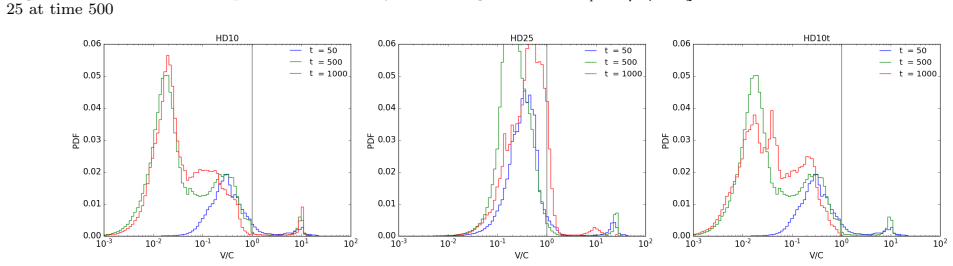
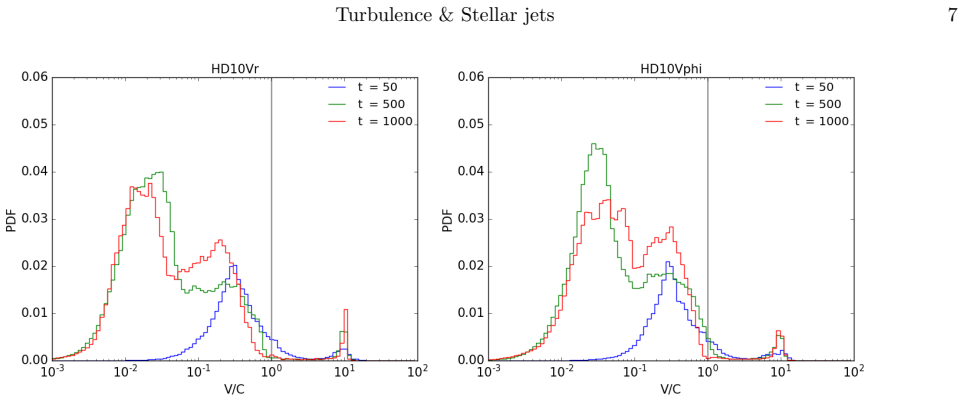
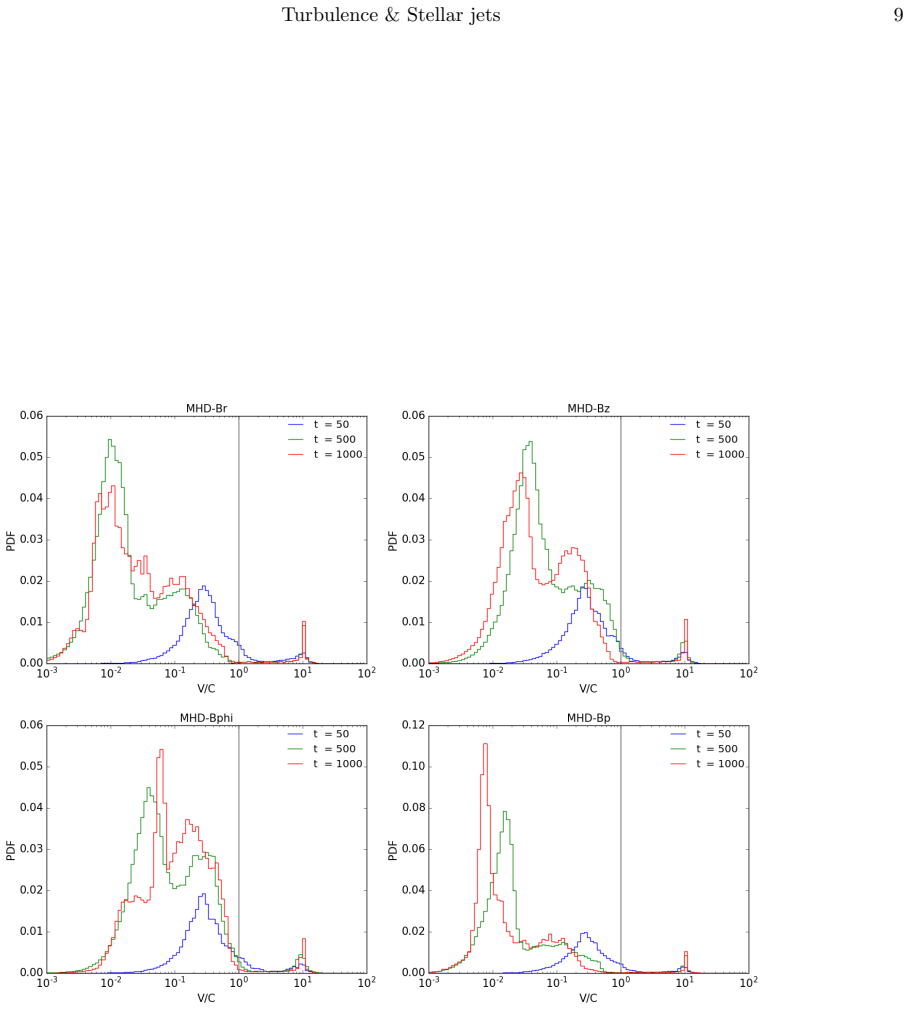
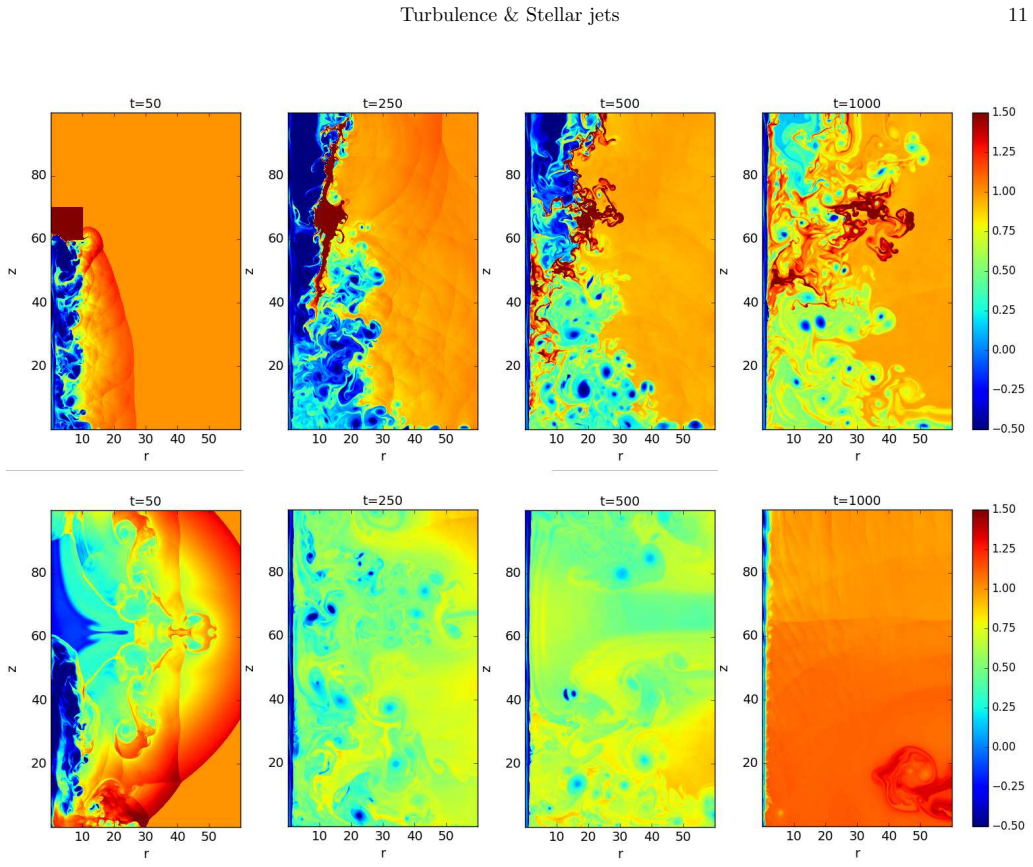
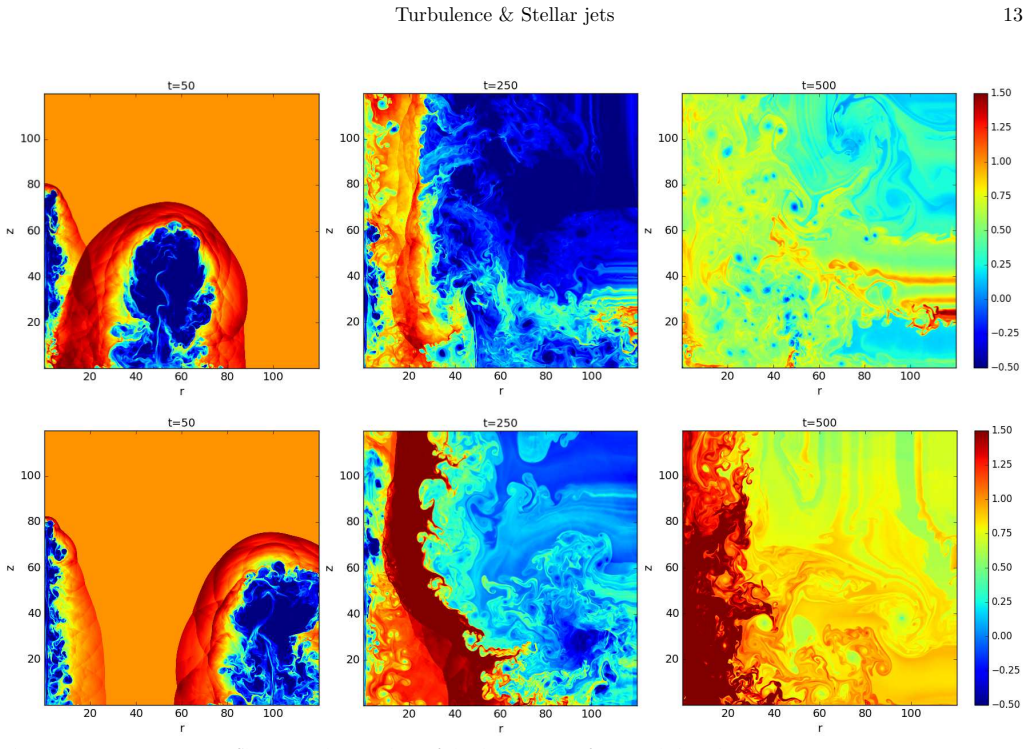
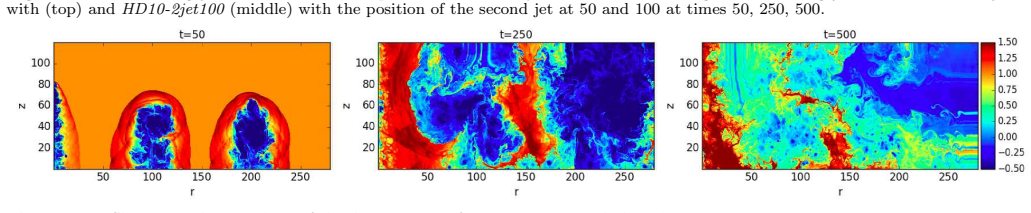
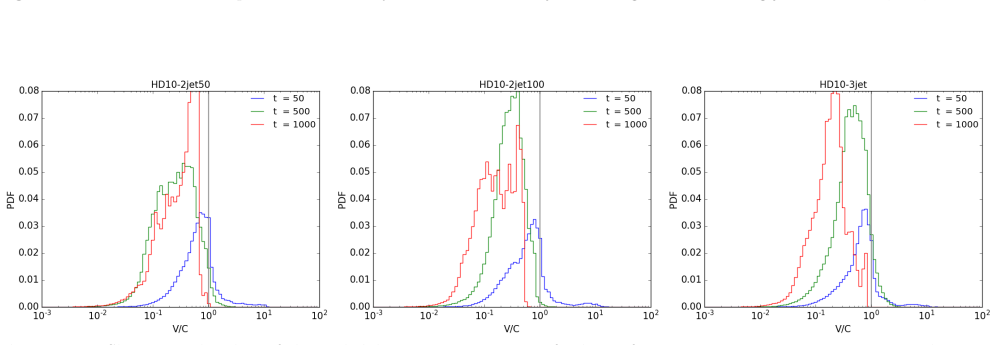
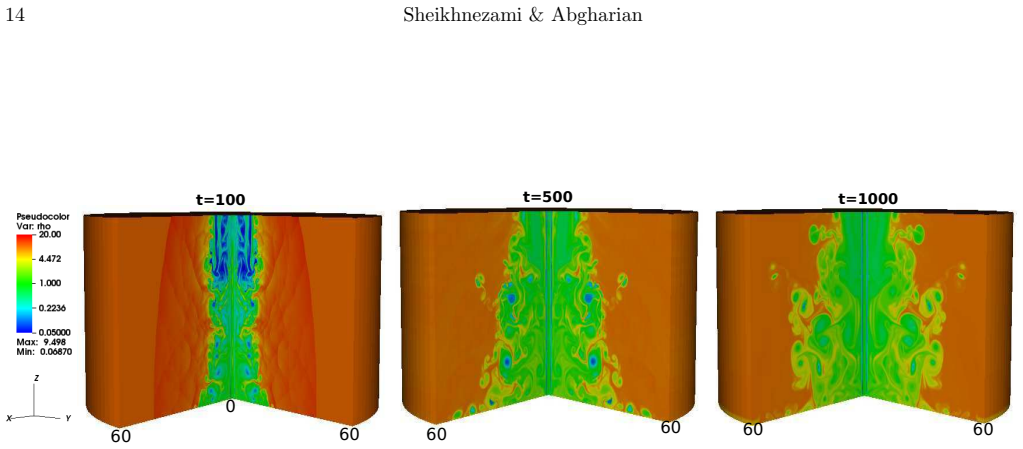
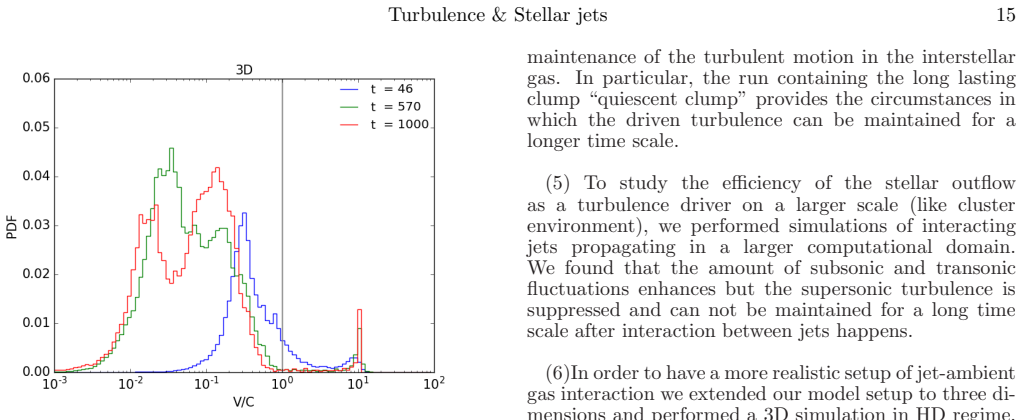
The central measurement is the velocity probability density function (PDF), defined by binning the poloidal velocity $v_p = \sqrt{v_r^2 + v_z^2}$ over all cells excited by the jet and normalizing by the total number of cells. Comparing the PDF with the local sound speed allows the authors to split the entrained gas into subsonic and supersonic populations and to track how the high-velocity tail decays after the jet engine is switched off. This PDF sits at the center of a deliberately broad parameter study: hydrodynamic and ideal-magnetohydrodynamic runs on a $60 \times 100$ jet-radius grid, with Mach numbers 1, 3, 10 and 25; runs with added radial or rotational jet velocity; runs with radial, vertical, toroidal, and poloidal background fields; runs with a quiescent or explosive dense clump in the ambient gas; runs with two or three interacting jets; and one 3D counterpart of the reference run. The comparison set is what lets the paper claim that the efficiency, not just the possibility, of jet-driven turbulence depends on these parameters.
What would settle it
A numerical experiment that switches a jet off at late time and measures the mass fraction of supersonic gas afterward: the paper reports that no supersonic features survive after switch-off, so any run that sustains a significant supersonic fraction for many crossing times after the jet dies would refute the claim. Observationally, mapping a star-forming region where outflows have recently ceased and finding cloud-scale supersonic line widths uncorrelated with outflow power would likewise contradict the insufficiency conclusion.
Extended reading notes
Core claim
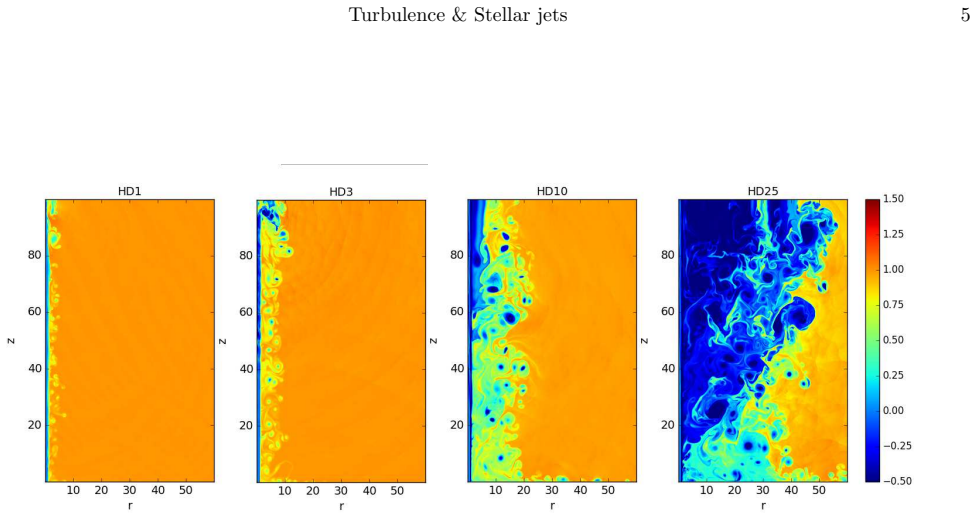
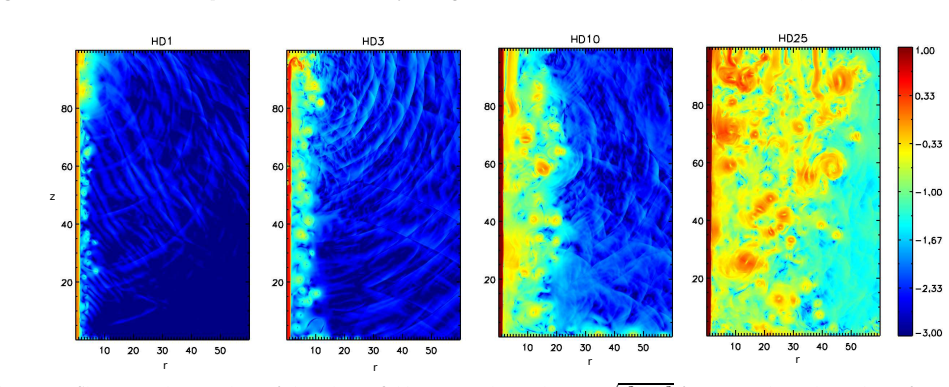
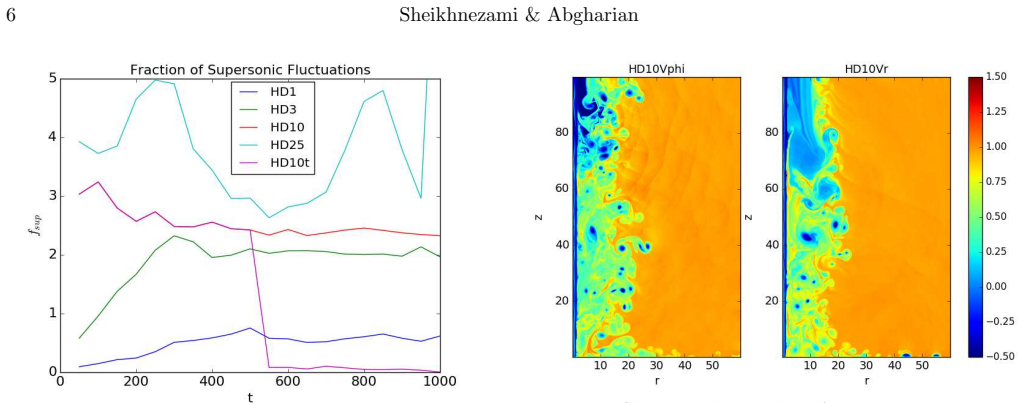
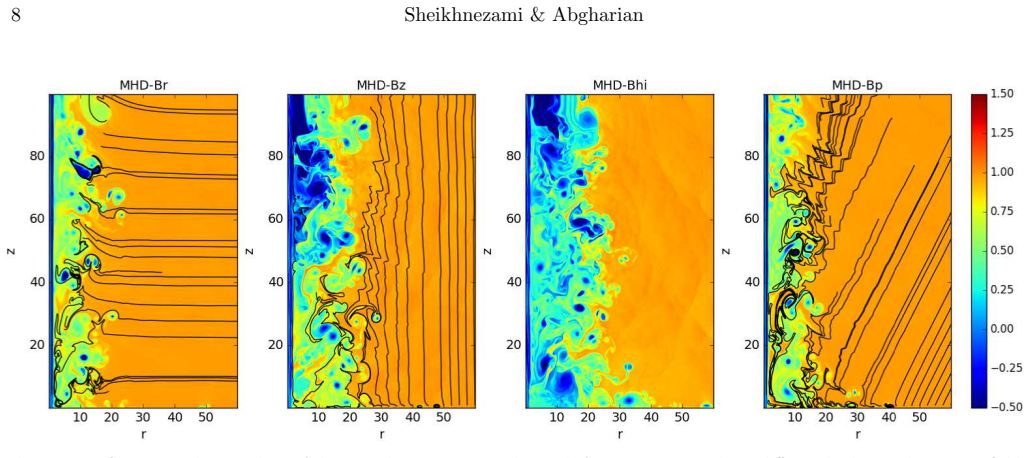
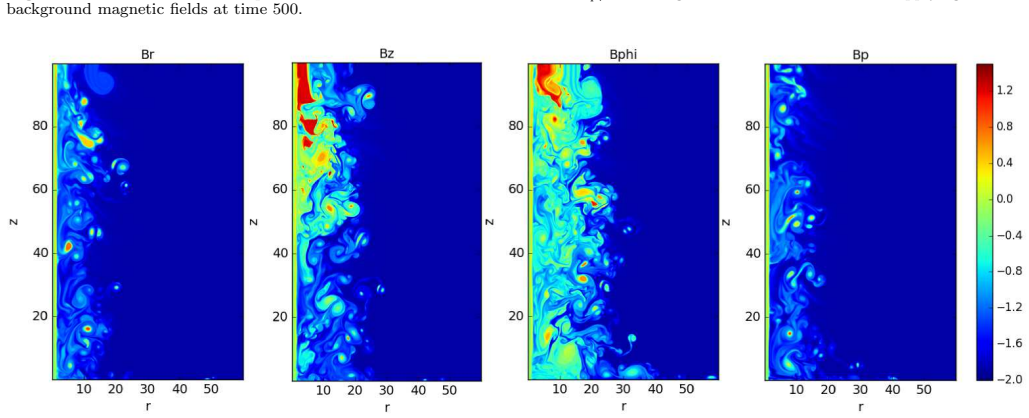
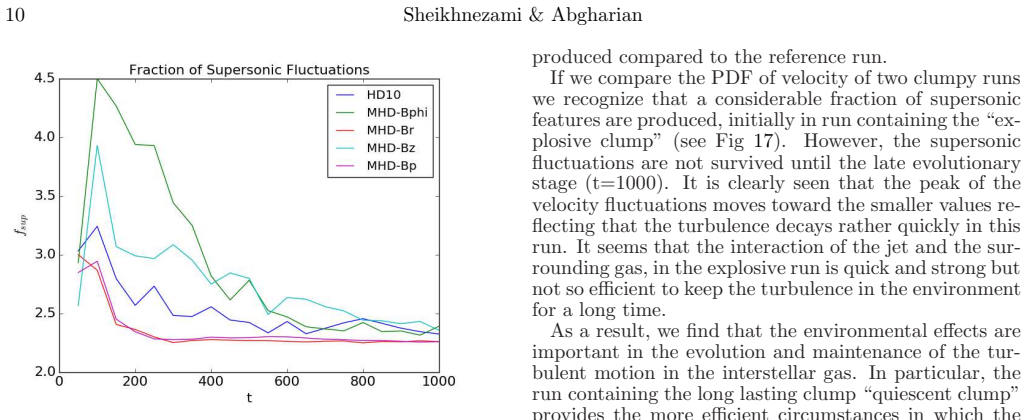
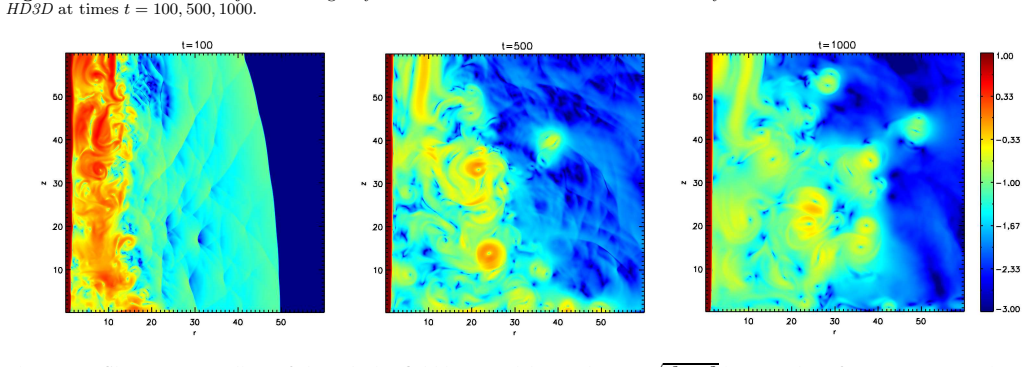
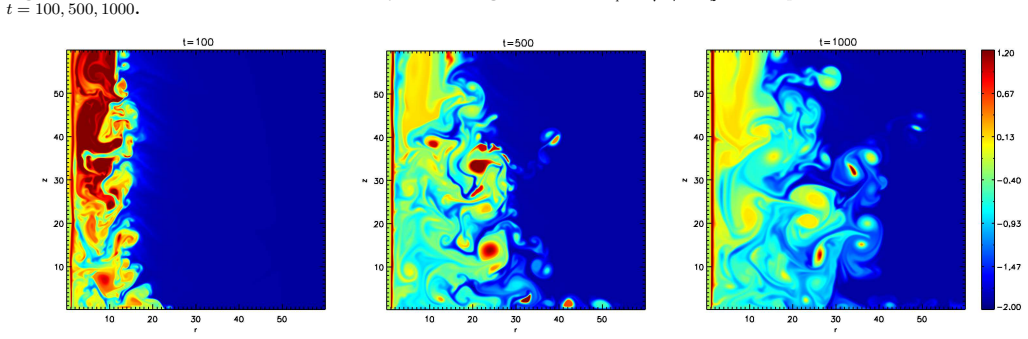
On the paper's own terms, the central discovery is a confirmation with expanded parameter coverage: protostellar jets transfer turbulence to their immediate neighborhood, but they are not sufficient drivers of large-scale supersonic turbulence in molecular clouds. The evidence is the velocity probability density function of the entrained gas: in every run the bulk of the excited motions lies at subsonic velocities, with only a small fraction supersonic, and that fraction decreases with time. A transient-jet run shows that when the driving stops, the supersonic part disappears almost immediately. The efficiency of the local driving does vary: higher Mach number, jet rotation, a toroidal background magnetic field, a clumpy ambient medium, and interacting jets all raise the amount and longevity of the fluctuations, and a 3D run produces more and faster entrained gas than the axisymmetric runs, though the paper attributes part of that enhancement to the lower resolution and higher numerical diffusivity of the 3D setup.
Load-bearing premise
The load-bearing premise is that a simulation box of about $10^4$ AU and simulated times of up to a few thousand time units (roughly $10^5$ to $10^6$ yr) captures the processes that decide whether jets can drive cloud-scale turbulence, even though the cloud itself is orders of magnitude larger and longer-lived.
Editorial extensions
If this is right
- In the immediate vicinity of a protostellar outflow, jets can keep the gas stirred with subsonic and transonic velocity fluctuations for as long as the jet keeps running.
- A single transient protostellar jet cannot maintain supersonic turbulence: once the jet is switched off, the supersonic fraction of the entrained gas drops away, so outflow feedback must be continuous or constantly replenished by new outflows to matter.
- The most powerful outflows, with higher Mach numbers, are the ones most likely to leave a lasting turbulent imprint on their surroundings, since their pdfs stay broader and their supersonic fractions survive longer.
- Outflow interactions in clustered star formation mainly add transonic and subsonic fluctuations; after jets collide, supersonic motions are suppressed, so cluster-scale multiple outflows do not by themselves solve the cloud-scale supersonic driving problem.
- In magnetized clouds, the toroidal field geometry is the one that most increases the entrained gas energy and the supersonic fraction, meaning the orientation of the background field relative to the outflow matters for feedback efficiency.
Reading between the lines
- Beyond the paper, if jets are only local drivers, then the global supersonic line widths of molecular clouds have to be sustained by processes the small box cannot see, such as large-scale gravitational contraction, converging flows, or supernova remnants, and jet feedback would set the local velocity dispersion near outflow cavities rather than the cloud's global turbulence.
- Beyond the paper, a testable extension would be a resolution-convergence study: the paper's 3D run mixes the physical growth of non-axisymmetric shear modes with numerical diffusivity from a lower resolution, so a matched-resolution 2D versus 3D comparison would isolate how much of the extra 3D fluctuations is real.
- Beyond the paper, the interacting-jet simulations suggest a saturation effect: adding more jets raises the transonic gas but suppresses supersonic tails, so one could predict that in a dense cluster the outflow-driven velocity dispersion approaches a ceiling set by jet separation and cooling, a relation observable as a flattening of outflow power versus local line width.
Signed reviews
Editorial analysis
A structured set of objections, weighed in public.
Referee Report
Summary. The manuscript reports a parameter study of two-dimensional axisymmetric and one three-dimensional hydrodynamic/magnetohydrodynamic simulations of protostellar jets interacting with a uniform or clumpy ambient medium, using the PLUTO 4.2 code. The models vary the jet Mach number (1, 3, 10, 25), the jet velocity field (radial and rotational components), the background magnetic field geometry, the presence of dense clumps, and the number of interacting jets. The principal diagnostic is the probability density function of the poloidal velocity magnitude (Eq. 5), from which the fraction of supersonic gas and its time evolution are measured. The central conclusion is that stellar jets can transfer turbulent motions to their immediate surroundings, with higher efficiency for higher jet Mach number, jet rotation, toroidal background magnetic fields, clumpy environments, jet-jet interactions, and three-dimensional geometry, but that jets are not sufficient drivers of large-scale supersonic turbulence in molecular clouds.
Significance. The question addressed is important for star-formation feedback, and the manuscript usefully expands the parameter space covered by earlier studies such as Banerjee et al. (2007). Its strengths include a systematic set of models in a well-tested code, a transient-jet experiment designed to measure the decay of the induced motions, and explicit admissions of the limitations imposed by the box size and by the lower resolution of the 3D run. If the central result is accepted, it strengthens the emerging picture that protostellar outflows are local turbulence drivers rather than cloud-scale supersonic drivers. However, because the velocity PDF used as the turbulence measure includes the coherent jet beam and no decomposition into mean and fluctuating components is made, the quantitative efficiency rankings are not yet established by the presented analysis; the paper's significance therefore depends on a re-analysis described below.
major comments (4)
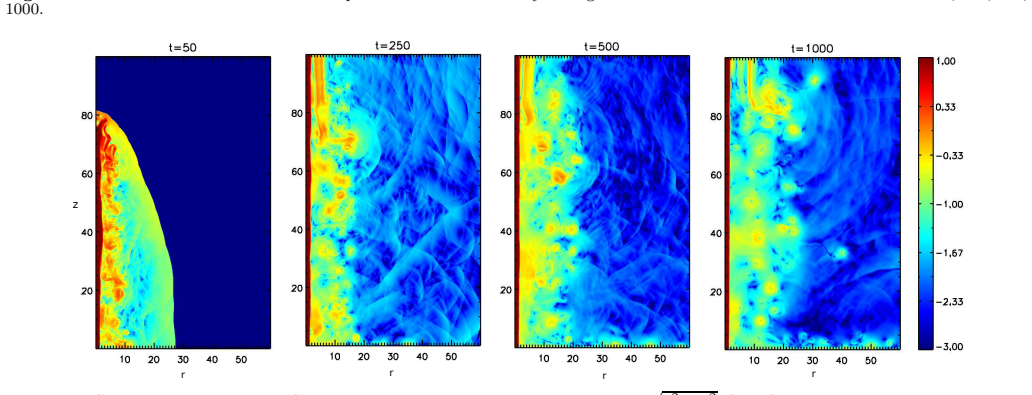
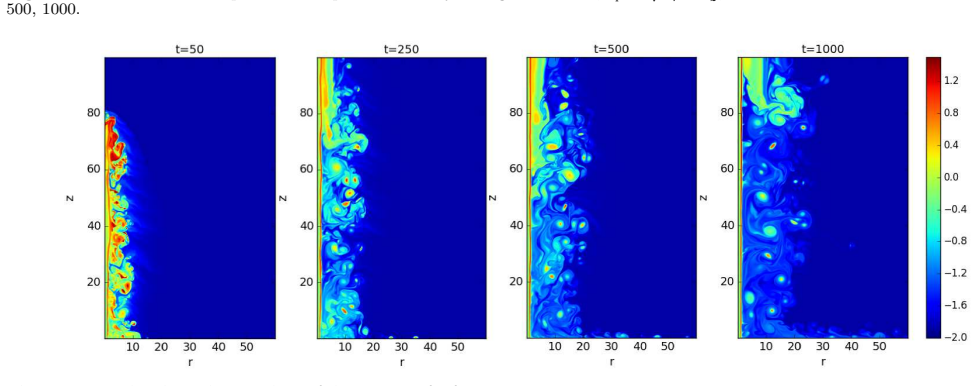
- [2.4, 3, Figs. 6, 7, 15, 20, 24] Equation (5) defines the velocity PDF using vp = sqrt(vr^2+vz^2) over all cells with nonzero velocity, so it counts the ordered, continuously injected jet beam together with any turbulent fluctuations. For the supersonic runs (M=10 and 25), cells inside the jet beam have vp > c_s by construction, so the 'supersonic fraction' plotted in Figures 7, 15, 20, and 24 is contaminated by the beam's coherent kinetic energy. The transient run HD10t (Figure 6) illustrates this: once the jet is switched off, the supersonic component disappears within a few hundred code units, which is exactly what one expects when the beam is removed, not necessarily evidence about the decay of a turbulent cascade. The efficiency rankings listed in the abstract and Section 4 are therefore rankings of the total velocity distribution, not of turbulence. I request a Reynolds decomposition or a masking of the jet-beam region (for example, cells with r < r_j and/or cells connected to the injection boundary) and the PDF of the fluctuating component, together with a velocity power spectrum, before the central claim of 'transferring turbulence' can be assessed quantitatively.
- [3, 3.1-3.5] The term 'turbulence' is used for what the velocity PDF and visual inspection of maps show, but a one-point PDF of the total velocity does not establish a turbulent cascade or distinguish random motions from coherent shear, and it cannot provide a scale-dependent measure of driving efficiency. No velocity power spectrum, structure function, or vorticity map is presented anywhere in the paper. The qualitative statements about 'more fluctuations and random motions' in Sections 3.1-3.5 are therefore not backed by a quantitative turbulence metric. I recommend adding at least one scale-resolved statistic (for example, a kinetic-energy power spectrum, a longitudinal structure function, or a vorticity map) to justify the term 'turbulence' and the efficiency rankings.
- [2.2, 3.5] No resolution or convergence study is reported for the axisymmetric runs, and the single 3D run uses a lower resolution than the 2D reference run (Section 3.5). The authors themselves note that the lower resolution implies higher numerical diffusivity and numerical heating that increase the entropy and the amount of fluctuations in HD3D. Since the paper's quantitative conclusions depend on PDF tails, supersonic fractions, and their decay times, a convergence check is load-bearing; without it, one cannot separate physical turbulence driving from numerical diffusion, and the 3D-versus-2D comparison is ambiguous. I ask for at least one higher-resolution 3D run (or two resolutions of the reference run with the same solver and domain) and a brief comparison of the PDF and supersonic fraction as a function of resolution.
- [3, 4] The concluding statement that jets are 'not sufficient drivers of the large-scale supersonic turbulence in molecular clouds' goes beyond the simulated domain, which is 60 x 100 r_j (about 10^4 AU) and which the authors themselves describe as smaller than the scale of interest, with the ambient gas still affected by jet propagation at the end of the runs (Section 3). The simulations contain no cloud-scale driving or large-scale velocity structure, so they can only constrain turbulence within a small star-forming core environment, not the maintenance of cloud-scale supersonic turbulence. The abstract and Section 4 should be reframed to state the negative result for the box scale, or supplemented with a quantitative argument connecting the box-size results to cloud scales (for example, comparing the turbulent energy injection rate with the dissipation rate on cloud scales).
minor comments (4)
- [3.3, Table 1] Section 3.3 refers to runs HD-M10cl and HD-M10pcl, while Table 1 lists the same runs as HD-Qcl and HD-Ecl; please make the run labels consistent throughout the manuscript.
- [2.3, 3.2, 4] There are several typographical errors that should be corrected: 'grcm' for 'g cm^-3', 'solenodality' for 'solenoidality', 'magnetite' for 'magnetic' in Section 3.2, and 'peresented' and 'studeid' in Section 4.
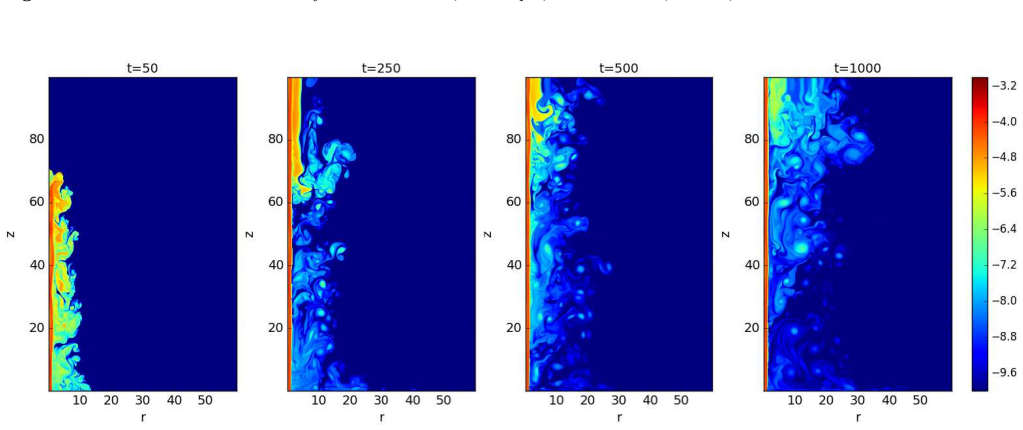
- [3, Figs. 3, 13, 23] The 'entropy' shown in Figures 3, 13, and 23 is never defined in Section 2; please specify the entropy diagnostic (for example, p/rho^gamma or a normalized version) so that the reader can interpret the maps.
- [3.5] The actual grid resolution of the 3D run HD3D is not reported in the text or in Table 1; since the authors state that the 3D run uses a lower resolution, the numerical setup is incomplete without the specific number of cells.
Circularity Check
No significant circularity found; the conclusions are drawn from simulations with hand-chosen inputs and compared against no fitted target.
full rationale
The paper's central claims are derived from PLUTO simulations with parameters chosen as a case study rather than fitted to reproduce any target outcome. The velocity PDF defined in Eq. 5 is a diagnostic applied to simulation output, not a quantity that the simulations were tuned to match. The transient-jet run HD10t is used as a physical control to show decay of supersonic features after driving stops, which is an independent behavioral test rather than a circular construct. The negative claim about large-scale supersonic turbulence is explicitly qualified by the box-size limitation noted in Section 3, and it is presented as confirmation of earlier independent work rather than as a consequence of a self-citation. The paper's self-citations concern jet-launching simulations and do not carry the load of the turbulence-efficiency argument. The skeptic's concern that the velocity PDF conflates the coherent jet beam with turbulent fluctuations is a substantive validity critique of the diagnostic, not evidence that a prediction is equivalent to an input by construction. No fitted parameter is renamed as a prediction, no uniqueness theorem is imported from the authors' prior work, and no ansatz is smuggled in via citation. Therefore the circularity score is 0.
Assumptions & free parameters
free parameters (5)
- Density contrast delta = rho_j/rho_a =
0.1 (chosen uniformly across runs)
- Jet Mach number =
1, 3, 10, 25
- Background magnetic field strengths =
B_r=0.001, B_z=0.002, B_phi=0.001 in code units
- Radial and rotational jet velocity components =
v_r=0.01, v_phi=0.01 (code units)
- Clump properties =
Not quantified in text
assumptions (6)
- domain assumption Ideal MHD/HD equations are the correct description; no resistivity or explicit diffusion in the induction equation.
- domain assumption Polytropic equation of state with gamma=5/3 and no heating/cooling.
- domain assumption Jet is initially in pressure equilibrium with the ambient gas.
- ad hoc to paper Axisymmetry in the 2D runs is representative of the jet-ambient interaction.
- ad hoc to paper The small computational box (60 x 100 r_j, about 10^4 AU) is representative of molecular-cloud turbulence driving scales.
- domain assumption Continuously powered jet injection at the lower boundary represents a formed jet.
Cite this review
Pith. "Pith review of Turbulence driven by stellar jets, the possibility and the efficiency." pith.science (2026). https://pith.science/paper/FS4XSHD6
@misc{pith2026190803225,
  author       = {Pith},
  title        = {Pith review of: Turbulence driven by stellar jets, the possibility and the efficiency},
  year         = {2026},
  howpublished = {\url{https://pith.science/paper/FS4XSHD6}},
  note         = {Machine review of arXiv:1908.03225}
}
read the original abstract
We investigate the feedback of the stellar jets on the surrounding interstellar gas based on 2D and 3D simulations applying HD and MHD module of PLUTO 4.2 code. The main question we address is whether the stellar jet can be considered as a turbulence driver into the interstellar gas. In addition, we investigate the most effective circumstances in which the driven turbulence is larger and can survive for a longer time scale in the ambient gas. We present a case study of different parameters runs including the jet Mach number, the initial jet velocity field and the background magnetic field geometries and the interacting jets. Also, we study the environmental effects on the jet-gas interaction by considering the non-homogeneous surrounding gas containing the clumps in the model setup. Among different setups, we find that for (1) a higher jet Mach number, (2) a rotating jet, 16 pages(3) a jet propagating in a magnetized environment, (4)a jet propagating in a non-homogeneous environment, and (5) the interacting jets more fluctuations and random motions are produced in the entrained gas which can survive for a longer time scale. In addition, we perform the 3D simulations of jet-ambient gas interaction and we find that the amount of (subsonic-supersonic) fluctuations increases compared to the axisymmetric run and the entrained gas gains higher velocities in a 3D run. In total, we confirm the previous finding that the stellar jets can transfer the turbulence on neighboring regions and are not sufficient drivers of the large-scale supersonic turbulence in molecular clouds.
Figures

Figures from the paper (20 more)


Reference graph
Works this paper leans on
- [1]
- [2]
- [3]
-
[4]
C., Blandford, R
Begelman, M. C., Blandford, R. D., & Rees, M. J. 1984, Reviews of Modern Physics, 56, 255
1984
-
[5]
Blandford, R. D. & Payne, D. G. 1982, MNRAS, 199, 883
1982
-
[6]
Brauer, R., W olf, S., Reissl, S., & Ober, F. 2017, A&A, 601, A9 0
work page 2017
-
[7]
Carroll, J. J., Frank, A., & Blackman, E. G. 2010, ApJ, 722, 14 5
work page 2010
-
[8]
Quillen, A. C. 2009, ApJ, 695, 1376
work page 2009
Show all 42 references
-
[9]
2010, A&A, 512, A54
Asplund, M. 2010, A&A, 512, A54
2010
-
[10]
& Keppens, R
Casse, F. & Keppens, R. 2002, ApJ, 581, 988
2002
-
[11]
Crutcher, R. M. 1999, ApJ, 520, 706
1999
-
[12]
M., Troland, T
Crutcher, R. M., Troland, T. H., Lazareff, B., Paubert, G., & Kaz` es, I. 1999, ApJ, 514, L121
1999
-
[13]
Quillen, A. C. 2009, ApJ, 692, 816
2009
-
[14]
2000, ApJ, 530, 923 16 Sheikhnezami & Abgharian
Delamarter, G., Frank, A., & Hartmann, L. 2000, ApJ, 530, 923 16 Sheikhnezami & Abgharian
2000
-
[15]
1997, A&A, 319, 340 G´ omez, J
Ferreira, J. 1997, A&A, 319, 340 G´ omez, J. L., Lobanov, A. P., Bruni, G., Kovalev, Y. Y.,
1997
-
[16]
V., Anderson, J
Sokolovsky, K. V., Anderson, J. M., Galindo, P., Kardashev, N. S., & Lisakov, M. M. 2016, ApJ, 817, 96
2016
-
[17]
E., Klein, R
Hansen, C. E., Klein, R. I., McKee, C. F., & Fisher, R. T. 2012, ApJ, 747, 22
2012
-
[18]
A., Miller, M
Hughes, P. A., Miller, M. A., & Duncan, G. C. 2002, ApJ, 572, 713
2002
-
[19]
R., Mac Low, M.-M., & Bryan, G
Joung, M. R., Mac Low, M.-M., & Bryan, G. L. 2009, ApJ, 704, 137
2009
-
[20]
2013, Plasma Physics and Controlled Fusion, 55, 124038
Keppens, R., Porth, O., Monceau-Baroux, R., & W alg, S. 2013, Plasma Physics and Controlled Fusion, 55, 124038
2013
-
[21]
Knee, L. B. G. & Sandell, G. 2000, A&A, 361, 671
2000
-
[22]
Krumholz, M. R. & Tan, J. C. 2007, ApJ, 654, 304
2007
-
[23]
& Nakamura, F
Li, Z.-Y. & Nakamura, F. 2006, ApJ, 640, L187 Mac Low, M.-M. 2000, in ESA Special Publication, Vol. 445, St ar Formation from the Small to the Large Scale, ed. F. Favata, A. Kaas, & A. Wilson, 457 Mac Low, M.-M. & Klessen, R. S. 2004, Reviews of Modern Physics, 76, 125
2006
-
[24]
R., & Ryle, W
Sigua, L., Miller, H. R., & Ryle, W. T. 2008, Nature, 452, 966
2008
-
[25]
McKee, C. F. & Ostriker, E. C. 2007, ARA&A, 45, 565
2007
-
[26]
2007, ApJS, 170, 228
Mignone, A., Bodo, G., Massaglia, S., Matsakos, T., Tesilea nu, O., Zanni, C., & Ferrari, A. 2007, ApJS, 170, 228
2007
-
[27]
2013, MNRAS, 436, 1102
Mignone, A., Striani, E., Tavani, M., & Ferrari, A. 2013, MNRAS, 436, 1102
2013
-
[28]
2012, ApJS, 198, 7
Mignone, A., Zanni, C., Tzeferacos, P., van Straalen, B., Co lella, P., & Bodo, G. 2012, ApJS, 198, 7
2012
-
[29]
C., Stone, J
Ostriker, E. C., Stone, J. M., & Gammie, C. F. 2001, ApJ, 546, 980
2001
-
[30]
2013, MNRAS, 429, 2482
Porth, O. 2013, MNRAS, 429, 2482
2013
-
[31]
Pudritz, R. E. & Norman, C. A. 1983, ApJ, 274, 677
1983
-
[32]
E., Ouyed, R., Fendt, C., & Brandenburg, A
Pudritz, R. E., Ouyed, R., Fendt, C., & Brandenburg, A. 2007, Protostars and Planets V, 277
2007
-
[33]
A., Blackman, E
Gutermuth, R. A., Blackman, E. G., Pipher, J. L., & Ridge, N. 2005, ApJ, 632, 941
2005
-
[34]
Aloy, M. A. 2016, MNRAS, 456, 3782
2016
-
[35]
2009, A&A, 504, 415
Bontemps, S., Cesaroni, R., Deharveng, L., Garay, G., Herpi n, F., Lefloch, B., Linz, H., Mardones, D., Minier, V., Molinari , S., Motte, F., Nyman, L.- ˚ A., Reveret, V., Risacher, C., Russeil, D., Schneider, N., Testi, L., Troost, T., Vasyunina, T., Wie nen, M., Zavagno, A., ...
2009
-
[36]
& Fendt, C
Sheikhnezami, S. & Fendt, C. 2015, ApJ, 814, 113 —. 2018, ApJ, 861, 11
2015
-
[37]
2012, ApJ, 757, 65
Sheikhnezami, S., Fendt, C., Porth, O., Vaidya, B., & Ghanba ri, J. 2012, ApJ, 757, 65
2012
-
[38]
& Fendt, C
Stepanovs, D. & Fendt, C. 2016, ApJ, 825, 14
2016
-
[39]
2014, ApJ, 796, 29
Stepanovs, D., Fendt, C., & Sheikhnezami, S. 2014, ApJ, 796, 29
2014
-
[40]
C., & Kainulainen, J
Tahani, M., Plume, R., Brown, J. C., & Kainulainen, J. 2018, A&A, 614, A100 W ang, P., Li, Z.-Y., Abel, T., & Nakamura, F. 2010, ApJ, 709, 2 7
2018
-
[41]
E., & Stone, J
Xu, J., Hardee, P. E., & Stone, J. M. 2000, ApJ, 543, 161
2000
-
[42]
2007, A&A, 469, 811
Zanni, C., Ferrari, A., Rosner, R., Bodo, G., & Massaglia, S. 2007, A&A, 469, 811
2007
Reviewed August 14, 2026 · model on record in the stance chip above.
Discussion (0). Continue with ORCID to comment.